In Between Loves (求愛夜驚魂, Allan Fung Yi-Ching, 1989)

Zany rom-com meets serial killer thriller in Allan Fung Yi-Ching’s decidedly odd horror comedy, In Between Loves (求愛夜驚魂). Though the title may hint at romantic melodrama, the film is filled with unexpectedly edgy humour and references to the real life “Jars Killer” case that also inspired the film Dr. Lamb in which a taxi driver murdered several of his female passengers and kept their body parts in Tupperware boxes at his home where he lived with his apparently oblivious family members.

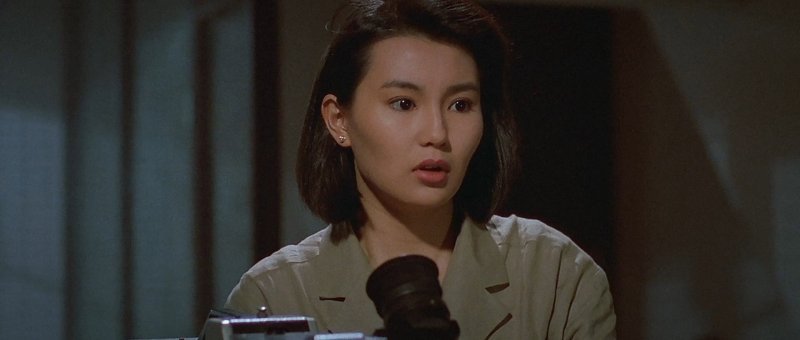
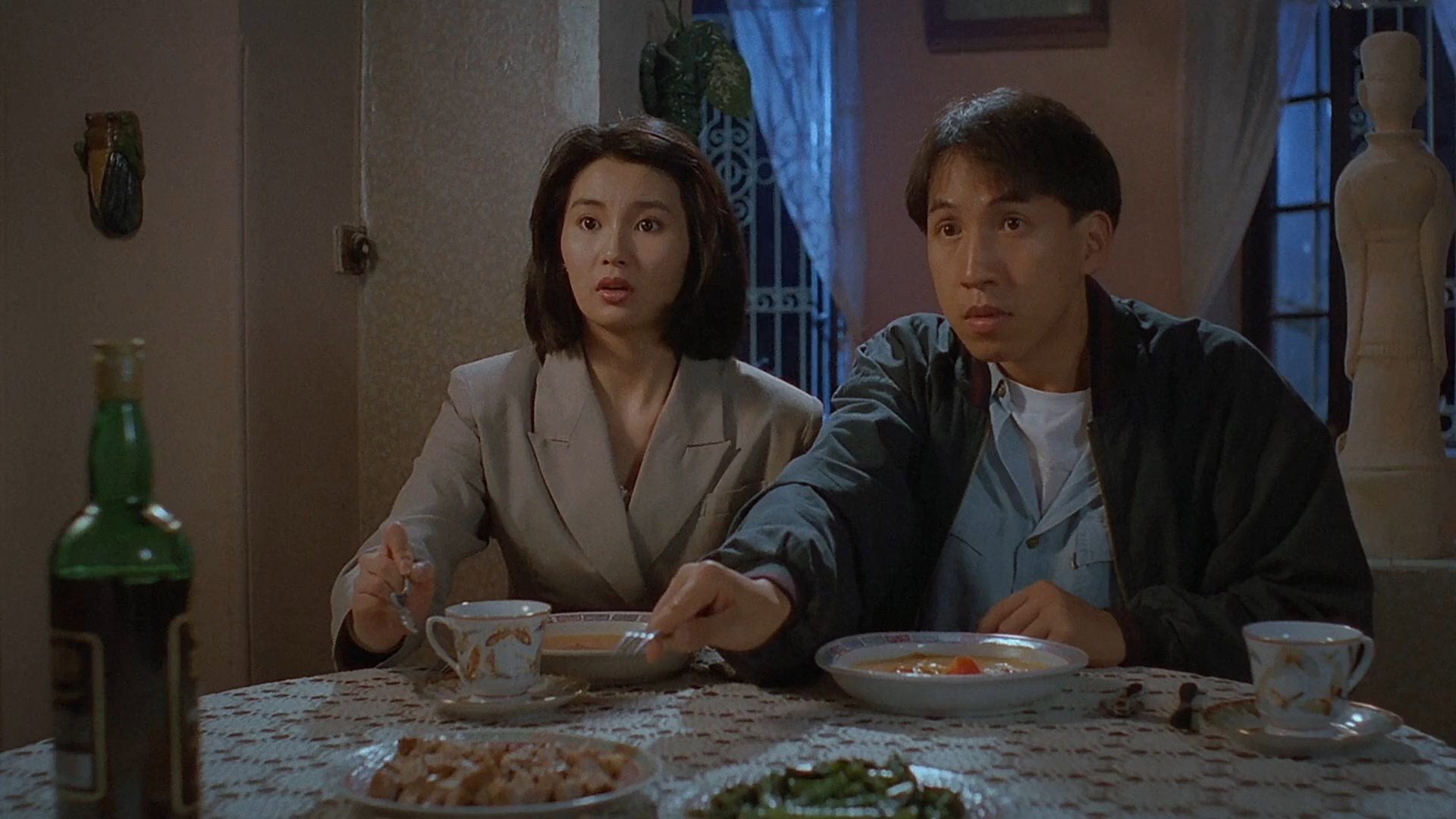
Lung (Alfred Cheung Kin-Ting) is the head of a small band of late night taxi drivers who entertain each other with various party tricks over the radio, Lung’s being the ability to tell Christmas cracker-style jokes. They seem to have a long-standing vendetta against another gang of taxi drivers who challenge them to drinking contests and other tests of strength. Lung, meanwhile, has a fixation with beautiful TV reporter Jenny (Maggie Cheung Man-yuk) who once said something nice to him getting out of his cab, and makes a point of watching the news whenever she’s on. His taxi driver friends mostly seem to support his crush and are keen to help him in his romantic quest which is why they all agree to pass on tips about newsworthy goings on that Lung can send to Jenny in the hope of making himself useful to her.

Jenny, meanwhile, is sort of grateful for the tips because she feels undervalued at the station where she works. She clearly wants to be a crusading reporter exposing things like political corruption and injustice, but as her boss tells her, the people of Hong Kong prefer soap operas to news and in any case, they don’t have the budget for serious investigative reporting. There is a mild criticism here of the mass media landscape which is increasingly compromised by its commercial concerns in world in which the line between factual reporting and entertainment is beginning to blur. The press are desperate for salacious content to keep viewers hooked, feeding on human misery and almost willing it into being.

Thus it’s not a stretch when it first appears that Lung has gone off the deep end after being insulted by Jenny’s terrible elitist boyfriend John (Lawrence Ng Kai-Wah) and actually become a serial killer just so that Jenny can have something exciting to report on followed by a scoop on his confession. It turns out that Lung is not the real killer and only wanted to give Jenny a real confession wrapped up in a false one, but this still bears out the depths of his problematic, one-sided romantic obsession with a public figure. In some ways, Lung is presented as an underdog whose pure-hearted love just hasn’t been properly noticed, yet. He picks up another man with flowers for Jenny who is more obviously deranged, but is irritated rather than noticing that he is really no different. He is also irritated to see John pick Jenny up, but, at the same time, perhaps thinks it’s fair enough if she has a boyfriend already.

The problem is that John might actually be the worst person in a film about a cannibalistic serial killer without needing to actually kill anyone. He is possessive of Jenny and has an unpleasant, elitist world view in which he is violent towards Lung and point-blank tells him that a lowly taxi driver who didn’t even finish high school has no business dating an educated, upper-middle-class woman like Jenny. Though this originally presented as an unpleasant point of view and a symbol of the kind of classist oppression faced by men like Lung, the film eventually embraces it with Lung coming to the conclusion that John is right, he’s not good enough for Jenny and ought to date someone from his own social class such as fellow taxi driver Ti (Sandra Ng Kwan-yue). As such, it adopts a rather conservative attitude that supports class divisions and negates the idea of social mobility in insisting that love across the class divide not only will not work but is in some way improper.

Lung may realise both that his infatuation is not “love” but “worship” and that his behaviour has been dangerously obsessive bordering on madness, but this is not the reason that he finally decides to give Jenny up so much as a sense of inferiority in returning to his own working-class world. Meanwhile, the film treats Ti as something of a joke, firstly mocking her for being a tomboyish woman in a man’s occupation, then half-hinting that she maybe transgender. Despite its offbeat humour, the film goes to a fairly grisly place in its final stretches, transitioning into slasher territory as Lung and Jenny are stalked by the real killer upset by Lung’s attempts to claim responsibility for their crimes. Order may have been restored, but this Hong Kong remains a fairly bleak place overshadowed by violence and anxiety in which romantic fantasy may be the only means of escape.


Trailer (no subtitles)

Three Days of a Blind Girl (盲女72小時, Chan Wing-Chiu, 1993)

An oblivious housewife undergoes a kind of awakening while confronted with her husband’s transgressions by a vengeful intruder in Chan Wing-Chiu’s home invasion horror, Three Days of a Blind Girl (盲女72小時). Rendered temporarily sightless after an operation designed to save her sight, the implication is that the heroine, referred to only as Mrs Ng (Veronica Yip Yuk Hing), has been living in a fantasy of aspirational domestic success largely dependent on her heart surgeon husband Jack (Anthony Chan Yau) and devoid of her own identity while blind to the patriarchal forces which oppress her. 

Having returned from surgery in the US, Mrs Ng is assured her sight will gradually return in around 72 hours though until then she will be entirely blind. The doctors give her no special instructions, and she and her husband return to their country home where they are cared for by a maid, May (Chan Yuet-Yue). Somewhat insensitively, Jack has to leave for an important heart attack conference in Macao leaving Mrs Ng solely in the custody of May only May has other plans. Her policeman boyfriend has got them concert tickets while she also needs to go out to refill her asthma medication meaning that Ms Ng will be entirely alone at home while attempting to adjust to her sightless existence. 

Mrs Ng is rendered vulnerable in what should be a safe space. The sanctity of the domestic is disrupted firstly by Jack’s absence and then by an uncanny lack of familiarity introduced by her blindness. Though she has a stick, she soon finds herself bumping into things or encountering unexpected obstacles while the design of the home’s staircase appears dangerous even to the sighted and a definite health hazard to anyone else. In a moment of foreshadowing, Jack warns the maid that there’s a problem with the phone while the mobile he left is also low on battery meaning that Mrs Ng could not even call for help if she needed it. 

Unsolicited help is however something she’s offered by an unexpected visitor, Sam (Anthony Wong Chau-sang), who claims to be an old school friend of Jack’s who also treated his wife for her heart condition. Mrs Ng can’t see it, but Sam is dressed in a rather unique outfit of lederhosen and a check shirt appearing something like malicious garden gnome. In an odd moment of comedy, Sam, who soon begins stalking Mrs Ng around the house, pretends to chase off an intruder by running up and down the stairs swapping characters as he goes but otherwise skews increasingly sinister while discussing his relationship with his wife who he claims has rejected him on the grounds of the printer’s ink that stains his hands. 

Sam is Jack’s inversion, an overly solicitous husband now hellbent on avenging his masculinity by raping Mrs Ng to get back at Jack whom he blames for his wife’s death claiming he treated her heart condition with vitamins while abusing his position to take advantage of her sexually. At first, Mrs Ng doesn’t believe him and trusts her husband but her literal awakening occurs in line with the return of her sight. She begins to see the light and the reality of her life with Jack, ironically thanking him for this experience because it’s taught her how to fight back and protect herself in the face of his male failure. “Don’t think women are easily bullied” she claps back after finally taking charge of her life and knocking the forces of patriarchy firmly on the head.

Nevertheless, she begins to resist with regular household items such as using the serrated edge on a box of clingfilm to try and saw through the ropes binding her hands. Despite her blindness, she uses her knowledge of the domestic space against the intruder Sam and tries to frustrate his plans for her through strategy and forward thinking even while beginning to discern the danger which has always surrounded her as evidenced by the unexpected appearance of an entirely different assailant wandering in by chance in the temporary absence of Sam. “Never fight with women,” a much more confident, fully sighted, Mrs Ng later exclaims finally awakened to the realities of the world around her and unafraid to confront its ever present dangers now armed with the stylish briefcase of an independent woman. Surprisingly feminist in its overtones, Chan turns the home invasion thriller inside out as Mrs Ng mounts a successful jailbreak from the confines of a stereotypical housewife life.


Three Days of a Blind Girl screens at the Prince Charles Cinema, London on 19th October as part of Silk and Bullets: The Sisterhoods of Revenge where it will feature a video introduction by producer Alfred Cheung and pre-recorded Q&A with Director Chan Wing-Chiu.

Original trailer (no subtitles)

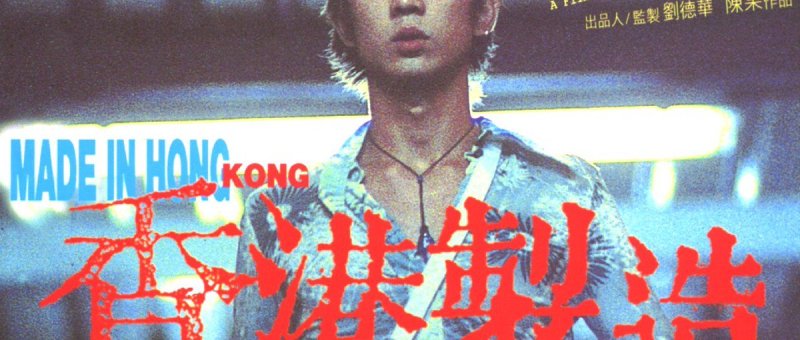
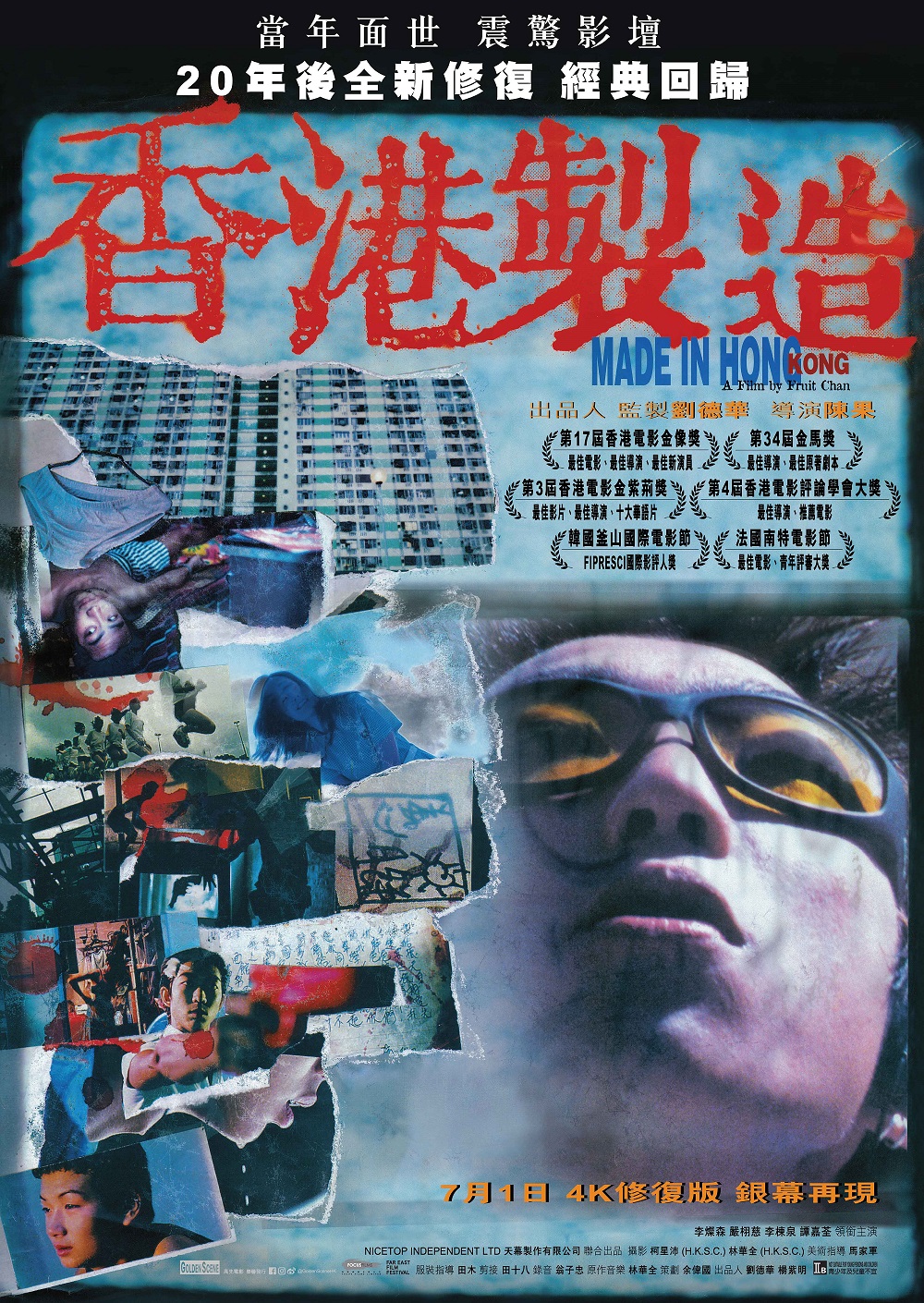
Made in Hong Kong (香港製造, Fruit Chan, 1997)

made in HK vertical posterThe Hong Kong of 1997 becomes teenage wasteland for the trio at the centre of Fruit Chan’s urgent yet melancholy debut, Made in Hong Kong (香港製造). Made on a shoestring budget using cast-off film and starring then unknowns, Chan’s New Wave inflected meditation on dead end youth is imbued with the sense of endings – illness, suicide, murder, and despair dominate the lives of these young people who ought to be beginning to live but find their paths constantly blocked. The world is changing, but far from possibility the future holds only confusion and anxiety for those left hanging in constant uncertainty.

Autumn Moon (Sam Lee), our narrator, is a boy fighting to become a man but too afraid to leave his adolescence behind even if he knew how. Living alone with his mother (Doris Chow Yan-Wah) after his father abandoned the family, Moon is a high school drop out with no real job who spends his time playing basketball with the neighbourhood kids and running petty errands for small scale Triad Big Brother Wing (Sang Chan). Already indulging in a hero complex, Moon is friends with and the de facto protector of a young man with learning difficulties, Sylvester (Wenders Li), who has been disowned by his birth family and is constantly picked on, beaten up, and molested by the local high schoolers. Taking Sylvester with him on a job one day, Moon runs into Mrs. Lam (Carol Lam Kit-Fong) whose debt he’s supposed to collect but when Sylvester has one of his frequent nosebleeds on seeing Mrs Lam’s beautiful daughter, Ping (Neiky Yim Hui-Chi), Mrs. Lam manages to send them packing. Nevertheless, Sylvester and Moon end up becoming friends with Ping and enjoying the last days of Hong Kong together, engaged in a maudlin exploration of teenage mortality pangs.

As Moon puts it in his voice over, everything starts to go wrong when Sylvester picks up a pair of blood stained letters in the street. They belonged to a high school girl, Susan (Amy Tam Ka-Chuen), who we later find out killed herself from the pain of first love. The spectre of Susan haunts the trio of teens left behind who remain morbidly fascinated with her fate yet also afraid and anxious. Together they pledge to investigate her death and return the letters to their rightful owners as, one assumes, Susan would have wanted. Even so, when they finally track down the recipient of the first letter, the man Susan gave her life for, he barely looks at it and tears her carefully crafted words of heartbreak into a thousand pieces, scattering them to the wind unread.

In investigating Susan’s tragic love affair, Moon and Ping begin to fall in love but Ping too already has the grim spectre of death around her. Seriously ill, Ping is at constant risk if she can’t get a kidney transplant but the list is long and she’s running out of time. Moon wants to be the hero Ping thinks he is, but he’s powerless in the face of such a faceless threat. He makes two decisions – one, to get the money to pay her debt, and two to go on the organ donor’s register so that if anything happens to him, Ping might get his kidney, struggling to do something even if it won’t really help.

Powerlessness is the force defines Moon’s life as he adopts a kind of breezy passivity to mask the fact that he has no real agency. He says he doesn’t want to join the Triads full-time because he values his independence, prefers making his own decisions, and hates taking orders but he rarely makes decisions of his own and when he does they tend not to be good ones. Moon drifts into a life of petty gangsterism partly out of a lack of other options, and partly out of laziness. Abandoned by his father and then later by his mother too, Moon’s only real source of guidance is the minor Triad boss Big Brother Wing who, unlike his mother, at least pretends to trust and respect him. Getting hold of a gun, Moon dances around like some movie vigilante drunk on power and possibility but once again fails in the hero stakes when a friend comes to him in desperate need for help but he’s so busy playing the cool dude alone in his apartment that he doesn’t even hear him over the music.

When it comes to pulling a trigger, Moon can’t do it, no matter how many times he’s visualised the moment and seen himself making the precision kill like an ice cold hitman in a stylish thriller. Moon’s illusion of his heroic righteousness crumbles. He couldn’t save his friends, has been rejected by his family, and has lost all hope for a meaningful future. As if to underline the hopelessness and fatalism of his times, Fruit Chan ends on a radio broadcast which instructs the lister to say the same thing again, only this time in Mandarin – the language of the future. Moon, Sylvester, and Ping are all cast adrift in this dying world, abandoned by parental figures and left to face their uncertain futures all alone. As a portrait of youthful alienation and despair, Made in Hong is a timeless parable in which an indifferent society eats its young, but it’s also the story of a Hong Kong Holden Caulfield standing in for his nation as they both find themselves approaching an unbreachable threshold with no bridge in sight.


Screened at Creative Visions: Hong Kong Cinema 1997 – 2017

Trailer for the 4K restoration which premiered at the Udine Far East Film Festival 2017 (English subtitles)