The President’s Barber (효자동 이발사, Lim Chan-sang, 2004)

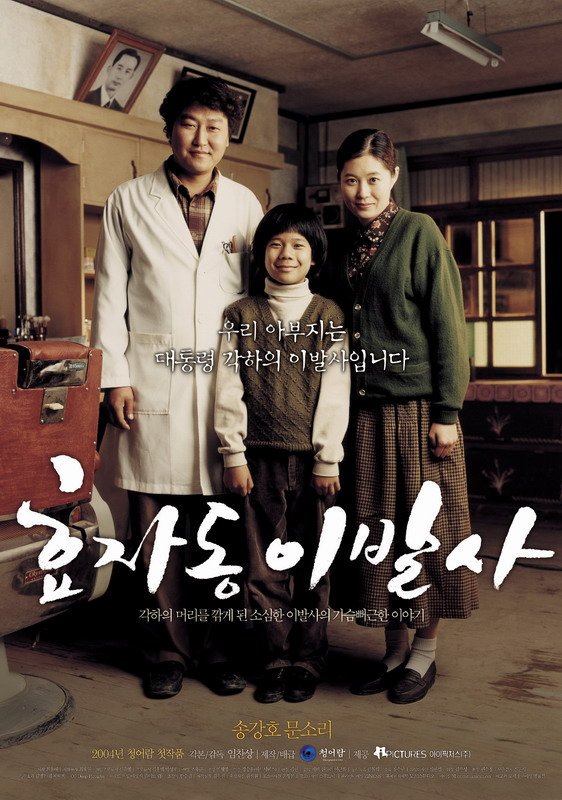
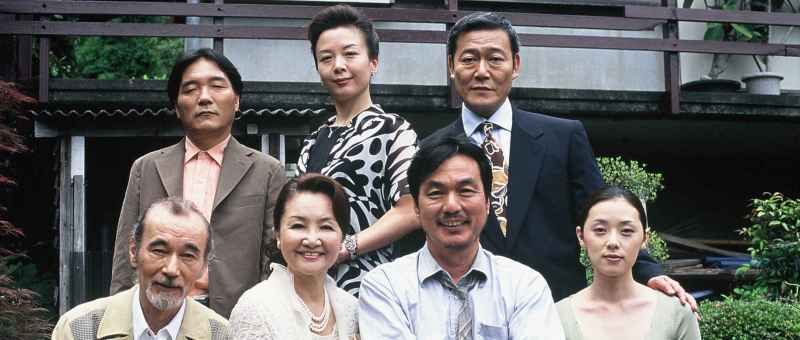
president's barber posterWe each of us live in the midst of history being made, some of us closer to the action than others. Most of us don’t quite realise how close we are or fully understand our role in events until it’s too late, but in any case we’re all just too busy getting on with the business of living to give much thought such grand concepts as history or legacy. Song Kang-ho has made a name for himself playing genial everymen forever at the mercy of historical machinations, but before he was an apathetic Taxi Driver, he was an apathetic barber giving haircuts to a dictator he half imagined was a friend. The President’s Barber (효자동 이발사, Hyojadong Ibalsa) is part journey into the intersection between rosy childhood nostalgia and national trauma, and part subtle political satire on the moral corruptions of authoritarianism but its own soft heartedness is often at odds with the grimness of its purpose.

Sung Han-mo (like the counter for tofu) is a nice but dim sort who has his own barber’s studio right across from the Blue House. As his son (Lee Jae-eung) tells us in his cutsey voice over, Han-mo (Song Kang-ho) is easily led and content to do whatever the village leader tells him to do, including participating in the ongoing corruption surrounding the re-election of despotic president Rhee Syngman. Our narrator, the oddly named Nak-an, was born as a result of a brief indiscretion between his father and an assistant (Moon So-ri) who had, apparently, hoped to marry someone else from her home village if Han-mo hadn’t trapped her with maternity. She wanted wanted an abortion but didn’t find out until after the much publicised five month cut off, meaning Han-mo talked her into staying and little Nak-an acquired the unfortunate nickname of “five months Na-kan”.

The family live happily enough until the mid-1960s when Park Chung-hee stages a coup and declares himself “President for Life”. When Han-mo somehow manages to catch a “North Korean Spy”, he gets himself a commendation and the attention of the authorities (for good or ill). A KCIA agent dutifully turns up and hauls Han-mo off to the Blue House because the president needs a trim…

Park’s reputation underwent something of a rehabilitation for a time. He did, in the minds of those seeking to justify his tyrannical reign, preside over Korea’s economic recovery. Han-mo is one of many to prosper, in his case directly in working indirectly for the regime. Han-mo is a simple man, he doesn’t think about politics but often feels belittled and downtrodden, made a figure of fun by those close to him even whilst remaining a cheerful optimist. He doesn’t take much convincing to hitch his mule to Park’s waggon, enjoying the personal boost in his social standing and finally feeling like a someone in being introduced to the world of the elites even when he is forced to accept that he does not and cannot exist fully within it.

Han-mo cuts hair, chatting away the way a barber does without really realising either that he is a vox pop spy or that he might, at any time, say the wrong thing and land himself in serious trouble. Serious trouble arrives during a heated and extremely bizarre period of political hysteria surrounding the “Marxus” virus – a lamentable episode in which an epidemic of dysentery was blamed on North Korean spies and all those who suffered from the condition taken in for “questioning”. Only when his own family is threatened does Han-mo start to reconsider his role in the affair – his status as a peripheral member of the Blue House team is no help in protecting those close to him and he can no longer pretend he does not know what happens in those basements, and that it happens to ordinary people not just “suspicious” ones.

The low level satire derives from Han-mo’s background presence becoming foreground as a very personal spat between a couple of high ranking Blue House staffers gathers in intensity before exploding into events which will have profound, though short-lived, consequences for Korean political history. Han-mo sadly takes down his portrait of Park hanging in pride of place in his shop and replaces it with one of Chun Doo-hwan (who was bald). Still a simple man he has, at least, learned his lesson and prepares to turn down the “honour” of shaving a dictator’s chin. Korea, the film seems to unsubtly hint, is finding its feet again though there will be another long reckoning before it, like Han-mo and his family, is finally able to free itself of the militarist yoke.


Sunny (님은 먼곳에, Lee Joon-ik, 2008)

Sunny 2008 posterLove, apparently, makes people do stupid things. So, apparently, does the absence of love. Lee Joon-ik’s Sunny (님은 먼곳에, Nimeun Meongotyi) takes another roundabout look at the recent past through the medium of music in the unlikely tale of a poor village girl married off to a resentful man whose love for another has sent him reeling off into a foreign war. While it’s nice to see this familiar story from the often neglected point of view of the unwanted wife, Lee’s tale is more one of male folly and the various ways a woman’s life is dictated by patriarchal values than it is of love and determination in the face of extreme danger.

Soon-yi (Soo Ae) sings a plaintive love song by contemporary singing star Kim Chu-ja for her fellow housewives in a small village, but her moment of reverie is broken when her domineering mother-in-law (Lee Joo-sil) arrives and orders everyone back to work. Victim of an arranged marriage, Soon-yi has been abandoned by her husband Sang-il (Uhm Tae-woong) who ran off to join the army right after the wedding. A letter he receives in the barracks tells us that he had a love in Seoul whom he was (presumably) forced to give up on in order to submit to his mother’s chosen bride (why he did this is never explained). Nevertheless, Sang-il’s mum is desperate for an heir from her only son and packs Soon-yi off for a conjugal visit every month. Sang-il, however, refuses any intimacy with his new wife, coldly rolling over as he tells Soon-yi to stop coming, wondering if she really has any idea what “love” is seeing as she’s obviously so blind to his emotional pain.

The next time Soon-yi tries to visit Sang-il she finds out he’s got himself sent to Vietnam – a source of panic to his devoted mother who blames her daughter-in-law for alienating her son so badly he’s decided to go off and get himself killed on a foreign battlefield rather than endure married life at home. Kicked out from her marital household and disowned by her birth family, Soon-yi decides to track Sang-il down in war-torn Vietnam, teaming up with a shady con-artist/musician (Jung Jin-young) as her only passage out of the country. 

The central problem is that Soon-yi does not love Sang-il. How could she, she barely knows him and their only on screen meeting is one filled with awkwardness, contempt, and resentment. Yet Soon-yi suddenly becomes bold, leaves her village, and refuses to back down until she finds Sang-il and convinces him to accept her as his wife. Given that he’s gone all the way to Vietnam in order to avoid her, it’s unclear what Soon-yi hopes to achieve in this – is her great gesture of sacrifice and perseverance supposed to make Sang-il suddenly abandon his resentment at his personal powerlessness and submit himself to inescapable (accidentally female) forces of social oppression?

Nevertheless, Soon-yi’s pureheartedness wins over all as they become unwilling allies in her quest. The innocence of the enterprise is soon stained with blood as Lee gives way to the bloody unpleasantness of the battlefield reality which our merry band of chancers are ultimately unable to escape. Eventually captured by the Viet Cong, they discover a mini society forged in underground tunnels complete with schools for the many children living in the dark. The Americans, by contrast, are cold and unyielding, cruelly executing the enemy and refusing to help Soon-yi in her quest until she makes a considerable sacrifice of her own.

Soon-yi, rechristened Sunny for her onstage persona, quickly becomes a pawn looking for a foothold in the midst of male squabbling. While Soon-yi’s determination to find Sang-il might have achieved melodramatic weight if it had been a real love story rather than a petty quest to remind an errant, weak willed man of his social obligations, it strains belief that she would really go this far just to save a man who can’t stand her (or really, cannot stomach the representation of his own moral cowardice), let alone that both the Korean and US armies would eventually allow a near silent young woman anywhere near an active battlefield just because she misses her husband. Enlivened by the energetic score of early ‘70s hits, Sunny is entertaining enough but never earns its contrived narrative nor manages to invest its heroine’s quest with any kind of weight or meaning, leaving her a passive presence in the film that bears her name.


Original trailer (no subtitles)

Kim Chu-ja’s My Love is Far Away

Children of the Dark (闇の子供たち, Junji Sakamoto, 2008)

Children of the Dark posterJunji Sakamoto’s career has been marked by a noticeable split between commercial projects and artier genre pieces but even considering his tendency towards socially conscious filmmaking, Children of the Dark (闇の子供たち, Yami no Kodomotachi) is a surprising entry into his filmography. Starring heartthrob Yosuke Eguchi as an earnest reporter determined to expose the extent of Japanese complicity in the exploitation of Thai children, Sakamoto’s film is hard hitting in the extreme, refusing to back away from the horrors that these children are forced to experience but perhaps taking things too far in putting his young actors through a series of emotionally difficult scenes. Children of the Dark was pulled from its slot in the Bangkok Film Festival for painting a less than idealised picture of the grim underbelly of Thai society but Sakamoto is also keen to point out that the problem is a global one which merely finds an unhappy home in a country many regard as a “paradise”.

Nanbu (Yosuke Eguchi), a Japanese ex-pat reporter living in Thailand, has been handed a hot tip on a difficult piece of investigate reporting relating to the illegal trafficking of human organs. His investigation brings him back into contact with a local NGO who operate a centre promoting educational and human rights whilst helping the impoverished children of the area. The NGO is currently investigating the disappearance of child they’d been trying to save, but the two investigations eventually overlap as it becomes clear that the organ trafficking and sexual exploitation of abandoned children are part of the same deeply entrenched cycle of human cruelty.

Nanbu’s key interest is in the Japanese connection to organ transplant case. A wealthy Japanese couple will apparently be bringing their son to Thailand for an illegal transplant to get around Japan’s strict medical ethics laws which prevent children becoming organ donors. Though it might be thought that the boy’s parents simply believe they will be undergoing a legitimate medical procedure only abroad, they are perfectly aware that the organ they will be receiving will have been acquired specifically for the purpose and will have been ripped from a healthy child rather than transplanted from an unfortunate accident victim.

Using the NGO’s contacts, Nanbu begins to realise how deeply the conspiracy runs. The NGO’s investigations lead them to a brothel in which extremely young boys and girls are kept in cages to be picked out like lobsters in a restaurant by the international clientele each after a different kind of sexual experience. The children are beaten if they refuse and literally “thrown out” in black bin bags should they contract illnesses such as AIDS. When one of the children is killed by a client who overdoses him on hormones, the matter is settled with financial compensation and the body disposed of. Many of these children are orphans from backgrounds of extreme poverty, neglected or abandoned by their parents into a life of sexual servitude in part caused by ongoing economic inequality which is only exacerbated by the thriving underworld enterprises of people and drug trafficking.

Nanbu is, however, only a reporter. Keiko (Aoi Miyazaki), a young and idealistic Japanese woman recently arrived in Thailand to work with the NGO, is committed to saving individual lives whereas Nanbu and the paper are committed to being passive observers exposing the truth in the hope that the whole sordid system will one day collapse. Keiko’s sometimes dangerous naivety is contrasted with Nanbu’s jaded complicity in essentially allowing a young child’s life to be sacrificed to get his story with only the justification that something might be done if the truth were known.

A final revelation, however, proves a step too far even if it encourages all to point the finger back on themselves and accept that personal complicity may run far deeper than most suspect. The tragedy is further undercut by the strange decision to end on an idyllic scene of paradise with a karaoke track playing over the top complete with lyrics pasted on the side – a tonal variation too far given the necessarily somber atmosphere of the the film as a whole. Despite the strangeness of the ending with its unexpected reversals and clumsy attempt at reflexivity, Children of the Dark is an urgent, difficult piece exposing the unspeakable cruelties hidden away in the underbelly of a foreign “paradise”.


Original trailer (no subtitles)

The Scarlet Letter (주홍글씨, Byeon Hyeok, 2004)

The Scarlet Letter posterSouth Korea has long had a reputation for being among the most conservative of East Asian nations, perhaps because of a strong Christianising influence, but even so the fact that adultery was only fully decriminalised in 2015 is something of a surprise. Ironically enough the legislation was enacted in the defence of women who enjoyed few legal rights and would be left destitute if their husbands left them, suffering not only the humiliation and social stigma of divorce but also having no independent income and very little possibility of gaining one. Nevertheless it quickly became another tool of social control, branding “harlots” rather than protecting “wives”. Byeon Hyeok’s The Scarlet Letter (주홍글씨, Juhong Geulshi) was released in 2004, which is a whole decade before adultery was removed from the statue books, and draws inspiration from the book of the same name by Nathaniel Hawthorne in which a young woman becomes a social outcast after giving birth to an illegitimate child.

Cocksure policeman Ki-hoon (Han Suk-kyu) lives in a world of his own dominion. Married to the elegant concert cellist Su-hyun (Uhm Ji-won), Ki-hoon is also carrying on an affair with the bohemian nightclub singer Ga-hee (Lee Eun-ju). One fateful day he is called to the scene of a bloody murder. The owner of a photographer’s studio has been found with half his head caved in and the prime suspect is his wife, Kyung-hee (Sung Hyun-ah), who found the body. Once she’s had some time to recover from the shock, Kyung-hee offers up some possible evidence regarding a local photographer who may have been semi-stalking her – something which had caused tension between herself and her husband. The photographer claims Kyung-hee asked him to take the photos, and others besides, but denies he was romantically interested in her or that the couple had been having an affair.

The murder case floats in the background as Ki-hoon’s personal life spirals ever more out of control. Both Su-hyun and Ga-hee are pregnant with his child and it seems inevitable the affair will be exposed. Ki-hoon fears this not out of guilt in causing emotional harm to one or both of his women, but out of a sense that it will be very annoying, inconvenient, and burdensome for him. When his wife does eventually confront him about the affair, Ki-hoon’s response is to ignore it and carry on as normal by acting excited about the baby as if to remind Su-hyun that she is already tied to him and it will be almost impossible for her to leave. Meanwhile, he refuses to give up Ga-hee whose mental state seems to be fracturing under the intense pressure of her need for Ki-hoon and his continuing disregard for the feelings of others.

Ki-hoon is a classic noir hero, wading into a morass of moral ambiguity and hurtling headlong towards an existential reckoning. A late, yet fantastically obvious, twist offers another perspective which the film has no time to expand on so caught up is it in the moral ruining of Ki-hoon in suggesting that oppressive social codes have in some way contributed to this intense situation, forcing three people into an uncomfortable love triangle where everyone has ended up with the wrong partner. Byeon does, however, choose to emphasise “morality” in lending a spiritual slant to Ki-hoon’s fall rather than choosing to attack the social oppression of Korea’s intensely conservative culture in which all the power was in Ki-hoon’s hands (even if he uses it to ruin himself, later left in a state of spiritual emptiness filled only with guilt and shame).

The reckoning comes in a literal evocation of Ki-hoon’s claustrophobic love life in which he finds himself trapped in an inescapable black hole, waiting to find out if he will be released or condemned to suffer an eternity of pain for his various transgressions. Byeon never quite manages to marry his higher purpose to the noir narrative, leaving his avant-garde final set piece out of place in an otherwise straightforward thriller while his final twist falls flat in retreading well worn genre cliches. Frank in terms of its depiction of sex and nudity, The Scarlet Letter takes on an anti-erotic quality, painting its various scenes of actualised sex as passionless acts of compulsion with only those of fantasy somehow imbued with colour and light though its melancholy conclusion suggests even these may carry a heavy price.


Original trailer (no subtitles)

Lost Paradise in Tokyo (ロストパラダイス・イン・トーキョー, Kazuya Shiraishi, 2010)

lost paradise in Tokyo posterHappiness seems an elusive concept for a group of three Tokyoites each chasing unattainable dreams of freedom in a constraining society. The debut feature from Kazuya Shiraishi, Lost Paradise in Tokyo (ロストパラダイス・イン・トーキョー) is much more forgiving of its central trio than many an indie foray into the forlorn hopes of modern youth but neither does it deny the difficulty of living in such frustrating circumstances.

Mikio (Katsuya Kobayashi) has a soul crushing job as a telephone real estate salesman at which he’s not particularly good and is often subject to trite rebukes from a patronising boss who breaks off from the morning mantra to enquire how the funeral went for Mikio’s recently deceased father only to then remark that Mikio’s dad won’t be able to rest in peace unless Mikio bucks up at work. At home, Mikio has just become the sole carer for his older brother, Saneo (Takaki Uda), who has severe learning difficulties and has been kept a virtual prisoner at home for the last few years. Saneo, however, is still a middle-aged man with a middle-aged man’s desires and so Mikio decides to hire a prostitute to help meet his sexual needs.

“Morin-chan” (Chika Uchida) as she lists herself, is also an aspiring “underground idol” known as Fala who makes ends meet through sex work. Depite Mikio’s distaste for the arrangement, Morin is a good companion to Saneo, calming him down and helping to look after him while Mikio is at work. In her life as Fala, Morin is also the subject of a documentary about underground idols and when the documentarians stumble over her double life they make her a surprising offer – allow herself to be filmed and they will give her a vast amount of money which might enable her to achieve her dream of buying a paradise island.

Mikio is doing the best he can but is as guilty of societal stigma relating to the disabled as anyone else and his guilt in feeling this way about his own brother coupled with the resentment of being obliged to care for him has left him an angry, frustrated man. Asked at work if he has any siblings Mikio lies and says he’s an only child, denying his brother’s existence rather than risk being associated with disability. At home he can’t deny him but neither can he be around to keep an eye on him all day and so there have been times when he’s had to literally (rather than metaphorically) lock his brother away.

Longing for freedom, Mikio wants out of his stressful, soul destroying job and the responsibility of caring for his brother while Morin is trapped in the world of “underground idols” who are still subject to the same constraints as the big studio stars only without the fame, money, or opportunities. As one of the documentarians points out, Morin (or Fala) is really a little old for the underground idol scene, her days limited and dreams of mainstream success probably unattainable. For as long as she can remember she’s dreamed of a paradise “island” where she can she live freely away from social constraints and other people’s disapproval.

Mikio had got used to thinking of his brother as a simple creature whose life consisted of needs and satisfactions but the entry of Morin into their lives forces him to consider what it is that his brother might regard as “happiness” and if such a thing can ever exist for him. Morin wants the three of them to go her paradise island where Saneo can live his life freely away from the unforgiving eyes of society but unbeknownst to any of them they may have already found a kind of paradise without realising.

Later Mikio admits that he and his father were content to lock Saneo away because they feared they wouldn’t understand him. Once Saneo hurt someone, not deliberately, but through being unable to express himself in the normal way and not fully understanding that his actions would cause someone else pain. Rather than deal with the problem, Mikio’s father decided to hide his son away – less to protect Saneo from himself, than in wanting to avoid the stigma resulting from his existence. Saneo, however, may not be able to express himself in ways that others will understand but is still his own person with his own hopes and ideas as his final actions demonstrate. Only once each has come to a true understanding of themselves and an abandonment of fantasy can there be a hope of forward motion, finally rediscovering the “lost paradise” that the city afforded them but they were too blind to see.


Available to stream in most territories via FilmDoo.

Original trailer (English subtitles)

Toilet (トイレット, Naoko Ogigami, 2010)

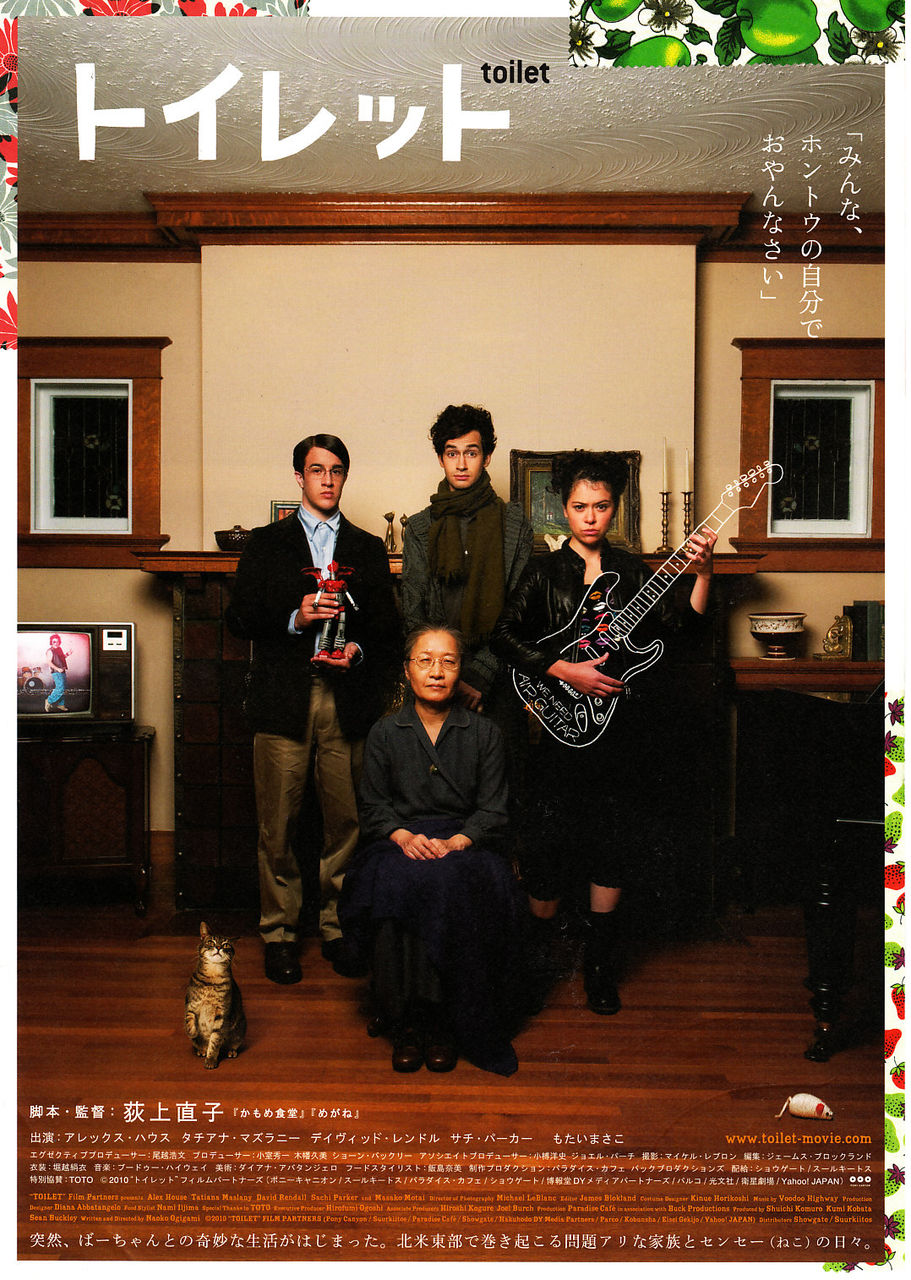
toilet posterBy accident or design, Naoko Ogigami’s career has existed to one side of Japan’s most representative genre, the family drama, in making a clear choice to embrace unusual or self defined family units. In Kamome Diner, a disparate group of runaway Japanese people became a kind of makeshift family and forged a mini-community with the friendly local Finns. Following the brief holiday sojourn of Megane, Ogigami returns abroad but this time to North America for her first English language feature. Once again it’s a tale of misfits learning how to fit, but it’s also a tale of the true nature of family which extends far further than mere blood relation.

30-something Ray (Alex House) is a hyper rational scientist who rejects all forms of emotion and attachments. Thus, he’s doing pretty OK even though his mother died just over a week ago. His siblings, neurotic poetess Lisa (Tatiana Maslany), and agoraphobic former pianist Maury (David Rendall) are not taking it quite as well. The other problem is that shortly before she died, Ray’s mother spent a lot of money tracking down her own long lost Japanese mother who is still living with them but speaks no English and and is still very affected by the death of the daughter she’d only just reconnected with. Ray resents having to look after “baa-chan” (Masako Motai) – a woman he’s hardly spoken to and has no connection with, but cannot exactly throw her out.

Ray, a rare male protagonist in an Ogigami film, is an emotionally repressed geek who pours all of his love and affection into collecting plastic Gundam models. Ironically enough, Ray, or”Rei” actually means “cold” in Japanese which is what his siblings often brand him. More “adult” than the others, he’d long left the family home and was barely present during his mother’s final days leaving Lisa and Maury to deal with everything alone. A sudden accident forces him to return and reassume his big brother role in trying to take care of the floundering Lisa and the fragile Maury.

After suffering a breakdown during a concert some years previously, Maury has been unable to leave the house. Discovering his mother’s old-fashioned sewing machine, he finds a new lease on life with an additional form of expression on top of his musicality. With Baa-chan’s help, he figures out how to use the machine and begins making skirts just like the ones his mother wears in the family photos, which he later wears for no particular reason other than it pleased him to do so.

Lisa, by contrast, seems set to walk a darker path after falling for a snarky, nihilistic poet from her creative writing class. His violent negativity seems to gel with her ongoing malaise, but all he really offers her is his own insecurities and embittered rigidity. Rediscovering the capacity to choose something else, Lisa finally finds the will to do something real and then asks baa-chan to help her triumph by doing something that’s sort of fake but will take her on the kind of journey she’s been looking for.

Having started out cold, distant, and resentful, Ray is brought back into the familial fold by accidentally bonding with his siblings in trying to understand Baa-chan. Played by Ogigami regular Masako Motai, Baa-chan never speaks but seems to understand what’s going on with her grandchildren on an instinctual level. Ray, half-hoping Baa-chan isn’t their real grandma, weighs up paying for a DNA test but ends up finding out more about himself than his other family members. Baa-chan maybe a kind of unknowable deity, hovering around the edges of the family with a giant wallet and wise smile, but she does seem to know what it is the orphaned siblings need and determines to gently nudge each of them in the right direction.

Deliberately moving away from Ogigami’s trademark style, Toilet adopts an even more heightened, detached approach than that seen in Megane but possibly suffers from hovering on the edges of on an established American-style of ironic comedy rather than striking a unique tone of its own. The toilet of the title refers to the well known Japanese “washlet” which becomes an unlikely point of connection between Ray and Baa-chan as he becomes increasingly intrigued by the strange sigh of disappointment she lets out each time she leaves their bathroom. Where take-away sushi failed, homemade gyoza and patience win out as Baa-chan imparts her silent wisdom in allowing the family to find themselves and each other in an atmosphere of unconditional love and support.


Original trailer (English with Japanese subtitles)

The Laughing Frog (笑う蛙, Hideyuki Hirayama, 2002)

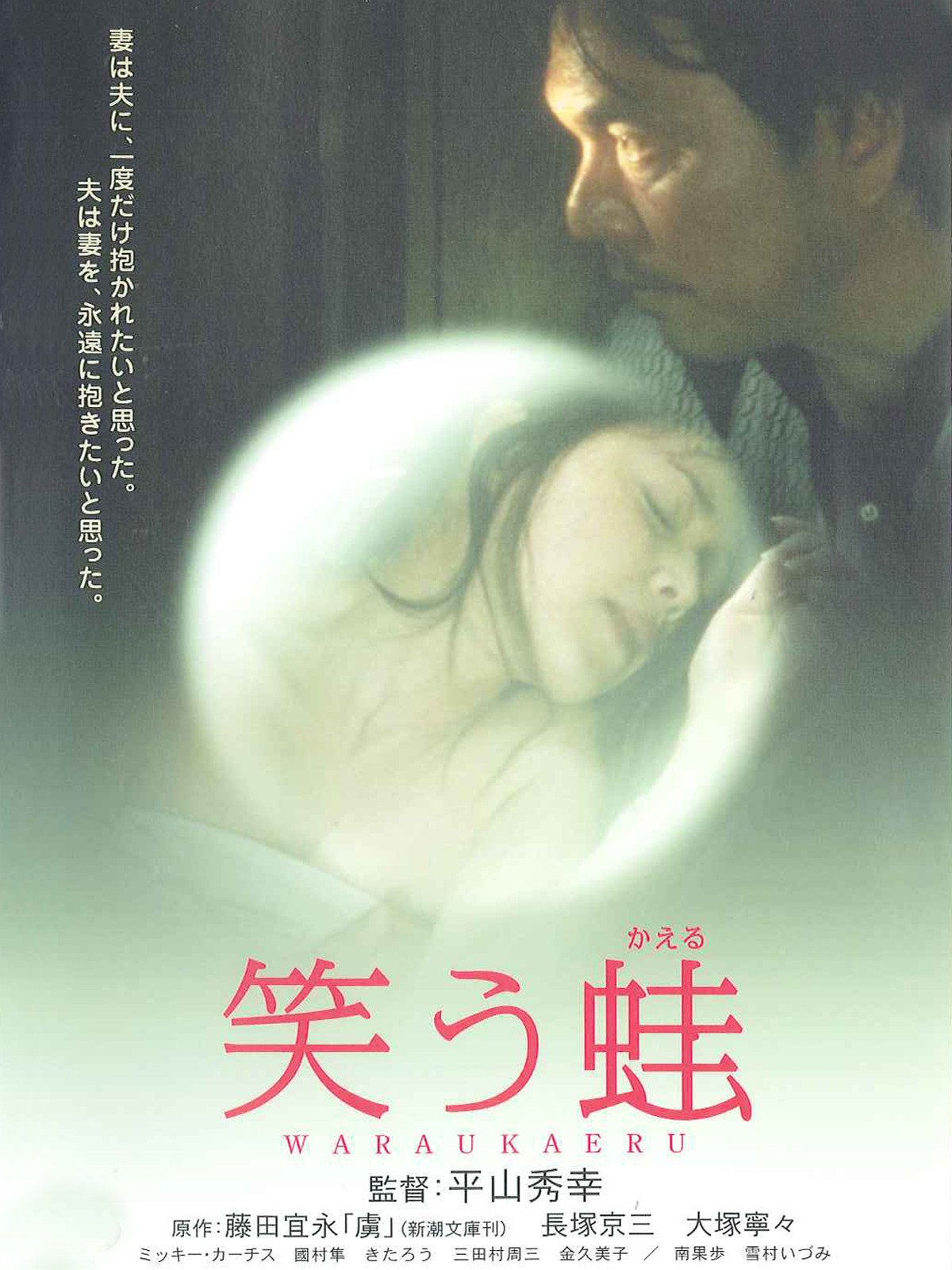
laughing frog posterEver have a day (or perhaps a lifetime) where you feel so stupid that even the frogs are laughing at you? That’s pretty much how it is for disgraced former bank manager Ippei when he turns up one day at a family holiday home he assumed would be empty but turns out not to be. In Laughing Frog (笑う蛙, Warau Kaeru) director Hideyuki Hirayama deftly dissects the modern family, the gradual redundancy of the middle-aged man, and the way society seems to have of anointing the lucky and the unlucky, in a darkly humorous satire in which even mother nature seems to be mocking our petty human concerns.

33 year old Ryoko (Nene Otsuka) is attending the third memorial service for her late father at which her greedy sister-in-law (Kumija Kim) asks for various things in an attempt to get some of the inheritance in advance while Ryoko’s brother (Shuzo Mitamura) wanders off to chat about silkworms in Chinese on his mobile phone. The event ends with Ryoko’s sprightly mother (Izumi Yukimura) and the sister-in-law urging her to sort out some kind of marital difficulties in order to ease the awkwardness surrounding her lack of external connections.

Meanwhile, Ryoko’s missing husband, Ippei (Kyozo Nagatsuka), rocks up at a rural station and climbs into a familiar house through an open window. Wandering around in his pants, he hears a noise and realises someone lives there after all. Ryoko has moved into her father’s old house in the country and started a whole new life for herself. After a brief discussion, Ryoko agrees to let him stay for a while on the condition that he finally sign the divorce papers but Ippei soon finds himself confined to an especial kind of irrelevance as he starts his new life in the hall cupboard observing his wife’s new freedoms by means of a tiny hole in the wall.

No one seems to have much of a good word to say about Ippei, which is fair enough seeing as he apparently became obsessed with a bar hostess and embezzled money from his bank to pay for a lavish affair before running away and leaving his wife to deal with the fallout. He is, however, paying for it now as his own irrelevance is once and truly brought home to him as he lives out his days like an impotent ghost trapped in a storage cupboard undergoing his wife’s strange mix of kindness and revenge.

Ryoko, the goodly wife, is not quite all she seems. Ippei’s mistress makes a surprise appearance to try a spot of extortion on the wealthy wife but she’s no match for Ryoko’s perfectly practiced poise. One of the oddly cruel accusations the mistress has to offer is that Ippei once referred to a kind of boredom with his wife’s properness, branding her a “fancy pet cat” whilst apparently avowing the mistress’ bedroom superiority. If Ippei’s sheepish behind the wall expression is anything to go by he is guilty as charged but then perhaps the uncomfortable statement leads right back to his uncomfortable place within Ryoko’s upperclass family who seem to look down on a mere bank manager, affecting politeness while secretly bemoaning the fact that their daughter has married beneath herself.

The model upperclass family is a simulacrum. Feigning politeness, elegance and dignity they attempt to disguise their otherwise distasteful affectations. Ryoko’s sister-in-law is at least honest in her constant harping on about the inheritance, plan to steal grandma’s house out from under her to knock it down and build a new one, and constant asides to her apparently hopeless (and unseen) son away at a (not great) university. Meanwhile her husband, Ryoko’s brother, pretends to chat silkworms in Chinese on his phone but is really talking to a Chinese mistress and Ryoko’s mum is planning to get married again to a (possibly dodgy) antiques dealer (Mickey Curtis) who is so deeply in debt there won’t even be any inheritance anyway.

Ryoko too has moved on. Ippei is forced to watch as she entertains her new boyfriend (Jun Kunimura), a stonemason whose main line is headstones, while the frogs outside work themselves into some kind of frenzy. Little by little all his manly affectations are worn away – he’s forced to realise how foolish he’s been, how irrelevant he is in Ryoko’s life, and how perfectly pointless his fugitive existence really is. Ryoko meanwhile remains calm and calculating. She “lies” and she wins in a bloodless victory, allowing her opponents to sentence themselves to the punishments they feel themselves to deserve. Ippei, it seems, is just a weak, unlucky man doomed to ruin himself through a series of poetic failures and petty self involved mistakes. Meanwhile the frogs look on and laugh at our human follies. Makes you feel small doesn’t it….


Kilimanjaro (킬리만자로, Oh Seung-uk, 2001)

Kilimanjaro posterMt. Kilimanjaro is the world’s tallest free-standing mountain. Oh Seung-ok’s debut, Kilimanjaro (킬리만자로), is not a climbing story, at least not in that sense, but a story of a man trying to conquer his own mountain without really knowing why. Twin brothers Hae-shik and Hae-chul are mirrors of each other, a perfect mix of light and dark, but when one makes a choice to choose the darkness, it throws the other into despair and confusion. A noir-ish tale of fragmented identities and fatalistic retribution, Oh’s world of tired gangsters and impossible dreams is as icy and unforgiving as the summit of its titular mountain, offering little more than lonely deaths and eternal regrets.

Policeman Hae-shik (Park Shin-Yang) drifts in and out of consciousness, tied up in a room by his twin brother, Hae-chul, with Hae-chul’s children looking on. Hae-chul murders his family and then shoots himself all while his brother is tied up and helpless, a policeman without recourse to the law. Taken to task by his colleagues who want to know how he could have allowed any of this to happen, if not as a brother than as a cop, Hae-shik has little to offer them by way of explanation. To add insult to injury, he is also under fire for unethical/incompetent investigation, and is taken off the case. Suspended pending an inquiry, Hae-shik goes back to his hometown but is immediately mistaken for Hae-chul and attacked by gangsters Hae-chul had pissed off before he left town and killed himself. Saved by local petty gangster Thunder (Ahn Sung-Ki), Hae-shik assumes Hae-chul’s identity and slips into the life of hopeless scheming which ultimately led to his brother’s ugly, violent death.

The film’s title is, apparently, slightly ironic in referring to the film’s setting of a small fishing village in the mountainous Gangwon-do Providence, known to some as “Korea’s Kilimanjaro”. Each of the men in this small town is trapped by its ongoing inertia and continual impossibility. They want to make something of themselves but have few outlets to do so – their dream is small, owning a family restaurant, but still it eludes them and they soon turn to desperate measures in opposing a local gangster in the hope of finally improving their circumstances.

Despite the seemingly tight bond of the men in Thunder’s mini gang – a mentally scarred ex-soldier known as “The Sergeant” (Jung Eun-pyo) and nerdy religious enthusiast knows as “The Evangelical” (Choi Seon-jung) rounding out Hae-chul’s goodhearted chancer, none of them has any clue that Hae-shik is not Hae-chul, or that Hae-chul and his family are dead. No one, except perhaps Thunder, is very happy to see him but even so Hae-shik quickly “reassumes” his place at Thunder’s side and takes over Hae-chul’s role in the gang’s scheming.

Hae-shik and Hae-chul had formed a perfect whole of contradictory qualities, each with their own degrees of light and darkness. Hae-chul had been the “good” brother who worked hard at home taking care of his parents while Hae-shik headed to university and a career in the city, never having visited his hometown since (in fact, no one seems to know or has already forgotten that Hae-chul even had a twin brother). Hae-shik’s “goodness” might be observed in his career as a law enforcer, but he’s clearly not among the list of model officers, and his home life also seems to be a failure. Hae-chul’s family might also have failed, and his shift to a life of petty crime provides its own darkness but living in this claustrophobic, impossible environment his crime is one of wanting something more than that his world ever had to offer him.

As might be expected, Thunder’s plans do not unfold as smoothly as hoped. Ineptitude and finally a mental implosion result in a near massacre costing innocent lives taken in a fury of misdirected vengeance. Despite wishing for a quiet life spent with friends on the beach, heroes die all alone, like mountain climbers lost on a snowy slope unsure whether to go up or down. Attempting to integrate his contradictions, become his brother as well as himself, Hae-shik reaches an impasse that is pure noir, finally meeting his end through a case of “mistaken identity”.


Screened at London Korean Film Festival 2017.

Christmas on July 24th Avenue (7月24日通りのクリスマス, Shosuke Murakami, 2006)

Christmas July 24th AvenueThey do Christmas a little differently in Japan. Rather than a celebration of family and commercial excess, Christmas is an occasion for romance much like the Western Valentine’s Day. Strangely, Japanese cinema has been slow to warm to the idea of the Christmas date movie though Christmas on July 24th Avenue (7月24日通りのクリスマス, 7 gatsu 24 ka dori no Kurisumasu) tries its best to plug the gap. Starring the ever reliable Miki Nakatani, Christmas on July 24 Avenue is a grown-up romance filtered through the innocence of the shojo manga its heroine has come to love.

Sayuri Honda (Miki Nakatani) is a 24 year old office lady who dreams of romance but has come to believe that she just isn’t destined for a great love of her own. Obsessed with a manga she’s loved since childhood which is set in Lisbon, Sayuri has begun to notice the various similarities between her hometown of Nagasaki and the Portuguese capital, living part-time in a kind of sunbaked European fantasyland. When her long lost high school crush, Satoshi (Takao Osawa), resurfaces as a famous architect with a bestselling book out, Sayuri’s dreams of romantic fulfilment are suddenly reawakened.

Constructed with obvious projected wish fulfilment, Sayuri’s arc is the rom-com classic of shy girl gets handsome boy after a series of coincidences and misunderstandings. Bespectacled and reserved, Sayuri’s major selling point is her propensity to suddenly fall over and make a spectacle of herself which she does in spectacular fashion during one of the amateur dramatic plays she helps out with. Embracing an unwelcome genre norm, Sayuri’s journey towards true love begins with prettying herself up – swapping her glasses for contacts, getting a more sophisticated haircut, and dressing in more typically elegant girlish outfits over her practical, dowdy tastes.

Rather than allow Sayuri to realise she’s fine as she is and doesn’t need to change herself for a man, the arc is Sayuri abandoning her anxieties to become the kind of person she thinks Satoshi would like. While all of this is going on there’s another potential suitor hanging around in the form of Yoshio (Ryuta Sato) – a geeky guy who works in a bookstore and has been nursing a crush on the oblivious Sayuri for years. Several times Yoshio confesses his love, and several times Sayuri fails to understand him. His being a pure love, Yoshio decides to help Sayuri find happiness no matter who with.

Sayuri sees her own situation mirrored in that of her brother. Where Sayuri sees herself as plain and undesirable, her brother is handsome and popular with the ladies – the kind of “prince” she herself dreams of. Despite having a long history of dating remarkable girls, Koji’s new girlfriend (Juri Ueno) is a virtual clone of Sayuri – mousy with glasses and a talent for mumbling. Oddly, Sayuri is not worried by this development in the way that might be expected, but only outraged at her brother’s breaking of romantic protocol in taking up with someone who is nowhere near his league. Resenting that a girl just like her has improbably managed to bag a prince, Sayuri treats her potential new sister-in-law with scorn and contempt whilst continuing to blame her own failure to do the same on her plainness and reserve.

Truth be told, Satoshi is a predictably dull love interest – a cardboard cutout prince of the kind familiar to shojo romance. Additional spice is added in an extra-marital affair between Satoshi and an old flame with whom he apparently has some unfinished business but even this hint of impropriety does not seem to put Sayuri off. Her final revelations tend towards realising that there’s nothing wrong with plain dowdy girls hooking handsome guys, even though she is no longer a plain and dowdy girl herself and her prince is also responsible for a crisis in the marriage of a friend. She has this revelation through a lengthy speech at someone else’s wedding which she has nearly derailed by provoking a crisis of confidence in the bride.

Based on a short story by Shuichi Yoshida – best known for socially conscious crime thrillers such as Villain, Rage, and Parade, Christmas on July 24th Avenue is a consciously cute affair filled with quirky details which attempt to recreate the world of shojo manga but cannot make up for the soulless quality of its romance. A lack of chemistry between Nakatani and Ozawa prevents the love story from taking off while the second lead is kept hovering the background but more sweet joke than credible option. Reaching an improbably neat conclusion in which everything is forgiven and everyone lives happily ever after, Christmas on July 24th Avenue fulfils its promise of magical romance filled with cheerful Christmas carols and twinkling lights but proves disappointing after all the fancy wrapping.


30 second trailer (no subtitles)

Wild Berries (蛇イチゴ, Miwa Nishikawa, 2003)

wild berries poster

The family drama was once the representative genre of Japanese cinema. In the turbulent post-war world, the one unchanging, unbreakable touchstone was the bonds between parents and their children even if it must also be realised that those bonds will necessarily change over time. Tiny cracks might have been visible even in Ozu’s Tokyo Story in the growing disconnection between the old folks in the country and their city kids, but it wasn’t until the ‘80s when Japan’s economic recovery had fully taken hold that the family itself began to come under fire. Yoshimitu Morita’s The Family Game kickstarted a trend of family implosion movies which implied that familial bonds were more social affectation than genuine connection, but post-bubble the tables turned again. These days, Hirokazu Koreeda has picked up the family drama mantle, depicting broadly positive pictures of normal family life. It is then all the stranger that his protege, Miwa Nishikawa, should be the one to ask again if family really is all it’s cracked up to be.

An ordinary breakfast in the Akechi household. Grandpa (Matsunosuke Shofukutei ) is dipping his toast in the coffee again while salaryman dad Yoshiro (Sei Hiraizumi) reads his paper. Schoolteacher Tomoko (Miho Tsumiki) barely has time to look at her breakfast before her mother, Akiko (Naoko Otani), reminds her that today is “Wednesday” – not only does she need her PE kit, but it’s also the day that her fiancé, Kamata (Toru Tezuka), is coming round to tea to meet the folks. The atmosphere is pleasant, genial, but why has Yoshiro had his mobile phone cut off and is the bald spot Akiko has just discovered on the top of her head really anything to worry about?

The Akechis are the archetype of a modern middle-class family, living a comfortable life in a nice home while dad goes out to work and mum does everything else. It is not, however, quite as it seems. Yoshiro’s phone has been cut off because he hasn’t paid the bill. He hasn’t paid the bill because he’s lost his job. He hasn’t told his wife he’s lost his job because he’s too ashamed, so he’s taken out vast loans from gangsters rather than trying to find a more honest solution. Mum Akiko plays the dutiful housewife, cooking, cleaning, putting up with Yoshiro’s imperious behaviour and looking after grandpa who has advanced dementia and thinks he’s still at war. In reality she’s bored and resentful, tired of the burden of looking after her husband’s ungrateful father and longing to have some time for herself. The only uncorrupted member of the family is schoolteacher Tomoko who finds herself giving a strange lesson on the evils of lying to her class of small children. Tomoko is perhaps too uncorrupted, prim as a schoolmarm but dull with it.

When grandpa meets an unfortunate end, the longstanding family secret is revealed – Tomoko is not an only child, she had an older brother, Shuji (Hiroyuki Miyasako), who had been expelled from the family for his immoral ways – i.e, lying, cheating, and stealing. In fact, Shuji’s return was an accident – his main job is stealing the condolence money from funerals and he just happened to be at the one next door. Shuji’s conman credentials might be just what the family needs, but could they and should they let him save them and is “saving” the family that rejected him really a part of Shuji’s grand plan?

Japan’s rapid economic recovery is usually blamed for the collapse of the family, sending sons away from the villages and prizing the commercial over the spiritual. Tomoko’s fiance, Kamata, has a slightly different take on the problem. After his first meal with the Akechis he’s touched by the warm and friendly family atmosphere, comparing them favourably with his own upperclass family which he feels to be cold and austere. The class difference and Kamata’s obvious discomfort surrounding it is one problem as is his problematic characterisation of Tomoko’s family as earnest and hardworking as, perhaps, he thinks people without inherited wealth ought to be is another, but the real irony is reserved for Kamata’s eventual reaction to discovering the truth. Yoshiro didn’t take to Kamata because he thought him “unconventional” with his unkempt hair and pretentious tastes, but Kamata proves himself the most conventional of all in his cruel rejection of his fiancée over what he sees as a betrayal by her family.

Wild berries, once they take root, quickly take over, leaving a trail of destruction in their wake. Secrets, and the need to keep them, have eaten away at the foundations of the Akechi family but which is the best way to repair them – starting all over again and working hard to put things right, as Tomoko would have it, or opting for Shuji’s dishonest quick fix? The youngsters battle it out amongst themselves for the soul of the family unit while mum and dad are just too world weary to even care anymore. Faith in the family may be running at an all time low, but Nishikawa at least manages to mine the situation for all of its bleak irony, laughing along knowingly with each dark revelation or small tragedy.


Screened as part of Archipelago: Exploring the Landscape of Contemporary Japanese Women Filmmakers.

Original trailer (no subtitles)