Tuna Girl (TUNAガール, Mana Yasuda, 2019)

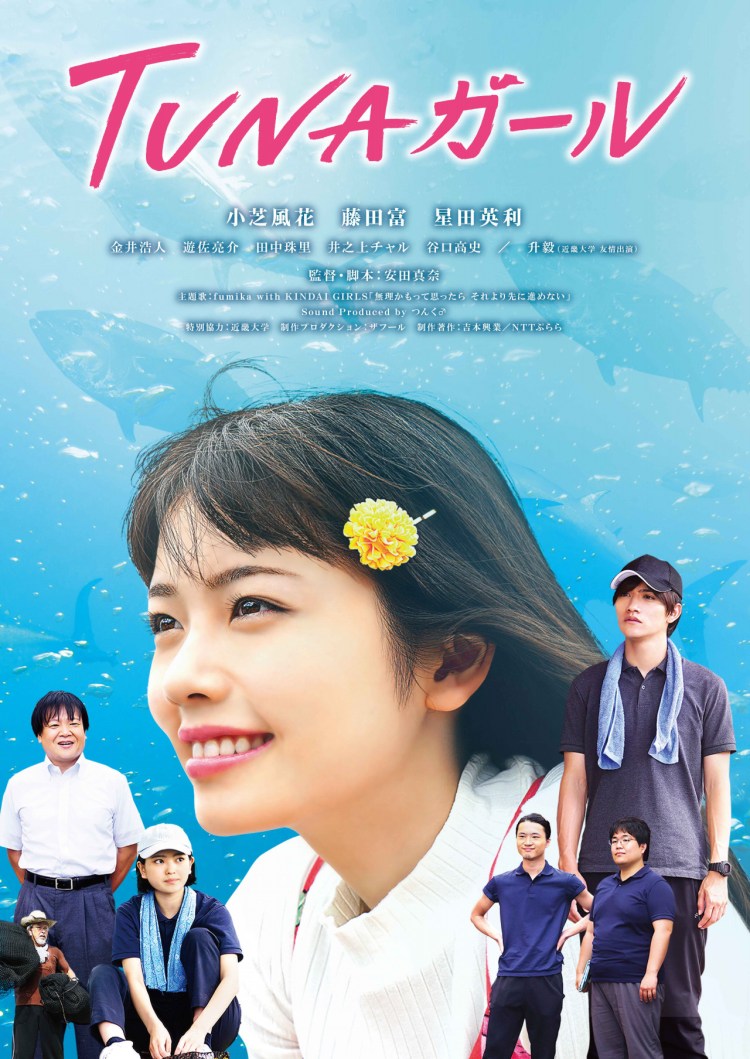
Tuna girl posterIn perhaps the greatest book review ever written, a young girl in 1944 remarked “This book gives me more information about penguins than I care to have”. After viewing Mana Yasuda’s Tuna Girl (TUNAガール) which is equal parts docudrama about the growing tuna farming industry in contemporary Japan and coming-of age tale about a plucky young girl who, just like the famously impetuous fish, has a habit of rushing headlong into things she doesn’t understand fuelled only by unstoppable enthusiasm and a good heart, you may feel something similar about the titular fish.

Minami (Fuka Koshiba), an excitable young woman, is a fisheries student from Osaka on a short course at a research facility where they pioneer tuna farming. Minami’s big problem is that she hasn’t figured out what her speciality should be which means she’s been put on general fish farming duties but is beginning to think perhaps she’s not cut out for this after all seeing as she’s extremely squeamish when it comes to the real blood and guts of animal husbandry.

Meanwhile, she’s become a little smitten with the handsome but geeky Sudo (Tom Fujita) who gets a bit teary eyed every time he mentions tuna which he describes as the “diamonds of the sea”. Unlike Minami, most of the other students are of the serious sort and all have their particular reasons for attending the facility. Kuroda, an earnest young woman, becomes increasingly fed up with Minami’s thoughtless antics, resenting the extra work and potential for ruin involved with someone like her permanently overexcited friend. As she later reveals, however, that’s largely because she comes from a much more conservative family in which most believe that a woman’s education is a pointless extravagance. Her comparatively progressive grandfather felt differently and left money in his will to make sure she could study to become whatever she wanted to be, only she’s obsessed with fish and it’s difficult to sell a career in fish farming as being of great importance to the future of the human race so she needs to make sure she doesn’t mess this up and risk giving her judgemental relatives additional ammunition.

Kuroda therefore is somewhat unsupportive when Minami goes way over the top in characteristic fashion and ends up on TV introducing the school to a film crew who seem to have some kind of ecological agenda. Dressed in a cheerful summer outfit and plush tuna hat, Minami actually proves quite a capable host providing easily accessibly explanations of the running of the facility and various facts about tuna but tragically makes a huge mistake when she trips and spills valuable specimens live on air, trending on Twitter as a fish killer in the process. Unfortunately, her mistake could have serious consequences for everyone in that the facility, though operating as a commercial venture selling their farmed tuna, is largely reliant on grants which may be revoked if they come under ill repute.

As another student tearfully explains, classmates ought to be supporting each other not acting like bullies when one of them messes up. Kuroda later regrets her actions, explaining that she hates herself for being so serious with other people and secretly wishes she could be more like Minami. They are, after all, all quite unusual people who are passionate about something most people would find strange. Sudo thinks that their mission of perfecting tuna farming in Japan is akin to a sacred duty which lends the whole thing an uncomfortably nationalist bent, while parasite specialist Hosoda is told that by eliminating diseases in fish they can prevent conflict over fishing rights and somehow bring about world peace. Which is all to say that, though this is a bloody business entirely geared towards the efficient consumption of living creatures, everyone has their heart in the right place even if it might take a beat or two to figure it out.

Despite repeated failures and getting dumped by her selfish long distance boyfriend Minami remains steadfast and enthusiastic. She might never figure out her speciality, but learns a valuable lesson from her mentor who tells her that there is no “goal” in research, merely an intention to keep moving forward, much like a tuna rushing endlessly towards the future. Filled with fish facts and possibly too authentic detail of fish farming in Japan, Tuna Girl is far from original but cheerful enough as its enthusiastic heroine gets a few humblings but never gives up on herself or her friends as she charges forth towards her own bright future as a champion of Japanese tuna.


Currently available to stream on Netflix in the UK (and possibly other territories)

TV spot (no subtitles)

Shippu Rondo (疾風ロンド, Teruyuki Yoshida , 2016)

Shippu Rondo posterIn this new age of anxiety, can we find the time to laugh about the possible release of a deadly bioweapon illegally developed and then stolen by a disgruntled employee who then finally gets hit by a truck before he can reveal what he did with it? On watching Shippu Rondo (疾風ロンド), your answer may be a predictable no. Adapted from a novel by Keigo Higashino, who is not particularly known for his sense of humour, Shippu Rondo fails to capitalise on the inherent absurdity of its premise, lurching between broad comedy and existential dread before making a late in the game shift towards sentimental family melodrama.

The trouble begins when a disgruntled employee (Shigeyuki Totsugi) fired for his zeal in creating a virulent bioweapon returns and steals its only sample, skiing out into the woods and burying it in a canister which will open automatically should the temperature rise above 10ºC. Hoping for a hefty ransom, he nails a teddybear containing a radio signal to the nearest tree and sends an email asking for cash in return for the location. Unfortunately, he gets hit by a truck before he can give more detailed information but does at least leave a radio transmitter and a photo as a clue.

Hapless widowed researcher Kuribayashi (Hiroshi Abe) is the one charged with bringing the extremely dangerous K-55 back under control, taking his 14-year-old son Shuto (Tatsuomi Hamada) along as a kind of guide/cover in the exciting world of Japanese ski resorts. The problem is, Shippu Rondo can’t decide if it wants to be an absurd black comedy about the potential death of thousands because of self-centred, selectively stupid scientists, a serious crime thriller, or a tearjerking melodrama of emotional repression and filial misconnection.

Thus, after arriving at the ski resort, we largely forget about the urgency surrounding the missing canister of deadly toxins while becoming involved in the various dramas of the otherwise peaceful town. The younger sister of one of the local teens apparently died of flu, leaving a nasty rumour behind that her depressed mother, who runs the local cafe, secretly plots revenge against the youngsters who “spread” the disease. Meanwhile, a man in a funny hat (Tsuyoshi Muro) keeps following Kuribayashi around while he looks for the canister, and the ski patrol guy (Tadayoshi Okura) tries to encourage his friend (Yuko Oshima) and probable love interest that she should fight for her sporting dreams while she wonders if to do so is irresponsible in the wake of mass tragedy like the 2011 earthquake and tsunami.

The irony of the flu proving deadly while the threat of mass death from incurable anthrax looms over the heads of everyone is never lost, though its eventual resolution is underbaked in the extreme. Despite the fact we’re repeatedly told that the lid on the canister is designed to dissolve if the temperature exceeds 10ºC, someone carries it in their pocket for an undetermined amount of time while considering whether to use it to poison all their friends in the hope of cheering someone up and rising in their estimation. It’s a peculiarly Higashino-esque touch in its bizarre mean-spiritedness, but then gives way to broad sentimentality as the beneficiary of the action reminds the would-be mass killer that they shouldn’t wish misfortune on others but rather should double up on happiness for all. Meanwhile, Kuribayashi’s jaded middle-aged cynicism rubs up against his son’s adolescent idealism as he tries to process the fact that his dad works in illegal weapons, has lied to everyone around him by telling them they were looking for an experimental vaccine needed to save a terminally patient, and is planning to brush the whole thing under the carpet to save his own skin.

More gentle comedy than disaster thriller, the crisis eventually works itself out if in continually farcical episodes of swapped vials and villains falling off cliffs, while Kuribayashi’s self-interested boss Togo (Akira Emoto) dances maniacally around his office. Low budget in the extreme, Teruyuki Yoshida’s direction is of the TV special variety, veering between broad comedy and a cynical drama in which the day is saved largely because a teenage boy has entirely lost faith in his feckless father to do the right thing. Still, it all ends in a positive message as the champion snowboarder resolves that the best way to help people might lie in embracing your unique skillset while her bashful friend supports from the sidelines, the older generation remember their responsibility to lead by example, and evil corporate mad scientists are forced to own their casual disregard for public safety.


Original trailer (English subtitles)

Ip Man 4: The Finale (葉問4:完結篇, Wilson Yip, 2019)

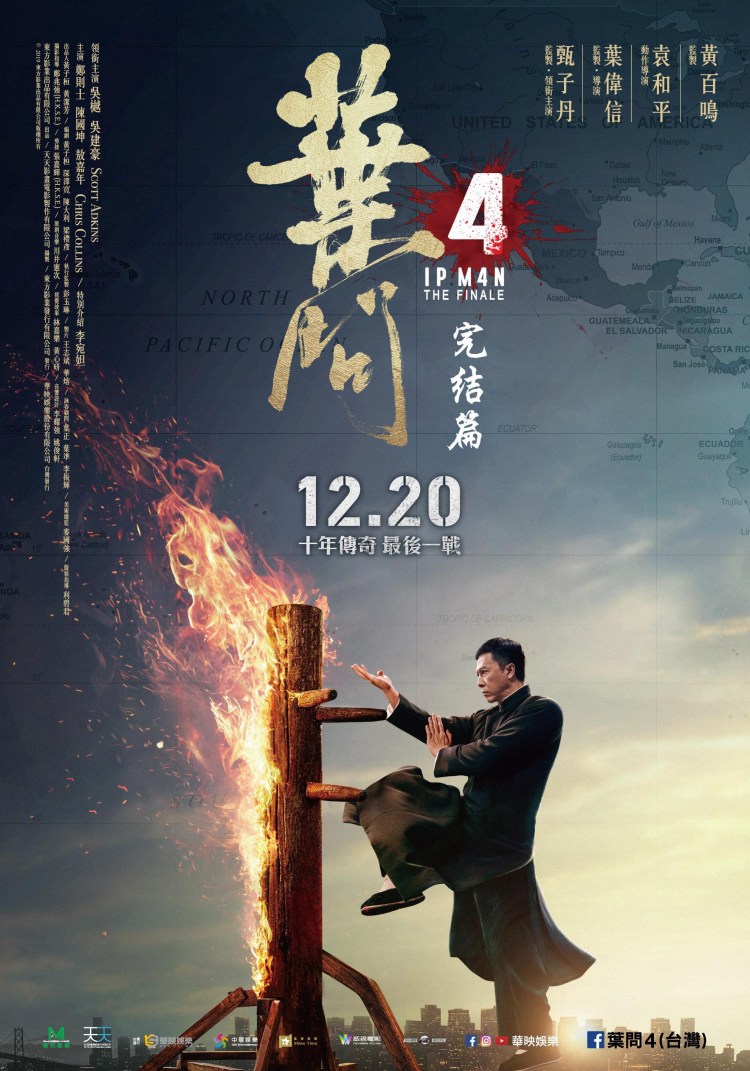
Ip Man 4 poster 1Superhero movies may be undergoing something of a complex reevaluation of late, but you can’t deny that they often come in unexpected forms. Ip Man, the man who made Bruce Lee, has himself become a mythical figure, a kind of kung fu saint defending ordinary Chinese people from oppressors and bullies. All heroes, however, must eventually meet their end. Ip Man 4: The Finale (葉問4:完結篇) brings the Donnie Yen starring series to a bombastic close with Ip seemingly facing off against the rising populism of the present day by kicking back against racist aggression in the San Francisco of 1964.

Why would Ip be in San Francisco, you ask? Because Bruce Lee (Danny Chan Kwok-kwan) invited him. Rewinding a few minutes, we discover that Ip has recently been diagnosed with throat cancer which is why he politely declines Bruce’s offer to pay for him to fly to the US to see him in a karate tournament. Personal matters, however, change his mind. His wife now passed away, Ip is struggling to connect with his increasingly rebellious son Jin (Jim Liu) who has been expelled from school for fighting. All Jin wants is to study kung fu like his dad, but Ip doesn’t approve. The headmaster advises him that unruly kids might do better abroad and so Ip decides to visit Bruce and check out schools in the US in the process, but he quickly runs into trouble on learning that the elite private institutions of the area require a recommendation from the Chinese Benevolent Association. The CBA are of the opinion that Chinese martial arts are for the Chinese people and are very angry about Bruce Lee’s determination to teach them far and wide. They were hoping Ip could talk some sense into his former pupil, but Ip is firmly on Bruce’s side. He too believes that martial arts should be a bridge between peoples, not a secret weapon preserving its mystique to intimidate.

This central divide becomes the film’s axis with head of the CBA Wan (Wu Yue) gently reminding Ip that he does not live in the city and is ill qualified to comment on local politics while advocating a gentle path of quiet appeasement. Wan clashes with his feisty daughter, Yonah (Vanda Margraf), who wants to be a cheerleader but faces constant micro aggressions from the openly racist rich kids at the same elite high school Ip wants to send Jin to. Yonah disagrees with her father’s turn the other cheek philosophy and longs to use the martial arts she didn’t particularly enjoy learning for their real purpose, later bonding with Ip after he steps in to frighten a group of posh thugs who attacked her on instruction from her rival on the cheerleading team.

The anti-racism theme slowly dovetails with the mirrored threads of failing fatherhood as Ip realises that he has made all the same mistakes as Wan. Yonah is impressed by Ip’s aura of quiet authority and spiritual power, instantly striking up a kind of paternal relationship with him, but offers cutting critique in casually echoing Jin’s words in complaining that her father has never supported her. Facing his mortality, Ip wanted to ensure his son’s independence as quickly as possible, but refused him the independence of deciding his own future. Eventually he realises that the only way to atone for his failure as a father is to pass his knowledge on while he still can, but a key part of that is that a martial artist must stand up to injustice wherever they see it, which is pretty much everywhere in San Fransisco in 1964.

Somewhat incomprehensibly, the great evil this time around is a group of massively racist karate enthusiasts who like to shout racial slurs at the practitioners of Chinese kung fu. Granted massive racists are not known for their critical thinking abilities, but no one seems to have told them that karate was not born in America which makes their animosity towards kung fu all the stranger. Yet, just as Ip and Bruce had suggested, martial arts can indeed be a bridge as Bruce discovers in besting a promising challenger in an alleyway and getting a big thumbs up in return.

Not everyone is as easily won over, however. Ip’s final battle against a crazed marine instructor (Scott Adkins) plays out as if he really has defeated racism in America by punching out a meat headed bigot with fatherly righteousness which is, however you look at it, a little on the flippant side. It also, of course, plays into the persistent “just stay in China” message of contemporary Chinese cinema, but nevertheless presents a slightly subversive front in clumsily uniting the oppressed population of the city under Ip’s revolutionary banner in opposition to entrenched racism, classism, corruption, and nepotism. Awkwardly delivered perhaps, but you can’t argue with the broadly positive plea for cultural exchange and international co-operation as the best weapons against injustice.


Currently on limited release in UK/US cinemas courtesy of Well Go USA.

International trailer (English subtitles)

Hot Gimmick: Girl Meets Boy (ホットギミック ガールミーツボーイ, Yuki Yamato, 2019)

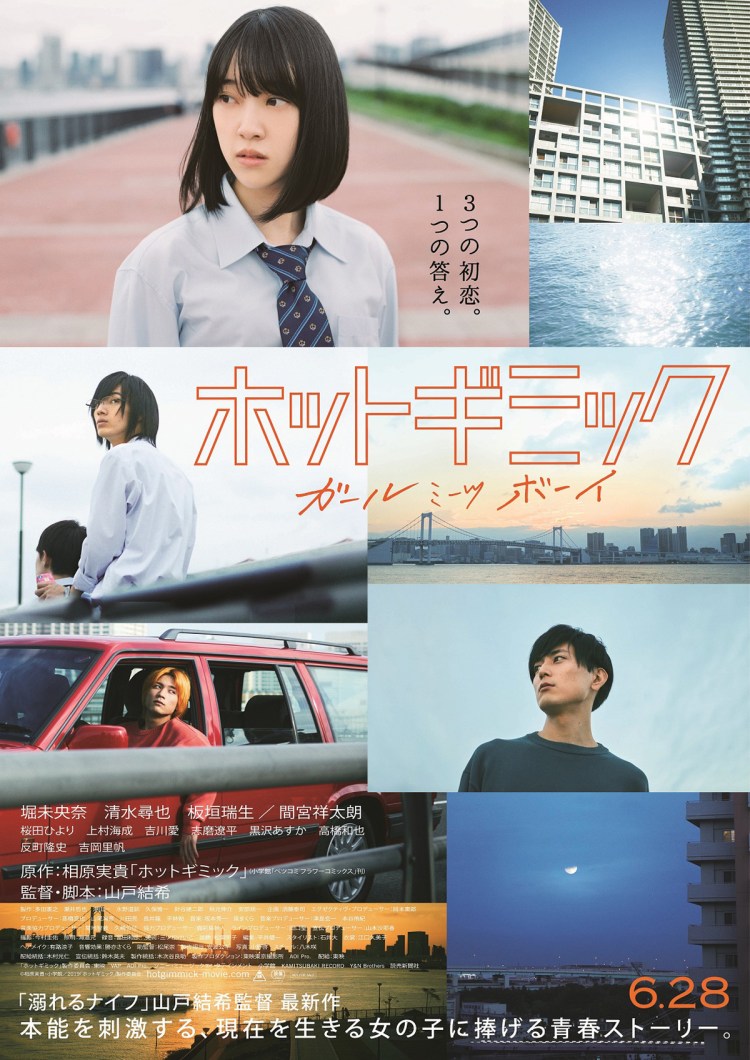
Hot Gimmick posterStrangely enough, shojo manga adaptations can in fact be among the most problematic exercises in contemporary Japanese cinema. Targeted very specifically at adolescent girls, the romantic world that they present is often consumed by its own sense of blind innocence as the shy heroine eventually finds love with a “handsome prince” who, though sometimes an inappropriate figure, is either improbably gentlemanly or a “difficult” Mr. Darcy type who more or less bullies her into submission. Yuki Yamato’s adaptation of Miki Aihara’s Hot Gimmick, given the subtitle “girl meets boy” (ホットギミック ガールミーツボーイ), however, seems to be well aware of the genre’s uncomfortable tendency to reinforce conservative social norms and normalise unhealthy relationship dynamics, even if it perhaps fails to entirely reject it in its broadly positive yet ambivalent conclusion.

Innocent and naive high schooler Hatsumi (Miona Hori) has been charged with secretly picking up a pregnancy test for her younger yet much more worldly sister Akane (Hiyori Sakurada) who ends up losing it on their way home from school. Unfortunately, it’s found by a schoolmate, Ryoki (Hiroya Shimizu), who uses it to blackmail her, forcing her to become his “slave” or he’ll send the test straight to her mother. For reasons not entirely clear besides her natural diffidence, Hatsumi goes along with it but is still carrying a torch for a childhood friend, Azusa (Mizuki Itagaki), who has since gone on to become a top idol. Unbeknownst to her, Azusa has in fact returned, apparently missing them all at the estate where he used to live. Increasingly terrorised by Ryoki, Hatsumi is more worried that Azusa will get the wrong idea and assume she is romantically involved with him. Meanwhile, her brother Shinogu (Shotaro Mamiya) is worried about both guys, overprotective in a disappointingly patriarchal way.

This is indeed a very patriarchal world. Unlike her sister, Hatsumi is romantically naive and terrified of the consequences of someone finding out about the pregnancy test even if Akane is fairly unfazed, simply brushing off questions from her mother by implying that someone is probably playing tricks on them. Hatsumi is preoccupied with the nature of “cuteness” and intensely insecure, which is perhaps why she allows herself to go on being manipulated by Ryoki even while knowing that is exactly what he’s doing. “I’m just stupid and unattractive” she’s fond of saying, fully believing that she has no right to her own agency because she is unable to see her own worth.

That essential insecurity seems to make her a magnet for all the creepy guys in a 10 mile radius. Talking to another somewhat imperfect boy, Akane tells him that guys like girls like Hatsumi who seem “vulnerable”, lamenting for a moment that that’s something she definitely is not (ostensibly, at least), but stopping short of reflecting on how dark a comment that might actually be or how the whole concept of “kawaii” is built on the idea of disempowered femininity. Azusa, who is originally posited as the “innocent” love interest, later turns out to be anything but, while Ryoki is later redeemed (to a point) in leading Hatsumi towards an awareness of an agency over her own body, while she, again problematically, turns to her protective brother rather than engage with the various ways in which all three guys have continually misused and manipulated her.

A intense subplot concerning the legacy of illicit romantic relations in the previous generation binds all of the troubled teens inside a net of moral resentment in which they embrace a kind of conservatism they reject their parents for rejecting. They are all, in a sense, attempting to break free of familial legacies, but find themselves paying for their parents’ mistakes while the parents themselves remain more or less absent, occasionally resurfacing to enforce obedience through shame. What Hatsumi comes to realise, however, is that the lesson they were teaching her was not quite wrong but misguided. Where they told her that she should guard her body because not to do so was shameful, she discovers that there is power in owning herself, that she is free to decide what she does and does not do with her body and has the right to grant or refuse access to it.

Nevertheless, her final sense of empowerment is undercut by her continued relationship with Ryoki who, while perhaps growing to accommodate a less misogynistic world view, is still a boy who tried to make her his slave and repeatedly calls her stupid even if eventually agreeing that the whole world turns in her. Yamato’s stylish visuals add to the sense of absurdity which defines the closing moments as Hatsumi at once affirms an awareness of herself as a being with worth and agency, yet also embraces her “stupidity” as she takes her first few diffident steps towards an assurance of adulthood.


Currently available to stream via Netflix in the UK (and possibly other territories)

Original trailer (no subtitles)

Send Me to the Clouds (送我上青云, Teng Congcong, 2019)

Send me to the clouds posterWomen hold up half the sky, Chairman Mao once said, but in contemporary China sexual equality is an unrealised dream of a previous era. The debut feature from Teng Congcong, Send Me to the Clouds (送我上青云, Sòng Wǒ Shàng Qīngyún) follows one “left-over” woman as she attempts to assert her independence in a world which still expects her to accept her subjugated position in a male dominated society by marrying and subsuming herself within a man’s career.

Ageing investigative journalist Shengnan (Yao Chen) whose name literally means “surpass men” has a cynical eye and fiercely independent nature but is struggling to make a living while protecting her integrity in an increasingly acquisitive culture. Getting kicked in the stomach by a “nutcase” while looking for evidence to support her theory that a local wildfire was started by a politician hoping to capitalise on successfully putting it out forces her to make a long delayed trip to the doctor who tells her that the pain in her abdomen is a result of advanced ovarian cancer and that she needs expensive surgery as quickly as possible.

As she’s been keen to ensure she acts ethically, ready money’s something Shengnan doesn’t have a lot of. Confiding in her cynical, ambitious best friend Simao (Li Jiuxiao) who has no such scruples, Shengnan finds him unwilling to help because, after all, there’s a chance Shengnan might die anyway which would mean it’s a bad investment because she won’t be able to pay him back. He does, however, offer her a job ghostwriting an autobiography for the eccentric father of the local official she was just in the business of exposing for shady double dealing. Understandably she doesn’t want to take the job and decides to try asking her parents without disclosing what the money’s for. Shengnan’s skeevy industrialist father (Shi Qiang), however, is currently losing out in the precarious Chinese economy and actually deigns to ask Shengnan for a loan before she can even broach the subject leading to a spiky father daughter argument. Shengnan has to take the job and throw her lot in with Simao even if she doesn’t feel quite right about it.

Simao cynically affirms that a problem which can be solved with money isn’t a problem, but unlike Shengnan he has no qualms about bowing before power if he feels there’s something to be gained by it. Shengnan nearly blows the gig when she takes offence to the official’s extremely condescending attitude but does after all have little choice given that her life is on the line. Meanwhile, the job is further complicated by the unexpected arrival of her mother (Wu Yufang) who decides to tag along while feeling neglected seeing as her now estranged husband is having yet another affair leaving her entirely alone in a culture which expects women to go back in their boxes until the menfolk want to take them out.

Shengnan and her mother come from very different generations, but in essence not much has changed. Shengnan’s mother married young and had her only daughter at 19 only to see her husband tire of her and the deeply entrenched idea that a woman’s career is a home and family exposed as a fallacy. Shengnan meanwhile was born during China’s reformist period and told that she had total equality only to be frequently criticised for her “manliness” in her desire to assert her independence. On visiting the doctor she displays worryingly little awareness of her health in her confusion regarding the cause of her cancer, stating that her love life ended years ago, but even if she’s quick to roll her eyes at Simao’s insensitive story about a woman who had the surgery and found it ruined her sex drive eventually decides she’d like to have one last hurrah with someone she really likes only to have her proactive stance on female desire rejected as unfeminine.

Yet this hyper capitalistic, intensely sexist environment is also harming men as Shengnan discovers in her unsatisfying encounters both with Simao and with a philosophical photographer she meets on a boat. Shengnan develops an attraction for Guangming (Yuan Hong) because of his softness and seeming desire to see further than others but eventually he disappoints her, trapped as he is by a hierarchal system to which he can offer only token resistance while hating himself for his cowardly complicity. Simao meanwhile has jumped headlong into the consumerist dream, obsessed with getting rich and not particularly caring what he has to do to make that happen.

The most meaningful connection Shengnan makes turns out to be with the subject of her biography, a randy 80-year-old poet (Yang Xinming) who quickly sets about romancing her mother with a series of cryptic text messages. The old man knows his son is a “complete moron” and even changed his name to something bland and commonplace so that the police might arrest someone else by mistake if he got caught while committing a crime, but has a sort of exasperated love for him and for the world that transcends his failing body and worldweary philosophy. Thanks to his refreshing earthiness, Shengnan starts to see a way forward, once again claiming her independence and resolving to live her life in the way she chooses for as long as it lasts while the men around her largely crumble under the weight of social expectations and a rampantly capitalist society.


Send Me to the Clouds  was screened as part of the 2019 London East Asia Film Festival.

International trailer (English subtitles)

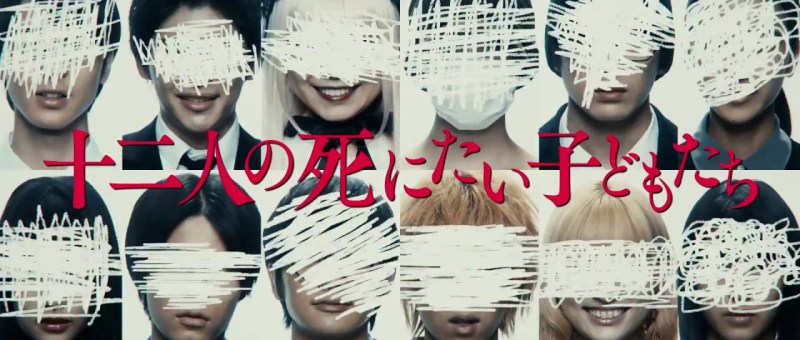
12 Suicidal Teens (十二人の死にたい子どもたち, Yukihiko Tsutsumi, 2019)

12 Suicidal Teens posterJapan has a relatively high suicide rate, but even so the number of people taking their own lives had been steadily decreasing, hitting a 22-year low in 2016. Conversely, youth suicide rates peaked, hitting a 30-year high. Inspired by Tow Ubukata’s novel, 12 Suicidal Teens (十二人の死にたい子どもたち, Juni-nin no Shinitai Kodomo-tachi), as the title implies, sees a dozen high school students forming a kind of club in which they will take the decision to live or die as a group, ironically undercutting the sense of powerlessness which has led them to the conclusion that they have no other choice other than death.

Ringleader Satoshi (Mahiro Takasugi) has recruited 11 likeminded souls and furnished them with complicated instructions involving a series of secret codes granting them access to a basement meeting room in an abandoned hospital. The 12 dutifully make their way into the building, but a surprise is waiting for them. When the first guest arrives, a young man is already lying in one of the 12 beds arranged around the edges of the room, apparently having jumped the gun, dead or dying after taking a large amount of sleeping pills. Everyone concludes he must be the event’s organiser, only for Satoshi to suddenly arrive and attempt to “open” the meeting at which they’re supposed to discuss the issues thoroughly so they can be sure they’re making the right decision. Because of the unexpected 13th guest, a decision is taken to postpone the discussion until after they figure out what’s going on.

Part of the reason for that is less curiosity than a kind of resentment. The teens are worried that their own deaths maybe misunderstood or misused if they’re discovered with this randomer in their midst. What if he’s the victim of a serial killer and everyone thinks they are too, never getting the message that each of them was desperate to send with their deaths? One young man who is dying to get back at a neglectful mother by denying her a life insurance pay out is worried it might backfire and she’d end up quids in if the police decide he’s a murder victim and not a suicide. He decides to live (for the moment at least) almost all out of spite.

Spite is, it seems, a powerful motivator in one sense or another. What most of our teens want isn’t really death but freedom, an end to pain or suffering. Suicide rates spike in September because bullied students can’t bear the thought of returning to school. Bullying is indeed the reason one of our teens wants to die, only the instigator was a teacher who led his class to victimise an innocent student solely for the crime of being an “annoying” person. Another teen, meanwhile, was bullied until he finally snapped, pushing his aggressor down a flight of stairs. Unable to live with the guilt, he too feels he can’t go on.

For the girls, the lack of control is all the more obvious. One young woman walks around with a surgical mask covering her face, not because she’s hideously burned but because she’s fantastically beautiful. One of Japan’s many celebrity idols, she’s on the cover of a thousand teen magazines but doesn’t recognise herself in the images that she sees and resents the way in which her existence is micromanaged by others. She wants to die as a means of seizing her own agency, to prove that her life and her individuality were valid and mattered as distinct from the fake persona created by her managers. Her fame endangers the mission of the group’s most emo member who declares that the mass suicide should be bomb detonated under an indifferent society, that she’s dying to reject her existence and rebelling against having been born.

Like some of the others, she’s a survivor of abusive parenting and resents having been given a “meaningless” life. A few of the other teens feel the same but for different reasons, they are suffering longterm or terminal health conditions and resent both their fates and being forced to live on without hope. They choose death now to prove they have a choice and are leaving on their own terms, not those of the universe.

Eventually the conclusion that they come to is that to live is also a choice. Working together to solve the mystery of the unexpected guest, they begin to understand a little of each other’s lives and their own, bonding in a shared sense of futility that slowly drifts into a rejection of the nihilism that had convinced them that their only choice was death. A strangely uplifting experience, 12 Suicidal Teens is a dark celebration of life that makes a virtue of endurance and finally finds meaning in commonality and the simple joy of empathic connection.


Original trailer (no subtitles)

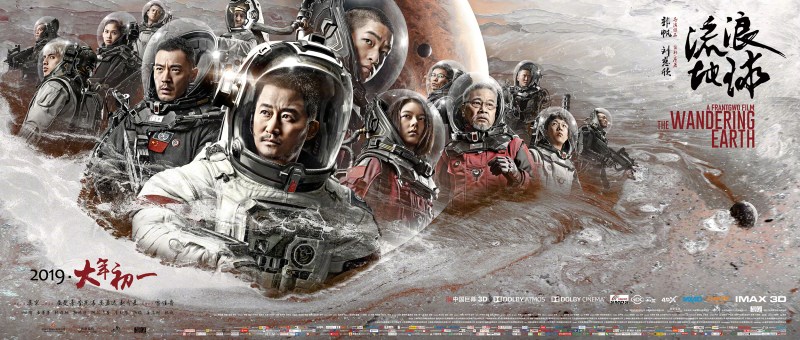
The Wandering Earth (流浪地球, Frant Gwo, 2019)

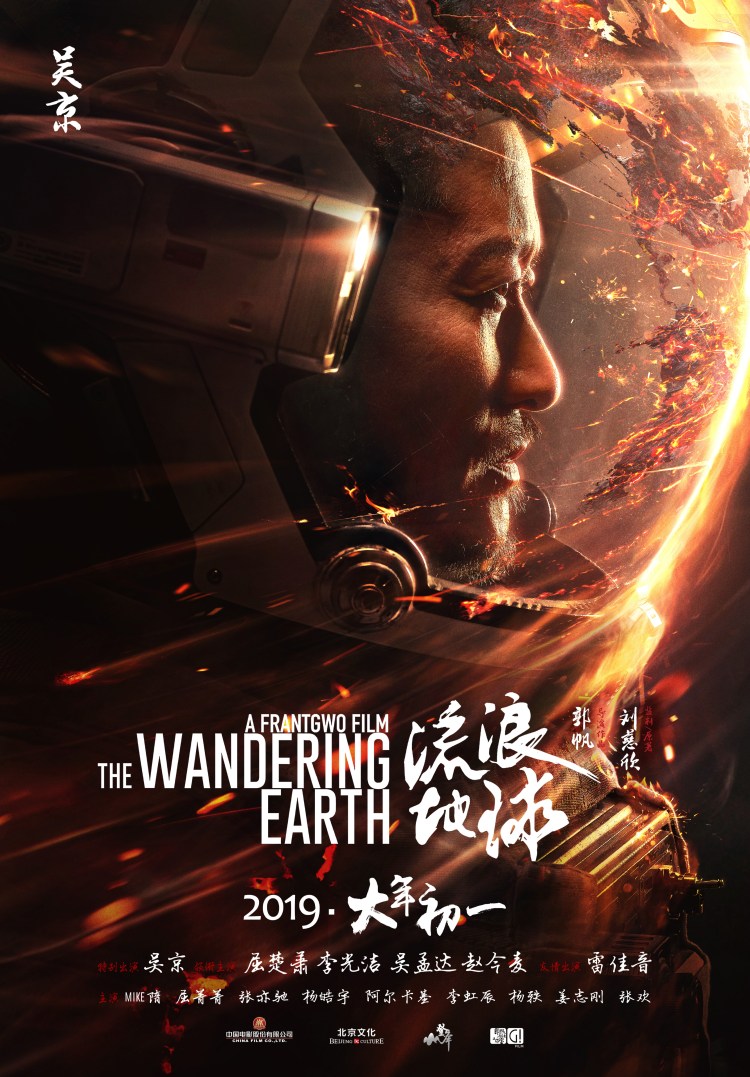
Wandering Earth poster 5Chinese cinema has not been as averse to science fiction as some would have it, but it’s true enough that The Wandering Earth (流浪地球, Liúlàng Dìqiú) marks a bold new chapter in its ambitious attempt to take Hollywood on at its own game. Adapting the novel by China’s premier sci-fi author Liu Cixin, Frant Gwo’s third feature is an interesting take on the New Year movie in which new beginnings are sought and families desperately try to reunite to see them in, only this time they do so against the backdrop of impending apocalypse as the universe threatens to swallow us whole.

Far in the future, the vast expansion of the sun will soon consume the Earth. The Wandering Earth project aims to save humanity by attaching jet thrusters to the Earth’s surface to push it out of harm’s way yet this safety measure has also had grave effects on the planet’s climate rendering the surface uninhabitable. 17 years previously, astronaut Liu Peiqiang (Wu Jing) left his 4-year-old son behind in the care of his father (Ng Man-tat) to take up a position on the space station intended to safeguard the Earth’s future. Now 21, Liu Qi (Qu Chuxiao) has grown up into a resentful, rebellious young man intent on seeing the surface for himself if only not to be home when Peiqiang finally returns to Earth. A natural disaster, however, leaves him stranded with his adopted teenage sister, Duoduo (Zhao Jinmai), just as the Earth is inconveniently drawn into a fatal collision course with Jupiter.

As much about fatherhood as it is about survival of a species, The Wandering Earth centres itself on the angry figure of Liu Qi who has been forced to live his entire adolescence underground and has come to deeply resent the memory of the father who allowed his sickly mother to die and then abandoned him. Peiqiang, meanwhile, has spent 17 years on the space station solely in order to save his son’s future, dreaming of the day they will finally be reunited. He cares little for his own life and has already spiritually handed the baton on to the next generation whose descendants, he hopes, may finally see a kinder sun rise over a new Earth.

This kind of selflessness is also reflected in the film’s refreshingly globalist outlook in which the world, no longer divided, has learned to act as one in order to combat the extreme threat from its own sun. The resistance may be China led, but depends on common endeavour and personal sacrifice. When a last ditch effort is required, the government cannot order its forces away from their families but can offer them the individual choice to keep fighting for survival, bringing teams from all corners of the Earth together as they descend on Indonesia where there just might be a one in a million chance to strike back at Jupiter and escape its gravitational pull.

Meanwhile, Peiqiang is up still up on the space station all alone and powerless while the annoyingly efficient operating system MOSS attempts to frustrate his efforts to save the Earth in service of its own mission to preserve humanity’s legacy. MOSS has made a series of calculations and given up, but giving up is not a very human trait and Peiqiang won’t do it. He makes impassioned speeches to the French-accented global authorities and ponders the best way to ensure his son’s survival even at the cost of his own but finally can only resist by literally attacking the system in overruling MOSS and acting on his own initiative.

A New Year tale through and through, The Wandering Earth is a celebration of family, togetherness, and home but is careful to dial down the patriotism for an insistence on the importance of mutual cooperation between peoples in order to combat existential threat with the spectre of climate change always on the horizon. The point, however, is that it is important to keep hope alive, if not for yourself then at least for others rather than give in to nihilistic despair. The Wandering Earth, grand and ambitious in scale, marks a new dawn of its own in terms of Chinese blockbuster sci-fi and does so with refreshing positivity as it places its hopes in human solidarity and individual sacrifice over jingoism and self-interest.


Currently available to stream on Netflix in the UK and possibly other territories.

Netflix trailer (English subtitles)

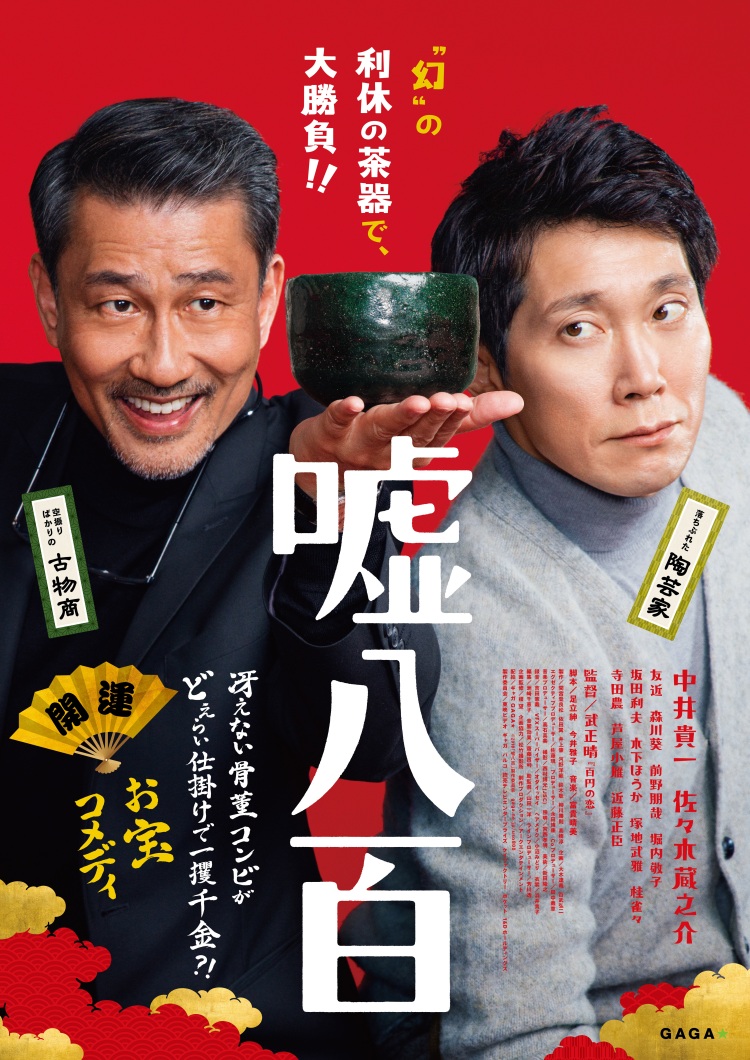
We Make Antiques (嘘八百, Masaharu Take, 2018)

We make antiques posterWho will scam the scammers? The antiques trade is a high stakes business, and at least as far as Masaharu Take’s We Make Antiques (嘘八百, Uso Happyaku) goes, one which makes use of its aura of respectability to cheat unsuspecting amateurs out of their hard earned cash for the false promise of exclusivity. Then again, does it really matter when something was made so long as it was made well and with artistic integrity? Perhaps collectors are just as happy with a nice piece as an authentic one, if only no one ever tells them the difference.

Jaded antiques dealer Norio Koike (Kiichi Nakai) prides himself on having a good eye, forced to learn to spot the inauthentic in record time after having his reputation trashed when he accidentally sold a “fake”, making the rookie mistake of taking provenance at face value without assessing all the facts. These days he’s not as precious as he used to be, mostly making his living out of buying up genuine antiques from clueless owners, convincing them their pieces are fakes and therefore worthless before selling them on at tremendous profit. It’s a trick he pulls on a wealthy man with a warehouse full of teacups that belonged to his father he’d rather get rid of so he can open a cafe, spotting an obvious fake and buying it cheap to take it straight back to where he knows it came from. Koike gets his comeuppance however when the man calls him back and says he’s found something interesting – an Edo-era letter in a box. Koike lies and says the letter is a random missive about a peasant revolt, when really it’s from grandmaster Rikyu and mentions coming with a tea bowl which Koike manages to find after searching the warehouse again.

After buying the entire stock to mask his desire for the tea bowl and letter, Koike realises he’s been had. The man he was talking to isn’t the owner of the warehouse but a caretaker, and the warehouse only exists to store fakes produced by a team of master forgers operating out of a nearby ramen joint. Noda (Kuranosuke Sasaki), who managed to scam Koike, was like him professionally embarrassed and by the same two corrupt elitists, Tadayasu Hiwatashi (Kogan Ashiya) and his celebrity authenticator Seiichiro Tanahashi (Masaomi Kondo), who picked him up as an aspiring ceramicist, giving him a fancy award but secretly using him to produce “replicas” to sell in their store. 20 years later, Noda is a cynical and jaded figure, unable to connect with his “nerdy” son (Tomoya Maeno) who spends his time building fantastically realistic military dioramas, and increasingly distanced from his patient wife who deeply resents the loss of his artistic integrity.

After a brief locking of horns, the two men decide to team up to scam the scammers, teach them a lesson, get a little ironic revenge, and become filthy rich in the process. Creating expert fakes, however, is a taxing business which requires an extreme depth of knowledge and in this case of a well known and hugely respected historical figure. Sen no Rikyu, the father of the tea ceremony, was, ironically enough, ordered to commit seppuku after speaking truth to power and, because he was an honourable man, he did it.

The reason most fakes fail is because they’re soulless replicas, often expertly crafted but essentially superficial. Creating a convincing fake allows Noda to regain the creative mojo that he’s been suppressing all these years in resentment towards Hiwatashi and Tanahashi, determined to craft something that reflects the spirit of Rikyu by virtue of the fact that it contains a piece of his own soul. Of course, the guys fully intend to exploit their own “artistic integrity”, Koike turning on the salesman’s patter to sell the dream of Rikyu to two soulless elitists too wrapped up in their sense of self-importance and blinded by greed to see things properly. Yet, there is a perverse love not only for the grift but for the craft and for Japan’s disappearing traditional culture, if only in the ironic rebuke of those who misuse it for their own gain. Bonded in revenge not only against the the venal Hiwatashi and Tanahashi but middle-age and and life itself, the guys generate an unlikely friendship, rediscovering their authentic selves through forgery as they scam the scammers and retake their sense of integrity in the form of a briefcase stuffed with cash.


International trailer (English subtitles)

Saint Young Men (聖☆おにいさん, Yuichi Fukuda, 2018)

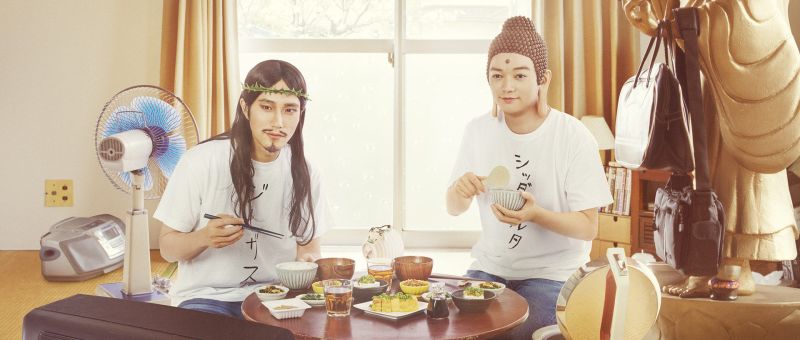
Saint young men posterWhat if Buddha and Jesus were flatmates in modern day Tokyo? Hikaru Nakamura’s much loved manga Saint Young Men (聖☆おにいさん, Saint Oniisan) attempted to find out, casting the two holy beings as conventional manga slackers on “vacation” in the mortal realm, supposedly researching modern Japanese society. A firm favourite with fans, the franchise has already been adapted into a popular anime and now receives the live action treatment from none other than Gintama’s Yuichi Fukuda.

Split into a series of short vignettes mostly featuring only Jesus (Kenichi Matsuyama) and Buddha (Shota Sometani) in their apartment, Saint Young Men first aired as a 10-part web series before being compiled into a 70-minute movie. The central conceit is that Jesus is a cheerful if slightly feckless hippy, while Buddha is the calm and the responsible one making sure he’s well looked after. Perhaps surprisingly, Saint Young Men presents its vision of contemporary Japan from the point of view of the two guys as they explore everyday life, occasionally including explanatory narration from a distant authorial voice which, presumably, contains information widely known to the target audience, such as an explanations of “White Day” – Japan’s secondary Valentines in which men given chocolates are expected to return the favour with gifts three times the cost, and spring festival “Setsubun” in which beans are thrown at people wearing ogre masks to frighten off bad luck.

For the two guys these are fascinating little anthropological details they can get quite excited about despite their thousands of years of existence. On a trip to the convenience store, Jesus is thrilled to think he’s finally “made it” after 2000 years because some high school girls said he looked like Johnny Depp. Buddha goes to see if he looks like someone too, but the girls immediately recognise him as looking “like Buddha” which is both a disappointment and somehow validating. Meanwhile, he laments that the majority of his artistic renderings have only captured him in his “fat period” rather than the handsome figure he currently cuts. 

Bickering like an old married couple, the guys fight about the usual things – money, and the irresponsible use of it. Jesus has a bad habit of buying random stuff he doesn’t need off the internet, causing Buddha to get so annoyed he starts physically glowing and only calms down when Jesus gives him a present, a manga artist’s starter kit. Sadly, Buddha is proved right when Jesus gets bored with his random electric pottery wheel after only a few minutes, but is witness to an unexpected miracle when the clay is magically transformed into bread, turning the wheel into a “bread oven” with which Jesus seems very pleased only to tire of it just as quickly.

Trying to keep their “real” identities secret, the guys are keen to keep their abilities behind closed doors – something Buddha forgets when he hatches on the great idea of levitating to save floor space. Jesus comes home and quickly closes the curtains in case someone thinks they’re some kind of weird cult. The guys consider moving somewhere with a little more room, but discover that even for holy beings it’s almost impossible to find a decent apartment in modern day Tokyo that doesn’t cost the Earth. The primary reason Jesus wanted to move, however, is not so much that the apartment’s a little poky for two full-grown guys, but that the other place was gated which means he won’t be getting bothered by cold calling newspaper sales representatives.

Jesus may be too nice to keep saying no to pushy salesmen, but Buddha has a few unexpected trust issues. Faint from hunger, the guys think about ordering a take away, but Buddha is a strict vegetarian and worries about the chain of communication involved in food preparation. He can only trust that the restaurant follows the instructions he gives them honestly and that the delivery guy won’t do anything weird with the food on his way over. In the end, you just have to have faith, but Buddha is struggling while Jesus is content to let it all hang out. Something similar occurs when earnest Buddha unwisely meditates for hours in the beautiful snow in only his ironic T-shirt and catches a cold with only Jesus to nurse him. Jesus wants to take him to the hospital, but they don’t have insurance and don’t want to risk extortionate medical bills. Jesus’ healing powers apparently don’t work on other holy beings, and so he finds himself healing a bunch of people at the hospital to earn a free visit from a doctor with whom Buddha can only communicate through possession and telepathy.

Obviously very low budget and mostly starring just the two guys with additional appearances from their middle-aged landlady and the confused doctor, Saint Young Men is very much a Fukuda production bearing his familiar hallmark of waiting slightly too long for a joke land, which it often does not. Though seeing all 10 episodes in one go necessarily flags up their essential sameness, they do provide an amusing exploration of slacker life in contemporary Japan with occasional forays into warmhearted cross-cultural exchanges between the serious Buddha and scatterbrained Jesus.


Original trailer (no subtitles)

My Long Awaited Love Story (わたしに運命の恋なんてありえないって思ってた, Takafumi Hatano, 2016)

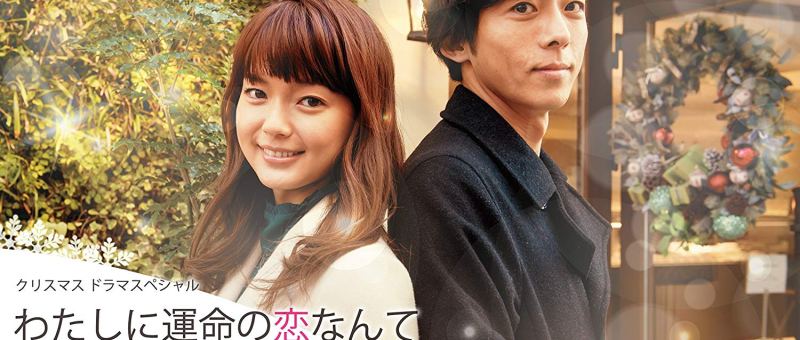
My Long Awaited Love Story posterChristmas is synonymous with romance in Japan, but should you really rush into love just to get a pretty picture under the bright lights of a shopping mall holiday display? Perhaps not, but rom-coms are not generally the best place to look for realistic dating advice. “Realistic dating advice” is what the lovelorn heroine of My Long Awaited Love Story (わたしに運命の恋なんてありえないって思ってた, Watashi ni Unmei no Koi nante Arienaitte Omotteta) ends up giving when she runs into a socially awkward CEO with a crush on an employee, but in true rom-com fashion finds herself falling for him instead.

27-year-old Riko (Mikako Tabe) has given up on love, at least in the “real” world. Ironically enough, her job is writing romantic storylines for dating sims at which she is apparently very successful which is why she’s been hired as a consultant by a tech firm looking to branch out in the hope of capturing the female market. The problem is that the more she observes “real” guys in the world all around her, the more they disappoint. The handsome “prince” at a coffee shop says all the right things but then claims to have forgotten his wallet. The clingy cutie has another girl on the line, and the domineering Type-A hunk crumbles in front of a strong woman. Riko knows that Hollywood-style meet cutes don’t happen in everyday life, but finds herself repeatedly running into them only for something to burst her bubble unexpectedly.

At the meeting for her new game, the assembled team being almost entirely female which, when you think about it, is a little bit depressing because it means the boss has used it to get all the women off the floor, Riko is taken by the handsome, sensitive Midoritani (Jun Shison) but gets a rude awakening when another guy turns up and immediately makes it clear he hates all her ideas. According to him, women who play dating sims must be ugly or stupid, the sort of people unwilling to see reality, retreating into a frothy fantasy land to escape their unhappy lives. Thoroughly fed up, Riko sets him right, only to realise this man, Kurokawa (Issey Takahashi), is actually the president of the company.

They haven’t exactly hit it off, and Riko is further enraged when she overhears him giving an interview to a women’s magazine in which he claims to be “supporting women”, parroting all the words she threw at him to make himself sound progressive. Gently teasing him about his obvious crush on Momose (Aya Ohmasa), a pretty employee, however brings them a little closer and earns her an apology. Kurokawa takes some of her advice, tries out a tactic from a game she wrote, finds it kind of works, and eventually asks her to teach him the ways of love. Despite feeling under confident in her own love life as an unattached 27-year-old, she agrees.

Gradually we discover that Riko’s taste for romantic fantasy is a clear eyed choice designed to keep her “safe” from heartbreak because it’s not real and the idealised 2D guys from her games are never going to let her down. Annoyingly, Kurokawa was right up to a point, but you can’t deny that the world Riko lives in is in itself disappointing, a fiercely sexist society in which the men are timid children and the women socially conditioned not to make the first move. Kurokawa’s courtship of Momose, it has to be said, borders on harassment considering he’s the boss and she’s much younger than he is. Early on, Riko outs herself as a youthful devote of shojo manga, given unrealistic ideas about romance from idealised stories of innocent love filled with charming, handsome princes and infinite happy endings. Riko wanted to fall in love like that, which is to say, unrealistically without fully engaging with all the difficult bits of being in a relationship.

Needless to say, she begins to fall for Kurokawa who, for all his awkwardness, has a good a heart and the willingness to learn. Thanks to him she gets the courage to humiliate a bunch of high school bullies at a reunion, but still struggles with the idea of opening herself up to “real” love and the possibility of heartbreak. When Kurokawa has a crisis and calls her, she knows where he’ll be but sends Momose instead, either out of a sense of awkwardness or perhaps just afraid to face him in such an emotional state. A professional humbling and the miracle of Christmas conspire to convince them both that you’ll never be happy hiding your feelings and if you want “real” love you’ll have to accept the risk of getting hurt. That’s reality for you, but it can probably wait until after the festive season.


Currently available to stream via Viki.

Teaser trailer (no subtitles)