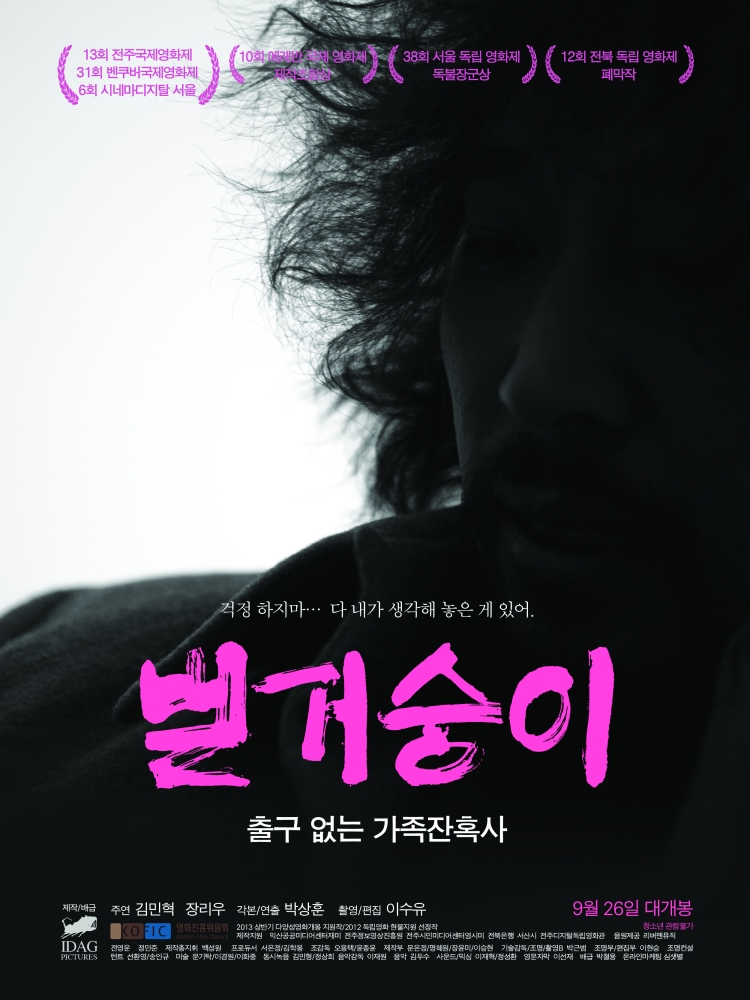
A Mere Life (벌거숭이, Park Sang-hun, 2012)

%e1%84%87%e1%85%a5%e1%86%af%e1%84%80%e1%85%a5%e1%84%89%e1%85%ae%e1%86%bc%e1%84%8b%e1%85%b5_%e1%84%91%e1%85%a9%e1%84%89%e1%85%b3%e1%84%90%e1%85%a5Anyone who follows Korean cinema will have noticed that Korean films often have a much bleaker point of view than those of other countries. Nevertheless it would be difficult to find one quite as unrelentingly dismal as A Mere Life (벌거숭이, Beolgeosungi). Encompassing all of human misery from the false support of family, marital discord, money worries, and the heartlessness of con men, A Mere Life throws just about everything it can at its everyman protagonist who finds himself trapped in a well of despair that not even death can save him from.

Park Il-rae (Kin Min-hyuk) and his wife Yurim (Jang Liu) own a small supermarket which isn’t doing so well. After approaching both of their parents for help and getting a flat no from both directions, the couple decide to throw all of their savings into buying a delivery van to increase their business potential. Il-rae excitedly travels into the city to sign the paperwork but gradually realises something is wrong when the salesman suddenly disappears. Having lost all of the family’s money, Il-rae travels home dejected and hits on a drastic solution – a family suicide. Poisoning his wife and son, Il-rae means to die too but survives even more burdened by guilt and regret than before. More failed suicide attempts follow as Il-rae attempts to come to terms with his actions, somehow surviving yet all but dead inside.

There really is no hope for Park Il-rae. At the very beginning of the film, the family visit a park in which his wife urges their son to make a wish by adding a stone to the top of a cairn, only to see the whole thing suddenly collapse in front of them like a grim harbinger of the way their lives are about to implode. Il-rae tries to repair the pile, but all to no avail. This quite awkward family trip in which Il-rae moodily strides on ahead will actually be the happiest they ever are, away from the destructive domestic environment where money troubles and male pride cast a shadow over an otherwise ordinary family life.

Both Il-rae and his wife seem to have strained relationships with their parents. Il-rae tries his own father first in the quest for help only for him to angrily tell his son to man up. When his wife visits her parents (alone with the couple’s little boy) it’s the first time she’s seen them in a decade and they are fairly nonplussed that it’s money she’s come for. After Yurim delicately states her predicament, her father tells her that he can’t help because he now has lots of hobbies which all require money. Offering perhaps the worst piece of fatherly advice ever uttered, he suggests she take up something fun herself and not worry about money so much.

The worse things get the more the family fragments. Il-rae drinks while the couple’s son seems to be addicted to video games. Faced with an obnoxious man who thoughtlessly parks his expensive car directly in the doorway of their store yet refuses to move because “he’ll only be a few minutes”, Il-rae is only saved from doing something stupid by his wife physically pushing him out of the way, but her physical dominance only worsens his sense of impotence. After making his drastic and irreversible decision, Il-rae is left alone and reeling from the worst kind of failure and regret. From this point on he’s marooned in his very own limboland, hovering on the brink of life and death.

Beginning with POV shots of a car dutifully following the only path laid out for it, A Mere Life states its bleak indie intentions right away as the gloomy lyrics of a folk tune run in the background constantly making reference to a despair which not even death could comfort. Recalling the great misery epics of the ‘70s, Park Sang-hun films with an anxious, unblinking camera save for the ominous shaky cam shots of a man facing the sea which begin and end the film. Il-rae may have made a decision as regards a future, but it remains unclear if there is any hope of salvation waiting for him. A Mere Life is never is never an easy watch thanks to its unshaking bleakness, but its strength of purpose and uneasy mix of morality play and character drama make for an unusual, interesting independent feature debut.


Reviewed at the 2016 London Korean Film Festival.

Original trailer (English subtitles)

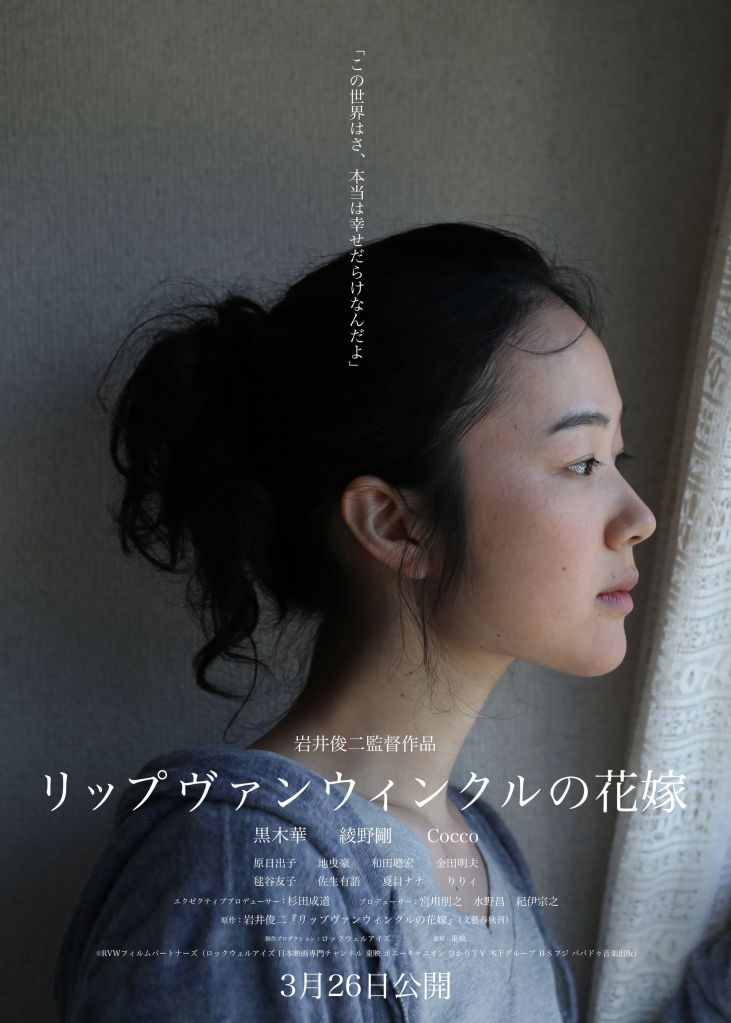
A Bride for Rip Van Winkle (リップヴァンウィンクルの花嫁, Shunji Iwai, 2016)

the_bride_of_rip_van_winkle“Being naked in front of people is embarrassing” says the drunken mother of a recently deceased major character in a bizarre yet pivotal scene towards the end of Shunji Iwai’s aptly titled A Bride for Rip Van Winkle (リップヴァンウィンクルの花嫁, Rip Van Winkle no Hanayome) in which the director himself wakes up from an extended cinematic slumber to discover that much is changed. This sequence, in a sense, makes plain one of the film’s essential themes – truth, and the appearance of truth, as mediated by human connection. The film’s timid heroine, Nanami (Haru Kuroki), bares all of herself online, recording each ugly thought and despairing notion before an audience of anonymous strangers, yet can barely look even those she knows well in the eye. Though Namami’s fear and insecurity are painfully obvious to all, not least to herself, she’s not alone in her fear of emotional nakedness as she discovers throughout her strange odyssey in which nothing is quite as it seems.

We first meet Nanami on an internet blind date with the man who will later become her husband. Looking lost and alone, she passively waits for her online suitor to find her in the busy city streets. Tetsuya (Go Jibiki) does indeed turn up and assume control of the situation, to which Nanami submits just as she has to everything else. Bonding over little more than their shared vocation of teaching the pair drift into a relationship and then later into a marriage, as is the natural order of things.

Though she seems happy enough, Nanami vents her frustrations in her caustic online blog. Isn’t this all just too easy? She asks herself. It’s almost like online shopping, she simply added a boyfriend to her basket and now she’s about to check out. A failure to win over Tetsuya’s mother adds to her sense of unease as does the fact she has no close friends or relatives (aside from her soon to be divorced parents) to invite to the wedding. Her decision to take the advice of an online friend and employ the shady fixer Amuro (Go Ayano) to hire a selection of professional party goers to bulk out her side of the hall will prove to be a disastrous one (though perhaps more in the short term), turning her entire life inside out.

Nanami’s essential personality trait is her passivity. Like Rip Van Winkle, she is largely asleep while things happen all around her. Though she dreamed of being a teacher, Nanami has only been able to find temporary supply roles with an agency but even this seems unlikely to last thanks to her softly spoken nature which makes classroom teaching a poor fit for her shy, attention avoidant personality. Discovered at her part time combini job by an old university friend, Nanami is embarrassed and has even been wearing a (useless but endearing) disguise in case any of her students come by despite the fact she chose a store far away from the school. Her friend now works at a hostess bar which Nanami finds a little bit shocking. That kind of unconventional way of living is not something she would contemplate, and so when offered the extremely dull but comfortable life alongside the dull but comforting Tetsuya, Nanami settles.

After Amuro spectacularly derails her non-happiness, Nanami is cast adrift which eventually leads her straight back into Amuro’s web of morally dubious activities. Taking a job as a maid at the cheap hotel she ends up in after leaving Tetsuya, Nanami also works part time as another of Amuro’s professional guests which is where she meets motivator no. 2 – Mashiro (Cocco), “actress” and all round live wire. Bonding over sad karaoke, Nanami and Mashiro later wind up working together as live in maids in a creepy, isolated mansion filled with poisonous animals. Enforced proximity leads to genuine friendship and then to more than that, but, ironically enough, Mashiro has not been entirely honest about her intentions and Nanami is soon adrift once again.

Undergoing a “fake” wedding that’s sort of real (in contrast with the “real” wedding which was sort of “fake”), at least in sentiment, Nanami looks much happier than in the extremely bizarre ceremony which bound her to Tetsuya. Nanami and Mashiro’s union was “engineered” yet mutually beneficial and ultimately genuine despite its artificial genesis. Making a last, heartbreaking speech, Mashiro attempts to explain herself and her life philosophy in a final act of nakedness. She prefers to pay for connection because, she says, the world is too full of kindness. There is so much happiness out there that it’s completely overwhelming. Sometimes there’s more truth in the lie than there is in the reality.

The resurfaced Iwai is both more cynical and more romantic than he has ever been before. He has serious things to say about constructed identities and disconnectedness, that the increasingly open nature of the anonymous online world only makes the real one seem less reliable and harder to navigate. We’ve all been wearing masks but we turned them round when we went online, and now perhaps we’re forgetting that we made them in the first place. Nanami may be adrift again at the film’s conclusion but she finds herself in a world of infinite possibilities. Emerging with more certainty and firmer sense of self, Nanami has retaken control and even if she doesn’t know where she’s going, the choice is entirely her own. Another beautifully nuanced, endlessly affecting character study from Iwai, A Bride for Rip van Winkle is a gloriously rich experience, filled with both hope and despair, but told with all the ethereal warmth and strangeness of the best of dreams.


This review refers to the 180 minute director’s cut, rather than the shorter international or four hour TV version.

Original trailer (English subtitles)
Dong-ju: The Portrait of a Poet (동주, Lee Joon-ik, 2016)

2016-03-12-1457751627-4889573

Lee Joon-ik’s previous film, The Throne, was a big budget period affair examining the well known story of tragic prince Sado who was, in a sense, murdered by his own nation as personified by his father, the king, for failing to bow to a tyrannous regime. Lee’s followup, Dong-ju: The Portrait of a Poet, charts a similarly melancholy path in its exploration of the life and times of its titular wordsmith, unhappily born into an age of anti-intellectual fervour with only the desire to write verses. Yet another of the recent films to address the Korea’s colonial history, Dong-ju, like its hero, may be the most contemplative as it raises a number of questions not only about the nature of resistance but also of its intrinsic values.

Growing up in a Korean religious settlement in Manchuria, Dong-ju (Kang Ha-neul) and his cousin Mong-gyu (Park Jung-min) have been largely cushioned from the effects of the Japanese occupation, but are aware it’s only a matter of time before their village loses its special status and is swallowed by the powers that be. Both boys have literary aspirations with the more bombastic Mong-gyu opting for prose and the dreamier Dong-ju committed to the far less well received world of poetry. Firm friends as they are, literary rivalry aside, each is bound for a different course as Mong-gyu becomes increasingly involved with the independence movement whereas Dong-ju’s rebellion remains largely on the page.

After travelling to Japan as students, both Dong-ju and Mong-gyu are arrested for insurrection and incarcerated in the notorious Fukuoka Prison where they are used as human subjects for experimentation. Regularly dosed with mysterious injections which blister the skin and weaken the constitution, neither lives long enough to see the return of their nation’s sovereignty just a few weeks later with Japan’s defeat at the end of the war.

Beginning with Dong-ju’s prison interrogation, the film is largely told through flashback as it follows the course of Dong-ju’s life from his adolescence in the village to domestic university and finally to Japan where he faces constant threat as an alien Korean in the land of the oppressor. Both he and Mong-gyu are committed to the idea that conscientious literature can change the world, even founding a student magazine dedicated to progressive texts. Mong-gyu, however, does not place the same faith in the art of poetry as does his friend, and eventually decides to head to China to join the left-wing arm of the Resistance movement in exile, only to become disillusioned with their extreme tactics.

Despite his loss of faith in Communist ideology, Mong-gyu remains committed to the idea of direct action and the eventual ushering in of the egalitarian revolution preceded by the expulsion of the Japanese. Far from opposing the draft of Korean students into the Japanese army, Mong-gyu plans to harness it to fill the army with capable, trained fifth columnists who will use the skills they learn in a foreign army to retake their homeland. After a brush with the ruling regime, Dong-ju tries to join the more active side of the resistance alongside his friend but is rebuffed. Mong-gyu knows his friend is not a born soldier and is much more valuable as a poet than on the front lines.

Dong-ju’s poetry is often not overtly political, anti-Japanese, or even anti-colonialist, but it is written in Korean – a daring act of political resistance in itself. During this era, Japanese was the dominant language, used in all official institutions and most schools (Dong-ju and Mong-gyu’s excluded because of its special religious status). One of the problems Dong-ju faces during his interrogation is that he delayed adopting a Japanese name much longer than was wise and subsequently continued to disseminate literature in Korean. When language is suppressed and nationhood denied to the extent that even names have been erased, what other means is there to reclaim an identity other than literature, and of literature what more powerful than poetry?

Dong-ju’s resistance to the brutalisation of of an oppressive regime is entirely internal. He writes in his native language about the things which matter, of his loneliness and youthful anxiety much of which is born of the uncertainty of his times. During his interrogation he is forced to sign a confession of his “crimes”, which he does, but with equal amounts of pride and shame as he wonders if his commitment to literature was time well spent when his comrades were dying in the streets. Was it responsible of him to commit himself to poetry rather than to medicine with all of its more immediately humanitarian benefits, or should he have thrown away the pen for the gun and joined the combatants in the armed struggle?

Mong-gyu, by contrast, feels only shame when he signs his papers which amount to a list of failed manifesto promises. Yes, he did plan all of these things but realised none of them, placing the lives of his friends in jeopardy as his did so. Perhaps he, like Dong-ju, should have agitated for social change through culture, rather than trying to fight an empire using only the empire’s cast offs.

There are no real answers to these questions, Korea regained its independence thanks to the collapse of the Japanese overseas empire rather than armed insurrection or the gradual enlightenment of the citizenry. Both men are left with a lingering sense of shame and impotence at having been unable to accomplish more in their cruelly shortened lives. Yet as for Dong-ju, there is rebellion enough in his poetry which bares all of his own soul as he suffered the torment of a poet forbidden from poetry, writing in a language proscribed by those that would seek to destroy the essence of his culture.

Filming in a crisp, washed out black and white, Lee imbues his world with a sense of melancholy and lost potential as two young men find themselves at the mercy of their times, fighting for their own independence as distinct from that of their nation but once again being denied. A necessarily sombre film unafraid to acknowledge the darkest edges of the colonial period, Dong-ju: The Portrait of a Poet is a celebration of the enduring power of the poetic form as exemplified by Dong-ju’s beautifully heartbreaking lines.


Reviewed at the 2016 London Korean Film Festival.

Original trailer (no subtitles)

Helpless (화차, Byun Young-joo, 2012)

121003-006_1211020310103Review of Byun Young-joo’s Helpless (화차, Hwacha) first published by UK Anime Network


Can you ever really know another person? Everything you think you know about the people closest to you is founded on your own desire to believe what they’ve told you is the fundamental truth about themselves, yet you’ll never receive direct proof one way or the other. Byun Young-joo’s Helpless is based on Miyuki Miyabe’s popular novel Kasha (available in an English translation by Alfred Birnbaum under the title All She Was Worth) which literally means “fiery chariot” and is the name given to a subset of yokai who feed on the corpses of those who have died after accumulating evil deeds, which may tell you something about the direction this story is headed. After his fiancée suddenly disappears, one man discovers the woman he loved was not who she claimed to be, but perhaps also discovers that she was exactly who he thought she was all along.

Mun-ho (Lee Sun-kyun) and Seon-young (Kim Min-hee) are newly engaged and on their way to deliver a wedding invite to his parents in person. They seem bubbly and excited, still cheerful in the middle of a long car journey. It’s doubly surprising therefore when Mun-ho returns to the car after stopping at a service station to find that Seon-young has disappeared. Seon-young is not answering her phone and has left her umbrella behind despite the pouring rain which only leaves Mun-ho feeling increasingly concerned. His only clue is her distinctive hair clip lying on the floor of the petrol station toilet. Reporting his fiancée’s disappearance to the police, Mun-ho is more or less fobbed off as they come to the obvious conclusion that the couple must have argued and Seon-young has simply left him, as is her right. Confused, hurt, and worried Mun-ho turns to his old friend, Jong-geun (Cho Seong-ha), a recently disgraced ex-policeman, to help him understand what exactly has happened to the woman he thought he loved.

Mun-ho, helpless as the title, has no idea what might have transpired – has she been abducted? Was she in trouble, was someone after her? Did she simply get cold feet as the policemen suggested? A trip to Seon-young’s apartment reveals the place has been pretty thoroughly turned over leaving little trace behind, the entire apartment has even been swept for fingerprints in chillingly methodical fashion. Another clue comes from a close friend who’d been looking into the couple’s finances and found some improprieties in Seon-young’s past which he’s surprised she wouldn’t have mentioned. Perhaps she was embarrassed or ashamed of her credit history, but running out onto the motorway in the pouring rain without even stopping to pick up an umbrella seems like a massive overreaction for such an ordinary transgression.

What transpires is a tale of identity theft, vicious loan sharks, parental neglect, and the increasingly lonely, disconnected society which opens doors for the predatory. Usurious loans become an ironic recurring theme as they ruin lives left, right and centre. Following the financial crash, a father takes out a loan from gangsters to support his business but promptly goes missing. His wife is so distraught that she becomes too depressed to care for their daughter who ends up in a catholic orphanage. Gangsters have their own rules, the debt passes to the girl, young as she is, who is then forced to pay in non-monetary services until she finally escapes only to discover the torment is not yet over. Meanwhile, another woman takes out a series of loans to cover credit card debt and is forced to declare bankruptcy, left only with a lingering sense of shame towards her ailing mother who then dies in a freak accident leaving her a windfall inheritance which she uses to buy a fancy headstone for the woman she was never able to look after whilst still alive.

The original identity theft is only made possible by this fracturing of traditional communities in favour of impersonal city life. Nobody really knows anybody anymore – Seon-young had claimed to have no family and no close friends so there was no one to vouch for her. Many other young women are in similar positions, orphaned and unmarried, living in urban isolation with only work colleagues to wonder where they’ve got to should they not arrive at the office one day. Loneliness and boredom leave the door wide open for opportunists seeking to exploit such weaknesses for their own various gains.

Byun hints that something is wrong right away by switching to anxious, canted and strange angles filled with oddly cramped compositions. The eerie score enhances the feeling of impending doom as Mun-ho continues to dig into Seong-young’s past, finding confusion and reversals each way he looks. Seong-young was not who she claimed to be, and her tragic past traumas can in no way excuse her later conduct, but even if Mun-ho’s faith in her was not justified, there is a kind of pureness in his unwavering love which adds to the ongoing tragedy. Mun-ho fell in love with the woman Seong-young would have been if life had not been so cruel, and perhaps that part of her loved him too, but life is cruel and now it’s too late. An intriguingly plotted, relentlessly tense thriller Helpless will make you question everything you ever thought you knew about your nearest and dearest, but it is worth remembering that there are some questions it is better not to ask.


Reviewed at the 2016 London Korean Film Festival.

International trailer (English subtitles)

Asura: The City of Madness (아수라, Kim Sung-soo, 2016)

asura-poster

Review of Kim Sung-soo’s Asura: The City of Madness first published by UK Anime Network.


Abandon all hope, ye who enter here. It’s a shame the title City of Violence was already taken, Asura: The City of Madness (아수라, Asura) is a place of chaos in which carnage has become currency. Re-teaming with actor Jung Woo-sung fifteen years after Musa the Warrior, Kim Sung-soo’s Asura: The City of Madness is, at heart, B-movie pulp steeped in the hardboiled world of tough guys walking alone through the darkness, but even if film noir’s cynicism is out in force, there’s precious little of its essentially chivalrous mentality to be found in this fiercely amoral universe.

World weary policeman Han (Jung Woo-sung) has been moonlighting as the “gun-dog” of corrupt crime boss mayor, Park (Hwang Jung-min), and soon plans on quitting the legitimate force to work for city hall full time. After helping Park “relocate” an inconvenient witness, Han runs into a problem when another policeman turns up and promptly gets killed, drawing unwanted attention to his shady second job. This also brings him into contact with a righteous prosecutor, Kim (Kwak Do-won), who claims to be hellbent on exposing Park’s not quite legal operations and ousting him from power in the hope of a less corrupt regime emerging. Despite his lofty claims, Kim’s methods are little different from Park’s. Han soon finds himself caught in the middle of a legal cold war as he tries to play both sides one against the other but slowly finds neither worth betraying.

The film’s title, Asura, is inspired by the creatures from Indian mythology who are imbued with immense supernatural power yet consumed by negative emotion, relentlessly battling each other in a quest for material rather than spiritual gain. The very male world of Annam is no different as men trade blows like money and wear their wealth on their faces. There are no good guys in Annam, each is involved in a desperate fight to survive in which none can afford luxuries such as pity or morality. Han emerges as the film’s “hero” not out of any kind of nobility or a desire to do good, but simply in being the least actively bad. Able to see the world for what it is – a hell of chaos and cruelty, Han is, perhaps, the best man his environment allows him to be but this same knowledge eats away at him from the inside as he’s forced to act in a way which betrays his own sense of righteousness.

Annam is a world founded on chaos. The forces which are supposed to represent order are the very ones which perpetuate a state of instability. The police are universally corrupt, either working for themselves or in the pay of larger outside forces, and the municipal authorities are under the control of Park – a vicious, mobbed up, sociopath. Prosecutor Kim who claims to represent the resistance against this cosmology of corruption is not what he seems and is, in fact, another part of the system, willing to resort to blackmail, torture, and trickery in order to achieve his vainglorious goal. Yet for all that, the force that rules is mere chance – the most meaningful deaths occur accidentally, the result of shoddy construction work and high testosterone or in the indecision of betrayal. Death is an inevitability for all living creatures, but these men are, in a sense, already dead, living without love, without honour, and without pity.

Kim Sung-soo makes a point of portraying violence in all of its visceral reality as bones crack and blood flows with sickening vitality. The film is extreme in its representation of what could be termed ordinary violence as men engage as equals in hand to hand combat until the machetes and hacksaws come out to combat the shootout finale, complete with the Korean hallmark corridor fight.

Beautifully shot with a neo-noir aesthetic of the nighttime, neon lit city filled with crime ridden back alleys, Asura: The City of Madness is a grimy, hardboiled tale of internecine violence fuelled by corruption and self serving compliance. The ‘80s style lowkey synth score adds a note of anxiety to the proceedings, hinting towards an almost supernatural presence in this strange city populated by the walking dead and morally bankrupt. An epic of “unheroic” bloodshed, Asura: The City of Violence presents a world which thrives on pain where men ease their suffering by transferring it to others. Bleak and nihilistic in the extreme, this is the hard edge of pulpy B-movie noir in which the men in the shadows wish they were as dark as the city streets, but find themselves imprisoned within a series of private hells which are entirely of their own making.


Reviewed at the 2016 London Korean Film Festival.

International trailer (English subtitles)

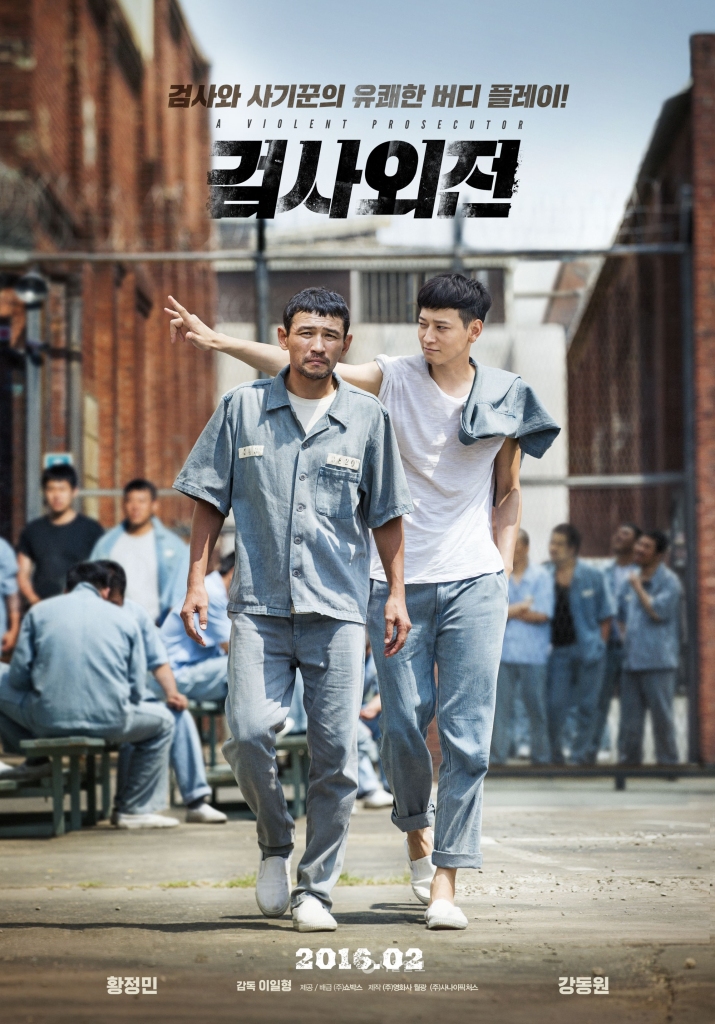
A Violent Prosecutor (검사외전, Lee Il-hyeong, 2016)

112997_47166_106Review of Lee Il-hyeong’s A Violent Prosecutor first published by UK Anime Network.


Police brutality is something of a hot button issue at the moment, so it’s a little disconcerting to see a film like A Violent Prosecutor (검사외전, Geomsawejeon) casting a rogue cop with a penchant for forced confessions as its hero. Then again, the theme plays into the obvious retro charm on offer and the film does, at least, make it plain that violence should have no place in law enforcement. The debut feature from director Lee Il-Hyeong, A Violent Prosecutor has a distinctly ‘70s vibe from its quirky credits sequence to the carefully managed tone which manages to be both serious and not at the same time.

Hwang Jung-min plays hardline prosecutor Byun Jae-wook, feared more than respected because of his willingness (or perhaps eagerness?) to indulge in physical violence in the name of justice. Already known as a trouble maker, Byun’s maverick status is an exploitable weakness and so when he kicks up a fuss trying to expose an obvious cover up, he’s framed for wrongful death after a witness dies in police custody.

Sent to prison among many of the men he helped to put there, Byun quickly finds his feet by providing free legal advice to the guards. Five years later, Byun has become the one of the prison’s top dogs but he’s still intent on clearing his name and nailing the guys who did this to him. Enter suave conman Chi-won (Gang Dong-won) and Byun sees an opening…

Aside from Byun’s problematic approach to his work, he’s definitely one of the good guys as justice, politics, and business have all come together in a whirlwind of mutually beneficial corruption. The whole mess begins during an environmental protest against an industrial complex which is about to be built right next to a bird sanctuary. The evil corporate bozos don’t want any delays so they pay a bunch of gangsters to infiltrate the protest and start a riot to make the environmentalists look like crazed, violent, loonies. Unsurprisingly, public opinion about the development improves following the unpleasant actions of the protestors. The police were just supposed to go along with this (police in Korean films never seem very interested in solving crimes after all), but Byun is different, he smells a rat and he’s not going to roll over and let powerful corporations abuse justice.

Unfortunately, his dedication is not matched by his colleagues who are more interested in their own careers than abstract concepts like truth or justice. Receiving pressure from above and realising Byun can’t be talked down, they decide to take drastic action. One of Byun’s bosses, Kang (Kim Eung-soo), later decides to move into politics, having solidified support through this alliance with the money guys, and is then interested in nothing other than his own success – lying, cheating, and smiling his way to the top. Corruption stemming from the power of monied corporations has become a constant theme in recent Korean cinema and A Violent Prosecutor makes good use of its cinematic background even if treating the subject matter in a necessarily light way.

Essentially, A Violent Prosecutor is a buddy comedy in which the two guys at the centre are kept apart for much of the film. Byun uses his hard won legal knowledge to fight his way out of prison by playing by the book, learning the error of his ways in the process. More often than not, he’s the straight man to Chi-won’s constant scamming as the charming conman comes up with one zany scheme after another trying to keep himself out of trouble whilst also helping Byun enact his plan of revenge. Actor Gang Dong-won is on fine form as the slippery but somehow loveable Chi-won whose main line of work is scamming chaebol daughters out of their inheritances by convincing them he’s a Korean-American Penn State business school graduate, peppering his speech with Americanisms but clueless when challenged on his English. He also deserves bonus points for subverting the “escape from prison dressed as a guard” trope by trying to escape from a corridor full of thugs by blending in with the very men sent to capture him.

Ending in a spectacular, if ridiculous, courtroom finale in which Byun defends himself by forcing a confession in a new, more acceptable way, A Violent Prosecutor delivers the necessary “justice” to all who seek it. Byun learns the error of his ways and accepts that his own violence was at least partly to blame for the way the situation developed, but also ensures that he gets justice for everyone else so that the rich and powerful can’t be allowed to ride roughshod over the people with no one to defend them. A smart buddy comedy, A Violent Prosecutor isn’t exactly the exploitative action fest the title seems to promise but is undoubtedly influenced by the bad cop movies of the ‘70s and excels at finding humour even in the strangest of places.


Reviewed at the 2016 London Korean Film Festival.

Original trailer (English Subtitles)

The Truth Beneath (비밀은 없다, Lee Kyoung-mi, 2016)

10_06_15__574b920705d42Politics in South Korea has never been exactly drama-free, though recent times have seen a multitude of storms engulf its top brass running from the national to the personal. Frequent Park Chan-wook collaborator Lee Kyoung-mi’s followup to her acclaimed 2008 debut Crush and Blush, The Truth Beneath (비밀은 없다, Bimileun Eobda) begins as if it’s going fit into the ‘70s dark political thriller mould but gradually shifts gear to present both a bleak family drama and the story of one woman’s descent into the near madness of grief as she attempts to uncover the true circumstances behind her private tragedy even as it plays out on a national stage.

Married to a prominent candidate in a tightly contested electoral race, Yeon-hong (Son Ye-jin) is perfect first lady material save that she’s from an inconvenient home town. Two weeks before the big day, Yeon-hong’s daughter Min-jin (Shin Ji-hoon) does not return from school as expected which, aside from the obvious distress, is not ideal for her father as his political campaign has largely been run on Min-jin’s face and the slogan “I will protect your children”. Jong-chan (Kim Ju-hyeok), Min-jin’s ambitious father, is reluctant to report her disappearance for fear it will hurt him politically and, after all, Min-jin has “disappeared” at times before. Yeon-hong is deeply worried and unable to understand her husband’s indifference to their daughter’s mysterious absence. As time passes, Yeon-hong steps up her investigation becoming ever more suspicious of those around her.

On the surface of things, Yeon-hong had the ideal life with a wealthy, handsome husband, and a nicely turned out, studious teenage daughter. The first glimpse we catch of them is a celebration of the campaign’s launch in which Yeon-hong is furiously cooking away, a motif which is to be repeated with an entirely different sense of celebration some time later. Yet there’s something slightly artificial about the setup even in its beginning as the conversation between the men takes on a barbed, guarded quality while Min-jin lies to her mother even whilst pledging to straighten up now that the campaign is in full swing.

The more Yeon-hong investigates, the more she realises how much of the life she’d been living was careful artifice. Min-jin had gone off the rails before, though perhaps no more than any other teenage girl and given her father’s position, she’d been under a considerable amount of strain. The “friend” Min-jin had claimed to be meeting does not seem to exist and on visiting her school, Yeon-hong finds out that Min-jin had been ostracised by the other girls, even experiencing violent treatment at their hands.

Min-jin had, in fact, eventually embraced her outsider status by forming a performance art-influenced, punk-inspired rock band with a similarly “uncool” girl, Mi-ok. Mi-ok may have been one of the last people to have contact with Min-jin before her disappearance and quickly becomes a person of interest in Yeon-hong’s investigations but whatever it is she’s hiding, it’s clear that there was a whole side of Min-jin’s life that her mother was entirely unaware of.

As Yeon-hong becomes increasingly desperate, she starts entertaining the idea of conspiracy. Her first thoughts turn to her husband’s rival, Noh, an unscrupulous man who may just be capable of kidnapping Jong-chang’s poster girl in order to punch a hole through his opponent’s ill-advised slogan by demonstrating that he can’t even protect his own child, let alone anyone else’s. Then again, how far would her husband be prepared to go in the quest for power? Would his campaign team really kidnap his own daughter to cast suspicion on Noh and win public sympathy? Jong-chang’s ongoing indifference could be easily explained if he already knows the score, but the more Yeon-hong finds out the more she begins to doubt everything she thought she knew about her family.

Son Ye-jin turns in a career making performance in capturing Yeon-hong’s increasingly volatile emotional state. A once elegant political wife, Yeon-hong’s disintegration is manifested in her untidy hair and progressively relaxed dress sense as she becomes ever surer that there is something larger at play than a runaway teen. Yeon-hong defiantly rejects the entirety of her experience through her appearance at a funeral wearing a bright and colourful floral dress almost as if demanding to be seen, remembered, and addressed. No longer will she remain Jong-chang’s silent partner, Yeon-hong’s grief-stricken, maternal fury requires answers and will not rest until the whole of the truth is known.

Lee’s composition is simply stunning making frequent use of dissolves, superimpositions, and a subtle floating of time periods to underline Yeon-hong’s precarious mental state. When Yeon-hong discovers a particularly unpleasant truth, the previously balanced camera suddenly slides into a canted angle, leaving the ordered world of a political thriller behind for a new kind of noir-ish murkiness. Yeon-hong is, literally, unbalanced, wrong footed and wild as she enters into a desperate quest to understand not only the truth beneath the events which have engulfed her, but the essential truth beneath her life. Playing out almost like an inverted The World of Kanako, the Truth Beneath is a similarly bleak tale filled with coldness and duplicity, yet its distressing finale carries with it a fragmentary warmth and the slightest glimpse of hope in the embrace of a motherless child and childless mother.


Reviewed at the 2016 London Korean Film Festival.

International trailer (English subtitles)

Luck-key (럭키, Lee Gye-Byeok, 2016)

luck-keyWhen it comes to intelligent farce, Kenji Uchida is Japan’s undisputed master so remaking his 2012 tale of love, crime, and mistaken identity Key of Life was always going to be a tall order. Thankfully it’s one Lee Gye-byeok largely manages to meet as he skilfully relocates the tale to South Korea and swaps Uchida’s complicated farce for a more lateral double sided comedy. While not as accomplished as Uchida’s hilariously intricate original, Luck-key (럭키) manages to charm with its thoroughly romantic, comically absurd, approach.
On one side of town, hitman Hyung-wook (Yu Hae-jin) finishes off his latest assignment and disappears into the night, while on another out of work actor Jae-sung (Lee Joon) contemplates suicide only to be interrupted by his landlady’s exasperated pleas for the back rent. In a fairly hopeless state, Jae-Sung heads out to the local bath house, intending to bid the world goodbye in a more dignified state. Hyung-wook also ends up at the same destination to wash the blood off his hands, only to embarrassingly slip on an errant piece of soap and knock himself out cold. Remembering admiring Hyung-wook’s expensive watch on the way in, Jae-sung makes a split second decision and switches locker keys with the unconscious rich guy.

Jae-sung decides to put his affairs in order by using Hyung-wook’s money to pay off old debts as well as experience one day as wealthy man before doing himself in. When Jae-sung discovers Hyung-wook has lost his memory and assumed Jae-sung’s identity, he decides against giving back Hyung-wook’s belongings in favour of trying on life in the fast stream. Jae-sung has also grown attached to a young woman who inexplicably appears on Hyung-wook’s TV, though he does wonder why Hyung-wook has all of these weapons and telephones, not to mention a big board of investigation material, stored away in a hidden room…

Each man begins to live a different life thanks to assuming the contents of the wrong locker. Hyung-wook has the rawer deal as he can’t remember anything about himself and ends up at Jae-sung’s apartment to find it covered in old food cartons and beer cans with his hangman’s noose still lying in the middle of the floor. With only two bucks in his wallet and no cards, he even has to ask the paramedic who brought him in, Lina (Jo Yoon-hee), to lend him the medical fees. Somewhat improbably Jae-sung’s identity card tells him that he is 32 years old (coincidentally the same as Lina) which can only make one think that he must have had a very hard life. Nevertheless, Lina decides to help him by taking him home and getting him a job in her mother’s restaurant.

Even though he can’t remember who he was before, Hyung-wook gradually reveals a different side to himself as Jae-sung, enjoying being a part of Lina’s busy family life. Jae-sung, by contrast, moves further towards the shadows as he becomes increasingly determined to protected the woman on Hyung-wook’s TV screen who turns out to be a whistleblower in a high profile fraud case. Eun-ju (Lim Ji-yeon) is a woman afraid for her life who leaves her apartment as little as possible, but eventually Jae-sung tracks her down and begins to woo her in impressively romantic ways, only to discover he’s made everything worse by misunderstanding the nature of the situation she finds herself in.

Experiencing a different sort of life highlights for each of the men what was making them so unhappy – Hyung-wook realises the value of a warm and supportive family life whilst Jae-sung finds purpose and drive in his desire to protect Eun-ju. Both men had, in a sense been “acting” as a part of their daily lives, living a kind of half life which frustrated their attempts to move forward. Through living in someone else’s world, these hidden parts of themselves – Hyung-wook’s softer, more feminine side, and Jae-sung’s masculine desire to charge of his life, become “unlocked” and allow them to become the people they always meant to be all along.

Dispensing with Uchida’s farce structure, Lee Gye-byeok more or less eliminates the third major character from the original script in order to more neatly split the action between the two guys who then mirror each other as they each begin to move more towards the centre whilst also making tentative moves towards romance. Filled with gentle, often absurd humour and taking pot shots at everything from gangster clichés to diva TV stars, Luck-key makes all the right moves in its relocation to Korea, bringing both amusing comedy and genuine romantic warmth with it.


Original trailer (no subtitles)

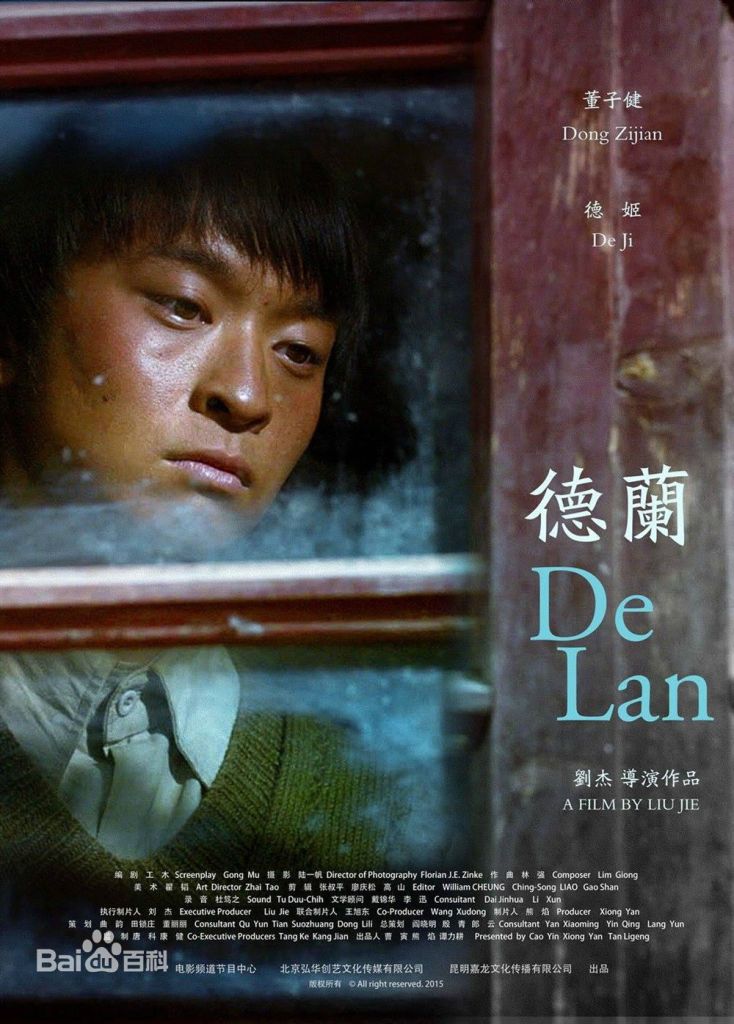
De Lan (德蘭, Liu Jie, 2015)

Set in 1984 in a rural Chinese backwater, De Lan (德蘭) is named not for its central character, but for his first love – a mountain woman far from home in search of a missing relative. Tasked with following De Lan (De Ji), Wang (Dong Zijian) finds himself entering a strange new world which he is incapable of fully understanding, not least because he doesn’t speak the language. A wordless love story between the tragic De Lan and the adolescent Wang is destined to end unhappily, but will affect both of them in quite profound ways.
Wang’s father has been missing for three months, and what’s worse is that around 2000 yuan went missing with him. Mr. Wang had been the loans officer for the local party office in this dreary mountain town and now the best idea anyone has come up with is for Wang to take over the position and pay back the missing money with deductions from his wages (this should take around ten years). Hardly fair, but what can you do? Wang’s first assignment is to take an audit of a mountain town where the residents have a lot of outstanding payments. Seeing as they’re heading to the same place, Wang is to accompany a mountain woman, De Lan, who had been travelling around local towns looking for a missing person but has now run out of money and must go home alone.

Wang is told to trust De Lan when it comes to the terrain, but that he should keep control of the food supplies in case she tries to run off. All things considered, the people at the foot of the mountains, aren’t very well disposed to those at the top. Wang is young and unused to walking such long distances, frustrating De Lan with his inability to keep up and frequent needs to rest. Nevertheless a kind of mutual affection seems to build up between them but largely goes unspoken and unacknowledged. Finding himself installed in De Lan’s home, Wang begins to feel very awkward indeed, unable to work out the strange family dynamic between the gruff man with the lame leg, ancient blind old woman, and the feisty De Lan.

Wang has, after all, been sent to the town to collect on loans – an entirely pointless enterprise as no one here has any money. Wang’s father was a much loved presence, mostly because he always came with cash and never pressed them on repayments. His son, with a father’s debt around his neck, is not quite so nonchalant. Calling a village meeting with no notice, Wang makes it clear he won’t be following his father’s lax approach and will not be issuing any new loans, rather he will be calling in the old ones. This does not make him popular in the village.

Eventually he changes his mind and decides to flash some cash but his worst assumptions are confirmed when the villagers, far from using the money they claimed to so desperately need to survive to invest in their businesses, club together to buy all the booze in the surrounding area and have a giant party. Originally put out by their trickery and De Lan’s ongoing unavailability, Wang suddenly finds himself trying some of their liquor and joining in with a dance around the fire. Perhaps learning to adjust to the Earthy, less ordered way of life, Wang has embraced the new found freedom of the place, but he will also discover that it only runs so deep.

De Lan’s life has undoubtedly been a difficult one which she faces with stoic resignation. Shared between two men and longing only for a child, De Lan has very little say in anything that happens to her yet she was able to set off all alone to look for her missing person. During the trip, De Lan is dismayed when a teenage boy in a home they spend a night in makes a vulgar comment about her body, leading her to try to leave as soon as possible only for Wang to pledge his protection. De Lan is aware of the dangers of the road, as well as the constraints placed on her life, whereas as Wang is still naive enough to think his physical strength and government position would be enough to keep De Lan any safer than she would be alone.

As Wang’s feelings for De Lan grow he fantasises about saving her from this strange, cold household though he barely stops to ask himself if saving is really what she wants. Unable to speak the local dialect, Wang necessarily needs to rely on look and gesture which is largely how he and De Lan have come to communicate – a pure kind of dialogue without need of words. Wang’s love for De Lan is destined to cost him dearly both in financial and emotional terms. A beautifully sad tale of frustrated first love set against the picturesque Chinese countryside and inside it’s much less pretty political system, De Lan is the story of one man’s transition from adolescence to manhood through heartbreak, filled with quiet, yet intense, emotion.


Reviewed at the 2016 London East Asia Film Festival.

Trailer (English subtitles)

Saudade (サウダーヂ, Katsuya Tomita, 2011)

saudadeReworked from a review first published by UK Anime Network in September 2012.


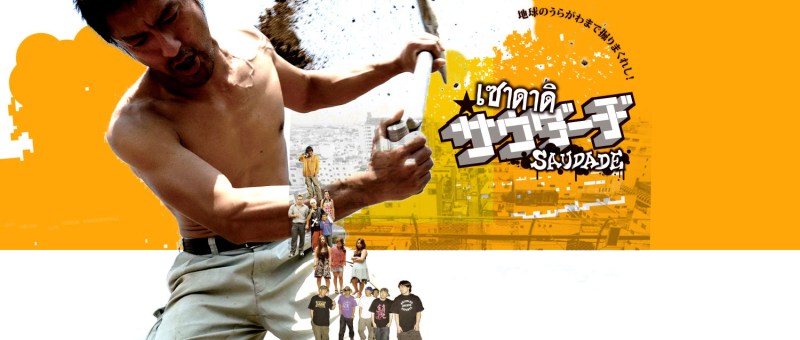
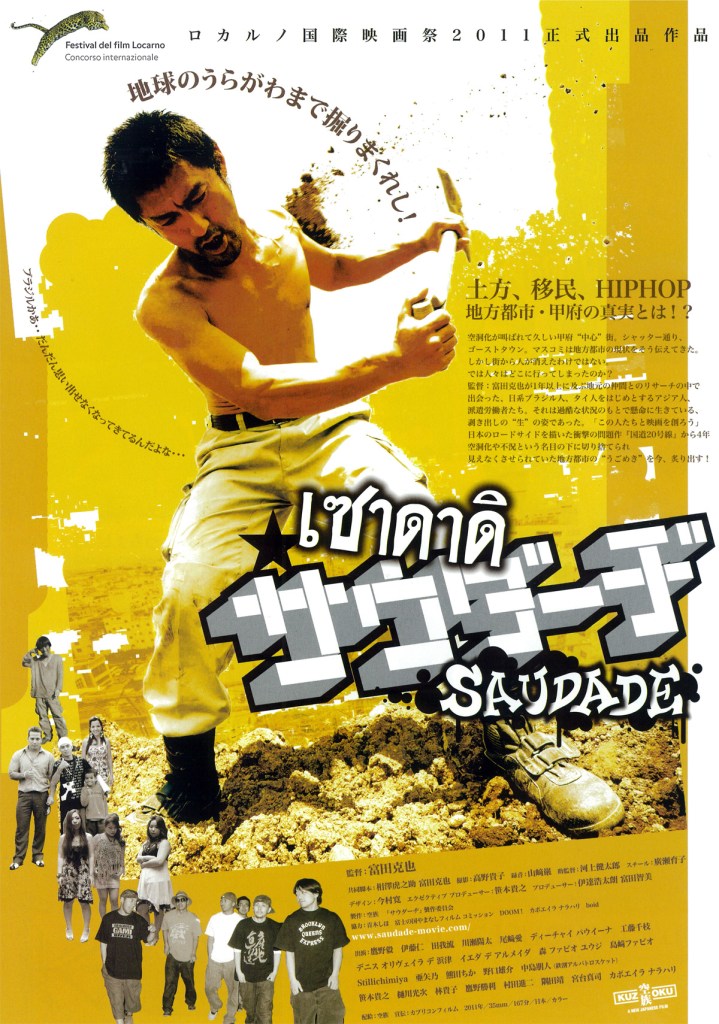
Saudade is one of those words that’s so unique to a particular language that it’s extremely difficult to translate into another. The recent Portuguese film, Tabu, is almost a literal expression of “saudade” itself but offers this brief explanation of it – a feeling of deep yearning or nostalgia for something that is past and can never be regained. Each of the residents in the small town of Kofu (which is, in many ways, a character itself) are all yearning for something, whether for a new life, opportunity or just a simple return to the promise of one’s youth. As the town’s prospects continue to decline its residents continue to long for something different – some kind of progress to lift them out of the tedious downward spiral in which they feel themselves to be trapped.

Seiji works in construction, employed on short term projects – when there is work going that is, something that’s becoming increasingly scarce. Married to a beautician whom he’s come to dislike due to her social climbing ambitions and desire to start a family, Seiji fantasises about running away with his Thai mistress and starting a new life with her in her home country. He’s joined by a new friend, Hosaka, who, coincidentally, has just returned from a long period of time living abroad in Thailand but seems to have his own problems and perhaps serious reasons for his flight and subsequent return. The newest member of the construction crew is the reluctant Amano, a leader of right leaning hip hop group, who has come to blame Japan’s immigrant population for his own inability to find work and progress in life.

There are also, of course, the non-Japanese populations including the Brazilians who came to Japan on the promise of wages ten times those they could earn in their home country but have found only poverty and discrimination. Many have decided to return home, others contemplate moving on – perhaps to the Philippines in search of a better life for themselves and their families. Some have been in Japan so long that although they are proud of their Brazilian heritage they barely remember their home country and feel they have nowhere to go besides Japan. Desperately trying to walk the line between integration and embracing their own culture, the non-native residents must also devote time to trying to gain acceptance from the local population. That’s not to mention the Thais working as hostesses or dancers or elsewhere in the entertainment industries – accepted but perhaps only in that specific context.

In painting a portrait of his own hometown, director Katsuya Tomita shows a side of Japan that is often absent from Western perceptions – blue collar workers trying to keep pace with the economic downturn while old prejudices rear their ugly heads in defence. The fact that most of the actors are non-professionals and residents of Kofu themselves gives the film a new weight, indeed the two main stars are friends of the director from childhood. Tomita spent a year researching his subject matter and many of these actors are simply repeating their former conversations in a new context for the camera. As the city crumbles and people pull away from each other in their search for something better, the tensions of everyday life grow stronger and threaten to tip over into violent intensity.

The film, however, seeks to remind us that we are all the same. We all have saudades for one thing or another – something we strive to reattain even though we know it’s impossible. The non-native residents yearn for home or for the acceptance they once felt, the Japanese for the prosperous Japan they grew up in and all the possibilities it afforded them in their youth. Seiji must know on one level that his dream of running away to Thailand with his girlfriend is an impossible fantasy, yet he continues to long for it with varying degrees of intensity. Amano’s problems are perhaps more to do with his own circumstances than the political stance he gives them – longing to be ‘someone’, admired, respected and perhaps loved even if the reason for that acclaim is something abhorrent.

At 164 minutes Saudade takes its time and, being an ensemble drama, perhaps lacks enough narrative focus to engage the majority of viewers. However, for those with long attention spans the film excels in character detail and in building a truly authentic atmosphere in the depiction of the decaying Kofu. Not always an easy watch, Saudade is an interesting and unflinching look at an all too often unacknowledged aspect of its home country.


Original trailer (English subtitles)