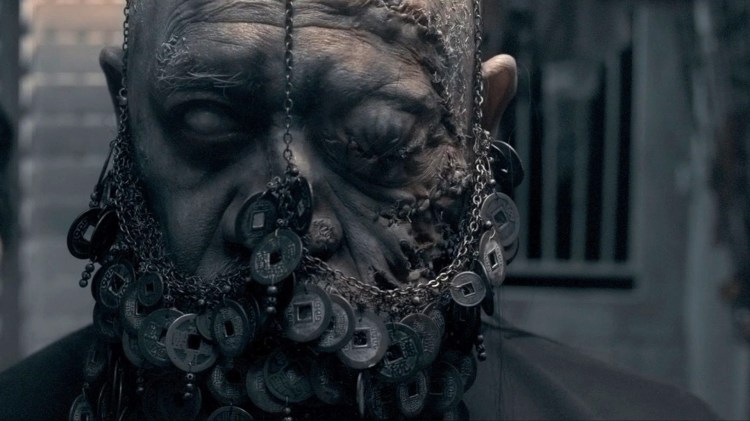
Rigor Mortis (殭屍, Juno Mak, 2013)

rigor mortisReview of this slick but not very scary horror movie up at UK Anime Network.


Juno Mak may be most familiar to UK viewers as the star of the rather macabre thriller Revenge: A Love Story but he began his career as canto pop singer in Hong Kong at just 18. An unlikely superstar in many ways, Mak has gone on to endure scrutiny over his career and family background whilst managing to carve his own path in the perilous Hong Kong entertainment industry. Having made his acting debut with Revenge: A Love Story he now makes another unusual move and steps behind the camera with a slick, modern horror film that seeks to pay homage to the much loved 1980s Mr Vampire movies.

Ditching the series’ trademark humour, Mak’s is a more meta take on its subject matter as it begins with the once famous actor Chin carrying a cardboard box full of his paltry possessions into a rundown apartment complex where he plans to end his own life. His plans are frustrated though as his newly lifeless body is possessed by the building’s resident ghosts. However, luckily or unluckily, the guy who runs the local noodle store doubles as an exorcist and manages to expel the demons from Chin’s body just in time to save his life. His troubles don’t end there though as a nice seeming old lady neighbour hides a terrible secret as does a frightened woman who often roams the corridors with her young albino son. Someone is indulging themselves in a bit of necromancy which threatens to change life on the block for ever more.

It’s certainly a very dour and gloomy affair as the suicidal Chin has flashbacks of his life as an A-list star with a pretty wife and a cute-as-button son whose last voicemail Chin keeps replaying. It’s all gone wrong for him already which is presumably why he’s come to live in such a “modest” place. He comes to build up a tentative relationship with the frightened woman and her son but they have traumas of their own linked to the strange haunting of the building. Mrs Mui who lives upstairs is the archetypal nice old lady who takes in sewing because she’s bored but after her husband dies in a freak accident she’ll stop at nothing to bring him back. It’s her husband that’s the stiff from the movie’s title (well perhaps – perhaps not) and she’s roped in a priest to work some black magic to bring him back but it isn’t really working necessitating her to take ever more drastic measures.

The Mr. Vampire movies are a Hong Kong institution and particularly well loved by the generation who grow up watching them in the ‘80s. However, they are considerably less well known here and viewers expecting a Western style “vampire” story are going to be disappointed. Chinese “hopping” vampires are more like a vampire/zombie hybrid – they feed on qi (life force) but shuffle like zombies and have about the same level of intelligence. There’s only one reanimated corpse here but Mak also throws in a couple of J-horror influenced ghosts with grudges that are also martial arts masters – as are the Taoist priests who are around to keep them in check. Mak has largely ignored the genre’s humorous aspects and gone for a fairly po-faced, supernatural martial arts drama which largely works but may have the less genre savvy viewer feeling a little lost.

Everyone’s just very bored in a very modern way – their ennui is close to religious. The former vampire hunter who runs the noodle stall downstairs and makes sure to produce extra food for the benefit of his customers who’ve already passed over (after all, they still need to eat, right?) spends all day in his boxer shorts and dressing gown and doesn’t even bother to put on any special vampire fighting gear. Chin is, obviously, suicidal and most of the other residents of the block are facing metaphorical demons even if they aren’t actually battling physicals ones (there are a lot of metaphorical layers in the film if you’re the sort that likes to see them). It’s all very cool in a slick and modern way but sometimes feels a little pompous and fails to engage.

Simply put, Rigor Mortis not quite as much fun as one might hope but also lacks the depth that might have made the experience feel more worthwhile. Having said that, it all looks great – aesthetically the film is very interesting and has a lot going for it including some unusually well made and impressively realised special effects. It is all a little style over substance though and the film’s final twist feels like a step too far (as does a strange mid credits shot and odd post credits sequence). There’s something a little cold and unengaging about Rigor Mortis (perhaps appropriately so) but it still has its moments and fans of slick, good looking martial arts movies with a supernatural bent may find a lot to enjoy.


Actually, this trailer is quite creepy though:

Available now in the UK from Metrodome.
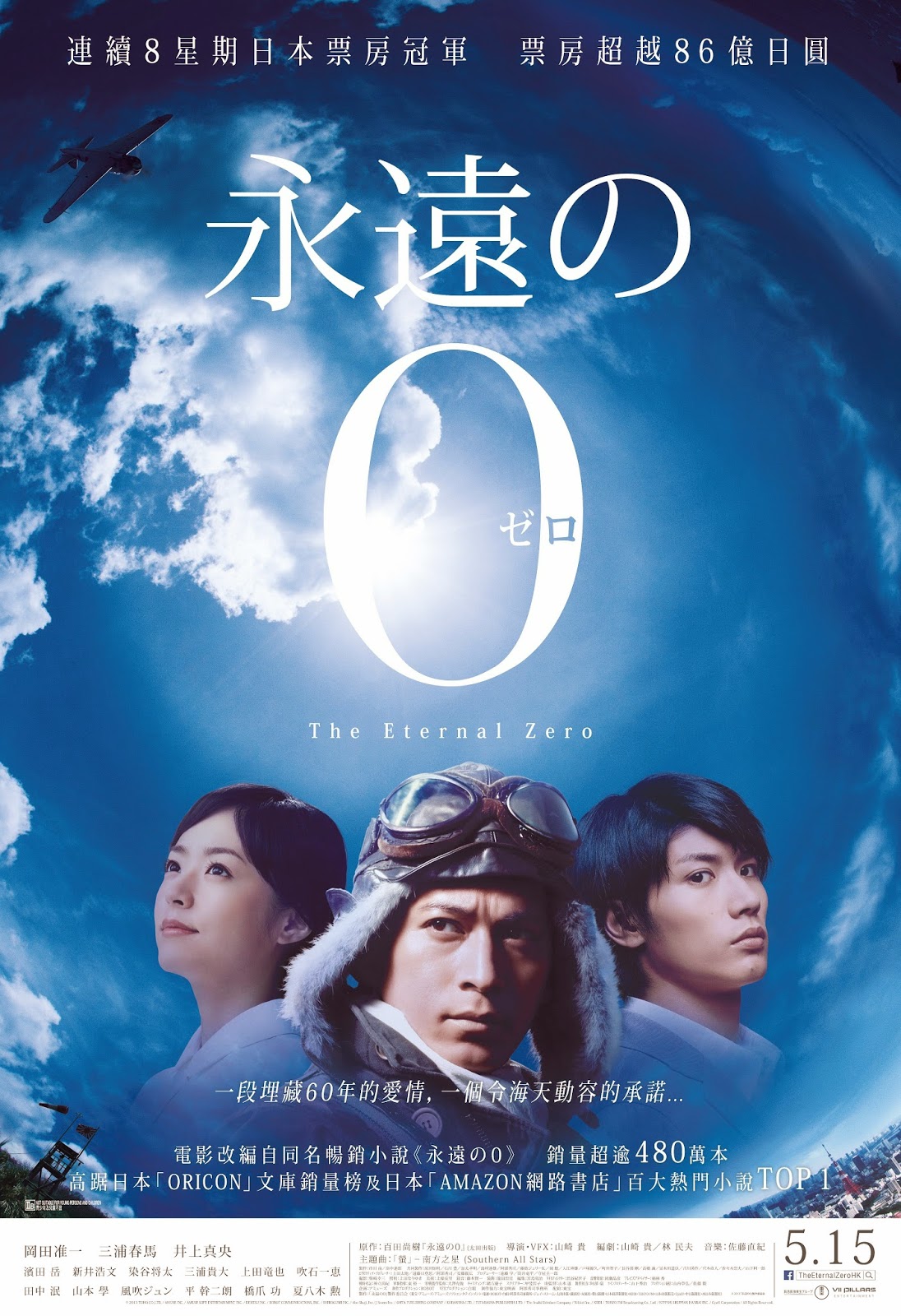
The Eternal Zero 永遠の0

eternal_zero

It’s difficult to think of a recent film that’s caused quite as much controversy as The Eternal Zero (save perhaps Hayao Miyazaki’s own World War II epic The Wind Rises). Written by a right wing pundit and close ally of current Japanese prime minister Shinzo Abe, Naoki Hyakuta, The Eternal Zero definitely has an ambiguous stance on several things that most people just don’t really want to talk about. However, it would also be fallacy to pretend that anybody else’s war movies are completely unbiased, or willing to look at the complexities of any given war beyond jingoistic drum beating which has often been the point of a war film. In truth, The Eternal Zero is actually more or less a-political for most of its running time save a possibly misjudged epilogue which does its best to undo the entirety of the film’s message up until right before the fatal flaw. Setting politics to one side, how does The Eternal Zero fare when it comes to taking this most American of subjects, in the most American of ways? Pretty OK, to be frank, not bad at all.

Like a lot of Japanese films tackling the recent past, the film starts in the present with little lost boy Kentaro (Haruma Miura) attending the funeral of his grandmother whereupon he discovers the heartbroken man he’d assumed to be his biological grandfather (Isao Natsuyagi) was in fact his grandmother’s second husband and not his mother’s true father at all. Mind truly blown, Kentaro is talked into further investigations by his older sister in which he discovers his biological grandfather was an air force pilot who died in a kamikaze mission during the war. On talking to some of his fellow officers, Kentaro and sister first hear that their grandfather was a coward, a supposedly skilled pilot who hid in the clouds during sorties and endangered the lives of his comrades through his negligence. Until that is, they chance upon those closest to him who tell a different story – that Kyuzo Miyabe (Junichi Okada) was the bravest of men. A man who knew the war was pointless and wasn’t afraid to say so, who simply wanted to survive and get back to protecting what was most important to him – his wife and child. Why then, would this man who was so desperate to survive finally give his life in a suicide mission for something he did not believe in?

To deal with the most obvious question first – no, The Eternal Zero is not “a propaganda film” in the truest sense of the term. Yes, it ignores the external context because it simply wants to focus on the nature of war and what it does to those who conduct it (as well as those who only stand and wait) which *is* a form of propaganda in a sense because of all the things that it refuses to acknowledge. However, for 90% of the running time, the film has a thoroughly modern sensibility where the overriding feeling is absurdity, that this war is a crazy waste of youth that no one should have to have gone through. The original group of pilots that brand Miyabe a “coward” are shown up for a group of brainwashed idiots and Miyabe portrayed as the soul prophet who sees things as they are and has the courage to speak his mind. Later, there are other headstrong boys who think they’re men and don’t understand what they’re getting themselves into but the main thing is just how stupid all of these ideas of honour and sacrifice really are when all it will likely mean is leaving destitute women crying and starving at a home you’ve failed to protect. However, all of these more “liberal” ideas are totally undercut in the last five minutes of the film which seeks to glorify an act that the previous two hours have branded an idiotic waste of life. Politically confused, Eternal Zero doesn’t quite know where to put itself when acknowledging the tremendous sacrifice that was made by an entire generation without quite wanting to see just what those sacrifices were in name of.

To be fair to it, it isn’t as if most most Hollywood war movies don’t also do the same thing to a similar extent – present the heroism and perhaps the personal conflict without acknowledging all that goes with it. In truth, what The Eternal Zero most resembles is a classic Hollywood war film which is quite invested in remorse for the loss of life (and sometimes even for that on all sides) but also in not wanting feel any lives were lost in vain. Thus there is a feeling towards the end of the film that young people of today still owe a debt to these men, that they owe it to them in return for the sacrifice that was made to live their lives freely and to the utmost. To spend so long saying that war is a cruel game that makes pawns of young men’s lives only to turn around and say it’s the job of the youngsters of today to make those pawns kings is a little perverse, but understandable on a human level.

The Eternal Zero is blockbuster movie in every sense, the budget and shooting style are also aping your typical Hollywood epic though doing it fairly well. The script is clunky with its inelegant switching between time periods and to be frank the entire “modern” section feels a little superfluous and underwritten.  It’s a little long at over two and a half hours and does occasionally fall into a televisual rhythm – there is a great deal of talking and explaining which probably would have had more impact if it were done in a less bald way. Nevertheless, what The Eternal Zero sets out to do, it does pretty well. It may speak to something dangerous, but it is not dangerous in and of itself. For the most part excellently filmed with its fair share of stand out sequences, The Eternal Zero will appeal most to fans of old-fashioned (and uncomplicated unless you want to really think about it) war films but may struggle to maintain the interest of more jaded viewers.

Roommate (ルームメイト, Takeshi Furusawa, 2013)

meinImage(Is the tag line really “A woman’s unpainted face is scary!”? I get where they’re coming from but, hmmm – problematic)

Adapted from the 1997 novel by Aya Imamura, you’d be forgiven be forgiven for thinking that Roommate is something of a rehash of seminal ’90s “my roommate is a psycho” drama Single White Female though it goes a couple of steps further in the influences stakes and throws in Fatal Attraction and The Three Faces of Eve for good measure. Honestly anything else is a spoiler (though anyone who’s ever watched a film of this nature before is going to guess 70% of the plot about ten minutes in) but sit back and get ready to enjoy a very silly (though not really silly enough) tale of violence and psychological intrigue!

The film starts with the police arriving at the scene of a violent crime where a severely injured man and woman are being taken to hospital leaving another man dead inside. Cut to three months earlier and Harumi (Keiko Kitagawa) – the woman from the crime scene, has been injured in a car accident and wakes up in a hospital dormitory. Shortly thereafter she’s visited by the man who was driving the car, Keisuke (Kengo Kora), along with his insurance broker friend who’s very keen to sort out the paperwork for the compensation etc. Whilst recuperating Harumi builds up friendship with one of the nurses, Reiko (Kyoko Fukada), and when it comes time for Harumi to be discharged the two decide to become roommates! It’s all amazing at first but cracks begin to appear as Reiko’s behaviour becomes increasingly strange and Harumi starts getting closer to Keisuke. Then Harumi starts seeing a woman who looks really like Reiko, but is not actually Reiko, hanging around and things just start to get even more bizarre from then on.

Yes, you’ve seen all of this before. Not just in Single White Female and every other identity theft stalker drama since but even the various twists and turns feel lifted from other, more successful, movies. There’s even an incident with a pet that’s kind of like the one in Single White Female but it’s been given a Fatal Attraction style twist to make it less obvious. At this point, when your roommate’s behaviour has become this dangerous, a normal person would actually do something about it, wouldn’t they? Not in the land of the movies though! Revelation after revelation and about an hour of psychobabble later it’s all explained (sort of, as long as you don’t really think about it) but the last twist and the subplot with Tomorowo Taguchi’s sleazy mayoral candidate seem a little superfluous.

Mostly the film has a disappointingly televisual feeling and though there are a fair few interesting techniques in play such as the use of split screens, this feels both too on the nose and underdeveloped to have much of an impact. Performances are also on the weaker side though this may rest partly on the lack of depth in the fairly schlocky script – Kengo Kora isn’t left much to do other than being generally ‘nice’ and though the bond between the two women is well brought out, neither of them really gets to let loose with the intense extremes of their characters. The problem, really, is that Roommate walks a fine line between camp horror movie and serious psychological thriller, which just makes it a little bit dull. It never manages to build up much of an atmosphere of fear and its unwillingness to play with ambiguity makes it that much less engaging. Had it gone further down the schlocky, campy, melodrama route, Roommate might have proved more fun but this light on gore heavy on drama approach makes it only mildly diverting.

It’s about as tame and mainstream as they come, but Roommate isn’t exactly a bad film, just not a very interesting one. Not crazy enough for the midnight crowd nor smart enough lovers of cerebral thrillers, it ultimately falls between two stools. With such a high profile cast you might have expected something a little more powerful but Roommate is the classically OK, yet totally inconsequential film that’s fine for occupying a couple of hours but little more.