Kabukicho Love Hotel (さよなら歌舞伎町, Ryuichi Hiroki, 2014)

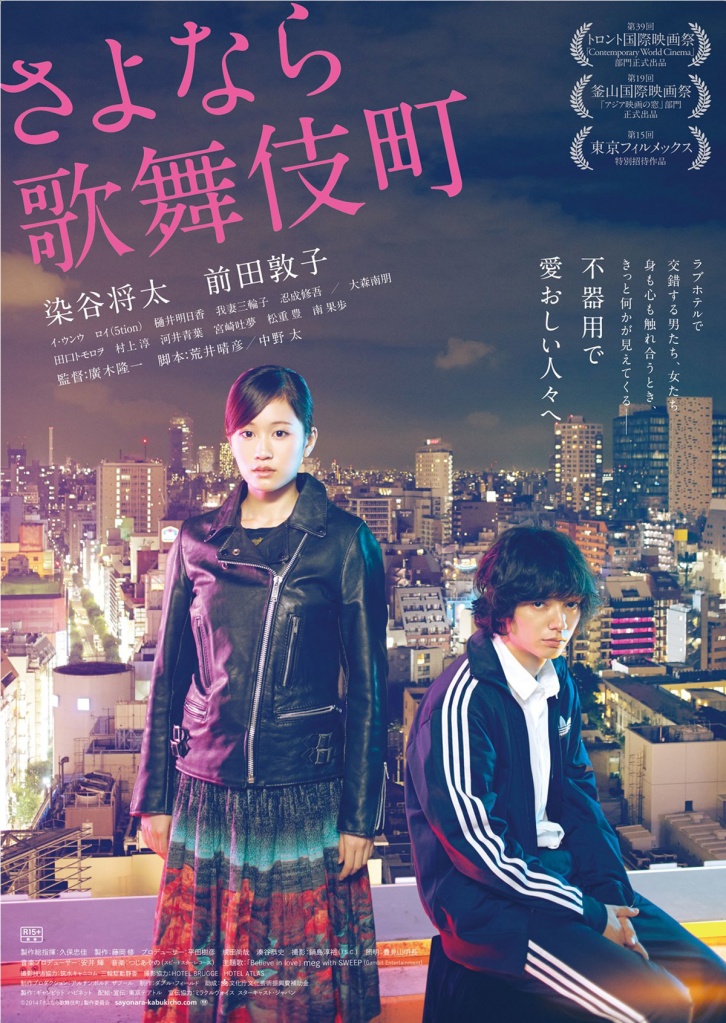
165709_02Kabukicho Love Hotel (さよなら歌舞伎町, Sayonara Kabukicho), to go by its more prosaic English title, is a Runyonesque portrait of Tokyo’s red light district centered around the comings and goings of the Hotel Atlas – an establishment which rents by the hour and takes care not to ask too many questions of its clientele. The real aim of the collection of intersecting stories is more easily seen in the original Japanese title, Sayonara Kabukicho, as the vast majority of our protagonists decide to use today’s chaotic events to finally get out of this dead end town once and for all.

The first couple we meet, Toru and Saya are young and apparently in love though the relationship may have all but run its course. She’s a singer-songwriter chasing her artistic dreams while he longs for a successful career in the hotel industry. He hasn’t told her that far from working at a top hotel in the city, he’s currently slumming it at the Atlas. Our next two hopefuls are a couple of (illegal) Korean migrants – she wants to open a boutique, he a restaurant. She told him she works as a hostess (which he’s not so keen on but it pays well), but she’s a high class call girl well known to the staff at the Atlas. Our third couple are a little older – Satomi works at the Atlas as a cleaner but she has a secret at home in the form of her man, Yasuo, who can’t go outside because the couple is wanted for a violent crime nearly 15 years previously. In fact, in 48hrs the statute of limitations will pass and they can finally get on with their lives but until then Satomi will continue to check the wanted posters on the way to work. That’s not to mention the tale of the teenage runaway and the hard nosed yakuza who wanted to recruit her as a call girl but had a change of heart or the porn shoot on the second floor which stars a lady with an unexpected relationship to one of the hotel’s employees…

It’s all go in Kabukicho. The punters come (ahem), go and leave barely a mark save for the odd tragedy to remind you that this is the place nobody wanted to end up. In fact, the picture Hiroki paints of Kabukicho is the oddly realistic one of someone hovering on its fringes, acknowledging the darkness of the place but refusing to meet its eyes. Everybody is, or was, dreaming of something better – Toru with his job at a five star hotel and a sparkling career in hospitality, Satomi and her romance or the Korean couple who want to make enough money to go home and start again. In short, this isn’t the place you make your life – it’s the one you fall into after you’ve hit rock bottom and promptly want to forget all about after you’ve clawed your way out.

However, while you’re there, you’re invested in the idea of it not being all that bad, really. There’s warmth and humour among the staff at the hotel who treat this pretty much the same as any other job despite its occasional messiness. In fact, the agency for the which the Korean hopeful works is run by an oddly paternalistic “pimp” (this seems far to strong a word somehow) who sits around in an apron and chats, offering comfort and fatherly advice in between dispatching various pretty young girls off to any skeevy guy who wants to rent them for an hour or two.

That’s not to say anyone is happy here though, all anyone’s focussed on is getting out and by the end the majority of them decide it’s just not worth it and the time to leave is now. Kabukicho Love Hotel may be one of Hiroki’s most mainstream efforts (despite its far less frequent than you might expect though frank sexual content) but its overlong running time and its failure to fully unify its disperate ensemble stories make it a slightly flawed one. An interestingly whimsical black comedy that takes a humorous view of Kabukicho’s darkside, Kabukicho Love Hotel is perhaps one it’s fairly easy to check out of well before the end of your stay but does offer a few of its own particular charms over the duration of your visit.


Or perhaps, you can check out any time you like, but you can never leave? We are all just prisoners here, of our own device….

100 Yen Love (百円の恋, Masaharu Take, 2014)

165856_02Actress of the moment Sakura Ando steps into the ring, literally, for this tale of plucky underdog beating the odds in unexpected ways. It would be wrong to call 100 Yen Love (百円の恋, Hyaku Yen no Koi) a “boxing movie”, it’s more than half way through the film before the protagonist decides to embark on the surprising career herself and though there are the training sequences and match based set pieces they aren’t the focus of the film. Rather, the plucky underdog comes to the fore as we watch the virtual hikkikomori slacker Ichiko eventually become a force to be reckoned with both in the ring and out.
Ichiko Saito is a 32-year-old woman with no job who still lives at home in her parents’ bento store where she also refuses to help out. With unkempt hair, slobbish pyjamas and a bad attitude, she stays in all day playing video games with her nephew other than running out to the 100 yen store late at night for more cheap and nasty snacks. Her sister has recently moved home after a divorce and to put it plainly, the two do not get on. Finally the mother decides the sister is the one most in need and more or less throws Ichiko out onto the streets. She gets herself a little apartment and a job in the 100 yen store where she’s perved over by a sleazy colleague and amused by a crazy old lady who turns up each night to help herself to the leftover bento.

Ichiko also becomes enamoured with a frequent customer who they nickname “Banana Man” because he just comes in, buys a ridiculous number of bananas, and leaves without saying anything. He’s even more awkward than Ichiko though he seems to kind of like her too. Banana Man is an amateur boxer and eventually ends up staying in Ichiko’s apartment following a rather complicated chain of events. When this too goes wrong, Ichiko decides to try her hand at boxing herself, hoping to make the next set of matches before she passes the age threshold.

We aren’t really given much of a back story for Ichiko, other than that her polar opposite sister thinks she’s too much like their father who also seems to be a mildly depressed slacker only now in early old age. Her mother is at the end of her tether and her sister probably just has problems of her own but at any rate does not come across as a particularly sensitive or sympathetic person. Getting kicked out at this late stage might actually be the best thing for Ichiko though it’s undoubtedly a big adjustment with her family offering nothing more than possible financial support.

Working in the 100 yen store isn’t so bad but it doesn’t really suit Ichiko with her isolated shyness and lack of work experience. Mind you, it seems like it doesn’t suit anyone very well as her manager quits right away and her only co-worker is a lecherous criminal who literally will not stop talking or take no for an answer. Ichiko’s only real relationship is with Banana Man but even this is strange with Ichiko becoming infatuated and coming on too strong for the rather immature amateur boxer who’s just hit the end of his career. If Ichiko is going to get anywhere she’ll have to do it on her own and on her own terms, no one is going to help her or be on hand to offer any kind of life advice.

That is, until she starts boxing where she gets some coaching, if only inside the ring. The gloves give her a purpose, in getting to a real match before the age limit passes (it’s 32 and she is already 32) she finally has something concrete to work towards and strive for. She just wants to win, once, after all the awful and humiliating things that have happened to her, she just wants to hit back. Even if she falls at the final hurdle, these seemingly small elements have caused a sea change within her. No longer holed up at home, too fearful to engage with anything or anyone, Ichiko has her self respect back and can truly stand on her own two feet.

Indeed, the film might well be called sympathy for the loser – what attracts Ichiko to the sport to begin with is the mini shoulder hug at the end between the victorious and the defeated. With the idea that it’s OK to lose, there are no hard feelings between athletes and even a mutual respect for those who’ve done their best even if they didn’t quite make it, this moment of catharsis seems to give Ichiko the connection she’s been craving. However, the film’s ending is a little more ambiguous and where this rapid transformation of the “100 yen kind of girl” might take her may be harder to chart.


100 Yen Love is Japan’s submission for the 2016 Academy Awards.

Princess Jellyfish (海月姫, Taisuke Kawamura, 2014)

b7dec6a631e5ad87baf2ff601d6b4872Originating as an ongoing manga series by Akiko Higashimura which was also later adapted into a popular TV anime, Princess Jellyfish adopts a slightly unusual focus as it homes in on the sometimes underrepresented female otaku.

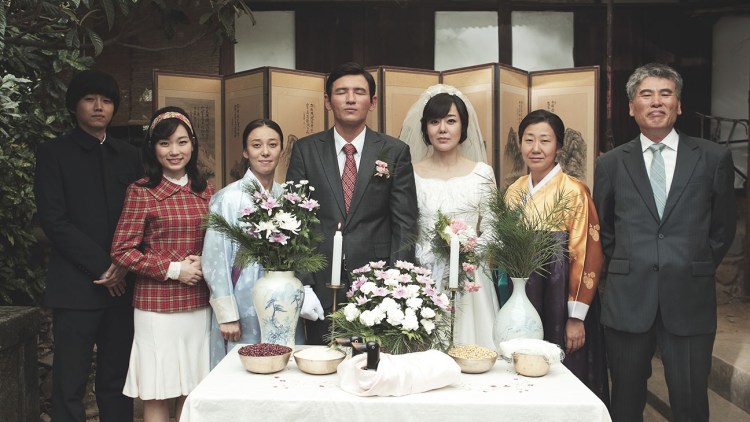
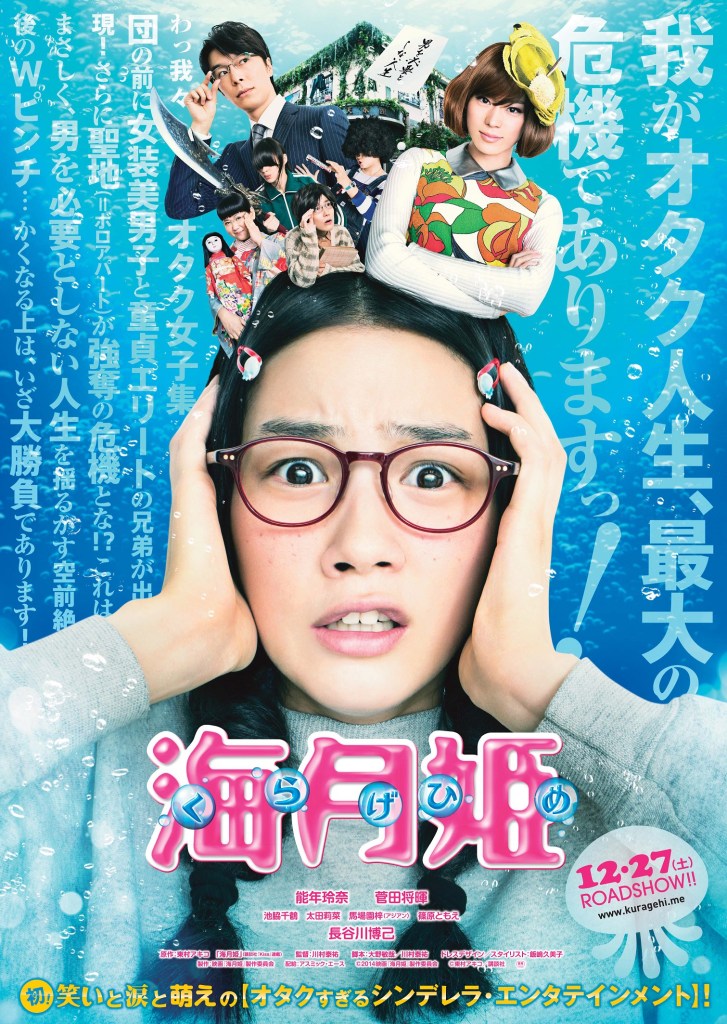
Tsukimi is an extremely awkward young woman who has an all encompassing obsession with jellyfish. Luckily for her, she’s managed to find a group of likeminded women of a similar age to room with. That is, they aren’t all as crazy about jellyfish as she is, but they all have their particular order of special interest, are fairly socially awkward with an extreme fear of “fashionable” women, and no formal form of employment. At the Amamizukan boarding house, the girls can all enjoy their otaku lives together (well, kind of separately) and, crucially there are no boys allowed!

However, one day Tsukimi finds herself at a crisis point when she notices one of the jellyfish she likes to visit at a nearby pet shop is in danger! The idiot shop boy has only gone and put a Moon Jelly in with a Spotted Jelly – does he just not know how dangerous that is?! Tsukimi will need to act fast to save her friend, but the guy behind the counter is a clueless pretty boy – absolutely the worst case scenario for Tsukimi. Despite her extreme anxiety she valiantly marches into the shop yet her confused mini lecture on jellyfish keeping only succeeds in convincing the shop boy that she’s some kind of nutcase. On being expelled from the shop, Tsukimi finds herself at the feet of an extremely glamorous looking woman who comes to her defence. What kind of strange parallel world is this? Tsukimi’s universe is about to undergo a sea change!

Though based on a manga and intended as a comedy, crucially, Princess Jellyfish casts its series of “different” heroines (and hero) in a favourable light – they are never the butt of the joke and sympathy is always placed with those who experience difficulty in their lives because they feel themselves to be different. Each of the girls is so deeply involved in their own particular obsession that they find it difficult to fit into the regular world and particularly to cope with conventional femininity. Tsukimi herself finds it particularly difficult to talk to men and the fact that no men are permitted at Amamizukan makes it clear that she is not alone in her fears.

This brings us to her new friend who is apparently a fashionable young woman – the sort who would never usually be seen dead talking to the likes of Tsukimi. However, this one not only acknowledges Tsukimi’s presence as another human of equal standing, but even lends her confidence and power as an attractive woman to Tsukimi’s predicament. There is, of course, more to this mysterious saviour than there might seem at first sight. In addition to being a fabulously well dressed lady, Kuronosuke is also a boy. This is something of a problem for Tsukimi as she only realises after letting him stay over at the strictly no boys allowed residence. The ruse also has to be maintained a little longer when Kuronosuke decides to stick around, eventually becoming known as “Kuroko”.

The situation intensifies as the girls’ secret haven comes under threat when a gang of ruthless developers want to buy up most of the town and redevelop the area. The group home is owned by one of the girl’s mothers who is also an otaku only her obsession is with top Korean actor Lee Byung-hun and she’s skipped off to Korea to be able to stalk him better. There’s no telling what she might do if it brings her closer to the object of her affections and things are looking a little desperate. Eventually a possible solution is found which plays to everyone’s strengths and offers the faintest glimmers of hope for the girls (and boy!) of Amamizukan.

Princess Jellyfish is the ultimate tale of acceptance, both in personal and societal terms. The residents of Amamizukan may be a little different, but that doesn’t mean they have nothing to offer the world and there’s no need for themselves to maintain a position of self imposed exile if the only reason is a belief in their own inferiority. This is a lesson taught to them by the exuberant rich boy and politician’s son with a traumatic past of his own, Kuronosuke. Truly unafraid to be who he is, Kuronosuke teaches the girl’s that almost any obstacle can be overcome with a combination of forthrightness and sincerity.

Though it runs a little long and gives in to some very over the top performances and melodramatic plotting, Princess Jellyfish is an enjoyably offbeat manga inspired tale. Very much not interested in demonising anyone other than those who seek to suppress individuality, it’s a cheerful celebration of the value to be found in difference offering plenty of laughter and warmth along the way. Perhaps not for those who prefer their cinematic experiences on the subtle side, Princess Jellyfish is nevertheless a fun filled film which carries its message of universal acceptance right into the closing credits.


The anime adaptation of this is actually really fun too.


Ruined Heart: Another Love Story Between a Criminal & A Whore

Ruined Heart
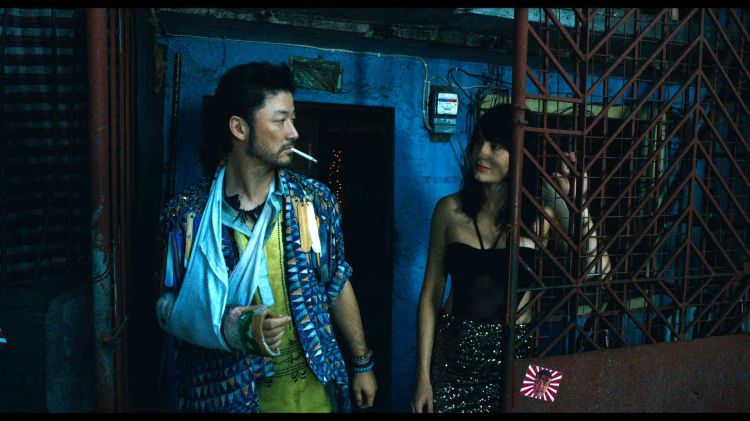
100% did not notice that sticker while I was watching the film…

Just “another love story between a criminal and a whore” –  so subtitles maverick Filipino film director Khavn his latest effort, Ruined Heart (Pusong Wasak: Isa na namang kwento ng pag-ibig sa pagitan ng kriminal at puta), though like much in the film you could read quite a lot more intro those few words than their subtext suggests. Light on conventional narrative and almost dialogue free, Ruined Heart is the deconstruction of the classic B-Movie. We have our noble, broken hearted outlaw and our damaged princess in need of rescue but what we’re denied is the sense of moral righteousness that generally pervades in a B-Movie and particularly in a film noir. The picture Kavn paints is of a hellish world where violence reigns and love will always be defeated.

There’s little point trying to tease out the plot bar the above ideas. What we are presented with at the beginning of the film is our dramatis personae – archetypes of this modern myth: The  Lover (Elena Kazan), The Criminal (Tadanobu Asano), The Friend (Andre Puertollano), The Whore (Nathalia Acevedo), and The Pianist (played by Khavn himself), each profiled against a butterfly patterned curtain neatly echoing Branded to Kill. Our hero, the Criminal, bonds with the Whore after offing one of her Johns, but their love is not to last after the Criminal decides to help The Friend rescue his Lover from the Godfather.

While all of this is going on we’re also treated to a far more surreal scene where the pianist reads out a street poem consisting of the repeated phrase “I am the poem of the world” before taking part in a bizarre ritual where he appears to resurrect the Godfather (Vim Nadera) who is now introduced for the first time. Is the pianist the god of this strangely operatic landscape, presiding over this violent world of song? For someone with such an elaborate introduction he makes relatively little impact thereafter. Is this hell, are we all dead already or merely doomed to relive these old stories over and over again to the point where names and language no longer have currency?

That said, there is something genuine to be found here in this otherwise cold landscape. The Criminal and The Whore find love against the odds though their romance is soon frustrated by the harshness of their world. They have fleeting moments of joy where they drink and dance and make music of all kinds. However, something is coming for them and however hard you try to escape there are things you cannot outrun.

Playing out more like an avant-garde opera than a conventional film, Ruined Heart offers little in the way of concrete explanations. Dripping with sometimes impenetrable symbolism the film paints an eerie, dream-like vision that often proves impossible to decode and like all the best poems, there are a hundred different ways to read it.

The score itself is an eclectic assault of catchy ’60s inflected broken heart ballads and electro pop, often repeating the same song in different arrangements (an apt stylistic choice given the nature of the film). Composed by a diverse collection of artists including French/German outfit Stereo Total who contributed to Third Window Films’ previous release pink musical Underwater Love, and Bing Austria & the Flippin’ Soul Stompers who provide the film’s catchy theme song, the musical element becomes the driving force of the film.

Shot with a youthful yet melancholy verve by Christopher Doyle, Ruined Heart is a high energy experience that proves difficult to digest, particularly on a first viewing. However, its extremely rich layers of symbolism and subversion of common archetypes lend it a mystifying and intriguing atmosphere that continues to fascinate long after the credits roll. More felt and experienced than understood, Ruined Heart may prove a difficult sell for some but comes bearing gifts for those that long to find them.


Ruined Heart is available on blu-ray in the UK now from Third Window films in a limited edition package which also includes a soundtrack CD (highly recommended for the CD alone). The blu-ray disc also includes Khavn’s short film with the same title and a similar theme (though filmed in an entirely different style and with a different cast).

First saw the film a couple of months ago and still can’t get this song out of my head.

Trailer for the film

http://www.youtube.com/watch?v=HPAGcbg2bww


Miss Granny (수상한 그녀, Hwang Dong-hyeok, 2014)

131212-001_1401140436597Review of Hwang Dong-hyeok’s age swap comedy Miss Granny (수상한 그녀, Soosanghan Geunyeo) up at UK Anime Network.


Miss Granny is something of a departure for Korean director Hwang Dong-hyeok whose previous two films have both explored fairly weighty subjects firstly in The Father which, based on a true story, features an American adoptee looking for his father only to find him languishing on death row, and more recently in Silenced (also known as The Crucible) which depicted the harrowing, and again true, events that occurred at the Gwangju Inhwa School for the Deaf in which pupils were routinely abused by teachers and staff. So far as we know, Miss Granny is not based on a true story and is a more mainstream comedy in which a “difficult” old lady suddenly finds herself transformed into her 20 year old self.

At the beginning of the film, Oh Mal-soon is a bad tempered 74 year old woman who terrorises everyone around her into submission including her middle aged daughter-in-law who eventually lands up in the hospital with a heart condition that may in part have been brought on by Mal-soon’s constant criticism. Mal-soon’s son faces an impossible choice, ship his mother off to a home and give his wife some peace or risk losing either his marriage or his wife by keeping his mother around. Heartbroken at the thought her son maybe about to abandon her, Mal-soon wanders around the city before deciding to enter a mysterious portrait photographers and dolling herself up for a “funeral photo”. However, when she emerges she’s mysteriously transformed into a lithe and pretty 20 year old! Suddenly young again with potentially a whole life in front of her, what sort of choices will Mal-soon make this time around?

Much of the comedy of Miss Granny centres around the young Mal-soon, renamed Oh Doo-ri after her favourite actress, Audrey Hepburn, speaking and acting as if she really really were a 74 year old woman with all of the freedoms (and the invisibilities) that age grants you. Snapping away in her thick rural dialect and handing out unsolicited advice in the way only a nosy old woman can, Doo-ri is a very strange, and perhaps a slightly frightening, young woman. Undoubtedly, as we find out, Mal-soon has had a difficult life – starting out as an upperclass woman before becoming a young, penniless single mother dependent on the kindness of others and doing everything in her power to ensure that her son will grow up a fine man. Life has made her hard and in turn she makes things hard for all around her.

As a young woman she’s initially much the same yet comes to understand something of who she was and who she is. In her younger days she dreamed of being a singer and even as an old woman was well known for her fine voice. After unexpectedly jumping up to sing at a senior’s event in order to best another old lady rival, she’s “discovered” by a producer who’s tired of all the soulless idol stars who walk across his stage. Doo-ri is exactly what he’s been looking for, a young and pretty face with a voice that’s full of a lifetime’s heartbreak. Here is the real coup of the film – the younger actress, Shim Eun-kyung, reinterprets these classic pop songs from 40 years ago beautifully with exactly the right levels of pain and regret perfectly matching the montage flashbacks to Mal-soon’s youth. Becoming young again, experiencing everything again as if for the first time – opportunity, romance, friendship, Mal-soon finally begins to soften as if some of the harsh years of her original young life had been smoothed away.

Of course, nothing lasts forever and Mal-soon eventually has to make a choice between her newly returned youth and something else precious to her. She comes to understand that however hard it was she’d do it the same all over again because the same things would always have been the most important to her. Though it’s far from original and drags a little in the middle, Miss Granny still proves a warm and funny tale that walks the difficult line between serious and funny with ease and throws in a pretty catchy soundtrack to boot.


Reviewed at the London Korean Film Festival 2015.

Also here is one of the musical sequences in the film – I think this is a famous song from the ’70s (?) called White Butterfly. ‘Tis quite beautiful (mild spoilers for the film as it includes a montage of Mal-soon’s youth in the ’60s).


Ode to My Father (국제시장, JK Yoon, 2014)

ode_to_my_father_stillReview of JK Yoon’s Ode to My Father (국제시장, Gukjeshijang) – first published by UK Anime Network.


Of late, we’ve seen a lot of films attempt to trace the history of a nation through the story of one man and his family which ultimately becomes a metaphor for the that of the land itself. Many of these have come from China which shares something of the turbulent history that has affected the Korean peninsula over the last hundred years. In Ode to My Father, director JK Youn has tried to pay tribute both to his own father and to all the fathers of modern Korea who underwent great difficulties and suffered immensely in the hope of building a better, happier, future for their own children.

Mostly we view events from the point of view of Duk-soo – an old man at the beginning of the film who has made a success of himself and is surrounded by a large, loving family though seems to retain a kind of unresolved sadness. When we travel back with him, he’s just a small boy fleeing his homeland with his parents and siblings. As the oldest, he’s put in charge of his sister only to have her cruelly snatched away from him during the final escape. This event colours the rest of Duk-soo’s life as he carries with him both the tremendous guilt of having failed to protect his sister and of losing his father has he went back to look for her. The remaining family members gather together at the small imported goods shop belonging to an aunt which becomes another motif of the film.

Growing into manhood, Duk-soo is now the man of the house with both his siblings and his mother to provide for. Making countless sacrifices which see him abandoning his own dreams and travelling abroad to seek better paid work – first in the coalmines of West Germany and later the warzone of Vietnam, Duk-soo puts his family before himself every single time. Working tirelessly, Duk-soo grows up but inside he’s forever the little boy on a boat watching his father drift away him and desperately hoping he’ll some day miraculously turn up at the shop with a smile and an improbable story.

This is a story of painful separations and the shockwaves they send through the rest of one’s life and of all the lives throughout history. Having fled the Chinese and the communists in the North, Duk-soo and his family are excited about the prospect of being able to go home at the “end” of the war. However, this is a war which is still not technically over, merely suspended by a truce, and Duk-soo will never see his hometown again. Eventually, during the ‘80s, 30 years since Duk-soo was separated from his father and sister, a nationwide campaign is held to try and re-unite family members forced apart by the traumatic events of the 1950s. Entire squares in the city are covered with people desperately looking for each other wearing signs with their relatives’ names and point of last sighting, clothing etc all in the hope of finally finding each other again. Needless to say, some of these people are luckier than others and there are tears of both joy and sadness.

Still, all in all, Duk-soo and South Korea made a success of themselves even if there’s a resulting ache from the great wound which has split the nation in two. Much of the story is universal – a father’s love for his family, but Ode to My Father will obviously speak loudest to Koreans who can identify more strongly with the historical context. Yoon has also injected some humorous incidents involving real life Korean historical celebrities which may mystify international viewers even if they’re sign posted well enough that one gets the gist of it anyway.

Unabashedly sentimental and oftentimes overblown, Ode to My Father nevertheless succeeds in tugging at the heartstrings in all the intended ways. A paean to the post war generation and all that they endured in building the modern Korea that their children could live in without fear or hunger, Ode to My Father is in the end far too sugary but also, it has to be said, affecting.


Reviewed at the London Korean Film Festival 2015.


Fires on the Plain (野火, Shinya Tsukamoto, 2015)

fires on the plain 2015 posterShinya Tsukamoto is back with another characteristically visceral look at the dark sides of human nature in his latest feature length effort, Fires on the Plain (野火, Nobi). Another take on the classic, autobiographically inspired novel of the same name by Shohei Ooka (previously adapted by Kon Ichikawa in 1959), Fires on the Plain is a disturbing, surreal examination of the effects of war both on and off the battlefield.
Late in the war when it’s almost lost though no one wants to admit it, Corporal Tamura (Shinya Tsukamoto) finds himself suffering with TB on the Philippine island of Leyte where supplies, and tethers, are running short. Shortly after being punched in the face by his commanding officer, he’s given five days’ worth of supplies and ordered to march to the field hospital for treatment as no one wants a sick man weighing down the unit. Only, when he finally arrives at the field hospital, they have their hands full (literally) with the battlefield wounded. Marching back to his unit again, Tamura is ordered back to the field hospital and told to use his grenade to ease the burden on his fellow soldiers if refused. So begins Tamura’s fevered, mostly solitary odyssey across the beautiful landscape of the Philippine jungle suddenly scarred with corpses, the starving and the mad.

Tsukamoto’s adaptation sticks closer to the original novel than Ichikawa’s 1959 version, though both eschew Ooka’s Christianity. Tamura is a man at odds with his fellow soldiers. Formerly a writer he’s “an intellectual” as one puts it, and a little on the old side for a corporal. Coughing and wheezing, he shuffles his way through just trying to survive. Unlike Ooka’s original novel in which the protagonist’s Catholicism makes suicide an unavailable option, it’s the memory of Tamura’s wife which stays his hand on the pin of his grenade. Tamura wants to go home, to escape this hellish island full of the walking dead, hostile locals and hidden clusters of enemy troops.

To get home, to survive, what will it cost? There was barely any food left to start with. The original five days’ worth of rations Tamura was given amounted to a handful of yams. On his second trip to the military hospital he was given nothing at all. There’s no wildlife, even if you manage to find some plant roots they’ll need cooking. Of course, there is one abundant source of food, except that it doesn’t bear thinking about. Tsukamoto’s version takes a less ambiguous approach to the idea of cannibalism than Ichikawa’s which removed Tamura’s moral dilemma by having his teeth fall out through malnutrition and rendering him unable to indulge in “monkey meat” even if he might have succumbed. Death feeds on death and there’s no humanity to be found here anymore where men prey on men like animals.

There’s no glory in dying like this. Half starved, half mad and baking to death in the heat of a foreign jungle abandoned by your country which cared so little for its men that it never thought to conserve them. When you make it home, if you make it home, you aren’t the same you that left. The things you had to do to get there stay with you for the rest of your life, and not just with you – with all of those around you too. Wars don’t end when treaties are signed, they survive in the eyes of the men who fought them.

A timely and a visceral look at the literal horror of war, Tsukamoto’s Fires on the Plain is a refreshingly frank, if stylised, examination of the battlefield. Limbs fly, heads explode, organs are exposed and brain fragments leak out of ruined corpses. At any other time, Leyte would be a paradise of lush vegetation, colourful flowers and beautiful blue skies but it’s corrupted now by the fruits of human cruelty. This is what it means to go to war. There’s nothing noble in this – just death, decay and eternal grief. Though the film often suffers from its low budget and some may be put off by the stark, hyperreal cinematography, Fires on the Plain is another typically troubling effort from the master of discomfort and comes as a warning bell to those who still think it is sweet and fitting to die for one’s country.


Reviewed at Raindance 2015.

Original trailer (English subtitles)

First published by UK Anime Network.

My Man 私の男 (Kazuyoshi Kumakiri, 2014)

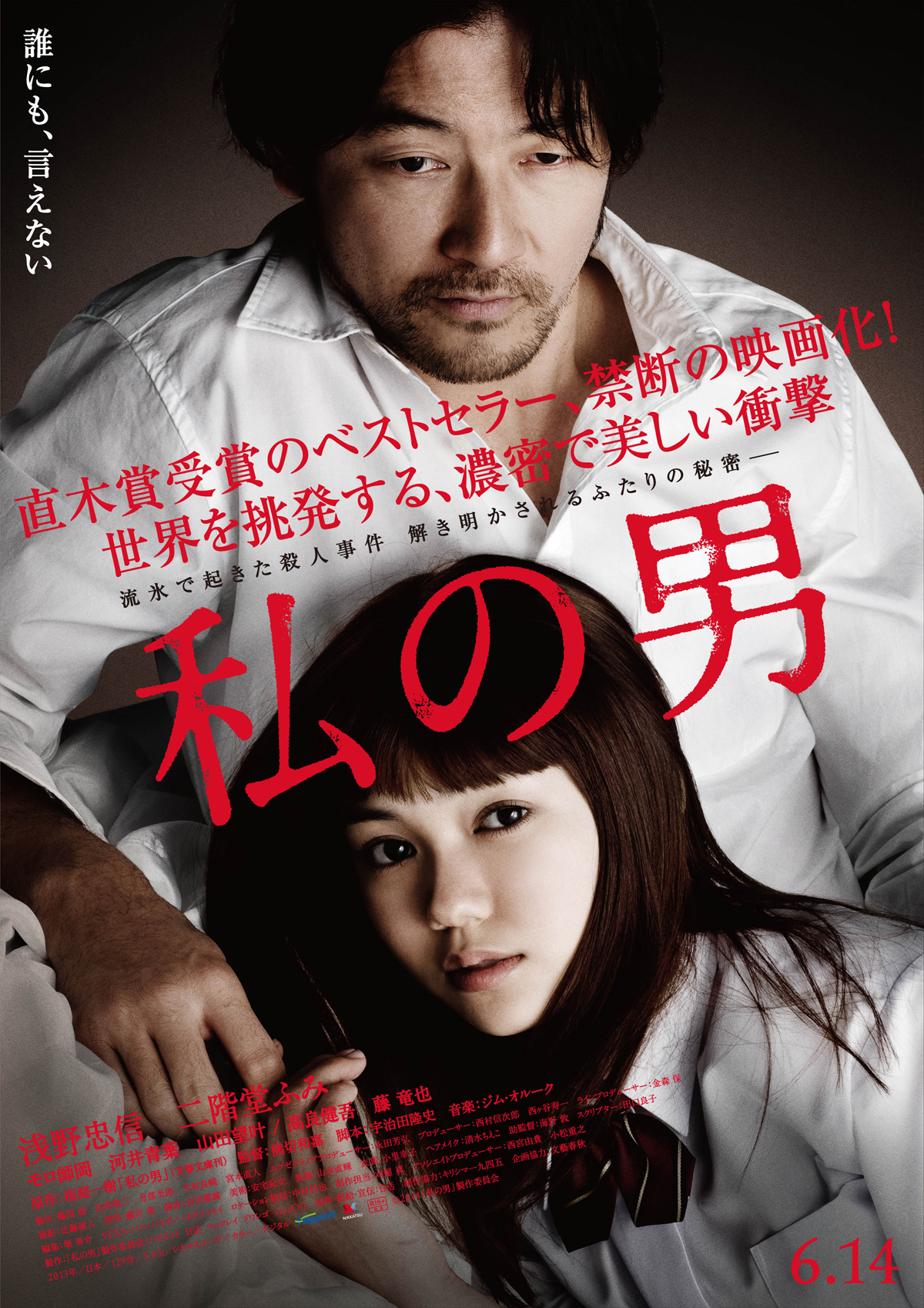
162276_02Based on the Naoki Prize winning novel by Kazuki Sakuraba, My Man tackles the difficult subject of a quasi-incestual “love” affair between a young orphaned girl and the “distant” relative who adopts her as his “daughter”. Though this taboo subject has never been far from Japanese screens (find me an art film from the ’60s which doesn’t involve incest in some way), My Man dares to examine in it in all its realistic muddiness and is marked by nothing so much as its raw intensity. Brought to the screen by Kazuyoshi Kumakiri whose last picture Summer’s End chronicled the romantic and existential dilemmas of a woman approaching middle age, My Man is a disturbing and unsettling film which poses a fair few unpleasant questions about the nature of familial and romantic relationships.

The film begins with a young girl, Hana, crawling away from a scene of intense devastation. Finally ending up at a refugee centre, it seems that Hana’s entire family have been killed in a natural disaster. Creeping back to her house, Hana is discovered by a rescue worker, Jungo, who by coincidence happens to be a distant relative of hers. Asked who the little girl is, Jungo immediately asserts that she is his daughter and there after claims her as his own. The pair continue to live together in a small, seaside Hokkaido town until Hana reaches middle school age at which point their relationship changes and the lines between father/daughter and husband/wife become exceedingly blurred. Only growing in intensity, the two will eventually even go so far as to kill to protect their illicit relationship which eventually takes them to the comparatively more anonymous Tokyo but what the outcome of their unconventional bond will ultimately be, only time will tell.

Hana and Jungo are both people in search of “family” and unbreakable bonds. Hana, having just lost her entire world in a tsunami is haunted by nightmares of being carried by her desperate father running from the coming storm but comes to see her new guardian Jungo as something more than a paternal figure. Jungo, as the kindly uncle Oshio remarks, is the sort of man who shouldn’t have a family. At this point, we don’t know why Oshio feels this way, merely that people seem uneasy in Jungo’s company and there’s something a little strange in his bearing and in his willingness to adopt an orphaned little girl with very little consideration. Though they are described as “distant” relatives, Jungo spent sometime in Hana’s familial home just before she was born and claims to have had a fondness for her mother – perhaps not such a “distant” relative after all.

In fact, Hana comes to feel an indestructible bond with Jungo precisely because of their blood ties. She believes he may be her true father and makes him also her carnal lover. Hana’s possessiveness begins almost at the beginning of their relationship with a repeated motif where she sucks on his fingers which takes on an increasingly erotic context as the film goes on. Seeing off Jungo’s more age appropriate girlfriend, Komachi, Hana delights in her triumphant ownership of Jungo decrying that he needs a blood relative and nothing else will do. Horrified, Komachi eventually leaves the area altogether and Hana and Jungo to their strangely intense “family” life. When Oshio accidentally discovers what exactly goes on in their household and comes to the conclusion Hana may once again need rescuing, talking may not quite be enough. Though their relationship has crossed social taboos the pair see nothing wrong in it yet are afraid of the possibility of being discovered and will go to great lengths to protect their illicit secret.

The tale starts to lose momentum a little after the move to Tokyo but it’s here that the central problem makes itself most plain. Jungo, having left the sea behind him, works as a cab driver in the city but eventually drifts into a life of aimless alcoholism as Hana grows up and away from him. “I just want to be a father” he cries after having just had a bizarre and humiliating encounter with a would be suitor of Hana’s. “You’re not good enough” he tells him, a repeated phrase offered to another of Hana’s men at the end of the film – fatherly words, but tinged with the jealousy of a rival. In the end, it seems as if Hana may have abandoned their “family” for a more conventional life, however, in a telling sequence set in a restaurant everything else appears to disappear leaving just the two of them isolated in their own world. Flirtatious and possessive, theirs is a bond which will truly never be broken, for better or worse.

Kumakiri shoots this bleak tale in a mostly naturalistic style occasionally giving way to expressionism and snaps of non-linear editing. In a pivotal scene as Jungo and Hana indulge their carnal passions one morning before school, the entire room rains blood – first falling as droplets on Hana’s back before becoming a torrent which leaves them both stained crimson. A blood wedding or presaging their further transgressions, this startling moment is only one of Kumakiri’s impressively nuanced symbolic touches. Though the film has its B-movie, melodramatic elements, Kumakiri has been able to integrate these into his slightly elevated tone with little difficulty to create a modern, melancholic mood piece which is rich with mystery and only hinted at implications.

Another interesting film from Kumakiri, My Man is an impressively directed dissection of its difficult subject matter. Anchored by extraordinary performances from Tadanobu Asano and particularly from Fumi Nikaido as the complicated and conflicted Hana, Kumakiri thankfully keeps the sleaze factor low though simmering enough for its necessary impact. It may not be a pleasant watch, but for those who can bear its unrelenting melancholy My Man offers a fascinating portrait of the modern family in crisis.

When Marnie Was There 思い出のマーニー (Hiromasa Yonebayashi 2014)

When-Marnie-Was-There-GhibliPerhaps the final effort from Studio Ghibli, When Marnie was There is directed by Hiromasa Yonebayashi whom some had seen as a potential successor to the company though it seems he too has now left Ghibli’s employ! Like Yonebayashi’s previous film The Secret World of Arriety, Marnie is also based on a vintage British children’s book – this time by Joan G. Robinson, though When Marnie Was There hasn’t enjoyed the same level on ongoing popularity as The Borrowers (maybe because it hasn’t received the same kind of televisual treatment as Mary Norton’s novels). Nevertheless, Marnie has been successfully shifted to modern day Japan whilst still managing to feel quite like ’60s England.

Anna is a solitary 12 year old orphaned girl living with her adoptive parents in Sapporo. A constant worry to her fretting mother, Anna suffers from severe asthma and has received complaints at school regarding her aloofness and seeming inability to make friends. Part blaming herself and her often absent husband, Anna’s mother decides to send her to the country for a while over the summer, hoping both that the clean air will be good for her lungs and a change of scene might help bring her out of herself. After arriving at a small seaside town to stay with some relatives of her mother’s, Anna hears tell of a mysterious grain silo which the local children think is haunted and also becomes strangely drawn to an apparently empty Western style mansion. Anna starts to dream about the house and eventually ends up meeting a mysterious and cheerful blonde girl there dressed in a distinctly old fashioned style. Though opposites in many ways the two have more than you might expect in common and quickly become firm friends. However, why can’t Marnie go very far from the mansion and why doesn’t anyone else seem to know about her? Only through solving the mystery of Marnie can Anna unlock the secrets that have been causing her pain in her own life.

Perhaps oddly, there are a lot of similarly themed children’s books from this period – enough to form a small genre all of their own though there are certainly much more well known examples than When Marnie was There. They are in fact so well known that to name any one of them might accidentally spoil the story but any British adult over 30 who grew up reading this kind of material or watching the numerous television adaptations has probably already figured out where this is going. Having said that, the film at least deviates from the norm in that the country relatives are actually nice if content to let Anna figure herself out while she’s there rather than the stern guardians you often see which necessitate the children getting out of the house to go on their adventures. Likewise, generally the stories focus on the accidental friendships developed by (oftentimes originally mismatched) children as they investigate whatever mystery has arisen – though Marnie has this, it leaves it as a nice, subtle detail that actually pays off in the end. Thankfully, though the resulting story is sad, there’s nothing really malevolent lurking and the resolution is such that it allows the central characters to close the loop on a traumatic event with their memories returned to them so they can move on with their lives.

By and large, the animation is just as impressive as any other Ghibli movie (though perhaps unremarkable by their very high standards). The pacing is, at times, strange – particularly the last segment in which the revelation is played as one long narrated tale, but Yonebayashi has been able to imbue this little seaside village with plenty of character full of tiny details and a fully realised life of its own. Though it’s a little more obviously sentimental than many of Ghibli’s other works and eschews some their more usual concerns, When Marnie was There stays true to the emphasis on the importance of friendship, loyalty and decency that has long been a mainstay in Ghibli movies. Unlike The Wind Rises or Princess Kaguya, this one is firmly aimed at girls of around the protagonist’s age and may have a little less to offer to those outside of it but its tale of adolescent connection still rings true.

Some might claim it’s second tier Ghibli, and they might be right, but even second tier Ghibli is still a ways ahead of most other animation. An old fashioned children’s mystery melodrama with friendship at its heart, When Marnie was There doesn’t exactly break any new ground but it does offer an intriguing tale told with characteristic warmth and intelligence by the promising young director Yonebayashi.

Monsterz (2014)

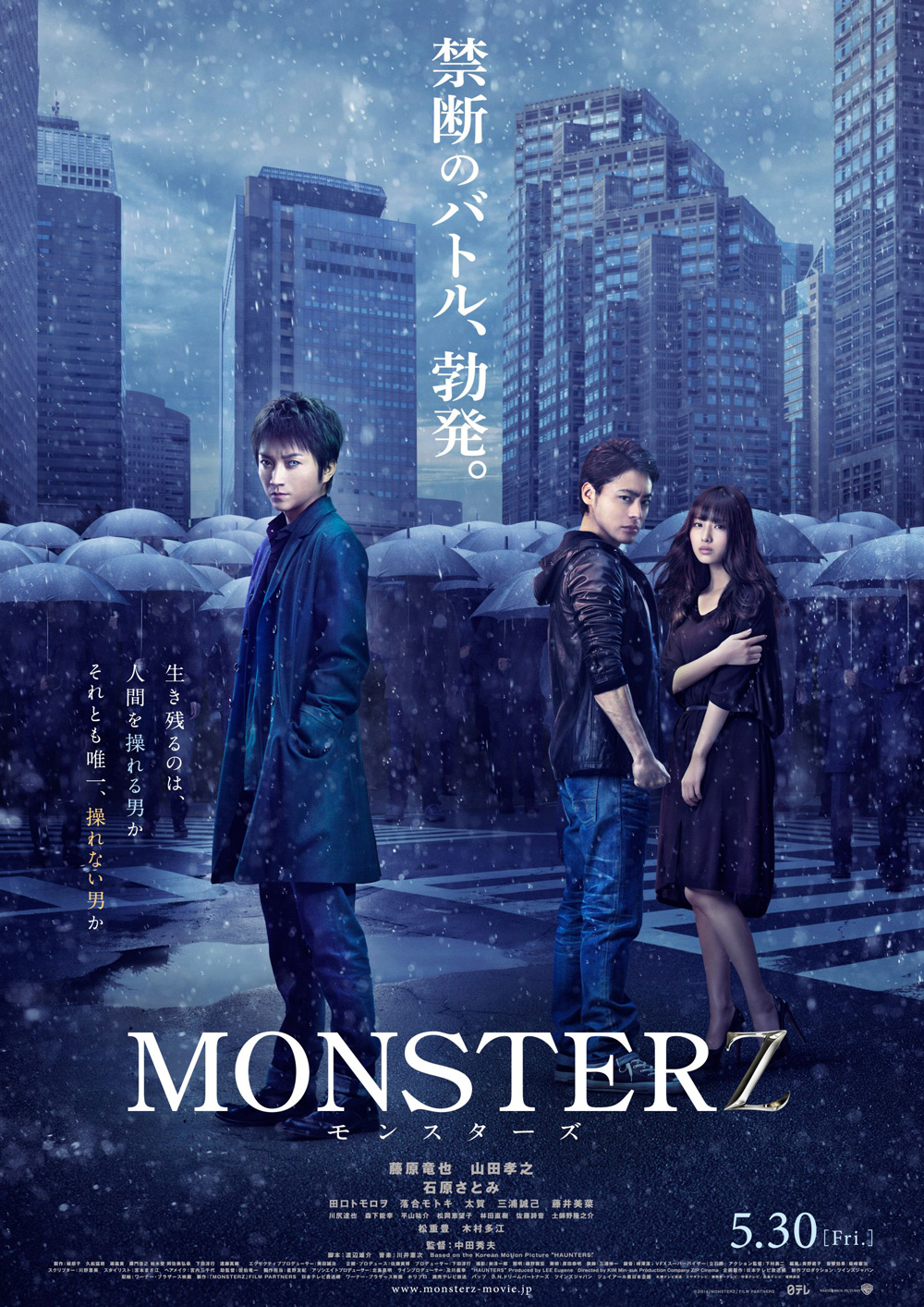
Monsterz_2014Hideo Nakata is best remembered as one of the driving forces of the J-Horror boom of the late ’90s thanks to his hugely influential Ring movies. However, despite a few notable hits including Dark Water, his career has seen something of a slump following a foray into American filmmaking with The Ring 2 – a sequel to the remake of his own Ring (though entirely different from his Japanese language Ring 2 completed in 1999). Monsterz sees him helming a remake of another foreign property – this time the Korean sci-fi thriller Haunters.

The film begins from the POV of Monster no. 1 (played by Tatsuya Fujiwara), who narrates much of the story and refers to himself solely as “monster”. Blindfolded, a small boy is dragged home by his mother only to be discovered by his abusive father who beats him and berates his mother whilst insisting “the monster” needs to die. At this point the blindfold comes off and the boy controls his fathers actions eventually persuading him to snap his own neck. Beginning to also control his mother, the boy stops short of giving her the same treatment and wanders off into the rain. Fast forward 20 years and the monster is now a criminal mastermind who uses his time freezing and mind control capabilities to make a living as a bank robber. However, one day he discovers someone who seems to be immune to his powers (Takayuki Yamada) and his whole world is shaken. The monster sets about removing this threat to his supremacy but it appears his opponent is also “a monster” – a man with super healing properties who cannot die! It takes a “monster” to fight a monster but which one will come out on top?

Yes, lots of predictably comic book style action adventures begin as the two guys with opposing super powers face off against each other. The most interesting aspect of the film is that it’s mainly told from the point of view of the otherwise unnamed “monster” though Nakata’s attempts to make him a sympathetic anti-hero never quite work out despite Fujiwara’s committed performance. The film’s ending is also unconventionally unresolved (though also very true to its American comic book roots) with a pleasing note of tolerance and inclusivity thrown in. However, that is in part facilitated by the lack of tension in the central dynamic – the two opposing forces are at a perpetual stalemate which only ends up feeling, well, stale – in a word. The monster’s freezing and mind control powers are impressive but the action sequences are much of a muchness and just get bigger rather than more interesting.

Having said that the action sequences aren’t unexciting, there are some impressive moments (bar the odd use of dodgy CGI and green screen). The main problem with the film is a slight mismatch in tones between Nakata’s portentous doom laden fatalism and the playful lightness of its comic book inspiration. The conventional hero, Shuichi, takes second lead here with his gang of sidekicks – otaku Akira and flaming queen Jun offering odd moments of comic relief. Though actually the role of Jun is another interesting inclusion as, despite offering a stereotypically “gay” character camping things up spectacularly, Jun is also presented fairly normally as a valued friend and comrade of the hero. His sexuality is merely a character trait, never a joke in itself which is a refreshing element particularly in a Japanese film. In the end, Monsterz aims to offer a message of tolerance and inclusiveness – that, oddly, there are no monsters and would be no villains if we could all just learn to accept each other’s differences and live together in harmony. However, the message is a little hamfisted and clumsily delivered and, some might feel, out of place in an action orientated film such as this.

Very typical of the comic book movie genre (though perhaps more Fantastic 4 than Dark Knight), Monsterz is middling mainstream fare which, while mildly diverting, fails to offer anything particularly memorable. A fine way to spend 90 minutes, Monsterz never outstays its welcome and offers generally high production values plus Nakata’s trademark visual flair but is unlikely to satisfy more genre savvy fans.