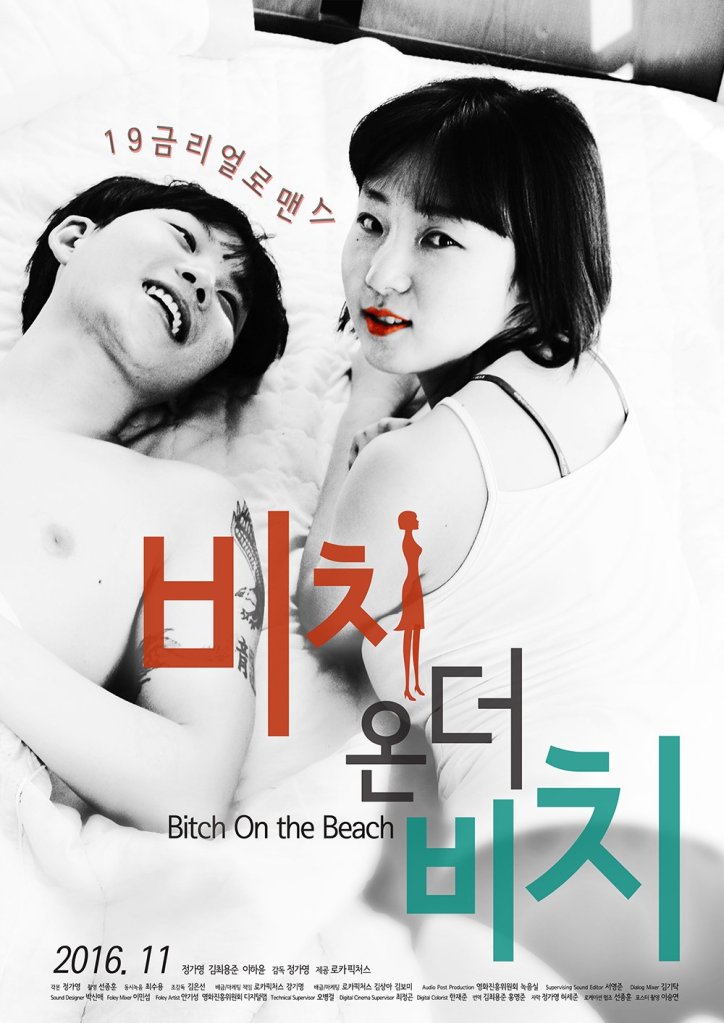
 Do you know Hong Sang-soo? So asks the heroine of Miss Ex (비치온더비치, Bitch on the Beach) as part of her nefarious mission to win back her childhood sweetheart. Unfortunately, his reply is to ask if he directed The Host, so Ga-young (Jeong Ga-young) is out of luck with her Dark Knight loving former love, but possibly in luck with us as her movie obsessed ramblings and strange stories about accidental AIDS tests during wisdom tooth extractions continue to dominate the screen for the next 90 minutes. Divided into three chapters and filmed in an oddly colourful black and white, director and leading actress’ Jeong Ga-young’s debut feature channels Hong Sang-soo by way of Woody Allen and the French New Wave but may prove funnier than all three put together.
Drunken Ga-young has invited herself over to her ex’s flat with the express intention of seducing him. Jeong-hoon (Kim-Choi Yong-joon) is sort of fed up with this kind of thing, in fact he has Ga-young listed in his phone under the name “do not answer” but she manages to bamboozle him into opening the door anyway. Ga-young has quit her job to pursue a career in the movies, though it seems she’s not having much success. Jeong-hoon knows she only calls him for a shoulder to cry on when she’s fed up but falls for it anyway. He has a girlfriend and makes it clear he’s not up for any funny business, but Ga-young is quite determined – only time will tell if Ga-young will get what she came for, or if she even really even knows what that is.
Miss Ex was originally titled “Bitch on the Beach” in Korean which, seeing as there are no beaches in this film, seems to be an obvious reference to the Hong Sang-soo movie Woman on the Beach – a similarly reflexive exercise about a film director and his relationships with a number of women who only really become fodder for his screenplay. Filming in black and white with simple, static camera set ups and concentrating on the amusing banter between its two leading characters credited only as “woman” and “man”, Hong’s influence is palpable. Ga-young is, however, a true cinephile who, after finding time to express her boredom with The Dark Knight, goes on to detail her strange dreams about other famous directors such as Bong Joon-ho (who really did direct The Host) and arguably Korea’s greatest living filmmaker Lee Chang-dong whom she asks to be her assistant director(!).
It’s fair to say the banter is more or less one sided as Jeong-hoon is forced to listen to Ga-young’s increasingly bizarre stories. Surprisingly frank and forthright in talking to her ex-boyfriend, Ga-young proceeds to tell him about various other men in her life, her sexual desires and preferences, and even those of her friends. Jeong-hoon listens patiently with occasional bemusement, but their relationship is close enough to be totally open without causing too much of a problem. Despite his protestations it’s clear Jeong-hoon is still on the hook for Ga-young, which she clearly knows, but it’s a little less clear whether she’s just keeping him there for convenience’s sake or is actively trying to win him back.
Even if Hong Sang-soo is the obvious reference point, he is after all referenced in the text, Miss Ex also owes a debt to the breeziness of the French New Wave and its freewheeling absurdity. Cutting between amusing silliness and understated emotional drama Miss Ex is perfectly posed to examine the various trials and tribulations of romance among contemporary young people. Ga-young is, perhaps, too modern for the slightly more conservative Jeong-hoon who tells her that her problems with men mostly stem from being too quick to take the lead and also constantly picks her up on her “unladylike” colourful language. One gets the impression Ga-young might not be very good for Jeong-hoon who eventually jeopardises his relationship with his current girlfriend to keep her happy, but whatever anyone else thinks about it, it seems as if he won’t be giving up on her any time soon. Cute, quirky and extremely smart, Miss Ex is an accomplished debut from director and leading lady Jeong Ga-young who marks herself out as an interesting new indie voice in Korean cinema.
Reviewed at the 2016 London Korean Film Festival.
Original trailer (no subtitles)

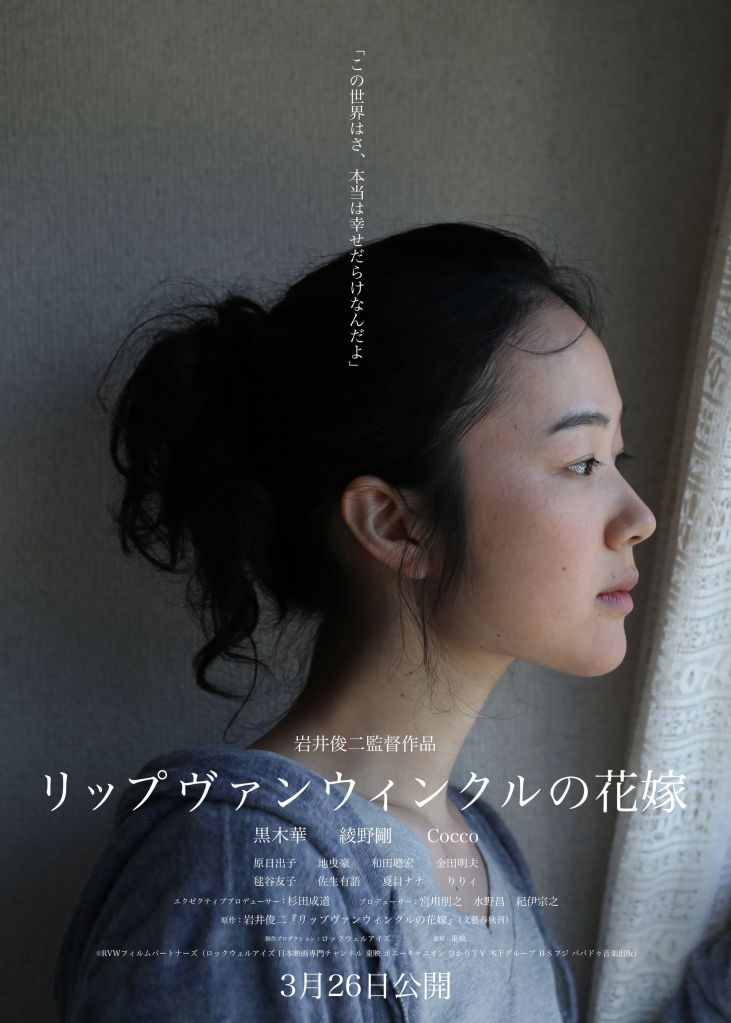 “Being naked in front of people is embarrassing” says the drunken mother of a recently deceased major character in a bizarre yet pivotal scene towards the end of Shunji Iwai’s aptly titled A Bride for Rip Van Winkle (リップヴァンウィンクルの花嫁, Rip Van Winkle no Hanayome) in which the director himself wakes up from an extended cinematic slumber to discover that much is changed. This sequence, in a sense, makes plain one of the film’s essential themes – truth, and the appearance of truth, as mediated by human connection. The film’s timid heroine, Nanami (Haru Kuroki), bares all of herself online, recording each ugly thought and despairing notion before an audience of anonymous strangers, yet can barely look even those she knows well in the eye. Though Namami’s fear and insecurity are painfully obvious to all, not least to herself, she’s not alone in her fear of emotional nakedness as she discovers throughout her strange odyssey in which nothing is quite as it seems.


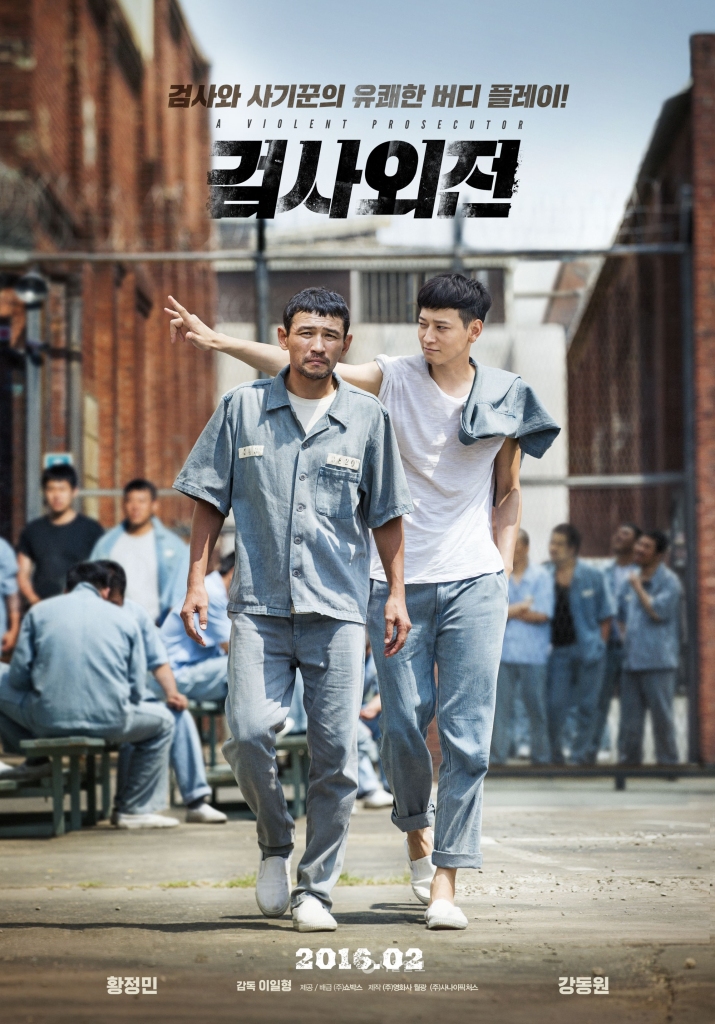 Review of Lee Il-hyeong’s A Violent Prosecutor first published by
 Politics in South Korea has never been exactly drama-free, though recent times have seen a multitude of storms engulf its top brass running from the national to the personal. Frequent Park Chan-wook collaborator Lee Kyoung-mi’s followup to her acclaimed 2008 debut Crush and Blush, The Truth Beneath (비밀은 없다, Bimileun Eobda) begins as if it’s going fit into the ‘70s dark political thriller mould but gradually shifts gear to present both a bleak family drama and the story of one woman’s descent into the near madness of grief as she attempts to uncover the true circumstances behind her private tragedy even as it plays out on a national stage.
 When it comes to intelligent farce, Kenji Uchida is Japan’s undisputed master so remaking his 2012 tale of love, crime, and mistaken identity Key of Life was always going to be a tall order. Thankfully it’s one Lee Gye-byeok largely manages to meet as he skilfully relocates the tale to South Korea and swaps Uchida’s complicated farce for a more lateral double sided comedy. While not as accomplished as Uchida’s hilariously intricate original, Luck-key (럭키) manages to charm with its thoroughly romantic, comically absurd, approach.
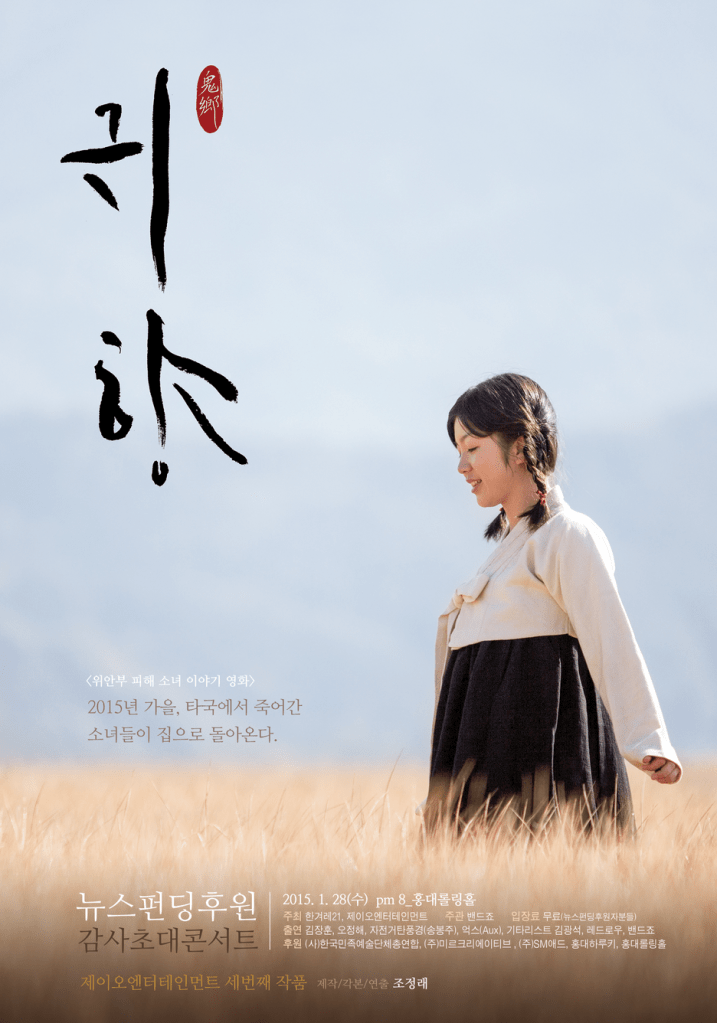 Of all the awful things that happened in the middle part of the 20th century, the trafficking, incarceration, enslavement and forced prostitution of women and girls from across Asia (including at least 65 Dutch women in what is now known as Indonesia) who were abducted for use as “comfort women” by the Japanese military remains one of the least discussed and most controversial. The issue (arguably) runs most deeply in Korea which had been experiencing a prolonged and often brutal era of colonial rule even prior to the intensification of hostilities in the early 1940s. The torment these women faced did not end with the ceasefire as entrenched social attitudes left them not only with a lifetime of physical and psychological trauma but also internalised shame which made it difficult for them to talk about their experiences even to those closest to them. Now more than ever, it is important that this story be told and the long suffering of these women, many of whom are no longer with us, is finally acknowledged.
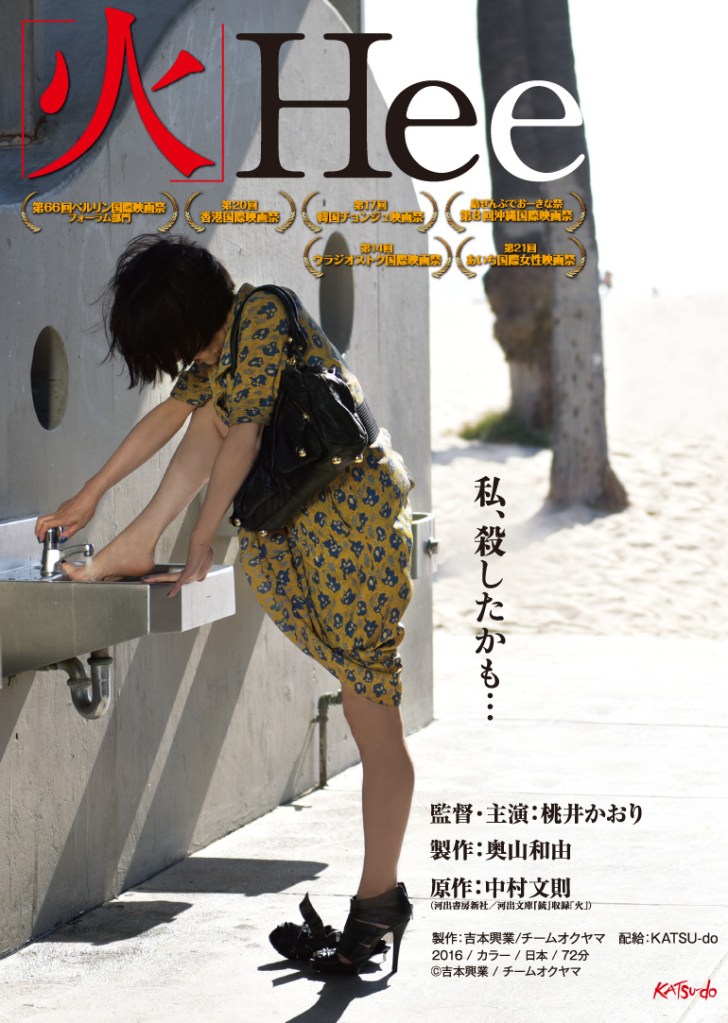 One of Japan’s best known actresses with a career spanning over forty years, Kaori Momoi is perhaps just as well known for her outspoken and refreshingly direct approach to interviews as she is for her work with such esteemed directors as Akira Kurosawa, Kon Ichikawa, Yoji Yamada, and Shohei Imamura. One of the few Japanese actors to have made a successful international career starring in Hollywood movies such as Rob Marshall’s Memoirs of a Geisha and international art house fare in Alexander Sukurov’s The Sun, Momoi currently lives in LA and is even reportedly preparing to play Scarlett Johansson’s mother in the upcoming US live action adaptation of Ghost in the Shell. It’s perhaps less surprising then that in choosing to adapt a short story by one of Japan’s best young writers, Fuminori Nakamura, Momoi has chosen to shift the story to LA whilst maintaining its Japanese characters.
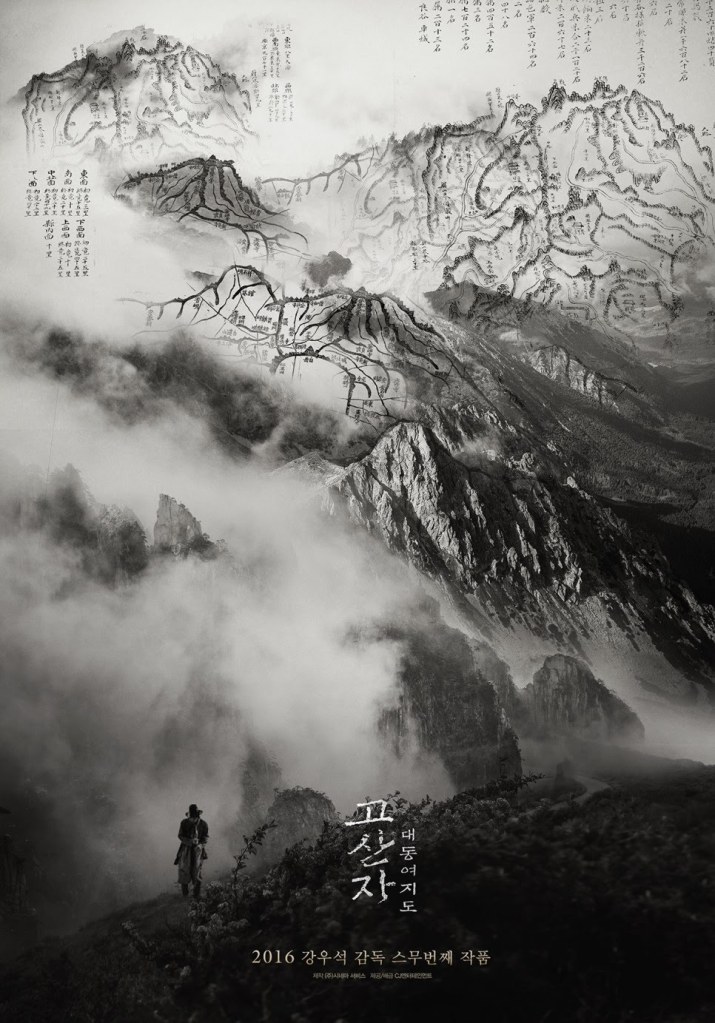 The map is not the territory – as the old adage goes. There’s always a difference between the thing itself and the perception of it but, as the “hero” of The Map Against the World (고산자, 대동여지도, Gosanja, Daedongyeojido) points out, if you’re about to set off on a long journey it’s a good idea to not to rely on a linear map else you’ll run out of good shoes long before you reach your destination. Kim Jeong-ho (Cha Seung-Won) was, apparently, a real person (though little is known about him) who set out to make a proper map of the Korean peninsula after a cartographic error led to the death of his father and many other men from his village when they ran out of resources crossing what they thought was one mountain but turned out to be one mountain range.
 Windows on Worlds