N@NIMONO (何者, Daisuke Miura, 2016)

Nanimono posterGrowing up is a series of battles in Japan. Exam hell soon gives way to the freedom and liberation of university but students know that their carefree days of youth and discovery will be short lived. Job hunting is done en masse and takes place in the final year of study (or even before). The process of securing a work placement is much the same as deciding on which school to apply to – attending job fairs to meet with representatives, getting hold of brochures, talking to anyone and everyone you know about the various reputations of the big firms, and then figuring out what your best bets are. Many companies run written exams which are then followed by group interviews in which the applicants are made to answer humiliating questions in front of their fellow candidates. What this all amounts to is a gradual erasure of the self in order to become the perfect hire, making the same tired phrases sound interesting in an effort to say all the right things whilst trying not too seem calculating or too bland.

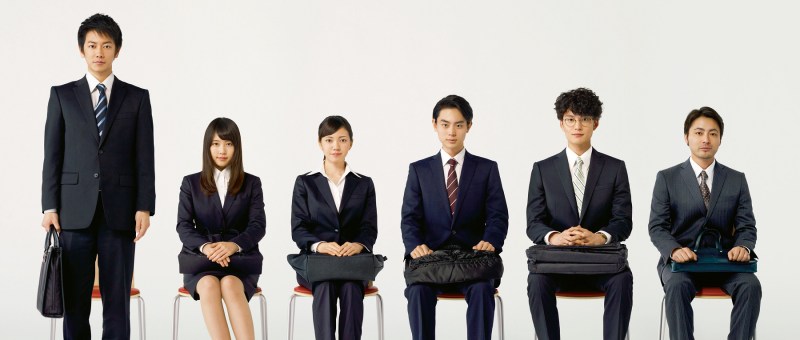
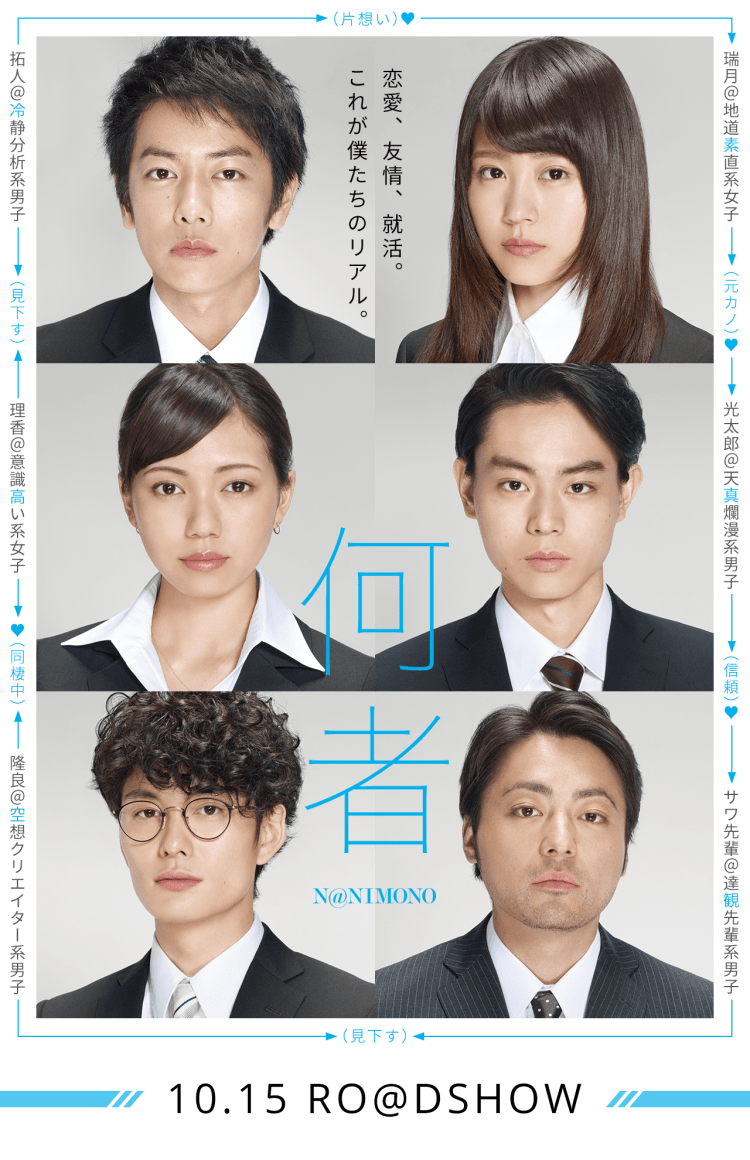
The group at the centre of Daisuke Miura’s adaptation of the Naoki Prize winning novel by Ryo Asai, N@NIMONO (何者, Nanimono, AKA Somebody / Someone), know this better than most. Protagonist Takuto (Takeru Satoh) used to be interested in theatre but has abandoned his dreams of the stage for the mainstream route into company life while his friend Kotaro (Masaki Suda) has played his last gig as the lead singer of a rock band, died his hair black again, and got a smart haircut in preparation for interviews. The boys are still good friends and roommates despite the fact that Takuto has long been carrying a torch for Kotaro’s former girlfriend, Mizuki (Kasumi Arimura), who has just returned from studying abroad. Mizuki is good friends with another girl, Rica (Fumi Nikaido), who happens to live upstairs from the boys and suggests that the four of them all get together to compare notes on the job hunting process. Rica lives with her boyfriend (still somewhat unusual in Japan), Takayoshi (Masaki Okada), who is working as a freelance journalist and is disdainful of the others’ passage into the regular workaday world but later tries to get into it himself.

There is a kind of sadness involved in this process, even if no one seriously thinks about fighting back. Everyone wants to get their foot onto that corporate ladder to become “someone”, at least in the eyes of society. There are a lot of rungs on the ladder to success, and if you miss your footing it’s near impossible to get it back – you’ll wind up one of the many crowded round the bottom staring up at the top even if you don’t want to admit it. University is the last time time there is real scope for indulging one’s personality before the corporate life takes hold – thus Takuto and Kotaro both accept that their artistic pursuits have to go in their quest for a regular middle-class life even if they inwardly struggle with their decisions to “sell-out”.

Takayoshi thinks of himself as above all this. He asks himself what all of this is for, why people put themselves through this humiliating ritual just to be locked into a nine to five that makes them miserable and turns them into soulless drones. There’s an obvious answer to that, and Takayoshi’s refusal to take it into account borders on the offensive, as does his often patronising attitude to those actively engaged in the job hunting process, but his hypocrisy is eventually brought home to him when he turns down a project to work with another artist because he thinks their work isn’t good enough. Maybe there’s courage in just putting something of yourself out there, even if it isn’t very good, rather than sitting at home looking down on everything and critiquing everyone else’s life choices whilst getting nothing done yourself.

It’s this conflict between interior and exterior life in which N@NIMONO is most interested. Main character Takuto begins as the everyman, depressed and stressed by his job hunting odyssey but aloof isolationism soon reveals itself as a kind of cowardice and self-involvement born of insecurity as he takes to a “secret” Twitter account for acerbic comments on his friends’ lives, sarcastically taking cruel potshots safe in the knowledge of his anonymity. Takuto’s entire concept of himself is a construction as his eventual descent into abstraction shows us in recasting his interaction with his friends as an avant-garde theatre show in which he finally begins to see the various ways his resentment of others is really just a way of expressing dissatisfaction with himself. This inability to fully integrate his own personality is offered as the final reason he hasn’t managed to find employment – his insincerity marks him out as a poor prospect. Takuto’s final realisation that he is unable to successfully answer the standard interview question “define your own personality in under one minute” for the perfectly sensible reason that the task is impossible kickstarts his own journey to a more complete life, even if it doesn’t do much to help the countless other “someones” out there hammered into a standard sized holes as mere cogs in the great social machine.


N@NIMONO seems to have been screened under the English titles of both “Somebody” and “Someone” but “N@NIMONO” is the one that features on the title card of the English subtitled Hong Kong blu-ray.

Original trailer (no subtitles)

https://www.youtube.com/watch?v=Ti0TMOtvUYI

Antiporno (アンチポルノ, Sion Sono, 2016)

Antiporno posterIf freedom exists in Japanese cinema, it exists only through sexual liberation. Only in this most private of acts can true individual will be expressed. Sion Sono, ever the contrarian, wants to ask if that very idea of “freedom” is in itself oppressive and he’s chosen to do that through his contribution to the Roman Porno Reboot Project in which five contemporary directors attempt to recreate Nikkatsu’s line in ‘70s soft-core pornography.

Opening in a room of bold primary colours – the sunlit walls of the yellow bedchamber and the garish red of the doorless bathroom, Sono homes in on the figure of Kyoko (Ami Tomite) who lies face down on a bed with her underwear around her ankles. She seems somehow broken and exhausted, staring into a piece of glass from a shattered mirror and making ominous statements to herself. Suddenly her mood changes, no longer the maudlin woman she transforms into the cute and quirky high schooler so beloved of certain genres of Japanese entertainment. When her assistant arrives, Kyoko delights in humiliating her, forcing Noriko (Mariko Tsutsui) to crawl around on all fours wearing a dog collar and then ordering her to allow herself to be raped by an (all female) team of newspaper reporters.

So far, so Petra von Kant, but Sono doesn’t stop here. He shows us that this brightly coloured room is a stand-in for Kyoko’s fracturing psyche, a failed attempt to order her chaotic world. Someone shouts “cut” and we’re on a film set – roles are reversed, Kyoko is no longer in control. Her memories enter free fall as she flits between an awkward (possibly imagined) childhood, and her present predicament as, alternately, plaything and dominatrix.

The roots of Kyoko’s confusion stem back to the contradiction in her parents’, or really her society’s, attitude to sex. During a very strange family dinner, Kyoko and her younger sister have a frank discussion with mum and dad about male and female genitals and how they fit together. The language is pointed, but Kyoko’s father has very clear ideas about what is obscene and what isn’t – “Cocks” are what men stick into prostitutes and they’re obscene, but he has no sensible answer when pressed on how exactly “cocks” and “male genitalia” can be all that different. Her parents tell her sex is indecent and shameful while continuing to talk about their own sex life openly and refusing to shield their daughters from their obvious appetites. They offer no answer for this continuing paradox, only the affirmation that Kyoko’s desires are “indecent” and must be rejected.

Kyoko’s sister finds her freedom in another way, but Kyoko pursues hers through sexuality, looking for a connection in midst of true liberation. She wants to become a “whore” which the adult version of herself describes as “a woman so pure it breaks her own heart”, but what she’s looking for is the freedom which eludes her in her day to day living. Kyoko and later Noriko repeat the mantra that they will dismantle the “annoying freedoms which restrict me”,  lamenting that there is no freedom of speech in a country like Japan and that no woman has ever been able to attain their own freedom in a world entirely controlled by men. A protest against the renewal of the ANPO security treaty runs on the TV while Kyoko’s sister holds up a book of butterflies, exclaiming that all the free things fly away. The women of Japan, according to Noriko, praise free speech but reject their own freedom, forced to chase false liberations and endlessly allowing themselves to be manipulated by a culture they themselves willingly create.

The fly away butterflies hit the ceiling, and Kyoko’s captive lizard cannot escape its bottle. Sono seems to suggest that there is no true freedom, that the very idea of “true freedom” as mediated through the idea of sexual liberation is itself another fallacy used to manipulate women into doing what men want. Kyoko ends up in a “Roman Porno” to empower herself, but is disempowered by it – rendered an anonymous object trapped inside an entirely different kind of tube. Blinded by colours and memory she searches for an escape but finds none, groping for the mechanism to set herself free from the delusion of liberation but grasping only empty air.


Antiporno is available to stream in the UK via Mubi until 8th January and will be released on blu-ray by Third Window Films in April 2018.

Original trailer (English subtitles)

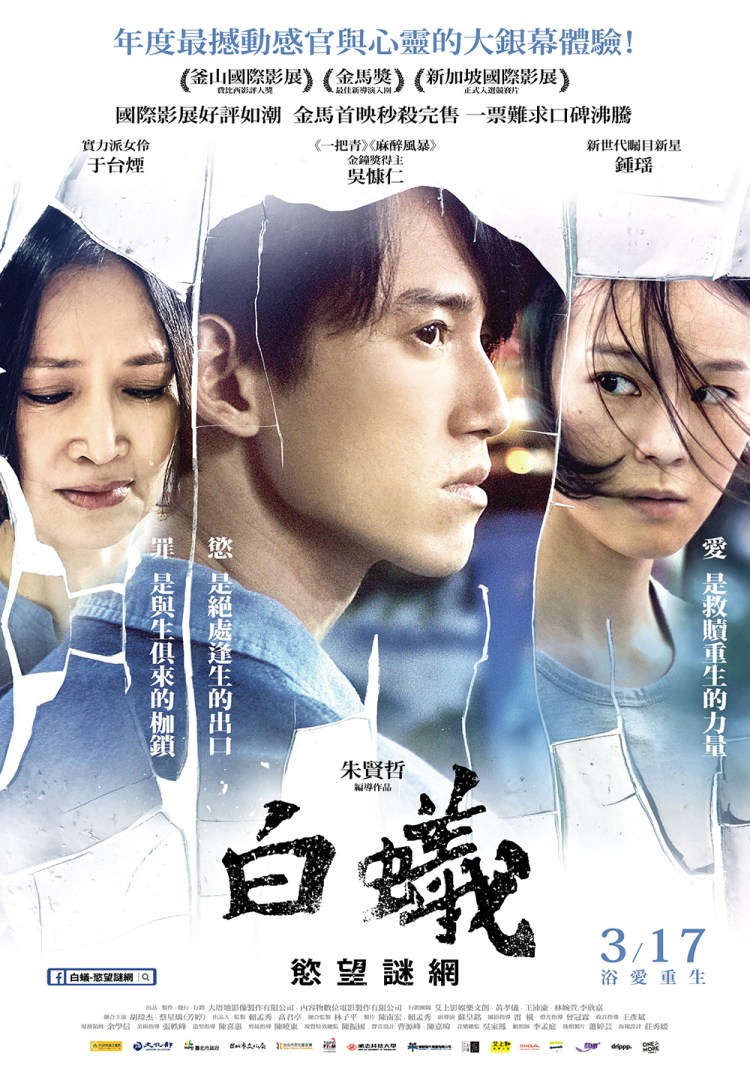
White Ant (白蟻─慾望謎網, Chu Hsien-che, 2016)

白蟻_poster_D_0105_final_更新tenga_cs5White Ant (白蟻─慾望謎網, Báiyǐ – Yùwàng Mí Wǎng) – another name for termite, is an apt title for this first indie narrative feature from veteran Taiwanese documentarian, Chu Hsien-che. Voyeurism, sexual fetish, social conservatism, stigma, embarrassment, and longstanding mental illness conspire towards tragedy as one young man becomes the target for a betrayed woman’s scorn, an innocent bystander in her quest for revenge as a salve for her own repressed emotional pain and loneliness. Chu certainly finds plenty of that as guilt and shame continue to eat away at our protagonists, burrowing ever deeper like the termite of the title, undermining already fragile foundations in each of these differently damaged people.

Bai Yide (Chris Wu Kan-Ren) is a quiet, aloof young man who works in a bookstore. On his way home one day, he stops to swipe a set of ladies’ underwear hanging out to dry in the courtyard where he lives. Bai puts on the underwear and then removes it to masturbate in front of his mirror, reduced to angry, desperate tears in the shame of his compulsion.

Unbeknownst to Bai, his illicit activities have not gone unnoticed. Two bored students, Tang Junhong (Aviis Zhong) and her minion Lu Peiyi, saw Bai steal the pants and bra and filmed him doing it. On the rebound for a bad breakup and looking for some random payback, Junhong mails Bai a copy of the DVD exposing his sordid needs. Junhong is, apparently, offended by Bai’s “depravity” though her true motivations remain unclear even to herself. Despite the urgings of Peiyi and Peiyi’s boyfriend who partially assists through his social media accounts, Junhong continues to taunt Bai who soon descends into a cycle of paranoia and depression which eventually has tragic consequences of the kind Junhong had not intended or imagined.

Besides the act of theft, which has admittedly deprived someone of a set of underwear, Bai’s unusual fetishes serve to harm no one though they appear to cause him a degree of mental stress in feeling himself to be in someway transgressive and required to keep his tastes firmly under wraps. The act of theft may be an attraction in and of itself, though if Bai desired pristine, unworn underwear he would likely find it difficult to acquire for the same reasons that lead him to feel ashamed just for wanting it. Junhong has no real right to feel as outraged as she does – it’s not as if Bai stole her pants or harmed her in any way. He is simply an innocent bystander who happened to step into a space approximating that of Junhong’s ex on whom she vowed revenge.

As we later find out from Bai’s melancholy mother, Lan (Yu Tai-yan), Bai had been experiencing a degree of mental distress since childhood. Following the death of his father and subsequently witnessing his mother with another man, Bai has suffered with a compulsion to steal ladies’ underwear beginning with Lan’s. Lan blames herself for this – in having been both too clingy in allowing him to sleep in the same bed long past the age most children lock themselves away in their own rooms, and in having been too self-centred in taking a lover which, she feels, led to a neglect of her son’s interests. Bai, suffering apparent paranoia and depression even in childhood, believing that there is a voice in his hair which torments him, is further unbalanced by Junhong’s campaign of terror. Trying to track down the blackmailer and figure out what is they want out of all of this, he becomes suspicious of everyone, permanently on edge, terrified, and angry lest his sordid secret be revealed.

Driven half mad by her own frenzy of vengeance, Junhong’s actions places a wedge between herself and her best friend Pieyi who thinks things have gone far enough. Friendships ruined, Junhong ends up just as lonely and isolated as Bai before eventually emerging scarred and guilty, unwilling to process the unintended consequences of what she saw as an amusing series of practical jokes probably designed to make her feel powerful when she felt anything but. Junhong attempts to atone by connecting with Bai’s sorrowful mother, Lan, who doesn’t know her true identity, but in any case continues to blame herself for her son’s death. Lan, a tragic figure, is also isolated by her feelings of guilt and self loathing both in claiming responsibility for Bai’s mental instability and for the loss of her husband which kickstarted the pair’s eventual downfall.

Strangely enough the two women bond through their shared guilt and grief, finding common ground even after the truth is revealed. Despite this final plea for empathy and connection, Chu’s premise seems to rest on an association of unusual sexual proclivities with mental illness. Bai’s suffering is never condemned, indeed the film seems to believe he should suffer for his “perversions” rather than criticising the society which has relentlessly excluded him, viewing his instability as further evidence of his otherness rather than a symptom of the isolation he is forced to feel through continued rejections. Nevertheless, Chu does seem to be clear that it is these repressed emotions that eventually become white ants, burrowing deeply inside the sufferer until they threaten to destroy the foundations of humanity, though whether the damage can ever be fully repaired appears to be far less clear.


Seen on Mubi.

Original trailer (English subtitles)

Interview with director Chu Hsien-che from Busan 2016

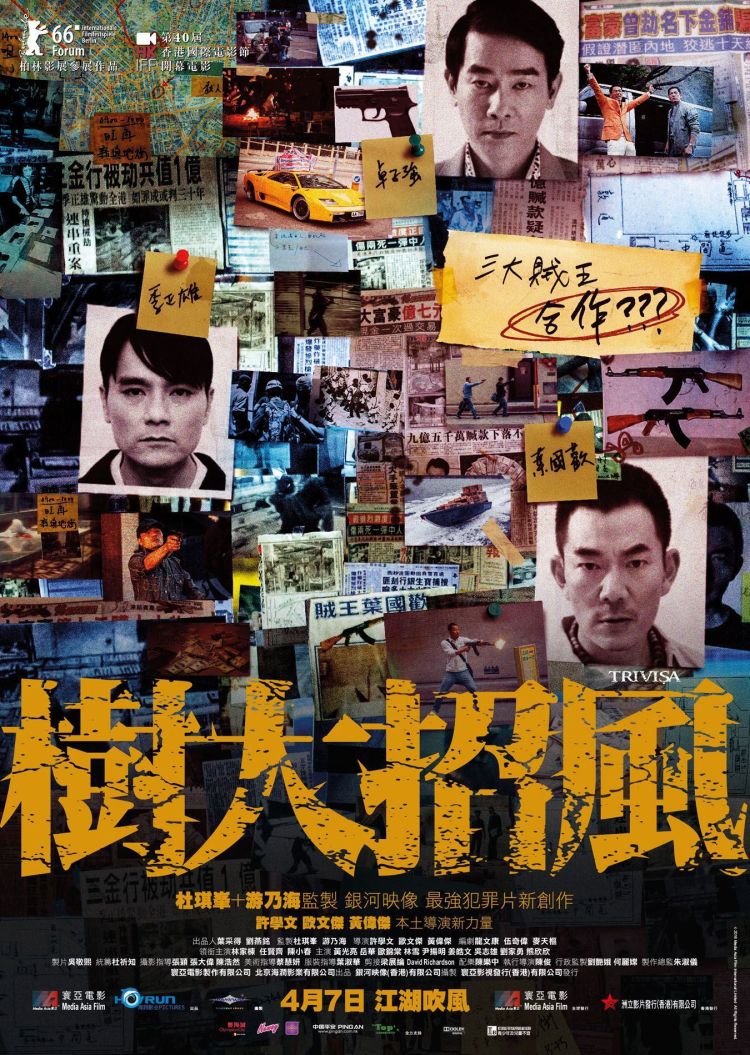
Trivisa (樹大招風, Frank Hui & Jevons Au & Vicky Wong, 2016)

Trivisa posterIt’s worth just taking a moment to appreciate the fact that a film named for the three Buddhist poisons – delusion, desire, and fury, is intended as a criticism of Hong Kong as an SAR that revels in the glory and subsequent downfall of three famous criminals who discover that crime does not pay right on the eve of the handover. Mentored by Johnnie To, Trivisa (樹大招風) is directed by three young hopefuls discovered through his Fresh Wave program each of whom directs one of the film’s three story strands which revolve around a trio of famous Hong Kong criminals.

Back in the ‘80s, as Mrs. Thatcher delivers her pledges on the Hong Kong handover, King of Thieves Kwai Ching-hung (Gordon Lam) gets stopped by a random police patrol, kills the officers, and then has to fake his identity to escape. 15 years later he’s a petty mobile phone trafficker dreaming of pulling off a big score. Meanwhile, Yip Kwok Foon (Richie Jen), once known for his AK47 brandishing robberies is a “legitimate businessman” smuggling black market electronics into Hong Kong and bribing Mainland officials to do it, while Cheuk Tze Keung (Jordan Chan) is a flamboyant gangster revelling in underworld glory and dreaming of eternal fame.

Rather than weave the three stories into one coherent whole or run them as entirely separate episodes, the three strands run across and through each other only to briefly reunite in the ironic conclusion. The most famous of the three real life criminals, Kwai Ching-hung’s arc is perhaps the most familiar though rather than fighting an existential battle against his bad self, Kwai’s quest is to regain his title as Hong Kong’s most audacious thief. To do this, he’s reunited with an old friend and comrade in arms who’s retired from the life and married a Thai woman with whom he has an adorable little daughter. Unbeknownst to him, Kwai has not come for old times’ sake but is taking advantage of the fact that the family live directly opposite his latest score. Employing two Mainland mercenaries, Kwai has his eyes on the prize but his friend is wilier than he remembered, is quickly suspicious of Kwai’s friendship with his daughter, and has his suspicions confirmed when he finds his kid’s backpack full of guns.

Yip’s story, by contrast, is one of diminished expectations and ongoing financial woes. An early scene at a restaurant finds Yip in the company of Mainland officials to whom he must scrape and bow, placating them with various bribes and engaging in the strange trade of precious vases which seems to pass as currency among corrupt civil servants. Corporate shenanigans and business disputes, however, are no substitute for good old fashioned firefights and Yip’s frustration with his new career is sure to lead to some kind of explosion at some point in time.

Cheuk becomes the lynchpin of the three as he takes an advantage of a rumour that the three “Kings of Thieves” are getting together to plan a giant heist to track down the other two and see if he can make it work for real. The most successful and happiest in his life, Cheuk has made his fortune out of ostentatious crime – kidnapping the sons of the extremely wealthy for hearty ransoms. He is, however, bored and dreams of making a giant splash which will ensure his name remains in the history books for evermore – i.e., blowing up the Queen.

Facing the approaching handover, each is aware the world will change, unsure as to how they’re in the process of trying to secure their futures either way. Kwai wants one last heist, Yip has already begun courting Chinese business, and Cheuk just wants to be the face in all the papers across the entire Chinese world. Kwai’s sin is “desire” – he wants one last hit as a criminal mastermind and he’s willing to take advantage of his friend (and even his friend’s young daughter) to get it, Yip’s sin is “fury” as dealing with constant humiliation leaves him longing for his AK 47, and Cheuk’s failing is “delusion” in his all encompassing need to be the big dog around town, all flashy suits and toothy grins. On the eve of the handover they all meet a reckoning – betrayal, a stupid and pointless death, or merely ridiculous downfall.

The heyday of crime has, it seems, ended but that’s definitely a bad thing, laying bare a change in dynamics between nations and a decline in the kind of independence which allows the flourishing of a criminal enterprise. Bearing To’s hallmark in its tripartite structure, ironic comments on fate and connection, and eventual decent into random gun battle, Trivisa is a ramshackle exploration of a watershed moment in which even hardened criminals must learn to live in a brave new world or risk being consumed by it.


Screened at Creative Visions: Hong Kong Cinema 1997 – 2017

Original trailer (English subtitles)

Wet Woman in the Wind (風に濡れた女, Akihiko Shiota, 2016)

wet woman in the wind poster largeBack in the early ‘70s, Nikkatsu reacted to the gradual box office decline of Japanese cinema by taking things one step further than their already edgy youth output in rebranding themselves as a purveyor of softcore pornography known as Roman Porno. Unlike the familiar “pink film”, Roman Porno was made with the assets of a major studio behind it including better actors, production values, and distribution power but it still obeyed strict genre rules calling for speedy turnarounds, minimal running times and the requisite amount of nudity (to the permitted parameters) at set intervals. 45 years later Roman Porno is back in a series of films directed by some of today’s most interesting directors who attempt to recreate the genre anew for modern audiences whilst paying homage to the originals.

Akihiko Shiota’s Wet Woman in the Wind (風に濡れた女, Kaze ni Nureta Onna) starts as it means to go on with hapless protagonist Kosuke (Tasuku Nagaoka) sitting by a river looking sad just as a strange young woman suddenly rides her bicycle directly into the nearby lake before climbing out and stripping off her T-shirt (which, amusingly enough reads “you need tissues for your issues”), revealing her bare breasts to a complete stranger. Kosuke is baffled and confused. He tries to leave but the woman follows him, asking if she can stay with him tonight because she has nowhere else to go. Kosuke is resolved, he’s given up girls and wants nothing whatsoever to do with weird women from ponds but Shiori (Yuki Mamiya) is not one to take no for an answer.

It’s never made clear but something unpleasant has obviously happened to Kosuke that has made him retreat from the city with his tail between his legs (so to speak). A respected playwright, Kosuke seems to have had something of an existential crisis and has decided to condemn himself to a life of self-imposed isolation because “you have to be alone if you really want to think deeply about things”. His isolation is, however, only up to a point. Kosuke’s semi-primitive lifestyle sees him living in a shack in the woods but he has electric lighting provided by generator batteries and grinds his own coffee beans by hand after buying them from a local cafe owned by a man Kosuke went to university with but claims not to have known at the time. The cafe owner’s wife has recently left and he blames Kosuke for reawakening a desire in her that had apparently lain dormant with her husband.

In a shocking coincidence, Shiori has also taken a job at the cafe and has set about seducing the recently lonely owner who has now become fixated and jealous, once again afraid Kosuke in particular is going to steal away his new plaything just like he stole his wife. This is a fallacy on several levels, not least that Shiori is not a woman to be constrained by any man but a true free spirit who gives her love freely to whomever that she chooses.

Spirit might be the best way to describe Shiori who arrives and departs with the wind, a force of nature with the sole intent of freeing her targets of the burden of repressed desires. A radio broadcast later reveals that a tiger has been on the run from the nearby zoo and if this were a fable, you could almost believe the tiger to be Shiori, sinking her teeth into soft centre of human weakness and leaving right after she tears its throat out.

Free spirit as she is, Shiori does find herself in moments of danger as the the threat of sexual violence rears its ugly head. Kosuke likes to think of himself as an enlightened kind of man, an intellectual, but he’s also a self-involved womaniser not above attempting to force himself on a woman he feels to be his for the taking or, half in jest, threatening to rape a former lover. Yet for Shiori much of this is sport – she sees through Kosuke and neatly undercuts all of his self delusions and neuroses, but she’s also merely toying with him.

Finding himself literally kicked out of bed and rendered redundant when Shiori finds more pleasure in getting together with his former lover Kyoko, Kosuke wanders outside in confusion and seduces, with a degree of tenderness, Kyoko’s shy, bespectacled assistant, Yuko. When the morning comes, however, he feels he made a mistake. Yuko has become attached to him, sharing a traumatic childhood story only for Kosuke to brush it aside and encourage her to go out into the world to explore the rich pleasures on offer now that he has “awakened” her. Kosuke remains as self-centred as ever, but Yuko at least does perhaps find something in his words of “wisdom”.

As in all good sex comedy, the men are pathetic slaves to desires they find themselves unable to express, whether out of fear or cultural ideals of masculinity, while the women remain in control and must guide the men either towards a healthier outlook or their own destruction. Both Kosuke and the cafe owner conspire in their own downfall in misguided battles for possession or conquest. Having already suffered defeat, Kosuke has retreated from the field dejected and humiliated, but in his all out impassioned attempt to re-enter the world of carnality he literally brings his entire universe crashing down around his ears. Forced to realise his own ridiculousness, Kosuke is left alone with little else to do than survey the scale of the destruction his various delusions have wrought. A fun loving pastiche, Wet Woman in the Wind is an oddly whimsical tale, witty yet insightful even its seeming lightness.


Currently available to stream via Mubi.

Original trailer (English subtitles) NSFW!

Mad World (一念无名, Wong Chun, 2016)

Mad World_posterThroughout the aptly titled Mad World (一念無明), the central character frequently asks if he is really the one who is “abnormal” or if everyone else is merely operating under some misguided notion of “normality”, either deluding themselves that they meet it or actively masking the fact that they don’t. The first feature from Wong Chun, Mad World is not only the story of a man attempting to live with mental illness in a society which is unwilling to confront it, but also a discourse on the various ills of modern life from the ageing population and breakdown of the “traditional” family to the high pressure nature of “successful” living. Carefully nuanced yet pointed, Wong Chun’s vision is at once bleak and hopeful, finding victory in the courage to move on in self acceptance rather than in a less ambiguous discovery of a more positive future.

Tung (Shawn Yue) has spent the last year institutionalised after being arrested in connection with the death of his mother (Elaine Jin). The doctors and courts have both absolved him of any blame, but Tung has also been diagnosed with bipolar disorder and is being released into the care of his estranged father, Wong (Eric Tsang), rather than simply released. When Wong picks Tung up at the hospital, the disconnect and anxiety between them is palpable, as is Wong’s embarrassment when he takes Tung back to the tiny room he inhabits in a low rent lodging house sharing a kitchen and a bathroom. Father and son will be sleeping on bunk beds with any idea of privacy or personal space firmly rejected.

Wong, a man in his 60s who’d all but abandoned his family for a career as a long-distance truck driver crossing the border into China, is ill-equipped to cope with caring for his son on several different levels. Perhaps a man of his times, he’s as ignorant and afraid of mental illness as anyone else, quickly getting fed up with Tung’s frequent crying fits and even stooping so low as to simply ask him why he can’t just be normal like everyone else. However, after getting more used to Tung’s new way of life, Wong does his best to get to grips with it, buying a number of books about depression and joining a support group for people who are caring for those with mental health needs.

Tung continues to struggle, finding it difficult to reintegrate into to society when society actively excludes those who don’t quite fit in. Attending a friend’s wedding shortly after having been discharged, Tung spots a few unpleasant social media posts referring to him under the nickname “Mr. Psychosis” while guests in the room mutter about the “nutjob” who must have just escaped the “loony bin”. Tung doesn’t do himself any favours when he grabs the mic and interrupts the groom’s speech to take the audience to task for their indifference, but the hostility he faces is entirely unwarranted. Later, experiencing another setback, Tung finds himself the subject of a viral video when he stops into a convenience store and guzzles Snickers bars in an attempt to improve his mood. It’s not long before someone has correctly identified him as the guy who was accused of killing his mother and put in a mental hospital, literally sending him right back to square one in terms of his recovery. To make matters worse, Tung can’t get any of his old contacts to look at his CV because they all have him branded as a dangerous madman and interviewing for new jobs never gets very far after they ask why there’s a one year gap in his employment history. 

Employment does seem to be a particular source of anxiety with frequent mentions of mass layoffs and even managerial suicides in the high pressure financial industries. Even before the events which led to his hospitalisation, Tung was undoubtedly under a lot of stress – planning a life with his fiancée, Jenny (Charmaine Fong), which adds the financial pressures of mortgages and saving to start a family. The sole carer for his elderly mother, Tung is also on the front line for her cruel, sometimes violent mood swings which, according to Wong, are a lifelong phenomenon rather than a symptom of the dementia she is also afflicted with. Tung lashes at out Jenny when she suggests putting his mother in a home where she can be better cared for, exhibiting a streak of unpredictable, frustrated violence of his own which also deeply worries him.

Tung may have inherited this impulsive volatility from his mother, in one sense or another, but his longstanding feelings of low self worth are as much to do with his parents’ seeming disregard for him as they are to do with anything else. His mother, unhappy in her marriage, blames her eldest son for trapping her in dead end existence while continuing to worship the younger one, Chun, who went to an Ivy League US university and has since left them all far behind. Constant, unfavourable comparisons to the golden boy only raise Tung’s levels of stress and resentment at being obliged to care for the woman who constantly rejects and belittles him after the “good” son and the “bad” husband both abandoned her. Wong “left” his wife because he couldn’t cope with her difficult personality and complicated emotional landscape, but now faces a similar dilemma with the son he had also left behind.

Hong Kong is, indeed, a maddening world as Tung and Wong find themselves crammed into a claustrophobic share house filled with similarly stressed and anxious people predisposed to see danger where there is none. Tung’s condition finds him semi-infantilised as the wiser than his years little boy from next-door becomes his only friend until his mother finds out about Tung’s condition and orders her son not to see him. Wong Chun’s central premise seems to be that the world will drive you crazy, but if there were more kindness and less hostility perhaps we could all stave off the madness for a little longer. Anchored by strong performances from Yue and Tsang, each playing somewhat against type, Mad World is a remarkably controlled debut feature which subtly underlines its core humanitarian message whilst taking care never to sugarcoat its less pleasant dimensions.


Screened at Creative Visions: Hong Kong Cinema 1997 – 2017

Original trailer (English subtitles)

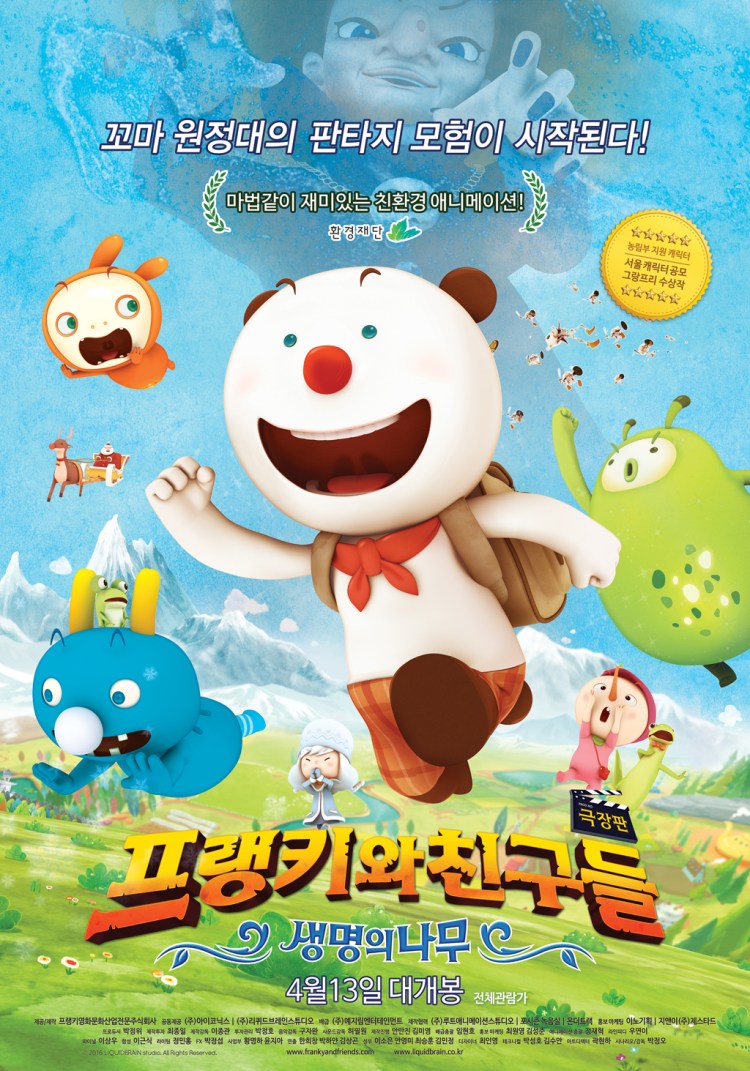
Franky and Friends: A Tree of Life (극장판 프랭키와 친구들: 생명의 나무, Park Jung-oh, 2016)

Franky and Friends tree of life posterChildren’s films are full of messages and advice about how to grow up into a fine, upstanding person. Franky and Friends began life as a TV series in which the titular polar bear, Franky, and his friends live in a world of self sufficiency in which everything they consume they must grow for themselves in their kitchen garden. The problem is Franky is essentially still a child which means he wants everything all at once and doesn’t know the reasoning behind his way of life. In other words, he’s just like the target audience and is about to learn what every parent wants to teach their child – to eat what they’re given and be grateful.

Franky, Kwon, and Pong live in a small cottage with the more mature Doo who cooks all their meals and tends to the house and garden. The boys, however (is it interesting that they’re so obviously male and Doo so obviously female even though they’re all fantasy creatures?), don’t want her sensible, wholesome food. They want everything else but *especially* fried sweet potatoes. Doo gives in and agrees to make some if the boys promise to eat everything all up. Of course, they do, but they’re full long before the pot of potatoes is even half empty. While Doo gets up to answer the door, Franky and Kwon scrape the food into a basket and take it outside to bury in the woods. They keep this up for a few days but weird mushrooms start growing everywhere and when the local insects eat them they grow to giant size and become ravenous, destroying the market garden!

As it turns out there is black magic at play in the strange land in which Franky lives. The only way to save everyone is to safeguard the Tree of Life from the clutches of an evil witch. The Fairytale Kingdom is home to a strange selection of creatures from abstract creations like Kwon, Pong, and Doo to guest appearances from Pinocchio, Santa, and The Monkey King. Later, Franky teams up with another friend, Misa, who seems to be something between the classic Snow Queen (only nice) and Elsa from Frozen but she doesn’t really do very much other than freeze things. Kids film this maybe but the references are retro beginning with a visit from a Godzilla-like creature to a large scale battle with skeletons resembling Harryhausen’s from Jason and the Argonauts.

The jokes, however, are considerably less highbrow with genuinely childish toilet humour providing the bulk of the comedy. Franky and his friends set off on their quest recklessly – not a good message for children, despite the positive reinforcement of Franky acknowledging his responsibility and pledging to correct his mistake, and appear not to have learned very much at the end of their quest. Still, the target audience probably won’t be thinking too hard about all of this and are most likely to pick up on the intended messages of the evils of wastefulness and lying to your mum about eating your vegetables. Hopefully they won’t remember the bit about magic mushrooms and life sucking aphids, but will remember that the Earth is everyone’s responsibility and if we don’t all agree to look after it together the tree will die and the witch will win.


Screened at London Korean Film Festival 2017.

Trailer (no subtitles)

Jamsil (누에치던 방, Lee Wanmin, 2016)

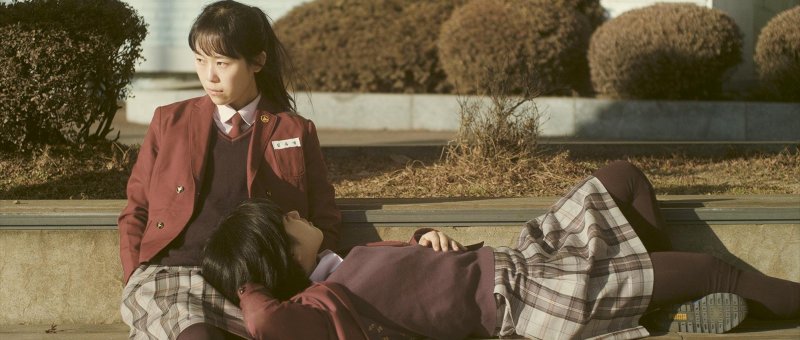
jamsil still 1Have you ever met someone for the first time but felt as if you’ve been friends all your lives? Maybe you’ve been depressed and lonely enough to knock on a stranger’s door wishing you had that kind of friendship because there’s very little else in your life, but you probably didn’t find anyone quite as willing to play along as the increasingly fragile Mihee (Lee Sanghee) does when she marches up to Sungsook’s (Hong Seungyi) home and announces herself as a long lost childhood friend. From that description alone Jamsil (누에치던 방, Nuechideon Bang) sounds as if it could be a dark tale of stolen identity and mental disturbance, but first time feature director Lee Wanmin’s intentions are not so severe. Defying rational explanation and looping back through past traumas and regrets, Jamsil is a tale of female friendship in all of its complexity but also of its immediacy and warmth.

30-something Mihee has taken the bar exam several times, unsuccessfully. Wondering if now is the time to give up on a legal career but afraid she’s left it too late to get any other kind of job, Mihee wanders aimlessly, not really doing much of anything at all. Growing tired of having no money and of having the moping, listless Mihee to contend with, Mihee’s graduate student boyfriend throws her out and ends the relationship. Faced with her lack of money, Mihee can only afford a run down apartment in a dodgy part of town with a strange and invasive landlady. Mihee, going quietly mad through loneliness and feelings of failure, makes the strange decision to knock on a stranger’s door, stating that she and the woman on the other side were once best friends at high school.

This seems improbable as the woman, Sungsook, seems to be around ten year’s older than Mihee, but even so Sungsook lets her in and tries to comfort the obviously distressed woman as best she can. Sungsook’s live-in partner, her childhood sweetheart Ikju (Lim Hyongkook), does not like Sungsook’s habit of letting strangers into their home and sets out to investigate Mihee only to begin having an affair with her whilst keeping his relationship to Sungsook secret. Meanwhile, Sungsook develops an attraction for a younger reporter who wrote something nice about an avant-garde theatre show in which she performed.

Though Mihee and Sungsook have obviously never met before they seem to share an immediate connection and soon become firm friends. Both women are thrown back to the trials and traumas of their teenage years, confronting choices they did and didn’t make or which were made for them. A ghost from Sungsook’s past has literally followed her all the way into the future as the spectre of absent friends continues to mar her relationship with Ikju. Mihee was guided to Sungsook by a teenage girl with the same name as Sungsook’s real teenage best friend, who for some reason reminded her of her younger self, but Mihee’s decision to track down her own high school confidant does not go well as she leaves repeated messages on her voicemail which are never returned before making a final, drastic bid for recognition.

Both Mihee and Sungsook are in some way, stalled, unable to reconcile what it is they want with what they’re supposed to be. Perhaps they, like the silkworms which give their name to this particular part of town, must leave something of themselves behind in order to move forward, but then perhaps those memories can be spun into something finer and softer to the touch than the jagged scars they currently seem to be. Lee’s shooting style leans towards indie naturalism, but mixes in a little avant-garde theatricality with her “actors” and their discussions of political terminology or brief snippets of philosophical musings on the wider nature of existence. Never quite earning its two hour plus running time, Jamsil is nevertheless a deep and fascinating exploration of romanticised pasts and depressed futures in which female friendship is both salvation and destruction but always a strong and abiding connection spun in the larval stage.


Screened at London Korean Film Festival 2017.

Subtitled clip

Interview with director Lee Wanmin conducted at Busan International Film Festival 2016.

Merry Christmas Mr. Mo (메리크리스마스 미스터 모, Lim Dae-hyeong, 2016)

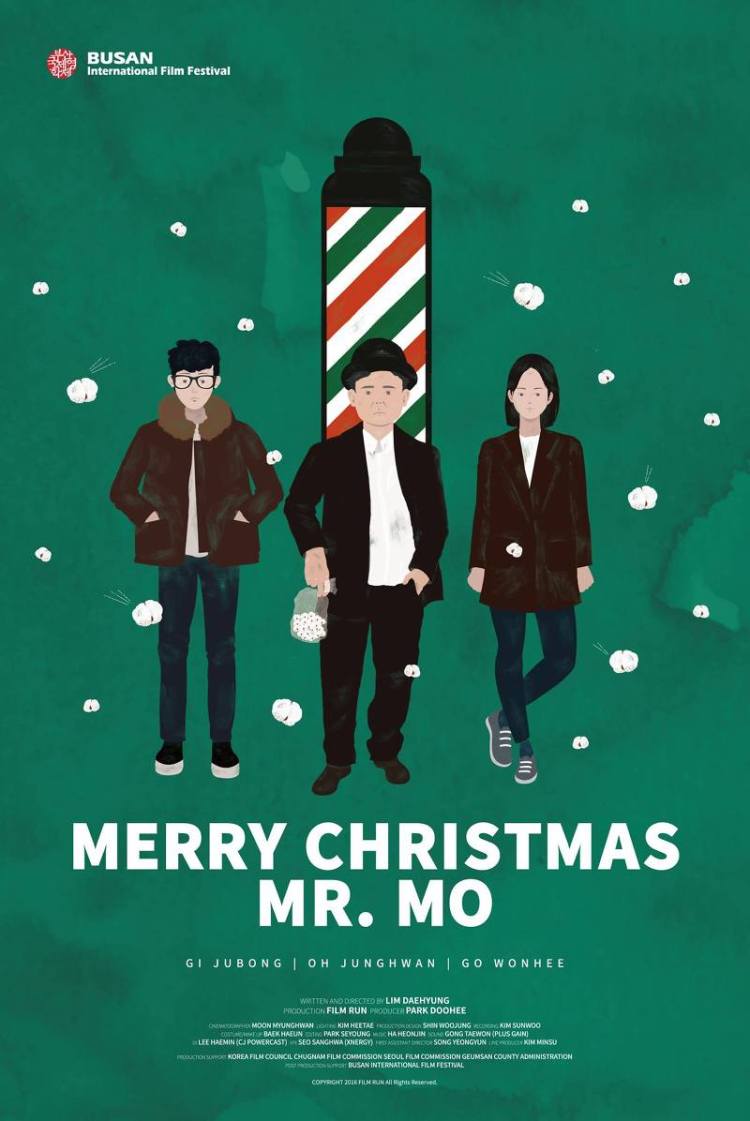
Merry Christmas Mr Mo posterMr. Mo does not at first seem the Christmassy type. He’s gloomy, sullen, and monosyllabic – about as far from festive as it’s possible to get, yet over the course of Lim Dae-hyung’s charming feature debut, he becomes an irresistible hero bravely fighting back against his loneliness and disappointment while there is still time. Shot in black and white with a deadpan, Jarmushian sense of humour, Mr. Mo’s journey of reconnection is one of quiet melancholy yet filled with its own strange warmth for its cast of disconnected characters each finding a point of recognition in the silent world of Mr. Mo.

The local barber, Mr. Mo (Gi Ju-bong) is known around town but does not encourage friendliness outside of his studio. His life begins to diverge from its usual routine when a visit to the doctor, who urges him to quit smoking, causes him to worry about his health. Despite his normally aloof nature, Mr. Mo engages in some slapstick humour in the pool where he swims everyday before asking a young woman, Ja-young (Jeon Yeo-bin), to go for a drink with him on the way home. Ja-young is somewhat taken aback and perhaps worried about an old man asking her to drink with him, replying that she’s quite tired and just wants to go home. Mr. Mo’s intentions are 100% honourable and he just really wanted some company on this quite depressing day. Ja-young decides to go anyway and regales him with horticulture tips and theories on physiognomy, her loquaciousness a perfect match for Mr. Mo’s laconic demeanour.

When he receives even worse news than he feared from the Doctor, Mr. Mo decides it’s time to put his house in order – clearing out a 15 year old Christmas tree but leaving the December 1999 calendar hanging on the door. It’s clear from Mr. Mo’s apartment that he once had a family and now lives alone, though he mostly spends his off time munching popcorn in front of the TV and writing in his diary. His nights are repetitions of insomnia in which he repeatedly thumps his pillow in frustration, sitting up reluctantly in the morning and tearing his eye mask off his face.

Having dreamed of being an actor in his youth, Mr. Mo’s final wish is to make a film with his distant, aspiring filmmaker son. Stephen (Oh Jung-hwan) lives in the city with his girlfriend, Ye-won (Go Won-hee), but he seems to be just as sullen and depressed as his dad though perhaps without so much of the reason. Mr. Mo is a big fan of Ye-won, though he can’t quite understand what she’s doing with his son. She puts up Stephen’s nonsense, his loss of drive and occasional fits of pique and the couple’s relationship seems solid, even if a little strained and sometimes difficult.

Making the movie, a Chaplin-esque slapstick piece, is partly an excuse to reconnect with Stephen but it also affords him an opportunity to revisit and reconsider the past, revealing hitherto hidden details of his son’s early life. Gi Ju-bong excels in the leading role of the vacant Mr. Mo who eventually becomes a hilarious silent movie comedian complete with silly walk and repeated sight gags which also take on and added degree of melancholy given Mr. Mo’s condition and his desire to push his own self-destruct button.

Despite his aloofness, Mr. Mo is a keen observer of people as revealed in the final voiceover of his diary for December (written in the form of letters to his late wife) in which he notes down his various meetings from the overly polite young man who says hello to too many people to picking up on Ja-young’s loneliness, and regretting his hostile reaction to his sister-in-law’s kindness. Getting everyone together at the end to reveal the solution to the enigma which is Mr. Mo, Lim’s debut is a whimsical journey through the loneliness and resignation of late middle age filled with a strange affection for its cast of eccentrics and enlivened by the quirky, acoustic guitar score which considerably adds to the air of mild surreality in strangely framed vistas of emptiness which perfectly capture Mr. Mo’s charming black and white world.


Screened at London Korean Film Festival 2017.

Original trailer (English subtitles)

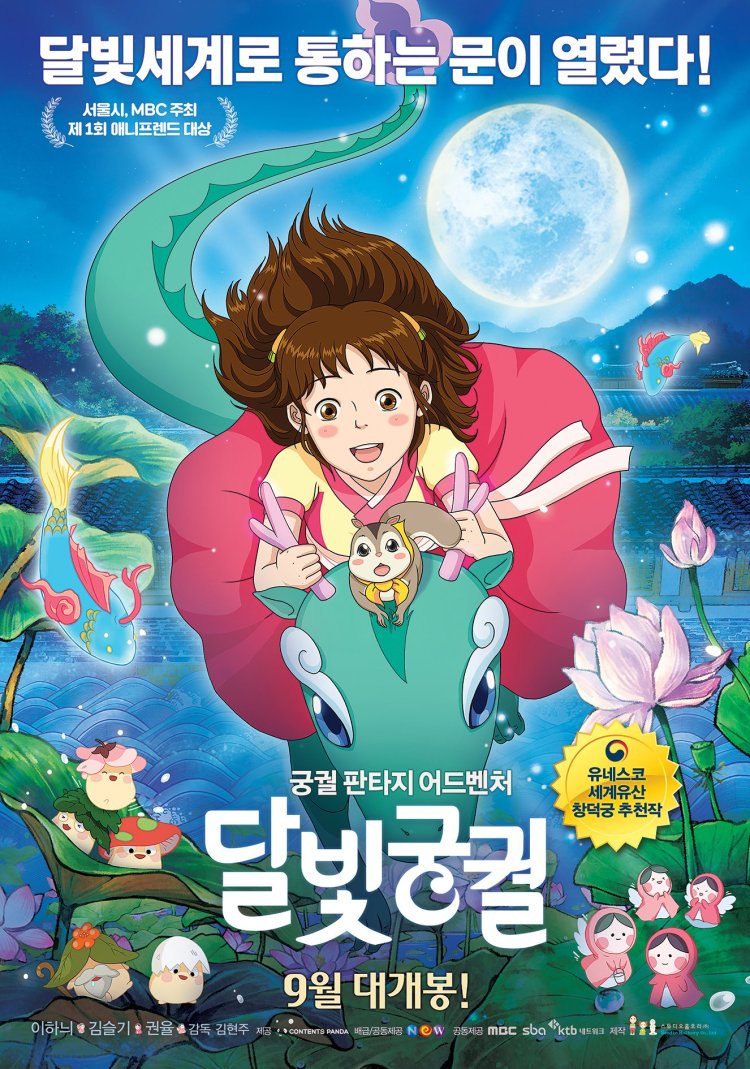
Lost in the Moonlight (달빛궁궐, Kim Hyun-Joo, 2016)

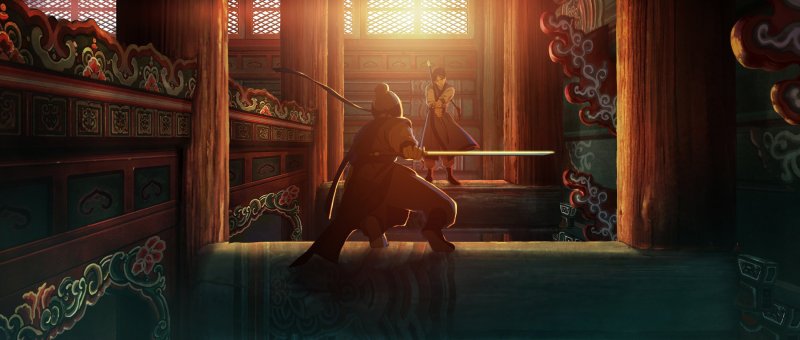
Lost in the Moonlight posterGirl gets lost in a fantasy land and has to find herself to find the way out – it’s a familiar enough tale but then perhaps Lost in the Moonlight (달빛궁궐, Dalbitkungkwol) is mostly about that kind of familiarity. The debut feature from Korean director Kim Hyun-joo, Lost in the Moonlight was plagued with widespread internet controversy on release of the movie’s trailer and publicity material which heavily echoed Studio Ghibli classic, Spirited Away. Though this is, in some ways, unfair – you can’t escape the fact that fantasy mythical Korea shares some aesthetic similarities with that of Japan or China, or the fact that girls slipping into fantasy realms is the nature of the genre, it’s hard to get past the presence of the tiny helpers and their resemblance to Dust Bunnies, or the poster which puts the flying dragon front and centre. Nevertheless, Lost in the Moonlight’s intentions are less intense than Spirited Away’s and focus more keenly on a particular notion of learning to shine in the role you’ve been given rather than desperately chasing an external spotlight.

Hyunjunli (Kim Seo-young) is an ordinary thirteen year old girl who is set to participate in the performance of a musical at Changdeok Palace. Her parents, remaining off screen, sound supportive and are excited about seeing their little girl in such a big show even if Hyunjunli is a typical teenager who’s mortified at the idea of her parents showing up and embarrassing her, or she them with her minimal involvement in the action. Though shy and dreamy, Hyunjunli longs for the spotlight and feels silly stuck at the back of the chorus playing the very uninspiring part of a tree while her friends get to play animal gods and all manner of other exciting things.

Meanwhile, a Rat God of time is feeling exactly the same, tired of just standing around in the back not really doing anything. He makes a break for it and ends up in the human world where he drops his magic tag. Hyunjunli, a helpful sort of person, picks it up and is whisked off to a fantasy land where she meets a new friend, Mr. Squirrel, and is taken to the Moonlight Palace by the mysterious Lady Blossom.

Hyunjunli in the land of Moonlight is story of a little girl lost that runs back through Alice in Wonderland among many others, though the stakes originally appear a little lower as Moonlight seems safe enough save for the talking animals and general unfamiliarity of the place. The setting is inspired by traditional Korean mythology with its bickering mountain gods and focus on the natural world but is also, of course, heavily influenced by Hyunjunli’s perception of it. Slightly confusingly, the film has a mild environmentalist message as the conspiracy Hyunjunli walks straight into revolves around the awakening of the juniper tree which allows all the trees which have apparently been arrested by the tyrannical rule of time to get up and exact revenge against humanity for its widespread destruction of the planet, meaning that Hyunjunli has to find a way to restore time and stop the murderous tree rampage to save the Earth (which is also what the trees want to do).

Predictably enough, the fantasy land situation echoes Hyunjunli’s own as the drama is revealed to have been caused by the Rat God who also felt bored and unloved working as part of a team rather than doing something flashier out in front. What Hyunjunli learns is that everyone has their place and that the system fails when the little guys don’t pull their weight. The message, that there are no small parts just small actors, is fair enough as Hyunjunli realises it’s wrong to try and steal a spotlight which does not belong to you but then it also reinforces a less palatable message about social conformity and the necessity of living only inside the box in which you were born. Nevertheless, even if it does not always make complete sense Lost in the Moonlight does manage to provide a family friendly fantasy that its target audience may well be far more forgiving of than the confused adults watching along with them.


Screened at London Korean Film Festival 2017.

Original trailer (no subtitles)
https://www.youtube.com/watch?v=A2PDfnGQtd4