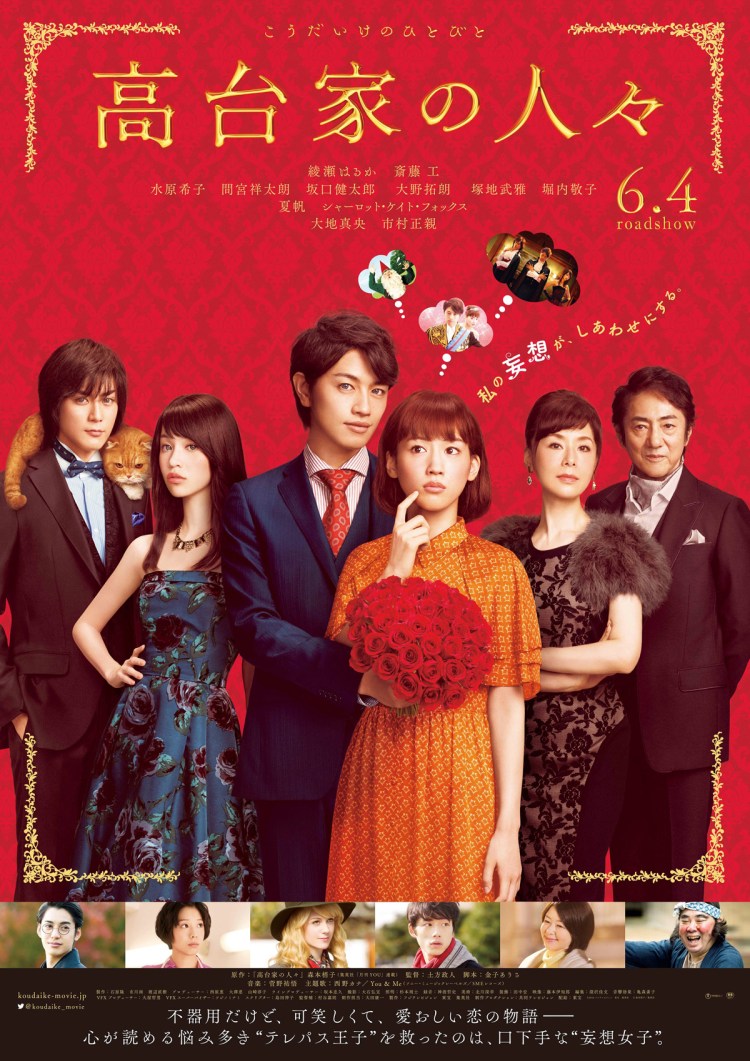
 Fear of “broadcasting” is a classic symptom of psychosis, but supposing there really was someone who could hear all your thoughts as clearly as if you’d spoken them aloud, how would that make you feel? The shy daydreamer at the centre of The Kodai Family (高台家の人々, Kodaike no Hitobito) is about to find out as she becomes embroiled in a very real fairytale with a handsome prince whose lifelong ability to read minds has made him wary of trying to form genuine connections with ordinary people. Walls come down only to jump back up again when the full implications become apparent but there are taller walls to climb than that of discomfort with intimacy including snobby mothers and class based insecurities.
29-year-old Kie (Haruka Ayase) has a dull job as a regular OL in the successful Kodai company. A self-confessed shy person who finds it difficult to talk, Kei spends most of her time alone though she does have a few friends at work. Though Kei’s exterior life may appear dull she has a rich, even overactive imagination which she uses to entertain herself by heading off into wild flights of fancy guided only by a friendly (?) gnome.
Kei’s life begins to change when the oldest son of the Kodai family returns to the office after studying abroad. Mitsumasa (Takumi Saito) is a handsome, if sad-looking man who quickly has all of the office in a flurry of excitement thanks to his dashing good looks and confident stride. Mitsumasa, however, has a secret – the ability to read other people’s thoughts inherited from his British grandmother, Anne. Whilst walking down the corridor and trying to ignore the lewd and avaricious thoughts of some of the ladies (and the worried ones of some of the men now fearing more than one kind of competition), Mitsumasa is treated to one of Kei’s amusing fantasies and is quickly smitten.
For Kei who finds voicing her true feelings difficult, Mitsumasa’s ability seems like the perfect solution. Finally, someone who will just understand her without the need for conversation. However, what Kei hasn’t considered is that a deeper level of intimacy is being asked of her than she’d previously anticipated. From the merely embarrassing to the tactless and tasteless, it is no longer possible to withhold any part of herself other than by an exhausting process of trying to close her mind down completely. Mitsumasa is used to this particular phenomenon in which his enhanced powers of communication only result in additional barriers to connection. Somewhat closed off himself, resigned to the fact he’s going to “overhear” things he’d rather not know, Mitsumasa has made a point of keeping himself aloof from ordinary people who, once they know about his abilities, find him suspicious and threatening.
Yet Mitsumasa’s telepathic powers are not the only obstruction in this fairytale love story. Kei already can’t quite believe what’s happening is real and struggles with the idea someone like Mitsumasa might seriously be interested in her. Though Mitsumasa’s brother (Shotaro Mamiya) and sister (Kiko Mizuhara), who share his ability, are broadly supportive (and equally entertained by Kei’s innocent and quirky flights of fancy), his mother (Mao Daichi) is anything but. Kei’s prospective mother-in-law starts as she means to go on by mistaking Kei for a new maid and then proceeding to further erode her confidence by pointing out that she knows nothing about this upper class world of balls and tennis and horse riding.
When it all becomes too much, Kei does what she always does – retreats to safer ground. Papering over her cowardice with the weak justification that she thinks she’ll only make Mitsumasa miserable, Kei backs away from the idea of baring her whole, unfiltered soul even if she knows it will cost her the man she loves and the ending to her real life fairytale.
Though charming enough and filled with interesting manga-inspired effects, Kodai Family never makes the most of its interesting premise, falling back on standard romantic comedy tropes from parental disapproval to predictable misunderstandings. The irony is that Mitsumasa and his siblings are so busy listening to the thoughts of others that they often can’t hear their own and are so deep in denial that they need a third-party (telepathic or not) to push them into realising how it is they really feel. This is a world of double insulation, in which the walls are both thick and thin, but there is a way a through for those brave enough to kick them down by baring all for love, snobby mothers be damned.
Original trailer (English subtitles)
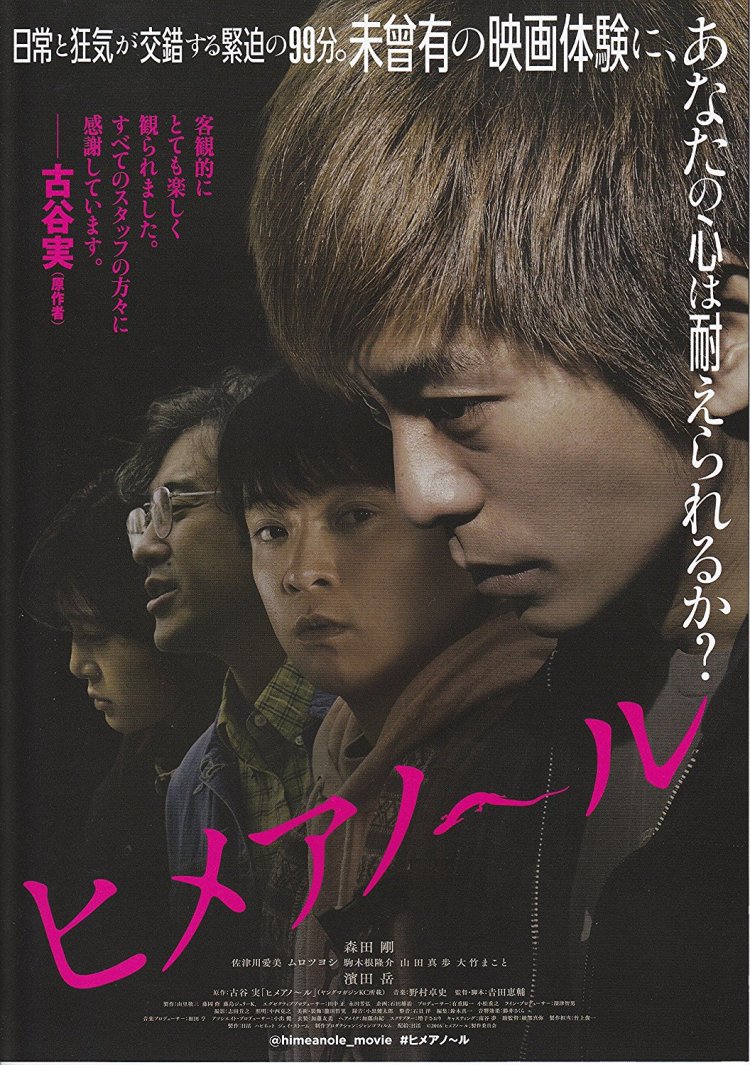 Some people are odd, and that’s OK. Then there are the people who are odd, but definitely not OK. Hime-anole (ヒメアノ~ル) introduces us to both of these kinds of outsiders, attempting to draw a line between the merely awkward and the actively dangerous but ultimately finding that there is no line and perhaps simple acts of kindness offered at the right time could have prevented a mind snapping or a person descending into spiralling homicidal delusion. To go any further is to say too much, but Hime-anole revels in its reversals, switching rapidly between quirky romantic comedy, gritty Japanese indie, and finally grim social horror. Yet it plants its seeds early with two young men struggling to express their true emotions, trapped and lonely, leading unfulfilling lives. Their dissatisfaction is ordinary, but these same repressed emotions taken to an extreme can produce much more harmful results than two guys eating stale donuts everyday just to ask a pretty girl for the bill.
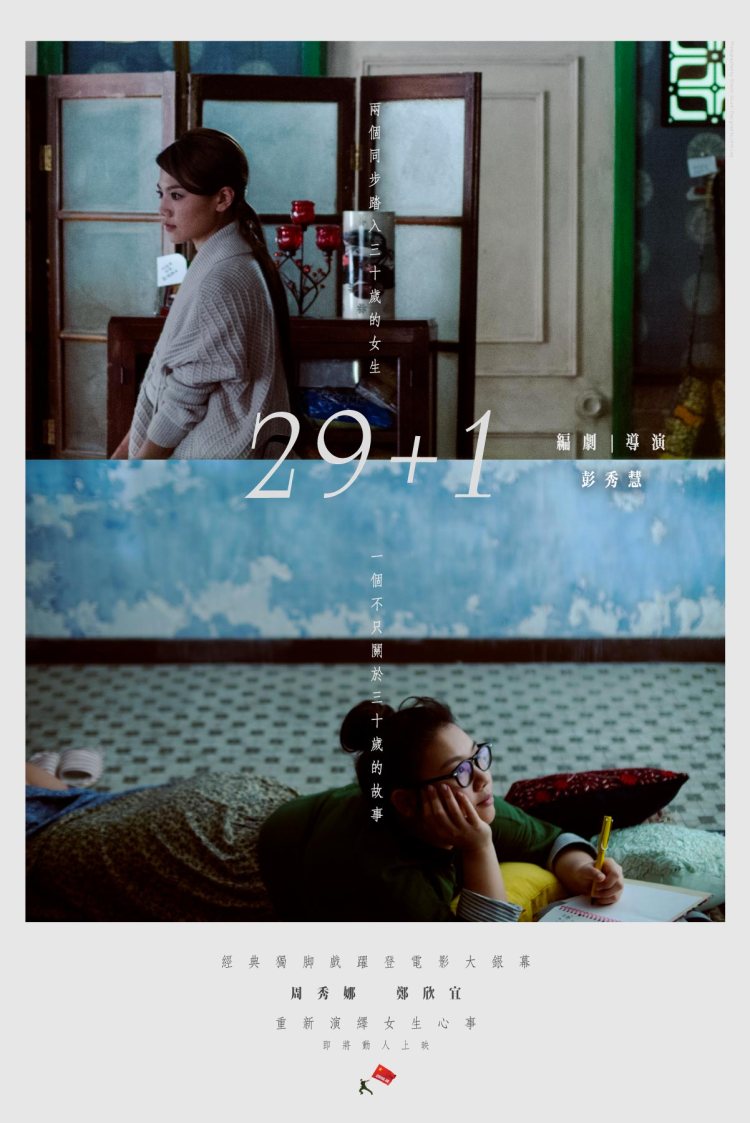 You know what they call women over 25 in China? “Christmas cake” – no one wants you after the 25th, so you’re condemned to sit on the shelf for all eternity like a piece of overproduced seasonal confectionary (a silly analogy because Christmas cakes, at least English ones, may outlive us all). Christy Lam lives in Hong Kong, not mainland China, and so her worries are a little less intense but still the dreaded 30 is causing its own share of panic and confusion in her otherwise orderly, tightly controlled life. In 29+1 Kearen Pang adapts her own enormously successful 2005 stage play about the intertwined lives of two very different women who happen to share a birthday and are each approaching the end of their 20s in very different ways. By turns melancholy and hopeful, 29+1 finds both women at a natural crossroads but rather than casting them into a bottomless pit of despair, allows each of them to rediscover themselves through a kind of second adolescence in which they finally figure out what it is they want out of life.
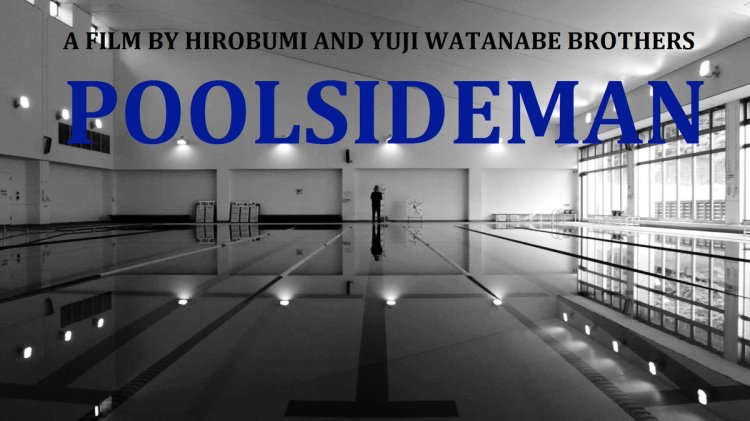 Around halfway through Poolsideman (プールサイドマン), the director himself playing an overly chatty colleague of the film’s protagonist, embarks on a lengthy rant about encroaching middle-age which is instantly relatable to those who find themselves at a similar juncture. He’s sure the world seemed better when he was a child, there wasn’t all of this distress and anxiety – everything just seemed like it would go on forever but time has inexplicably sped up with a series of rapid changes packed into recent years. The life of a poolsideman is improbably intense, or at least it is for Mizuhara (Gaku Imamura) whose days are all the same but filled with tension and the low simmer of something waiting to explode. Loosely inspired by the real life case of a man who left Japan for the Middle East with the idea of joining Isis, Poolsideman wants to explore why such a surreal thing might happen but finds it all too plausible.
 Times change so quickly. The “danchi” was a symbol of post-war aspiration and rising economic prosperity as it sought to give young professionals an affordable yet modern, convenient way of life. The term itself is a little hard to translate though loosely enough just means a housing estate but unlike “The Projects” (団地, Danchi) of the title, these are generally not areas of social housing or lower class neighbourhoods but a kind of vertical village which one should never need to leave (except to go to work) as they also include all the necessary amenities for everyday life from shops and supermarkets to bars and restaurants. Nevertheless, aspirations change across generations and what was once considered a dreamlike promise of futuristic convenience now seems run down and squalid. Cramped apartments with tiny rooms, washing machines on the balconies, no lifts – young people do not see these things as convenient and so the danchi is mostly home to the older generation, downsizers, or the down on their luck.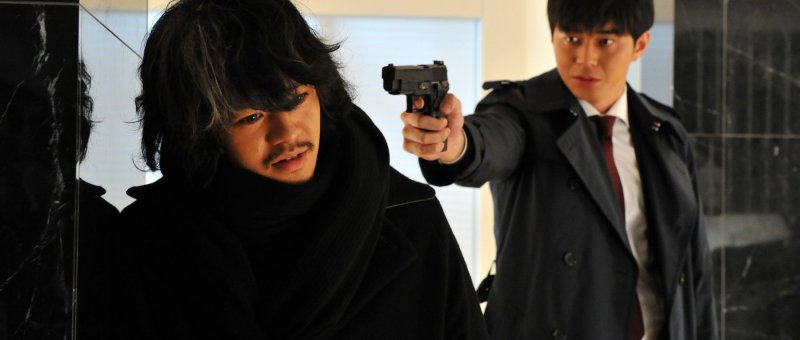
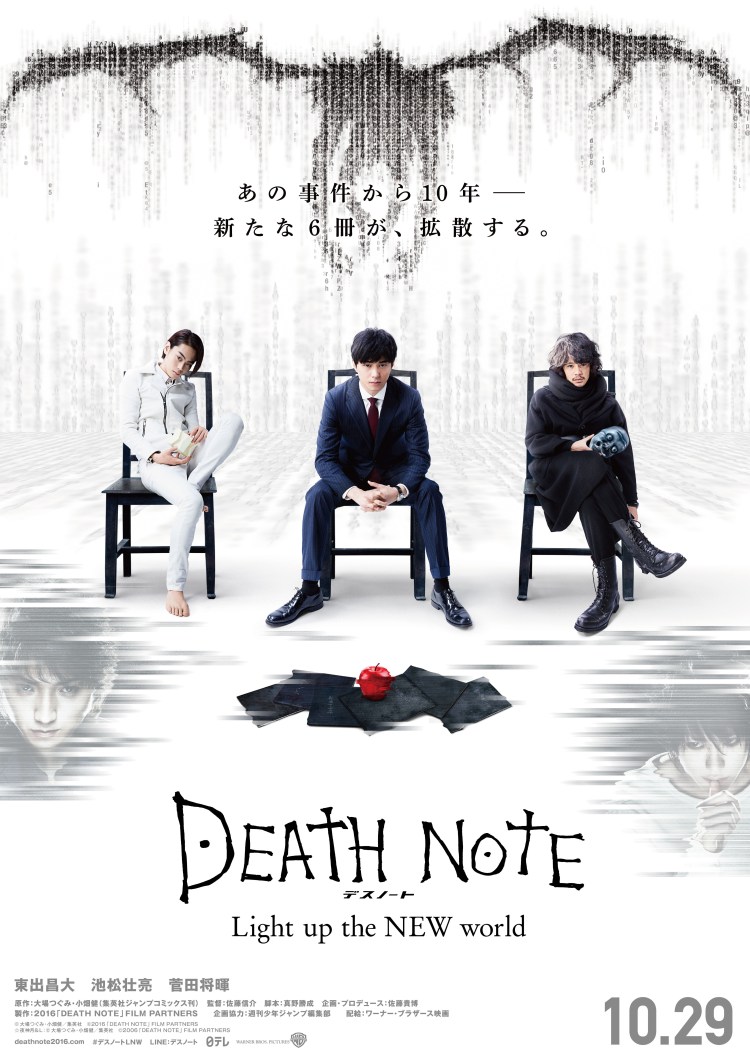 Tsugumi Ohba and Takashi Obata’s Death Note manga has already spawned three live action films, an acclaimed TV anime, live action TV drama, musical, and various other forms of media becoming a worldwide phenomenon in the process. A return to cinema screens was therefore inevitable – Death Note: Light up the NEW World (デスノート Light up the NEW World) positions itself as the first in a possible new strand of the ongoing franchise, casting its net wider to embrace a new, global world. Directed by Shinsuke Sato – one of the foremost blockbuster directors in Japan responsible for Gantz,
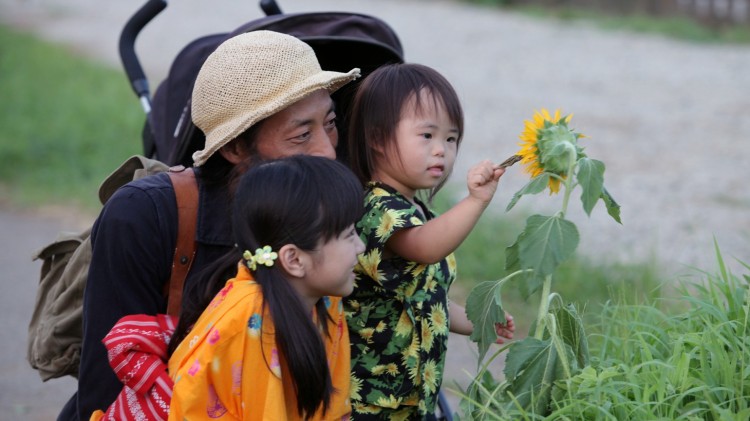 When tragedy strikes the one thing you ought to be able to rely on is your family, but when the tragedy occurs within that sacred space which exits between you what is to be done? Yosuke Takeuchi’s The Sower (種をまく人, Tane wo Maku Hito) attempts to provide an answer whilst putting one very ordinary, loving and forgiving family through a series of tests and tragedies. Lies, regret, and despair conspire to ruin the lives of four once happy people but even in the midst of such a shocking, unexpected event there is still time to turn towards the sun rather than continuing in the darkness.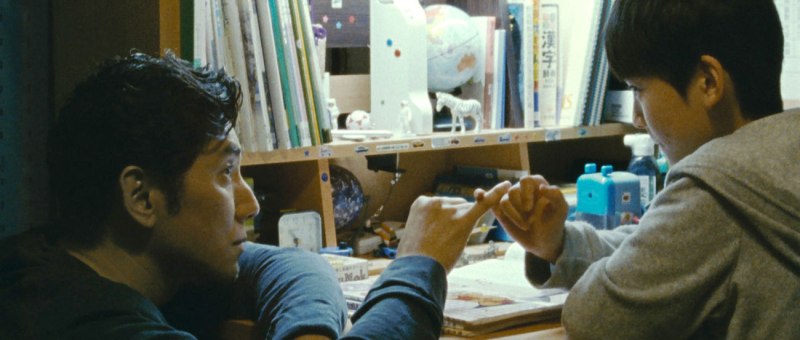
 Self disgust is self obsession as the old adage goes. It certainly seems to ring true for the “hero” of Miwa Nishikawa’s latest feature, The Long Excuse (永い言い訳, Nagai Iiwake) , in which she adapts her own Naoki Prize nominated novel. In part inspired by the devastating earthquake which struck Japan in March 2011, The Long Excuse is a tale of grief deferred but also one of redemption and self recognition as this same refusal to grieve forces a self-centred novelist to remember that other people also exist in the world and have their own lives, emotions, and broken futures to dwell on.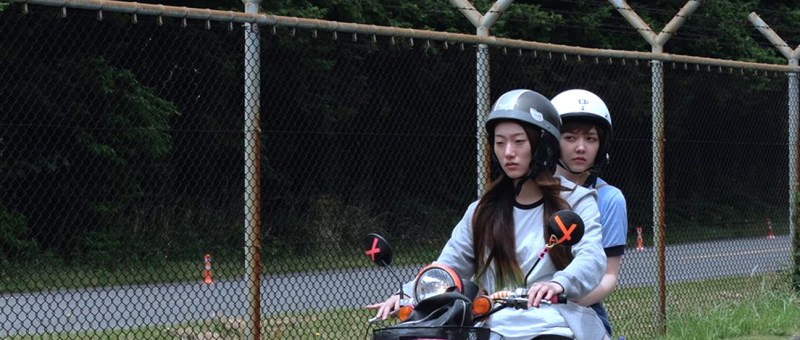
 When you think of the American military presence in Japan, your mind naturally turns to Okinawa but the largest mainland US base is actually located not so far from Tokyo in a small Japanese town called Yamato which is also the ancient name for the modern-day country. The US has been a constant presence since the end of the second world war prompting resistance of varying degrees from both left and right either in resentment at perceived complicity in American foreign policy, or the desire to reform the pacifist constitution and rebuild an independent army capable of defending Japan alone. Daisuke Miyazaki’s second feature, Yamato (California) (大和(カリフォルニア) dramatises this long-standing issue through exploring the life of hip-hop enthusiast and Yamato resident Sakura (Hanae Kan) who idolises an art form born of political oppression in a country which she also feels oppresses her as a Japanese citizen living on the other side of the fence from land which technically still belongs to the US government.
 “Memories are what warm you up from the inside. But they’re also what tear you apart” runs the often quoted aphorism from Haruki Murakami. SABU seems to see things the same way and indulges an equally surreal side of himself in the sci-fi tinged Happiness (ハピネス). Memory, as the film would have it, both sustains and ruins – there are terrible things which cannot be forgotten, no matter how hard one tries, while the happiest moments of one’s life get lost among the myriad everyday occurrences. Happiness is the one thing everyone craves even if they don’t quite know what it is, little knowing that they had it once if only for a few seconds, but if the desire to attain “happiness” is itself a reason for living could simply obtaining it by technological means do more harm than good?
 Windows on Worlds