Bring Me Home (나를 찾아줘, Kim Seung-woo, 2019) [Fantasia 2020]

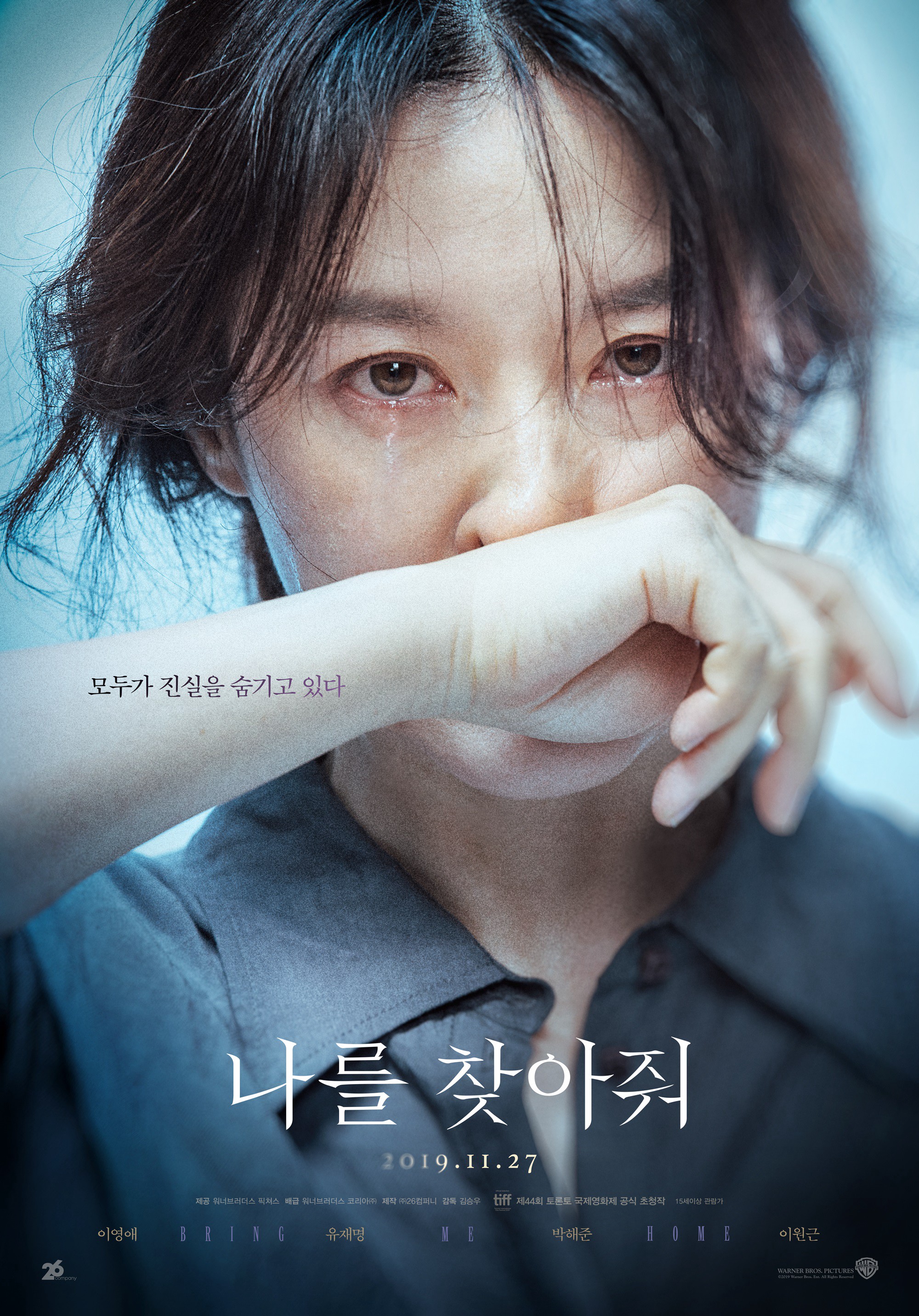
“They were all like me” a drowning man exclaims, trying to justify his inhumanity but gaining only poetic retribution as he finds himself shackled, quite literally, to his crimes. Kim Seung-woo’s debut feature Bring Me Home (나를 찾아줘, Nareul Chajajwo) stars Lady Vengeance herself, Lee Young-ae, in her first big screen leading role since Park Chan-wook’s seminal thriller once again cast as a figure of wounded maternity coming for systemic societal corruption and the savagery born of hopeless desperation in her singleminded determination to retrieve her son and take him with her even if with a dark destination in mind. 

Six years previously, Jung-yeon’s (Lee Young-ae) son Yoon-su vanished from a playground at six years old. Since then, her husband (Park Hae-joon), formerly a teacher, has spent every waking moment looking for him while she works as a hospital nurse where her colleagues describe her as a cool, infinitely professional presence. She continually berates herself for a vague memory of wanting a break from her child, exhausted by the act of caring for him as if she somehow brought this on herself or at any rate gave the universe her permission to take him away. Just when the conditions of her life seemed as if they were about to improve with her husband agreeing to return to work, he is killed in a car accident while pursuing a lead which turned out to be useless anyway, a cruel prank played by insensitive children. Left so totally alone, Jung-yeon begins to consider suicide only to receive another promising lead. A boy who looks like Yoon-su and has a burn on his back and a birthmark behind his ear, is working at a fishing pool in a rural town.

The sad truth is Yoon-su or not, the “family” running the fishing pool have “adopted” two displaced children which they use for slave labour, cruelly abusing them both physically and sexually. It’s this essential act of inhumanity which alerts the corrupted community to the danger presented by Jung-yeon. They could give the boy back, claim the reward, and hope she asks no more questions, but the likelihood is all their dirty dealings would be exposed and then they’d have to replace him. Corrupt policeman Sgt. Hong (Yoo Jae-myung) who for some reason seems to be in charge of the fishing pool is confident he can make all of this go away, pretending to be sympathetic to Jung-yeon’s search but insisting that there is no such boy while introducing her to the landlady’s “son” , keeping “Minsu” chained up in the shed. 

Sgt. Hong is fond of reminding people that he works for the government, a symbol of corrupt and oppressive authority obsessed with maintaining his own status as the man in charge apparently insecure in his sense of control. He claims that he was only able to do the things that he has done because no one really cared. Hundreds of people came through and saw Minsu, none of them said anything until another officer noticed that he looked quite like the boy on the news and was struck by the large reward on offer. The same officer accepted a pay off not to say anything, but apparently took the money and talked anyway. Even Jung-yeon’s brother-in-law tries to get money out of her and then comes up with an elaborate ruse to get his hands on the reward after accidentally being given the tip-off. The only one of the gang to treat Minsu with any sort of compassion eventually turns against Jung-yeon out of fear, citing the economic precariousness of the town. He’s worried that their business will be ruined, more shops will close, and as an ex-con he’ll never find another job which is a problem because he wants money to make sure his son goes to university so he doesn’t end up like him. 

“The living must go on living” another of the gang agrees, indifferent to the costs or the consequences of their actions through it’s difficult to see how their desire to save the town could ever justify their treatment of these displaced children, dehumanising Minsu because of his learning difficulties. Jung-yeon finds one of her fliers pasted on a pillar partially covered by another one for missing dog while the gang’s most deranged member keeps his own wanted poster listing rape and murder on the wall of his shack as if it were some kind of commendation. Hinting at a dark history of missing children as evidenced in one young man’s (Lee Won-geun) recollections of being adopted abroad mistakenly believing that his parents had abandoned him, Bring Me Home eventually descends into archetypal pulp for its misty finale, returning to the mythic vistas of desolation in which it began with the dishevelled Jung-yeon walking the shore of life and death consumed by futility in the depths of her maternal guilt, but does perhaps offer a glimmer of hope in the crushing irony of its final revelations. 


Bring Me Home streamed as part of this year’s online edition of Fantasia International Film Festival.

International trailer (English subtitles)
Legally Declared Dead (死因無可疑, Steve Yuen Kim-Wai, 2019) [Fantasia 2020]

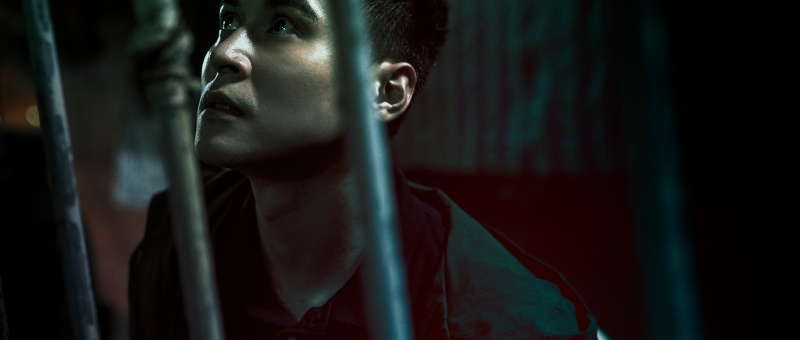
“The road to hell is paved with good intentions” a well-meaning insurance agent is advised in Steve Yuen Kim-Wai’s Legally Declared Dead (死因無可疑), though he struggles to fully understand its meaning and in the end you have to wonder how good his intentions really were. Yusuke Kishi’s novel The Black House has been adapted twice before, firstly in an idiosyncratically absurdist take by Yoshimitsu Morita, and then in Korea by Shin Terra who remained firmly within the realms of contemporary K-horror. Yuen lands somewhere between the two, adopting a stylish veneer of neo noir as the traumatised hero has his worldview upended by heinous immorality. 

Yet as Wing-shun (Carlos Chan Ka-Lok) tells Ching (Stephen Au Kam-tong), the office investigator, he’s just a broker and it doesn’t do to be suspicious of all his clients. A nice, well mannered young man, Wing-shun is all poised customer service charm, but he also firmly believes that the business of insurance is a noble good, that he’s helping people by being there for them when disaster strikes. As such, he doesn’t like to think that people are abusing the system, and is reluctant to reject a claim. On the other hand, he calms a pair of panicked gangsters who are most definitely on the fiddle by explaining that neither he nor his colleague can help them because being a broker is like being a dealer at the casino, they can only push the paperwork to the floor manager who alone has the authority to decide whether or not to pay out and wait for their instructions. 

Wing-shun’s casino metaphor is more true than he intends it, what else is insurance after all than a kind of gambling? Wing-shun can tell himself he’s there to provide relief and support in times of need, but really he’s betting against misery which might be better than betting in its favour but it’s still wagering people’s lives. That fact’s brought home to him when he takes a call late one evening from a man who asks him if they pay out on suicide. Cheerful as ever, Wing-shun asks for his policy number to check the paperwork before realising the darkness inherent in the question and telling the person on the other end of the phone not to do anything rash, “money doesn’t solve everything”. The man simply asks for his name and then abruptly hangs up. Wing-shun chalks it up to just another weird thing that sometimes happens and forgets about it but the next day he’s told that a client has personally requested him to talk over their policy and wants a home visit to a rural location outside the city. A little bemused, Wing-shun does as he’s told and encounters Chu Chun-tak (Anthony Wong Chau-Sang), not realising he’s the man from the phone only noticing he’s behaving quite strangely. Suddenly Chun-tak starts shouting for his son Kafu and gesturing to another room inside which Wing-shun discovers the boy hanging. 

The boy’s death triggers painful memories for Wing-shun who is burdened with a sense of guilt over the death of his older brother in childhood. Unable to escape the idea he’s been set up and Chun-tak only invited him out here to “find” the body, Wing-shun is convinced that he killed Kafu in order to claim his life insurance payout. Kafu was Chun-tak’s stepson and also had learning difficulties, while Chun-tak’s wife Shum Chi-ling (Karena Lam Ka-Yan) is partially sighted and walks with a pronounced limp. Wing-shun is particularly worried because Chun-tak also has a policy on her and it’s reasonable to assume she’ll be next in the firing line. He struggles, however, to convince others of his suspicions. The policeman investigating closes the case when the autopsy comes back with suicide as the cause of death, attributing the motive to exam stress, while the insurance company fails to find evidence to deny the claim.  

Unlike the other adaptations, Legally Declared Dead keeps the suicide option on the table while Wing-shun begins to go quietly out of his mind. Meanwhile, his psychology student girlfriend (Kathy Yuen Ka-Yee) hooks him up with her dubious professor (Liu Kai-chi) who is studying the “criminal personality” and claims that while some people commit crime because of trauma and desire a few so because they’re simply born bad and can never be saved. These people, he says, are manipulative narcissists who often exploit the vulnerable, making them a kind of “slave”. Professor Kam becomes overly invested in Wing-shun’s case, convinced on meeting him that Chun-tak is a clear case of “criminal personality”, murdered his son, and is almost certainly going to murder his wife. But is it really fair to decide someone’s killed their child just because they’re a bit odd and admittedly desperate for money, aren’t they just being judgemental and prejudiced? Come to that, is it sexist and ablest to assume that Chi-ling is naive and powerless, that she is a potential victim and could not have been involved in her son’s death or conversely maybe planning to off her husband?

Wing-shun lives with a collection of rare insects including a few praying mantises, which he states cannot be caged in pairs because the female will devour the male, but he continues to think of Chi-ling as sweet and harmless seeing her tenderly calm her husband down after starting to accompany him on their daily visits to the insurance office to ask about the money. On the other hand, with her limp and milky eye Chi-ling is also uncomfortably coded as villainous in an unpleasant alignment of physical deformity and “evil”, while Chun-tak is also assumed to be abusive largely because he struggles to communicate in the “normal” way. 

Nevertheless, the idea that some people are deliberately maiming themselves to claim on “workers’ insurance” either at their own behest or forced into it by loansharking gangsters pursuing gambling debts is presented as no real surprise just another element of a cynical and duplicitous society. Wing-shun knew this, but perhaps didn’t really believe it. The Chu case exposes to him the ugliness of the world in which he lives, raising with it old memories of his childhood trauma, the very kind of trauma which professor Kam insists causes some to commit crimes. Becoming fixated on the idea of Chun-tak as a murder, Wing-shun descends into nervous paranoia but is perhaps less interested in getting justice for Kafu and protecting Chi-ling than vindicating himself and defending the “nobility” of insurance as a concept for social good while avoiding dealing with his own childhood trauma in refusing his responsibility towards his brother. 

Shooting the pulpy material with a stylish, B-movie sheen, Yuen closes with a Silence of the Lambs-inspired climax which sees Wing-shun venture alone into the nest of a killer, repeatedly blinded by ultraviolet light and denied the ability to fully asses his reality. He thinks he finally understands Ching’s caution that the “road to hell is paved with good intentions” which he perhaps had in his desire to get justice for Kafu and protect Chi-ling, but in the end he might have to admit that the killer had a point when they said he  was “just like me”, a “criminal personality” consumed by latent violence caused by unresolved childhood trauma. “You do what you need to to survive, you scam people and they scam you” Wing-shun’s friend shrugs, but it’s a lesson Wing-shun learns all too well, once again refusing his responsibility as a secondary victim looks to him for help but discovers only cold and cynical resentment.


Legally Declared Dead streamed as part of this year’s online edition of Fantasia International Film Festival. It will also be available to stream in New York State on Sept. 5 only as part of this year’s New York Asian Film Festival.

Original trailer (English subtitles)

Me and Me (사라진 시간, Jung Jin-young, 2020) [Fantasia 2020]

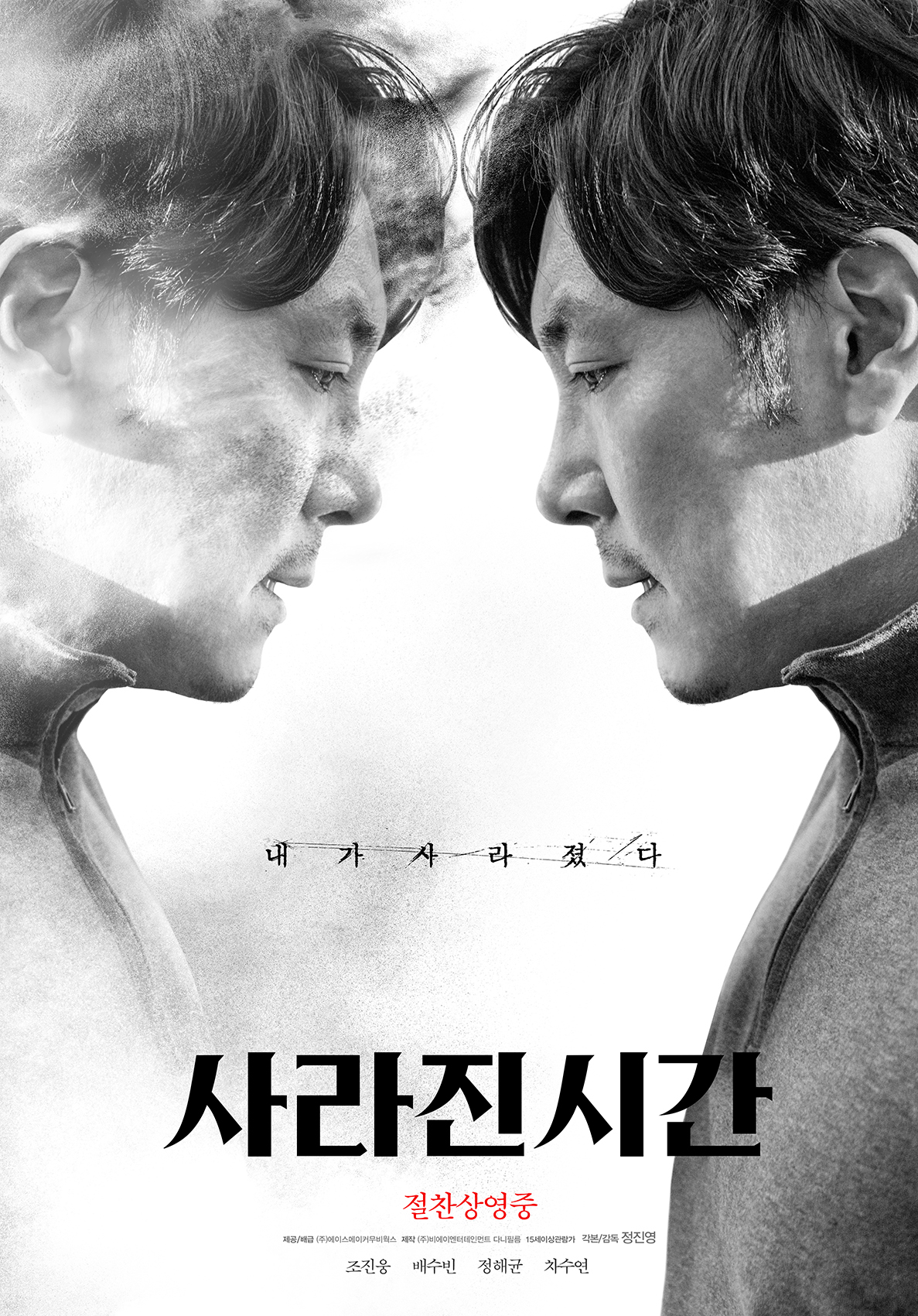
“Don’t invent stories, just go with what you see” the hero of Jung Jin-young’s Me and Me (사라진 시간, Salajin Shigan) is advised, only to find himself investigating his own disappearance. The first directorial feature from the veteran actor, Me and Me throws its existentially displaced hero into another world but then asks him who it is he thinks he is if everyone is telling him he’s someone else. “It’s painful” he finally commiserates unexpectedly encountering a similarly troubled soul, living with another self inside him and consumed by a sense of loss for another life that perhaps never was or will be.

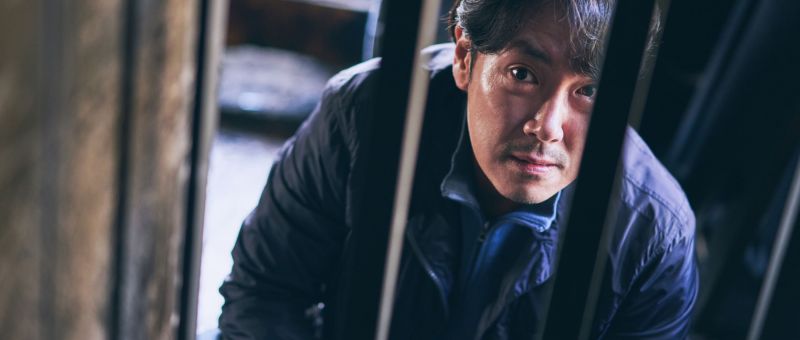
After a brief black and white title sequence featuring policeman Hyung-gu (Cho Jin-woong), Jung opens with a lengthy prologue following primary school teacher Soo-hyuk (Bae Soo-bin) who has just moved to a small, rural town along with his wife Yi-young (Cha Soo-yeon) who has, we discover, a secret. When the locals find out that at night she’s quite literally someone else, repeatedly possessed by departed spirits, they decide that she must be dangerous and install bars and a gate inside her home to cage her inside. Soo-hyuk refuses to leave her, asking to be locked inside too, and the sense of partial acceptance, that the townspeople know of her condition and have decided to meet her halfway, seems to free his wife. Having long been resistant, Yi-young warms to the idea of having a child, that perhaps they could have a happy family life despite her unusual affliction. 

Unfortunately, however, the house is consumed by fire and as they were locked inside, village foreman Hae-gyun (Jung Hae-Kyun) who has the key apparently out of town in a love hotel with the wife of the local police chief, Soo-hyuk and his wife are unable to escape. Hyung-gu finally arrives to investigate the crime, only to be bamboozled by the anxious locals who trick him into drinking some of their homemade pine needle liquor after which he wakes up to discover that he’s not a policeman after all, but the local schoolteacher and he’s very late for work. 

Obviously confused, Hyung-gu tries to figure out what’s going on. He misses his wife and his sons, but is distressed to discover that none of his neighbours recognise him, someone else lives in “his” apartment, and according to the school his kids don’t exist. Half-wondering if the pine needle liquor did something funny to his brain or even perhaps catapulted him into an alternate reality, Hyung-gu is forced to wonder if his previous life was a dream he’s now physically but not mentally woken up from, which means his wife, children, colleagues, and position in society as a policeman were not “real” no matter how real they might seem to him. The dilemma he now faces is in whether he should carry on trying to “wake up” from his new life to return to his “true” reality, or accept his new identity in the knowledge that this too could also be a “dream” from which he may someday wake and will eventually grieve. 

“When it’s time a new season comes” Hae-gyun reminds him, “and when it’s time it goes away”. Freeing himself, having the bars removed from his new home, Hyung-gu begins to accept his new reality, after all what choice does he have? But still he reflects on his own interior life, necessarily a secret from those around him and filled with private sorrow. Even little Jin-kyu, Hae-gyun’s dreamy son, had insisted on his right to privacy over his messy school locker which itself contains a secret pain for another life that he perhaps cannot share with those closest to him. “Everyone’s got a sickness” Hyung-gu sympathises with his new friend as she begins to tell him hers which is, ironically, another echo of his “dream” but also points towards the secret lives that most people have or more to the point never have, carrying something inside them never to be shared. “Don’t worry,” he reassures her, “you’re not the only one”. Each person is a hundred different people, or maybe just one in a hundred different parts. Perhaps in the end it is other people who will tell you who you are and you’ll eventually agree with them because it’s less painful than resisting, leaving that other life as a half-remembered dream. Elliptical and contemplative, Jung’s existential detective story refuses clear interpretation but is in its own way filled with a gentle humanity and a sense of acceptance for all of life’s transitory sorrows as well as its comfort and joy. 


Me and Me streamed as part of this year’s online edition of Fantasia International Film Festival.

Original trailer (no subtitles)

Project Dreams: How to Build Mazinger Z’s Hangar (前田建設ファンタジー営業部, Tsutomu Hanabusa, 2020) [Fantasia 2020]

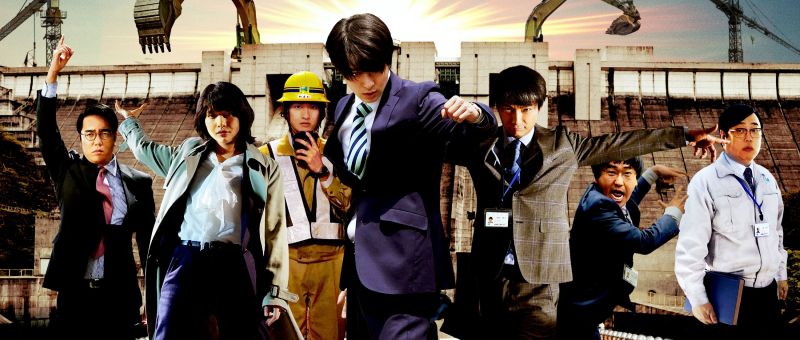
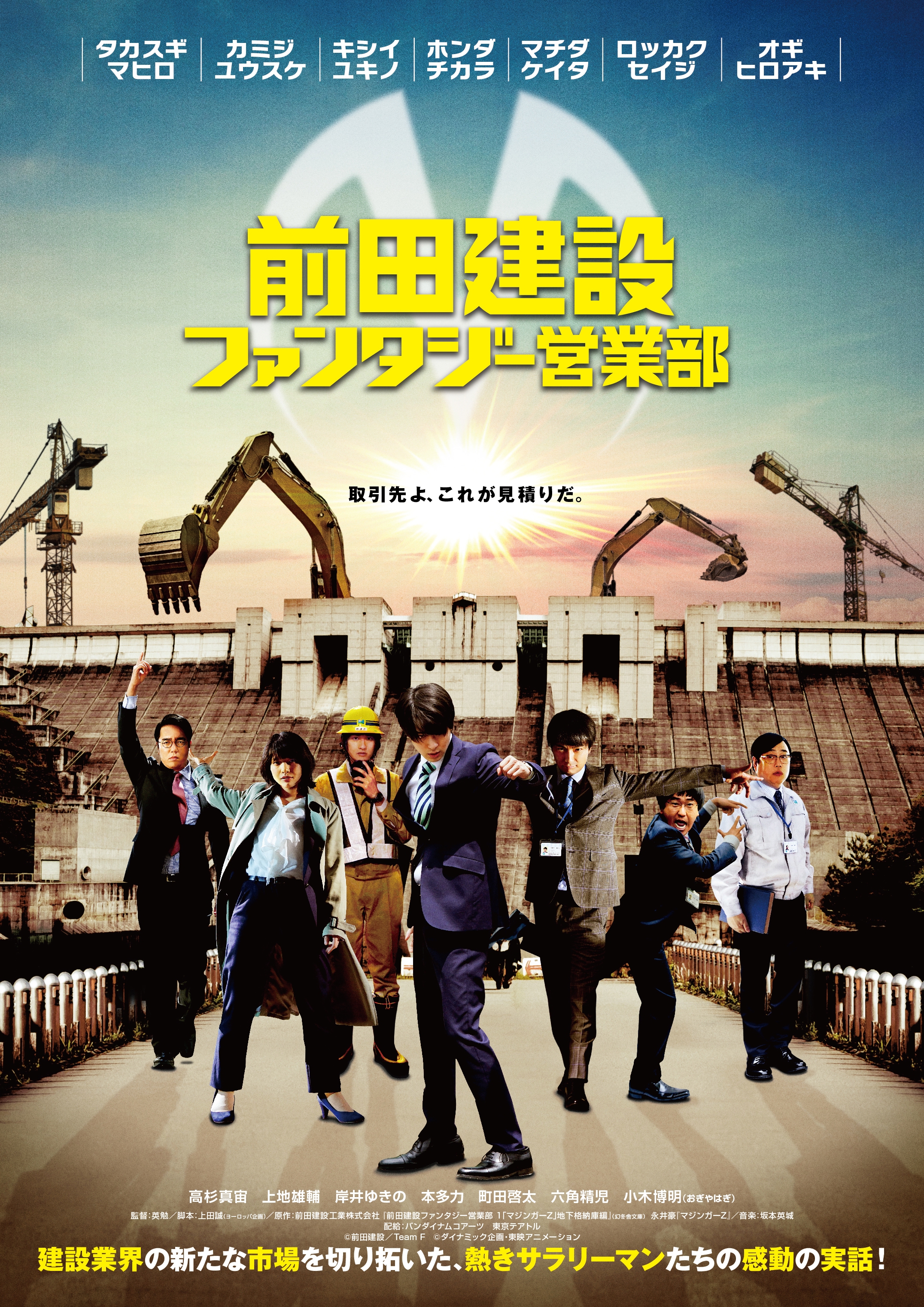
Construction was the post-war powerhouse and a traditional solution for governments looking to boost the economy but what are successful firms to do when everything’s already been built? Maeda made a name for itself as an expert in the construction of dams, but there are only so many you can build and theirs were state of the art so no one’s really looking for any more in the near future. Enter enterprising PR chief Asagawa (Hiroaki Ogi) who has a bold new plan to raise the company’s profile – start an enticing web project in which they draft iconic buildings from the fantasy world as if they existed for real starting with the underwater hangar from nostalgic ‘70s mecha anime, Mazinger Z!

As you can imagine, not everyone is taken by the idea even if initially swept up by Asagawa’s impassioned sales pitch. Being an otaku isn’t something you really want to advertise at work, and perhaps especially if you’re really into kids robot shows from 40 years ago. The point however is less about Mazinger Z than it is that Maeda can build anything it sets its mind to and if it can figure out the wilfully outlandish designs of classic anime which, it has to be said, rarely thought through the real world physics of its creations which are not even generally internally consistent, there’s nothing it cannot handle. 

The major sticking point with the Mazinger Z design is that the hangar is covered by a large amount of water (Mazinger Z is made from a special metal which is completely rust proof) which, given their proficiency with dam technology, shouldn’t be so much of a problem, but the more they look into it the more issues they find from the joints on the “roof” to the platform which pushes Mazinger Z into the launch position needing to boost him within 10 seconds. It doesn’t help that the anime often ignored the constraints of the original design for reasons of plot such as when Dr. Yumi suddenly has the robot slide to the left and bust out of the concrete rather than using the shoot. 

The team will need to show all of their engineering knowhow in order to solve the increasingly annoying number of problems, which is in a sense the point of the project in showcasing Maeda’s superior engineering power. Not all employees are originally behind it, however. Emoto (Yukino Kishii), a young woman entirely uninterested in mecha anime discovers that her colleagues quickly leave the canteen when they see her coming, while reluctant office worker Doi (Mahiro Takasugi) and former engineer Besso (Yusuke Uechi) both find themselves accosted by section chiefs who want them to undermine the project because they are embarrassed to be associated with something so “silly” and worry it will damage the firm’s reputation. Asagawa however is undaunted, sure that this kind of “silliness” is perfect for improving the company brand and capturing an online audience that will eventually lead to more business in the future even if it’s true that their “Fantasy World” clients aren’t going to be paying them nor will they actually be building any of their designs. 

In this Asagawa may well have a point because Project Dreams: How to Build Mazinger Z’s Hangar (前田建設ファンタジー営業部, Maeda Kensetsu Fantasy Eigyobu) just might be the most accessible intro to civil engineering imaginable as they somehow manage to make even the driest of calculations seem exciting in direct contrast to the frequent complaints that the ideas they’ve come up with aren’t “glamorous” enough. Dragged along by his passion, the team gradually come on side one by one with even Doi, the most cynical who told himself that he needed to knuckle down after becoming a regular salaryman, realising that there’s no shame in having fun at work, unexpectedly finding a new appreciation for the craft of engineering after being ordered to read a lot of books about dam building by the company’s foremost expert, himself quietly in favour of the project in its capacity to show off their collective know how and inspire the next generation of engineers. Contrary to expectation, they discover there’s much more industry support than they ever could have imagined for this kind of “silliness” with other companies enthusiastically coming on board to help them achieve their Mazinger dreams. Inspired by true events, Project Dreams has real love and affection for the craft and for those who are just very good at what they do no matter what it might be, embracing a childish sense of fun and imagination along with teamwork and camaraderie which suggests that anything really is possible when you put your mind to it, even constructing an underwater hangar for a robot that doesn’t exist to defend the world against the forces of evil.  


Project Dreams: How to Build Mazinger Z’s Hangar streamed as part of this year’s online edition of Fantasia International Film Festival.

Original trailer (English subtitles)

Beneath the Shadow (影裏, Keishi Ohtomo, 2020)

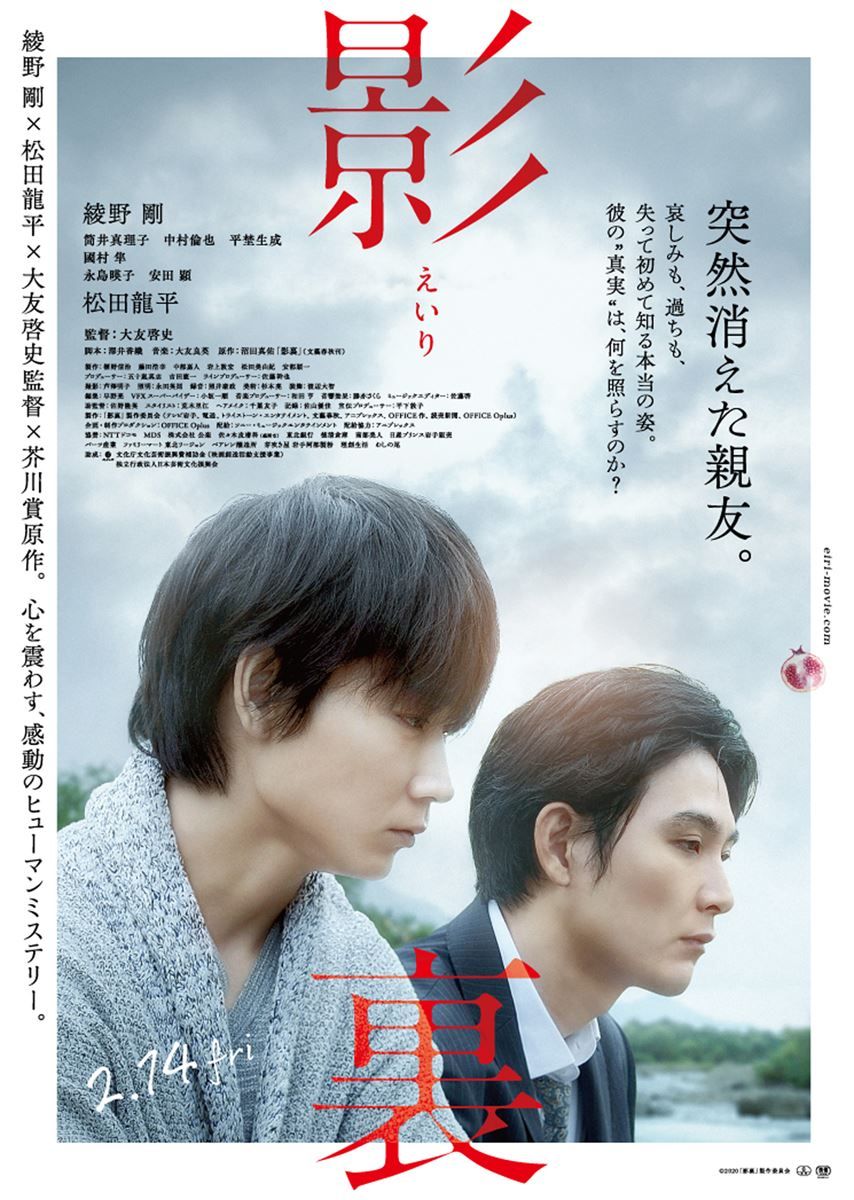
“There’s nothing wrong with leaving it a mystery” the enigmatic presence at the centre of Keishi Ohtomo’s Beneath the Shadow (影裏, Eiri) advises the hero as he vows to look into the unexpected appearance of a fish found swimming in the wrong river. Best known for mainstream blockbusters such as the Rurouni Kenshin series, March Comes in Like a Lion, and Museum, Ohtomo shits towards an arthouse register in adapting the Akutagawa Prize-winning novella by Shinsuke Numata which is in a sense obsessed with the unseen, the hidden details of life and secret sides we all have that are perhaps intended to protect but also leave us vulnerable. 

Konno (Go Ayano), an introverted man in his 30s, has just been transferred to rural Morioka by the pharmaceuticals company at which he works. He keeps himself to himself and largely spends his time caring for a Jasmine plant which appears to have some especial yet unexplained significance. It’s at work that he first encounters the enigmatic Hiasa (Ryuhei Matsuda), reminding him that theirs is a non-smoking building only to discover that Hiasa isn’t the sort to care very much about rules. For some reason or other, Hiasa takes a liking to Konno, turning up at his house with sake, teaching him how to fish, and going on what to anyone else look like dates. Yet when winter comes Hiasa abruptly quits his job and disappears without a word, resurfacing a few months later with a better haircut and a sharp suit explaining that he’s now a top salesman for a suspicious insurance company designed to help pay for expensive ceremonies such as weddings or more commonly funerals. The two men resume their friendship, but soon enough Hiasa again disappears. Only when he’s contacted by a co-worker (Mariko Tsutsui) after the earthquake hoping to find him because it turns out he owes her a large some of money does Konno begin to reflect on how little he might really have known this man he thought a friend. 

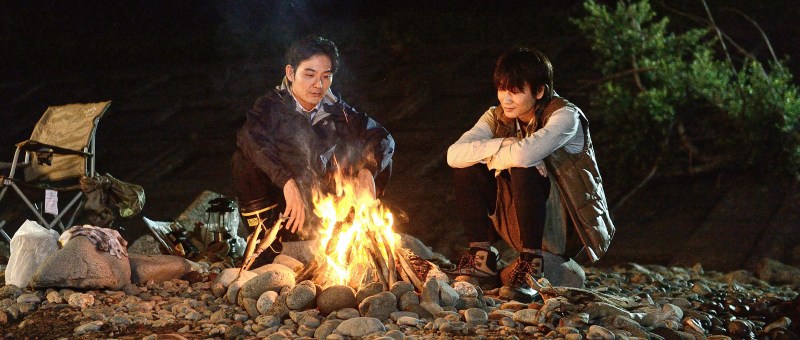
“Right from the start you have to groom it so it’s tantalised” Hiasa later explains, operating on several metaphorical levels but talking quite literally about lighting a fire. Konno has to wonder if that’s all it really was, if Hiasa is just a manipulative sociopath playing a long game, getting him on side in case he’d be useful later. When he resurfaces after his first absence, Hiasa eventually asks Konno to sign for one of his policies claiming that he’s one away from his quota and will be getting the can if he can’t fill it despite having talked a big game in proudly showing off a commendation he’d won as a top salesman when he turned up on Konno’s doorstep. “What you see is where the light hit for an instant, no more than that. When you look at someone you should look at the other side, the part where the shadow is deepest”, Hiasa had pointedly told him during a heated fireside conflagration, seemingly hurt as if in the moment he had wanted to be seen and is disappointed to be met with Konno’s irritated rejection, fed up with his mixed signals and distance both emotional and physical. 

Yet Konno is also himself living half in shadow as a closeted man choosing not to disclose his sexuality to those around him. A meeting with an old friend who has since transitioned presumably having embraced her own essential self raises further questions about the reasons he accepted the transfer to Morioka as if he too, like Hiasa, wanted to disappear from his old life and reinvent himself somewhere new, he’s just done it in a more conventional way. Even in contemporary Japan which is in some ways very old fashioned when it comes to the technology of everyday life and with a strong belief in personal privacy it’s surprisingly easy to just vanish at the best of times, but even his family members who are in no hurry to find him wonder if Hiasa may simply have used the cover of disaster to disappear for good. His conflicted brother (Ken Yasuda) affirms he thinks he’s probably alive because he’s “someone who can survive anywhere” which in the way he’s putting it is not much of a character reference. 

The conclusion Konno seems to come to, in a happier epilogue some years later, is that Hiasa himself was perhaps a fish swimming in the wrong waters, unable to adapt to the world around him. Perhaps it’s alright for him to remain a mystery because a mystery was what he was. Konno, by contrast, sets himself free apparently less gloomy, no longer living half in shadow, even if still hung up on the one that got away. A slow burn affair, Beneath the Shadow eventually refuses conflagration in favour of something cooler in accepting that you never really know anyone, perhaps not even yourself, even when you peer into the darkest part of the shadow. In the end you just have to let it go, “the cycle keeps repeating”. 


Beneath the Shadow streams in the US via the Smart Cinema app until Sept. 12 as part of this year’s New York Asian Film festival.

Original trailer (no subtitles)

Beasts Clawing at Straws (지푸라기라도 잡고 싶은 짐승들, Kim Yong-hoon, 2020)

If you found a big bag full of money and then waited a while but no one came to claim it, what would you do? Many people would do as Jung-man (Bae Seong-woo) did, but sometimes gifts from the gods are sent to tempt you and are decidedly more trouble than they’re worth. Beasts Clawing at Straws (지푸라기라도 잡고 싶은 짐승들, Jipuragirado Jabgo Sipeun Jibseungdeul) is an apt way to describe our small group of interconnected protagonists, each desperately trying to get their hands on the money not necessarily for itself but for the power and possibility it represents or simply to free themselves from a debt-laden existence. 

Jung-man finds the Louis Vuitton bag stuffed inside a locker at his part-time job in a bathhouse. It seems that he is feeling particularly powerless because he’s somehow lost the family business and either never told his extremely domineering mother (Youn Yuh-jung) or she’s simply forgotten, often going off on crazed rants about how her daughter-in-law is secretly plotting to kill them all. Meanwhile, across town, immigration officer Tae-young (Jung Woo-sung) is desperately trying to find his missing girlfriend, Yeon-hee (Jeon Do-yeon), who has, apparently, run off with all his money leaving him in a difficult position with vicious loan shark Park (Jung Man-sik), and melancholy hostess Mi-ran (Shin Hyun-bin) is miserably trapped in an abusive marriage and plotting escape with the help of Jin-tae (Jung Ga-ram), an undocumented migrant from China she met in the club. 

As expected the streams will eventually cross, it is all connected, though it’ll be a while before we start to figure out how in Kim Yong-hoon’s tightly controlled non-linear narrative, adapted from the novel by Japanese author Keisuke Sone. Other than the money the force which connects them is powerlessness. Some of them, maybe all, are “greedy” but it’s not necessarily riches that they want so much as a way out of their disappointing lives. Jung-man feels particularly oppressed because he’s made to feel as if he’s failed his father by losing the family business, something he’s constantly reminded of by his ultra paranoid, domineering mother who eventually pushes his wife down the stairs provoking a crisis point in the foundation of the family. If working part-time in a bathhouse in his 40s hadn’t left him feeling enough of a failure, he is further emasculated by being unable to pay his daughter’s university tuition after she fails to win a scholarship and informs them she’s planning to take a term or two off to earn the money by herself. 

Tae-young is in much the same position, humiliatingly trapped by having foolishly co-signed his girlfriend’s loan only for her to disappear off the face of the Earth, leaving him wondering if he’s just a complete idiot or something untoward has happened to her. He thinks he can regain control of the situation by slipping further into the net of criminality, helping an old uni friend who’s committed large-scale fraud escape to China in exchange for a cut of the loot (and secretly plotting to nab the lot with the help of his shady friend Carp (Park Ji-hwan) who works at the club). 

A crisis of masculinity is also behind Mi-ran’s life of misery as her husband takes out his resentment towards his reduced circumstances on his wife, beating her mercilessly while forcing her to work at a hostess bar to pay off their debts from unwise stock market investments. For her, the money is both revenge and a pathway to a better life. She wants to be free of her husband, and profit in the process. Unable to do it alone, she manipulates male power in the lovestruck Jin-tae all too eager to play white knight to a damaged woman. But Jin-tae is male failure too. When all’s said and done he’s still an innocent boy, not quite prepared for the ugliness of causing a man’s death even if he is a wife beating tyrant the world may be better off without. As an undocumented migrant, he’s pretty marginalised too. Taking advice on how to solve the Jin-tae problem, a more experienced player reminds Mi-ran that no one’s coming looking for an illegal alien and it’s not as if she actually likes him so he is infinitely expendable. 

In an odd way, getting the money is about not being an expendable person anymore. They want the money because they think it will give them back a degree of control over their lives, a kind freedom to move forward with a sense of possibility they do not currently have because of all their debts both financial and emotional. Yet they find themselves farcically scrabbling in chaos, beasts clawing at straws, as they try to outsmart each other and the universe to get their hands on the bag. The universe looks on and laughs, rejoicing in its darkly humorous punchline as the bag finds itself another owner, tempted by its dubious charms with only the promise of more chaos to ensue.


Beasts Clawing at Straws streams in the US via the Smart Cinema app Aug. 29 to Sept. 12 as part of this year’s New York Asian Film festival. Now available in the UK on digital download courtesy of Blue Finch Films!

International trailer (English subtitles)

Family Bond (太陽の家, Hajime Gonno, 2020)

“All I ever wanted was to make everyone happy” claims the father at the centre of Hajime Gonno’s Family Bond (太陽の家, Taiyo no Ie). Once again placing the modern family under the microscope, Gonno’s take is perhaps more traditional than most taking a largely uncritical stance against its extremely patriarchal patriarch whose heart might be in the right place even if his extremely outdated vision of idealised masculinity continues to undermine the idea of family that he is endeavouring to build. 

A manly man, Shingo (Tsuyoshi Nagabuchi) proudly introduces himself as a “Master Builder”, tearing up some revised blueprints from his excited newlywed clients who admittedly unreasonably have proposed major changes to the design at the groundbreaking ceremony on their new home. Such fits of artistic temperament are apparently not uncommon, Shingo’s understanding wife Misaki (Naoko Iijima) profusely apologising and later talking him down while reminding him that he might be a master craftsman but he also runs a business and his family need to eat. Shingo prides himself on being a paterfamilias, subscribing to a traditional ideal of masculinity in which a man must be strong to protect his family, and most particularly his women, but that protection extends in the main to the physical. As Misaki later complains, he largely does what he likes because family means no consequences, rarely bothering to consider the feelings of others in his impulsive drive to live in a thoroughly manly way. 

That’s perhaps one reason why he walks off the site of the traditional woodframe house he’s being paid to build to have coffee with a pretty young woman, Mei (Ryoko Hirosue), who as it turns out has an ulterior motive in that she wants to sell him an insurance policy. Despite all his life claiming that insurance is for cowards, Shingo signs as gesture of patriarchal solidarity helping out a struggling single mother while perhaps harbouring sightly less altruistic intensions. Nevertheless, it’s her son Ryusei that he’s eventually taken by, struck by the loneliness in his eyes as a boy without a father and taking it upon himself to fulfil that role. For her part, Mei is disturbingly unconcerned by this strange, over friendly, middle-aged man with a strong interest in her young son, encouraging Ryusei to hang out with him expressly because Shingo signed a policy with her as if she were in a sense loaning him out in exchange. In any case, it’s difficult to believe a modern woman would be entirely happy about Shingo’s well-meaning fathering, transmitting this extremely problematic, toxic masculinity to a new generation in instructing Ryusei that he needs to get strong because it’s a man’s responsibility to “protect womenfolk” and Ryusei’s to protect his mother as the man of the house. 

These outdated chauvinistic ideas also undermine his relationships with his wife and children, teenage daughter Kanna (Mayu Yamaguchi) resentful at his bond with a random little boy whom he seems to be grooming as a replacement son and potential heir having already alienated his adopted son and apprentice Takashi (Eita Nagayama). Kanna, studying to become an architect, resents her father for his sexism, largely ignoring her because she is a girl and therefore in his eyes unable to assume the family business. Takashi meanwhile resents him because he sent him off to apprentice as a plasterer rather than training him in carpentry as if suggesting he didn’t have what it takes to become a master builder himself. Both of them are hurt by his desire to simply get a new son in its implication that they were never good enough, a feeling compounded by the fact that they are both adopted. Shingo later signals something similar himself when Ryusei’s estranged birth father resurfaces, immediately backing off believing that he couldn’t win against blood as if that really is everything. 

“It’s all a big lie” Kanna and Takashi yell on different occasions trying to get through to their irritatingly distant father whose manly code means he doesn’t engage with emotion or feel the need to respond to their distress, eventually striking Kanna for her disrespect and kicking her out of the house. Of course, he doesn’t really mean it but it’s just another example of the ways his problematic manliness continues to destroy his relationships, Takashi also apparently harbouring resentment towards him for his unreconstructed chauvinism in his many affairs believing his desire to help Mei is just him getting up to his old tricks again. What Shingo discovers however is that he’ll have to literally repair his family through building it anew by helping Mei and Ryusei do the same as her estranged husband reassumes his male responsibility to protect his family. In essence, he’s forced to accept the family he has rather than chasing a better one, drawing a clear divide in building a house for Ryusei and his parents which is separate from his own while entreating his children to return to him through getting them to help build it. Shingo might not have changed, still defiantly patriarchal, but he has perhaps begun to accept that family is a mutual construct that requires strong support. In the end you have to build it together or the structure won’t hold.


Family Bond streams in the US via the Smart Cinema app Aug. 28 to Sept. 12 as part of this year’s New York Asian Film festival.

Original trailer (no subtitles)

Love You Forever (我在时间尽头等你, Yoyo Yao Tingting, 2020)

“Don’t overthink it. It’s fiction” the hero of Yoyo Yao Tingting’s tearjerking romance Love You Forever (我在时间尽头等你, Wǒ Zài Shíjiān Jìntóu Děng Nǐ) advises the heroine, attempting to keep his secret right until the very end. Inspired by Zheng Zhi’s novel, the original Chinese title translates to the more poetic “I’ll wait for you at the end of time”, hinting at the central, sci-fi-inflected romantic tragedy in which the hero finds himself selflessly sacrificing his years on Earth to fulfil the dreams of the woman he loves. 

Describing himself as a man who does not exist because there are no memories of him in this world, Lin Ge (Lee Hong-chi) is writing a memoir as a way of recapturing the past. He tells us of his lifelong love for Qiu Qian (Li Yitong), a woman he first met when they were both children in the summer of 1991 shortly after his mother had passed away from illness. Lin Ge describes her dancing like sunshine piercing through the thick clouds, a force which has illuminated his life. Trying to retrieve her lost marble from a pond, he discovers a mysterious clock which inspires their childish games all through that golden summer, yet at summer’s end they are cruelly separated when Qiu Qian moves away. At 17 he meets her again and she playfully pretends not to remember him, later embarking on a tentative teenage romance only for Qiu Qian to be hit by a car and killed on her way home from a birthday date. Activated by his tears, the mysterious clock sends Lin Ge back in time, or more accurately into a parallel universe where he is able to prevent the accident and save her life but only at the cost of his existence. This time Qiu Qian really doesn’t remember him because he never existed. Not even his father (Fan Wei) knows him, and he seems to have aged a good decade which in itself presents a barrier to possible romance. 

There’s something of a poignant metaphor in Lin Ge’s intense desire to crawl back inside his memories by writing them down, neatly laying out the various timelines of his life which he has willingly sacrificed to save Qiu Qian resigned to the fact that, in the final version, she will never know him. Later, she asks him how he knows the woman in his novel would be happy with the future he has engineered for her in which he is a deliberate absence but Lin Ge has no answer for her. The Qiu Qian that we see has achieved her dreams of becoming a prima ballerina with the Shanghai ballet, but she is perhaps unfulfilled aware there’s something missing in her life. About to leave the stage, she’s engaged to an old school friend, Huang (Chao Zhang), who is distant and controlling, actively discouraging Qiu Qian from continuing to dance after they marry and emigrate to America reminding her that she’ll have “more important things to think about” once she’s his wife. Lin Ge, meanwhile, now appearing as a man around 60, has taken a job as a caretaker at the theatre where he watches over Qiu Qian from the wings only for her to discover his memoir and become intrigued by its similarities to her own life. 

“The fate is destined, you will use up your time” an Eastern European fortune teller cautions Lin Ge after realising there’s something not quite right with Qiu Qian’s lifelines, “Don’t change the fate again, otherwise everything will become tragic”. Conflicted in her dance career, Qiu Qian reflects that had she known how it would turn out she’s not sure if she would have pursed her dreams, but Lin Ge, perhaps talking more for himself, affirms that of course she would. Even knowing how it would end, he’d do it all again for the brief moments of happiness he spent with Qiu Qian, “it only counts when we’re by each other’s side” as it says in the diary. Fate, however, keeps conspiring against him even as Qiu Qian undergoes her own parallel quest to solve the mystery of their love story in reverse. A poetic meditation on the lover’s exile, selflessness, the power of memory, and the indelible connection of a fated love, Love You Forever is genuinely romantic in all senses of the word even in its inescapable melancholy for those who pledge to love until the end of time.


Love You Forever is currently on release in UK cinemas courtesy of Cine Asia.

UK release trailer (English subtitles)

I WeirDO (怪胎, Liao Ming-Yi, 2020) [Fantasia 2020]

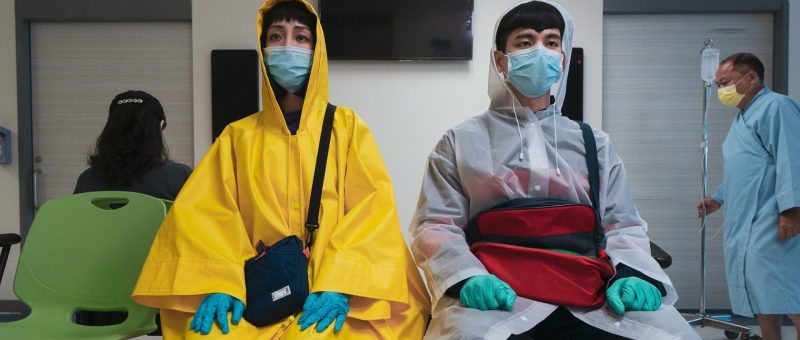
Being in love can be a little like a sickness, but what happens when the spell wears off? A meditation on fatal attraction syndrome and the duplicitous delusions of “normality’, Liao Ming-Yi’s charming romance I WeirDo (怪胎, Guàitāi) arrives at the most opportune moment in which we’re all “weirdos” now, stuck at home obsessively washing our hands and dutifully remaining “alert” as we disinfect everything we see. Liao’s PPE-clad heroes find love in shared anxiety, but happiness is the enemy of fear and the things that brought you together may in the end drive you apart.

Chen Po-ching (Austin Lin Bo-hong) is somehow able to afford a spacious two-level home working as a full-time literary translator despite the fact it takes him ages because he’s unable to type. A sufferer of severe OCD, he lives by strict routine and is deathly afraid of germs. For most of his life he simply remains at home, but on the 15th of every month he dons full body PPE and braves the outside to pay his bills, do his shopping, and visit a doctor he hopes can help him beat the condition but only gives him mysterious medication which doesn’t seem to make much difference. His life changes one particular 15th when he spots a woman dressed much like himself who is also headed to the supermarket where she shoplifts a bar of chocolate and buys up the remaining stocks of his favourite disinfectant. Chen Ching (Nikki Hsieh Hsin-Ying), as she later gives her name, approaches him to make sure he’s not going to dob her in about the chocolate which she doesn’t even like, it’s just a compulsion. She suffers from OCD too along with a skin allergy that means she’s not supposed to spend a lot of time outdoors. 

Love eventually blossoms. Ching opens up Po-ching’s world, conspiratorially involving him in her shoplifting and inviting him to visit her at work as a life model for a drawing class where she’s asked to pose like a fallen angel with broken wings. They go on weird “dates” taking germ challenges like eating at tiny eateries with questionable hygiene standards and picking up rubbish before Po-ching realises that going “out” so much is placing a strain on Ching’s health so he proposes she move in with him. Luckily she’s an ace typist so she can help with his work as well as the intensive cleaning regime he already has in place. What they’ve made is a blissful world of two, isolated from the confusing pollution of regular society. But paradise can also be a cage, and it’s natural enough to long for freedom. Before long a problematic pigeon and a loitering lizard have them each pondering life in the outside.  

Opening in a boxy, claustrophobic square, Liao eventually swaps narrators and switches to a comparatively open widescreen as horizons quite literally expand, a development which introduces, ironically, a new but distinctly unhelpful anxiety into a relationship both apparently hoped would be unchanging. The couple’s OCD struggles become a stand-in for the giddy obsession of new love as they cocoon themselves happily within their romantic bubble only for the magic to inevitably begin wearing off. Despite all they have in common, the pair have an ideological mismatch. She actively craves their difference, believing OCD is a gift that allows them to lead unique lives, but he secretly yearns for “normality”, to be cured and become a “normal” person living a “normal” life. She’s for staying in, he’s for going out. “Why do we have to be the weirdos?” Ching asks Po-ching seconds after revealing suicidal tendencies. He tells her he’s never given it too much thought. His OCD simply is, it can’t be changed, so he just accepted it. But change, which is of course what they most fear, eventually comes, paradoxically because when you’re “happy” and you feel accepted perhaps you don’t need so much obsessive control over your life. 

Liao undercuts the darker side of a life ruled by intense anxiety through whimsical production design adding a touch of fairytale glamour to the sad romance of the two similarly named protagonists falling in love in an uncertain world. Shot entirely on iPhone, the cinematography is unexpectedly rich and innovative, handsome even in its immediacy and like the protagonists embracing its limitations with wit and charm. Perfectly tailored for the post-corona world, I WeirDo wants to ask us if love can survive our fear of change or if our intense need for control over our lives robs us of the ability to live, if being “normal” is worth the price of love, and if there’s really anything wrong with being a “weirdo” especially if you find someone to be a weirdo with. Po-ching and Ching are still figuring it out, but aren’t we all even in these admittedly strange times? 


I WeirDO streamed as part of this year’s online edition of Fantasia International Film Festival.

Original trailer (English subtitles)

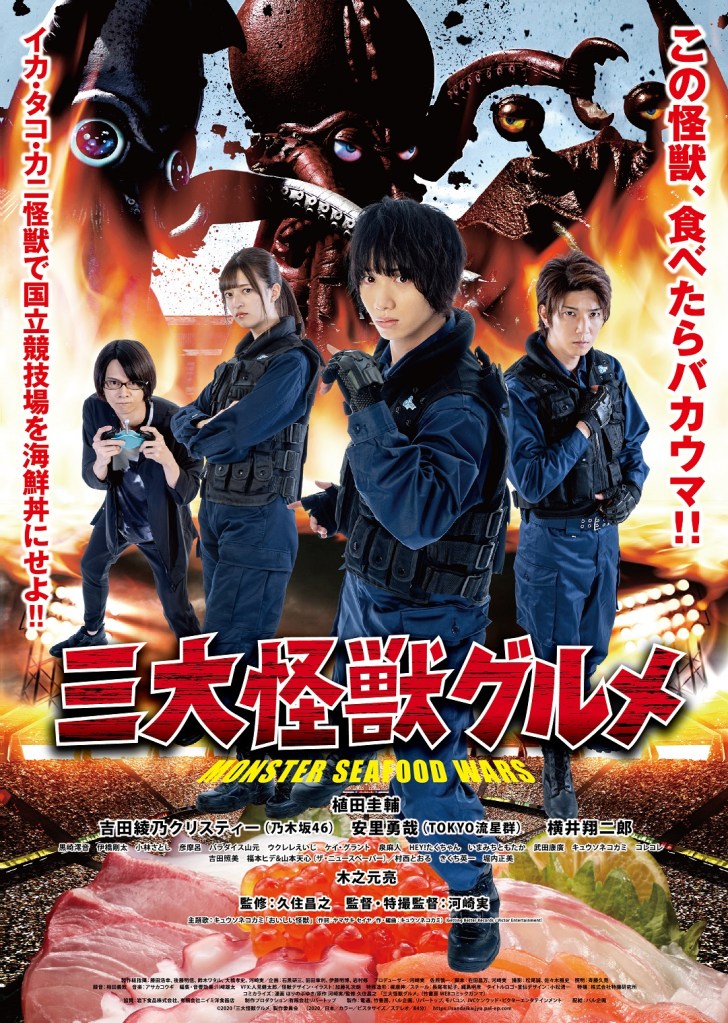
Monster SeaFood Wars (三大怪獣グルメ, Minoru Kawasaki, 2020) [Fantasia 2020]

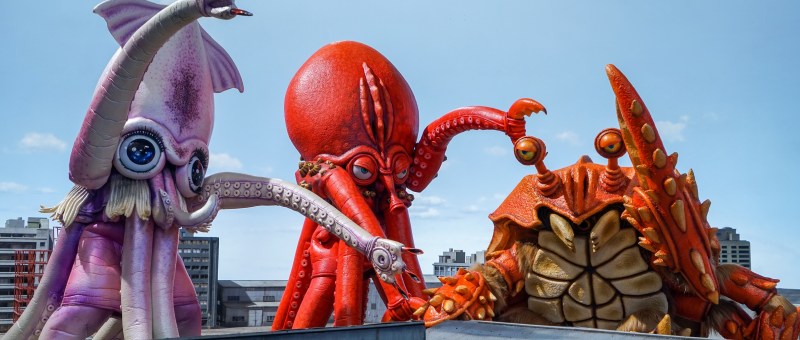
Ever wondered what happens to a fallen kaiju? After Godzilla and friends have ransacked the city, there’s certainly a lot of cleaning up to do but disposing of kaiju corpses isn’t something your average monster movie gives a lot of thought to. According to Monster SeaFood Wars (三大怪獣グルメ, San Daikaiju Gourmet), there’s surprisingly good eating to be had in monster meat and when it comes to taking down a giant squid, perhaps it’s better to ask a chef rather than a scientist or the boffins from the Ministry of Defence. 

Switching between documentary sequences featuring talking heads looking back on the bizarre events and the events themselves, Monster SeaFood Wars follows scientist/sushi shop heir Yuta (Keisuke Ueda) who accidentally unleashes three giant kaiju on the city of Tokyo after he’s knocked off his bike while delivering some prize seafood to the local temple as an offering. In addition to being the heir to a sushi shop, Yuta is also a scientist apparently obsessed with giant monsters which he describes as “cute” and had been working on a serum, Setap Z, to turn ordinary foodstuffs giant in order to end world hunger. Before you know it, angry octopus Takolla and his frenemy Ikalla are on the rampage through the city. 

Of course, Yuta is the prime suspect which is perhaps why he somewhat arrogantly describes himself as the “biggest victim” while reluctantly agreeing to help out SMAT, Seafood Monster Attack Team, as they try to figure out how to mitigate the effect of Setap Z and stop the kaiju assault but is further irritated by being denied a spot on the team as a full member. Meanwhile, he’s also facing off against rival scientist Hikoma (Yuya Asato) who impresses with an obvious idea, vinegar, while charming Yuta’s childhood friend and unrequited crush Nana (Ayano Christie Yoshida) who now works for the Ministry of Defence and has only contempt for the weirdo monster geek. 

Yuta’s plan had been to let Takolla and Ikalla duke it out, assuming Takolla would win and then they’d somehow lure him into a giant octopus trap. Hikoma meanwhile suggests giant rice vinegar cannons, regular missiles already having proved ineffective against the sea creatures’ springy flesh. Hikoma’s plan would have worked, had it not been for the sudden and unexpected return of Kanilla whose hard shell protects him against the corrosive effects of the vinegar. During the fight, however, some of Takolla’s tentacles are chopped off, chunks of meaty white flesh falling to the ground as SMAT commander Hibiki (Ryo Kinomoto) unconsciously licks his lips. 

While very much a classic kaiju movie, Monster SeaFood Wars has its tongue firmly in its cheek, scaling back on the monster-fighting action for some gentle satire as the gang find they just can’t resist the urge find out what kaiju tastes like. The answer is surprisingly good, with the effect that kaiju meat becomes the latest culinary trend. “Forget bubble tea” one commentator says, monstrous squid is where it’s at. The TV news also comes in for a kicking with its placard unveiling confirming the kaiju’s name as well as a state of the nation address from an Abe-esque PM using the crisis to further his quest to “take back Japan” while speaking in a distinctly squeaky voice.

Meanwhile, drunk salarymen complain about their exploitative working conditions, joking that they’d need to be eight-armed octopuses to get through the amount of work expected of them only for Takolla to appear out of nowhere and slap them down seconds after they’ve made a few inappropriate remarks to some passing young ladies. Aside from the kaiju, the big bad does seem to be pervasive sexism with Ministry of Defence employee Nana often relegated to little more than eye candy and eventually the subject of an offensive bet between the icy Yuta and slick Hikoma whose equally sexist cheesy lines actually seem to impress her. 

Yuta, however, gets the chance to redeem himself by revealing that the really did make the formula to help starving people in Africa rather than just because he actively wanted to usher in the great kaiju apocalypse, owning his legacy as the son of a sushi shop while his best friend Niima (Shojiro Yokoi) has a few surprises of his own up his sleeve which prove that the best person to have at a giant octopus is a skilled chef. Of course Setap Z turns out to cause a few additional problems, accidentally spreading itself around after hitting the mosquito population, while it seems the villain is not quite done with their desire to misuse the serum, hinting at a possible sequel. A humorous but never mocking take on the classic tokusatsu, Monster SeaFood Wars pits culinary science against the giant monster threat and discovers that all you need to save the world is a good cook.


Monster SeaFood Wars streams in Canada from 20th August to 2nd September as part of this year’s online edition of Fantasia International Film Festival.

Original trailer (no subtitles)