Ribbon (Non, 2022)

What is the place of art amid a global crisis? A young student finds herself wrestling with her sense of purpose uncertain if art is more necessary than ever before or a completely worthless waste of time that could be better used dealing with the situation on a more practical level. Written, directed, and edited by actress/singer Non, Ribbon is a response to pandemic anxiety but also a meta drama about an artist reclaiming a sense of confidence in their work along with their right to make it even if not widely understood. 

As the film opens, art student Itsuka (Non) is lugging a series of paintings and art equipment back to her university for the upcoming graduation exhibition, only the exhibition has just been cancelled because the university will be closing its doors the following day due to the COVID-19 pandemic. Itsuka has to cart all her stuff home again, but she’s luckier than some she witnesses who are left with no choice other than to destroy the precious works of art into which they’ve poured four years of their lives because they can’t store them and neither can the university. 

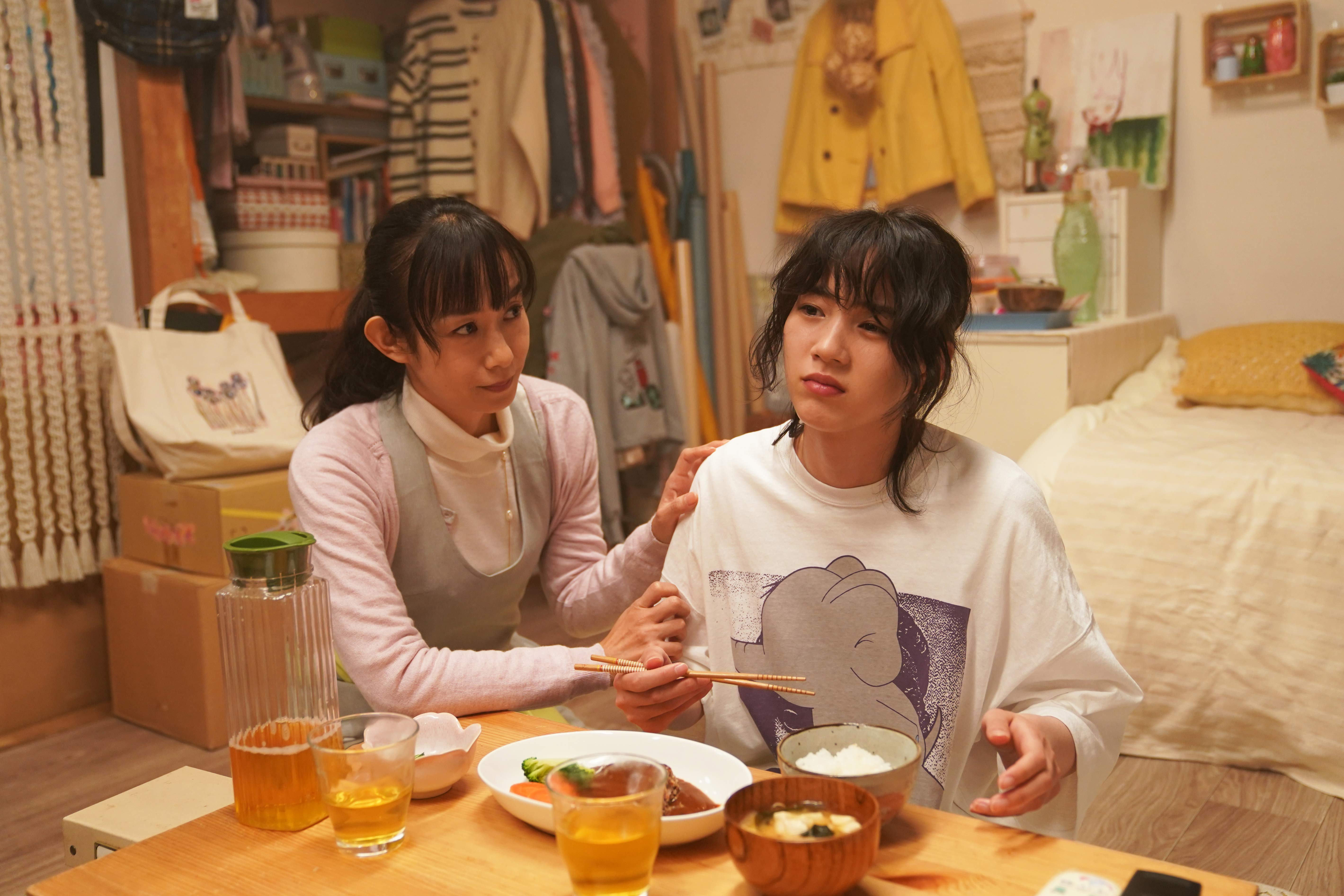
Watching her fellow students in tears as they crush, tear, and bludgeon their projects Itsuka can’t help but wonder what separates her painting from “trash”, seeing these precious pieces dismembered and left out for the binmen. The feeling is compounded when her mother (Misayo Haruki) pays her a visit, clad in a homemade hazmat suit, and throws the painting out justifying herself that as it had stuff stuck on it she thought it was just something she’d made messing around, more like a child’s collage than a serious piece of “art”. Unable to accept her mistake, Itsuka’s mother defensively doubles down leading to a climactic argument and the visits of other family members including her father (Daikichi Sugawara) who arrives with a social distancing pole and her sister (Karin Ono) who now dresses like an assassin each armed with passive aggressive peace offerings but ultimately seeking validations that her mother was right to dismiss her incomprehensible art. 

While her friend Hirai (Rio Yamashita) is later caught sneaking into uni to work on her much more conventional piece, a large canvas painting featuring a young girl in a forest with giraffes and leopards, Itsuka has been unable to find the desire to paint. The painting, a mixed media portrait of a young woman surrounded by ribbons, sits looking down on her taped to the wall but she can’t get away from the idea that perhaps her work really is “trash” and she’s just been wasting her time on something meaningless that other people don’t understand or care about. The feeling is compounded when she’s informed that the job offer she had from a design firm for after graduation has been rescinded due to COVID uncertainty. Only when she accidentally reconnects with a middle-school classmate (Daichi Watanabe) who had praised her work does she begin to rediscover its value not least in allowing her to vent her frustrations not only with the pandemic-era society and its isolating anxieties, but the conservative ideas embodied by her mother’s constant complaints about her “attitude” reminding her she’ll never get married if she carries on as she is.  

“This is what our frustration looks like” she explains incorporating her friend’s fractured painting to turn her formerly chaotic apartment into an installation covered in the ribbons which had previously swarmed around her. Opening with scenes of the deserted university peopled with broken statues, headless mannequins, and crude drawings on walls, Non captures a sense of the lonely despair of the early days of the pandemic allowing these now empty places to seem almost haunted by an eerie sense of absence. There is an unavoidable absurdity in the constant masking, obsession with social distance, and spraying anything and everything with sanitiser but also a care beneath the anxiety in the concern for others’ safety as well as one’s own. “Heavy” is how Itsuka frequently describes her situation not only the physical weight of her work but its spiritual burden along with her despair and anxiety for her uncertain future, but learning to bear it allows her to rediscover a purpose and value in art not despite but because of the times in which she lives. Quirky and heartwarming, Non’s accomplished directorial debut is not only a snapshot of ordinary life in a pandemic, but a meta tale of a young woman reclaiming her right to create and vent her frustrations towards a sometimes restrictive society. 


Ribbon screened as part of this year’s New York Asian Film Festival.

Original trailer (English subtitles)

Images: ©︎”Ribbon” Film Partners
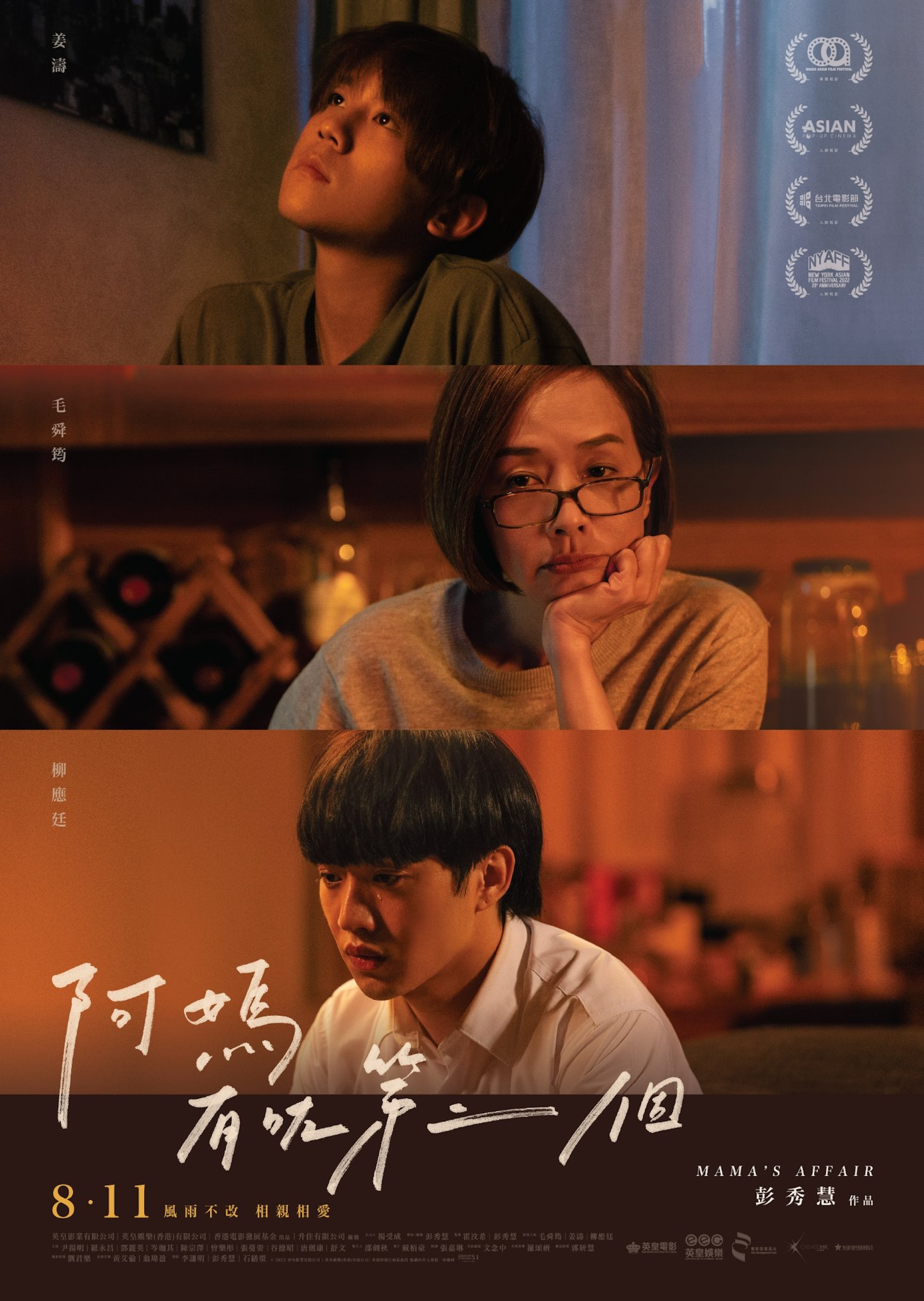
Mama’s Affair (阿媽有咗第二個, Kearen Pang, 2022)

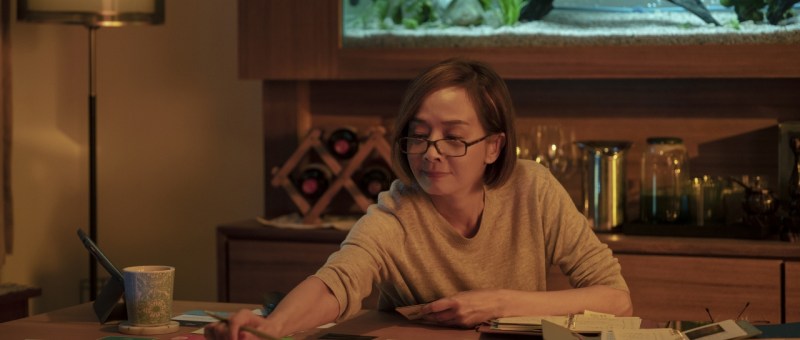
A middle-aged woman finds her desire to take back her life after the failure of her marriage frustrated by her teenage son’s resentment and the lingering patriarchal social codes of the contemporary society in Kearen Pang’s familial dramedy Mama’s Affair (阿媽有咗第二個). The “affair” of the title is an ironic take on her new maternal relationship with a young man she takes under her wing framing it as in a way cheating on her son which is clearly the way he feels about it, while it’s clear that some still view her desire to find fulfilment outside of her role as a wife and mother as a betrayal of her family. 

Before her son was born, Mei-fung (Teresa Mo Shun-kwan) was a top talent manager at a record label but gave up her job at her husband’s insistence after suffering a miscarriage. With her son, Jonathan (Jer Lau of boyband Mirror), about to graduate high school and hoping to get into Cambridge University, she decides to re-enter the world of work but soon discovers that those she once helped in their careers are not necessarily keen to repay the favour. An old associate more or less laughs her out of the room suggesting she’s simply too old for the music business and recommends she join another old friend at his music company which turns out to be a school for small children. She takes the job anyway and quickly bonds with the two younger employees who introduce her to Fang Ching (Keung To of boyband Mirror), a young man with a prodigious talent for song and dance that has Mei-fung thinking of getting back into the management game.  

Though Jonathan had mostly reacted with indifference to his mother’s decision to return to work, claiming that he’d long wanted more independence anyway, he can’t seem to let go of a sense of resentment towards Ching which is compounded by his confusion surrounding the status of his parents’ marriage which it seems had long gone cold. His father Yan has moved out and though Jonathan doesn’t know it is having a baby with an old friend of his mother’s all of which informs his feelings of displacement as if he’s been pushed out of the family circle fearing that Mei-fung has gone out and got herself a new son who admittedly seems to appreciate her more. Displaced from his own family by tragic circumstances, Ching does indeed value the small things Jonathan has begin to resent in teenage angst yet is also unexpectedly sensitive and mindful of the ways in which his relationship with Mei-fung and presence in the household may be affecting Jonathan who is still struggling to come to terms with his parents’ decision to end their marriage without even really telling him. 

In an another ironic note it’s Mei-fung’s maternity which is positioned as her key strength as a manager, quietly lending support and encouragement that allows Ching to reach his full potential. On Ching’s arrival to the studio a mother had come in to the school with her young son who was bawling his eyes out because he wanted to join a dance class but the mother wouldn’t let him because she said he was too fat and would only embarrass himself only to be proved wrong when Ching invites him to try out on the dance floor demonstrating both the damage that can be done by a judgmental parent and the positive influence of an actively supportive environment. While Mei-fung keeps telling Jonathan he needs to learn to look after himself, she patiently nurtures Ching and eventually encourages to him sort out his complicated feelings towards his family while helping him achieve his dreams as an artist. 

In some ways, Mei-fung never really transcends the role of mother or escapes the tendency to define her role in relation to the two boys while somewhat resentful of all she was forced to give up because of the patriarchal, authoritarian mindset of the husband who later left her for a younger woman. Jonathan and Ching eventually sort things out through a good old fashioned fist fight generating a kind of brotherhood that leaves each of them equally displaced but also finding firmer footing more secure in their roles and relationships. “No one can handle everything alone” Ching wisely advises, as each of the trio develops a kind of independence founded on mutual solidarity, Mei-fung reclaiming her right to an individual life while giving each of the boys the courage to go off and pursue their destinies through the superpower of maternal love. 


Mama’s Affair is in UK cinemas from 19th August courtesy of CineAsia.

UK trailer (English subtitles)

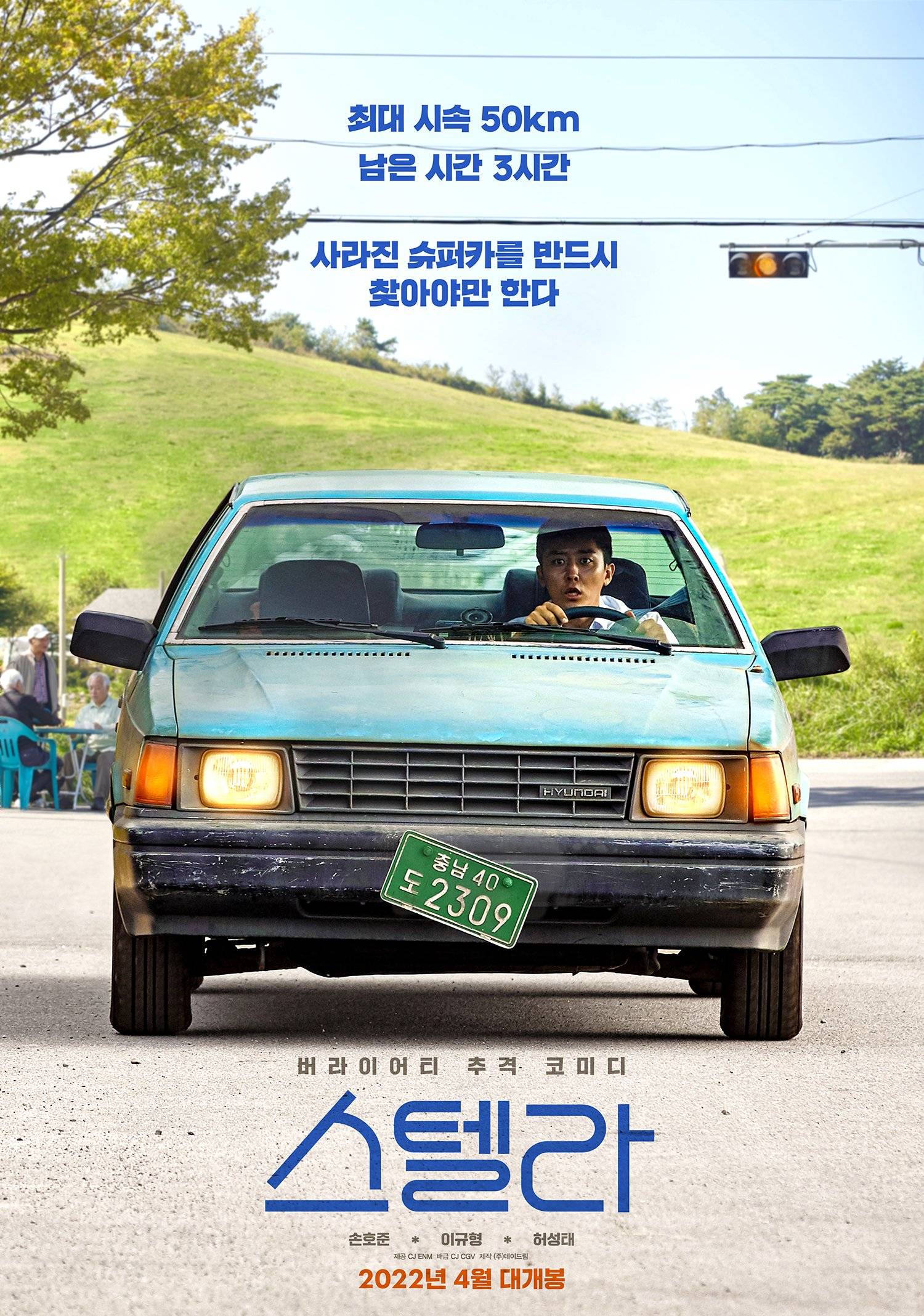
Stellar: A Magical Ride (스텔라, Kwon Soo-kyung, 2022) [Fantasia 2022]

A cynical man learns to forgive the father he resented for abandoning him while on a road trip in his banged up ‘80s Hyundai Stellar in Kwon Soo-kyung’s quirky dramedy, Stellar: A Magical Ride (스텔라, Stellar). Not everyone is suited to being a parent, as he’s fond of saying not incorrectly, but even if his father’s love was imperfect it doesn’t mean it wasn’t there and just because he feels his own father failed him it doesn’t mean he’d do the same to his own child.

Young-bae (Son Ho-jun) makes a living repossessing luxury cars on behalf of shady gangsters. After unwisely entrusting a Lamborghini to his childhood friend Dong-sik (Lee Kyu-hyung) who now runs a logistics company, Young-bae’s life is derailed when he goes awol leaving him to deal with his violent boss. Meanwhile, he’s just found out his wife might be pregnant after stumbling on a pregnancy test in their bathroom and his sister has been in contact to let him know their estranged father has passed away. After the gangsters track him down to the funeral, he manages to make a daring escape by taking off in his father’s old Hyundai Stellar which is not exactly the most ideal getaway vehicle seeing as Young-bae struggles to get it over 30 and the driver’s side door doesn’t open anymore. 

In a way there might be a reason for that, Young-bae both driver and passenger as he shifts over into his father’s old seat at the wheel. For some reason he finds himself talking to the car without really understanding why while the car itself always seems to come to his rescue just at the right moment as a magical twinkling plays in the background. It’s difficult to avoid the interpretation that the car is possessed by his father’s spirit, though it may equally be the manifestations of Young-bae’s childhood memories as he remembers a happier time in his life when he spent time with his father in the car which he described as his family’s “star”. 

“Becoming a father is easy, but living as one is hard” Dong-sik laments having been somewhat humiliated in front of his own kids little knowing that Young-bae is facing just this dilemma as he tries to come to terms with impending fatherhood. As an older man looking back on traumatic childhood memories, he gains a new perspective if perhaps still struggling to forgive his father for abandoning him only later coming to the realisation that he may have shown his love in a different way in thinking that the best thing for his family might be to remove himself from it. 

The root cause of all these problems is however debt. Young-bae resents his father for getting into trouble with loansharks after a traffic accident disrupted his taxi business, while the reason Dong-sik double-crossed him with the car is because he is deeply in debt himself. Even a farmer’s wife he meets explains that they’re alive because they can’t die, now in masses of debt following several poor harvests and the onset of her husband’s lumbago. Young-bae technically makes a living off debt given that the reason most of these cars are being repossessed is that their owners have fallen into financial difficulty. One such man Young-bae targets is currently living in the car when he tries to repossess it having lost his life savings and everything he owned trying to pay for medical treatment for his wife. Young-bae unsympathetically tells him that he hates irresponsible and incompetent fathers projecting memories of his own onto him while unable to show any kind of compassion or mercy for the difficulties he is facing. As the film opens, he helps save a man who was planning to take his own life but only so he can get his signature on the repossession papers before he passes away. 

Literally having to take his father’s perspective by sitting in the driving seat of his car while interrupted by nostalgic songs from the tape deck which seems to have a mind of its own, Young-bae comes to an acceptance of paternity while making peace with his father’s memory. A quirky road trip movie with a series of strange characters who all have important lessons for Young-bae about the nature of friendship and family, Stellar is certainly a magical ride through frustrated grief and paternal anxiety finally arriving at a place of warmth and safety free of past trauma and resentment in the driving seat of a beaten up family car. 


Stellar: A Magical Ride screened as part of this year’s Fantasia International Film Festival.

International trailer (English subtitles)

Intimate Stranger (親密な他人, Mayu Nakamura, 2022)

“This society pampers men too much, no matter their age” according to a middle-aged woman searching for her missing son, yet in many ways it’s the primacy of the mother and maternal neglect that drive Mayu Nakamura’s eerie psychological chiller, Intimate Stranger (親密な他人, Shinmitsuna Tanin). Perhaps in some ways, that’s what a mother and a son should become, of course close and loving yet each with their own lives unknown to one another but for Mrs Ishikawa those boundaries have perhaps become corrupt in her overwhelming need to embody the maternal ideal. 

Mrs Ishikawa (Asuka Kurosawa) lives alone and is searching for her grown-up son, Shinpei, who went missing a year ago. She has a job in shop selling baby clothes and accessories but is described by other staff members as a bit strange though they continue to invite her to afterwork gatherings knowing she won’t come. One day she gets a call from a young man, Yuji (Fuju Kamio), who says he has information about Shinpei but in reality is part of a gang running “ore ore” scams who are also looking for him because he previously worked with them. Yuji’s purpose in approaching Mrs Ishikawa is to get info out of her, but she’s a little bit ahead of him and manages to plant the seeds of a dark seduction. 

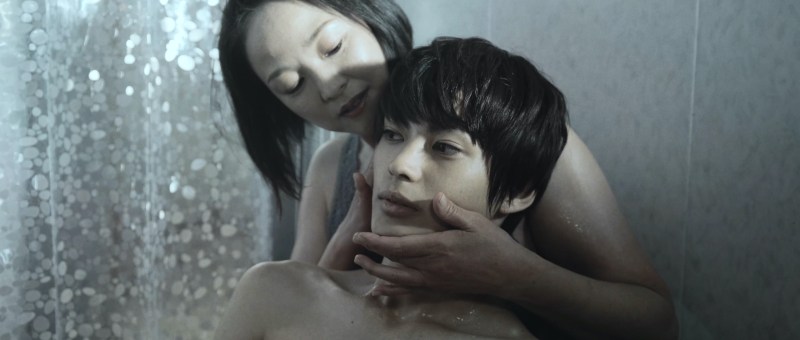
Seduced is what Yuji eventually is in a discomforting mix of the erotic and the maternal. Casting shades of Vertigo, Mrs Ishikawa persuades him to move into her apartment, sleep in Shinpei’s room, and wear his clothes keeping him a virtual prisoner while forcing him into the role of her surrogate son. As we later discover, Yuji was a teenage runaway seemingly abandoned by his mother and craves maternal affection but is ashamed of admitting and fearful of accepting it all of which would make him ideal prey for a woman like Mrs Ishikawa who at all rates seems to need a son to feel herself complete. 

At the shop where she works, Mrs Ishikawa transgressively sniffs and fondles clothes for newborn infants while at one point driven to distraction by a crying child temporarily separated from its mother to the point that she inappropriately picks it up. She appears to be totally consumed by the maternal image and to that extent or else because of some previous trauma becomes extremely hostile when confronted with her sexuality. Her horror on being picked up by a gigalo when expecting to meet a man with info about Shinpei might be understandable, but the glee on her face after slashing a man with a straight razor when he attempted to attack her is less so while Yuji’s eventual confusion about the nature of their connection highlights the discomforting intersection of the maternal and the erotic. 

We have to wonder if Shinpei simply decided to escape the grasp of an overbearing mother who could not bear to accept that her son was now a man, or if Yuji’s suspicions that he may have met a darker fate are more than mere reflections of his own fear of maternal connection. Yet like story of the bluebird of happiness that Shinpei was apparently fond of telling, perhaps each of them for a time found what they needed in the other only to lose it again on identifying the darkness that underlines their relationship. 

Listening to a report on the news, Mrs Ishikawa explains that “ore ore” scams only happen in Japan because nowhere else would a parent drop everything and run cash in hand when told a grownup son is in financial trouble which might in a sense be unfair save for the urgency, similar scams circulate via text and messaging apps in many countries. Yet the scam hints at this same level of disconnection, that the often elderly targets cannot tell that it is not their son or grandson’s voice on the phone nor realise that the information they’re being given does not make sense so estranged have families become. The coronavirus pandemic meanwhile only makes the scammers’ job easier given the loneliness of enforced isolation coupled with generalised masking which decreases the level of intimacy on both sides dehumanising the target while allowing the scammer to further conceal their identity. 

Mrs Ishikawa is in a sense wearing a permanent mask, consumed by the maternal ideal and unable to conceive of herself as anything outside of a mother. There is something unsettling and vampiric in her need as she at one point sucks blood from her finger and wields her razor with dangerous affection when offering Yuji the closest shave he’ll ever have but also a deep sadness that like the bluebird of happiness that which she most wants is always going to fly away from her one way or another. The uncanniness of the desaturated colour palate adds a further note of dread to the noirish tale of a young man seduced by Oedipal desire and drawn as much towards death as love.


Intimate Stranger screened as part of this year’s New York Asian Film Festival.

Original trailer (no subtitles)

Images: © Siglo/Omphalos Pictures

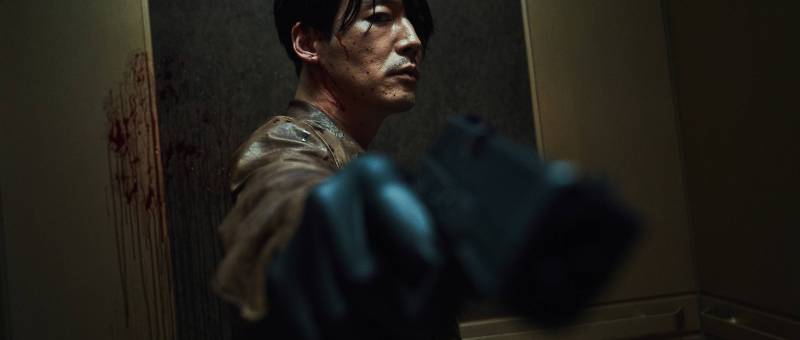
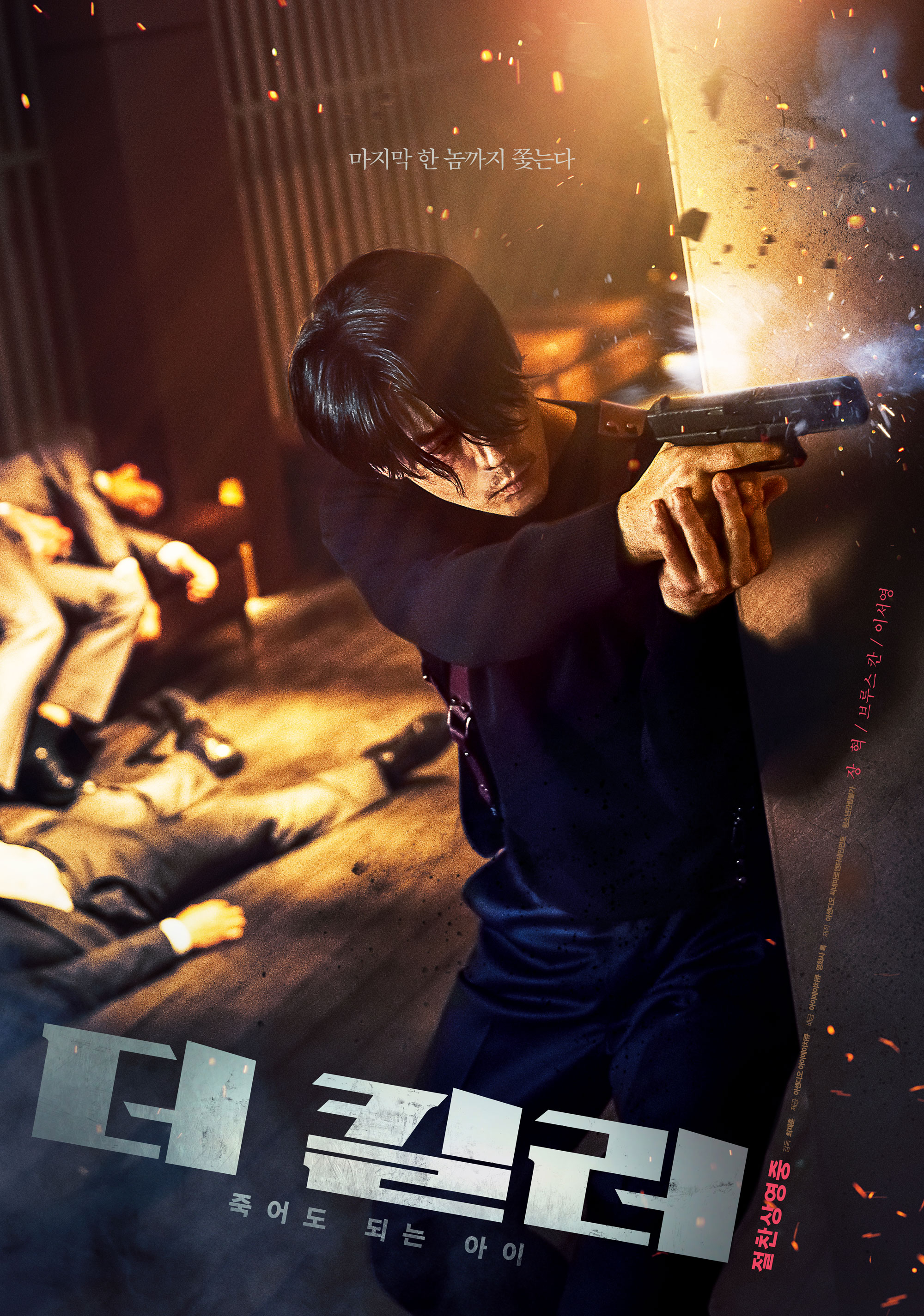
The Killer (더 킬러: 죽어도 되는 아이, Choi Jae-hoon, 2022) [Fantasia 2022]

A retired hitman gets back in the game when he’s charged with babysitting a naive teen who almost immediately ends up getting kidnapped by human traffickers in Choi Jae-hoon’s retro action fest, The Killer (더 킬러: 죽어도 되는 아이, The Killer: Jookeodo Dweneun Ai). The Korean title of the film is appended by that of the novel from which it is adapted, The Girl Who Deserves to Die by Bang Jin-ho, and hints at the secondary drama which underpins the main narrative in which the kind of masculinity the cynical hitman projects is redefined to accommodate a nascent paternity, 

When questioned by the 17-year-old Yoon-ji (Lee Seo-young), Ui-gang (Jang Hyuk) tells her that he has no children because he didn’t want them. Even so he appears to be in touch with some of the children of his wife’s friends whom he mostly calls by generic names such as “Punk Ass 1”, and his rejection of paternity appears to be born of a desire for a simple life spent in comfort with his wife without additional responsibilities. When his wife asks him to take care of her friend’s daughter so the two of them can jet off to Jeju island for two weeks, he’s understandably reluctant especially as a girl of 17 hardly needs a babysitter but at the end of the day he generally does as his wife tells him. 

Consequently, he allows Yoon-ji a high degree of (illusionary) freedom while placing a tracker on her so he can at least keep tabs on where she is. Perhaps because her mother is away and has left her with a random middle-aged man she doesn’t know, Yoon-ji takes advantage of the situation and makes a few bad choices which result in her falling into the trap of a gang of people traffickers. Ui-gang wants to get her back mostly because his wife will be upset with him if he doesn’t but also begins to develop a fatherly bond with Yoon-ji while morally outraged by the societal corruption he uncovers through searching for her. 

In a genre archetype, sensitive killer Ui-gang has the moral high ground in that he has a code to live by along with a sense of justice that is revulsed by the casual cruelty of those who would trade human beings like cattle. He discovers that Yoon-ji’s kidnapping was not an accident but that someone actively chose her and wants to know who and why stopping not just at rescuing her but trying to take down the whole corrupt mechanism while discovering that its roots extend even further than he had expected. His final resolution that no child deserves to die restores his humanity as evidenced by his acceptance of a paternal responsibility and the creation of a new family unit with his wife and Yoon-ji. 

Even so his path to rescuing her is structured in the same way as a video game, Choi’s composition sometimes referencing that of a first person shooter as Ui-gang emerges from lifts and cooly takes out a gangster who then crashes violently into the background. He fights his way towards resolution hacking and slashing at hordes of oncoming foot soldiers while armed with nothing other than a pair of chair legs or else cooly executing them with a single shot. An arms dealer friend literally references The Man from Nowhere which the film at times also echoes both narratively and visually in its tightly controlled and well choreographed action sequences. This sense of unassailability is in itself a reflection of Ui-gang’s moral goodness while the bumbling quality of the crooks and the ease with which he dispatches them equally reflects their immorality. 

A retro action fest, The Killer makes the most of a modest budget while taking aim at a contemporary society that leaves young people so unprotected that traffickers can even claim to be “helping” them given that there are few other ways for runaway teens to earn a living on the streets. Then again it may be a little problematic that the solution presented lies in a restoration of the patriarchal ideal in Ui-gang’s resumption of his paternity in pledging to protect Yi-joon until she comes of age. Nevertheless, anchored by another strong performance from veteran actor turned rising action star Jang Hyuk, Choi’s stripped back action thriller is a visceral journey into the dark heart of the contemporary society.


The Killer screened as part of this year’s Fantasia International Film Festival.

International trailer (English subtitles)

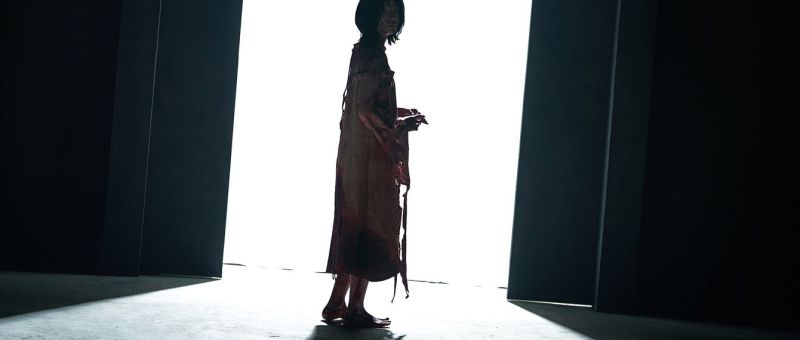
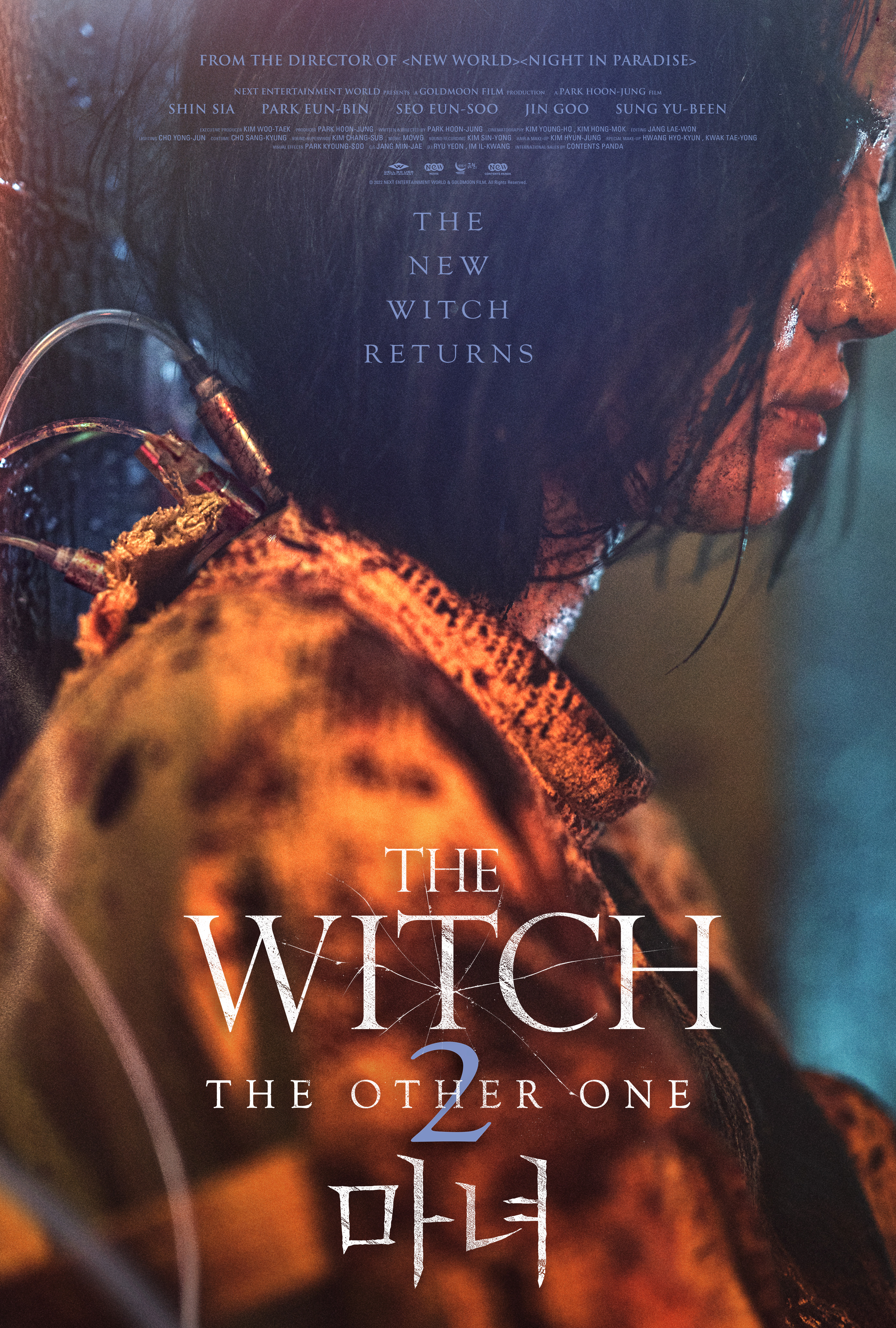
The Witch: Part 2. The Other One (마녀 2, Park Hoon-jung, 2022) [Fantasia 2022]

In Park Hoon-jung’s The Witch: Part 1.The Subversion, a young woman managed to escape a shady research facility to live as a regular high schooler while her adoptive parents wondered if their love for her could cure the violence with which she had been nurtured. Four years on, Hoon returns with Part 2: The Other One (마녀 2, Manyeo 2) which as the title implies follows another girl who similarly escapes her captivity and fetches up on a farm where she forms a surrogate family with a brother and sister in immediate danger of displacement. 

Unlike the first film’s Ja-yoon (Kim Da-mi) who rebuilt a life of “normality” after seemingly losing her memory, the unnamed girl emerges into a confusing and unfamiliar world in which everything is new to her. Challenged by a shady gang of guys on a highway, she’s bundled into a car which is where she encounters Kyung-hee (Park Eun-bin), a young woman kidnapped by a former associate of her late father who plans to murder her and steal her land for a lucrative construction project. Realising what might be in store for her, Kyung-hee tries to protect the girl and urges the gangsters to let her go before the girl decides to protect Kyung-hee in return by using her special abilities to total the car and set them both free. The girl is just about to finish off one of the mobsters when Kyung-hee tells her that she doesn’t need to, starting her on a path to questioning the indiscriminate violence with which she has been raised even as she determines to continue protecting Kyung-hee and later her brother Dae-gil (Sung Yoo-bin) who are now caught between the venal gangsters and an international conspiracy with various groups of people intent on either kidnapping or eliminating the escaped test subject. 

As had been hinted at in the previous film’s conclusion, there is a definite preoccupation with twins but also with internal duality. The shady corporation hints that the girl may be an upgraded edition, the “perfect model” of transhumanism, yet she appears less amoral than the unmasked Ja-yoon almost always seeking to incapacitate rather than kill while determined to protect Kyung-hee at any cost. To begin with, she is largely unable to speak but reacts with wide-eyed wonder to outside world visibly stunned by the wide open spaces on her way to the farm and develops a fascination with food eager to try anything and everything charging round a supermarket eating all the free samples while piling the trolley high with snacks. 

Like Ja-yoon however and in a superhero cliché she finds refuge on a farm and helps to complete the family which had been ruptured by absence but her new happiness is fragile on several levels not least of them that the farmhouse is under threat from venal gangster Yong-du (Jin Goo) who wants the land to build a resort. In an undeveloped plot strand, it seems that Dae-gil has lingering resentment towards his sister for leaving for America and returning only when their father died with the intention of sorting out the estate while it otherwise seems clear that their father was himself a gangster who may have used his ill-gotten gains to buy the farm in the first place. This is no ordinary rural backwater, but one brimming with darkness as the backstreet doctor turned drunken vet makes clear. 

In another duality, the girl is chased by a series of opposing forces split between “union” and “transhumanism” and represented by mercenary Sgt. Cho (Seo Eun-soo) and her South African partner (Justin John Harvey) and a gang of Chinese vigilantes from the Shanghai lab who are looking for the girl to get her to join them. Like the girl, the mercenaries appear to act with a code of ethics, trying their best to avoid civilian casualties while viewing death as a last resort while the ruthless vigilantes rejoice in violent brutality. In any case Park leaves the door open for a further continuation of the series in which the two women search for their shared origins in the hope of a literal, physical salvation but also perhaps the answer to a mystery long withheld from them. With a series of large scale and well choreographed action sequences, Park builds on the first film’s success and quite literally tells a sister story as “the other one” pursues her mirror image destiny while ironically finding beauty in the fireworks of a volatile society. 


The Witch: Part 2. The Other One screened as part of this year’s Fantasia International Film Festival and is released in the US courtesy of Well Go USA.

International trailer (English subtitles)

Images: Courtesy of Well Go USA Entertainment

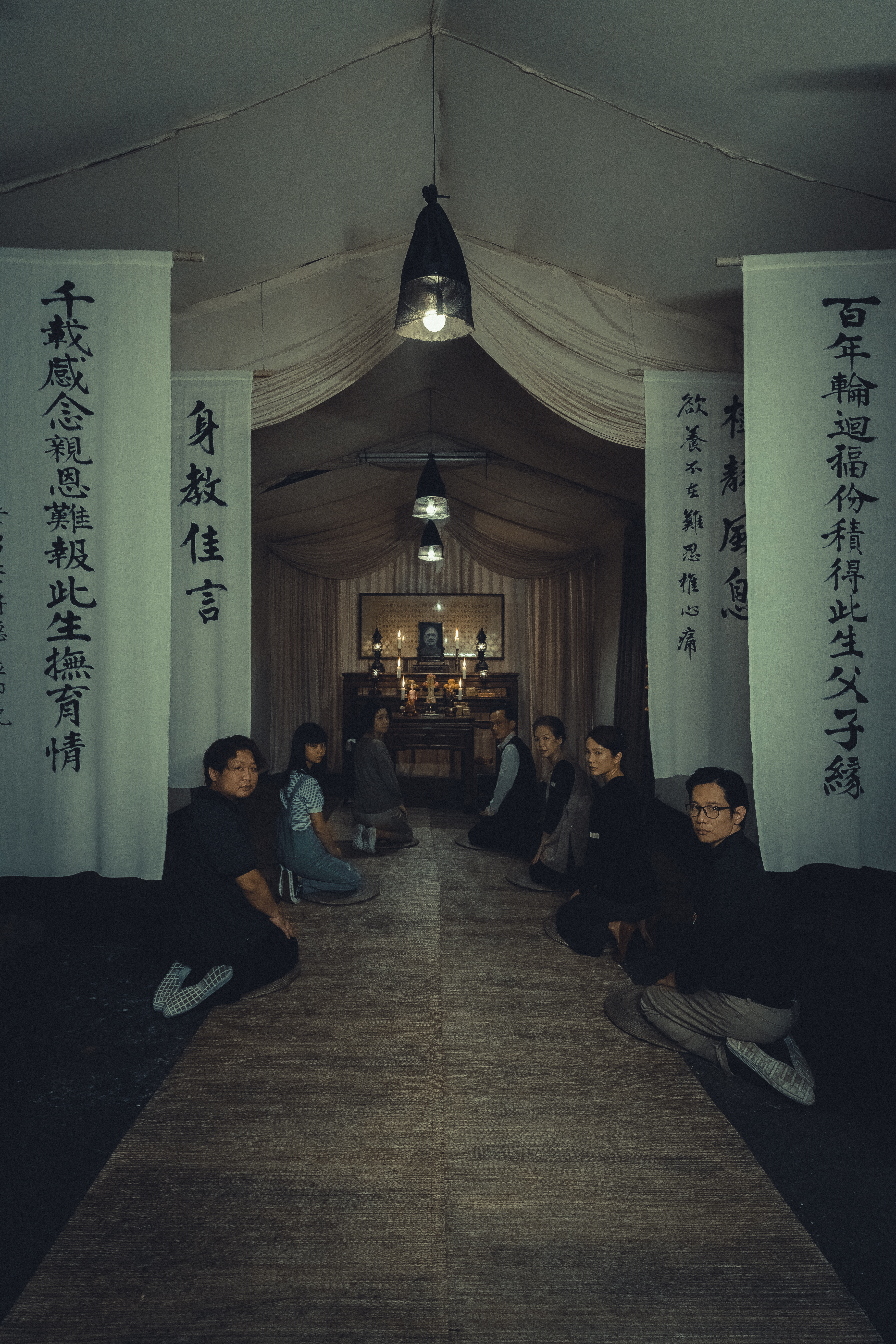
The Funeral (頭七, Shen Dan-Quei, 2022) 

“They’re your family, they won’t hurt you anyway” a little girl is consoled on suggesting that her relatives’ home may be haunted but it’s a statement which seems remarkably naive given the toxic situation at the centre of Shen Dan-Quei’s gothic drama, The Funeral (頭七, tóuqī). There may well be supernatural goings on, but the root of the problem remains familial exile and the outdated social codes which lead to it causing nothing but misery and loneliness for all concerned. 

Single mother Chun-hua (Selina Jen Chia-hsüan) hasn’t seen her family in a decade. She works several jobs trying to support herself and her daughter Qin-xuan (Bella Wu) who is seriously ill and on the list for a kidney transplant. When in the opening scene she begins to suspect a ghost has entered the convenience store where she works nights, it’s impossible to tell if she’s actually being haunted or is just tired and anxious. In any case, she’s later let go from that job after a co-worker complains about her falling asleep on shift which is right about when she gets a call from her estranged uncle (Nadow Lin) to let her know her grandfather, whom she had been very close to as a child, has passed away and she should come home for the funeral. Chun-hua is however reluctant because she evidently fell out with her authoritarian father (Chen Yi-Wen) when she left home and returning now is awkward in the extreme. 

Having set the scene with Chun-hua haunted in the city, Shen moves the action to the creepy gothic mansion where she grew up which does indeed seem to be a spooky place defined by its hostile atmosphere. Her father wastes no time telling her that she’s not welcome, but Chun-hua holds her ground and insists on being allowed to pay her respects to the only member of the family who seems to have shown her any affection. Later flashbacks suggest a concrete cause of the family’s disintegration, but then Chun-hua’s father seems to have taken against her even in childhood apparently refusing to allow her to celebrate her birthday with her sister seemingly also resentful of her for no clear reason. Though her mother clearly loves her, she cannot defy her husband and is unable to defend her daughter. The only one of the family privately happy to see Chun-hua, even her mother eventually tells her it would be better if she returned to Taipei as soon as possible given the awkwardness of the situation. 

Then again, as we later learn, she may have another reason in mind though this attempt to reframe the family’s animosity towards Chun-hua is a little problematic in suggesting they are cruel because they love her and want to her leave the toxic environment of the house to save her from its poisonous legacy. The grandfather may have been the only one to show her love, but it is his failings that have created division within the family causing some to feel rejected, excluded from the circle for no fault of their own. Her father’s rejection of her is in its own way similar, even if we later see him remorseful realising that his authoritarian parenting has cost him his daughter.

There may be a lot of supernatural action with the taoist priest permanently engaged in rituals over the grandfather’s body, but the darkness and resentment is purely human, born of loneliness and rejection in a lack of love and respect between those who are related by blood. Qin-xuan is at a disadvantage in knowing nothing of her extended family or mother’s relationship to them, she also rejected on arriving for the funeral. The place is indeed haunted beyond the scuttling figures that seem to catch their eyes and laden with the heavy atmosphere of the family’s inherent toxicity. But then through this extremely dark event, the relationship between mother and daughter is in its own way strengthened not least in Chuan-hua’s selfless determination to save her daughter from her own familial curse not to mention her medical precarity. Even so, the melancholy conclusion may hint that the toxic familial curse cannot be completely cured and is destined only to repeat itself in a perpetual cycle of hauntings. 


The Funeral screened as part of this year’s New York Asian Film Festival.

Original trailer (Traditional Chinese/English subtitles)

Images: © PINOCCHIO FILM CO. LTD

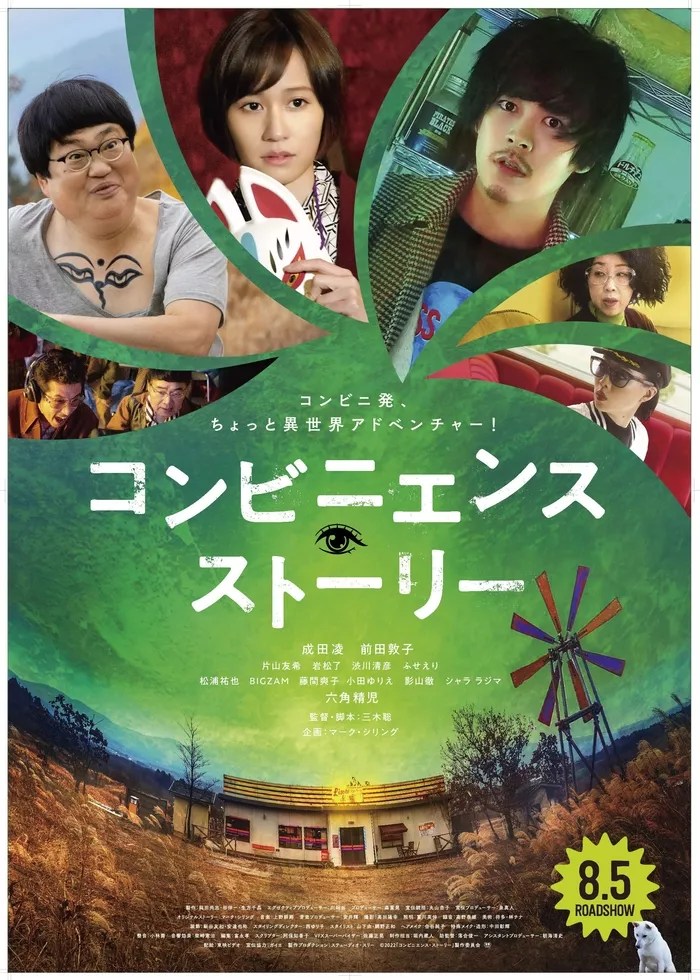
Convenience Story (コンビニエンス・ストーリー, Satoshi Miki, 2022) [Fantasia 2022]

“This is unreal, but it’s real” a blocked screenwriter exclaims in finding himself in an uncanny world only slightly divorced from his previous reality but perhaps excellent fodder for his art. Quite clearly influenced by David Lynch in its Twin Peaks-esque setting, jaunty jazz score, and overt references to Mulholland Drive, Fire Walk with Me, and Blue Velvet, Convenience Story draws inspiration from a short story by veteran Japan Times critic Mark Schilling to spin an elliptical tale of otherworldly adventure and inexorable fate. 

Down on his luck screenwriter Kato (Ryo Narita) can’t seem to get an idea off the ground and is in an increasingly volatile relationship with aspiring actress Zigag (Yuki Katayama) whose dog Cerberus he barely tolerates. When he has to venture out in search of Cerberus’ favourite brand of dog food, Weredog, the adorable pooch accidentally deletes the screenplay Kato has been working on leading him to decide to abandon him in the remote countryside. However, after damaging a Buddhist statue, he stops at a random petrol station convenience store which looks like it hasn’t been touched since the 1980s. Sucked through some kind of portal, he finds himself in an alternate combini reality in the company of pretty damsel in distress Keiko (Atsuko Maeda) and her decidedly weird husband Nagumo (Seiji Rokkaku). 

As the film begins to head into The Postman Always Rings Twice territory, Kato begins to rejuvenate his creative mojo while Zigzag, who is about to get her big break working with an incredibly insecure director (Kiyohiko Shibukawa) and sleazy producer, wonders what’s happened to her dog and takes drastic steps to find out. “Life’s big chances come in an instant” the director insists, though for Kato time seems to have stopped while he contemplates the combini existence. After all, it’s called a convenience store for a reason. They have everything you’ll ever need so there’s no real reason to leave. Smarting from his creative block, Kato asks if convenience stores sell interesting stories and in a way they do, or at least this one and the one in his neighbourhood which may or may not be connected by some kind of cosmic combini network, conspire to feed his imagination so he can deliver a promising script to his eccentric editor (Eri Fuse). 

Then again, Keiko asks him if he writes about an ideal world or his personal reality and it’s a question that he can’t quite answer hinting that this strange alternate universe may be some kind of fever dream conjured up by his latent imagination. “A screenwriter’s job is to fantasise”, Keiko seductively tells him, though his editor and a producer with whom he had also exchanged a flirtatious email had previously giggled over his non-starter of a screenplay which they described as an embarrassingly chauvinistic male fantasy. That’s certainly one way you could describe his otherworldly combini adventure in the foxy damsel in distress characterisation of Keiko who quite obviously just wants him to take her away from all this, sick of the oppressive convenience of the combini life and of her incredibly strange, seemingly controlling husband. 

Then again on their attempt to escape, the couple end up in an endless three-day ceremony of eternity during which the souls of the dead are supposed to journey to the afterlife. Everyone is keen on travelling to another world, except perhaps for Kato who is already in one, yet struggles to escape the uncanny uniformity of the combini society. “Another world exists in here” Kato is creepily told on a visit to his local, much more contemporary though not all that different, convenience store beginning to realise that perhaps there is no real escape from this maddening world of convenience at least not for him. Shades of Orpheus and Eurydice guide him out of his purgatorial existence yet ironically only into more of the same until the inevitable, karmic conclusion. Fantastic production design adds to the sense of retro absurdity strongly recalling Twin Peaks in its use of ‘50s-style diners and the frozen in time petrol station road stop existing for some reason the middle of nowhere with no road in sight, while casting a note of fatalistic dread over the life of a blocked screenwriter who eventually comes to realise that convenience isn’t always quite what it’s cracked up to be.


Convenience Story screened as part of this year’s Fantasia International Film Festival.

Original trailer (English subtitles)

The Girl From the Other Side (とつくにの少女, Yutaro Kubo & Satomi Maiya, 2022) [Fantasia 2022]

A kindly exile and lonely little girl find mutual salvation in Yutaro Kubo & Satomi Maiya’s gorgeously animated fairytale, The Girl from the Other Side (とつくにの少女, Totsukuni no Shojo). A poetic mood piece, the film has a painterly feel reminiscent of classic children’s picture books and essentially tells a very simple story about the redemptive power of kindness and acceptance in which two exiles find the strength to begin again taking care of the other in a world of warmth and safety.

Set in an indistinct time period, the film opens with a cohort of soldiers from the Inside dumping bodies in the forest, apparently victims of some kind of curse. Hearing a noise, one turns round explaining that they have to kill them all or their efforts will be meaningless, while mysterious man with goat horns on his head discovers the angelic figure of a little girl, Shiva (Rie Takahashi), fast asleep. Evading the soldier, who is later himself “cursed”, the man takes her home with him but explains that he cannot ever touch her, not even to treat her wounds, lest he infect her with the “curse” though he is not like the other “Outsiders” who spread it deliberately. 

The curse has robbed the man, whom Shiva calls “Teacher” (Jun Fukuyama), of his humanity. He is certain that he was once human and lived a normal life with a wife and child behind the walls of the Inside, but is now a lonely exile who no longer knows his name. He worries that Shiva will be frightened by his appearance and may choose to leave putting herself in danger in the process but Shiva accepts him instantly and quickly settles in to his cottage-style home while experiencing brief nightmares in which she is eventually rescued from her loneliness by the Teacher. But the closer they get, the more Teacher feels guilty convinced that Shiva would be better off in a community with other humans rather than living with him under the danger of inheriting his curse. 

Shiva and Teacher are each in their ways exiles, though there is also something dark in the constant references to Insiders and Outsiders along with the looming threat of the military and their determination to wipe out anything “suspicious” fearful of any kind of contamoination. The Outsiders are those in some way rejected by the mainstream society, many of whom have become dark and marauding, feeding on the souls of others who live outside the walls. Teacher wants to save Shiva from the unbearable loneliness he feels as a cursed man who no longer knows his past and is forbidden from human touch yet in the need to protect her he also discovers a purpose and begins to recover something of his humanity. “She is my light” he later explains to a supernatural force, himself stunned by the realisation that even he could be a light for someone else and discovering in it a new possibility for life. 

There is of course a sadness for the world that’s been lost and can never be regained, but also warmth and tenderness in the simple life of Teacher and the girl as symbolised by smoke rising from their chimney as if the house itself were breathing. As Teacher had said, all things must end in time, but the time is not necessarily now and there is much to be done before it runs out. In Teacher, Shiva finds a place of safety and protection. In her dreams she is rescued by the hands which on waking cannot touch her, while Teacher finds in her a path towards reclaiming his humanity. They may never find their way back to those they’ve lost, but they can now begin again as a new family overcoming their loneliness and despair through mutual compassion. 

Beautifully illustrated with a retro flickering effect and water colour-esque backgrounds, Girl From the Other Side situates itself in a melancholy world in which some are consumed by the curse of their inner darkness and suddenly sprout into huge burnt trees, yet as Shiva says there’s a poignancy even in their destruction noticing that whole communities sprouted together rather than wandering apart. Moving and tender, it reaches a kind of serenity in its final moments in the simple act of living with warmth and possibility. 


The Girl From the Other Side screened as part of this year’s Fantasia International Film Festival.

Original trailer (no subtitles)

Hansan: Rising Dragon (한산: 용의 출현, Kim Han-min, 2022)

“A battle of the righteous against the unrighteous” is how Admiral Yi (Park Hae-il) frames his resistance against the Japanese invasion, not a war between nations but an attempt to push back against the authoritarian ruthlessness of Toyotomi Hideyoshi’s desire to conquer most of Asia in a bid to cement his historical legacy as his health continued to fail. Hansan: Rising Dragon (한산: 용의 출현, Hansan: Yongui Chulhyeon) is a kind of prequel to 2014’s The Admiral: Roaring Currents set five years earlier during Hideyoshi’s first campaign and pits the the wise and steadfast Admiral Yi against ambitious yet overconfident Japanese general Wakizaka* (Byun Yo-han). 

Wakizaka’s ruthless cruelty is not in dispute even as the film opens with him dispatching a report stating that he intends to destroy the Korean naval detachment harboured on the southern coast which it seems is all that stands between him and conquest of the peninsula in its capacity to disrupt his supply line. When some of his men return in defeat talking about a “Bokkaisen” with a dragon’s head spouting fire, Wakizaka orders them killed to stop them spreading rumours of supernatural threat among the troops. Retrieving what looks to be a dragon’s tooth from the ruined vessel he begins to realise there might be something their story but still doesn’t take the threat of Admiral Yi’s fleet very seriously. 


Admiral Yi meanwhile, who was wounded in the same battle pitching his bow and arrow against a Japanese rifleman, is plagued by dreams and anxiety while trying to sort out a strategy for dealing with the Japanese invasion. Some of his fellow officers think offence is the best defence and they should try to strike before Wakizaka is able to amass his forces, while others think they should play it safe and continue to defend the coast. He and his chief engineer are working on improvements to their turtle boat which had so spooked the Japanese soldiers at the previous battle but at the same time had its limitations. They don’t call it a turtle boat for nothing, on ramming into the Japanese vessel its dragonhead became lodged in the side locking the two boats in a deathly embrace. Yi suggests removing it, but as it turns out the ability to latch on to the enemy like a snapping turtle can also be an advantage if you know how to use it while figuring out how to get the best out of limited resources, along with managing interpersonal relations, turns out to be Wakizaka’s weakness. 

Ever ambitious, Wakizaka is distracted by petty rivalry with his co-general who disagrees with his strategies and eventually betrays him. A Korean-speaking Japanese retainer sent as a spy later decides to defect precisely because of this ruthless disregard for the lives of one’s fellow soldiers, struck by Yi’s personal presence on the battlefield and willingness to put himself in harm’s way to protect his men. Though he is originally viewed with suspicion by some, Junsa (Kim Sung-kyu) is embraced as a fellow soldier after joining the defence forces at an inland fortress and told that all that is necessary is that he have a “shared righteous spirit” fighting together against the “unrighteous” Japanese invasion. 

In any case, neither Wakizaka or the Japanese care very much about Korea all they’re doing is clearing a path to China. Meanwhile, the nervous king continues to travel North leaving his generals fearful he will defect to the Ming and they will end up losing their sovereignty to China if not to Japan. Wakizaka’s strategy is somewhat hubristic, leaving himself vulnerable in the rear as he pushes forward while using land tactics to fight a war at sea and thereby allowing Yi to set a trap for him perfectly tailored to his vain complacency. Wakizaka may have the numbers, but Yi has superior technology and the respect of his men. Quite fittingly the real Wakizaka was marooned on an island after the battle and had to survive on seaweed while waiting for his chance to escape. With plenty of spy action, double crossings and betrayals, Kim Han-min saves the big guns for the final naval battle which begins in ominous fog before exploding in all out war but still makes clear that the battle is on the side of righteousness and that Yi owes his victory to human solidarity and compassion (leaving aside his torture of suspected spies) and Wakizaka his defeat to hubris and cruelty. 


Hansan: Rising Dragon screened as part of this year’s New York Asian Film Festival and is in US cinemas now courtesy of Well Go USA.

*these subtitles use Wakizaka but his name is sometimes also romanised as Wakisaka.

International trailer (English subtitles)

Images: Courtesy of Well Go USA Entertainment