Heavy Snow (폭설, Yun Su-ik, 2023)

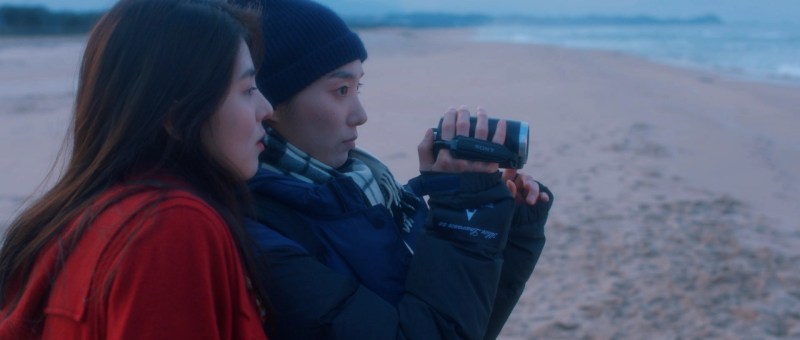
“It’s obvious it was a romance, why did you pretend it wasn’t?” one wounded woman asks another while their connection seems to be frustrated by internalised shame and conflicting desires. Yun Su-ik’s frosty drama Heavy Snow (폭설, pokseol) does indeed seem to suggest that their love for each other can only exist in a kind of otherworld, eventually segueing into a metaphysical realm which simultaneously implies that this isn’t actually a romance but self-reflection and interrogation as a tomboyish actress searches for herself inside her various roles.

Indeed, Su-an (Han Hae-in) views Seol (Han So-hee) with a kind of awe which might be understandable given that Seol is a TV drama superstar improbably transferring to her rural arts school for a break from the world of showbiz. Or as Seol would later imply, because she’s become too difficult to manage and is rebelling against the emptiness of her ostensibly glamorous life through increasing acts of reckless self-harm. Su-an might wonder if that’s all her flirtation is, an attempt to flaunt a taboo while otherwise puzzled and jealous as to why someone like Seol would actually be interested in her. 

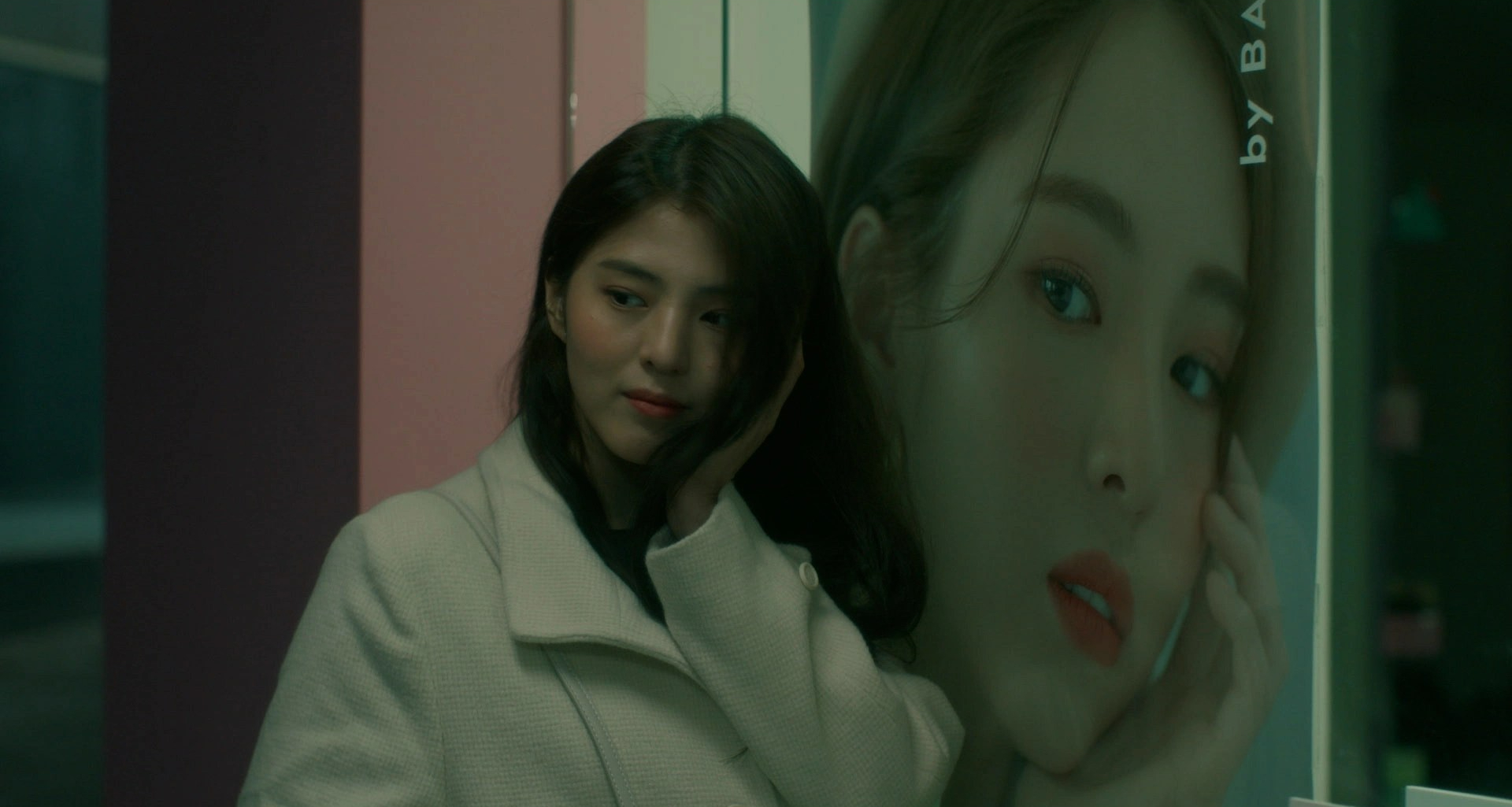
Yet Su-an’s interest is also in part idolisation, attracted to Seol because she fears she is everything she wants to be but isn’t, beautiful and talented. But Seol seems to doubt she’s either of those things while otherwise superficially confident in her sexuality and drawn to Su-an because of her ordinariness. Experiencing a moment of identity crisis, she’s looking for herself outside the frame yet also perhaps like Su-an caught in moment of self-idolisation. Noticing one of the giant billboards of her face that the litter the city she briefly touches it before walking away as if attracted to an image of herself she recognises and doesn’t. 

Yet it seems it’s less the awkwardness of too much intimacy that causes Su-an to pull away when Seol kisses her than shame. She tells Seol that she thinks it isn’t right, and perhaps goes on to regret that decision while continually pining for an idealised teenage love. The two women in a sense trade places. Years later Su-an is a famous TV actress, having in a way taken over the image of Seol, while Seol is evidently no longer acting but a depressed and defeated figure still resentful of Su-an’s rejection. The effects of their shifting fame deepen the gap between them with the teenage Su-an further nervous in her relationship with Seol knowing the danger that her celebrity presents. There is a suggestion that their creative desires conflict with the romantic, that they feel they cannot embrace their sexuality freely and remain in the entertainment industry because of the intense pressures a conservative society places on prominent people to be shining examples of moral purity. Each of them appear to become worn out by the demands of their fame, Su-an turning to drugs in attempt to mask her depression while the teenage Seol ponders quitting acting to become more her authentic self.

In the dreamlike third act which commences at the sea, a touchstone for each of the women connected to the innocence of their teenage romance, may suggest that in looking for Seol Su-an is really looking for herself or perhaps simply to recapture the person she was at the beginning of everything. At odds with each other, the two women become marooned in a snowbound land with no one else around. Finally repairing their relationship, it seems that they can only embrace their love in this barren place where no one else exists to judge them. The implication maybe that as Seol says the things Su-an wants to say to Seol she really wants to say to herself in a desire for self-acceptance, but equally that we can’t be sure that any of this “real” rather than dream or wishfulment.  In any case all that remains is a painful longing either for an unrealised love or the elusive self. 

Hinting at the pressures of the contemporary society, the unrealistic expectations placed on those in entertainment industry and outward social conservatism the film never less presents its central romance with an evenhanded poignancy even in its continuing impossibility as the two women continue to look for the self in each other but seemingly struggling to see past the hollow images of their own self-projections.


Original trailer (no subtitles)

Heavy Snow screened as part of this year’s BFI Flare.

Push Pause (ココでのはなし, Ryoma Kosasa, 2023)

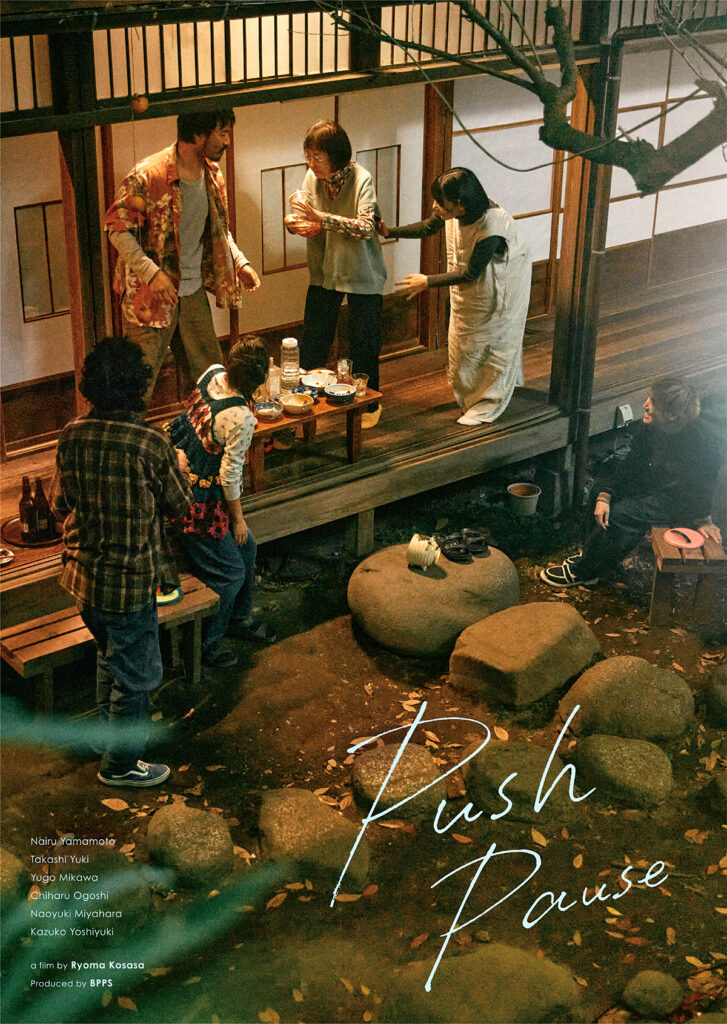
A small hotel becomes a refuge for those “struggling with the everyday” according to live-in helper Utako in Ryoma Kosasa’s heartwarming drama, Push Pause (ココでのはなし, Kokoro de no Hanashi). As she said, most of their customers are there because they’re uncertain of something and looking to take take some time out for reflection, much as she is while otherwise taking advantage of the tranquil and unjudgemental space of the inn along with the comfort it offers.

Guest House Coco is however suffering too amid the post-pandemic decline in custom. Th owner Hirofumi, attempts to sell his bike to pick up some extra cash only to discover it worth much less than he thought. The first of their guests, Tamotsu, is struggling for similar reasons seeing as the owner of the batting cages where he works is considering closing down as customers continue to stay away leaving him floundering for new direction. Helping an old friend move brings him into contact with someone he worked with for the Paralympics, but it only seems to fuel his sense of insecurity reflecting that unlike his friend he has no talents or ambitions and isn’t sure he wants to return to work for with him because it only makes him feel bad.

For Xiaolu, meanwhile, she’s dealing with issues as of a different order while house hunting in Tokyo ahead of a job transfer. Though her colleague had agreed to help her, he suddenly tells her he’d rather she didn’t come mostly it seems because he’s afraid she’ll expose him as an otaku thanks to their shared love of anime and people in the office will make fun of him. But then he also drops in that most of his colleagues are subtly racist, even insensitively adding that Xiaolu doesn’t “look Chinese” on first glance especially as her Japanese is so good unwittingly exposing his own latent prejudice. Her parents in China keep calling her to come home especially as her grandmother is in poor health leaving Xiaolu feeling guilty and now slightly unwanted unsure if it’s a good idea to accept the transfer or even remain in Japan at all.

Even Izumi, a permanet resident of the guest house, accidentally hurts her feelings in innocently asking if she’s from China on hearing her name though as it turns out Izumi was herself born in Manchuria and apparently a war orphan though in truth she seems nowhere near old enough to have been born in the 1940s. In any case, Izumi is the beating heart of Coco providing the warm and homely environment that sets people at their ease and makes them feel welcome and accepted. As she tells Xiaolu, fate has a way of bringing people together or at least getting them where they need to be so they can make an informed choice about their futures.

That’s why she echoes the title of the film in giving some advice to the young from a position of age in telling them that it’s alright to slow down, take a few moments to think things through rather than feeling as if they need to charge ahead. According to her, youth is just a part of your life that doesn’t even last very long so there’s no need to rush through it which seems like valuable advice to near middle-aged inn owner Hirofumi who is considering proposing to his girlfriend but is uncertain because she has children already and he isn’t sure they’ll accept him. Utako too has her own problems she’s in part been hiding from in leaving her home town to hole up in the inn. 

As if bearing out the sense of community that arises at there, Utako reveals that they stay in contact with their guests giving them the sense of a secure place to return to where they’ll always be accepted and cared for. Thanks to the support of the others at the Coco, each of them begin to find new directions in their lives and are able to proceed with more confidence and certainty. Warmhearted and empathetic Kosasa’s gentle drama is and ode to the quiet solidarity and unexpected connections that arise between people each struggling with the everyday but finding new strength in each other.


The Missing (Iti Mapukpukaw, Carl Joseph E. Papa, 2023)

The title of Carl Joseph E. Papa’s meta animation The Missing (Iti Mapukpukaw) most obviously refers to the hero’s uncle with whom his mother has lost contact, but in a deeper sense refers to the protagonist himself and the various things he too is missing which notably includes his mouth. Shot in a rotoscope style, Eric’s (Carlo Aquino) mouth is literally blurred out as if it had been erased and smoothed over. He can no longer speak but uses a dry erase board to communicate with those around him.

His troubles start just he’s about to go on a sort of date with coworker Carlo (Gio Gahol) which ends with them discovering the body of his uncle who has apparently passed away in a lonely death. It’s it at this point that Eric is plagued by an alien who keeps trying to abduct him claiming that they have unfinished business. Eric later asserts that he’s afraid the alien is trying to take over his body, hinting at a deeper childhood trauma and anxiety over bodily autonomy and intimacy. The alien’s attacks seem intensify as he grows closer to Carlo, frustrating their tentative romance as if it actively trying to obstruct it. 

The alien’s presence leads to what may seem to others like strange or inconsiderate behaviour. He disappears on Carlo, locks him out of his flat, and seemingly drops out of contact for days on end causing him not an inconsiderate degree of worry given he’s just lost his uncle and appears to be in a state of emotional distress. Yet the most surprising thing is even on being told about the alien Carlo decides to just go with it, taking Eric’s explanation at face value and trying to help him evade it for as long as possible. He eventually admits that he can’t see what Eric sees and they aren’t where he thinks they are but otherwise provides a safe and non-judgmental presence that quietly supports him while he battles his internal demons. His mother Linda (Dolly De Leon) does something similar apparently aware of the alien’s existence, but not what lies behind it or what it really might mean.

Just as reality and fantasy begin to blur for Eric, Papa uses the medium to express his mental state as the world seems to literally crumble around him. The alien steals parts of his body and they literally disappear, a missing ear and blurred out eye along with a blankness where his hand should be. When Eric begins to recall his childhood memories, the animation style switches from the sophisticated rotoscoping of the rest of the film to something much simpler echoing a child’s drawings. In these sequences, the face of Eric’s uncle is always scribbled over in black pen echoing his more literal refusal to see and accept the past. He has been literally silenced by his trauma but now finds it banging on the doors of his mind demanding to be let in.

Yet the reason he is able to overcome it is precisely because of the love an acceptance he receives from his mother and Carlo who never question his reality or attempt to break him out of it, instead deciding to join him there and help him in his quest to get rid of the alien that has plagued him since his childhood. Only this way can he begin to reclaim the parts of himself that were missing, digging through the buried past to retrieve what was taken from him and eventually recovering his voice. 

His quest has a gently absurd quality as parts of him suddenly detach themselves and run away, leaving it unclear for much of the film if Eric’s alien is “real” in a more concrete sense or merely a representation of his childhood trauma and very much inspired by logics and aesthetics of a small child who has been forced to keep a secret out of fear and shame and thereby unable to communicate his pain. In the end it’s love that brings him out of it, a gentle, patient and unconditional love that takes him as he is and gives him the space to find his own way out his trauma. Filled with a sense of warmth despite the darkness of its centre Carl Joseph E. Papa’s strangely poignant film for all its talk of aliens and destruction is remarkably human allowing its protagonist to finally begins to recover himself thanks to the loving support of those around him.


The Missing screened as part of this year’s Osaka Asian Film Festival.

Original trailer (English subtitles)

Not Friends (เพื่อน (ไม่) สนิท, Atta Hemwadee, 2023)

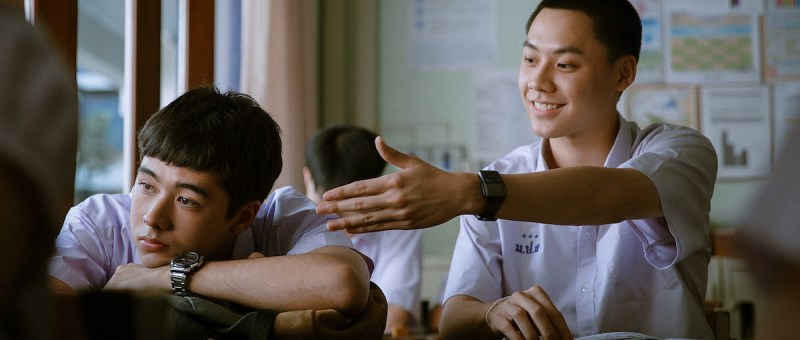
There’s a gentle sense of loss that runs through Atta Hemwadee’s quirky Thai dramedy Not Friends (เพื่อน (ไม่) สนิท), not only for those who are now absent and exist only in our memories but for missed opportunities and things left unsaid. Then again, its hero, Pae (Anthony Buisseret), takes a while to warm up to the benefits of friendship, like many teenage boys resentful and alienated, unable to accept the hand extended to him by his infinitely cheerful new deskmate, Joe (Pisitpol Ekaphongpisit), who walks around with a beatific smile permanently plastered across his face. 

Before he can make amends, however, Joe is hit by a car after returning from a school trip sending the school into a period of shocked mourning that for some reason includes a talent contest. After hearing of a competition that offers entrance to film school as a prize, Pae decides to enter and to make his late “best friend” Joe the focus of the film only to immediately be caught out in his duplicity by Joe’s former best friend Bokeh (Thitiya Jirapornsilp) who resents his intention to exploit Joe’s death for his own ends. 

It has to be said, that Pae does not come out of this well though his predicament does highlight a social stigma towards working class boys in his intense desire to escape having to take over his dad’s flour mill having been teased by his former classmates about his “stinky shirt” because he has to air dry his clothes in an area adjacent to the factory. A similar sense of lonely alienation is found in a short story Joe had submitted to a story contest which is about a boy who feels hopelessly ordinary and looks up to the stars thinking about all the other versions of himself on other planets who are “special”, top athletes or super spies or dim but loved by those around him. The boy wants his other selves to see him and know that he is special too, but seems not to feel it himself. 

Coming late to the idea, Pae slowly realises that Joe is special because “Joe is our friend” though he’d mostly ignored his attempts at friendship while he was alive. In any case, he doesn’t really notice the friendships he’s making with Bokeh or the others working on the film either but remains focussed on his own goal of winning the contest and escaping the flour mill. In the end the film he’s making ends up becoming less about Joe himself and more of an ode to absent friends, something echoed in Bokeh’s valedictory speech in which she bids goodbye to her “best not friends” and hopes that though they may not meet, they’ll miss each other every now and then. 

It comes down to a question of what friendship really is and whether Pae can be persuaded to abandon his sense of self interest to defend it. He realises that Joe had a lot of dreams too, ones he never got to fulfil and a couple that could be fulfilled for him if not in reality than in fantasy imagining how their lives might have turned out if Pae had been less self-involved and Joe had lived. Still, on finding out something unexpected he’s forced to confront the idea that perhaps you don’t really know anyone. Everyone knows a slightly different version of the same person but friendship is really about shared intimacy and a willingness to be open and vulnerable while simultaneously respecting the boundaries of others.

To that extent it really is about the friends we make along the way. Pae slowly comes to realise that he’s accidentally become friends with the crew on the film and lets go of some of his resentment becoming less self-centred and more willing to interact with others even warming to his father and family business he’d previously been ashamed of while also gaining the courage to pursue his dream of a career in film. Cineliterate, Atta Hemwadee breaks the action with a filmmaking rap and makes frequent references to popular film but invests the high school movie with a wistful sense of loss and nostalgia for the absent friends of youth whom we miss once in a while but are in another sense always with us. 


 Not Friends screened as part of this year’s Osaka Asian Film Festival.

Trailer (English subtitles)

The Clinic (ဆေးခန်း, Midi Z, 2023)

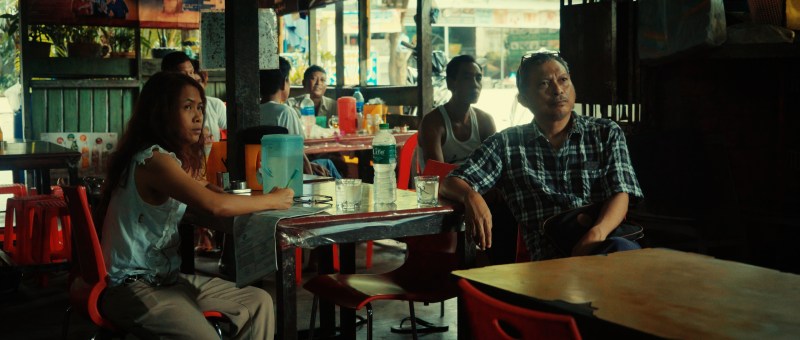
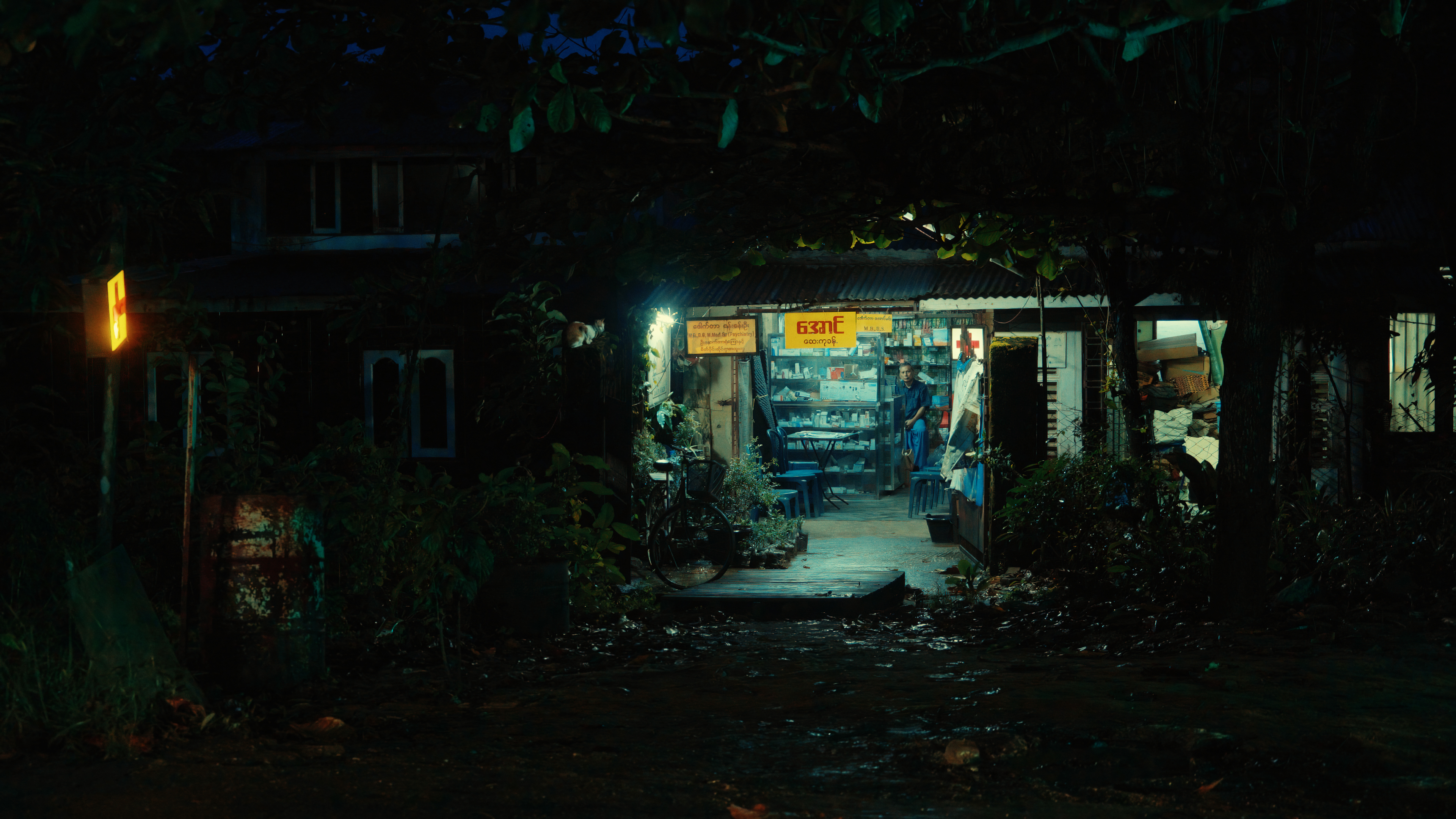
The title of Midi Z’s documentary The Clinic (ဆေးခန်) most obviously refers to that run by the two doctors at its centre providing a safe haven in the midst of chaos, but the director apparently envisaged secondary meaning in which the entire nation is a clinic filled with those in desperate need for treatment. It does seem that there is a lot of sickness and despair in this small corner of Yangon, the husband and wife doctors largely treating conditions related to alcohol and mental illness while otherwise powerless to do much more than treat their symptoms. 

It’s clear that there is little medical provision otherwise available in the local area. One woman has brought her sister from several towns over, explaining that there aren’t many doctors as kind as these ones are. They even invite their patients to return for dinner. The woman’s sister, however, has picked up head lice after a stay in hospital and seems to be under what they assume is a delusion of having been tried by the army for joining the Rohingya and rebelling against the Burmese state despite living in completely the wrong part of the country to have any contact with the conflict. Later the doctors sit in a cafe and listen to a speech by Aung San Suu Kyi about the Rohingya crisis which ends with an announcement for the delegates to head to a post-conference party. Doctor Aung Min quips that apparently they are not invited.

Aung Min is not invited to the party in many ways as he discovers when a film he’s made is screened at a human rights film festival but he’s harangued by a pro-military audience member who found his work offensive. A filmmaker as well as a doctor, he’s planning a film about an actor with fractured cultural identity as a Buddhist Rakhine taken to Bangladesh by the Rohingya. The actor is conflicted while considering whether to accept a film role that requires him to have a beard knowing that he may be mistaken for a Rohingya and will face social censure. In a meta touch, Aung Min’s film is like this one somewhere between documentary and narrative, incorporating photographs of the felling Rohingya in anguish and agony.

Meanwhile, Aung Min and his wife San San Oo treat similar ailments in their clinic, notably one middle-aged man with an infected leg wound originally caused by a drunken accident. Aung Min tells the man he might have to cut his leg off, but struggles to convince him when he says he’ll have to avoid alcohol for a few months to try to save it. San San Oo also answers the phone to reports of people in severe mental distress threatening to harm themselves or others. In quieter moments they offer art therapy to some of their patients and otherwise attempt provide a safe and comforting space. Both artists themselves, San San Oo is a keen painter while Aung Min has his film career. 

The film follows them in the midst of the military coup, the famous video of the woman filming a yoga session as the soldiers head towards the seat of government, during which the doctors and the clinic seem to stand firm while overseas radio reports reflect on the dire situation in the nation. Yet they are largely powerless to treat the wider sicknesses around them, the fear, the anxiety, guilt or indifference in a divided society. Instead, they take solace in their art but also in its capacity to heal while keeping the clinic open as a beacon of hope for wounded locals and those from further afield. 

Midi Z films with a detached naturalism that sometimes adds to a sense of absurdity echoing the outside chaos of the society mired in anxiety and confusion. “What’s in a film isn’t real,” Aung Min and a potential actor reflect, but even if this were not a documentary that is never quite true. Midi Z hints at the wider sicknesses in the society but in the end finds only powerlessness to treat it if tempered by the resilience of the doctors who keep their clinic open even in the darkest hours allowing the illumination of their signage to stand as a small beacon of hope amid so much despair.


The Clinic (ဆေးခန်း, Midi Z, 2003) screens in New York 17th March as part of this year’s First Look.

Trouble Girl (小曉, Chin Chia-hua, 2023)

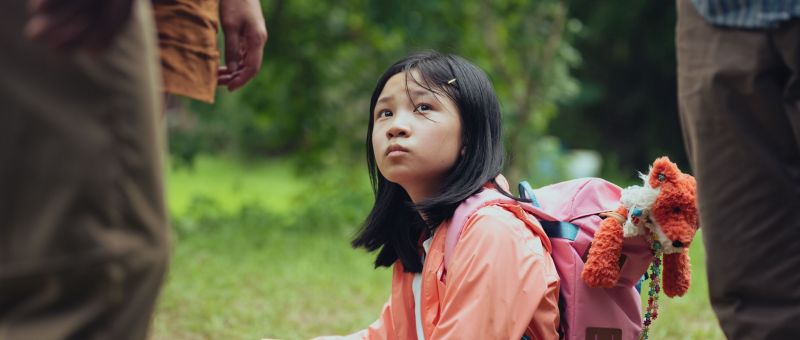
The sad thing about Xiaoxiao’s life is that everyone is so intent on making her just like everyone else rather than trying to find ways to allow her to be more of herself. The film’s English title, Trouble Girl (the Chinese being simply her name, 小曉, xiǎo xiǎo), might hint at the external attitudes towards her in which she is seen only as a disruptive troublemaker while largely friendless and bullied by the other kids in her class.

The irony is that it’s only her teacher, Mr Chen (Terrance Lau Chun-him), who is actively trying to help her but he does so from a place of corrupted paternity in that he’s been having an affair with her mother, Wei-fang (Ivy Chen Yi-han), which began as a consequence of their meetings to discuss Xiaoxiao’s ADHD diagnosis and how to manage it at school. Seemingly under stimulated, Xiaoxiao ignores her classes and plays video games instead while Mr Chen doesn’t really say anything before gently taking her aside to suggest it’s not a good idea. He’s a proponent of positive reinforcement but is also a regarded as a soft touch by some of the other parents who increasingly turn against Xiaoxiao, regarding her as a disruptive presence damaging their kids’ education. 

Then again, it’s mostly these kids who are bullying Xiaoxiao for being not quite like them. Mr Chen has started some kind of secret program in which kids can get stickers for being nice to her, but it’s largely backfired as they alternately provoke Xiaoxaio because they think it’s funny when she loses her temper and act friendly when the teachers are around. Rather than attempting to make some accommodations for her, the school is only capable of trying to force her to behave in exactly the same way as everyone else. On an awkward camping trip with her mother and Mr Chen, he suggests capturing a frog but despite her fascination with them Xiaoxiao rejects the idea. She wouldn’t want the frog to be trapped in a bottle, and later attempts to free an owl from a cage symbolising her own desire to be free to be herself. After being suspended from school, she heartbreakingly tells her mother that she just wants to stay home and learn not to take pills anymore.

But then Wei-fang has problems of her own. She’s trapped too. Her husband has been living abroad for some time and it’s clear the marriage is all but over while she struggles to bond with Xiaoxiao and is ill-equipped to deal with her needs, perhaps on some level ashamed that she isn’t living up to the middle class ideals professed by the other mothers. She even may even resent her for trapping her in a dissatisfying domestic arrangement but is alternately frustrated that Xiaoxiao does not really want to play with her and prefers her father or Mr Chen. We see her struggle with her emotions too, sometimes slapping Xiaoxiao and shouting at her for doing something wrong or getting into trouble. 

Her affair with Chen may be a kind of escapist fantasy, but he seems to take it seriously and provides a positive, paternal presence in the absence of Xiaoxiao’s father who though he seemed caring later offers quite a harsh critique of his daughter that suggests he regards her as a disappointment. Nevertheless, it’s quite troubling that her sort of friend Xiaoshan calls Mr Chen “Paul” and is friendlier with him than seems appropriate but then her parents are involved with running the school so perhaps she simply knows him on a more personal level. Even so, the connection seems to arouse an odd kind of jealously that interacts with her disapproval of her mother’s betrayal of her father in having the affair. 

When Xiaoxiao tries to free the owl, she is surprised to discover that it simply flies back to its porch as trapped as both she and her mother though no longer with any desire for escape. Sympathetic towards the film’s twin heroines, Chin shoots with a down to earth naturalism though through the eyes of Xiaoxiao who is really just looking to be accepted for who she is while observing that her mother is much the same but even approaching middle-age seems no closer to finding accommodation or fulfilment.


Trouble Girl screened as part of this year’s Osaka Asian Film Festival.

Original trailer (English subtitles)

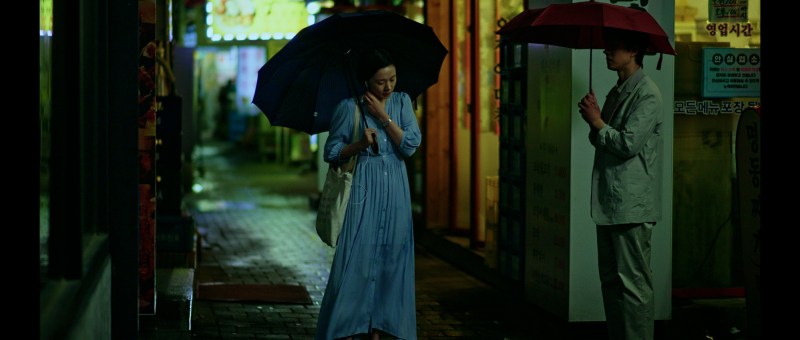
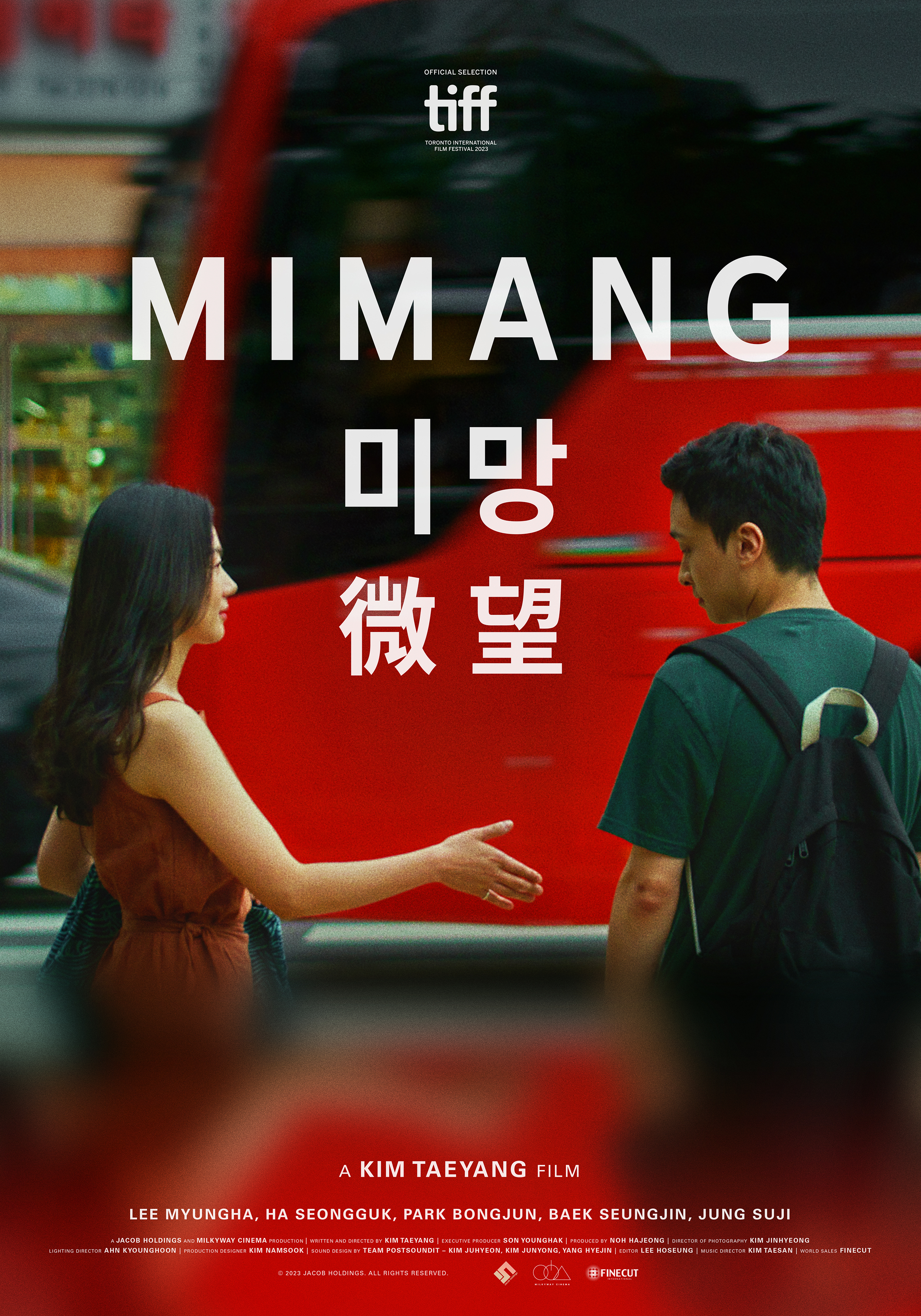
Mimang (미망, Kim Tae-yang, 2023)

Part way through Kim Tae-yang’s Mimang (미망, Mimang), a woman giving a talk about a classic Korean film the ending of which is lost to time remarks that the audience will walk out onto the same Seoul streets the protagonists of the film once trod in 1955. They are literally the same streets, but of course they aren’t. On her way there, she’d talked to an old friend she’d bumped into along the way about the imminent redevelopment of the area which will lead to the cinema she’s on her way to being torn down. A statue of Admiral Yi they frequently refer to as a meeting point and landmark will be moved to accommodate the new road structure leaving them even less certain of direction than they were before.

In fact, the statue itself is compromised in that it depicts Yi holding his scabbard in his right hand which implies he was left handed in contrast to all the other statues of him that suggest otherwise. The woman claims her friend, the man, told her this before a long time ago and insisted that this sculptor did his homework and got it right though another woman he later meets, his current girlfriend, claims the reverse is true. A man the woman later meets, the organiser of the event she was appearing at, offers another interpretation which insists the only answer is uncertainty. There’s no historical record as to whether Yi was right or left handed, and in any case given the stigma towards left-handed people he may have been forced to behave as if he were right-handed even if he were not.

The conversations themselves are meandering and circular, offering no real conclusions and like the classic film missing an ending. The word “Mimang” can have many connotations some of which are outlined by title cards appearing throughout the film though all echoing a sense of being lost, wandering in a literal but also intellectual sense unable to reconcile oneself to an ever changing world that in other ways never changes. The man complains that everything repeats itself and that life is just a cycle that revolves from noon to midnight which is indeed what happens in the parallel conversations of the man and woman as they travel through the city in the company of their respective partners each revolving around the shortly to be (re)moved statue of Admiral Yi. 

In any case, we can feel a sense of loss between them that perhaps they were once together and then parted or almost but never were. In the third arc of the film which occurs some years later they re-encounter each other at the funeral of a university friend, someone their age who has passed away though as another friend points out they’re all still too young to see each other only at funerals. They make an arrangement to visit a bar they used to go to, near the statue of Admiral Yi, though something comes up, someone leaves, and they part again without really having said anything much at all. Moments pass without noticing, and as the song the man sings in memory of his friend suggests, were really “nothing special” after all. 

The organiser of the event the woman takes part in has a habit of saying “that happens” as if nothing really surprises him amid the mundanity of an ordinary life. As the film opened, the man had got off the bus at the wrong stop which is how he meets the woman to whom he explains that often finds his way by getting lost, a sentiment echoed in what he tells her learned in drawing class that things which seem like mistakes can actually be interesting diversions which take you somewhere new. A less comfortable motif sees both men confidently give the woman directions, assuming they know where she wants to go and somewhat unwilling to let her walk her own way though she in turn seems lost for direction and unsure which way to turn. We too can see the passage of time in the differing quality of the photography, the ADR’d dialogue and gentle ageing even the various ways the man and women dress though obviously more formally in the final sequence. Like the classic film this one has no ending either, just a gentle fade in which we can’t be sure if the man the woman will ever meet again or what might pass between them if they do only that they will continue to wander these ever-changing yet familiar streets in search of something they know not what.


Mimang screens in New York 17th March as part of this year’s First Look.

Trailer (English subtitles)

Monster (怪物, Hirokazu Koreeda, 2023)

Part-way through Hirokazu Koreeda’s probing drama Monster (怪物, Kaibutsu), a distant headmistress tells one of her teachers that “What actually happened doesn’t matter.” As in The Third Murder, the truth, so far as it can be said to exist at all, is an irrelevance. We need narrative to serve a purpose. Confronted by a worried mother, a teacher accused of using violence against a student claims there’s been a “misunderstanding,” but in many ways there has. We’re so often prevented from speaking our truth by the social conventions that govern us, because of shame, or fear, or simply because when all is said and done is it often easier not to speak.

In may ways this is the internal battle Minato (Soya Kurokawa) finds himself fighting. He sees another boy being bullied, mostly just for being different, and he wants to do something about it but he’s different too and so he’s afraid. He befriends the boy, Yori (Hinata Hiiragi), but also tells him to not speak to him in front of their classmates because he doesn’t want to end up being a target. In the midst of futility all he can do is flail randomly, trashing the schoolroom not to mention his bedroom at home solely because he is unable to voice himself clearly or communicate in any other way.

Because of these lapses in communication, a series of misunderstandings arise. The language we use is often thoughtless and arbitrary. Well-meaning words can still wound. Minato’s mother, Saori (Sakura Ando), tells him that she promised his late father she’d take care of him until he had a wife and family of his own but perhaps that not something Minato will want. Similarly their teacher, Hori (Eita Nagayama), described by one of his colleagues as “shifty-eyed and creepy”, makes a series of throwaway remarks that the boys should act let men, filling their heads with an idea of toxic masculinity echoed in Saori’s insistence that girls prefer boys who don’t know the names of flowers. 

Minato is reminded that the bottom layer of the pyramid holds everything else in place, but it’s a responsibility he doesn’t think he can bear. He knows he can’t be the kind of man his father apparently was, a rugby player who may have been with another woman when he died, and feels an acute sense if failure and inferiority in being unable to live up to the expectations of others. He later tells the headmistress (Yuko Tanaka) who is carrying a burden of her own that he knows he can never be happy and believes himself unworthy of it only to find an unexpected source strength in her advocation that happiness is something anyone can have, otherwise it wouldn’t be happiness at all.

Yet for all that Yori seems to be happy, or at least to affect cheerfulness in all things despite his dismal circumstances living with a troubled father who drinks and refers to him as monstrous and diseased. One of the teachers also brands the parents of his pupils as monsters feeling they unjustly “torture” them while shifting the blame for their own bad parenting. Minato too feels himself to be a monster because he senses that he’s different from those around him and is afraid of them and of himself. Throw away remarks hint at buried prejudice, such as in Hori’s dig at single mothers stating that his own mother was one and exposing a degree of insecurity masked by an outward conservatism.

We judge him for this remark, but it’s also true he’s merely parroting something that was said to him. We can never know all of the truth, and Hori suffers in part because of his “shifty-eyed and creepy” appearance that contributes to our conviction the accusations against him are likely to be true in the same way he misunderstands Minato because of his confusing behaviour and inability to communicate. Gossip weaves itself into a kind of folk truth that becomes difficult to unravel no matter the degree of veracity within it, while we discover we can never know the whole of something only the facets of it that are presented to us and might well result in “misunderstandings.”

Koreeda shifts our perspective and exposes the flaws in our assumptions, illuminating with empathy a sense of a more objective truth that was hidden from us but equally the various reasons we cannot always be truthful even with ourselves nor can we see what others see of us. Obsessed with the idea of rebirth, the boys discover their own kind of paradise in private world in the midst of nature free of social conventions or expectation and free to be exactly as they are. The ambiguity of the ending may subtly undercut its seeming utopianism but nevertheless suggests that the only objective truth may be that happiness is something anyone can have if only they can free themselves from the prejudices and petty social conventions which govern our world.


MONSTER is out in UK and Irish cinemas on March 15th. For more information, go to https://monsteruk.film/ 

Uk trailer (English subtitles)

13 Bombs (13 Bom di Jakarta, Angga Dwimas Sasongko, 2023)

There’s an interesting juxtaposition in opening scenes of Angga Dwimas Sasongko’s action thriller 13 Bombs (13 Bom di Jakarta). A security guard in a cash van listens with exasperation to a radio broadcast voicing the nation’s economic decline before remarking that his mortgage keeps going up but his pay stays the same. Meanwhile, across town, two youngsters celebrate after receiving a huge payout from the cryptocurrency exchange app startup they’ve been running, drinking and partying oblivious to the poverty that surrounds them. Yet it’s the two youngsters that have unwittingly spurred a desperate man towards revolution, giving him the false idea of a utopia uncorrupted by money.

The interesting thing about the terrorists is that after attacking the cash van they blow the doors open and then leave without the money, allowing the people to pick it up instead. The explosion was apparently one of several more to come as the gang have placed 13 bombs around the city which they are holding to ransom, demanding to be paid in bitcoin solely through the boys’ exchange. The level of the crypto kids’ complicity is hard to discern, but it soon becomes clear they weren’t up for loss of life even if there’s a large payout at the end of it though they don’t really trust the police either. 

The police, or more precisely, the Counter Terrorism team, don’t come out of this very well. They’re originally quite reluctant to view the incidents as “terrorism” because that will make everything very “complicated” and also worsen the already precarious financial situation. They also seem to be fairly blindsided, arguing amongst themselves about the proper course of action with the sensible and reliable Karin (Putri Ayudya) often shouted down for relying too much on gut instinct as in her decision to trust bitcoin boys William (Ardhito Pramono) and Oscar (Chicco Kurniawan) only for them to immediately run away hoping to find the gang’s hideout for themselves after being disturbed by a strange message from the gang branding them as their allies.

Bitcoin seems like a strange thing for the revolutionaries to pin their hopes on, though it later seems they hope to do away “money” in its entirety, though it’s true enough that all of them have suffered because of the evils of contemporary capitalism. Many were victims of the same pyramid scheme, one man losing everything after his mother invested the family fortune and died soon after, and another scarred by the suicide of his wife and later death of his child. You can’t say that they don’t have a point when the press the authorities on their failure to protect the poor along with their uncomfortable cosiness with wealth and power. As their leader says, people starve to death every day because of poverty or die earlier than they would have because of a lack of access to healthcare yet the authorities don’t seem to be doing much at all to combat those sorts of “crimes”.

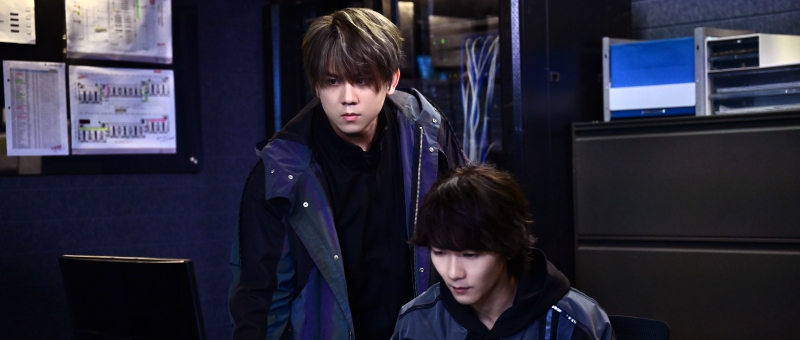
Nevertheless, there’s tension in the group with some opposing leader Arok’s (Rio Dewanto) increasingly cavalier attitude to human life and worrying tendency to suddenly change their well designed plans. The battle is essentially on two fronts, the police stalking them with traditional firepower and Arok fighting back with technology, harnessing the power of the internet to disguise his location while hacking police systems and public broadcasting alike to propagate his message of resistance against corrupt capitalism and oppressive poverty. Counter Terrorism does not appear to be very well equipped to deal with his new threat, but can seemingly call on vast reserves of armed troops even if in the end it’s mostly down to maverick officer Karin to raid the villains’ base largely on her own trying to rescue the boys after realising they are trying to help her after all.

These action sequences are dynamic and extremely well choreographed even if some of the narrative progressions lean towards the predictable and the final gambit somewhat far fetched in its implications. Then again, it’s also surprising that Counter Terrorism doesn’t seem to have much security and should perhaps have considered paying a little more for bulletproof glass in the control room. The subversive irony of the seeing the words “New Hope” and “deactivated” on the final screens cannot be overstated even as a kind of order is eventually restored in an otherwise unjust city.


13 Bombs screened as part of this year’s Osaka Asian Film Festival.

Original trailer (English subtitles)

Shadow of Fire (ほかげ, Shinya Tsukamoto, 2023)

The ruins of a firebombed city become a purgatorial space haunted by tortured souls who cannot escape the traumatic wartime past in Shinya Tsukamoto’s eerie voyage through post-war Japan, Shadow of Fire (ほかげ, Hokage). Even the small boy (Ouga Tsukao) who desperately looks for a place to belong is plagued by nightmares of the flames that took his home and family while it otherwise seems that those around him live their lives in the shadow of a war which for many is still far from over. 

This state of ruination is immediately brought home to us by the heightened presence of sound. Not only do the cicadas buzz amid the scorching heat of an oppressive summer, but we constantly hear the sound of people walking over rubble or the clinking of broken glass. The unnamed woman we first meet (Shuri) lives in a room behind a small bar which appears to have scorch marks across the fusuma, a dank and dingy place filled with hopelessness and despair. The woman herself has a vacant look, a little dead behind the eyes either numbed with the sake a neighbourhood man brings her as pretext for extracting sexual favours or simply too tired of life to think much about it. Though she technically runs a bar, it’s more of a front for her only means of supporting herself, casual sex work, though as later becomes apparent she too may have been slow poisoned not only by the war but it’s immediate aftermath and the lingering traumas of those left behind and those who returned. 

The boy who eventually comes to stay with her remarks that those who did not come back did not turn into scary people, as if they were somehow lucky to have escaped this purgatorial hellscape. Later he wanders through the black market and discovers an abandoned tunnel filled with returned soldiers who stare out at him with vacant eyes sitting with eerie stillness like dormant zombies. He spots a man among them that he knew well, a young soldier (Hiroki Kono) who had been a teacher before he was drafted and took a maths textbook with him to war as a kind of talisman that reminded him he’d survive and teach again. The soldier had formed an odd kind of family unit with the woman and the boy, almost as if the husband she lost in the war and son who died in the firebombing, had been returned to her but his trauma refuses to set him free surfacing in moments of unexpected violence that hint at war’s realities. 

Later the boy meets another man with a traumatic past though one who sees himself as both victim and villain, resentful towards himself and the militarist regime that convinced him to betray his humanity and do dreadful, terrible things in its service. Tellingly this man, Shuji (Mirai Moriyama), is the only one granted a name. Perhaps names are only for the living, there’s a part of Shuji that is painfully alive a way that others aren’t even as he fixes his sights on his revenge as if it would somehow restore the humanity that was taken from him. Completing his quest, he lets down his hair and proclaims that for him at least the war is finally over. His commander, meanwhile, appears to have been living a fairly nice and successful life reminding him that he should stop dwelling on the past because it was after all a war and such things are only to be expected.

Shuji uses the boy in a way that seems counterproductive, taking advantage of the gun he’d found to help him take revenge on war. The woman tries to change the boy’s path, instructing him not to steal but to work honestly for his pay and to try to be better than this infinitely corrupted world. He wanted to be her protector, in his way acting as guide trying to free those around him from the purgatorial space of ruin and destitution but when he asks a medicine seller if he can exchange his money for something that will cure sickness he is told it’s not enough. He then tries to buy a dress for the woman, as if anticipating the salvation through consumerism that will eventually arrive though the constant sound of gunshots from the black market might indicate that for some at least there’s only one way out. The old man who visits the woman explains that he only approaches the ones who look okay, but that in the end you never really know. Shot in the half light or caught from behind the previously friendly take on an almost demonic intensity, wandering ghosts or broken souls already half consumed by the flames that in their minds at least are still burning and casting their shadows over the scorched earth of a traumatised society.


Shadow of Fire screened as part of this year’s Japan Foundation Touring Film Programme.

International trailer (English subtitles)