 Bus trips might be much less painful if only the drivers were all as kind as Mr. Thank You and the passengers as generous of spirit as the put upon rural folk travelling to the big city in Hiroshi Shimizu’s 1936 road trip (有りがとうさん, Arigatou-san). Set in depression era Japan and inspired by a story by Yasunari Kawabata, Mr. Thank You has its share of sorrows but like its cast of down to earth country folk, smiles broadly even through the bleakest of circumstances.
Mr. Thank You is everyone’s favourite bus driver. In fact, some of his passengers have even deliberately decided to “miss” the previous bus because they heard he was driving the next one. It’s not hard to see why, he’s a good a driver and a very polite, nice young man who’s been given the affectionate “Mr. Thank You” nickname because of his habit of shouting a loud thank you to everyone who moves out of the way for his bus to pass in the narrow mountain roads (the aforementioned pedestrians are also to be seen waving wildly and shouting his nickname back at him as he grins at them in the rear view mirror). He’s also prepared to stop and pick up passengers along the way as well as carrying messages between villages and filling requests for the latest records to hit Tokyo stores.
Mr. Thank You was apparently shot without a firm shooting script other than the inspiration of Kawabata’s story so the dialogue has a very immediate, contemporary feeling. There isn’t so much of a story as a journey taken with this disparate group of people all travelling from one place to another for various different reasons with the small interjections of other passersby on the roadside. The main drama occurs between a woman and her daughter who have such ashen faces they might as well be ascending the gallows, a very modern whiskey swilling travelling woman, and a grumpy guy with a handlebar moustache who seems very anxious about the bus being delayed by all these pleasantries. Along the way, Mr. Thank You offers commentary on some of the people he knows from his regular trips which amounts to a collection of sad stories decrying the state of the nation in which fathers are selling their daughters and mad men wander the streets searching for lost love.
“Young women used to laugh, but you never hear that now.” Says one passenger glancing at the sad face of a girl on a bus to the city. The mother and daughter seem reluctant to talk about their journey but it’s obvious to all that the girl is to be sold to a geisha house, never to see her home again. Mr. Thank You is sympathetic to her plight whilst silently listening to the lamentations of his customers like a sober barman. At one point he wonders out loud if he might be better off driving a hearse – acknowledging his own complicity in taking money for escorting this poor girl off to a life of rack and ruin. The flirtatious modern woman sitting behind him (most likely a prostitute herself) reminds him that women who pass these mountains rarely make a return journey, perhaps there is another way he could help her even if he can’t do the same for everyone.
Shimizu also stops a minute to consider the human costs of all this rapid progress. Taking a brief break from driving, Mr. Thank You chats to an acquaintance who has been working on the road building programme. A Korean migrant, she is among the most put upon of workers. She hoped she might have enough money to ride on Mr. Thank You’s bus just the once, but no sooner has one road been completed than she’s despatched off to build another one on another mountain so she’ll have to bid him goodbye. Mr. Thank You (seemingly quite taken with her and sorry to hear they may not meet again) offers to let her ride for free but she looks back at the masses of other people who are walking the mountain passes because they can’t afford the bus either and says it’s OK, she will stay with them, walking onward with everyone else caught in the same predicament as herself.
Filmed in 1936 Mr. Thank You has an extremely modern sensibility with a lot of naturalistic location shooting outside of the cramped environment of the bus which forms the main setting for the drama. The bus drives onward without stopping as obstacles fade from view only to reappear in the rear view mirror like ghosts, phantom images reflected on the landscape here one minute and gone the next. Time and history are marching on though one gets the impression Shimizu at least does not approve of the way his country is heading. The passengers on Mr. Thank You’s bus all have their troubles, but they’re trying to do the best they can by putting a brave face on it. They laugh, they drink, they sing but eventually they will all have to get off the bus, away from the careful protection of Mr. Thank You, and return to land of badgers and foxes where it’s every man for himself and those who cannot pay the fare will have to walk the rest of the way on their own two feet alone.
Mr. Thank You is the second of four films in Criterion’s Eclipse Series 15: Travels with Hiroshi Shimizu box set.
Scene featuring the Korean migrant worker (with English subtitles)
 Nobuhiko Obayashi might be most closely associated with his debut, Hausu, which takes the form of a surreal, totally psychedelic haunted house movie, but in many ways his first feature is not particularly indicative of the rest of Obayashi’s output. 1984’s The Deserted City (AKA Haishi, 廃市), is a much better reflection of the director’s most prominent preoccupations as it once again sees the protagonist taking a journey of memory back to a distant youth which is both forgotten in name yet ever present like an anonymous ghost haunting the narrator with long held regrets and recriminations.
 Feelings can creep up just like that, to quote another movie. Like Wong Kar-Wai’s In the Mood for Love, Temptation (誘惑, Yuwaku) also echoes Lean’s Brief Encounter with its strains of accidental romance between unavailable people even if only one of the pair is already married. However, this time there’s much less deliberate moralising though the environment itself is a fertile breeding ground for the judgemental.

 Released in 1949, The Invisible Man Appears (透明人間現る, Toumei Ningen Arawaru) is the oldest extant Japanese science fiction film. Loosely based on the classic HG Wells story The Invisible Man but taking its cues from the various Hollywood adaptations most prominently the Claude Rains version from 1933, The Invisible Man Appears also adds a hearty dose of moral guidance when it comes to scientific research.
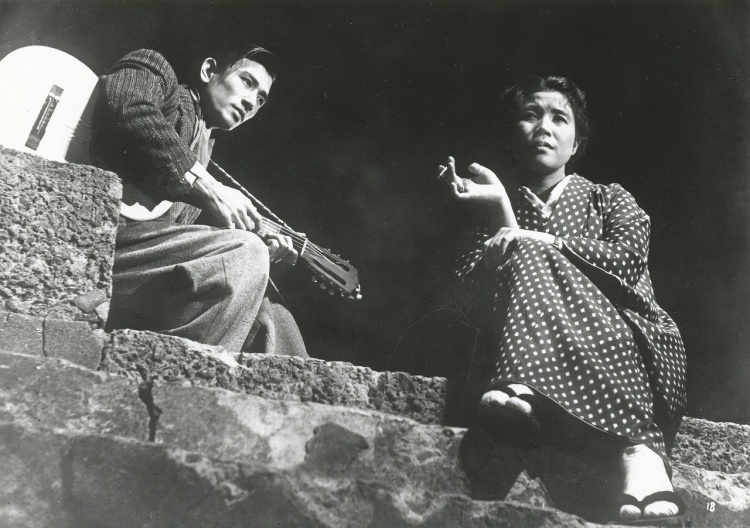 A Japanese tragedy, or the tragedy of Japan? In Kinoshita’s mind, there was no greater tragedy than the war itself though perhaps what came after was little better. Made only eight years after Japan’s defeat, Keisuke Kinoshita’s 1953 film A Japanese Tragedy (日本の悲劇, Nihon no Higeki) is the story of a woman who sacrificed everything it was possible to sacrifice to keep her children safe, well fed and to invest some kind of hope in a better future for them. However, when you’ve had to go to such lengths to merely to stay alive, you may find that afterwards there’s only shame and recrimination from those who ought to be most grateful.
 Starting as he meant to go on, Nobuhiro Yamashita’s debut feature film is the story of two slackers, each aimlessly drifting through life without a sense of purpose or trajectory in sight. His humour here is even drier than in his later films and though the tone is predominantly sardonic, one can’t help feeling a little sorry for his hapless, lonely “heroes” trapped in their vacuous, empty lives.
 Having taken avant-garde story telling to its zenith in
  The second film contained within Arrow’s Kiju Yoshida boxset is perhaps his least accessible. Ostensibly, Heroic Purgatory (煉獄エロイカ, Rengoku Eroika) is an examination of leftist politics in the years surrounding the renewal of the hugely controversial mutual security pact between Japan and America. However, it quickly disregards any kind of narrative sense as time periods blur so finely as to leave us with no objective “now” to belong to and characters switch identities with no warning or discernible reason. Yoshida is not really after objective truth here – there is no truth in cinema, film lies repeatedly until it finally exposes the truth.
 Windows on Worlds