
Rewrite (リライト, Daigo Matsui, 2025) [Fantasia 2025]

A mysterious transfer student arrives from the future. You have 20 wonderful days with him, but then he must return to his own time. He tells you that he came back to meet you and experience your time because of a book you will write, and your future self also shows you the book, tells you you did indeed write it, and that everything’s going to be okay. But in 10 years’ time, when you’re your “future self”, you from the past does not show up to get any of this information. Did something go wrong? Is the timeline crumbling? Or did you just imagine all this as a manifestation of “youth”?

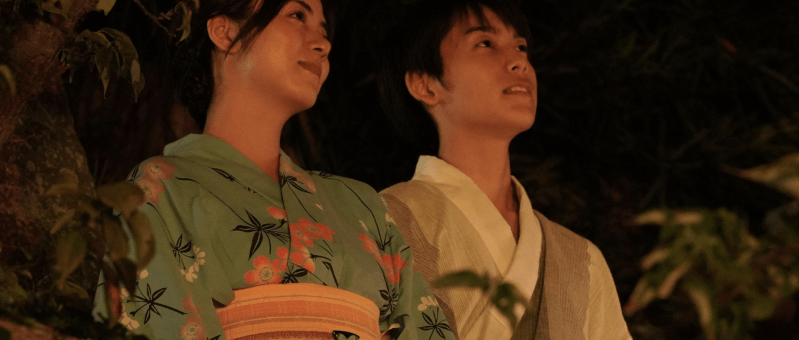
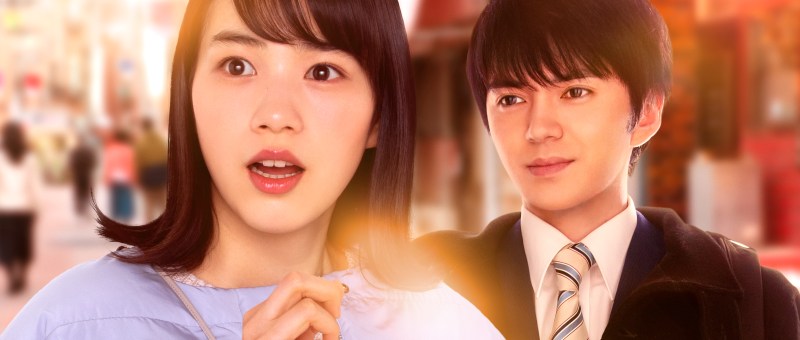
When this happened to her, Miyuki (Elaiza Ikeda) believed that she was “the heroine of that summer,” but the truth is of course that she was always the heroine of her own life and had the right and power to make her own choices. Adapted from the novel by Haruka Honjo, Daigo Matsui’s Rewrite (リライト) is, like Obayashi’s The Little Girl Who Conquered Time, about the dangers of nostalgia and the over romanticisation of youth. What Miyuki gradually comes to realise is that one of the formative experiences of her teenage years may not have been unique or special but happened to literally everyone and changed them too in ways that were not always good. Because she met Yasuhiko (Kei Adachi) from 300 years in the future, she became a writer. But it remains true that her first few books weren’t about him at all. She always had the talent and the inclination. The impetus of destiny was only what gave her the confidence to pursue it. She knew she could, because she already had.

Yet, she’s in her hometown to close a loop on this unresolved romance of her youth despite having built a good life for herself as a successful author with a nice husband she met during the course of her work who is caring and supportive of her career. At the high school reunion she’s cajoled into going to, her former classmates sing the song they were practising for choir, “Cherry” by Spitz, which is also about “rediscovering each other, some day, same place,” echoing Yasuhiko’s cryptic claim that they’d meet again “in the future” (whose he doesn’t say) hinting at the way these feelings have been left hanging with only a yearning for the past and a painful nostalgia in their place. What Miyuki really has to ask herself is if she’s the person she wants to be in the present and is who she is because of the choices she made independently rather than solely because she was trying to fulfil the destiny given to her Yasuhiko.

To do so, she must face the fallacy of the “chosen one” mentality. The film rams this home in the parallel story of one of Miyuki’s classmates who tells her that she wasn’t chosen but actively chose to accept a kind of destiny rather than simply going along with it and that Miyuki too could “rewrite” the past if she wanted. In effect, this is what she’s already done as her husband implies when he repeatedly asks her if the book is “fiction”. Of course, it is, though she believed it not to be because it’s rooted in nostalgia and the personal myth making of the idealised romance of her youth. Matsui too plays with this sense of nostalgia in moving the setting of the story to Onomichi to mimic that of Obayashi’s The Little Girl Who Conquered Time and making frequent visual references to the 1983 film along with casting Toshinori Omi, the original boy who leapt through time, as the class teacher at the 10 years later reunion.

But the truth remains that Miyuki must learn to let go of the past, or else take mastery over it by rewriting her own story to accept that, as her husband says, the past and present are all hers. She can write anything and can finally leave her own time loop by writing her way out of youthful nostalgia and accepting something more like an objective reality along with the life she has now which appears to be happy and successful. Scripted by Makoto Ueda who has a long history of time-travel themed movies from Summer Time Machine Blues to River, Matsui’s poignant drama is shot through with irony and in constant dialogue with pop culture touchstones from the Obayashi film to Shunji Iwai’s Love Letter, while at the same time insisting that while you are the main character in your own life, you’re not the only one and a hundred stories are going on at the same time as yours. What really matters is not hanging on to the memories of an idealised past, but to live the life you want in the present for as long as this particular loop lasts.


Rewrite screened as part of this year’s Fantasia International Film Festival.

Original trailer (English subtitles)

BAUS: The Ship’s Voyage Continues (BAUS 映画から船出した映画館, Hokimoto Sora, 2025)

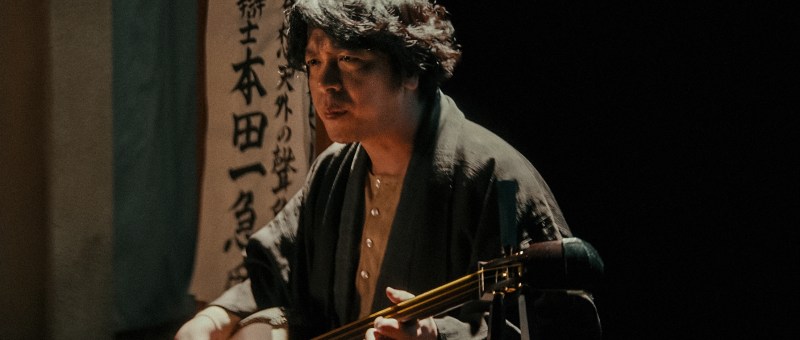
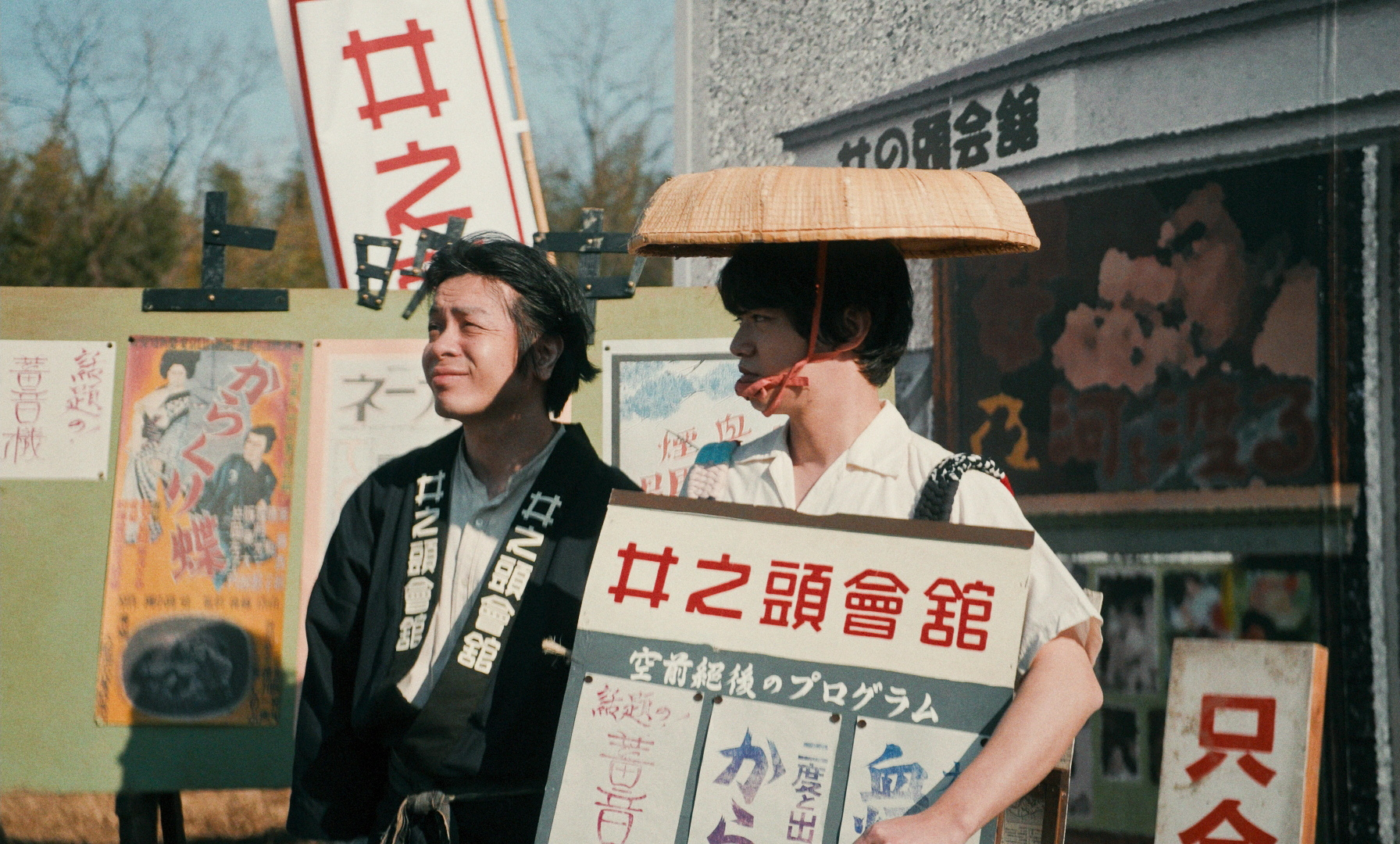
According to the hero of Sora Hokimoto’s BAUS: The Ship’s Voyage Continues (BAUS 映画から船出した映画館, Eiga kara Funadeshita Eigakan), films are born of man’s battle against time and the desire to extend one moment into eternity. Yet his father was always looking for a new “tomorrow” and a path towards the future that ironically kept him from being fully in the  present. Inspired by the memoirs of Takuo Honda, the film is effectively a people’s history of cinema culminating in 2014 with the closure of the Baus Town cinema amid a climate in which film itself seems to have entered a terminal decline.

Indeed, Takuo’s father Shigeo (Shota Sometani) becomes almost a ghost himself. Having come to Tokyo insisting that movies were his “tomorrow,” the war leaves him a shadow of his former self and a spectral presence in the auditorium. Though Takuo’s mother (Kaho) and others at the cinema have discovered a new community eating together every night after the final screening, Shigeo is often out drinking with the chamber of commerce and rarely returns home. Still looking for “tomorrow,” he appears lost for direction despite opening a new, more modern cinema fit for the post-war era. 

As the mother of Shigeo’s wife Hama says, men are focused on past and future while it’s women who are forced to face the present leaving most of the more practical problems for Hama to deal with. Shigeo’s brother Hajime (Kazunobu Mineta) had perhaps been overly obsessed with the past and ultimately unable to move forward. After coming to Tokyo with Shigeo, he became an unsuccessful benshi only to be rendered obsolete by the arrival of talkies. Despite being drawn to the anti-capitalist rhetoric of the migrant workers, he later falls hard for militarism and becomes a casualty of the war both literally and spiritually. Shigeo laments the increasing censorship of the late 1930s complaining that it has become impossible to make or show films, but it’s little better afterwards as the Occupation forces push Hollywood movies at the expense of the European or Japanese.

Hajime had snapped back that entertainment wouldn’t change anything and that war purified the world, but Shigeo insists that films are a window from which the local population can learn about other lives and other places, a means of “building the heart” that might a save a soul. The older Takuo envisages a world in which watching a film normally or loving someone normally might become political acts in themselves. He weaves his personal history of film, which is also that of his family, with the political realities of the mid-20th century in which beautiful forests are cut down to make coffins for the endless dead and unexploded incendiaries lurk like ticking time bombs both literally and psychologically as, as one old man puts it, the nation’s struggles to reckon with its role in the war or its traumatic consequences. 

Nevertheless, even if Takuo is closing Baus Town for reasons stemming from his own traumatic loss, he continues to look for tomorrow despite his old age. Asked what his dream was, he replies only that he wanted his children to have better lives than he did, though he worries he may have failed. In any case, he remains lost within the labyrinths of cinema. The building itself, originally surrounded by fields in a much smaller Kichijoji, becomes a haunted space in his memory, half dream and longed-for place of warmth and salvation in which he remains a small child searching for his father in the empty auditorium.

The name for Baus Town is taken from the bow and stern of a ship, echoing Takuo’s own search for other horizons and a constant process of moving through the world. He too is trying battle time and make a moment last an eternity while admitting that there’s nothing so beautiful as smoke in the projector beam. He asks his daughter if smoke, like movies, isn’t connected to the afterlife and there are ways in which Takuo has also become a ghost, both haunted and haunting while films are themselves a kind of other world of the living past and a way of communing with those no longer here. Taking over production after Shinji Aoyama passed away, Sora gives the film an elegiac, poetic quality while asking if cinemas too might be resurrected in the same way as film even as Takuo ponders new directions while continuing to sail ahead in search of tomorrow.


BAUS: The Ship’s Voyage Continues screened as part of this year’s Nippon Connection.

Original trailer (no subtitles)

Images: ©Honda Promotion BAUS/boid 

Until the Break of Dawn (ツナグ, Yuichiro Hirakawa, 2012)

If you had the opportunity to reunite with someone no longer here for a single night, would you take it? The young hero of Until the Break of Dawn (ツナグ, Tsunagu) is beginning to wonder whether or not it’s a good thing to be able to converse with the dead, if some people regret their choice to meet again, and if it’s better to just move on accepting that there will always be unanswered questions at the end of a life. Arriving shortly after the 2011 earthquake and tsunami, Hirakawa’s moving drama is a meditation on grief and living with loss, but also on life and legacy and everything it means to be alive. 

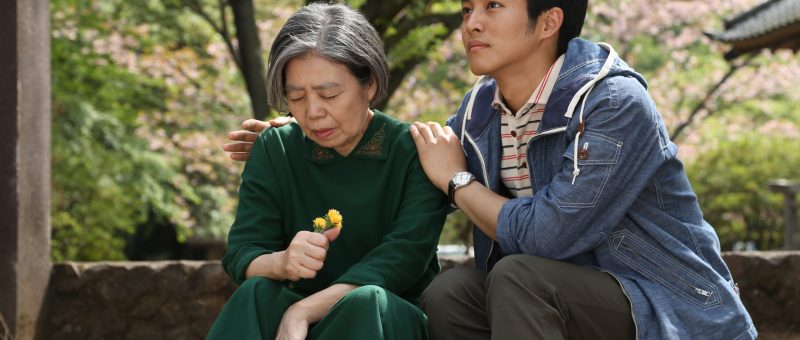
High schooler Ayumi (Tori Matsuzaka) is being apprenticed by his grandmother Aiko (Kirin Kiki) to become a “connector” able to meet with spirits of the dead. As he explains to his potential clients, each person is allowed to meet only one other from the other side for one time only and should the deceased decline the invitation the petitioner will not be permitted to make another. If all goes to plan, Ayumi sets up a meeting at a fancy hotel where the pair can stay until dawn on the night of a full moon. Obviously this is not exactly a well publicised activity and the first customer Ayumi meets, Hatada (Kenichi Endo), is reluctant to trust him assuming it’s some kind of scam no better than an end of the pier clairvoyant despite repeated assurances that they accept no money and even the hotel expenses are covered.  

Tellingly, in the first reunions which we see the deceased does not tell the living anything they did not already know, Hatada claiming that he wanted to talk to his mother to find out where she put the deeds for their house only for her to tell him he already knows where they are and obviously had some other reason for wanting to see her. Even Aiko admits that she can’t be sure she’s really summoning the spirit of the deceased, Ayumi wondering if they really call someone back from the other side or if it’s more like the memories of a person who is no longer alive that have remained in the world are pulled back to together building a composite picture of someone as others saw and remembered them. He isn’t sure if what they’re doing is ethical, or if some people might wish they’d never chosen to meet again. The subject of another meeting, a young woman who died while presumed missing, is uncertain whether to meet her former boyfriend on hearing that he had spent the last few years waiting for her return realising that the her that had remained in him will die when he is forced to accept her death but deciding it’s worth it so that they both can achieve some closure and he can perhaps begin to move on. 

Moving on is something Ayumi is himself struggling to do, presented with the option of setting up a meeting of his own before he prepares to take over from his grandmother as the connector while meditating on the deaths of his parents wondering if he should meet one of them and simply ask why they left him behind. Meanwhile, he also finds himself proximate to death when a classmate is killed in a traffic accident, her guilt-stricken friend unknowingly asking for his services though for less than altruistic reasons worried her friend may use the service to tell others about their falling out. She’s fond of repeating the phrase that you regret more the things you didn’t do than the things you did though her reunion turns out to have a sting in the tail she may not have been expecting hinting at the bad outcomes Aiko had also warned were possible in such emotionally fraught situations. 

The conclusion that he comes to is to embrace the true nature of his calling as a connector hearing that Aiko only got the power from her brother (Tatsuya Nakadai) to keep her connected to the family while she later gave it to her son for the same reason only to harbour a sense of guilt that her imperfect instruction may have contributed to his death. Learning to see with his heart, Ayumi comes to understand that just because you can’t see something doesn’t mean it isn’t there discovering a source of comfort in the feeling of someone gently watching over those below while accepting that perhaps it doesn’t matter if the reunions are real or illusionary because their true purpose is to comfort those left behind. A gentle meditation on grief and living with loss, Hirakawa’s quietly moving film eventually makes the case for growing old happily with no regrets living to the full until the break of dawn.


Until the Break of Dawn streamed as part of Japanese Film Festival Online 2022.

Original trailer (English subtitles)

OZLAND (オズランド 笑顔の魔法おしえます。, Takafumi Hatano, 2018)

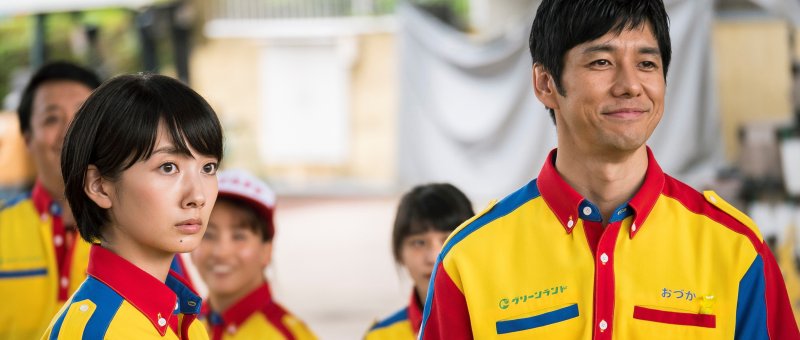
A snooty elitist gains a new perspective after being unexpectedly transferred to an old school rural theme park in Takafumi Hatano’s heartwarming workplace dramedy Ozland (オズランド 笑顔の魔法おしえます。, Ozland: Egao no Mahou Oshiemasu). Echoing The Wizard of Oz’ Dorothy, Kurumi (Haru) suddenly discovers that she’s not in her familiar Tokyo anymore and is originally resentful, sullen, and aloof refusing to engage with her new coworkers while dismissive of their work but gradually comes to see that there was method in the madness realising the ways she herself has been petty and small-minded while all anyone wanted to do was make people happy. 

Kurumi’s problem is that she’s a hometown girl. She loved her city, her family, her friends, and most particularly her boyfriend Toshi (Tomoya Nakamura) even going so far as to get a job at the company where he works so they can be together all the time. Tragedy strikes when she’s abruptly transferred to a theme park in provincial Kumamoto, Toshio suggesting she go and make the most of the experience of living alone for the first time while they do long distance. Coming from straight-laced Tokyo she experiences a kind of culture shock especially as her eccentric supervisor, Mr. Ozuka (Hidetoshi Nishijima), chooses to haze her with a pretend bomb scare immediately on her arrival. Aside from that, it seems the boss (Akira Emoto) misread her name on her résumé (as it turns out, the main reason he hired her) so no matter how often she corrects them everyone keeps calling her “Namihei” rather “Namihira”, suggesting that it might be easier if she changed her name because they’ve already had it printed on all her things. 

In a way, the name dilemma hints at Kurumi’s sense of superiority over her new coworkers in that she refuses to simply let it go out of politeness, as well she might in refusing to allow them to get away with calling her by a name that’s easier for them without bothering to learn her own, but equally using it as more evidence of their lack of sophistication rather than deciding to see the funny side. Though she’s been hired as part of the planning department, Ozuka assigns her mostly menial tasks further fuelling her sense of resentment. She might have a point when she says she didn’t go to uni to pick up trash for a living, but obviously looks down on her coworkers while the young man who joined at the same time as her, Yoshimura (Amane Okayama), simply gets on with the job without complaint. Kurumi went to a good university which adds to her snooty sense of elitism but later discovers that Yoshimura went to an even better one yet obviously doesn’t feel the same sense of belittlement in being asked to perform manual labour. 

What she later realises is that all of the “pointless” menial tasks had a point but she missed it because she tried to cheat, hoping to get in Ozuka’s good books in the hopes of being transferred back to Tokyo or allowed to do actual planning work. Not until she’s begun to settle in and accepted that she’s been unfair to her coworkers does Kurumi begin to look at herself realising that her snobbishness has only made her unhappy while the relaxed atmosphere and gentle camaraderie at the park is what has kept her new colleagues so cheerful. The extent of her personal growth is thrown into sharp relief when Toshio visits from Tokyo and immediately begins running the park down, describing her colleagues as “nosey”, and finally exclaiming that he preferred the old snooty Kurumi and wants her to come back to elitist Tokyo with him before she turns into a happy provincial. So changed is she that she can’t quite believe he’d be so snobbish and no longer knows what she saw in him realising that she’s much happier now she’s less judgemental and more engaged with those around her. 

In essence, she’s a Dorothy who decided to stay in Oz discovering a new home and a new family in a rundown theme park in Kumamoto that might quite literally be a dreamland making families happy all year round. Filmed at the real life Mitsui Greenland amusement park, Ozland might come from the sponsored by the tourist board school of Japanese cinema (local mascot Kumamon makes several guest appearances) but undoubtedly has a lot of heart not to mention surreal whimsy in its frequent Oz references and insistence on the importance of magic in everyday life. 


OZLAND streams until 27th February in several territories as part of Japanese Film Festival Online 2022.

Original trailer (English subtitles)

Hold Me Back (私をくいとめて, Akiko Ohku, 2020)

“Humans fly solo from the day we are born. You need to make an effort to be with someone” the heroine of Akiko Ohku’s latest chronicle of the contemporary woman’s inner loneliness, Hold Me Back (私をくいとめて, Watashi wo Kuitomete), is reminded. Like the heroine of Ohku’s mega hit Tremble All You Want, 31-year-old office worker Mitsuko (Non) is an introverted lonely soul through unlike the slightly older protagonist of My Sweet Grappa Remedies she is clearly much less happy with her single life than she likes to pretend often talking over her existential worries with an inner voice she refers to as “A” for “Answers”. 

As we first meet Mitsuko she’s taking part in a weekend workshop making fake food samples out of wax, later stopping off to pick up take out tempura on her way home because it saves stinking out her kitchen frying for one. She spends her free time thinking up things to do on her own on the weekends, but always seems to carry a degree of anxiety about her culturally taboo singledom. Having decided to try out a popular sandwich place, she finds herself leaving a nearby park because she feels awkward taking up a picnic table for four surrounded by couples and families on a day out. For similar reasons she nixes an idea to go to the beach, frightened she’d stand out as a lone woman. She finds herself asking A what she could do to make people like her more, clearly hungry for company but also afraid of it admitting it’s much easier to relax when she’s on her own and presumably free from the pressures of potential judgement.  

It’s potentially because of this awkwardness that she ends up in an ill-defined non-relationship with an equally diffident salaryman who often visits her office. The perfectly pleasant Tada (Kento Hayashi) is a young bachelor surviving off cutlets from a food stand in the neighbourhood where they both coincidentally live. Mitsuko tells a few fibs about her gourmet lifestyle but is actually a good cook though her probably made out of politeness invitation to make Tada dinner somewhat backfires as she finds herself cooking him “takeout”, preparing a meal while he waits awkwardly in her hallway before taking it home to eat on his own. A conversation with A reveals she does indeed have a crush on Tada and would like to ask him to stay but is fearful of ruining the non-relationship they already have if he should suddenly mention a girlfriend or refuse her invitation. 

Unrevealed even with her conversations with herself is a potential history of personal trauma, recalling a bad date with middle-aged dentist who told her he didn’t want to date a patient in public but had already booked a hotel room while getting handsy in the bar. On an onsen getaway she’s gifted by a friend who got it at wedding she doesn’t want to spend time thinking about, Mitsuko witnesses a comedian stage rushed by a pair of creepy guys and desperately wants to say something but finds herself unable. Talking it over with A she berates herself for her internal complicity with a patriarchal society, remembering all the times she let it go when a sleazy boss grabbed at her, an older co-worker who tried to convince her that it wasn’t OK eventually forced out of her job. She takes refuge in the fact her supportive female boss has managed to carve out a career for herself, believing she will eventually triumph over sleazy and incompetent men who take credit for the work done by their talented female subordinates but also assumes that Ms. Sawada (Hairi Katagiri) must be a lonely workaholic who sacrificed her personal life for the professional. 

An invitation from uni best friend Satsuki (Ai Hashimoto), meanwhile, who married an Italian and moved to Rome further deepens her sense of early life crisis, especially on discovering that Satsuki had neglected to mention that she was pregnant in any of their correspondence. It’s telling in a sense that A seems to desert her when she has someone “real” to talk to, absenting himself for the entirety of her time in Italy during which she realises that happy as she is Satsuki is also lonely living in an unfamiliar country and understandably anxious about the birth of her first child so far from home. Yet A’s frequent absences only exacerbate her fear of abandonment, after all if even her inner consciousness is jumping ship what possible hope is there for anyone else? 

But then as he tells her “You cannot escape being you”, her inner voice will always be there even if she doesn’t really need him anymore. “It was easier fighting loneliness alone” she exclaims in panic, suddenly getting cold feet about a possible step forward in terms of human intimacy, only later calming down after a final pep talk with A convinces her it’s worth the risk. Less surreal than Tremble All You Want while less rosy than My Sweet Grappa Remedies, Hold Me Back embraces its heroine’s internal vulnerabilities with a relatable realism as she tearfully asks the absent A “I’ll be OK this time, right?” before daring to find out come what may. 


Hold Me Back screens in Brisbane (Nov. 14), Melbourne (Nov. 20/24), and Sydney (Nov. 27 / Dec. 3) as part of this year’s Japanese Film Festival Australia.

Teaser trailer (English subtitles)

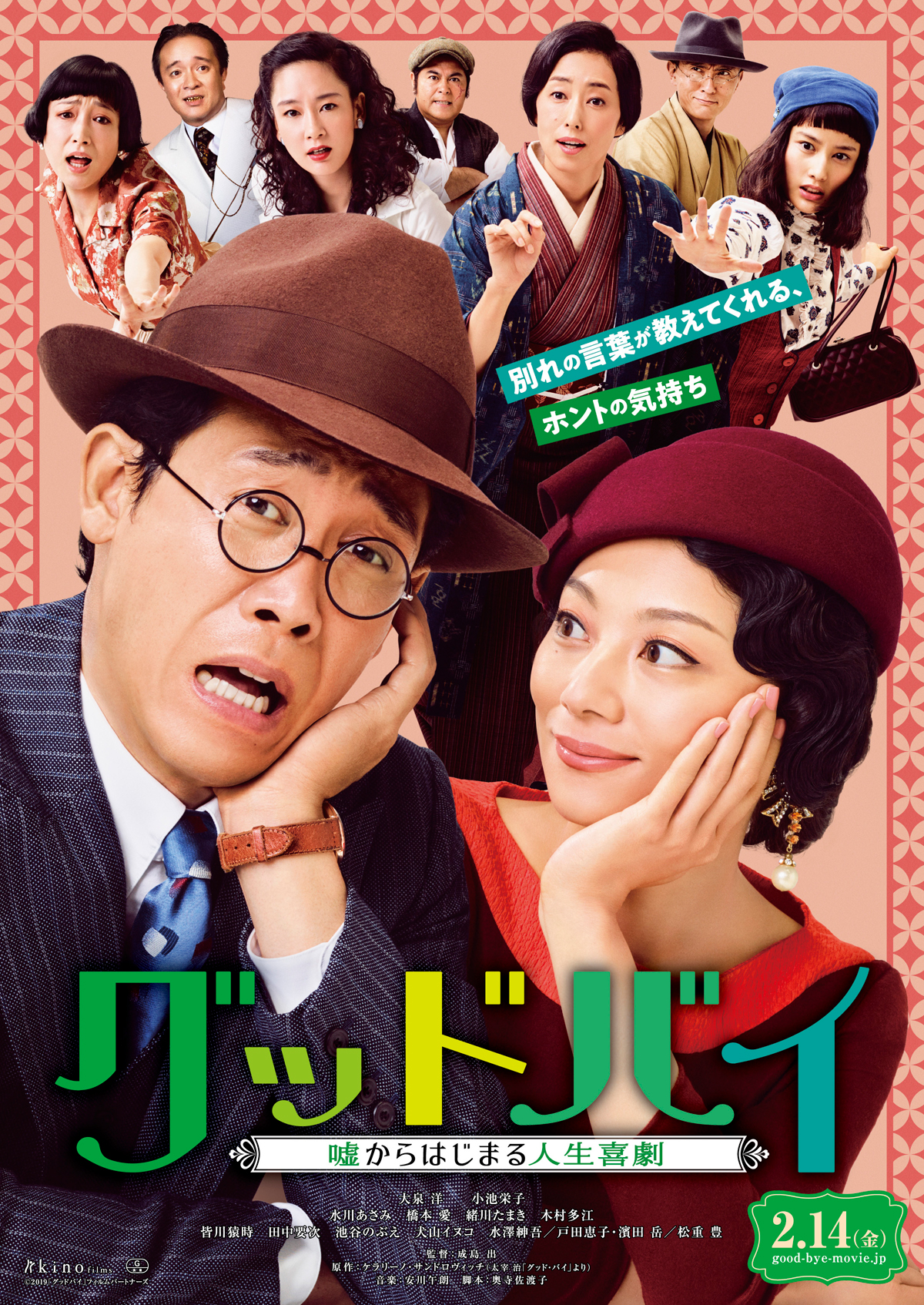
Farewell: Comedy of Life Begins with a Lie (グッドバイ~嘘からはじまる人生喜劇~, Izuru Narushima, 2019)

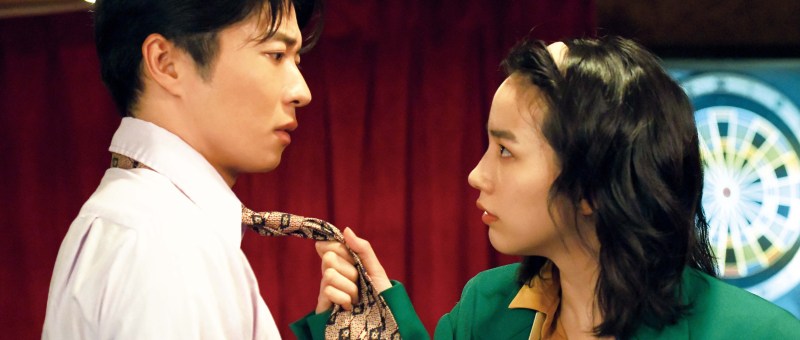
“You wrote that a man should be pure and honest” a conflicted editor reminds his friend, “yes”, he replies, “but that was fiction.” Osamu Dazai is not particularly remembered for his sense of humour, but Farewell: Comedy of Life Begins with a Lie (グッドバイ~嘘からはじまる人生喜劇~, Goodbye, Uso kara Hajimaru Jinsei Kigeki) adapted from a play by Keralino Sandrovich (Crime or Punishment?!?) inspired by his final and in fact unfinished novel Goodbye is a dark-hearted farce grafting ‘30s screwball comedy onto an ironic satire of heartless post-war capitalism through the prism of one man’s emotional cowardice. 

As the black and white newsreel-style opening informs us, literary magazine editor Tajima (Yo Oizumi) made a bit of money on the black market amid post-war chaos but is beginning to feel conflicted about his Tokyo existence especially after receiving a postcard from his small daughter Sachiko in provincial Aomori whom he hasn’t seen since her infancy. His problem is that he’s an inveterate womaniser with several mistresses on the go at once who ironically all already know that he’s a married man, to that extent “honest” at least, but remain unaware of each other. Suddenly wanting to reform his image and become a proper father to his little girl, he’s realising he ought to sort out his problematic love life but Tajima is also the sort of man who can’t bear unpleasantness and is too frightened to break up with his lady friends in case they cry. His writer friend, Rengyo (Yutaka Matsushige), comes up with a cunning ruse – find a pretty woman to pretend to be his long absent wife returned and the mistresses will most likely retreat voluntarily. Tajima decides to do just that on catching sight of a beautiful lady through a peephole in the gents at a bathhouse only she turns out to be someone he already knows, manly black-markeeter Kinuko (Eiko Koike) who secretly loves dressing up in the latest fashions. 

Kinuko is in a sense everything Tajima is not. An abandoned child, she’s learned to take care of herself and is strong both physically and emotionally. She agrees to help him with his nefarious plan because he offers to pay her handsomely, feeding her well in her copious desire for food which perhaps indicates her strong desire to live in a society where many are starving. She’s a black-marketeer because that’s all that’s left for her to be and perhaps has made her peace with exploiting the desperation of others in the knowledge that they also need the service she provides. In any case, she won’t let herself be trampled, frequently getting into fights with male dealers and later throwing Tajima off a balcony when he follows some bad advice from Rengyo and attempts to seduce her in the hope that then he wouldn’t have to pay her for participating in his scheme to rid himself of extraneous women. 

Yet it’s also clear that it’s women who are most at the mercy of the times, Tajima’s first mistress being a heartbroken war widow (Tamaki Ogawa) making a living as a florist who later attempts suicide after saying “Goodbye” to Tajima and the possibility of romantic salvation from post-war hopelessness (though her involvement with him does perhaps eventually lead her to that). The second mistress is a young painter (Ai Hashimoto) who approached him for work on the magazine attempting to support herself while her brother (Sarutoki Minagawa) remained in a Siberian labour camp, and the third is a self-assured doctor (Asami Mizukawa) looking perhaps for company though seemingly aware that Tajima is a weak-willed, unreliable man. His wife, Shizue (Tae Kimura), meanwhile, has become fed up with waiting for him to accept his male responsibility as a husband and father and unbeknownst to him his plans to keep her looked after may have backfired. 

Yet strangely Kinuko finds herself falling for the “pathetic” Tajima without quite knowing why while he perhaps begins to accept that maybe what he needs is a capable woman to look after him because he is after all too cowardly to look after himself. He’s fond of saying that the war changed everything for everyone, but she points out that her life has always been one of scrappy survival and now perhaps they are all equal in that. The post-war world however seems to be in permanent decline, an associate of Tajima’s (Gaku Hamada) eventually becoming accidentally rich, buying a suburban mansion, dressing in a garish white suit and snarling with a mouth full of gold teeth as he advances that money is everything and can even love can be bought. In this at least it turns out he may be wrong. Taking a “detour” allows Tajima to shed his commitment phobia and finally say “Goodbye” to post-war limbo in embracing both a desire to live and the possibility of enduring love. 


Farewell: Comedy of Life Begins with a Lie streamed as part of the 2021 Japan Foundation Touring Film Programme.

Original trailer (no subtitles)

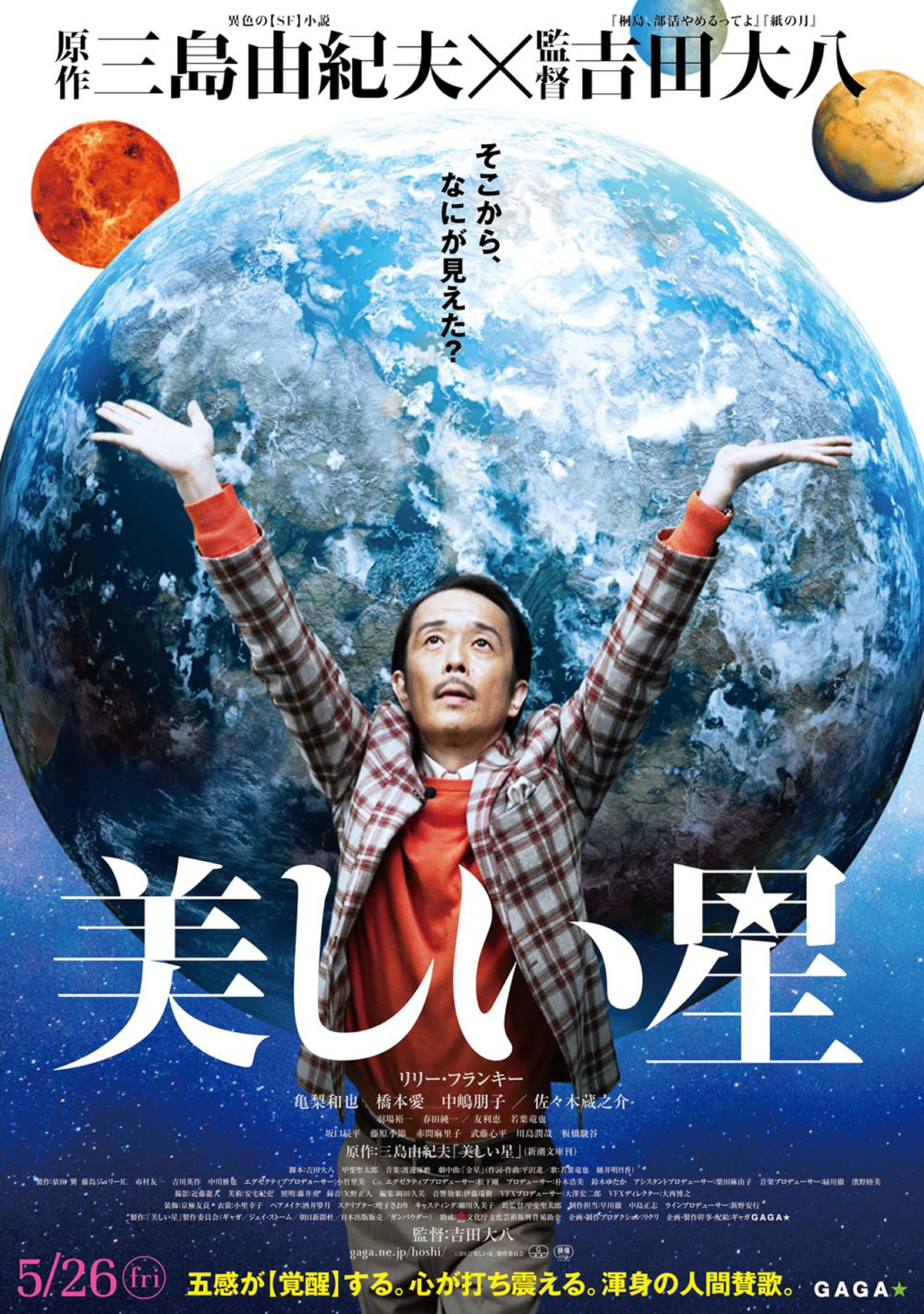
A Beautiful Star (美しい星, Daihachi Yoshida, 2017)

A Beautiful Star poster 1Given life’s anxieties, it can sometimes be hard to remember that the world is a beautiful place. If only we humans could learn to stop and smell the flowers every so often, we wouldn’t be so eager to destroy the place that gave us life. Loosely adapting a novel by Yukio Mishima, Daihachi Yoshida’s A Beautiful Star (美しい星, Utsukushii Hoshi) swaps Cold War nuclear paranoia for climate change anxiety as a collection of extra-terrestrials consider differing strategies to save the Earth, the most radical of them being the eradication of the human race.

Yoshida opens with the Osugi family, minus son Kazuo (Kazuya Kamenashi), “enjoying” a birthday dinner at an Italian restaurant. The tension between them is obvious as patriarch Juichiro (Lily Franky) bad mouths his absent son, daughter Akiko (Ai Hashimoto) sits sullenly not touching her food, and mum Iyoko (Tomoko Nakajima) tries to keep the peace. Juichiro, as we later realise, is a minor celebrity – a much loved TV weatherman whose predictions are not terribly good but he does have a very personable manner. Unfortunately, he’s not so nice offscreen and has been cheating on his wife with a much younger woman who is after his job. After a tryst at a love hotel, the pair get into some kind of bizarre car accident and Juichiro wakes up on his own in a field feeling not quite right. After a colleague suggests he might have been abducted by aliens, he develops an interest in UFOs and, after being moved to tears on air, comes to the conclusion that he is a Martian emissary from the League of Solar Planets come to enlighten the Earth to the dangers of global warming before it’s too late.

In fact, Juichiro is not the only member of the Osugis to believe he is not of this Earth. Except for mum Iyoko, everyone eventually realises they are actually from another planet but their feelings of “alienation” are perfectly Earthbound and born of extremely normal anxieties the like of which can cause discord in any family. Complaining about his son’s lateness to the birthday dinner, Juichiro runs down Kazuo’s lack of full-time employment and writes him off as “just an errand boy”. Kazuo, resentful of his father, feels an intense insecurity about his failure to forge a successful life for himself – something that is thrown into stark relief when he meets an old college buddy now a salaryman who seems to take pleasure in the fact that the captain of the basketball team has made a mess of things where he is now on the road to career success. So when Kazuo meets shady fixer Kuroki (Kuranosuke Sasaki), currently running the campaign for conservative politician and climate change denier Takamori (Jyunichi Haruta), and finds out he is actually from Mercury, it restores his sense of purpose even if it pushes him towards becoming a slightly dangerous right-wing manipulator.

His sister, meanwhile, is a lonely, depressed university student with a complex about her appearance. Approached by a creepy guy running some kind of campus beauty pageant, she can’t get away fast enough but is captivated by the song of a street busker who eventually tells her she likes his music because it’s inspired by their shared roots as Venusians and that the reason she “despises” her own beauty is that Venusians used to set the beauty standards on Earth but now they’ve been usurped. Feeling not quite so alone and more confident in her skin, Akiko decides to enter the pageant to “correct” the perception of beauty in human society.

“Beauty” seems to be the key. Iyoko finds herself sucked into a pyramid scheme selling “beautiful” water mostly out of a sense of lonely purposelessness. Apparently from power spot deep within the Earth, the water is supposed to be its rejuvenating life blood but like so much else, humanity has misused and commodified it. Juichiro’s Martians have a conventional solution to the present problem in that they want humanity to wake up and slow down. The Mercurians, however, have more radical ideas. Seeing as humanity is toxic to this planet that we all love, the obvious answer is simply to eliminate it, engineer a reset in which the Earth could heal itself after which point a new, more responsible humanity could be permitted to return. The problem, they say, is that humans do not think of themselves as a part of nature or realise that extinction is a perfectly natural part of the ecological life cycle. If they did, they might not be in this mess, but now they need to accept their responsibility and agree to a mass cull to save the planet.

Each of the Osugis has their insecurities wielded against them, and in the end each of them is in some way deceived. Kazuo’s resentful ambition is exposed by Kuroki, but he eventually realises he’s not much more than a patsy, while Akiko has to face up to the possibility that she’s been spun a yarn by an unscrupulous man who was only after the usual thing from a naive and vulnerable young woman. Iyoko’s deception is of the more usual kind as she figures out that “beautiful water” is an obvious scam she only bought into because of the false sense of belonging and achievement it afforded her, and Juichiro has to wonder if his Martian “delusion” has a medical explanation, but through their various deceptions the family is eventually forced back together again springing into action as a unit. The Mercurians dismissed humanity as unable to see the world’s beauty, remaining wilfully ignorant of the gift they had been given. The Osugis have at least been awakened to a kind of beauty in the world and in themselves as they face their alien qualities and integrate them with those of others. Yoshida may not have a clear answer for the problems of climate change (who does?), but he is at least clear on one thing – you lose that which you take for granted. Smell the flowers while the flowers last.


International trailer (English subtitles)

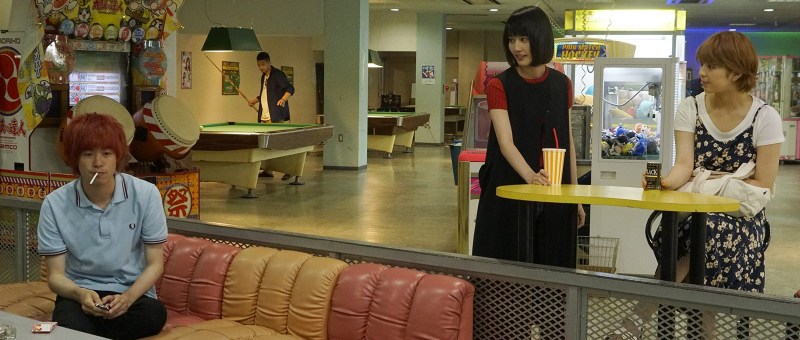
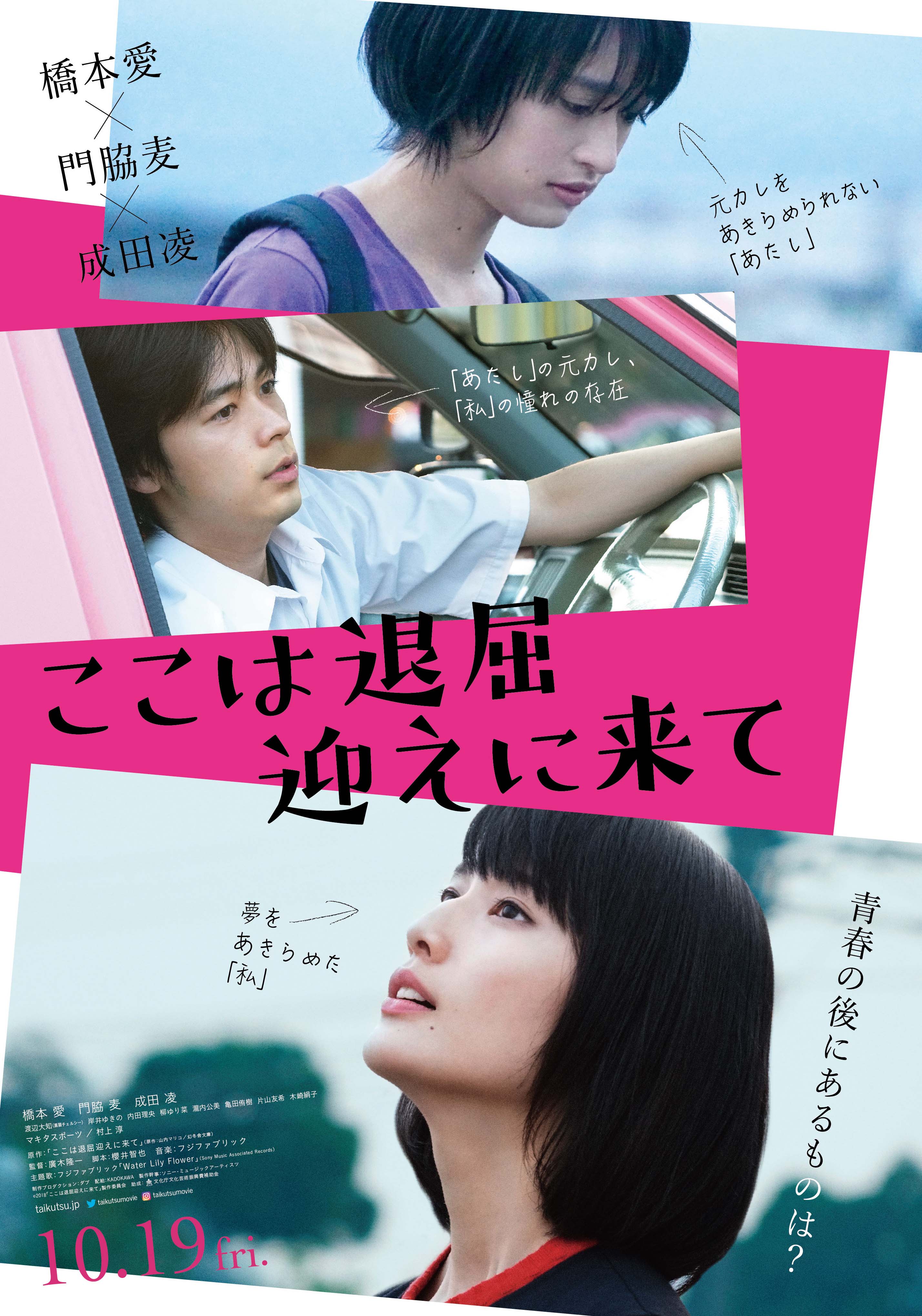
It’s Boring Here, Pick Me Up (ここは退屈迎えに来て, Ryuichi Hiroki, 2018)

SR2_teaserWhere now the dreams of youth? Japanese cinema seems to have been asking that very question since its inception but the answer remains as elusive as ever. The heroine(s) of Ryuichi Hiroki’s adaptation of a series of short stories by Mariko Yamauchi, It’s Boring Here, Pick Me Up (ここは退屈迎えに来て, Koko wa Taikutsu Mukae ni Kite), idolise Audrey Hepburn and long for urban sophistication only to find themselves hung up on unfulfilled high school promise and unable escape the wholesome romanticisation of their small-town youth to embrace the demands and possibilities of adulthood.

Hiroki follows his small-town high schoolers from 2004 to 2013, jumping freely between time periods as memories spark one another in emotional rather than chronological order. We begin with the unnamed protagonist, “I” (Ai Hashimoto), who has returned to her hometown after 10 (seemingly disappointing) years in Tokyo and now works as a freelance journalist for the provincial paper writing local culture articles on ramen shops and patisseries. She has contacted only one friend since her return, Satsuki (Yurina Yanagi), who has suggested, rather tongue in cheek, that they reconnect with former high school crush Shiina (Ryo Narita).

Back in high school, Shiina was like some kind of untouchable god. Everyone just wanted to be around him as if he alone made the sun shine. All the girls were in love with him, and the all boys wanted his approval. Asked about his hopes and dreams, Shiina just wants high school to go on forever, perhaps realising that he’ll never have it so good again. “I” meanwhile, claims that she wants to “become someone”. A small town girl who didn’t fit in, she hoped to find herself amid the hustle and bustle of the big the city but has returned with an even deeper sense of alienation than when she left with only the bright memory of her brief time as a chosen member of Shiina’s after school posse to cling to.

Satsuki, meanwhile, stayed behind but seems equally hung up on unfinished high school business. Having never been to Tokyo she is envious of her friend’s experiences and longs for the anonymity of the city. If you mess up in Tokyo, she claims, people will eventually forget whereas if you make a mistake in the country it’s all anyone will talk about for the rest of your life. That certainly seems to be true for another of the girls’ contemporaries (Rio Uchida) who left to become an idol only for it all to go wrong and come home branded as a loose woman. Cynical and calculating, she decides on an arranged marriage only to find herself shackled to an old man she doesn’t like very much while her shy friend (Yukino Kishii) seems to have found love by stealth and apparently won the jackpot without even knowing it.

Continuously travelling, the now almost-middle-aged high schoolers meander without direction as if circling around the locus of their departing youth and the sense of possibility disappearing with it. Running into another classmate, Shinpo (Daichi Watanabe), also connected with Shiina, I and Satsuki get a few more clues about their high school crush who apparently now lives a fairly ordinary life as a driving instructor thanks to Shinpo’s recommendation without which he was set to hit rock bottom after some kind of breakdown while failing to make it in Osaka. Nicknamed “Chinpo” (which means “willy”) in school, Shinpo’s dream for the future was to exist alongside someone that he loved but he seems to have given up even on this depressingly compromised desire and resigned himself to loneliness and lovelorn misery as someone who will never be able to find his place in a conservative and conformist society.

I meanwhile, like a similarly unnamed counterpart (Mugi Kadowaki) who really did date Shiina until he cruelly cast her aside, is finally able to burst her high school bubble by confronting it directly and seeing the reality rather than her romanticised impression of it. Those shining days of fun and friendship with everything still ahead will never come again, and so the memory of them remains bittersweet at best. Adult life is dull and disappointing, but there is perhaps melancholy happiness to be found in learning to embrace the present moment rather than harping on a largely imagined past or idealised future. 


It’s Boring Here, Pick Me Up was screened as part of the 2019 Nippon Connection Film Festival.

International trailer (English subtitles)

Little Forest (リトル・フォレスト 夏・秋 / 冬・春, Junichi Mori, 2014/15)

Divided into four hour-long segments, Little Forest (リトル・フォレスト) opens with a voice over from Ichiko (Ai Hashimoto) introducing us to Komori, her home village. High in the mountains, Komori is a community of farmers without a single store though there is a farmer’s co-op if you make the half-hour bike ride to the high street. It’s downhill so not so far on a bike on your way, but a good 90 minute walk in the winter snow. Most people do their shopping at the supermarket a few towns over but if Ichiko wants to go there it takes her the best part of a day. Ichiko, however, has a taste for doing things herself and so she grows most of her own food or barters for that which she doesn’t have with some of the other sharecroppers. Always with one eye on the future and particularly for the winter to come, Ichiko preserves her produce and makes the most of all she has.

Despite her feelings of inadequacy and incompleteness, Ichiko throws herself into the business of farming, weeding her rice field and preparing for the harvest all alone. She doesn’t seem to mind the solitude or the monotony, rejoicing in cooking the food she has grown and savouring each of its flavours. A gifted cook, Ichiko also likes to experiment, finding new ways to use each of the vegetables in her garden and trying them out on her two old school friends Yuta (Takahiro Miura) and Kikko (Mayu Matsuoka).

Yuta, like Ichiko, tried life in the city but ultimately decided to come home to the country. Despite wanting nothing but escape, Yuta found that he couldn’t adapt to the city’s insincerity. He missed real conversation and the ability to talk seriously about serious things whilst learning from others – something he so admired in the village. Ichiko, rather than empathising with him, is a little jealous. Yuta came home to face himself and discovered who he really was whereas she suspects she came back to escape doing exactly that. In short, she ran away and is living in hiding.

Yuta, adopting the gentle tones he was so in praise of, almost points this out to Ichiko albeit in a subtle way by telling her that he admires the way she does everything for herself but that he’s worried she may have missed the point. Ichiko’s need for independence is perhaps a reaction to abandonment by her mother which apparently happened quite abruptly in her teenage years. Her mother’s letters are vague and don’t include a return address or any details regarding where, how, or with whom she is currently living. Her last letter, however, seems to contain some relevant advice in the form of various excuses. Ichiko’s mother tells her that she was worried she’d just been wandering round in circles but finally realised that the arc of her life has been more like a spiral. Never taking the same path twice, she learned as she went and so finding yourself back at the start is not the same as never having set off.

Rather than actively making the choice, Ichiko merely commits to making it. Realising that it’s time to come out of hibernation and figure out where it is she wants to be rather than simply allowing Komori to become her default setting, the decision is made quickly and keenly. Yet it takes time, effort, and experience to bring something to fruition and, skilled as she is, Ichiko still has a few things to learn. Filled with wonderful food and idyllic scenery, Little Forest is perhaps an idealised view of country life – the kind of life lived by those who know how to live happily even when life is hard, but there is truth in its age old wisdom as long as you know how to harvest it.


Released as two two-part movies: Summer/Autumn (2014) & Winter/Spring (2015)

Summer/Autumn trailer (no subtitles)

Winter/Spring trailer (no subtitles)

https://www.youtube.com/watch?v=Agqqgb0TbOQ

Parks (PARKS パークス, Natsuki Seta, 2017)

parks posterParks are a common feature of modern city life – a stretch of green among the grey, but it’s important to remember that there has not always been such beautiful shared space set aside for public use. Natsuki Seta’s light and breezy youth comedy, Parks (PARKS パークス), was commissioned in celebration of the centenary of the Tokyo park where the majority of the action takes place, Inokashira. Mixing early Godardian whimsy with new wave voice over and the kind of innocent adventure not seen since the Kadokawa idol days, Parks is a sometimes melancholy, wistful tribute to a place where chance meetings can define lifetimes as well as to brief yet memorable summers spent with gone but not forgotten friends doing something which seems important but which in retrospect may be trivial.

Student Jun (Ai Hashimoto) begins the story with a meta voiceover declaring her intention to begin among the cherry blossoms – letting us know right away that this will be an ephemeral sort of tale. She’s young, in love, and carefree – too carefree, actually, she’s already got a job lined up for after uni but has forgotten to do any of the work needed to graduate. Then, disaster strikes. Dumped by her boyfriend, Jun finds a letter from the university reminding her that she’s way behind and in a lot of trouble (the letter is dated six months previously).

On top of all of this, she bumps into the strange and dreamlike Haru (Mei Nagano) who barges into her apartment which apparently was once home to the lost love of her late father in the 1960s (he was evidently quite an aged dad). Chasing the leads they find in a collection of love letters and photographs the girls track down some of the pair’s old friends and eventually the grandson of the woman in question, Tokio (Shota Sometani), who discovers a reel-to-reel tape among his late grandmother’s effects which contains the remnants of the love song Haru’s father and Tokio’s grandmother were creating together. Seeing as the tape is damaged the trio decide to finish the song which will also form a part of the thesis Jun is supposed to be writing to graduate university.

Light, bright, and breezy like a spring day in a beautiful park, Parks is necessarily slight but filled with all the whimsical nostalgia of the no longer young. Celebrating the park’s 100th birthday, Seta apparently wanted create something which tied the various ages together – hence the 1960s focus, though her 1960s is much more French New Wave and postmodern silliness than it is student protests or economic anxiety. Romance is in the air as lovers meet in the park vowing never to part, only they do for reasons which Haru is desperate to know even if no one else particularly cares about the background to their ongoing project.

The interplay between the three accidental friends is the heart of the drama as they find themselves pulled in various different directions. Shota Sometani’s oddly spirited Tokio with his city boy accent and nerdy attempt at cool wants more Twitter followers and has his eyes set on musical fame where as poor Jun just wants to be left alone to finish Uni while Haru is swept up in the romantic love story of her much missed father.

Or is she? Seta throws in a few meta gags leaving us unsure of who or what Haru really is or if any of this is real. Taking a decidedly Lynchian detour with strange and surreal scenes focussing on a mysterious door, she lends this world an odd sort of charm through, like her New Wave inspiration, often refuses to follow the trail to its conclusion. Flitting between past and future, allowing the two to mingle and overlap and Haru to become a friend of her father as a young man, Parks is a sweet summer daydream filled with gentle music and warm air fit to blow away on the breeze.

The song itself, a characteristically whimsical composition by Tokumaru Shugo (who also has a brief cameo in the film), is a beautifully innocent ‘60s folktune which is then corrupted by the conflicting modern dreams of the easily swayed realists Tokio and Jun while the idealistically romantic Haru listens in horror before Jun finally remembers what all of this was about and tries to fix things before they get any more broken. Some songs are intended to float away on the breeze, like summer adventures and casual friendships and Parks is such a one, though a pleasant way to dream away a warm afternoon.


Parks was screened at the 17th Nippon Connection Japanese Film Festival.

Original trailer (English subtitles available by clicking subtitle button)