Four Hours of Terror (高度7000米 恐怖の四時間, Tsuneo Kobayashi, 1959)

It seems quite strange now to think of a time when air travel was both new and exciting and as easy as catching a bus. It’s this juxtaposition that Tsuneo Kobayashi’s hijacking thriller Four Hours of Terror (高度7000米 恐怖の四時間, Kodo Nanasen Metoru: Kyofu no Yojikan) plays with as an armed fugitive takes a passenger plane hostage in an attempt to escape after committing a murder while those on board struggle to accommodate themselves to this new form of transportation. 

This sense of exoticisation is obvious from the opening voiceover which sings the praises of Haneda airport as the gateway to a newly internationalised Japan though in actuality the flight in question is a domestic service travelling from Tokyo to Sapporo. The voiceover also introduces us to each of the passengers which come from differing strata of society and even includes a middle-aged American couple. There are in fact three generations of couples on board who seem to represent different stages of life from the newly wed students so wrapped up marital bliss that they barely notice anything else, to a long-married reporter and his wife on their first holiday together since their honeymoon, and an elderly couple returning from a trip to the capital who are mystified by this new age of mass media and air travel. The newlyweds apparently won this free trip on an aeroplane after agreeing to have their wedding broadcast on television in an early example of reality TV, reinforcing the sense of irony that they weren’t necessarily supposed to be on this doomed flight after all. 

Neither was car saleswoman Kazuko (Hitomi Nakahara) who has apparently been pulled away to Sapporo by a short notice business opportunity. She gets a standby ticket, as does her boyfriend/rival Fujio (Tatsuo Umemiya) who is also on track to the same opportunity. Weirdly, Kazuko is not overly sympathetic having randomly kicked a basket containing a little dog about to be smuggled on the plane by its doting owner, but does perhaps represent something of a more independent post-war womanhood even as she effortlessly deflects unwanted attentions from a client she may also have been exploiting in order to obtain his business. Having boarded the plane, she ends up sitting next to another man who requested a standby ticket and was using a surname that was the same as hers but evidently turns out to have been assumed. So lax is the security, you don’t necessarily have to travel under your legal name. In any case, she briefly flirts with him as an overture to a business relationship and also to annoy Fujio before overhearing a news report about the escaped fugitive on her portable radio.

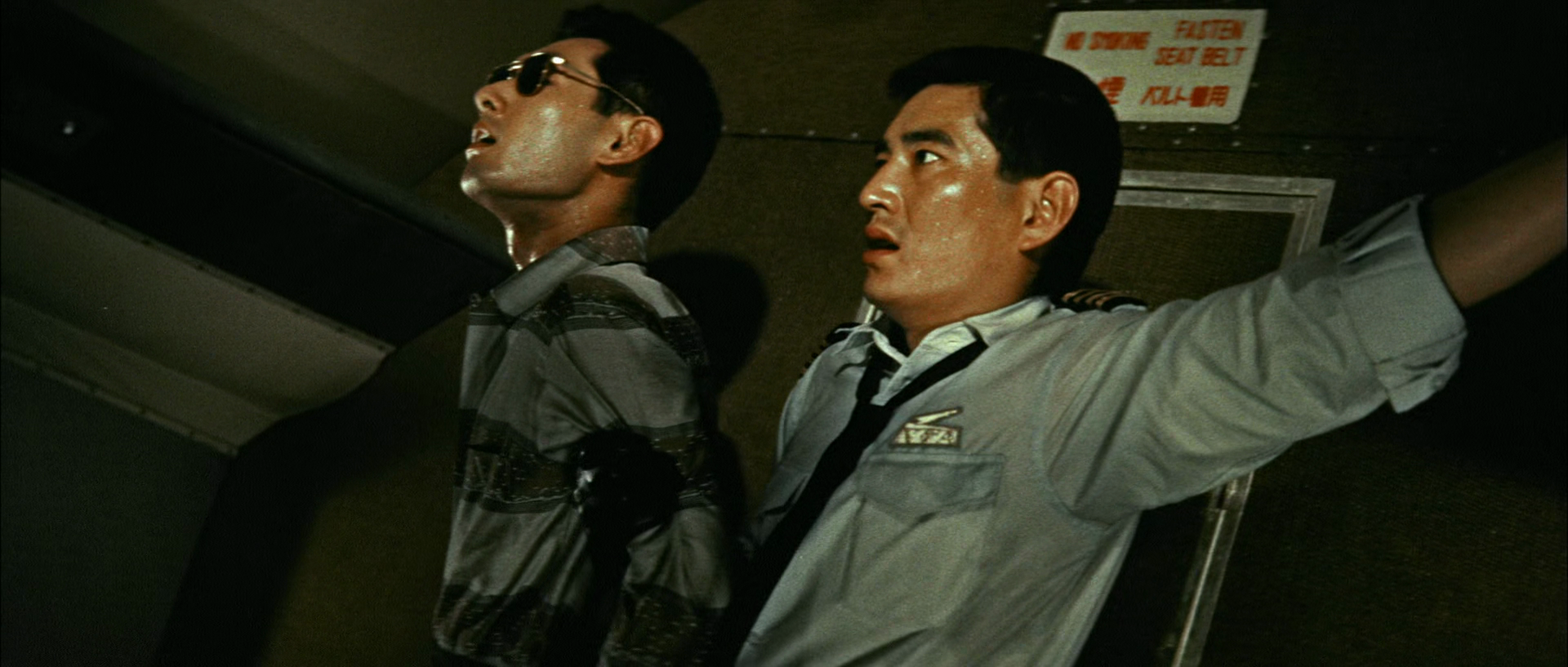
Kida (Fumitake Omura), the fugitive, is dressed like a stereotypical yakuza which makes it odd that no one treats him with suspicion until they spot he’s carrying a gun which he had no trouble at all bringing on board. Though hijackings are not exactly unheard of, they aren’t particularly common either so no one would really suppose anyone had any reason to take a domestic flight to the provinces hostage, and really that was never Kida’s intention merely a last resort after being discovered. Later he gives a partial justification for his life of crime in that his mother beat him and then threw him off a cliff which is why he has a false leg. In any case, there’s a small moment of potential redemption towards the end when the kindly old lady tells him he can’t undo what he’s done, but could still resolve to change assuming they all survive this difficult situation with the plane which now has mechanical problems thanks to the gun going off. 

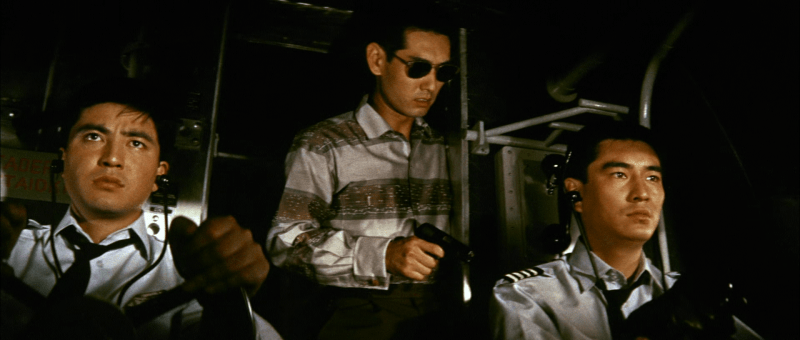
Even so, it’s the passengers who tie Kida up after the pilot ,Yamamoto (Ken Takakura), manages to disarm him by weaponising the plane. By flying to a high altitude, they knock him out with the air pressure, but are then faced with the mechanical failure of the landing gear which seems to be linked to with Yamamoto’s wartime trauma. A secondary drama revolves around his stoical character with one of the stewardesses apparently in love with him while simultaneously wary of his iciness given that he apparently showed no emotion after receiving the news his wife had passed away but simply flew the plane home as normal. Some see this as his devotion to the aircraft which is in a way a commitment to his duty over his human feelings, the factor that perhaps allows him to save the plane and get the passengers home safely. He is however saved by his love for his late wife with the cigarette case that contains her photo saving him from the worst effects of a bullet. 

The same may go for the co-pilot Hara (Kenji Imai) who is dragging his feet over his marriage to Yamamoto’s sister because he wants to achieve 3000 flight hours before getting married so he can call himself a real pilot. Though the film plants the seeds of these random plot threads and the social commentary that goes with them, it does not particularly engage while the hijacking itself remains fairly low key given that Kida is not a particularly “bad” bad guy. He just wants to go to a random place where the police won’t be waiting for him, but otherwise refrains from harassing the passengers save threatening a little boy travelling on his own to return to his parents after visiting his grandfather in Tokyo. In essence, there’s a kind of innocence and naivety in play which speaks to something of post-war hopefulness and a wonder in the frantic pace of progress in which the day is saved by keeping calm and carrying on even in the face of severe adversity.


Trailer (no subtitles)

Cantankerous Edo (大江戸喧嘩纏, Kiyoshi Saeki, 1957)

A noble-hearted samurai on the run falls for a fireman’s sister in Kiyoshi Saeki’s hugely enjoyable jidaigeki musical adventure Cantankerous Edo (大江戸喧嘩纏, Oedo Kenka Matoi). Another vehicle for Hibari Misora and samurai movie star Hashizo Okawa, Saeki’s wholesome drama finds its heroes not only standing up to the oppressions of a rigid class system but also taking on a bunch of entitled sumo wrestlers intent on throwing their weight around having apparently lost sight of the tenets of traditional sumo wrestling such as fighting for justice and having a kind heart. 

To begin at the beginning, however, young samurai Shinzaburo (Hashizo Okawa) is on the run believing that he has accidentally killed another man who attacked him in order to clear the path towards his fiancée, Otae (Hiroko Sakuramachi), whom he wasn’t going to marry anyway because he realised she was in love with someone else and wanted to help marry him instead. Having escaped to Edo, he takes refuge inside a parade of firemen lead by Tatsugoro (Ryutaro Otomo) and his feisty sister Oyuki (Hibari Misora) who decide to take him in after hearing his story. Adopting the simpler, common name of “Shinza” he begins life as a fireman and gradually falls for Oyuki but remains a wanted man constantly dodging the attentions of his uncle, the local inquisitor, and the magistrates. 

More a vehicle for Okawa than Misora who plays a relatively subdued role save for boldly stealing the standard and climbing a roof herself when the others are delayed, Cantankerous Edo takes aim not particularly at a corrupt social order but of the oppressive nature of class divisions as Shinza discovers a sense of freedom and possibility he was previously denied as a samurai while living as a common man. It’s this desire for personal autonomy and the freedom to follow one’s heart that led to his exile from his clan, unwilling to marry a woman he knew not only did not love him but in fact loved someone else and would have been forever miserable if forced to marry him out of duty alone. “The life of a samurai who has to be somebody or not to suit another’s convenience is utterly stupid” he bluntly tells his uncle and Otae’s father, “how you cling onto family status, heritage, and honour. All that fuss, I hate it.” he adds before turning to Otae and encouraging her too to stand up to her father and insist on marrying the man she loves rather than be traded to another. 

Meanwhile, the two women exchange some contradictory messages about the nature of class and womanhood, the samurai lady Otae confessing that she isn’t sure she’s strong enough to fight for love in the face of tradition and filial duty in contrast to Oyuki’s spirited defence of Shinza the fireman insisting that firemen don’t think about such trivial things as name or family status before throwing themselves into harm’s way for the public good. “All women are weak” Otae sighs, Oyuki replying that they need to be strong for the men they love, “that’s what it means to be a woman”. Love may be in this sense a force of liberation, destabilising the social order but also a means of improving it, yet it still reduces women to a supporting role ironically as perhaps the film does to Misora who in contrast to some of her feistier performances takes something of a back seat. 

Romance aside, the main drama revolves around a conflict between the local sumo wrestlers who have turned into thuggish louts under their boorish leader Yotsuguruma (Nakajiro Tomita), taking against the fireman and forever spoiling for a fight. The samurai proving unexpectedly understanding, the sumo wrestlers become the main source of oppression in usurping a class status they don’t really have. The noble Tatusgoro tries to stave off the fight insisting that they aren’t brawling yakuza but responsible firemen here to serve the public good and should save their energy for fighting fires rather than their obnoxious neighbours. Nevertheless the fight cannot be held off forever. Tatsugoro is forced to redefine the nature of “fire” after hearing a warning bell informing him one of his men is in grave danger unable to manage their anger anymore.  

Saeki’s jidaigeki musical has surprisingly good production values for a Toei programmer, making space for a few songs along the way celebrating the valour of the firemen while Oyuki meditates on her potentially impossible romance and the perils of love across the class divide. While the conclusion may end up ironically reinforcing the hierarchical society, it does however make the case for the right to romantic freedom along with the necessity of human compassion in the face of inconsiderate arrogance and intimidation.


Note: This film is sometimes titled “Fight Festival in Edo” but according to Eirin’s database, the official English-language title is “Cantankerous Edo”. Rather confusingly, a very similar film with a very similar title (大江戸喧嘩まつり) was produced in colour at Toei in 1961 and is known as “Fight Festival in Edo” in English. Meanwhile, Hibari Misora also starred in another colour film with a very similar storyline in 1958 (唄祭りかんざし纏) which is known as “Girl with the Fire Banner” in English but listed as “Festival of Song” on Eirin’s database.

Three Sisters with Maiden Hearts (乙女ごころ三人姉妹, Mikio Naruse, 1935)

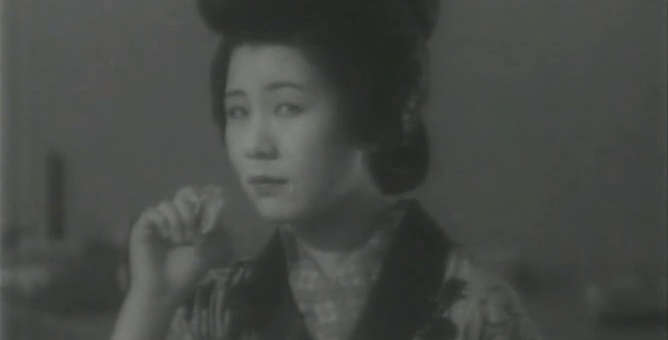
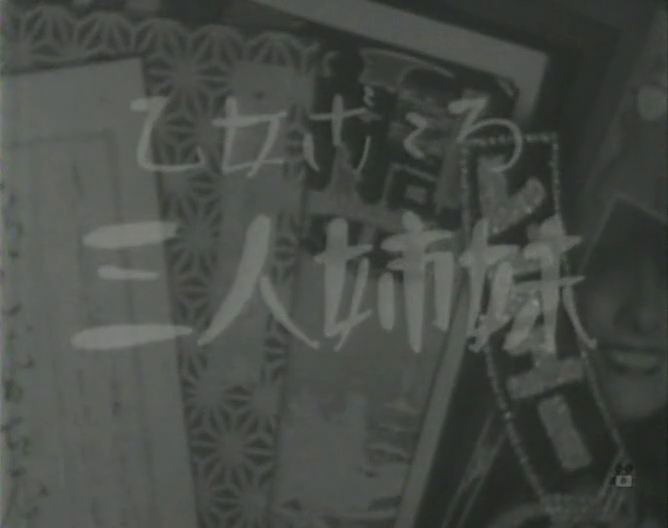
Three sisters with maiden heart title card“From the youngest age, I have thought that the world we live in betrays us” Mikio Naruse is often quoted as saying, and it’s certainly an idea which informs much of his filmmaking. 1935’s Three Sisters with Maiden Hearts (乙女ごころ三人姉妹, Otome-gokoro  Sannin-shimai), adapted from a short story by Yasunari Kawabata, is indeed a tale of the world’s cruelty as its saintly heroine attempts to escape her austere mother’s icy grip through kindness alone but finds her efforts frustrated by the world in which she lives.

Osome (Masako Tsutsumi) is the middle of three sisters raised by a cold woman (Chitose Hayashi) who forced her daughters to earn their keep by playing the shamisen on the streets of Asakusa. Oldest daughter Oren (Chikako Hosokawa) left the family some time ago after falling in love with a salaryman and hasn’t been heard from since, and while Osome is still expected to ply her trade, youngest daughter Chieko (Ryuko Umezono) has been spared, becoming a “modern girl” currently working as a dancer in a revue. Unbeknownst to her family, Chieko has also got a boyfriend – the handsome and seemingly quite wealthy Aoyama (Heihachiro Okawa) who runs into Osome by chance in the street and offers her a handkerchief to help fix her broken geta. This is not the story of a love triangle, however, so much as cruel fate accidentally bringing the sisters back together through a shared destiny.

While Chieko idly muses that it might have been better if her mother had opted for group suicide (joking with her lover about dying together as was apparently a fad at the time), Osome tearfully asks her to “please accept us as we are” but her pleas largely fall on deaf ears. Having taken in a series of apprentices, Osome’s mother continues to treat them cruelly, berating them for not picking up the shamisen, and insisting on “discipline” when she discovers one of the girls has had the temerity to buy a magazine with some of the money she herself has earned. Osome, in a characteristic act of kindness, insists she bought the magazine as a morale booster only to receive her mother’s scorn. “I put so much effort into raising you, but you still haven’t become people who’ll give an honest day’s work” she complains, commodifying them once again. “You don’t know how much easier it would be to go out and earn money myself”, she adds unconvincingly, telling her daughter she can always leave if she doesn’t like it despite having irritatedly complained about Chieko’s increasingly late return home and the possibility she may leave just like Oren did.

As Osome tells us, she and her sister were forced to play the shamisen in unsavoury Asakusa from only eight years old. As they got older, Osome was worried about the attention Oren seemed to be getting from “rough” men in the streets. Eventually Oren stopped carrying her shamisen at all and fell in with a bad crowd, only escaping when she met her husband Kosugi (Osamu Takizawa). Kosugi, however, is ill with TB and finding it difficult to hold down a job. Increasingly jealous and paranoid, he is afraid Oren will hook up with her old gangster friends and fall back into bad habits. Meanwhile, Osome is still playing her shamisen and putting up with rough treatment from the drunken clientele who sometimes try to manhandle her or make unreasonable requests. An irritated bar owner eventually knocks on a record to drown her out as if signalling her impending obsolesce.

Nevertheless, the older two sisters have largely remained traditional. Oren’s fall into the gangster underworld is signalled by a sighting of her in Western clothes, looking like a well to do young lady as Osome puts it, but once with Kosugi she soon reverts to kimono and fully embraces the role of a conventional housewife supporting her husband with all her strength. Chieko, however, is a “modern girl”, dancing in a nightclub revue and dressing exclusively in Western fashions. Some horrible boys who make a point of singing the rather vulgar song back at the girls through the window yell “modern girl” at her in the street, indicating just how shocking and unconventional her appearance was back in 1935 even in the backstreets of Asakusa. Nevertheless, Chieko appears to have found a satisfying romance with a “modern boy” in Aoyama who dresses in suits and seems to have a bit of money but is undeterred by a possible class difference and just as nice as his potential sister-in-law.

Despite Osome’s attempts to reunite the sisters, fate conspires against her. Oren hooks back up with her lowlife friends who use her in a plot to extort Aoyama while she remains completely unaware that she’s targeting her sister’s young man. Osome tries to tries to stop them but is stabbed by thugs in the process and, figuring out what’s happened, keeps Aoyama and Chieko away from the station where she has arranged to bid Oren goodbye on the last train out of Ueno. Poignantly, Oren seems happy that her sister has found someone nice, saying that she’d have liked to meet him still unaware she already has. The sisters know they likely won’t meet again, and Osome is content only in knowing that in theory at least she has saved the memory of the bond they once shared through preventing Oren’s involvement in the incident with Aoyama from coming to light.

Osome’s kindness is her undoing. Her world betrays her, she is simply too good, too pure-hearted to be able to survive in it. The three sisters struggle to overcome neglectful parenting, but their mother has at least survived if unhappily, suggesting the world is kinder to those whose hearts are colder. Oren and Chieko go their separate ways, into the past (on a train) and the future (by car), but Osome remains stubbornly in the waiting room with only the inevitable awaiting her.


Hibari Ohako: Ojo Kichisa (ひばり十八番お嬢吉三, Yasushi Sasaki, 1960)

Ojo Kichisa still 1Following Benten Kozo, Ojo Kichisa (ひばり十八番お嬢吉三, Hibari Obako Ojo Kichisa) is the second in a small series of movies starring Hibari Misora in a tale adapted from a well known kabuki play and featuring a cross dressing hero/heroine. This time around Misora plays a young woman dressing as a man for the purposes of revenge who eventually meets up with two men sharing the same “Kichisa” name – a lord (Obo), and a priest (Osho), to form a brotherhood of three including her “Ojo” as in “young lady”. Together they fight the injustices of the feudal world (which are myriad) whilst helping Ojo Kichisa get revenge on the men who murdered her parents forcing her into a precarious life of self preservation.

Beginning with Misora singing the title song of the three Kichisa, the action then switches to a small drinking house where a young woman gets herself into trouble with a bossy samurai who accuses her of spilling sake on him. Though the woman, Otose (Eiko Maruyama), apologises profusely, the samurai threatens to make her pay with her body. Fortunately Ojo Kichisa strides in and fights the samurai into submission, temporarily saving the day. Unfortunately, the samurai come back later brandishing a loan agreement Otose’s father had signed and demand immediate repayment or they will take Otose in its stead.

Once again the feudal world is one of intense unfairness and corruption in which the samurai class abuse their privilege to oppress the ordinary men and women of the Edo era. The samurai who takes such extreme offence at Otose’s possible slip-up has no real reason to do so other than expressing his superiority and once humiliated by Ojo Kichisa feels himself duty bound to double down. The samurai order looks after its own and so his underlings spring into motion to manipulate Otose’s family into giving her up. The two loan sharks gleefully celebrate their good luck, confessing that a major reason for lending money to the needy is for occasions such as this – not only for the interest but for the leverage in getting the desired outcome in ongoing schemes.

Meanwhile, there is a bigger game at play concerning the new finance minister and local governor. The governor accepts “gifts” from a shopkeeper hoping to be promoted onto the council whilst subtly hinting that more “gifts” might be an idea while he needs to be turning a blind eye to the smuggling that’s currently going on in town. Of course, the governor turns out to be involved in Ojo Kichisa’s mission too and is currently being blackmailed by an old acquaintance who once helped him steal a famous sword from its rightful owner.

Another of Misora’s frequent cross-dressing roles, Ojo Kichisa starts out as male but is later revealed to be female having adopted male dress to survive in male dominated Edo and pursue revenge on those who rendered her an orphan. After losing her parents, Ojo Kichisa and her young brother Sannosuke (Takehiko Kayama) were travelling in search of relatives when they were abducted by slave traders and separated. Presumably, both managed to escape at some point and have been living by their wits vowing revenge and reunification but apparently largely untouched by the darkness of feudal society.

The darkness is something which gets pushed into the background in this otherwise comedic tale of the little guy standing up to corrupt elites. The three Kichisas each represent various areas of society – the priest, the noble lord who hates the cruelty of his class, and the elegant lady, Ojo. Obo Kichisa (Tomisaburo Wakayama), the lord with a conscience, is committed to protecting the weak and fighting injustice everywhere he sees it, but it’s not long before pretty much everyone has decided the governor has to go thanks to his inherently corrupt approach to governing in which he’s all about take and never about give, neglecting the townspeople under his care and prioritising his personal gain.

Hibari Misora sings the title song twice – at the opening and closing, as well as another insert song but her brother Sannosuke also gets an opportunity to showcase his singing his voice in a mild departure from the star vehicle norm (actor Takehiko Kayama was also Misora’s real life brother). As in Benten Kozo, Wakayama takes on the bulk of the heroic fighting but Misora gives it her all in the many fight scenes in which she too gets to defeat injustice and rescue maidens to her heart’s content. A straightforward jidaigeki idol movie, Ojo Kichisa is unremarkable in many ways but nevertheless another entertaining example of Misora’s talent for playing ambiguous gender roles.