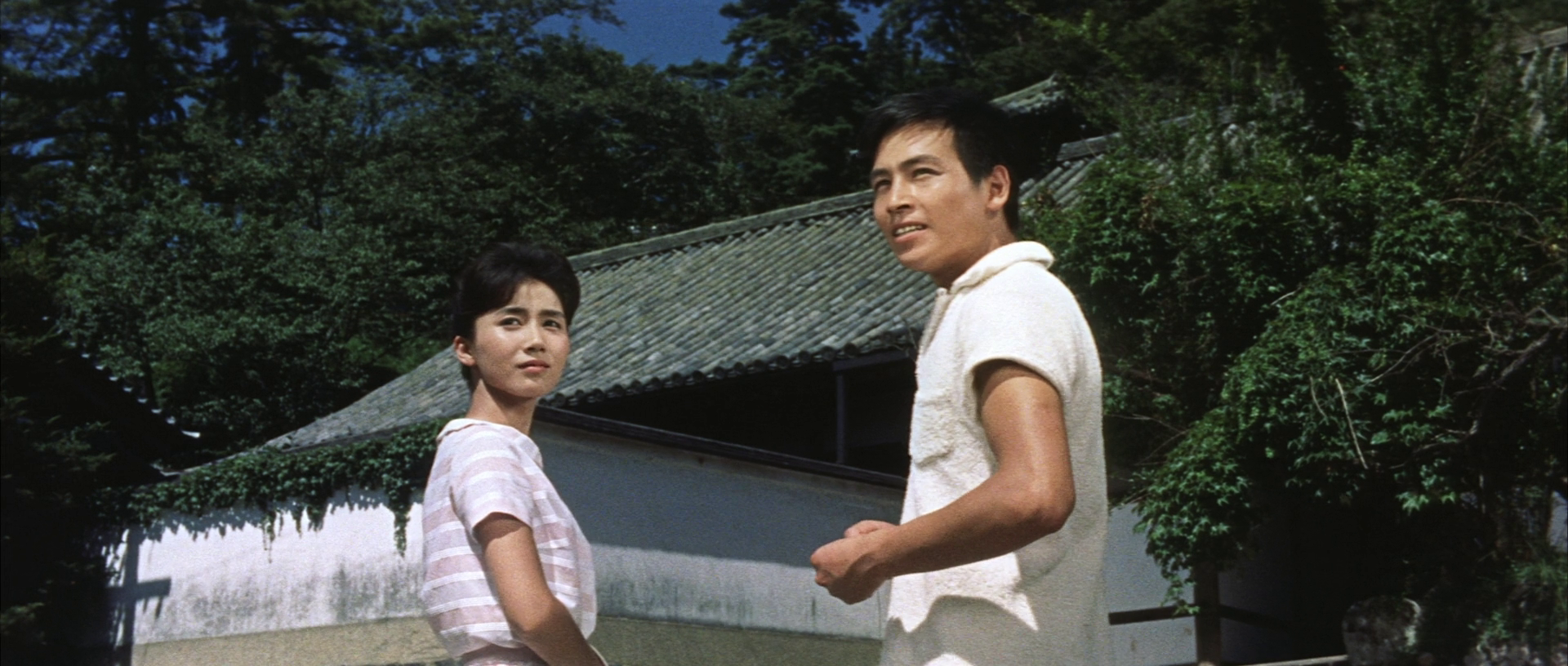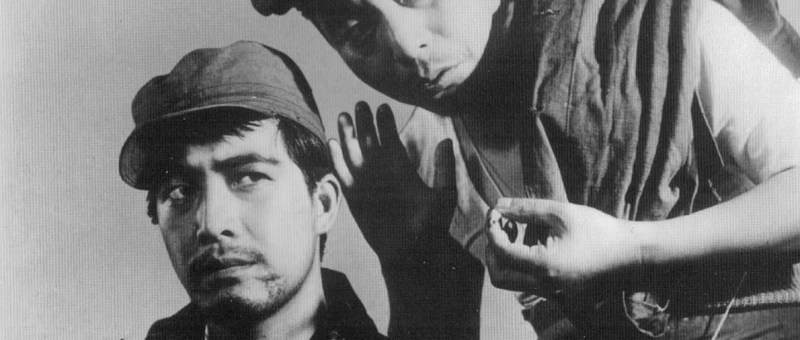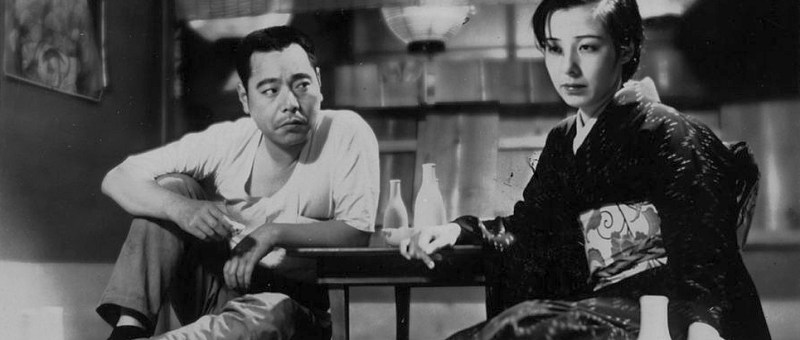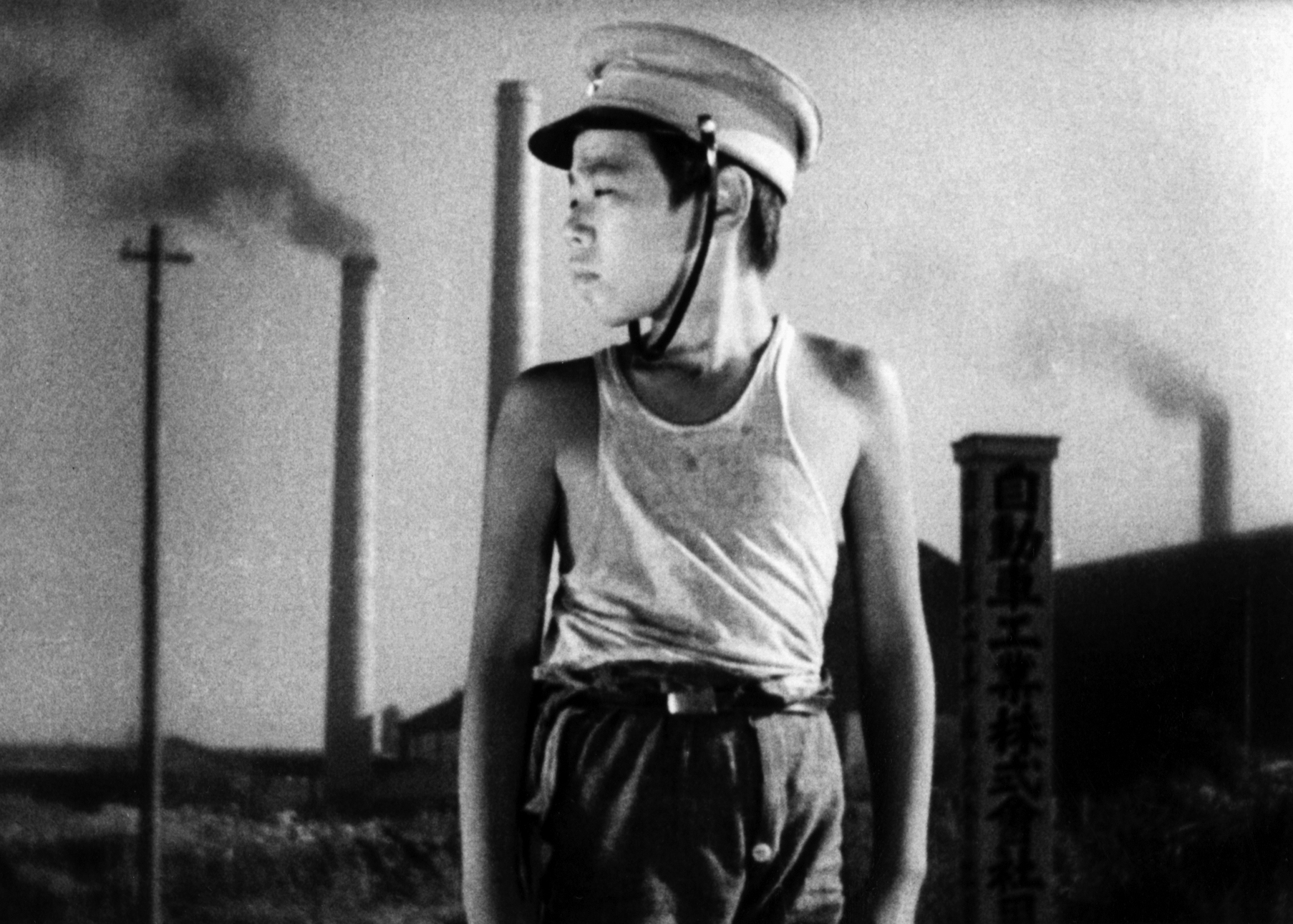
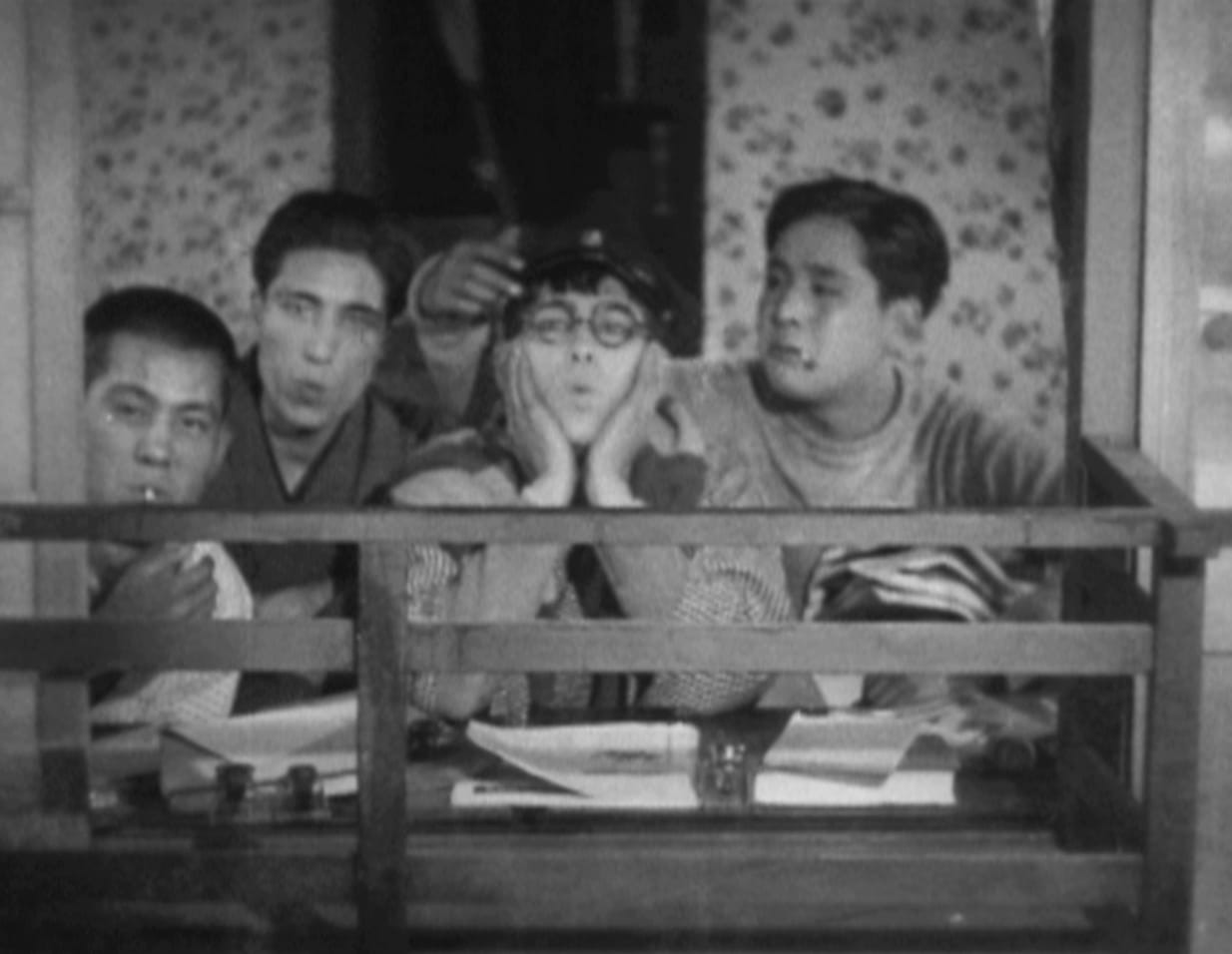
I Flunked, But… (落第はしたけれど, Yasujiro Ozu, 1930)

Yasujiro Ozu never went to college. By all accounts a poor student and rebellious young man, he took an early teaching position in a remote rural area precisely because it required no degree. Unsurprisingly, he didn’t last long in the job and eventually returned to Tokyo,  joining Shochiku as an assistant cameraman. Nevertheless, in his early career at the studio he found himself contributing to their popular brand of college comedies of which I Flunked But… (落第はしたけれど, Rakudai wa shitakeredo) is his third, directed when he was 26 years of age. 

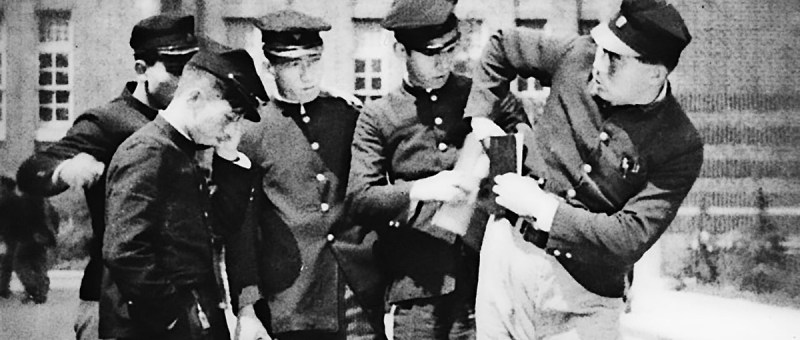
Drawing inspiration from Hollywood campus movies and in particular Harold Lloyd’s The Freshman as we can see from the various US state college pennants seen hanging throughout the film, I Flunked But… follows a group of young men preparing for their final exams. They are all excited about the idea of graduating into the adult world as symbolised by the neat business suits they have each bought in preparation for their new lives and few seem burdened by anxiety about a potentially precarious future as members of a generation stepping into a world of reduced economic potential and growing political instability. 

In fact they live the last days of their student lives to the full, greeting each other with silly dances, playing turntable roulette to decide who pays for dinner, and spending more time figuring out how to cheat on the exam than studying to pass it. There may be truth in the idea that passing exams is all about the knack, but our boys are overly invested in kicking back against the system rather than playing by its rules to get ahead. As the film opens, two students are arguing because one supposedly betrayed the other in promising to help him cheat and then not following through. Takahashi (Tatsuo Saito) is supposed to help his friends by wearing a shirt which has a cheat sheet scrawled on the back, but he oversleeps and the landlady swipes it for the laundryman. The others manage to scrape through on their own while Takahashi alone fails. 

The remainder of the film becomes a more melancholy mediation on the changing fortunes of Takahashi and his friends. Overcome with shame and disappointment, Takahashi is left out of the others’ cheerful graduation celebrations, left with the choice to drop out or repeat the year (amusingly, one of his perpetual failure friends appears to be much older, even middle-aged, and one wonders if he is a serial repeater). The suit he had bought is now a grim reminder of his defeated hopes, as is the tie his girlfriend (Kinuyo Tanaka) who works in the bakery next-door was making for him as a graduation present. He now feels unworthy of wearing it, a fraudulent human trapped in adolescence by embarrassing failure. The girlfriend, however, already knows all about it and reassures him that even if he has not graduated, he still has the right to wear his graduation suit. 

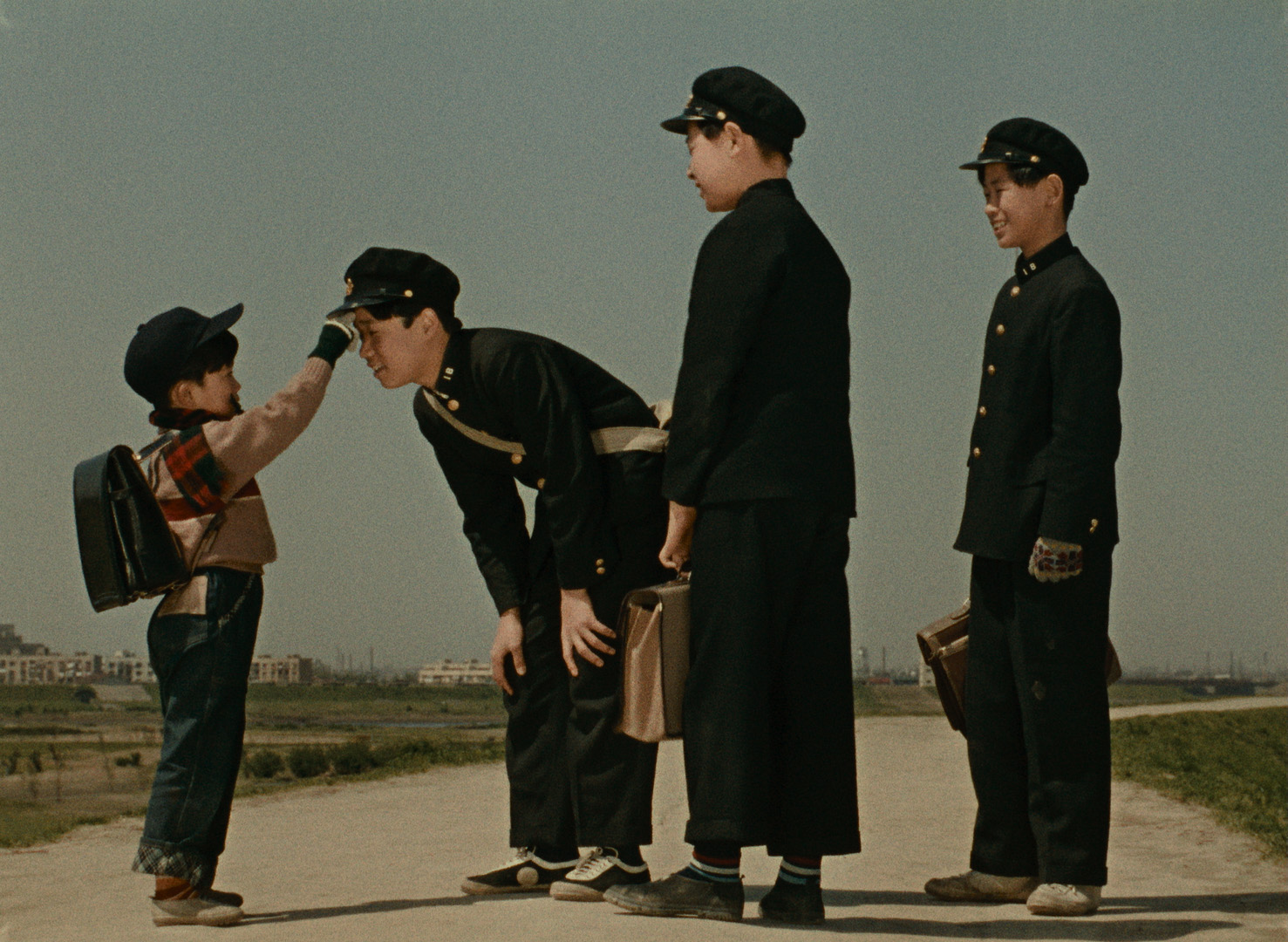
As time moves on, however, Takahashi realises that he might actually be the more fortunate. Still wearing his student uniform, he lives a carefree student life and is still receiving money for his upkeep which makes him the rich man among his dorm mates who are still living in the same rooms with him and have all had to pawn their graduation suits because there are no jobs for them to go to. “I heard it’s hard to get a job these days”, the girlfriend laments, and it’s clear the depression continues to bite. The college world was safe and easy. Takahashi carries on goofing off, silly dances and cheerleading the order of the day. In this sense at least, a perpetual childhood might not be so bad a thing. The graduates wistfully play with a student’s cap, wishing they could return to their carefree college days rather than stuck in their old dorm receiving nothing but rejection letters and hand outs from a slightly smug Takahashi. “If I’d known it would be like this I wouldn’t have graduated so hastefully” they lament. Maybe flunking is actually the smart choice, riding out economic instability until something better comes along. You might as well enjoy yourself while you can, Ozu seems to say, you’ll never have it so good again.
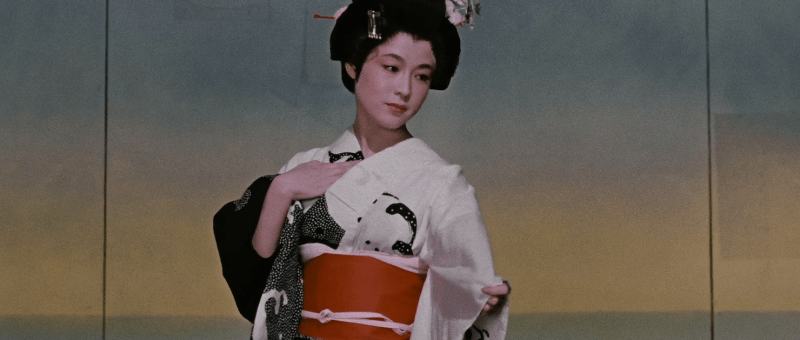
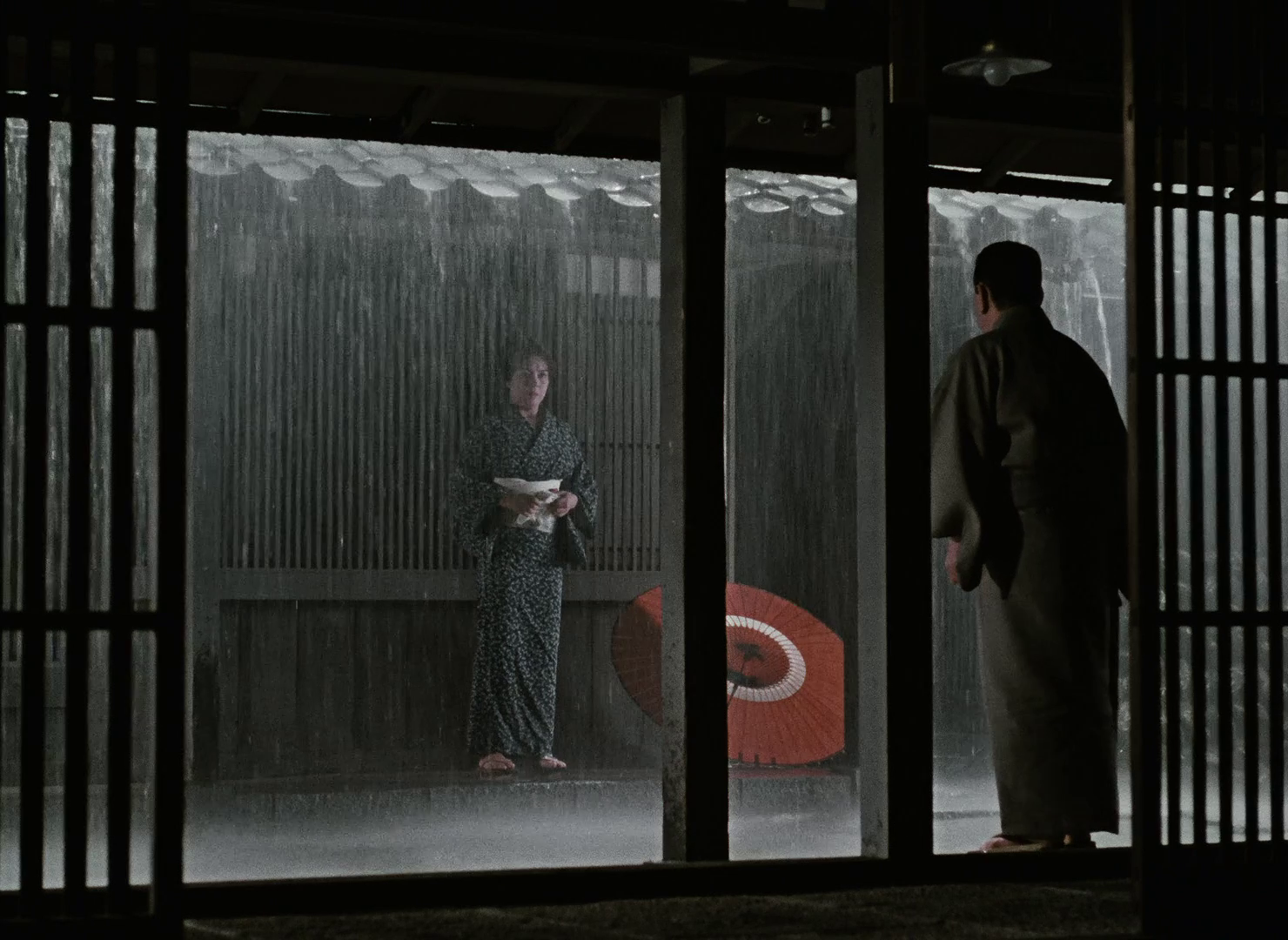
Floating Weeds (浮草, Yasujiro Ozu, 1959)

An oft-repeated criticism of the work of Yasujiro Ozu is that it is all the same. The similarity of the English-language titles with their ubiquitous seasonality doesn’t help, but you have to admit there is some truth in it. On closer inspection, however, it becomes clear that Ozu was not so interested in uniformity or repetition as he was in dialogue with himself. Thus Late Spring becomes Late Autumn and the abandoned father a conflicted mother, the two boys of I Was Born But… who rejected their father’s descent into corporate lackydom become arch consumerists seceding from society until their parents give them a TV set in Good Morning. Ozu refrained from remarking on the repurposing of old plots for new dramas, but did expressly regard his 1959 Floating Weeds as a “remake” of the 1934 A Story of Floating Weeds updated to the present day and filmed in the, by then, classic Ozu style. 

As in the 1934 version, the action centres on the arrival of a theatrical troupe to a small town which they have not visited in some years, in this case 12. This time around, the troupe is a little more exulted, performing kabuki-style narrative theatre rather than rustic entertainment, but is subject to many of the same problems. Kihachi is now Komajuro (Ganjiro Nakamura), a much older man though cheerful and energetic. He has chosen this town because it is home to an old flame, Oyoshi (Haruko Sugimura), who is the mother of his adolescent son, Kiyoshi (Hiroshi Kawaguchi). Kiyoshi thinks that Komajuro is his mother’s brother and that his father is long dead. He recognises Komajuro right away and is pleased to see him, though they evidently have not met in many years. 

The 1934 version had revolved around Kihachi’s corrupted paternity in his shame regarding the stigma of being a travelling player. By 1959 that is simply no longer so much of an issue, but whereas the financial difficulties Kihachi’s troupe faced were partly a symptom of the depression and partly of their misfortunes, those of Komajuro take on a more melancholy quality because it is obvious that this is a way of life which is coming to an end. When Kihachi says he’s going to start over, it seems futile but he is still young enough to have a credible chance. Komajuro is already “old” and it’s clear that he will struggle to support himself as a travelling actor simply because it is no longer a viable occupation. 

Thus Komajuro’s story is less one of frustrated fatherhood than of melancholy resignation to the vagaries of a lifetime. “Life is an unknown course”, he tells Oyoshi, “the only constant is change”. Like Kihachi he doesn’t want his son to see the show, though perhaps more out of embarrassment. Kiyoshi complains that the character in his play is “unrealistic” because he doesn’t relate to the modern world. Komajuro objects but explains that he is “a character from another era”, making it plain that he is talking as much about himself. Komajuro is a man left behind by time and incapable of understanding the world in which he now lives which may be one reason he seems to hang on to an intense desire to save Kiyoshi from being affected by the stigma of being the son of a travelling actor even though that is no longer something he would need saving from. 

This slight disconnect, along with Gajiro Nakamura’s cheekily comical performance, adds to the genial comedy which characterised the majority of Ozu’s colour films though this one is admittedly slightly less colourful owing to being produced by Daiei as one of a handful of films made outside Ozu’s home studio of Shochiku. Komajuro becomes a tragicomic rather than purely tragic figure, a man suddenly realising he has become old and facing the decline of his patriarchal authority. Like Kihachi he turns violence on both his mistress, Sumiko (Machiko Kyo), and the young actress Kayo (Ayako Wakao) who has fallen for his son, but it’s futile and born of desperation. A more sympathetic figure than 1934’s Otaka, Sumiko seems to genuinely like Komajuro and is hurt as well as jealous and threatened by the existence of his “secret” family. Her petty revenge is taken in response to Komajuro’s bitter claim that his son “belongs to a higher race” moments after bringing up her past as a sex worker. Rather than a simple desire for chaos and upset, she intends to pull Kiyoshi down to her level through getting him to sleep with Kayo, but Kayo falls for him for real only to worry she is perhaps ruining his bright future. 

“One can’t suddenly show up out of nowhere and assert one’s parental authority,” Komajuro eventually realises. His hopes are dashed by Kiyoshi’s relationship with Kayo not because of her proximity to the world of the travelling actor, but because he fears it means that Kiyoshi is just like him, an irresponsible womaniser. He wanted to save Kiyoshi as a means of saving himself, pushing his son into a more respectable world he had been unable to enter. Kiyoshi, however, rejects his sacrifice, describing his parents as “selfish” for keeping the secret all this time only to drop a bombshell now. He complains he’s been fine these 20 years and does not want or need a father beyond the one he already thought to be dead. Rather than the nobility Komajuro’s of paternal sacrifice, the focus is pulled back towards the son and his filial responsibility to live up to it by becoming a fine and upstanding young man while Komajuro is once again exiled back to the moribund world of the travelling actor. 

Of course, the world of 1959 was very different to that of 1934. The economy was at last improving and consumerist pleasures were very much on the horizon, meaning that for many life was comfortable at last. Japan was at peace if not completely free of political strife which removes the constant anxiety felt by those trying to survive the mid-1930s. But Ozu himself was also 25 years older and had perhaps reached that sense of resignation with the world that allowed him to sigh and laugh where before he may have trembled with fear or rage. Komajuro is as he always was, a floating weed, a man without a home, but now perhaps one of many rootless wanderers off the post-war landscape.


A Good Man, A Good Day (好人好日, Minoru Shibuya, 1961)

It’s funny, in a way, that life can hold so much goodness in it even with an underlying, barely visible melancholy. Goodness does indeed breed goodness for the sometimes misunderstood heroes of A Good Man, a Good Day (好人好日, Kojin Kojitsu) who struggle to adjust themselves to changing times but at the end of the day just want each other to be happy and for life to be blissfully dull and free of complication.

The obvious point of friction is that 20-something daughter Tokiko (Shima Iwashita) has had a proposal. She behaves as if it’s an arranged marriage, but in reality Ryuji (Yusuke Kawazu) is actually her boyfriend and the two of them have mutually decided to formalise their union but are doing things the “proper” way perhaps in part because Ryuji’s family run a 200-year-old ink shop and are intensely conservative. Though it’s Tokiko’s fuddy-duddy professor father Hitoshi (Chishu Ryu) who is often regarded as the sticking point, it’s equally Ryuji’s family and particularly his traditionalist grandmother (Tanie Kitabayashi) who isn’t sure that Tokiko is really good enough. She is however the only member of the family who thinks it’s not a big deal after discovering that Tokiko is adopted while others regard her with an increased suspicion and the prejudice often held towards orphans that they don’t want to let someone into their family whose familial lineage they don’t know.

It’s most likely for their benefit that Tokiko and Ryuji are intent on compromising by doing everything the “proper” way rather than as her mother Setsuko (Chikage Awashima) tells her just get married on their own without worrying about what anyone thinks. But in this awkward mix of tradition and modernity we can see that times have changed and Ryuji and Tokiko have decided their future for themselves. They firmly believe it will work out so they’re remaining patient, but should that patience run out they will decide to prioritise their own happiness. 

For his part, Hitoshi later says that he never actually objected to the marriage but just hates the idea of big weddings which he regards, not without reason, as stupid and pointless. In any case he warms to Ryuji when he loses his temper and calls him an “old fart,” realising that he’s a young man with a backbone and possibly worthy of Tokiko. A professor of mathematics, Hitoshi is an awkward man who doesn’t quite fit into polite society but has a good heart even if he has a funny way of showing it. When he wins an important medal from the government for his contribution to scholarship and it gets stolen, he won’t let the hotel owner report it because of his embarrassment but when the chastened thief brings it back he sends Tokiko after him with money for his train fare and a little more as a thank you. 

Still, he was probably not an easy man to live with and Setsuko’s not so secret sake habit is likely a result of the strain of dealing with him and his constant faux pas in the boredom of a rural life in which she says all she does is make pickles. But despite that, she still tells Tokiko that marriage is essential to a woman’s happiness if also encouraging her to fight for what she really wants. Tokiko is already doing just that, but has lingering doubts over her parentage and wants to know who her birth parents may have been partly out of curiosity but also a mild fear of the implications it may have. But what Hitoshi eventually tells her is that she is a war orphan which makes her a kind of everywoman and a symbol of the young, post-war generation which is making a break with the past. 

The film in fact includes a small satirical, anti-war sequence in which Hitoshi is accosted by a snooty nationalist who shouts out that he lacks “patriotism” for allowing the medal the emperor so generously gave him to be stolen. The man tells him he should face the direction of the Imperial Palace and apologise all which makes him look quite mad and paints Hitoshi as the figure of exasperated sanity. He also rejects contemporary consumerist culture in continuing to live like a student counting every last yen and rejecting the TV set Ryuji buys him because it would deprive him of going to the coffee shop to watch baseball games instead (though he does regret it later). In any case, Hitoshi’s guileless goodness does seem to ameliorate the world around him in making others, like the thief, want to live up to it as he, like Tokiko, defiantly does what he wants and though at times perhaps insensitive generally has his heart in the right place.


A Brother and His Younger Sister (兄とその妹, Yasujiro Shimazu, 1939)

A young man’s love of go ends up getting him into hot water at work in Yasujiro Shimazu’s surprisingly progressive shomingeki, A Brother and his Younger Sister (兄とその妹, Ani to Sono Imoto). It seems office politics might not have changed all that much in the last 80 years even if many other things have, but conversely the film seems to have more to say about the changing nature of gender roles and attitudes towards women in a time in which it was becoming possible for a woman to live a fully independent life. 

This window wouldn’t last very long and the situation largely reversed itself even amid the supposed equality enshrined in the post-war constitution, but Fumiko (Michiko Kuwano) at least has a well paying job as a secretary at a large company and consequently little desire to marry even at the comparatively late age of 24. Her earning capacity is later put forward as a reason that there “aren’t many opportunities” for marriage as men apparently feel threatened and embarrassed especially if their salary is lower than hers. It’s not exactly that she’s against marriage, but as she can support herself and is otherwise happy living with her brother Keisuke (Shin Saburi) and his wife Akiko (Kuniko Miyake). She doesn’t see the need to rush into such an important decision. Though she might change her mind if the right person came along, for the moment she just isn’t interested. Then again, Akiko’s sucking of her finger when she’s ironically cut by a thorn on a bouquet of roses from an unwanted admirer might suggest another reason marriage is not on her radar.

Her suitor, Michio (Ken Uehara), despite his handsomeness is a little creepy in his courtship and cannot seem to take a hint that Fumiko isn’t interested in him. A friend of her boss, he has a habit of dropping into the office for no real reason and attempts to ask her out when the boss isn’t there. She lies and tells him she’s married already (to a penniless painter!) but after the boss reveals the truth it doesn’t seem to occur to Michio that if she made up a story like that it’s because she doesn’t want to go out with him. We’re told that Michio studied at Oxford and is attracted to Fumiko because he’s impressed by her language skills, but he’s also some kind of stockbroker which quickly paints him as no good seeing as the film seems to have a minor message about how dabbling in stocks and shares is little better than gambling and definitely dangerous.

One of Keisuke’s colleagues has been given a warning because there’s a rumour that he’s into shares while another has apparently been demoted because it came to light that he had a fondness for horse racing. More than a moral judgement, it seems the reason is that these sorts of hobbies may eventually lead someone towards embezzling from the company to cover their debts. Keisuke’s supervisor is also worried that his 18-year-old son is refusing to go to university and apparently wants to join some kind of “investment society” which admittedly does not sound like a good idea so he wants Keisuke to talk him out of it. The big boss, meanwhile, who is also Michio’s uncle, turns out to be into shares himself which makes him a very compromised authority figure. 

Keisuke is not into shares, but he is very into the game of go which causes him to stay out until late at night playing with his bosses. He does this because he genuinely likes playing, but Fumiko worries that his colleagues will come to resent him assuming that he does so to curry favour. Apparently, something similar happened at his previous job which is why he ended up quitting abruptly. As he was quite lucky to get this one despite how impressed everyone seems by his capabilities, it would be better if that didn’t happen again. Nevertheless, the perspicacious Fumiko turns out to be right as as his co-worker Yukito (Reikichi Kawamura) becomes increasingly jealous of his success fearing that he will leapfrog him to take the shortly to open up supervisor position which he believes to be his simply because he’s been there longer (which is generally how things work at Japanese companies). Consequently, starts a series of rumours that Keisuke is a snitch who got the horse racing guy demoted and is only in his position thanks to schmoozing with the bosses.

This obviously leaves him with a huge dilemma when his boss asks him to put in a good word for Michio with Fumiko whom he is pretty sure won’t be interested. To his credit, Keisuke maintains that it’s up to her and his career is nowhere near as important as her happiness though he is also aware it’s going to be embarrassing for him when she says no. Fumiko knows this too, and it’s clear that she also feels incredibly awkward when he puts it to her but only asks for a few minutes to think before offering her primary justification for refusing which would be that she fears Keisuke’s colleagues will resent him even more if they come to the conclusion that he sold his own sister in the hope of career advancement. This does in fact turn out to be the case as Yukito has already started a rumour about a dynastic marriage that turns the rest of Keisuke’s colleagues against him especially as he’s given the promotion immediately before he was going to tell the boss Fumiko isn’t interested. 

Confronted by the horse racing guy, Keisuke ends up quitting again after getting into a physical confrontation with a seemingly remorseful Yukito who probably didn’t mean for it to go that far. Keisuke quits because he won’t have people think he was gossiping behind their backs and is offended by this attack on his integrity, but his decision is also a rebuke against this infinitely corrupt employment regime in which hypocritical bosses hand out jobs to their favourites and maybe do expect that Keisuke will persuade his sister to sacrifice herself for his career. She meanwhile is portrayed as an independent woman, but ironically rejects the marriage to save her brother’s reputation though perhaps equally she feared her “no” would not be enough on its own. Then again, she had apparently turned down several suitors already and no one really expected her to say yes this time unless she’d suddenly begun to feel anxious about her age and declining prospects. 

Nevertheless, it’s refreshing that the film does not force Fumiko into accepting marriage as so many others would and in fact legitimises her opposition to it and right to live as an independent woman for as long as she chooses. Keisuke is also in some ways rewarded for quitting his job at the corrupt company in immediately getting another one from a former co-worker who’s since started his own business and wants to expand to Manchuria. But this final scene almost seems tacked on for the censor’s benefit. It is perhaps a little unusual for 1939 that the film has so far made no mention of Japan’s imperial ambitions nor made any kind of patriotic appeal. It’s even been quite pro-internationalist in the talk of people speaking English and engaging in European trade (even if the currency trading Michio’s doing is definitely framed as bad). Fumiko spots a little patch of grass clinging onto the plane as they take off for Manchuria with Keisuke remarking that he hopes this little piece of Japan will take root on the continent. On one level, it suggests that contemporary Japan was too corrupt for an “honest” man like Keisuke to prosper while Manchuria will offer greater freedom for himself and the independent modern girl Fumiko (who declares she won’t marry until Keisuke’s successful), but it’s also of course an unpalatable advocation for the ongoing imperialist expansion which seems so out of keeping with everything that’s gone before. Even so, the message is clear that it’s Keisuke and Fumiko who are in the right and should be allowed to live just as they are in a society free of judgement and hypocrisy.


Passing Fancy (出来ごころ, Yasujiro Ozu, 1933)

“We have to help one another” a sympathetic soul insists towards the conclusion of Yasujiro Ozu’s Passing Fancy (出来ごころ, Dekigoroko). Ozu’s depression-era silents are not as devoid of hope as it might at first seem, but it is a much more positive statement and perhaps surprisingly the central messages lie more in the necessity or otherwise of repaying kindness and the kinds of forms that action may finally take. It is also, however, the first in a loose trilogy of films revolving around a single father named “Kihachi” and the only one in which he is not (at least potentially) exiled from the family he has been trying to protect. 

This Kihachi (Takeshi Sakamoto) has one young son, Tomio (Tokkan Kozo, AKA Tomio Aoki), and casual job working in a brewery though he is hardly a model employee and is often late due to oversleeping after a night of heavy drinking. A roguish womaniser, he is also a kinder soul than he seems which is why he stops to talk to a pretty young woman, Harue (Nobuko Fushimi), wandering around in distress late in the evening. His first approach is slightly crass, responding to her question about lodging for the night by explaining that he has a kid and no wife but then he takes her to a local cafe he frequents and persuades the owner, Otome (Choko Iida), to take her in. Otome takes a liking to her, and decides to offer her a job as a waitress. 

Kihachi develops a hopeless crush, comically dolling himself up in his fanciest kimono and getting an advance from work to buy a pretty comb, an unmistakably romantic gift, to present himself to Harue. Of course, she’s grateful but sees him as a nice older gentleman rather than a potential husband. In fact and somewhat surprisingly she develops a crush of her own on the brooding Jiro (Den Obinata) despite the fact he is constantly rude to her and more or less implies she’s an untrustworthy woman out to take advantage of “vulnerable” men like himself. There is something quite touching and unusual in the brotherly friendship between the two men that occasionally comes off as something more in Jiro’s deep antipathy to Harue, which is to say she isn’t going to come between them but the situation is indeed complicated. 

Harue is, in that sense, a distraction that takes Kihachi’s eyes off his proper role as responsible father. He and Tomio have a close, interdependent relationship and it’s clear that it’s often little Tomio, older than his years, who finds himself managing Dad. Kihachi is immensely proud of his son, fond of saying he’d be top of his class if only he had better manners. Like any father what he most wants for him is that he escape their life of poverty which is why he’s so glad that the boy does well at school. But little Tomio finds himself bullied precisely because of Kihachi’s lack of standing. The other boys mock his illiteracy, unable to believe a man could reach adulthood without being able to read. When his son is taken ill, Kihachi laments circumstances even more. “It’s horrible not having an education”, he tells Jiro, “I got my son sick and I can’t even pay the doctor’s bill”.

The depression may be less visible than in Ozu’s other ‘30s films, but its evidence is everywhere. Harue ends up on the streets after losing her job at a silk mill and having no family to fall back on. At the naniwabushi performance which opens the show, a series of spectators hopefully open a lost wallet but find it empty. Kihachi notices the discarded purse is slightly bigger than his own and makes a swap as a hopeful investment for the future. Just before the performance ends, several of the guests seem to be plagued by fleas. Kihachi is forever asking for advances for frivolous reasons but assumes he’ll be able to manage hand to mouth only to enter a moment of crisis when hit by the unexpected expenses of his son’s illness for which he feels responsible in attributing it to an excess of luxury after giving a him a pocket money bonus which he unwisely blew in one go on sweets (like father, like son after all). 

Yet what shines through is compassion and camaraderie. A friendly barber loans Jiro the money for a doctor, which is one reason he intends to leave for Hokkaido even after realising his feelings for Harue. As with the other Kihachis, this Kihachi rediscovers a sense of fatherly duty in feeling as if this debt must be his, that he should be the one to go to Hokkaido to repay it even if that means leaving his son behind. The barber tells him not to bother, the sentiment is enough for him and he doesn’t mind missing the money knowing it saved a boy’s life. “We have to help one another”, kindness doesn’t necessarily have to be repaid directly but can be paid forward in becoming a way of life. The Kihachis of A Story of Floating Weeds and An Inn in Tokyo are exiled from their families and serve their sons only by abandoning them, but this Kihachi turns back, his sense of “responsibility” perhaps a “passing fancy” but one that’s taught him the true meaning of fatherhood and what it is to live in a society.


An Inn in Tokyo (東京の宿, Yasujiro Ozu, 1935)

Yasujiro Ozu was perhaps most at home in the genial world of the shomingeki in which everyone is comfortable enough and the problems, such as they are, are emotional rather than practical. He was also, however, an exacting chronicler of his times and unafraid, even in the tightening world of 1935, to explore life on the margins of a society on the brink of crisis. A proto-neorealist take on depression-era fatherhood, An Inn in Tokyo (東京の宿, Tokyo no Yado) finds that there are good people everywhere, but also that people can be good and make bad decisions even in their goodness. 

Kihachi (Takeshi Sakamoto), a widowed father of two boys, is unemployed and looking for work. He tells the guard at a factory that he is a skilled lathe operator, but the man doesn’t even look up from his paper as he unsympathetically tells him to be on his way. Remaining polite, Kihachi thanks him for his time and returns to his sons who are obviously disappointed and mildly irritated by the “mean” guard. The boys look on sadly as other children go off to school and tell their dad they aren’t hungry because they know he has no money for food and do not want to depress him further after being turned down for yet another job. 

We don’t know exactly what landed Kihachi in the circumstances he’s currently in, what happened to his wife, or why he lost his last job but we can probably guess the economic depression is to blame for most of it. The guard at the factory ignores him because he has no work to give and perhaps Kihachi isn’t the first to ask. The small family has been lodging at the titular “inn”, sleeping in a communal room while their resources dwindle. After losing all their possessions, they face the choice of whether to go for dinner and sleep in a field or go hungry and return to the inn. They opt for food, only for the heavens to open, but on this occasion rain is perhaps their salvation because it enables them to run into an old friend, Tsune (Choko Iida), who is able to put them up for a while and help Kihachi find work. 

Meanwhile, on the road the family bumps into a widow and her daughter who are in much the same situation only, as must be obvious, hers is much more serious because if Kihachi cannot find honest work then it may be near impossible for a woman with a child. Mrs. Otaka (Yoshiko Okada) and her daughter Kimiko are staying in the same inn and the children quickly become friends. “Childhood is the best time of life” Kihachi wistfully laments as they watch the kids play, “Children are lovely”. Mrs. Otaka agrees that it’s difficult with a little girl, but that she also keeps her going. The boys too are resilient and positive, the oldest Zenko cheerfully insisting that everything will be alright tomorrow while his father’s attempt to comfort Mrs. Otaka with the claim that things work out in the end cannot help but ring hollow. 

Zenko is quite literally burdened by his father’s failure in that it is he who is expected to carry the small parcel which contains all of their worldly possessions. Later he tries to delegate the responsibility to his younger brother, an act which backfires causing the bundle to be lost. They try to help out by catching stray dogs they can turn in to the police for 40 yen as part of an anti-rabies drive, but they are also children and want what other children have which is why Zenko makes an irresponsible decision to spend the money from catching a dog on a fancy cap he took a liking to after seeing another boy at the inn wearing one. Kihachi is obviously displeased, catching a dog means they can eat and they don’t have money for frivolous things like caps but we hear from his old friend Tsune that he has his irresponsible sides too as evidenced by his longing for sake while the boys long only for wholesome meals rather than sweet treats.

Nevertheless Kichachi is a good man, as Mrs. Otaka later says. He takes a liking to the widow which might be somewhat insensitive to Tsune who has by this point taken him in and started to help him put his life back on track while taking care of the kids, but his desire to help her also has an unpleasantly conservative streak. On learning she’s taken a job at a bar he rants at her in disappointment, exclaiming that he didn’t think she was that sort of woman and wondering why she suffered so long only to finally give in to sex work. Her tearful justifications that her daughter is ill fail to move him. He tells her to quit the bar and get money some other way, which seems unrealistic and even more so in the absence of a good friend like Tsune, who seems to have made a decent life for herself as an independent woman, to miraculously sort everything out. He tries asking Tsune for money, but she worries he’s up to no good and doesn’t want to enable him messing up his life just as he’s getting himself sorted, and so he makes a terrible and frankly irresponsible decision which places his own children in jeopardy solely to “save” Mrs. Otaka from becoming a fallen woman. Leaving the women behind to pick up the pieces and take care of the children, he trudges off alone, a fugitive father exiled from his family and at the mercy of an increasingly indifferent society. 


Luminous Moss (ひかりごけ, Kei Kumai, 1992)

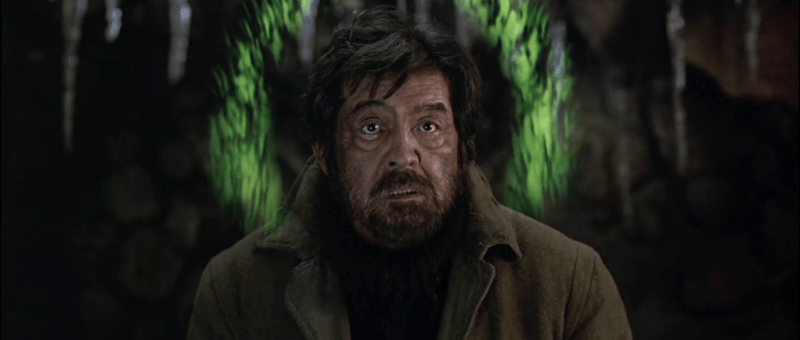
At the end of the increasing surreal trial which concludes the play within a play in Kei Kumai’s Luminous Moss (ひかりごけ, Hikarigoke), the protagonist turns to the people of the court and asks them to look at him. He wants to know if they see the ring of light around his head that looks like the luminescent plants inside the cave where he spent three months or so after being shipwrecked in the middle of the war. His plea is as much to ask what would you have done and if we can ever really judge him when we ourselves have never been faced with his dilemma.

It is however a dilemma many were faced with, and one tacitly suggested in other earlier films such as Kon Ichikawa’s Fires on the Plain though at that point too taboo and painful to address openly. In the framing sequence which bookends the film, an author visits a town in Northern Hokkaido in search of inspiration and is guided to a cave, now reachable by a roadway built after the war, where luminous moss grows. The man who takes him, a headmaster (Rentaro Mikuni), also tells him of an incident which took place there in which four shipwrecked men swam to shore and took refuge within the cave. Only the captain (also played by Rentaro Mikuni) survived, making a perilous trek across the ice a few months later when his food source depleted and he was left with no other choice.

The middle of the film is presented as a flashback, but actually the play the author is writing based on the investigations of the headmaster who says that he increasingly came to sympathise with the captain because of his own experiences as a prisoner of war in Siberia. Hachizo (Kunie Tanaka), a middle-aged father to a large family who refuses to eat the corpse of the first man to die, Gosuke (Tetta Sugimoto), because he promised him he wouldn’t, describes the captain as a “resourceful man” in both positive and negative senses of the word. He assumes the captain is already calculating when the current supply will run out, and when his own body will have consumed, leaving him with a dilemma about what to do next. The captain is in no real doubt about the necessity of eating Gosuke’s flesh and feels no guilt about it, after all he died of natural causes after consuming seawater and is now, in the captain’s view, simply meat so not eating him is just a pointless waste. Perhaps the situation would be different if he had killed him deliberately in order to eat him, but on the other hand it would not really be advantageous to do so given that the captain’s end goal is surviving until the end of the winter when it will be possible to return to the mainland. Thus he waits for his men to die and leaves the rest up to fate. 

The situation only comes to light when a wooden box is washed to shore containing the bones of Private Nishikawa (Eiji Okuda), whom the captain did actually kill but accidentally while he was trying to commit suicide so that the captain would not be able to eat him. Nishikawa is originally a thorn in the side to the stranded men, a brainwashed militarist who insists they must survive out of loyalty to the emperor. He refuses to eat Gosuke’s corpse on moral grounds, but is eventually unable to resist unconsoled by Hachizo’s well-meaning advice that he should tell himself he did it for the emperor. Knowing that he did it solely for his own survival shatters his illusions of himself as a loyal subject and fractures his sense of identity. He cannot live with himself having eaten human flesh, while as the captain says those who were going to die were always going to while those who must survive must to everything to do so. 

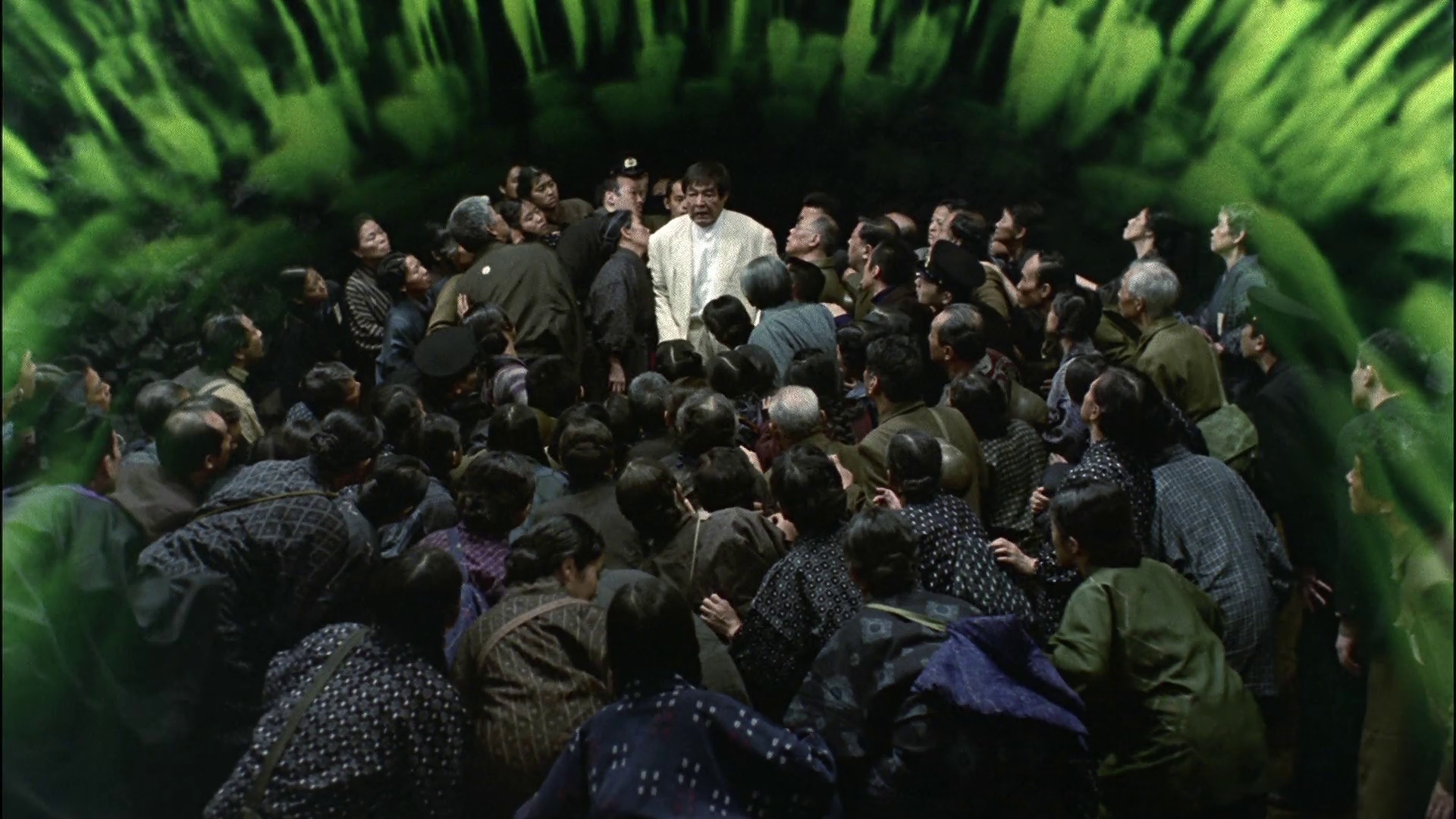
Thus at his trial, in which he appears to have lost his mind, he stresses that though he does not object to the legal process or its consequences he will not feel himself to have been judged by the prosecutor (Hisashi Igawa) as he has never eaten human flesh nor had his own flesh eaten. While in the cave, Hachizo had claimed to see a glowing ring around Nishikawa’s face which he attributed to a folk belief that such a ring resembling the green glow of luminescent moss was a signifier of his guilt visible only from a certain angle and for a short time only to those who look for it. It’s this ring that captain asks others to look for at his trial, to show him the signifier of his own guilt so that he may himself accept it. But then he may actually have a point that those who have never experienced what he has experienced are incapable of judging him. At the critical moment, the trial is interrupted by an air raid, there after becoming increasingly surreal as the location is shifted back to the cave as if it were all taking place within the captain’s mind. 

The prosecutor tries to attack him for attempting to blame it all on nation and society, suggesting that his actions have disgraced all of Japan and brought shame on the emperor about whom the captain makes an inappropriate remark suggesting that the emperor too is human and merely “enduring” his circumstances. Pressed to explain himself, the captain only says that he is “enduring” many things and that during his time in the cave he simply “endured”, doing what seemed to him the only thing he could do. The prosector points out that Hachizo refused and chose death, while Nishikawa attempted suicide to atone for his actions, asking what right the captain had choose survival but the only ones who can really judge him the three men he cannibalised each of whom appear as (almost) silent ghosts whose judgement cannot be interpreted. 

Though the film is not as visually striking as others in Kumai’s earlier career, he succeeds in conjuring a sense of primeval eeriness in the swirling mists and oddly shaped icicles of the cave while avoiding any sense of gore in the act of cannibalism itself which might otherwise unbalance the ethical dimensions he wishes to address. In the closing sequence, both the writer and the headmaster are positioned behind the bars which now protect the moss as if this kind of primal impulse could really be restrained or tempered by our civility. After the death of Gosuke and given the objections of the other two men, the captain suggests waiting a day or two to see how long their “human feelings” could hold in the face of their survival, the answer perhaps being less than you’d hope and about as long as you’d expect.


Good Morning (お早よう, Yasujiro Ozu, 1959)

Even the most casual viewer of Japanese cinema will be aware that something as simple as “lovely weather today” can mean quite a lot more than it at first seems. Small talk isn’t really so small after all and without it, as one quite perceptive yet perennially tongue-tied translator points out midway through Yasujiro Ozu’s charming late career comedy Good Morning (お早よう, Ohayo), our lives would be quite boring. Boring it is not, however, when two young boys decide to rebel against the pointless politeness of the adult world by taking a vow of silence after being told off for going on in their constant tantrums over the unfairness of being denied a TV set. 

As he often did, Ozu repurposes the plot of an earlier film, in this case I Was Born But… and subverts it. The two boys at the centre of the 1932 silent film ended up going on a hunger strike out of humiliation and despair on realising that their dad, who they’d idolised, was also a soulless corporate lackey forced to debase himself in deference to his boss. The father is ashamed, he doesn’t want his boys to end up living a meaningless worker drone existence, but the boys’ decision not to eat also carries much more weight considering they are in living in a time of economic depression during which many do not have the luxury of choice. 

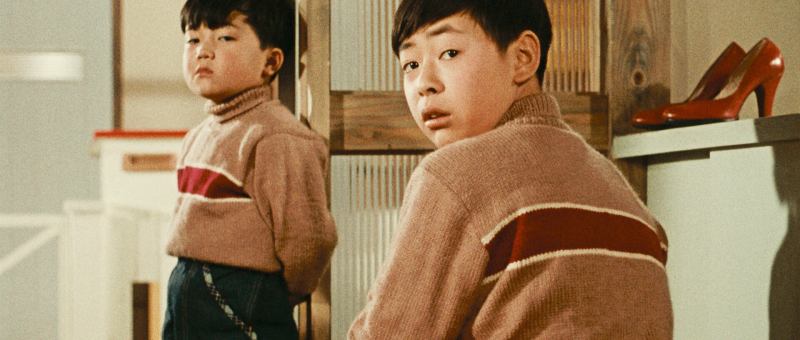
The Hayashi boys, Minoru (Koji Shitara) and Isamu (Masahiko Shimazu), by contrast are also rebelling against the meaningless adult world but for the opposite reasons. They don’t seem to have a lot of respect for their father and probably don’t really care if he humiliates himself on a daily basis so long as they can watch sumo on TV without needing to go next door. These are consumerist kids, they want what they want and they want it now. Minoru is really too old for screaming tantrums, but still rolls around on the floor kicking his legs in frustration because it’s all just so unfair that mum and dad won’t get him a TV even though it’s not a matter of money. The parents, for their part, are trying their best to resist the onset of consumerism. Mr Hayashi (Chishu Ryu) is against the TV because he fears the boys will stop studying and hours of vacant staring will ruin their young minds. He might have a point, but you can’t hold back the tides forever. 

It’s his scolding of the boys which eventually leads to all the subsequent problems as his insistence that they are being far too noisy and talk much more than children have a right to leads them to declare an ironic vow of silence in protest against the “meaningless” chatter of adults filled with random pleasantries such as “good morning”, “where are you off to today?”, “what lovely weather we’re having!”, etc. Their decision, however, comes at a bad moment. There has recently been some unpleasantness over misplaced money for a local community group and gossip about Mrs Haraguchi’s (Haruko Sugimura) new washing machine. The other housewives on the block also seem to be resistant to consumerist desires and do not approve of the purchase, channeling their resentment into assuming that Mrs Haraguchi may have embezzled the money. Grown up chatter isn’t always meaningless and the frivolous local gossip has a profound bearing on the social politics of the block. So when the boys don’t reply to Mrs Haraguchi’s good morning, she assumes they are deliberately snubbing her on their mother’s instruction because of a petty grudge over harsh words exchanged on account of the misunderstanding surrounding the missing club dues.

Meanwhile, we can see the shadows of a lingering economic instability. These are all modest homes where families make an effort to appear frugal, hence the outrage over the washing machine, but the family friend who teaches the boys English and has a crush on their aunt, Heiichiro (Keiji Sada), has been laid off after his company went bust. He’s supported by his older sister who remains unmarried and works at a car dealership (more consumerism) while doing translation on the side for extra money. The neighbour across the way is technically “retired” but looking for work partly because his pension’s not enough to live on and partly because what’s a man supposed to do all day in a society which expects everyone to be productive? The new neighbours next-door to the Hayashis who’ve caused all this trouble because of their TV set are viewed as scandalous because they live in their pyjamas and she used to be a cabaret bar girl. The middle-aged gossips don’t think they’re respectable while she eventually decides to move because the neighbours are too “annoying”. 

Ironically enough, it’s sumo the boys most want to watch, about as traditionally Japanese a pastime as is possible even as they yearn for colourful consumerist modernity. They communicate by refusing to communicate. As Heiichiro points out, small talk is a social lubricant but meaningless things are easy to say while important things are not. Which is not to say you can’t communicate something important by saying something seemingly as meaningless as “that cloud has an interesting shape”, but that you won’t get anywhere unless you listen to what people are actually saying even when they’re saying nothing at all. They boys can’t win against the inherent meaninglessness of adult life with its superficial conformities, petty resentments, and wilful misunderstandings but perhaps we can all learn something from their straightforward earnestness in their refusal to submit themselves to empty pleasantries. 


Home Sweet Home (我が家は樂し, Noboru Nakamura, 1951)

There must have been a lot of families like the Uemuras in the Japan of 1951. As film’s title implies, their home is a happy one and though they may not have much they make the most what they have and are cheerful and loving towards each other. Still, the world stores up trouble for them perhaps because they are so very defiant of their circumstances. In many ways a classic shomingeki, Home Sweet Home (我が家は樂し, Waga Ya wa Tanoshi) was the film that put Noboru Nakamura on the map and finds Japan at a kind of crossroads edging past post-war privation towards a broadly consumerist society.

We can get a sense of that in the constant needs of four children in the Uemura family, patriarch Kosaku (Chishu Ryu) picking up his young son Kazuo (Katsumasa Okamoto) after baseball on his way home and noticing that his mitt is almost worn through only to get there and spot his daughter’s boots are getting pretty thin too. It’s clear they struggle for money despite Kosaku’s steady job for which he is about to receive a 25-year good service commendation as wife Namiko (Isuzu Yamada) supplements the family income by taking in sewing at home while we later find out that she’s already sold most of her kimono to help make ends meet and is considering selling her wedding ring to pay for middle daughter Nobuko’s (Keiko Kishi) school trip to Kyoto.

But her hard-nosed sister Kayo (Mutsuko Sakura) tells her that secondhand kimono have lost their value with so many new ones now available. In the immediate post-war era, rice and kimono were the only things that had held their value and so selling one could bring in a lot of money quickly. Conversely, after receiving a sizeable bonus along with his commendation, Kosaku and Namiko visit a department store which has a large range of affordable clothing for sale though the kimono fabric Kosaku picks out for Namiko is still fairly expensive so she instinctively puts it back insisting that they buy the presents they promised the children first. 

That was probably a good move, seeing as the rest of the money is stolen from them on their way home to a congratulations party the children are busy setting up. Kosaku asks why someone would rob people like them, honest, hardworking types who don’t have much to begin with but as Namiko sensibly points out pickpockets don’t really think like that and how would they know anyway. The subtext is that times are still hard for a lot of people even if there are now more exciting, definitely non-essential things appearing on shelves for people with disposable income to buy and a new kimono, though out of fashion, is no longer so out of reach for the ordinary housewife. 

The loss of the money might seem as if it should place a wedge between husband and wife, but bar a moment of disappointment cured by the realisation that oldest daughter Tomoko (Hideko Takamine) has been considerate enough to place hot water bottles in their futons, they resolve to muddle through together and in any case they’re no worse off than they were before. Tomoko herself is conflicted, feeling as if as a young woman in her early 20s she should give up her dreams of becoming a painter and get a job to support the family but Namiko always tells her not to. She encourages each of her children to follow their dreams, perhaps a sign of a new post-war liberation, telling her sister that she’d happily sell all her kimono so that Tomoko could go on painting. Later we discover that she also dreamed of becoming an artist and that though Kosaku had encouraged her to keep it up, a housewife’s day is never done and there was simply no time left for herself. Painting is just another thing she sacrificed for her family and Namiko seems to be determined that Tomoko won’t have to do the same not that she particularly regrets her decision.

Tomoko only really comes to understand her mother’s sacrifices on noticing that the cupboards really are bare, she’s sold everything that could be sold and pawned her ring though the colleague that owned the house they were renting has encountered some financial difficulties of his own and going to to sell to the grumpy old man who bought the house across the way. The Uemuras are such obviously good people that it feels so unfair that so much bad luck has come their way all at once though it is their goodness that eventually saves them when the old man is touched by seeing youngest daughter Mitsuko (Kazuko Fukui) playing with his dog. He later comes to admire Tomoko’s painting of his garden though he’d put a fence up to stop her peering in. The scars of the post-war era are visible in the damage to Uemura’s front wall which would have blocked the way but now perhaps enables them to become good neighbours after all. Though the film may lack some of the visual flair present in Nakamura’s later work, it more than makes up for it with genuine sentiment and the implication that in the end the world is basically good and rewards those who are the same even if it sometimes tests their resilience.


Song of the Flower Basket (花籠の歌, Heinosuke Gosho, 1937)

The daughter of a tonkatsu shop finds herself with an overabundance of suitors in Heinosuke Gosho’s generally cheerful yet occasionally dark melodrama Song of the Flower Basket (花籠の歌, Hanakago no Uta). Adapted from a novel by Fumitaka Iwasaki and scripted by Kogo Noda, the film finds its heroine caught at a moment of social change as she battles her snooty aunt for the right to decide her romantic future while her impoverished student boyfriend does something much the same in defying his family’s attempts to micromanage his life dreaming of the bright lights of Ginza. 

Yoko (Kinuyo Tanaka) is the “kanban musume” of her father Keizo’s (Reikichi Kawamura) pork cutlet restaurant, attracting customers with her charm and beauty while the Chinese chef her father brought back with him from Shanghai, Lee (Shin Tokudaiji), is the culinary star. Lee is secretly in love with Yoko whom he continues to refer to largely as “the young lady” and has long been writing an ode in her honour. Yoko meanwhile is in love with a penniless student, Ono (Shuji Sano), who at the beginning of the film has just returned home after visiting his family whom he has alienated by declaring that he doesn’t want to work in an office in the country while refusing an offer to marry into another family as an adopted son-in-law. The reason for this is less his pride than his desire to stay in Tokyo amid the bright lights of Ginza, sighing as he looks out into the neon-lit night gazing at adverts for Club Hamigaki toothpaste and Meiji Chocolate. The second reason may also be that he’s fallen for Yoko but given his precarious financial situation and lack of prospects does not quite dare to imagine a future with her. 

He must however be serious as we later learn he’s given up going to hostess bars with his friends, a bar girl greeting him in the restaurant evidently not having seen him in ages asking where he’s been much to Yoko’s embarrassment. The encounter places a seed of doubt in her mind in a minor role reversal as she begins to resent Ono’s past irrationally annoyed by the idea he has dated other women. Meanwhile, at the memorial event marking 11 years since her mother passed away while working as a steward on a boat in Singapore, Yoko’s snooty aunt tries to set her up with an arranged marriage to an Osakan doctor who may or may not marry depending on the “negotiations” but has also been promised his own clinic by his wealthy parents if the marriage is confirmed. Okamoto (Toshiaki Konoe) has visited the restaurant to get a better look at Yoko making him the third suitor to encircle her even though the chief concern of the family is that Yoko is almost 24 and therefore ageing out of top tier matches.  

To his credit, Yoko’s father is fully in her corner trying to stand up to the domineering aunt who is definitely overreaching in trying to micromanage the romantic lives of her nieces in the absence of her sister. He determines to find out if Yoko has her eye on someone already to get the aunt off their backs, but the situation develops in an unexpected direction when Lee mistakenly assumes that she likes him back. Too shy to say himself, he advises Keizo to ask frequent customer and best friend of Ono, Hotta (Chishu Ryu), who is on track to become a Buddhist priest and take over the family temple, only Hotta obviously tells him, correctly, that Yoko is in love with Ono having completely forgotten that Lee had once confessed his feelings to him. 

The film does its best to present a more positive vision an internationalist Japan even in 1937 despite the Aunt’s obvious disapproval of the family’s wandering past and is largely sympathetic of the lovelorn Lee yet implies that a romance between he and Yoko is so unthinkable that no one really considered the possibility that he may be in love with her himself even though it is incredibly obvious given his ongoing attempts to write a love song while he’s even torn out a picture of Yoko which appeared in a magazine and hung it on his wall. Yoko is oblivious to his feelings, believing that he is in love with their waitress, Oteru (Yaeko Izumo), who is indeed in love with him, and perhaps doesn’t appreciate the effect moving Ono in as a trainee chef will have on him both professionally and emotionally. The message that is emerges accidentally or otherwise is that Lee’s place at the cafe is insecure despite his skill being a large part of its success as he falls into a deep depression and eventually decides it’s too painful for him to stay. 

The revelations surrounding Lee further destabilise Yoko’s confidence in her choice of Ono whom she constantly doubts even suspecting he may have committed a violent crime when carted off by the police after newspaper reports stating the bar hostess he introduced her to earlier has been murdered in her apartment. Perhaps it’s normal enough to be uncertain if you’ve made the right choice in the early days of a marriage, but believing your spouse capable of murder is a significant stumbling block as is her final admission that she doesn’t really trust him and isn’t ready to accept his past with other women in a further reversal of their roles given he has now married into her family and taken her name. Nevertheless, the crisis seems to be repaired by her father’s simple act of ordering a round of beers making clear that he plans to celebrate and obviously still has confidence in Ono while preparing to adapt their restaurant to their new circumstances by branching out into sukiyaki. Expressing some of the anxieties of the 1930s from the precarious economy and uncertainty of the future to changing social mores as young people reject the traditional to craft their own romantic futures, Song of the Flower Basket nevertheless ends on a note of melancholy in the wandering Lee’s ode to loneliness and heartbreak under the neon lights of Ginza.