Here’s to the Young Lady (お嬢さん乾杯!, Keisuke Kinoshita, 1949)

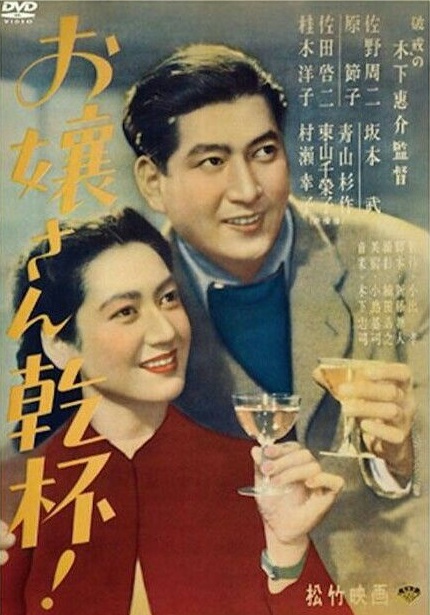
Here's to the young lady DVD coverLove across the class divide is a perpetual inspiration for melodrama, but what if the problem is less restrictive social codes and more emotional inertia and frustrated desire? Many things were changing in the Japan of 1949, racked by post-war privation and burdened with a scrappy desire to remake itself better and kinder than before. Keisuke Kinoshita, the foremost purveyor of post-war humanism, looks back to the 1930s for his 1949 cheerfully superficial romantic comedy Here’s to the Young Lady (お嬢さん乾杯!, Ojosan Kampai!). A tale of changing social codes and youth trying to find the courage to break free, Kinoshita’s easy romance is as breezy as they come but also hard won and a definitive step towards the freer, fairer world he so often envisages.

Keizo Ishizu (Shuji Sano), a 34-year-old self-made man and successful garage owner, is still single and seemingly pestered by his well meaning friends who keep finding matches for him that he doesn’t really want. Reluctantly, he acquiesces to the demands of his good friend Mr. Sato (Takeshi Sakamoto) who is desperate to introduce him to a pretty young woman from a wealthy family and agrees to meet Yasuko (Setsuko Hara) – a demure 26-year-old apparently keen to get married. Ishizu is instantly smitten, dumbstruck by her beauty and elegance. He begins to think all this marriage talk isn’t so silly after all, but then he is only a country bumpkin made good in the scrappy post-war economy. Yasuko is old money. How could he ever be permitted to enter her world and would she ever truly fit in his? Ishizu falls hard but his dreams of romance are eventually crushed when he discovers that the Ikedas, once a noble family, have hit upon hard times following half the family’s repatriation from Manchuria and the unwise business relations of Yasuko’s father which have landed him in jail as a co-conspirator in large scale fraud.

Despite his misgivings, Ishizu is talked into “dating” Yasuko for a few months during which he plans to find out if she could fall in love with him for real or if the marriage is likely to be an eternally one-sided affair which will make them both miserable. Ishizu resents being thought of as the cash cow, the classless nouveau riche upstart roped in to breathe new life into the fading aristocracy, but can’t let go of the hope that Yasuko might fall for his down to death charms even if not all of her family are very happy with this particular means of survival.

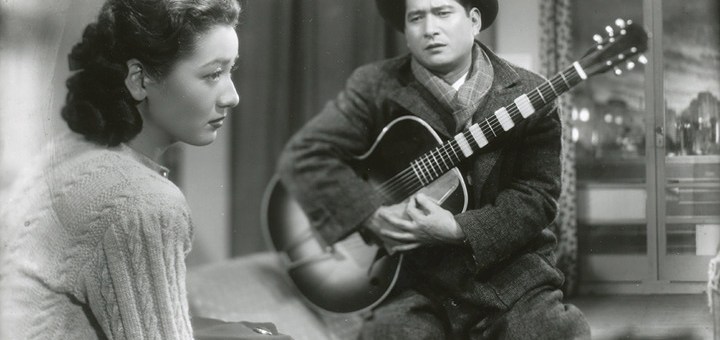
Yasuko’s grandparents are at great pains to emphasise (repeatedly) the immense gap in social class between Ishizu and their cultured, refined ingenue of a granddaughter who enjoys such elegant hobbies skiiing, tennis, and the ballet. Ishizu is into boxing and drinking at his favourite bar. He has no idea what the tune is that Yasuko plays on the piano that he bought for her and somewhat gauchely had delivered direct in front of the mildly scandalised family who can’t help feeling belittled by his generosity, but he finds it charming all the same even if his lack of refinement also stings with embarrassment. Nevertheless, the youngsters end up finding their own way – she takes him to the ballet where he is bored and then somehow moved, and he her to the boxing where she is frightened and then thrilled. They grow closer, but also not as Ishizu becomes increasingly frustrated (if in his characteristically good natured way) by Yasuko’s continuing aloofness.   

Perhaps unusually, it is Yasuko who struggles to move on from the idealised pre-war past in which she lived the romanticised life of a wealthy noblewoman who had not a care in the world and no need to worry about anything. The war has destroyed the nobility but this no Cherry Orchard-style lament for a declining world of elegance and rise of the unrefined in its place but a plea for rational thinking and a desire to move forward into a more egalitarian future. Yasuko’s grandparents cannot accompany her on this journey even if her parents and siblings are minded to be pragmatic, but it’s she herself who will need to make the decision to abandon her rigid ideas of what it is to be a fine lady and learn to embrace her own desires if she is to find happiness (as her father urges her to do) in the rapidly changing post-war world.

Then again, Ishizu is not entirely free of petty prejudice and the mild conservatism of the upwardly mobile as he shows in his intense hostility towards his best friend’s (Keiji Sada) tempestuous relationship with a club dancer (Naruko Sato). Nevertheless, after a good old fashioned case of fisticuffs and a proper consideration of all the obstacles he faces in winning the heart of Yasuko, Ishizu eventually reconsiders and urges his friend to chase happiness wherever it may lie. He vacillates and doubts himself, finds it impossible to approach the icy lady of the manor because of a feeling of social inferiority and finally decides to give up on an unrealistic idea of romance to spare them both pain, but then the obstacles were not all his to overcome and if there is a choice to be made it is Yasuko’s to make. A joyous throwback to the screwball ‘30s, Here’s to the Young Lady, banishes the darkness of the postwar world to the margins while its melancholy youngsters use romantic heartbreaks as a springboard to free themselves from the restrictive social codes of the past in order to choose happiness over misery and despair.


Titles and opening scene (no subtitles)
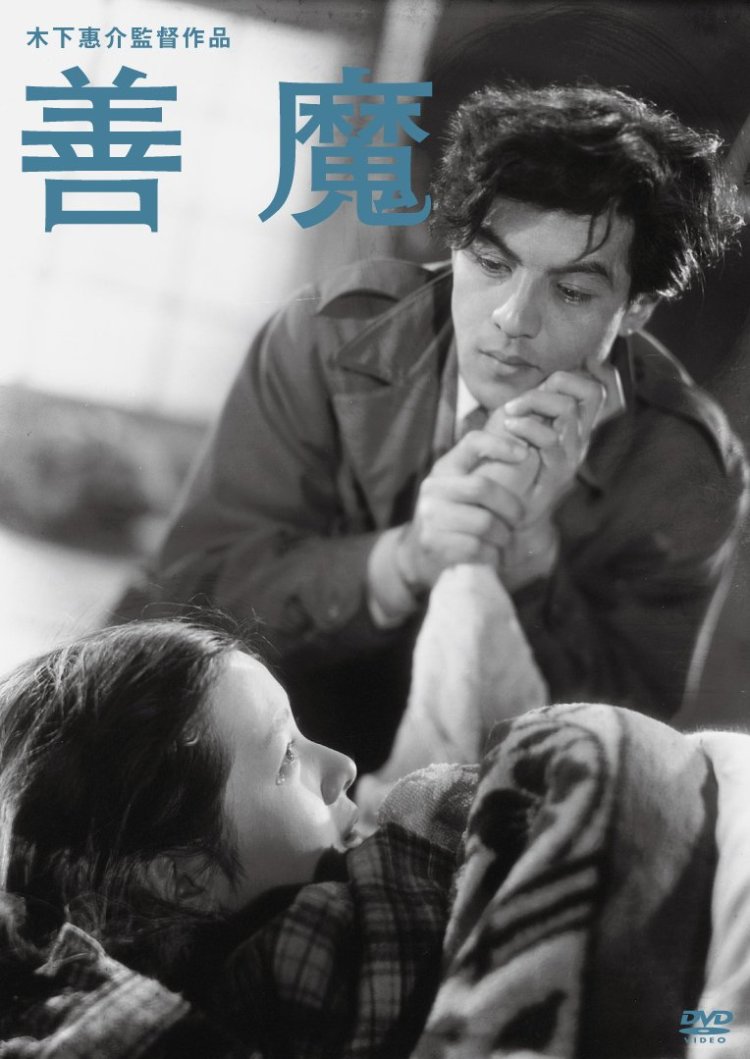
The Good Fairy (善魔, Keisuke Kinoshita, 1951)

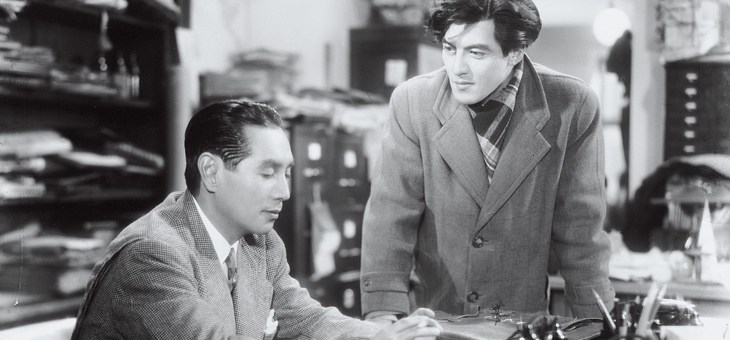
Good fairy DVDAlthough one of the more prominent names in post-war cinema, the work of Keisuke Kinoshita has often been out of fashion, derided for its sentimental naivety. It is true to say that Kinoshita values heroes whose essential goodness improves the world around them though that is not to say that he is entirely without sympathy for the conflicted or imperfect even if his equanimity begins to waver with age. 1951’s The Good Fairy (善魔, Zemma), however, working from a script penned not by himself but Kogo Noda and adapted from the novel by Kunio Kishida, seems to turn his life philosophy on its head, wondering whether the tyranny of puritanical goodness is an evil in itself or merely the best weapon against it.

After beginning with a hellish, ominous title sequence set against the flames, the film opens with newspaper editor Nakanuma (Masayuki Mori) getting a hot tip regarding a politician’s wife who seems to have mysteriously disappeared. He hands the assignment to rookie reporter Rentaro Mikuni (played by the actor Rentaro Mikuni who subsequently took his stage name from this his debut role) who specialises in political corruption. Mikuni doesn’t like the assignment. He thinks it’s unethical and whatever happens between a man and his wife is no one’s business, but ends up going to see the politician, Kitaura (Koreya Senda), anyway and instantly dislikes him. Mildly worried by Kitaura’s lack of concern over his wife’s sudden absence, Mikuni stays on the case and visits the wife’s father (Chishu Ryu) up in the mountains where he also meets her sister, Mikako (Yoko Katsuragi), who eventually leads him to the woman herself, Itsuko (Chikage Awashima), who has taken refuge with a friend after becoming disillusioned with her husband’s “vulgar” pursuit of success at the continuing cost of human decency.

To pull back for a second, in any other Kinoshita film, Itsuko would be among the heroes in standing up against her husband’s corrupting influences, but for reasons which will later be explained she lingers on the borders of righteousness owing to having made a mistaken choice in her youth which was, in many ways, defined by the times in which she lived. Nukanuma had not been entirely honest with Mikuni in that he had known and secretly been in love with Itsuko when they were both students but he was poor and diffident and so he never declared himself, his only attempt to hint as his feelings either tragically or wilfully misunderstood. Where Itsuko, who married for money and status as a young woman was expected to do in the pre-war society, has mellowed with age and gained compassionate morality, Nakanuma who became a reporter to fight for justice against the background of fascist oppression has become cynical and selfish. Never having quite forgotten Itsuko, he has been in a casual relationship with a young actress, Suzue (Toshiko Kobayashi), for the last two years never realising that she has really fallen in love with him.

Thinking back on his college relationship with Itsuko, Nakanuma remembers talking with her about unsuccessful romances, that if a man tries his best to make a woman happy but isn’t able to then it must be because she doesn’t love him. Itsuko agrees, adding that men never seem to know what makes a woman happy in love but that friendship is a different matter. She says something similar when she tells him she’s getting married but doesn’t want to lose his friendship, and when he begins floating the idea of marriage hinting that he wants to marry her but perhaps giving the mistaken impression that there’s someone else in stating that it’s sad when a friend marries because the relationship with never be the same again and knowing that he intends to marry she now treasures their friendship even more. In a sense, Nakanuma thinks of Suzue as a “friend” with whom he occasionally sleeps, believing that their relationship is only ever liminal and temporary but mutually beneficial and capable of continuing even if the sexual component had to end.

Having failed once in love, Nakanuma is resolved not to do so again and determined to fight to win Itsuko rather than lose her through cowardice, but to do so he will cruelly wound Suzue who has treated him with nothing other than tenderness. By this time, Mikuni has fallen in chaste, innocent love with Mikako who reminds him of the parts of himself he feels are being erased by his compromising job as part of the mass media machine. Mikuni’s terrifying “goodness” is largely a positive quality which leads him to fight for justice against oppression even within his own organisation but his love for the saintly Mikako only intensifies his moral purity and threatens not only to turn him into an insufferable prig but to create in him a new oppressor, spreading guilt and unhappiness like the self-righteous hero of an Ibsen play.

Early on, following their mild disagreement about journalistic ethics, Mikuni and Nakanuma have dinner together over which they debate the power of the press to bring about social change and hold power to account. Nakanuma says he’s become cynical because hating injustice isn’t enough and there’s nothing that the individual can do against an oppressive system. What he’s telling Mikuni is that he used to be like him, but time has taught him righteousness is not an effective weapon against entrenched social privilege. He recounts a dark story from a Buddhist monk who told him that good can never win over evil because it isn’t strong enough, only evil is strong enough to fight evil and so in order to counter it you will need to affect its weapons. Later, crazed by grief and exhaustion, Mikuni’s “goodness” seems to pulse out of him with ominous supernatural force as he takes Nakanuma to task for his callous treatment of Suzue only for he and Itsuko to come to the conclusion that they’ve heard the voice of “evil” and are now condemned by their past choices to lives of morally pure unhappiness.

This central conundrum seems to contradict Kinoshita’s otherwise open philosophies in its unwelcome rigidity which says that there are no second chances and no possibility of ever moving on from the past with positivity. Itsuko made the “wrong” choice when she was young in choosing to marry for material gain, but she was only making the choice her society expected her to make in the absence of other options – it wasn’t as if she had any reason to wait around for Nakanuma whose regret over his romantic cowardice has made him cold and bitter. She realised her mistake too late and resolved to correct it, but the “Good Fairy” won’t let her, it says she has to pay (for the crimes of an oppressive society) by sacrificing again her chance of happiness in the full knowledge of all she’s giving up. Kinoshita’s films advocate the right to love by will, free of oppressive social codes or obligations but Itsuko is denied a romantic resolution despite having “reformed” herself and made consistently “correct” choices since discovering her husband’s “fraud”. She is denied this largely because of Nakunuma’s failing in being unkind to one who loved him, which is, in a round about way, still her fault for not having realised he loved her and deciding to marry him instead. In fact, the only one who seems to get off scot-free is Kitaura whose fraudulent activities will be covered up on the condition he consent to Itsuko’s divorce petition and sets her fully “free” so she can be fully burdened by the weight of her romantic sacrifice.

In the end, it’s difficult to see a positive outcome which could emerge from all this unhappiness which seems primed only to spread and reproduce itself with potentially disastrous consequences. Mikuni’s purity has become puritanical, unforgiving and rigid, condemning all to a hellish misery from which there can be no escape. The cure is worse than the disease. No one could live like this, and no one should. Goodness, tempered by compassion and understanding, might not be enough to fight the darkness all alone but it might be better to live in the half-light than in the hellish flickering of the fires of righteousness.


Title sequence and opening scene (no subtitles)

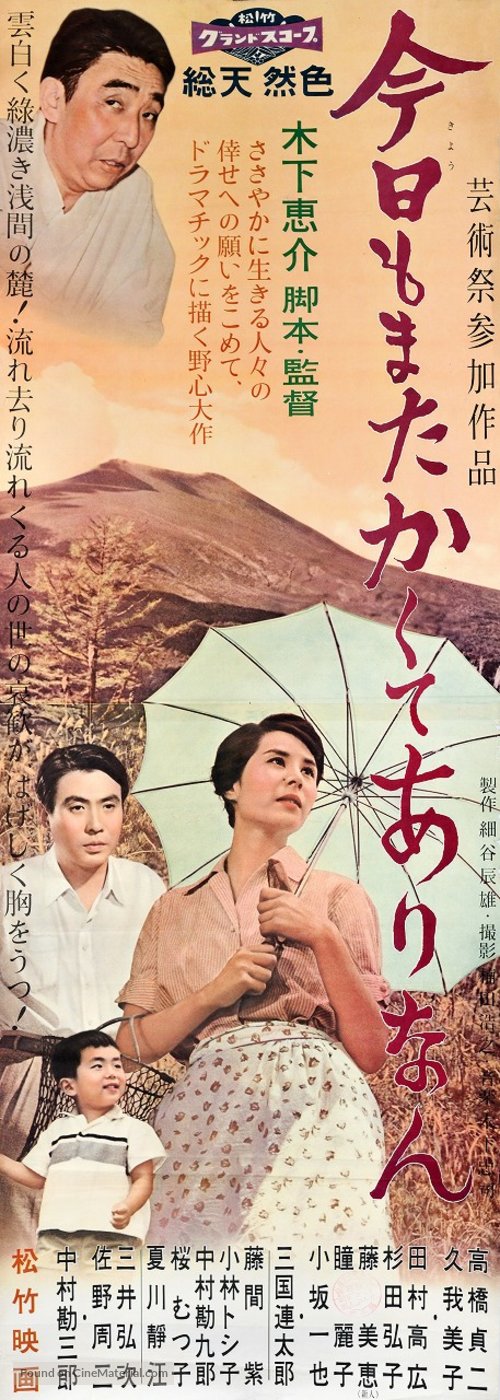
Thus Another Day (今日もまたかくてありなん, Keisuke Kinoshita, 1959)

Thus Another Day vertical bannerThe cinema of the immediate post-war era, contrary to expectation, is generally hopeful and filled with the spirit of industry. Keisuke Kinoshita might be thought of as the primary proponent of post-war humanism in his fierce defence of the power of human goodness, but looking below the surface he’s also among the most critical of what the modern Japan was becoming, worried about a gradual loss of values in an increasingly consumerist society which refuses to deal with its wartime trauma in favour of burying itself in intense forward motion.

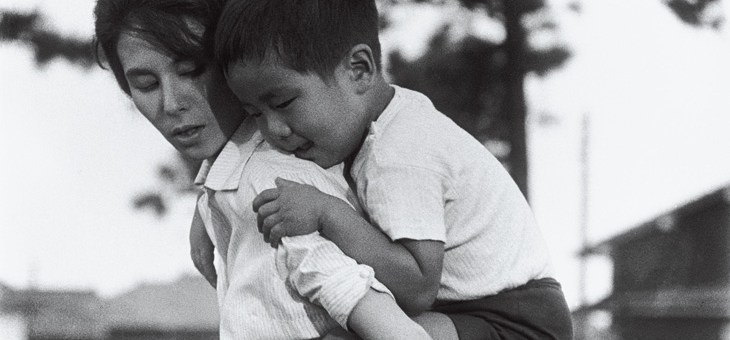
The housewife at the centre of Thus Another Day (今日もまたかくてありなん, Kyo mo mata Kakute ari nan), Yasuko (Yoshiko Kuga), is a perfect example of this internal conflict. She and her husband Shoichi (Teiji Takahashi) have built a modest house way out of the city in the still underdeveloped suburbs for which they are still burdened by an oppressive mortgage. Shoichi has a regular job as an entry level salaryman but his pay is extremely low and Yasuko is forced to scrimp and save just to get by. The central conflict occurs one summer when Shoichi’s boss declares he’s looking to rent a summer house in the quiet area where the family live. Shoichi thinks it would be a great idea to rent out their house to his boss earning both money and favour. Yasuko can go stay with her family who live in a pleasant resort town while he will stay with a friend in a city apartment. Yasuko does not really like the idea, but ends up going along with it.

Shoichi is trying to live the salaryman dream, but it isn’t really going anywhere. Yasuko is home alone all day with the couple’s small son, Kazuo, who is too young to understand why the family lives the way it does and continuously asks probing questions which upset and embarrass his mother. Watching her painstakingly washing clothes by hand, Kazuo wants to know why they don’t have an electric washing machine like some of his friends’ mothers do. Yasuko tells him they’re saving money to get one, at which point he pipes up that he personally would rather have a TV set. Like his father, he is rather self-centred but being only four can perhaps be forgiven. Nevertheless, Yasuko is constantly embarrassed by the family’s relative poverty. When another neighbour spots her out shopping and decides to accompany her, she is visibly distressed that the stall she takes her to is a little more expensive than the one she had in mind. Wanting to save face, she buys expensive fish but is mindful of there being less money for the rest of the week.

Meanwhile, Shoichi is obsessed with “getting ahead” by ingratiating himself with his bosses – hence why he decided to let out his own house over the summer. The house is, after all, Yasuko’s domain and she perhaps feels family atmosphere isn’t something you should be selling. She resents that the family will be split up over the summer even if it gives her an opportunity to visit her mother and sister out in the country. Even when Shochi arrives to visit, he makes them trot out to a neighbouring town to visit his boss’ wife also on holiday in the area, and stays there all day playing mahjong while Yasuko and Kazuo are bored out of their minds sitting idly by. The second time he doesn’t even bother to invite them.

The small resort town itself is something of a haven from the demands of the city but there is trouble and strife even here. Shortly after her arrival Yasuko meets a strange, rather sad middle-aged man who is a stay at home dad to his beloved little girl, Yoko. Takemura (Nakamura Kanzaburo XVIII) came of age in the militarist era, attending a military university to become one of the elite. The world changed on him and he remains unable to reconcile himself to the demands of the post-war society. Experiencing extreme survivor’s guilt, Takemura is filled with regret and resentment towards the ruined dreams of his misguided youth in which he abandoned a woman he loved to marry a wealthy man’s daughter who he has also let down by refusing his military pension, forcing her into the world of work and eventually onto the fringes of the sex trade as a hard drinking bar girl.

As if to underscore the looming danger, a thuggish gang of yakuza have also decided to spend the summer in the resort, holing up at the inn where Takemura’s wife is working. The young guys terrorise the youngsters of the town, disrupting the well established social hierarchy with acts of violence and intimidation. The punks cause particular consternation to Takemura who remembers all the men their age who went to war and never came back only for the successive generation to live like this. Having lost everything which made his life worth living, Takemura decides to take a stand against modern disorder, hoping to die in battle the way he feels he ought to have done all those years ago.

Thus Another Day is among the darkest of Kinoshita’s post-war dramas, suggesting that there really is no hope and that past innocence really has been lost for good. The values of Takemura’s youth, however, would not perhaps line up particularly well with those most often advanced in Kinoshita’s cinema, as kind and melancholy as he seems to be. Yasuko goes back to her crushing world of unfulfillable aspirations with her obsequious husband and demanding son with only gentle wind chimes to remind her of happier days while she tries to reaccommodate herself to the soullessness of post-war consumerism .


Original trailer (no subtitles)

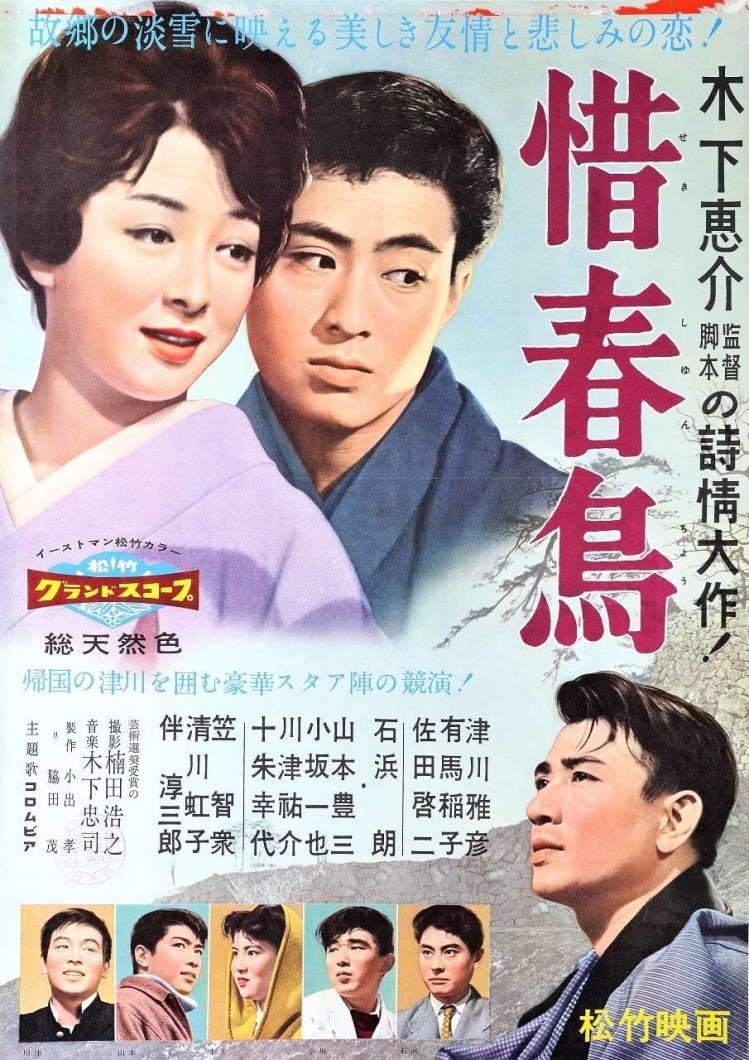
Farewell to Spring (惜春鳥, Keisuke Kinoshita, 1959)

(C) Shochiku 1959

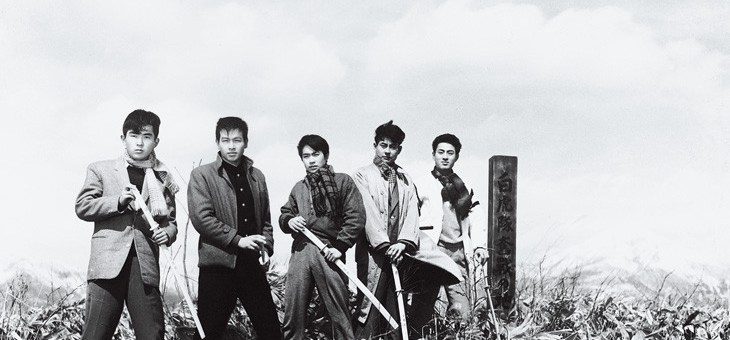
Farewell to Spring posterFor Keisuke Kinoshita, people are basically good even if the world around them often isn’t. Even so, there are limits to goodness. Can friendship survive if an intimate trust is abused, or will betrayal cut the cord once and for all? Unlike many of his contemporaries, “youth” was not a theme in which Kinoshita was particularly interested – or, at least, not quite in the same way. Farewell to Spring (惜春鳥, Sekishuncho) is in some senses an awkward fit for his usual concerns but then the concerns here are perhaps closer to the personal in examining the changing fortunes of a group of five male childhood friends who find themselves scattered in the complicated post-war landscape, facing their mutual troubles in solitary, manly fashion while their friendship withers under the weight of their individual sorrows.

The drama begins when Iwagaki (Yusuke Kawazu) returns to his Aizu mountain village after being away at university for the previous two years. As Iwagaki’s parents have died and his half-brother moved to Hokkaido with his family, Iwagaki has no “home” in his hometown as he sadly tells a familiar face spotted on the train. Nevertheless, his friends are very excited to see him and have all rallied round without even being asked. Iwagaki will be staying at an inn owned by the family of his friend, Minemura (Kazuya Kosaka). The other boys all stayed in the village – Makita (Masahiko Tsugawa), the illegitimate son of a bar owner is being primed to take over the family business while sort of dating the step-daughter of his estranged father; Teshirogi (Akira Ishihama), the younger son of an impoverished former samurai family, is working at a local factory and heavily involved in the labour movement; while Masugi (Toyozo Yamamoto), who is disabled with a lame leg thanks to a childhood accident, works alongside his parents in a traditional lacquerwork shop but finds his livelihood threatened by political troubles with China.

Once a tight group of small-town friends, none of the boys quite wants to acknowledge how far they have drifted apart – not just from each other, but from the young men they once were even though comparatively little time has actually passed. Nevertheless, the shadow of their old bond still exists – it is obvious to all the boys that Iwagaki has returned in some kind of disgrace. A favourite of their teacher, Iwagaki had been given a valuable opportunity to better himself by going to university in Tokyo but has apparently fallen out with his sponsor and into hard times. The story he tells his friends is dark – they’d heard it had to do with a “dalliance” with a maid which annoyed his patron but the way he describes it sounds more like a rape revenge followed by an unwanted romance which he eventually ran away from. Iwagaki is not making himself look good which might suggest that he trusts his friends enough to tell them the truth, or perhaps just doesn’t quite see the various ways in which his conduct discredits him, but either way there is deepening gulf between each of the men in which none is quite being honest with the other.

Iwagaki’s arrival doesn’t so much stir up old troubles as occur alongside them. The central drama revolves around a squaring off between Makita and Teshirogi over a girl, Yoko (Yukiyo Toake), who is the niece of Makita’s biological father – a nouveau riche pawnbroker with a steely wife, Tane (Teruko Kishi), who hates Makita’s mother for obvious reasons. The mistress and the wife are locked into an internecine battle of wills and resentments and so both are opposed to a marriage between Makita and Yoko even though they have fallen in love independently. As there is no son in the family, Makita’s father needs someone to marry in through marrying Yoko – it would obviously be ideal for him if his “real” son could inherit his estate, but Makita’s mother wants him to take over her bar and Tane is directly opposed to suffering the humiliation of a mistress’ son living under her roof and so they are at an impasse. Meanwhile, Tane has been trying to arrange a socially beneficial marriage and has settled on Teshirogi – the impoverished son of an aristocratic family.

A confluence of post-war problems, the first question pits the traditional arranged marriage against the youngster’s right to choose. Yoko doesn’t want the arranged marriage – she’s doing everything she can to fight it even if she ends up alone, but Makita has already given up believing the situation is futile. Teshirogi tries to ask him if it’s OK to pursue Yoko, but Makita doesn’t really answer. What he says is does as you see fit, but Teshirogi hears only what he wants to hear and fails to notice that Makita minds quite a lot and has only said that out of a sense of despondency and a possible romanticisation of his emotional suffering. Yoko is living in the post-war reality – she rejects the idea of arranged marriage and of her adoptive parents’ right to control her future, but she is unable to fully resist alone – she needs Makita to stand with her, but he doesn’t have her courage. Meanwhile, Makita is also consumed by thoughts of romantic impossibility thanks to the sad story of his melancholy uncle (Keiji Sada) who tried to run off with a geisha (Ineko Arima) only for her to be dragged back by her madam because of an outstanding debt.

Debt bondage is something else that’s thankfully on its way out in the post-war world thanks to the prostitution laws which are contributing to a decline in the fortunes of Minemura’s inn. Feudalism, however, is doing its best to cling on – especially in tiny mountain backwaters. Teshirogi may now be a proletarian factory worker flying the red flag and taking an active part in the labour movement as a striker protesting for better pay and conditions, but at heart he’s still a nobleman and has a natural sense of entitlement and superiority towards his friends which is only deepened by his resentment over his comparative financial inferiority. Yoko asks him to turn down the marriage proposal because she’s in love with Makita and fears her family won’t listen to her alone, but Teshirogi roughly tells her he doesn’t care much for her feelings and will make his own decision. Later he insists on giving his answer “the proper way” by going through his father, and submits himself entirely to the processes of the pre-war society. Making a half-hearted justification to Makita, Teshirogi confesses that his decision to push for the marriage was motivated by his poverty and a desire to regain his status if also partly because he too is attracted to Yoko and admires her spiky spirit even if it otherwise seems to contradict his conservative views.

Teshirogi breaks the bro code in favour of self interest, not actually caring very much if it costs him friendships which he appears not to value. As openly gay as it was possible to be in the late 1950s, Kinoshita creates an intensely homosocial world of male honour-based bonding, but makes a tragic hero of the innocent Masugi who is in a sense feminised by his disability which prevents him from participating in the manly rituals of the other boys – most notably in the coming of age sword dance in which he becomes narrator rather than sword bearer. Teshirogi, in an early instance of smug insensitivity, throws a mildly barbed comment at Masugi in tersely suggesting that his affection for Iwagaki runs beyond friendship – something which the group seems to be aware of but does not want to go into, or at least not really like this. Masugi and Minemura emerge as the most pure hearted and the most hurt among the friends, clinging on to the idea of their friendship even as they are betrayed by those closest to them while Makita wonders if betrayal is an essential component of connection or merely its inevitable end.

Despite the central betrayal, the boys eventually manage to salvage something of their friendships, leaving the field of battle together and alive if also wounded and sorrowful. Unlike the tragic White Tigers in the song which recurs throughout the film who elected mass suicide on believing their battle was lost, the boys move forward – Makita, at least, spurred on by his uncle’s tragic romance decides that love is worth fighting for after all and that he doesn’t have to blindly accept the profound inertia of small-town Aizu life or the natural authority if the hypocritical Teshirogi who shouts socialist slogans but insists on his social superiority. Friendship may not survive the compromises of adulthood, but perhaps the bonds between people aren’t so easily broken after all even if they consistently break your heart.


Original trailer (no subtitles)

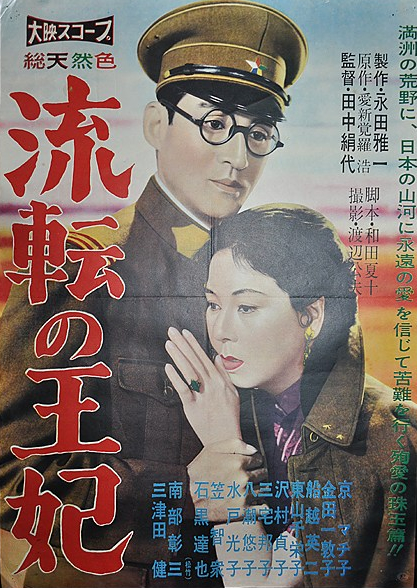
The Wandering Princess (流転の王妃, Kinuyo Tanaka, 1960)

Wandering Princess posterAs in her third film, The Eternal Breasts, Kinuyo Tanaka’s fourth directorial feature, The Wandering Princess (流転の王妃, Ruten no Ouhi), finds her working with extremely recent material – in this case the memoirs of Japanese noblewoman Hiro Saga which had become a bestseller immediately after publication in 1959. Tanaka’s filmic adaptation arrived mere months later in January 1960 which was, in an ironic twist, a year before the real life tale would meet something like the conventional romantic ending familiar from classic melodrama. Nevertheless, working with Daiei’s top talent including Kon Ichikawa’s regular screenwriter (and wife) Natto Wada, Tanaka attempts to reframe the darkness of the preceding 20 years as the defeat of compassionate idealism at the hands of rigid austerity and unstoppable oppression.

Tanaka opens with a scene taking place in 1957 which in fact depicts a somewhat notorious incident already known to the contemporary audience and otherwise unexplained on-screen in which the older Ryuko (Machiko Kyo) tenderly bends over the body of lifeless schoolgirl. The camera then pulls back to find another girl in school uniform, Ryuko, twenty years earlier. A young woman with innocent dreams, Ryuko’s life encounters the usual kind of unwelcome disruption in the unexpected arrival of a marriage proposal but this is no ordinary wedding. Ryuko, as the oldest daughter of a prominent noble family, has been selected as a possible bride for the younger brother of the former Qing emperor now installed as the symbolic leader of the Japanese puppet state of Manchuria. Against the odds, Ryuko and her new husband Futetsu (Eiji Funakoshi) are well matched and endeavour to build a happy home together just as they intend to commit themselves to the creation of a new nation born from the twin legacies of the fallen Chinese empire and the resurgent Japan.

Foregrounding Ryuko’s experience, the film does its best to set “politics” aside but the inescapable truth is that each of our protagonists is a prisoner of the times in which they live. The second scene finds Ryuko in 1937 as an innocent schoolgirl gazing at the young men in uniform as they march past her. She remains out of step with them, walking idly and at her own uneven rhythm while they keep rigorous and seemingly unstoppable time. The family are understandably wary of the implications of the marriage proposal, especially as it comes with a military escort, with Ryuko’s beloved grandmother the only one brave enough to ask to see whoever’s in charge of this outrage only to be told that their fates are in the hands of the nebulous concept known as “army” which knows no individual will.

Assured by her family that the decision rests with her, Ryuko consents – not only to becoming a stranger’s wife (which would have been her fate in any case) but to being a kind of ambassador, the presentable face of imperial ambition. On her marriage she’s presented with a deep red cheongsam and continues to dress in Chinese fashion for remainder of her life in Manchuria where she learns to speak Mandarin and devotes herself to becoming as Chinese as it’s possible to be. Meanwhile, her husband Futetsu busies himself with a complementary desire to become Japanese, intensely worried that the sometimes degrading treatment he and his family receive is exclusively caused by his problematic nationality. When their daughter, Eisei, is born, the couple determine to raise her as the child of a new world, the embodiment of idealised cultural integration.

The world, however, is not so kind and the blunt force of militarism continues to present a barrier to familial harmony. Futetsu is prevented from seeing his brother by the officious forces of the military police while the lonely, paranoid “emperor” suspects that Ryuko is nothing more than a Japanese spy sent to undermine his rule. Ryuko was sent to Manchuria to be the bridge between two cultures. Her, in a sense, feminine energy which attempts to build connection through compassion and understanding is consistently contrasted with the prevailing male energy of the age which prizes only destruction and dominance. Filled with the naivety of idealism, she truly believes in the goodness of the Manchurian project and is entirely blind to the less altruistic actions of her countrymen engaged in the same endeavour.

Confronted by some children in a park while pushing the infant Eisei in a pram, Ryuko is identified as a Japanese woman by her accent while conversing in Mandarin. She assures the children that Eisei is Manchurian like them, and that seeing as she married a Manchurian she is now too despite her Japanese birth. The kids are satisfied, so much so that they warn her that some Manchurians were killed recently in this park by Japanese soldiers, adding a mild complaint that it upsets their parents when Japanese people come to their restaurant and leave without paying. Mortified, Ryuko decides to use some of her (meagre) resources to buy all of the kids and everyone else in the park some sweets from a nearby stand, fulfilling her role as a Japanese ambassador even while insisting that she is a proud citizen of the newly born state of Manchuria.

Nevertheless the Manchurian project is doomed to fail, the kind of idealism fought for by Ryuko and Futetsu crushed under the boot of militarism. Despite everything, Ryuko still wants to be the bridge if only to prevent a catastrophe of this kind happening again (while perhaps refusing to engage with some of the reasons it happened in the first place) but in Eisei’s eventual death, foreshadowed in the melancholy opening, a deeply uncomfortable implication is made that the kind of cross-cultural harmony that Ryuko dreams of may not be viable. In contrast to the salaciously reported real life events (somewhat alluded to by presence of a schoolboy’s cap next to the body) which hinted at a suicide pact or murder, Ryuko attributes Eisei’s decision to end her life to an inability to reconcile her twin heritage coupled with the heavy burden of being the last descendent of the Qing Dynasty. Despite this minor misstep of tying the fate of Eisei to the failure of the Manchurian dream and the loss of its misplaced idealism, Ryuko ends her account on a hopeful note in admiring the flowers she planted finally in bloom and looking forward to a more hopeful age governed by warmth and compassion rather than violence and austerity.


The Wandering Princess was presented by Japan Foundation London as part of a series of events marking the publication of Tanaka Kinuyo: Nation, Stardom and Female Subjectivity.

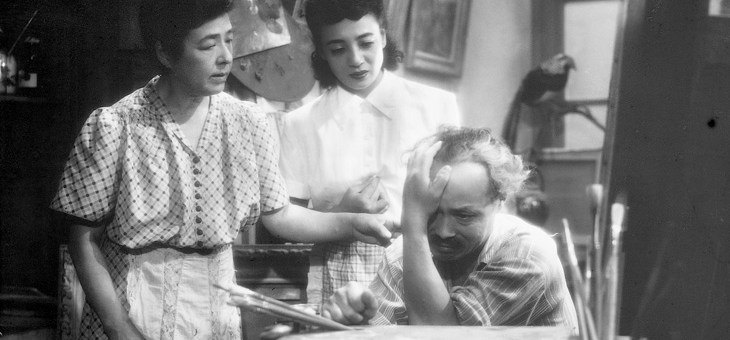
The Portrait (肖像, Keisuke Kinoshita, 1948)

vlcsnap-2018-09-06-01h35m07s763The immediate post-war period was one of fear and hardship. You might survive, but you might not like the person you’ll have to become in order to do so. The (unexpected) heroine of Keisuke Kinoshita’s The Portrait (肖像, Shozo) thought she’d made her peace with her choices, only to be confronted by a vision of her essential self as seen through the eyes of a cheerfully innocent artist. Despite the harshness of the times, there are those who’ve learned to be happy in their lot, but is their talent for happiness inspiration or irritation for those who’ve chosen a different path?

Kinoshita opens with a comic scene in which two shady real estate brokers take a look at a local property. Deciding it’s overpriced and impractical, the pair nevertheless decide to buy it together with the intention of flipping it once they convert the downstairs workspace into more practical living accommodation. There is, however, a slight hitch in that there are sitting tenants – a painter and his family who live in the room upstairs and use the rooms below as a studio. Thinking it will be easy enough to evict them, the men aren’t bothered but the the family are all so relentlessly nice that no one has yet been able to tell them to go. As a last resort, one of the men, Kaneko (Eitaro Ozawa), decides to move into the upstairs with his mistress, Midori (Kuniko Igawa), in the hope that the family will feel so awkward and in the way they will decide to vacate. Innocent and unworldly, the Nomuras all assume Midori is her lover’s daughter rather than his mistress, and start treating her like a well to do young lady. Such sudden and unexpected respect starts to weigh on Midori’s mind as she finds herself playing along, pretending to be “nice” and “respectable” while knowing that the life she’s living is anything but.

The problem is that the Nomuras are so essentially kind and welcoming that they really don’t mind sharing the house. Mr. Nomura (Ichiro Sugai), the middle-aged painter, feels guilty that he doesn’t earn more money and is too poor to move, but he’s also the sort to get over excited about having grown a giant pumpkin that he can’t resist showing to absolutely everyone. As it turns out the Nomuras are also living with a private tragedy – their eldest son Ichiro (Toru Abe) whose wife Kumiko (Kuniko Miyake) and son Koichi also live with the family has not yet returned home from the war and his whereabouts are unknown. Still, they don’t mind talking about it and are as happy as they can be, dancing away under the light of the moon – an unexpected upside to constant power outages. Meanwhile, Kaneko complains loudly as he attempts to finish his accounts in the evening gloom.

Midori half envies, half resents her new neighbours. The longer she lives with the Nomuras the guiltier she starts to feel in deceiving them. Matters begin to come to a head when Mr. Nomura asks permission to paint her portrait. He thinks Midori has a very “interesting” face, in part because he can see a sadness in her eyes that is totally absent in those of his daughter, Yoko (Yoko Katsuragi). Midori agrees and swaps her usual Western attire for the kimono her mother once gave her, but the picture Mr. Nomura paints begins to bother her. The portrait is of a pure young woman, innocent and honest, which is about as far from the way she sees herself as it’s possible to be.

As a friend of Midori’s puts it, you have to survive somehow and Midori thought she’d made her peace with the way she has decided to live but the portrait reminds her that she wasn’t always like this and now she’s not sure which version of herself she ought to despise. She wishes she could paint herself over, but feels her fate is sealed and there’s no way back. Kumiko, a little more worldly wise than her in-laws, is perfectly aware of what’s been going on upstairs but isn’t at all bothered by it. She doesn’t blame Midori for the choices that she’s made and thinks the picture is accurate in capturing her true soul, advising her that it is possible to be that woman again if that’s what she really wants.

The Portrait was scripted by none other than Akira Kurosawa whose belief in the essential goodness of humanity was perhaps not quite as strong as Kinoshita’s but the Nomuras are nevertheless typical Kinoshita heroes and it’s their unguarded warmth and kindness which begins to change the world for those around them. Even the cynical Kaneko is eventually moved by their cheerful selflessness, forced to accept their accidental moral victory rather than continue with his nefarious plan. Midori, forced into a reconsideration of herself, stands in for a generation attempting to make peace with the compromises of the past, learning that they don’t need to define the future and that it isn’t too late to strive for a more authentic life of simple happiness even if you feel you may have already sunk too far.


The Nomuras dancing in the moonlight

The Snow Flurry (風花, Keisuke Kinoshita, 1959)

Snow Flurry poster 2

Studies of the post-war world have often made the cities their home. Filled with the starving, the ruined, and the hopeless, the cities of post-war Japan were places of defeat but also of perseverance as a betrayed generation struggled to survive in whatever way they could. Generally speaking, the rural countryside seems to fare better, coping only with the absence of lost sons and lonely daughters as life goes on much as it always has. Nevertheless things are changing even here. Recalling the subversion of his earlier Army, Keisuke Kinoshita’s The Snow Flurry (風花, Kazahana) employs a complex non-linear structure to examine the various ways in which the past continues to inform the future, trapping post-war youth in the same way their parents were trapped not only with a legacy of wartime rigour but with the weight of the feudal world pressing down upon them as they struggle to escape the authority of the generation by whom they have been betrayed.

We begin with the conventional “happy ending”. A middle-aged woman looks on with genuine happiness as a younger one leaves in a bridal outfit before running off to look for her son, Suteo (Yusuke Kawazu), who has run off towards the river with dark thoughts clouding his mind. Stepping back a little, we are told that 19 years previously Suteo’s mother, Haruko (Keiko Kishi), attempted double suicide with his father, Hideo (Masanao Kawakane) – the son of the local lords. Hideo, fearing that he would soon be sent away to war and knowing that his noble family would never approve of the woman he loved, felt death was his only solution but while his attempt succeeded, Haruko’s did not. Surviving she gave birth to a child and was eventually taken in by Hideo’s family, the Naguras, but only to avoid the gossip in town that their heartlessness was the cause of their son’s death. Haruko and Suteo, rather than living in the main house with the other family members, occupy a small shed to the side of the property and are treated as a maid and farm hand respectively. The only member of the family to treat them kindly is the grand-daughter, Sakura (Yoshiko Kuga), who is a little older than Suteo and remains unmarried at 25 while her grandmother insists on finding a wealthy man willing to marry into the family and save it from dying out altogether.

Though the main action takes place in 1959, not much has changed in the village and the eventual arrival of modern cars belonging to Sakura’s prospective suitors proves jarring in more ways than one. The Naguras, once the feudal landlords, have been greatly reduced in status thanks to the post-war agricultural reforms which limited the amount of land which could be held by one family to that which they could reasonably farm themselves. This obviously means that their income has sharply decreased which, coupled with the patriarch’s profligacy, makes their present way of life untenable unless they can find a wealthy man to marry into the family and re-inject it with cash while they figure out how to make money by farming their own land. Sadly, this will be hard because the Naguras are terrible people with a bad reputation thanks not only to their unpleasant personalities but the lingering stigma of Hideo’s death and the continuing existence of Suteo.

Nagura (Yasushi Nagata), a hard man, rejected his son’s remains out of shame for his “cowardice” in refusing to die bravely for the emperor. When Suteo is born in 1941, he takes it upon himself to register the child’s birth name without consulting the mother, insisting that the child is neither hers nor his but belongs to the nation and will be expected to sacrifice himself in his father’s place to make up for Hideo’s failure of duty. “Suteo” itself means “abandoned boy” and is hardly a warm legacy to leave to anyone let alone your own grandchild and the only offspring of your own late son.

Despite their reduced circumstances, the Naguras continue to behave like lords and are trapped within the feudal pre-war world, obsessed with status and position while those around them have entered the brave new era of promised equalities and modern possibility. Sakura, the only “legitimate” child of the last generation, is literally kept a prisoner by her hardline grandmother (Chieko Higashiyama) who has insisted on conferring various “accomplishments” such as traditional dance and learning to play the piano intended to hook an upperclass husband. Such things hardly matter now in the post-war world and any man who valued them is unlikely to make her very happy, but the Naguras care little for happiness and only for their own “good” name. Sakura wanted, like her friends, to go Tokyo for university but of course she couldn’t – her family wouldn’t even let her spend time with the other girls because there were boys around and they viewed even that as “improper” given her “position”. It’s no wonder that Sakura already feels as if her life will be “crushed by the weight of this house” and longs to leave it, as well as her cold and oppressive family, far behind her.

Suteo’s tragedy is the same has his mother’s, he has fallen in love with someone who can never be his because of outdated notions of social class and the unbreakable authority of the older generation. Sakura loves him too, though she hardly knew it until faced with her own dilemma and realises a marriage is the only way to escape her miserable existence even if she must sacrifice her feelings to do so. Despite all this lifelong suffering, grandma declares herself satisfied in having reasserted her noble status in marrying Sakura off to another prominent family, even if it is to a second son and no one could be persuaded to take on their family name. The Nagura family ends here and she gives her permission for the estates to be sold after she’s gone. All of this sacrifice in name of honour was, apparently, entirely pointless.

Employing a bold non-linear structure in which past and present inhabit the same space, Kinoshita mythologises his ordinary villagers through the repeated use of theatrical narration in the songs which accompany Sakura’s traditional dance, commenting on the action with a melancholy passivity. Trapped by circumstance and burdened by legacy, his protagonists are backed into corners with no way out other than to accept the paths before them. The future for Suteo lies in “abandonment” as he prepares to reject his cruel history and attempts to start again by walking bravely into the post-war world free of feudal oppression.


Original trailer (no subtitles)

The Ballad of Narayama (楢山節考, Keisuke Kinoshita, 1958)

ballad of narayama kinoshita 1958 posterMany naughty children running low on filial piety have probably been told the folktale about a man who took his son along when he abandoned his senile father on a mountain to die only to have his son later do the same thing to him. In Japan, the mythical practice of “obasute” or “ubasute” is a kind of Logan’s Run equivalent in which elderly people elect to remove themselves from society in order to reduce the burden on the young. The Ballad of Narayama (楢山節考, Narayama-bushi Ko) has, perhaps, taken on an additional degree of pathos in ageing Japan in which many elderly people find themselves metaphorically cast out from a society in which they have become the majority, but the idea of “obasute” is intended to be a lesson to the young to treasure their elders and accept the responsibility to care for those who can no longer care for themselves in the knowledge that they too will one day be old.

Keisuke Kinoshita is sometimes criticised for his supposed sentimentalism but his central concern was always in the redemptive power of the relationships between people, that there is always kindness even in the worst of circumstances and that this is enough for hope to survive. In telling the sorry tale of Narayama in which those of over 70-years-of-age are forced into a ritual suicide by social convention, Kinoshita opts for alienation in deliberately shifting into a theatrical register inspired by kabuki featuring obvious studio sets, stylised action, and traditional narration, but his decision to pull back makes the message all the more painful, as does the insistence on the timelessness of his tale.

Long ago in the distant feudal past, 69-year-old Orin (Kinuyo Tanaka) knows that it will soon be time for her widowed son, Tatsuhei (Teiji Takahashi), to carry her to Narayama where she hopes to die of exposure in the New Year snows. She has made her peace with this, it is the will of the gods and she has no call to disobey. Her son, however, is distraught to think of the time he will be expected to carry his elderly mother to a remote spot in the mountains and leave her there, alone, to die of cold and starvation. When a messenger arrives from Orin’s home village to propose a match for Tatsuhei, a recently widowed woman of exactly the same age – Tama (Yuko Mochizuki), Orin is overjoyed – she can go to Narayama without fear or worry, her son and grandsons will be looked after even after she is gone.

The tradition began because the villages in this region are extremely poor. Tatsuhei and Orin will be enjoying their one and only bowl of white rice for the year in celebration of Bon. Orin’s self-centred grandson Kesakichi (Danko Ichikawa) has made up a horrible song about his grandma in which he criticises her for still having all her own teeth at 70 – implying that, as she is not malnourished enough to have lost them, she must have been greedy and taken more than her fair share of food. Unable to bear such reproach, Orin smashes out her own front teeth to better conform to the conventions of her society and make herself a more acceptable sacrifice to the gods as a good and pious woman.

This early horrific act is perhaps the key in illuminating Kinoshita’s gentle critique of social conformity as a tool of social control – something which had become increasingly apparent during the militarist era. Orin, a kind and decent woman, is herself complicit in this abhorrent custom – her acceptance of it is part of her goodness, a sign of her altruistic self-sacrificing nature, but her own unwillingness to challenge the darker aspects of the society in which she lives leads only to their perpetuation and an ongoing descent into unkindness and cruelty.

Tatsuhei, a good and pious son, cannot reconcile himself to his mother’s fate, while his own son, Kesakichi, openly mocks his grandmother for not going sooner and Kesakichi’s pregnant girlfriend (Keiko Ogasawara) looks on enviously at the extra beans on offer if there were one less mouth to feed. Old and bent, Orin still plays a vital part in her community – she harvests the rice while Kesakichi lounges in trees, and she alone knows the best place to catch trout, a valuable skill in a village where food is scarce. Despite the possibility for disaster, Orin and Tama bond instantly as kindred spirits, both kind people in an often unkind world. It’s to Tama that Orin finally divulges her knowledge – something the village will be poorer for when she is gone, having passed her familial responsibilities to another woman and seen her son happily settled with a perfectly suited second wife.

When Tatsuhei returns, broken, after having performed the dreaded ritual he watches his own cruel son laughing and joking from within their shared home, caring only for himself and his easy pleasures. Tama, equally upset over the loss of Orin with whom she had bonded as mother, tries to comfort her husband but is eventually overcome by the tragedy of life, taking comfort only in the fact that, when they are 70, she and Tatsuhei will climb Narayama together.

Hardship, far from bringing people together in the famous harmony that Japanese society praises itself for, has forced them apart, infected them with a sense of mutual distrust and a them or us mentality. Orin feeds the senile old man cast out from his own unfeeling family, but she also urges him towards making a sacrifice of himself on Narayama, genuinely believing that both of their existences have become inappropriate, a greedy usurpation of time which rightfully now belongs to others. Kinoshita respects Orin for her stoicism and righteousness, but pities her for the cruelty of the world in which she lived and was so powerless to resist that it never occurred to her that she should. There is a painful sensitivity around those who willingly went to their deaths in service of something they believed to be right because their society said it must be so, never daring to consider the ways in which their society may be mistaken.

Heavily stylised and markedly experimental for a mainstream Shochiku melodrama of the late 1950s, Kinoshita’s The Ballad of Narayama is a heartrending tale of transience and inevitability, but it’s also one of the various ways a stringent society erodes the bonds between people. The intense love of Tatsuhei for his mother is destroyed by a terrible custom that no one is brave enough to defy, leaving the family rudderless and the village poorer for having been robbed not only of Orin’s wealth of experience but of her warmth and kindness. Kinoshita ends on an ambiguous image showing us the modern train station which stands on the former village of “Obasute”, demonstrating the passage of time and arrival of “modernity” but also that ancient customs are never quite as “ancient” as they seem.


Scene from near the end of the film (English subtitles)

Wedding Ring (婚約指環 (エンゲージリング), Keisuke Kinoshita, 1950)

(c) Shochiku Co., Ltd

wedding ring still 2Many things have changed in the post-war world, but not everything and even with the new freedoms there are some lines which cannot be crossed. Keisuke Kinoshita made his career considering where these lines are and examining the lives of those who find themselves standing in front of them. Starring the veteran actress Kinuyo Tanaka who also produces the film, and the very young and fresh faced Toshiro Mifune, Wedding Ring (婚約指環 (エンゲージリング), Konyaku Yubiwa (Engagement Ring)) is a classic melodrama filled with forbidden love, repressed passion, and societal constraints but Kinoshita brings to it his characteristic humanity expressing sympathy and understanding for all.

Noriko (Kinuyo Tanaka) has been married seven years but her husband, Michio (Jukichi Uno), was drafted shortly after the wedding and was not repatriated until two years after the war ended. A year after he returned, Michio fell ill and has been on extreme bed rest ever since. After her father-in-law’s retirement and her husband’s illness, running of the family jewellery store fell to Noriko and so she spends the week in Tokyo taking care of business and comes back to the seaside fishing village of Ajiro where Michiro lives for the benefit of his health at the weekends. Consequently, though the couple care for each other, the marriage has never really been given the chance to take hold and they remain more companions or good friends than husband and wife.

Things change when Michio gets a new physician, Dr. Ema (Toshiro Mifune), who literally falls into Noriko’s lap during a packed bus ride from the station. Where Michio is sickly and weak, Ema is physically imposing and in robust health. Ema lives in the peaceful resort town of Atami which is on the train route from Ajiro to Tokyo meaning that Noriko and Ema sometimes wind up on the same train, developing an obvious attraction to each other which they both know to be impossible but cannot bring themselves to abandon.

In many ways Noriko is the archetypal post-war woman – strong and independent she runs the family business singlehandedly and lives alone in the city while her husband remains in the country busying himself with writing poetry. Despite the difficult circumstances, Noriko is not particularly unhappy save being unfulfilled and perhaps craving the physical intimacy her husband can no longer offer her. Her first meeting with Ema brings something in Noriko back to life as she swaps her dowdy, dark coloured suits for looser, more colourful clothing and walks with a new found spring in her step.

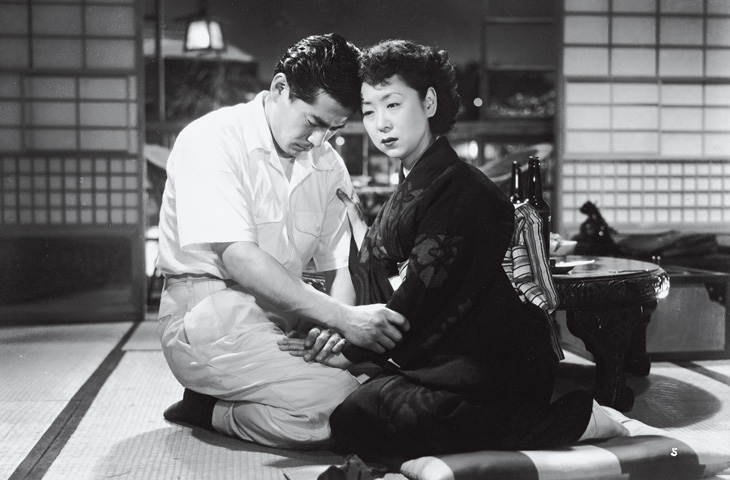
This change in his wife has not escaped the attention of Michio who astutely notices that she seems to be “glowing” – a development he silently attributes to the presence of Dr. Ema. Michio does his best not to resent the doctor but internalises a deep seated feeling of guilt and inadequacy as he realises that he can no longer provide what his wife needs and has become an obstacle to her happiness. A sensitive man apparently marked by his wartime experiences, Michio is angry and jealous but also resents himself for feeling that way, deepening his depression and conviction that he is nothing but a burden to his wife who deserves a full marriage with a man who can satisfy all of her needs and desires.

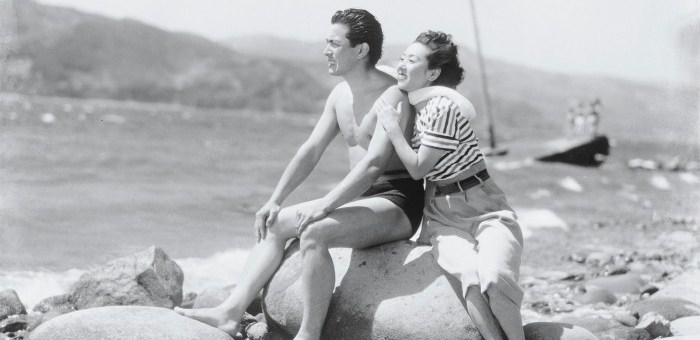
Desire is certainly something Noriko feels as she gazes at Ema’s powerful hands, broad shoulders, and athletic physique. Clasping his sweaty jacket to her breast in desperation eventually gives way to accidentally bold physical contact as hands catch hands and Noriko finds herself caressing Ema’s shoulder as he prepares to dive back into the sea dressed only in his woollen trunks. Ema feels the same attraction but also understands that it cannot be, not least because he is Michio’s physician and has begun to have idle fantasies of being unable to save him, freeing Noriko from her unfulfilling marriage so they can finally be together. Both sensible people, Noriko and Ema are eventually able to discuss their feelings and social responsibilities in a mature fashion, agreeing that they cannot act on their desires even if they find them hard to relinquish.

Rather than wedding ring, the Japanese title of the film more accurately refers to an engagement ring. Noriko’s wedding ring never comes off, but the engagement ring with its large stone comes to represent her shifting allegiances. Discovering the ring abandoned on the dresser, Michio begins to understand he is losing his wife to the strapping young doctor whose healthy, powerful body he cannot help but envy. The camera seeks out Noriko’s hand, with or without the shiny diamond of the engagement ring, quickly signalling the current direction of her desires.

Michio, who cannot give full voice to his emotions, expresses himself through tanka poetry, something which the equally sensitive doctor can also understand and later makes use of himself in communicating the inexpressible delicacy of his feelings to the married woman with whom he has fallen in love. Torn between love and duty, Noriko and Ema battle their mutual passion while Michio battles his sense of self and feelings of ongoing inadequacy but Kinoshita refuses to condemn any of them, rejecting an angry showdown for a nuanced consideration of personal desire versus social responsibility. The conclusion may be conservative, but the journey is not as the trio eventually part friends even if with lingering sadness in accepting the choice that has been made and resolving to move forward in friendship rather than rancour.


Screened at BFI as part of the Women in Japanese Melodrama season.

Opening scene (no subtitles)
Three Loves (三つの愛, Masaki Kobayashi, 1954)

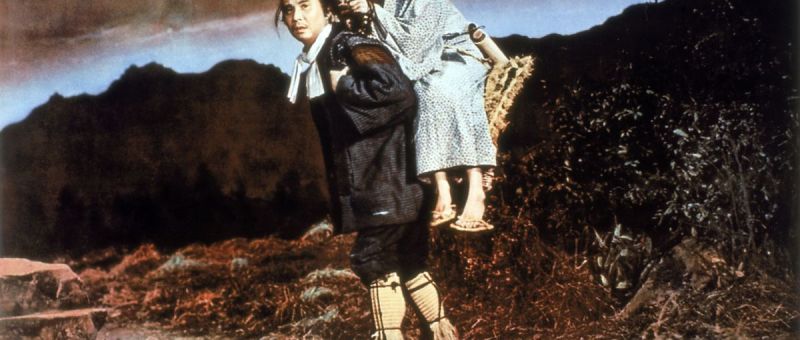
three-lovesMasaki Kobayashi had a relatively short career of only 22 films. Politically uncompromising and displaying an unflinching eye towards Japan’s recent history, his work was not always welcomed by studio bosses (or, at times, audiences). Beginning his post-war career as an assistant to Keisuke Kinoshita, Kobayashi’s first few films are perhaps closer to the veteran director’s trademark melodrama but in 1953 Kobayashi struck out with a more personal project in the form of The Thick-Walled Room which dealt with the fates of lower class war criminals. Based on a novel by Kobo Abe, the film was sympathetic to the men who had only been “following orders” but was careful not to let them off the hook. Still far too controversial, The Thick-Walled Room could not be released until 1957 and Kobayashi went back to more conventional fare such as this Christianity infused tale of three kinds of frustrated loves – romantic, spiritual, and familial, Three Loves (三つの愛, Mittsu no Ai).

Ikujiro is riding into town on a donkey cart, playing his flute which attracts the attention of a strange boy who exclaims that he is a butterfly. Following the death of his father, Ikujiro’s mother has apprenticed him to a man who owns a sake brewery but is also a member of the school board and has promised that he will get his education. Riding the same cart in is a down on his luck artist, Nobuyuki (Ko Mishima) – the lover of the town’s new music teacher, Michiko (Keiko Kishi), who has travelled to this remote country spot both for the benefit of her health and to help provide for her struggling artist boyfriend. This slightly unusual town is also home to a humble church whose Holy Father, Yasugi (Yunosuke Ito), came to the town as an evacuee alongside the now professor father of the little boy with a pigeon obsession, Heita.

Somewhat unusually, Three Loves opens with a choral rendition of a Christian hymn followed by a brief voice over and intertitle-style caption bearing the message that only those who live sincerely and seriously will be granted true joy but that this same joy is born from the bitterness and sadness of life. There are certainly an array of bitter circumstances on offer but Kobayashi choses to focus on them as filtered through three very different stories of love as children are separated from their parents, lovers are kept apart by cruel twists of fate and the love of God is both keenly and invisibly felt by those who take refuge at the underused church.

Ikujiro has been “sent away” by his mother who has been convinced to allow her oldest child to be raised by foster parents given that it will now be difficult for her to support all of the children in the absence of her husband. Feeling alone and unloved though missing his family, Ikujiro does not quite fit in at the local school but faces even more problems at his new home where it transpires that his foster father is not quite as altruistic as he originally claimed. Forming an odd friendship with Heita, Ikujiro begins to find some comfort in the place but nevertheless continues to suffer.

Heita, is, in many ways the heart of the film though his status as a kind of holy fool is perhaps uncomfortable from a modern standpoint. Yasugi, who has developed the closest relationship with the boy outside of his mother, describes him as beautifully sensitive and someone who requires especial care. Yet, his mother found it difficult to connect with him until he was allowed to return to nature, and his scholarly father mostly ignores him, describing his work as a kind of “atonement” for the way his son has turned out. Even given Heita’s unorthodox relationship to his environment in which he feels himself more bird or butterfly than human, he experiences only warmth and occasional exasperation from those around him rather than outright hostility.

These kinds of frustrated familial or social loves feed back into the intertwined romantic melodrama as tortured artist Nobuyuki has an attack of male pride in partially rejecting Michiko over her decision to become the major breadwinner despite her failing health. Professing love but remaining unwilling to marry because of his lack of financial security, he only wounds the woman he loves who wants nothing other than for him to go on painting and thinks of what he regards as a “sacrifice” of herself in working to support them both as part of their shared struggle. Becoming gloomy and depressed, Nobuyuki posits giving up on love, but eventually comes around, realising some things are more important than pride though old fashioned ideas about illness still pose a problem.

This in turn drives the central spiritual dilemma as Father Yasugi is forced to face his own emotional pain which he has long been trying to sublimate with service to something higher. Ten years previously, his wife left him for another man but his continuing love for her is the very reason he cannot bring himself to do what his own religion requires and forgive her for the pain and suffering which now cloud his heart. God is love, but love is pain and suffering without end. Thus he councils the romantically troubled couple against a marriage which may end suddenly creating even more heartbreak and everlasting sadness, which seems at odds with his own, and the film’s, insistence on the joy that life brings even whilst filled with sorrow and regret.

An early effort from Kobayashi, Three Loves is not as successful as his other work from the period offering none of the rawness or innovation of The Thick-walled Room, falling back on established melodrama techniques though making interesting use of montages and dissolves even if coupled with familiar horizontal wipes. The tone is more forgiving than Kobayashi’s later angry social tirades, but the muddled structure and strange use of religious themes make for a frustrating experience which ends in a traditionally melodramatic way offered abruptly and without further comment. A death of innocence may be Kobayashi’s concession to his own bleaker world view but feels like a standard Shochiku tearjerker ending, an afterthought tacked on as a concession to studio requirements. Still, an interesting meditation on the nature of love in all its different forms, Three Loves is an unusually contemplative piece even if frustrated by a slight clumsiness of execution.