Veteran (베테랑, Ryoo Seung-wan, 2015)

1439210220_베테랑1Review of Ryoo Seung-wan’s Veteran (베테랑) – first published on UK Anime Network.


One of the top Korean box office hits of 2015, Ryoo Seung-wan’s Veteran is a glorious throw back to the uncomplicated days of ‘80s buddy cop crime comedy thrillers. A little less than subtle in its social commentary, Veteran nevertheless takes aim at corrupt corporate culture and the second generation rich kids who inherit daddy’s company but are filled with an apathetic, bored arrogance that is mostly their own.

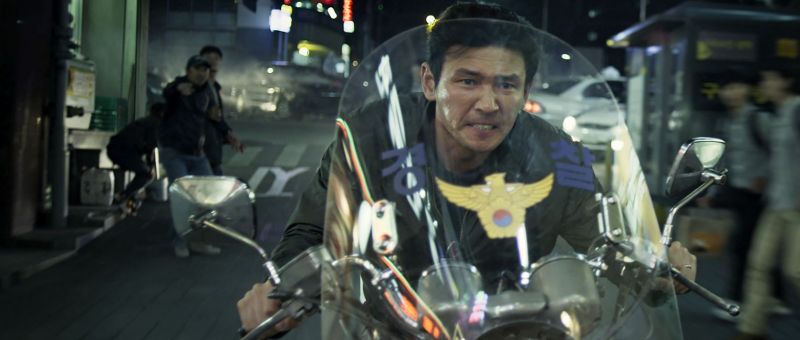
Seo Do-cheol (Hwang Jung-min) is, as one other officer puts it, the kind of police officer who joined the force just to beat people up. He loves to fight and isn’t afraid of initiating a little “resisting arrest” action just to make things run a little more smoothly. However, when he strikes up a friendship with a put upon truck driver and his cute as a button son only to miss a crucial telephone call that eventually lands said truck driver in the hospital, Do-cheol’s sense of social justice is inflamed. After trying to join a trade union, Bae, the truck driver, is unceremoniously let go from his company. On taking his complaint directly to the head of Sin Jin Trading, play boy rich kid Tae-oh, Bae is subjected to the most cruel and humiliating “interview” of his life before apparently attempting to commit suicide after having realised the utter hopelessness of his situation. Incensed on his new friend’s behalf, Do-cheol is determined to take down these arrogant corporatists what ever the costs may be!

Veteran makes no secret of its retro roots. It even opens with a joyously fun sequence set to Blondie’s 1979 disco hit, Heart of Glass. Like those classic ‘80s movies, Veteran manages to mix in a background level of mischievous comedy which adds to the overall feeling of effortless cool that fills the film even when things look as if they might be about to take a darker turn. The action sequences are each exquisitely choreographed and filled with sight gags as the fight crazy Do-cheol turns just about any random object that appears to be close to hand into an improbable weapon.

Make no mistake about it either, this is a fight heavy film. Though Veteran has a very masculine feeling, it is to some degree evened out by the supreme Miss Bong whose high class high kicks can take out even the toughest opponents and seem to have most of her teammates looking on in awe, and the withering gaze of Do-cheol’s put upon wife who seems determined to remind him that he’s not some delinquent punk anymore but a respectable police officer with a wife and child who could benefit from a little more consideration.

Indeed, Tae-oh and his henchmen aren’t above going after policemen’s wives in an effort to get them to back off. Though this initial overture begins with an attempt at straightforward bribery (brilliantly dealt with by  Mrs. Seo who proves more than a match more the arrogant lackeys), there is a hint of future violence if the situation is not resolved. Tae-oh is a spoiled, psychopathic rich kid who lacks any kind of empathy for any other living thing and actively lives to inflict pain on others in order to breathe his own superiority. Probably he’s got issues galore following in his successful father’s footsteps and essentially having not much else to do but here he’s just an evil bastard who delights in torturing poor folk and thinks he can do whatever he likes just because he has money (and as far as the film would have it he is not wrong in that assumption).

He also loves to fight and finally meets his match in the long form finale sequence in which everything is decided in a no holds barred fist fight between maverick cop and good guy Do-cheol and irredeemable but good looking villain Tae-oh. Veteran never scores any points for subtlety and if it has any drawbacks it’s that its characterisations tend to be on the large side but what it does offer is good, old fashioned (in a good way) action comedy that has you cheering for its team of bumbling yet surprisingly decent cops from the get go. Luckily it seems Veteran already has a couple of sequels in the pipeline and if they’re anywhere near as enjoyable as the first film another new classic franchise may have just been born.


Reviewed at the first London East Asia Film Festival and the London Korean Film Festival.

The Bullet Vanishes (消失的子弹, Law Chi-leung, 2012)

20128291720405212Review of Law Chi-leung’s The Bullet Vanishes (消失的子弹, Xiāo Shī Dè Zǐ Dàn) – first published on UK Anime Network in June 2013.


In 1930’s Shanghai there’s a bullet factory where a young girl has been accused of pilfering. The punishment, it seems, is a cruel and very public trial by Russian roulette where fate, the gods or whoever will judge her innocent or guilty with a simple click or a loud bang. Crying out her innocence to the end, the girl pulls the trigger and presumably never actually hears the outcome as her co-workers look on in horror – she must have been guilty though, right? Or she would have been spared by the immortal powers at be.

Following this horrific incident, other deaths start to occur in the factory – the strange thing is, on examining the bodies, no trace of a bullet can be found (nor any casings at the scene). Some of the munitions workers start to believe the ghost of the poor girl who died must have returned to take revenge – perhaps she was innocent after all. To solve this intriguing mystery, the police turn to two unorthodox detectives – recently transferred former prison warden Song (Lau Ching-Wan) and maverick cop “fastest gun in town” Guo (Nicholas Tse). Neither of these two are buying the “supernatural” explanation and both are determined to get to the truth even if they work in very different ways. The solution is going to be a lot more complicated than anyone could have thought, and will, ultimately, be painful to hear.

Let’s get this out of this way first – yes, the film owes a significant debt to the recent “westernisation”, if you want to put it that way, of Ritchie’s Sherlock Holmes and other Victorian set crime dramas (e.g. Ripper Street) which seek to present themselves as taking place in a totally lawless world denizened by a criminal population that is somehow both repellent and glamourous. Although The Bullet Vanishes is set in 1930s, it still has a noticeably “Victorian” sensibility presenting a world in which rapid industrialisation has brought about mass corruption and a decline in morality. Once again, setting a film in China’s past proves to be a surefire way of getting subtextual criticisms of modern China past the country’s strict censorship regulations.

The murder mystery itself is certainly very intriguing with a series of unpredictable twists and turns. The idea of disappearing bullets might not be a new one, but The Bullet Vanishes manages to find an original solution that is perfectly plausible within its own time setting. Also, the “supernatural” element exists only as an idea and is never seriously entertained as an explanation by any of the investigators – something of a break from the genre norm.

The two detectives seem much more like rivals than partners for much of the film though an awkward sort of camaraderie does eventually grow up between them. Lau and Tse both give excellent performances but Tse in particular who’s often criticised for being a pretty boy trading on family connections, really proves himself with his surprisingly complex Guo. There is, however, the familiar criticism that the female characters are severely underdeveloped and seem almost like a rushed afterthought. Yang Mi gives a lot to the barely two dimensional Little Lark but can’t disguise the fact that the character only exists as a love interest for Guo and that in turn a love interest for Guo only exists so that we can have the “obligatory” love scene. That wouldn’t be so much of a problem if the love scene itself didn’t feel quite so “obligatory” – it could easily have been excised and the film would have remained pretty much unchanged as the scene feels as if it exists purely to satisfy a perceived audience need for romance.

There really isn’t much to fault with The Bullet Vanishes. As a slightly cerebral mainstream period thriller it’s certainly very successful. It has an engaging mystery element, strong characters played excellently by the cast and extremely slick, modern direction. In Song they’ve created a very interesting character who’d be very welcome in a sequel or two. His relationship with female prison inmate, a sort of Irene Adler figure to Song’s cerebral detective, who he’d previously investigated before being transferred was quite an usual idea that would really benefit from further exploration. All in all The Bullet Vanishes is a very impressive and enjoyable period procedural that is truly a cut above its genre origins.


http://www.youtube.com/watch?v=8oZOMNeJjzQ


Pale Moon (紙の月, Daihachi Yoshida, 2014)

Pale-Moon_MainDaihachi Yoshida’s last venture into human dynamics, The Kirishima Thing, took the high school environment as a microcosm for society as a whole. In some senses painting on a large canvas by illuminating the inner lives of these teenagers acting as both individuals and as members of a group, The Kirishima Thing was equal parts ensemble character drama and probing social commentary. Pale Moon (紙の月, Kami no Tsuki) is no different in this regard although it focuses more tightly on one individual and shifts age groups from turbulent adolescence to middle aged desperation. Set in 1994 just after the bubble burst, this gleefully cheeky (im)morality tale takes another sideways glance at the social norms of contemporary Japan.

Rika (Rie Miyazawa) is a demure woman in her early forties. A childless former housewife, she’s recently moved from a part time position at a bank to a full time job where she works as a kind of personal banking assistant visiting wealthy clients at home to discuss their financial needs and physically depositing their money in the bank for them. Efficient, reserved, reliable – Rika is the perfect employee, that is until one day she spends some of a client’s money because there isn’t quite enough in her purse. She takes the money straight out of an ATM and replaces it right away, of course, but a line has been crossed. It’s a quick step from a gentle misappropriation of funds to a series of interestingly decorated hotel rooms with a boy half your age, embezzlement on a grand scale, blackmail, bank fraud – the list goes on. How did it ever come to this? Yet, it’s the strangest thing – Rika has never felt more alive.

Money – it’s the life blood of capitalism. It makes the world go round and drives people crazy as they try to amass even more little bits of paper with numbers written on them. It’s fake, an illusion that we’ve all bought into – no more real than a paper moon (to go by the film’s original Japanese title), though we continue to set all of our hopes afloat on its surface. When Rika finally convinces her financially challenged young lover to accept her (stolen) money, she tries to convince him that nothing will change but, of course, it does. The dynamics fluctuate and money gets in the way, the toxicity of debt starts to eat away at any genuine connection that may have existed. The irony is, Rika is one of those people who steals in order to give away. It sounds selfless, even altruistic, but is in fact the most intensely selfish action that can be taken. “It’s better to give than to receive” goes the mantra of the nuns of the Catholic school where young Rika was educated, but they also council that charity should never have anything to do with your own gratification. This is the lesson that Rika finds so hard to learn, it feels so good to give – how can it be wrong to take?

It’s easy to say that the world has changed a lot in the intervening twenty years between now and the time the bulk of the action takes place, but maybe it hasn’t. The first thing that strikes you is how extraordinarily sexist Rika’s world is. It’s not long before she’s being asked questions about her marital status whilst being made to feel uncomfortable, alone in the home of her elderly male client. Then at the office her boss praises her efforts whilst sadly lamenting that women have more “tools” at their disposal than men do, which is both insultingly crude and a put down of her skills and hard work. Rika only gets her permanent position because another woman, an employee of nineteen years standing, has been forced out through a campaign of constructive dismissal because the big wigs don’t like paying higher salaries to older female workers but they won’t promote them past a certain level either. Her younger colleagues make fun of their “spinster” supervisor, Sumi (Satomi Kobayashi), who, only a generation older, had to make a clear cut choice between work and family and having chosen a career now sees the rug being pulled out from under her with the standard “transfer to head office” game plan in place to force her into retirement.

Rika’s home life offers a similar level of hope for the future. Her husband is probably well meaning, but totally insensitive and the marriage is at best unfulfilling. He pooh-poohs his wife’s thriftiness and her new “hobby” at the bank, totally failing to understand her motivation. At one point he announces he’s being transferred abroad so she’ll have to give her notice – it never occurs to him she may not wish to go, let alone that she’d refuse over something so trivial as her own job. It’s little surprise then that she’d so quickly fall for a handsome and attentive stranger. An “amour fou”, an old story but no less potent than it ever was.

Rika knows none of it’s real – that her temporary crime fuelled reprieve can’t go on forever, but that only makes her feel more free. In one telling episode, Rika is talking to a granny she’s in the process of swindling and remarks on her beautiful new necklace. What a shame it’s fake, Rika says, but the old lady replies that she knows it’s only imitation but she doesn’t care – it’s pretty, she likes it and she’s happy. That perhaps is the answer. Rika saw her chance and she took it. That takes some courage and whatever the moral outrage one might feel, there’s something undeniably admirable, even exciting, about Rika’s dramatic escape from the constraints of conventional social behaviour.


Pale Moon is receiving its UK Premier at the Glasgow Film Festival on 19th February so if you’re in the Glasgow area be sure to check it out!

Brain Man 脳男

imgnewly1-187l

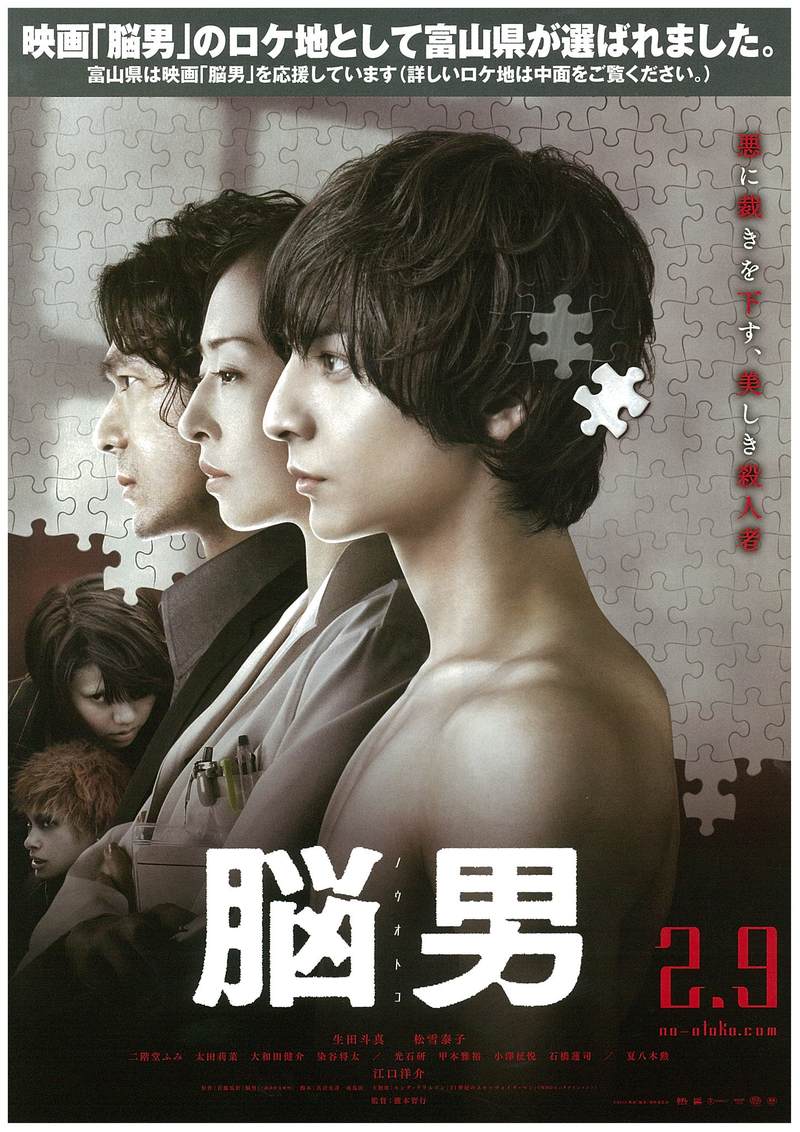
Based on the Edogawa Rampo award winning novel by Urio Shudo, Brain Man is a stylish psychological thriller which addresses such themes as guilt, redemption and the effects of childhood trauma. Are some people just born bad, can even those who’ve committed terrible crimes be rehabilitated? People on opposite sides of the legal system seem to have some conflicting ideas but perhaps the answer is never going to be as simple as ‘yes’ or ‘no’.

While a series of explosions rock a small provincial town, forensic psychologist Mariko Washiya (Yasuko Matsuyuki)  is the head of a research programme which aims to help convicted felons come to terms with their crimes through interacting with the victim’s families and there by coming to feel a kind of empathy for all the hurt and destruction they have caused. After leaving the office one day she races to catch the bus only to miss it by seconds while a bunch of bratty kids make faces through the window. Moments after the bus pulls away, it explodes killing all on board. Becoming an unwitting witness to events, Mariko finds herself at odds with the hardline policeman investigating the crime. When the police arrest the perfect suspect, a strange, near silent man discovered at the site of an explosion, Mariko is called upon to examine him. Ichiro Suzuki (Toma Ikuta) presents himself robotically, answering each of Mariko’s questions at face value no matter how strange and otherwise remaining motionless. That is, until something disturbs his sense of justice and he breaks out some killer martial arts moves. As might be expected, nothing is quite as cut and dried as it might seem on the surface and something convinces Mariko that there might be something more ‘human’ locked away deep down in Ichiro’s psyche.

First and foremost Brain Man is pretty mainstream thriller which means it isn’t totally free of a few melodramatic turns and far fetched plot developments but by and large it gets away with them. The first plot line centred around the bombings quickly gives way to the mystery surrounding Brain Man himself before getting back to the bombers towards the end. The two narrative strands sometimes seem at odds with each other and don’t feel as cohesive as they perhaps should. Though having said that though the “bombers” plotline is definitely the film’s second strand it gives ample room for Fumi Nikaido’s gloriously crazed depiction of a drug addled lesbian terrorist which she manages to play in a refreshingly restrained way (well, as far as the part allows – it is a particularly well pitched performance). There is also even a third subplot regarding Mariko’s prestige project of a young man who’s shortly to be released from a young offenders institute (played by Shota Sometani) seemingly rehabilitated and eager rejoin society all thanks to Mariko’s new therapy program which plays in conjunction with a fourth subplot concerning Mariko’s family and its own past traumas. Undoubtedly, there’s a lot to juggle but Brain Man makes a surprisingly valiant attempt at getting it all to work together.

Director Tomoyuki Takimoto is probably best known for his previous film Ikigami: The Ultimate Limit – a low budget though similarly impressive adaptation of a manga. Brain Man has a slightly higher budget and its fair share of flashy direction both of which impress from the get go. Even more so Takimoto has amassed a cast of up and coming stars who each turn in well rounded performances ranging from the completely out there extremes of the aforementioned Fumi Nikaido to Shota Sometani’s small but complicated patient and, of course, Toma Ikuta’s powerful portrayal of the near silent and emotionless killing machine the Brain Man not to mention Yasuo Matsuyuki’s warm hearted doctor.

Although a little slow to get going initially and excusing the odd lacuna brought about by throwing the points on the great train track of narrative, Brain Man manages to pack in a decent amount of excitement into its relatively tightly plotted structure. In many ways it isn’t particularly original, but it does what it does pretty well and mixes in enough twists and turns to keep even the most jaded mystery enthusiast interested. Perhaps a little bit too crazy for its own good, Brain Man is another classy Japanese thriller that isn’t afraid that isn’t afraid to go to some pretty strange places in the name of entertainment.

Cold in July

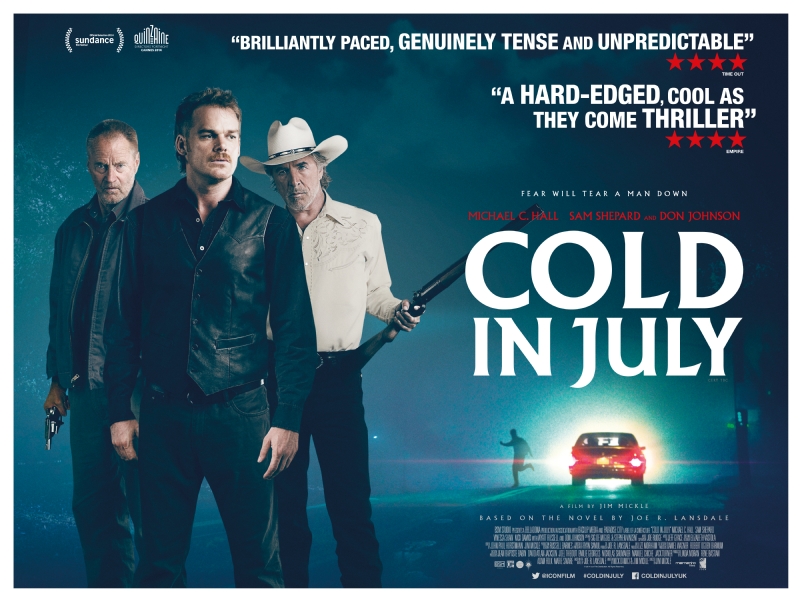
cold-in-july-quad-posterBased on Joe R Lansdale’s novel of the same name, Cold in July is an homage to classic ’80s neon tinged noir with a noticeable digression into Southern Gothic, revenge thrillers and B-movie heroics. Small town Texas picture framer Richard Dane (Michael C. Hall) is woken by his wife one night after she begins hearing strange noises from downstairs. Fearfully arming himself with his father’s old pistol hidden in a shoebox in his wardrobe, Richard tiptoes downstairs only to find a masked and hooded figure standing in his living room. In a halted moment Richard confronts the intruder with the gun and, hands shaking, uncertain what to do next locks eyes with the would-be burglar now held motionless as if in a tractor beam. As Richard holds his course, the mantlepiece clock begins to strike and whether accidentally or in panicked terror the gun goes off sending its explosive charge into the scenic landscape hanging on the wall by way of the burglar’s right-eye. The police arrive to find a traumatised Richard near catatonic in disbelief but oddly seem fairly congratulatory – “it must have been difficult, for a man like you” his Sheriff friend tells him, with heavy implications. Assured that it’s legally self defence and nothing further is likely to come of the matter Richard tries to return to his previous small town, family man life but the incident has left him jittery and with a noticeable ambivalence toward firearms. However, despite what the police may say it’s not quite over yet – the burglar had a father, and a psychotic one at that. An eye for an eye as they say, or a son for a for son – only, that’s not quite it either and before he knows it, Richard finds himself involved in a complex circle of crime and conspiracy.

Cold in July lines itself up with those late ’80s slightly sleazy, hyper violent crime thrillers in which one ordinary man must face off against some kind of larger danger which threatens the very foundations of his world. The period detail is exact with the book’s 1989 setting recreated faithfully down to every last detail from the bizarre red neck haircuts, giant portable telephones and floral furniture craze to VCRs and vintage 80s Apple Macs. The look has an appreciably 80s vibe with heavy grain despite having been filmed on digital RED cameras and the Carpenter-esque synth score give it the air of something that could have been made thirty years ago. Like all the best 80s small town crime stories there’s the melancholy and oppressive feeling of something not quite right, that there are no safe places and even in these cosy little towns there’s a great festering wound that’s rapidly turning rotten.

Like its ’80s settings, these are some old fashioned ‘heroes’ who display an unabashed adherence to ‘traditional’ ideas of masculinity. Richard is a mild mannered picture framer – work that requires skill and artistry rather than physical strength. After Richard shoots the man who threatened his home, the town’s reaction is less fear or sadness but almost joyful respect. “We didn’t think you had it in you” seems to be the general consensus from everyone from the local postman to the glowing write-up in the local paper. Before he was an emasculated husband and father, but now – having killed, he’s a man. Real men shoot first and don’t bother with questions at all. Despite Richard’s discomfort with his actions, with the reaction to his actions and even his own lingering feeling of inferiority he can’t escape the fact that something that he sees as weakness is being held up as heroism.

These old fashioned macho ideas are clearly something that continues to be passed from father to son – something that Richard begins to worry about when his own son playfully points a toy gun at him. The two older men – Don Johnson’s Jim-Bob the private-eye-cum-pig farmer and would be vengeful father Russell (Sam Shepard) are veterans of the Korean War and come from a generation steeped in conflict in which men are judged by their physical strength and survival techniques. Richard appears to have had some kind of strained relationship with his own (presumably deceased) father as though he keeps his gun in a shoebox at home, he seems pained every time the subject comes up. Russell hasn’t seen his own boy since he was a child and feels he’s failed as a father and perhaps as a man (in so far as a man is duty bound bring his son up right). What Richard learns from them is a lesson in old school masculinity – you carry the gun, you put things right. There’s an archetypal idea of chivalry there, that you stand up and protect your own and that the sins of the son are also visited on the father who must atone for failing to prevent such transgressive behaviour. There is something noble in it, but it is also dangerous – can a man who’s taken care of business, even in the name of his community, really return and live amongst other men?

Genre-busting as it is, the Cold in July mostly keeps itself together even as the action threatens to descend into the ridiculous. A thin stream of black humour helps to paint over its excesses as does its sheer joy in the larger than life elements such as the improbable Jim-Bob’s gaudy red cadillac, stetson hat and penchant for cool one-liners. There are undoubtedly a host of plot holes to the extent that it might be better to just avoid thinking about the sequence of events as a whole – the most obvious being a glaringly obvious loose end that everyone seems to have forgotten about. To be fair, no one leaves The Big Sleep shouting “yes, but who killed the chauffeur?”, a few potholes here and there don’t necessarily ruin the road and Cold in July is not a film about its plot. As an exercise in style, Cold in July excels but it also manages to pack in enough social commentary and primal melancholy to give its old fashioned morality tale some weight. Its politics maybe unpalatable and its outlook distinctly 1950s but Cold in July is among the best of recent retro exploitation B-movie throwbacks and walks its own path with considerable assuredness.

The Snow White Murder Case (白ゆき姫殺人事件, Yoshihiro Nakamura, 2014)

Review of The Snow White Murder Case (白ゆき姫殺人事件, Shiro Yuki Hime Satsujin Jiken) published on UK-anime.net


The sensationalisation of crime has been mainstay of the tabloid press ever since its inception and a much loved subject for gossips and curtain twitchers since time immemorial. When social media arrived, it brought with it hundreds more avenues for every interested reader to have their say and make their own hideously uniformed opinions public contributing to this ever growing sandstorm of misinformation. Occasionally, or perhaps more often than we’d like to admit, these unfounded rumours have the power to ruin lives or push the accused person to a place of unbearable despair. So when the shy and put upon office worker Miki Shirono (Mao Inoue) becomes the prime suspect in the brutal murder of a colleague thanks some fairly convincing circumstantial evidence and the work of one would-be microblogging detective, the resulting trial by Twitter has a profound effect on her already shaky sense of self worth.

The body of Miki Noriko (Nanao) has been found in a wood burned to a crisp after being viciously stabbed multiple times. Beautiful, intelligent and well connected, Noriko seems to have been well loved by her colleagues who are falling over themselves to praise her kind and generous nature, proclaiming disbelief that anyone would do such a thing to so good a person. One of these co-workers, Risako (Misako Renbutsu), happens to have gone to school with TV researcher, Akahoshi (Go Ayano) who’s a total twitter addict and can’t keep anything to himself, and decides to give him the lowdown on the goings on in her office. Apparently the offices of the popular beauty product Snow White Soap was a hotbed of office pilfering filled with interpersonal intrigue of boy friend stealing and complicated romantic entanglements. Working alongside Noriko and Risako was another ‘Miki’, Shirono (Mao Inoe), who tends to be overshadowed by the beautiful and confident Noriko who shares her surname. Shy and isolated, Shirono seems the archetypal office loner and the picture Risako paints of her suggests she’s the sort of repressed, bitter woman who would engage in a bit of revenge theft and possibly even unhinged enough to go on a stabbing spree. Of course, once you start to put something like that on the internet, every last little thing you’ve ever done becomes evidence against you and Shirono finds herself the subject of an internet wide manhunt.

In some ways, the actual truth of who killed Noriko and why is almost irrelevant. In truth, the solution to the mystery itself is a little obvious and many people will probably have encountered similar situations albeit with a less fatal outcome. Safe to say Noriko isn’t quite as white as she’s painted and the film is trying to wrong foot you from the start by providing a series of necessarily unreliable witnesses but in many ways that is the point. There are as many versions of ‘the truth’ as there are people and once an accusation has been made people start to temper their recollections to fit with the new narrative they’ve been given. People who once went to school with Shirono instantly start to recall how she was a little bit creepy and even using evidence of a childhood fire to imply she was some kind of witch obsessed with occult rituals to get revenge on school bullies. Only one university friend stands up for Shirono but, crucially, she is the first one to publicly name her and goes on to give a lot of embarrassing and unnecessary personal details which although they help her case are probably not very relevant. Even this act of seeming loyalty is exposed as a bid for Twitter fame as someone on the periphery of events tries to catapult themselves into the centre by saying “I knew her – I have the real story”.

Of course, things like this have always happened long before the internet and social media took their primary place in modern life. There have always been those things that ‘everybody knows’ that quickly become ‘evidence’ as soon as someone is accused of something. Some people (usually bad people) can cope with these accusations fairly well and carry on with their lives regardless. Other people, like Shirono, are brought down in many ways by their own goodness. What Risako paints as creepy isolation is really mostly crippling shyness. Shirono is one of those innately good people who often puts herself last and tries to look after others – like bringing a handmade bento everyday for a nutritionally troubled colleague or coming up with a way for a childhood friend to feel better about herself. These sorts of people are inherently more vulnerable to these kinds of attacks because they already have an underlying sense of inferiority. As so often happens, this whole thing started because Shirono tried to do something she already thought was wrong and of course it turned into a catastrophe which resulted in her being accused of a terrible crime. The person who manipulated her into this situation likely knew she would react this way and that’s why meek people like Shirono are the ultimate fall guy material.

Like Yoshihiro Nakamura’s previous films (Fish Story, The Foreign Duck, The Native Duck and God in a Coin Locker – both available from Third Window Films), The Snow White Murder Case is full of intersecting plot lines and quirky characters and manages to imbue a certain sense of cosmic irony and black humour into what could be quite a bleak situation. The Twitter antics are neatly displayed through some innovative on screen graphics and the twin themes of ‘the internet reveals the truth’ and ‘the internet accuses falsely’ are never far from the viewer’s mind. It’s testimony to the strength of the characterisation (and of the performances) that Shirono can still say despite everything she’s been through ‘good things will happen’ in attempt to cheer up someone who unbeknownst to her is the author of all her troubles, and have the audience believe it too. A skilful crime thriller in which the crime is the least important thing, The Snow White Murder Case might quite not have the emotional pull of some of the director’s other work but it’s certainly a timely examination of the power of rumour in the internet age.


Original trailer (English subtitles)

Seven Psychopaths – LFF 2012

I won’t lie – I almost didn’t go to this screening as I’d seen a lot of ‘worst film I’ve even seen’ comments coming in from various festivals and then from the LFF press screening and I wasn’t sure I was definitely going to be able to make it. However being a huge fan of McDonagh’s stage work (I count the original production of The Pillowman at the RNT one of the theatre going highlights of my life) there was no way I was never going to see this film. Although I wasn’t as enamoured with In Bruges as many people were – mostly because I missed the sense of anarchy from his stage productions – I’d been looking forward to his next film for some time. Seven Psychopaths plays out almost like a big screen version of Lieutenant of Inishmore only it’s a missing dog rather than a cat and psycho crook rather than a guy who was thrown out of the IRA for ‘being too mad’ with a whole load of metatextual commentary  going on. Oh and bloody violence, lots of that, alongside totally absurd, jet black humour – yep, that’s a McDonagh script!

Marty (Farrell) has some problems. The first of which being that he’s way behind on a screenplay he’s supposed to have delivered already – in fact he hasn’t even started it, well he has the title ‘Seven Psychopaths’. Only he’s only come up with the one – a Buddhist psychopath but he can’t work out how all the homicidal mania and enlightenment go together. Besides which he really wants to write a film that’s not all guns and violence, one that’s about peace and love and humanity. His second problem is drink, which is possibly part of the cause of his first problem. His third problem is a incredibly poor choice in friends – i.e. an out of work actor, Billy Bickle (Rockwell), who makes his money through a dog kidnapping scam and thinks a really great way to help with the psycho problem is to take out an ad asking for the biggest psychos around to call Marty’s own number and offer their stories for the film. One day however Billy and his friend Hans (Walken) are going to mess with the wrong guy’s dog and drag Marty into a whole world of psychopathic violence and general existential despair.

Yes, like its filmic counterpart the Seven Psychopaths that we are watching is a film about humanity and friendship and art that ended up having lots of guns and violence and blood in it anyway. There’s a great moment near the beginning where Billy and Marty are discussing the screenplay problem whilst sitting in a virtually empty cinema watching Takeshi Kitano’s Violent Cop and Marty insists he doesn’t want the film to be all about guys with guns in their hands. The violence is inevitable though as the two tussle over how the film’s going to end – in a hail of bullets or with a fireside heart to heart.

You might think so far so nineties Tarantino with its long stretches of stylised dialogue and classic/cult film references but it’s much less alienating than Tarantino’s approach and somehow manages to be both reflexive yet unpretentious. It’s much all less obvious and if it’s winking at you it’s doing it without looking you in the eye and certainly without waiting for you to wink back. The absurdity of the piece feels totally natural and effortlessly constructed so that all the crazy goings on just seem to roll together with a feeling of ‘of course, it must be so’.

Seven Psychopaths is a totally insane thrill ride of a movie – the sort of film where you feel like jumping up with arms stretched out to the sky and shouting YES! as soon as it’s finished. It’s a fair assumption that a lot of people won’t like this film, it strikes a very specific tone that you either go with or don’t and even those who admired In Bruges might find themselves lost in this film’s comparative lack of control. However, Seven Psychopaths is a hilariously funny black comedy that’s also very smart in its criticism both of itself and of cinema in general. Destined to become a cult classic this is one film too much to miss!

Pitfall

Pitfall, Teshigahara’s 1962 ‘documentary fantasy’ is a difficult film to describe. It begins with the story of a poor migrant worker and his son, skipping out on an ill paying prospect the worker travels to another mine but discovers he doesn’t  have the necessary papers. Despite this he is offered another job, however this turns out not to be the stroke of luck he hopes it might be. A strange man wearing a white suit and gloves begins to follow him and around and eventually spreads confusion throughout this strangely desolate landscape.

The film is deliberately vague and offers no answers to the problems it poses. Though its political intentions are quite clear through the use of actual documentary footage of mining accidents and malnourished children the more surreal aspects remain unexplained. Exactly who is the white suited man, and who (if anyone) has given him his instructions? In this ghost town that is both literal and figurative, where identities are confused and long for events always arrive too late is there something strange and unnatural going on, or is it just the surreality of everyday life? The figure of the boy is also problematic, why does he only react to the death of the man who resembles his father but isn’t? Though perhaps if he’s the type of boy to pull the skin of frogs and watch a rape impassively through a small hole in a wooden wall the answer to this may be self evident. As he runs off alone down the winding road at the end of the film, what or whom is he running from or to. Is it his childish passivity that’s saved him, for the moment at least, from from the adult’s internecine warfare or is it just blind dumb luck that might just be leading him deeper into hell.

Pigs and Battleships / Stolen Desire – Eureka MOC Blu Ray Review


contains mild spoilers

 Pigs and Battleships, Shohei Imamura’s 1961 absurd portrait of the transformation of a small fishing port during the American occupation is a biting indictment of postwar society. Kinta (Hiroyuki Nagato), the young would be Yakuza, is excited when he is given responsibility over the gang’s latest asset – a herd of pigs, which they plan to fatten up and sell back to the Americans at an inflated price. His girlfriend, Haruko (Jitsuko Yoshimura), is unhappy about his connection to gang and constantly urges him to get a proper job. Kinta, however is unwilling to do this because he doesn’t want to end up like his father, sacked from his long time factory job after becoming ill, or be just another ordinary low age worker living hand to mouth. He seems to want to be something, someone more than that but also seems unable to do anything about it other than follow the gang. He likes the respect and the feeling of being the big man that the gang affords him but is unable to see that it’s illusionary, his status is only that of expendable fall guy in a petty gang of punks. Haruko’s family on the other hand are unhappy with her relationship with Kinta and constantly urge her to become the kept mistress of a wealthy American who’s shown an interest in her. For obvious reasons this isn’t something Haruko is very interested in doing but her mother’s quite violent instructions are becoming harder and harder to defy. Eventually Kinta agrees to go with Haruko to an uncle in another town who might be able to find them work, after he’s completed one final gang related task which he hopes will provide them with money to take with them. However, predictably things do not go to plan and the young couple’s hopes are frustrated.

There are only really two things going on in this town, the pigs and the battleships. Everyone is completely (and quite desperately) dependent on the Americans, they drive the entire town’s economy. The red light district in which the film is set is dedicated to catering for the foreigners on shore leave, and most of the women in the picture are engaging in either casual or outright prostitution, encouraged by their petty yakuza boyfriends or families. Even our heroine Haruko at one point, angry with Kinta but also with her family, decides to give this a go with disastrous results which leads to one of the most masterful shots of the film – the much praised spinning top shot which perfectly articulates the chaos and horror of that terrible situation. The entire town has become like pigs running toward a feeding trough, the final scene of the town’s women running to greet the newly arrived ship, desperate for attention and the material benefits that attention might bring. The only hope in this final scene is with Haruko finally leaving her overbearing mother, defiantly marching straight ahead through this crowd of baying women to start again in a new town, with a proper honest job away from all these corrupting influences.

Pigs and Battleships is a masterful film and in fact quite darkly humourous, highly recommended  for anyone interested in the history of Japan or Japanese Cinema. The Blu Ray release from Eureka’s Masters of Cinema series is top notch, the picture quality is mostly excellent  as is the soundtrack (the disc comes with optional English subtitles which are also very good).

Also provided is Imamura’s debut feature for Nikkatsu, Stolen Desire, the story of a middle class young man (also played by Hiroyuki Nagato) who ends up joining a traveling Kabuki (though leaning more and more towards burlesque elements) group, not so far away from the directors own youthful experiences. This is a more typical Nikkatsu B Movie, a ribald comedy with jokes about randy peasants, vain/difficult actors, misplaced love and the sort of tensions present within a traveling group  of artists who’ve hit upon slightly low times. However there are the uniquely Immamura elements that lift this above the rest, the documentary like opening for example and the genuine warmth with with he paints the earthy peasants in all their unbridled vitality. This is the first time this film has been available commercially available with English subtitles in the West and is definitely well worth seeing, its transfer, whilst not quite as strong as that of Pigs and Battleships is certainly very good. There is the odd cut or damage in the frame and the image is certainly a bit softer but it’s still an excellent transfer given the nature of the material. Both releases are accompanied by a booklet containing essays by Tony Rayns about each film which are very useful and informative. This is another fantastic release from MOC, very much deserving of a place in every collection. Fantastic.


The Girl With the Dragon Tattoo – Official Greenband trailer

http://www.youtube.com/watch?feature=player_embedded&v=nYyKUM1NQ8c

After all the excitement following the leak of a cam captured Red Band trailer over the weekend, an official Green band trailer has been released! Pretty much the same as the red band but without the more extreme elements the film looks fantastic, we can only hope the film lives up to this fantastic promo. As a card carrying member of the Lisbeth Salander fanclub (yes I’ve read all the books and seen the Swedish movies, and no I don’t view this as remake because it’s an entirely new script taken directly from the first book) I can’t wait to see this and I hope it’s as good I think it will be because I already want to see the next two!