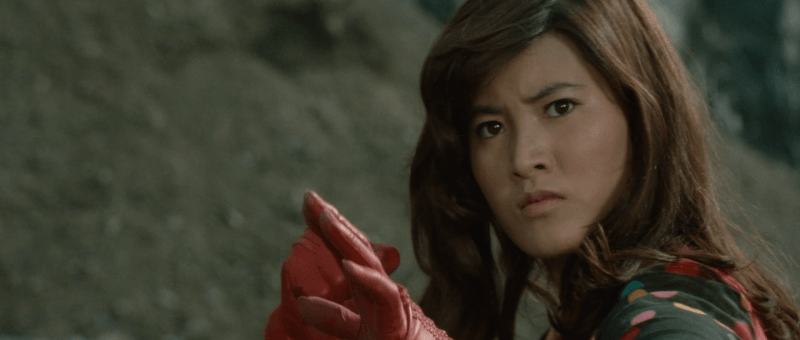
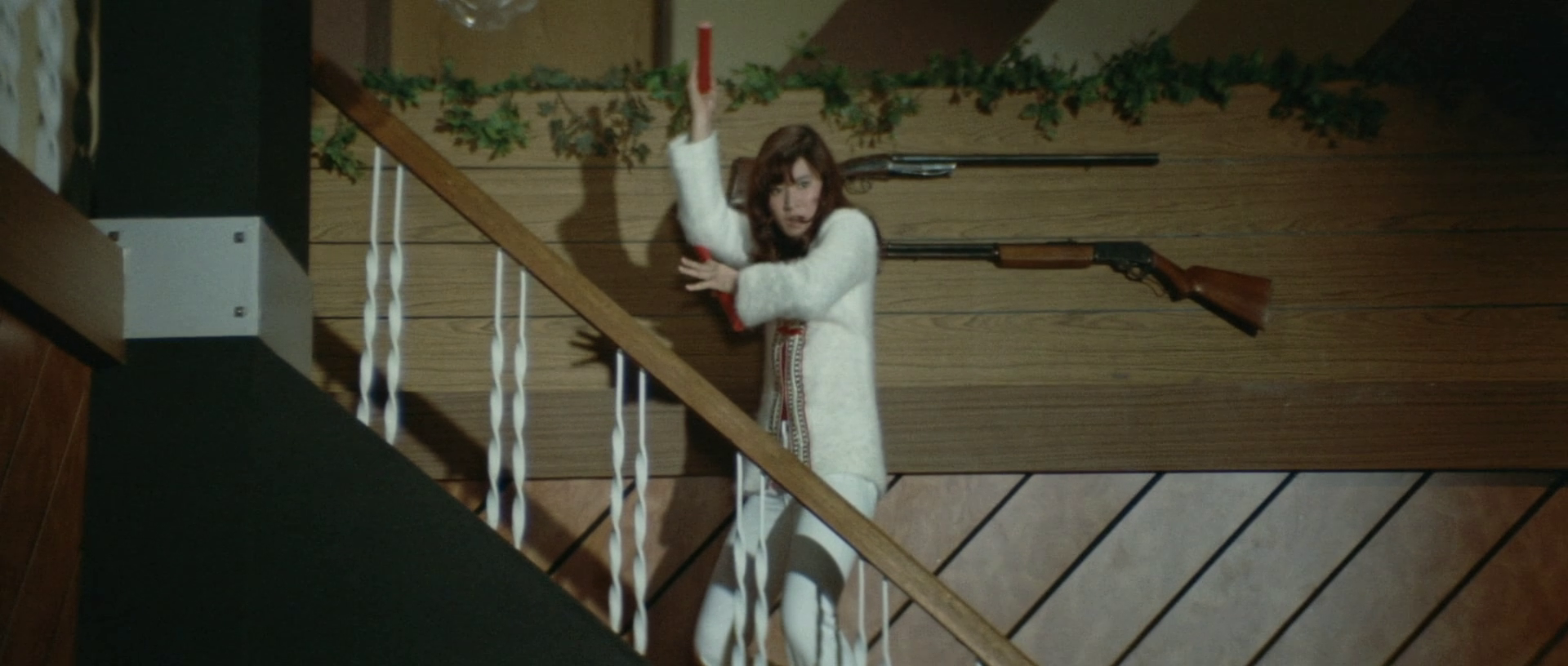
The Great Chase (華麗なる追跡, Norifumi Suzuki, 1975)

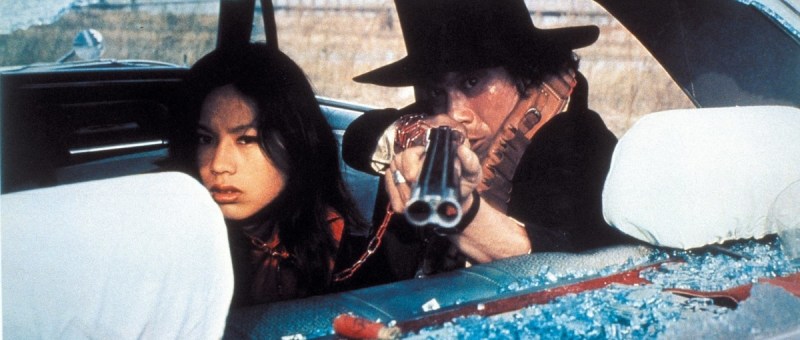
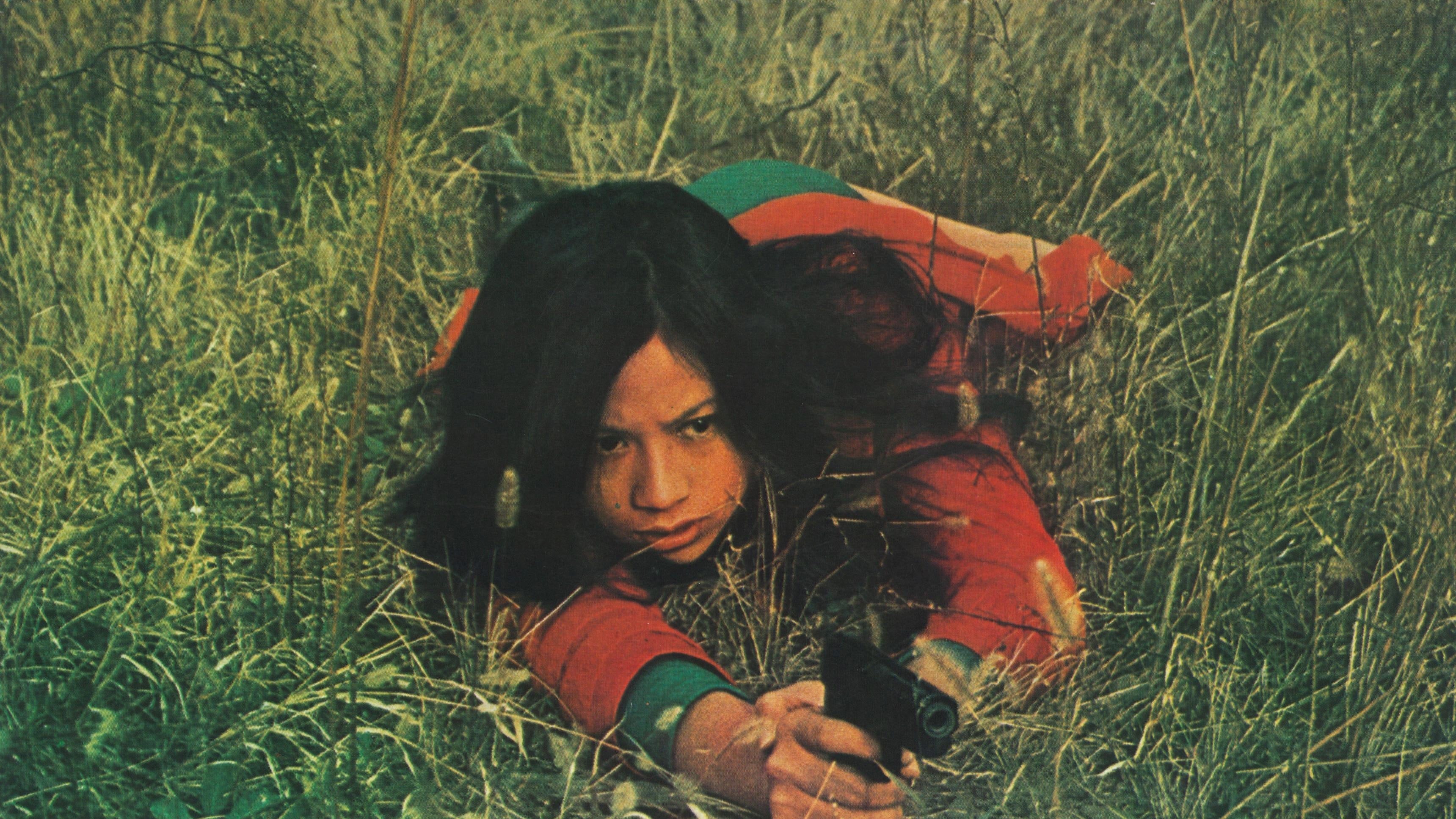
What about if you rebooted the Bannai Tarao series, but the hero was a female spy who is also a champion race driver and martial artist? Norifumi Suzuki did actually make a Bannai Tarao move in 1978 starring Akira Kobayashi, but the heroine of The Great Chase (華麗なる追跡, Karei-naru Tsuiseki) certainly loves a disguise or two and like the famous man of a thousand faces seems to have no trouble pulling them off as she infiltrates a gang of evil traffickers led by a furry which has come up with an ace new plan of packing heroin into coffins and having them shipped to nuns!

Oh, and the gang were also behind the death of her father who “committed suicide” in prison after being framed for drug smuggling. The Great Chase takes place in a world of pure pulp which somehow maintains its sense of cartoonish innocence even after Shinobu (Etsuko Shihomi) has infiltrated the heart of darkness and seen most of her associates killed by sadistic gang boss Inomata (Bin Amatsu). But at the same time, it delves into a deep sense of ‘70s paranoia as it becomes clear that the authority figures are all corrupt. Inomata has become a politician, while Shinobu’s father’s murder was orchestrated by the prison warden who was working with him in return for financial gain. The man who framed her father was a friend of his, implying that no one can really be trusted when there’s money to be made.

In a roundabout way,as this sense of anxiety is only reinforced by Shinobu’s role as some sort of secret agent working for the spy ring run by her uncle which is currently hot on the trail of the drug dealers even if they haven’t yet figured out who their boss is. Conversely, her home life is as wholesome as it could be with her two adopted siblings who run a florist’s along with Shinobu’s fan club. Her status as a kind of race car idol lends Shinobu a particular kind of ‘70s cool and turns her into some sort of superhuman figure capable of triumphing over any kind of adversity like a superhero worthy of any kid’s lunchbox. The siblings, Nagi (Fujika Omori) and Shinpei (Naoyuki Sugano), were taken in as orphans by her father which once again signals his goodness in contrast to the greed and selfishness of the gang that had him killed to cover up their crimes. 

That they peddle in drugs marks them out as a force of social disruption, but they’re also actively heretical in hiding behind the shield of the church. Suzuki frequently uses religious imagery in his films and here again echoes the romanticism of School of the Holy Beast with the use of red roses to decorate the coffin of the unfortunate young woman who has been turned into a vessel for smuggling drugs and has for some reason been laid out otherwise entirely naked. When it comes to retrieving the merchandise, we can see that many of the habits are being worn by men while Inomata himself masquerades as a priest. Then again, perhaps he is merely indulging his love of costume play seeing as he also has a hobby of wearing a furry bear suit to attack and rape women in his living room. 

Inomata’s claws then seem to represent something else, a rapacious, grasping sense of patriarchy in which he also uses drugs to bind women to him. Shinobu’s childhood friend Yukiko (Hisako Tanaka) has apparently fallen victim and laments that she is possessed by him body and soul to the point that the old Yukiko is dead which is why she hasn’t been able to step in and help Shinobu and is doing so now fearing that it may cost her her life. Suddenly, it’s all quite grim with the basement sex cult, whipping and torture, but Shinobu maintains her plucky spirit and is somehow able to lure Inomata towards a cable-car-based showdown. With a cameo from real life wrestler / singer Mach Fumiake, the film enters a kind of meta commentary on a real-life Shinobu (though she was not, as far as anyone knows, one of Japan’s top spies), but otherwise remains within the realms of pulp in which the heroine is able to pull off her difficult mission with the help of her talent for disguises before dramatically unmasking herself as the woman who’s going to take them all down. Camp to the max and incredibly surreal, the film never drops its sense of silliness even as the grim events enveloping Shinobu lead to tragic consequences that she barely has time to deal with before barrelling straight into the next duel with the forces of corruption.


*Norifumi Suzuki’s name is actually “Noribumi” but he has become known as “Norifumi” to English-speaking audiences.
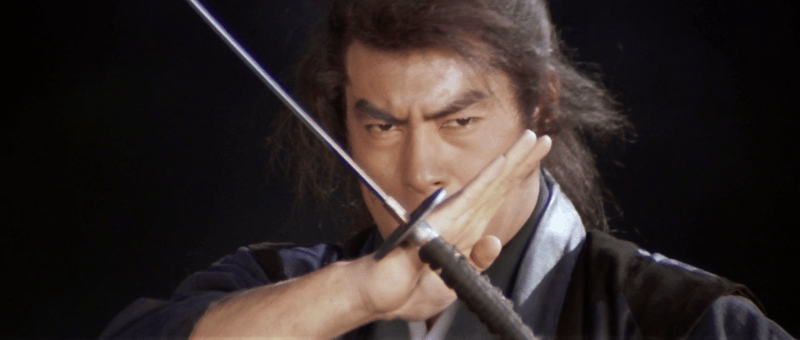
Haunted Samurai (土忍記 風の天狗, Keiichi Ozawa, 1970)

An exiled spy is confronted by the cruel inequalities of the feudal era in Keiichi Ozawa’s possibly mistitled ninja drama Haunted Samurai (土忍記 風の天狗, Doninki Kaze no Tengu). There is a kind of fatalism that follows him, and he is in some senses haunted not only by men like himself charged with the neutralisation of a deserter but by the ills of a corrupt society, though the only ghost here may be himself. Based on a manga by Goseki Kojima who illustrated Lone Wolf and Cub, the film ultimately suggests that to be a good man necessarily means to walk alone as a melancholy exile from a society founded on greed and power.

Indeed, Rokuheita’s (Hideki Takahashi) sole desire is to live a “simple and decent” life as an ordinary farmer. The film opens with him squaring off against a childhood friend, who is also his sister’s love interest, having been ordered to execute him for deserting from their ninja clan. His friend no longer wants to live “like a beast”, and so there’s nothing more either of them can really do in this situation. Rokuheita carries out his duty, and his sister takes her own life in despair. When he’s given another similar mission, he questions it but again resolves that he has no real choice. Only he discovers that his target, Ushizo (Yuji Odaka), has chosen to desert after marrying and having a child. When his family suddenly show up just as he’s contemplating delivering the final blow, Rokuheita decides to let him go warning Ushizo that the Yagyu will never give up and he’ll be haunted all his life so he should try to live it well for as long as it lasts. 

But this also makes Rokuheita an exile too, himself now a target and on the run from the Yagyu and his clan. On his travels, he runs into a small family who’ve been attacked by bandits while returning from town to buy wheat seeds because their harvest has failed in the drought and they’re facing onerous taxes from an unforgiving lord. Rokuheita decides to stay in the village hoping to become an ordinary farmer but is regarded with suspicion by some because of his samurai status, while there is also another samurai exile in town, Tarao (Seiichiro Kameishi) who first worked hard to be a part of the community but has since become lazy and aloof.

Tarao is also suspicious of Rokuheita but mostly fearing that either he’s come to make trouble for him or is a fugitive who will lead trouble their way. Unlike Rokuheita, Tarao was kicked out of his clan for stealing and now lives a slightly disreputable life made all the more so by his attempts to pan gold from the local river. Rokuheita fears that if the villagers find out about Tarao and the gold it will only cause chaos and the obsession with easy riches will in the end be much worse for them than the famine. Even Tarao’s wife Oryo (Utako Shibusawa) insists they’ve already got plenty to live on and should simply go somewhere else to lead a quiet life but Tarao wants more, his hand reaching out for his purse even while attacked by corrupt retainers themselves intent on discovering the gold and keeping it a secret from their lecherous lord. 

The retainers have been taking one life for every bale of “hidden” rice, carting off young women from the village to place into sexual slavery. Rokuheita tries to teach the villagers how to skirt the feudal order by secretly farming on rough terrain to evade taxes and ensure their own food supply, but this simply incurs harsher penalties even as one of the young men points out hungry farmers can produce nothing at all. Yet there’s nothing Rokuheita can really do for the villagers because it is the feudal order which is most at fault, an order which his ninja clan supports through their spy activities. The man who tracks him, Matahei (Isao Natsuyagi), says he does so as a means of appeasing the Yagyu and protecting his home territory from them but to do he must choose a lesser evil in killing those who have chosen to try to live “simple and decent” lives outside of this system.

Ozawa brings them together in a supernaturally charged conclusion which takes place during a solar eclipse marked by the eerie winds of the Japanese title but finds them both defeated, left with only the melancholy acceptance of their rootlessness as men who will always be pursued by the invisible hands of the feudal order. Utilising wuxia-esque jump cuts to recreate the ninja magic of Rokuheita’s spy craft along with a degree of surrealism in the underwater sequence in which he is attacked by a band of topless female ninjas the film seems to edge towards a more contemporary reading of jidaigeki and not least in the unexpected violence of its final scenes.


Zero Woman: Red Handcuffs (0課の女 赤い手錠, Yukio Noda, 1974)

“Your sense of duty is too strong! The world isn’t a pretty place,” barks an irate policeman, scolding a female officer with a tendency to take things, in his view at least, too far. Yukio Noda’s kidnap drama Zero Woman: Red Handcuffs (0課の女 赤い手錠, Zeroka no onna: Akai Tejo) is on the extreme end of pinky violence and soaked in the political concerns of the 1970s along with all their concurrent paranoia but nevertheless positions its fearless avenger as a lone arbiter of justice in an incredibly unjust world. 

We know this from the start as we see Zero (Miki Sugimoto) almost date raped by an apparent serial killer who has his own torture suitcase and apparently killed her friend. Knowing that he is a diplomat and therefore has diplomatic immunity, she simply shoots him in the balls in the film’s extraordinary opening sequence. But even though it could be argued what she did was self-defence, Zero is kicked off the force and thrown into a woman’s prison for an indefinite period of detention to keep the lid on any possible scandal. Zero is only reprieved when the daughter of a politician is kidnapped by thugs and, wanting to keep things quiet, they need someone to rescue her and also wipe out all of the kidnappers to ensure no one ever finds out.

Kyoko (Hiromi Kishi), the politician’s daughter, claims that her father will do “anything” to ingratiate himself with the prime minister and has in fact already arranged her marriage to his son. Kyoko, however, already has a boyfriend who, inconveniently, is quite obviously a student protestor given his yellow construction hat and other paraphernalia. The pair are accosted while sitting in a car near an old American base, and as Kyoko is gang raped, firstly by the gang leader Nakahara (Eiji Go) who is wearing a hoodie with the words US Navy printed on the back, US planes fly over her as if she were being raped by America in an obvious metaphor for the legacy of the occupation. 

Indeed, the flashbacks later experienced by Nakahara are of his mother whom he describes as a sex worker who worked at the base suggesting a very literal allusion to the corrupting influence of American servicemen. The gang operate out of a bar called “Manhattan” which is surrounded by other similar bars with Western names in a neon-lit area, while they constantly run across various signs written in English in fact peeing directly on a no peeing sign outside a largely disused residential area on the edge of the base where they later take hostage some kind of amateur dramatics / English-language class currently in the middle of a production of Romeo and Juliet. 

Yet the big bad turns out to be essentially homegrown in the form of the corrupt lackey policeman Osaka, and the politician Nagumo (Tetsuro Tanba), who is more concerned with his political capital than his daughter’s safety keen that the police keep everything out of the papers otherwise the wedding will be called off and he’ll have a problem with the prime minister. Seeing a very pale Kyoko, her clothes torn, barely conscious having been drugged by the gang, he says he no longer cares to think of her as his daughter and perhaps it would be better if she simply passed away in an “accident”, instructing Osaka to care of loose ends like Zero too. 

It’s very clear that women’s lives have little currency in this very patriarchal world, something Zero seems to know all too well even if at the beginning of the film she was content to work for the oppressive organisation of the police force though she later tears up her warrant card in disgust. The fact that division zero, operating like a secret police force on the behalf of an authoritarian government, exists at all is a clear indication that this is already a police state though one subverted by Zero who uses her red handcuffs to deliver ironic justice to all those who deserve it. Then again, unlike other pinky violence films there’s precious little solidarity that arises between herself and Kyoko whom she later describes as nothing more her mission objective seemingly caring little for her as a fellow human being. Noda cuts back between the Diet building and police HQ as if actively critiquing the latent authoritarianism of the early 70s society but even if Nagumo gets a kind of comeuppance it’s abundantly clear that nothing really will change and Zero stands alone wilfully freeing herself of the handcuffs of a controlling society. 


Operation Plazma in Osaka (実録外伝 大阪電撃作戦, Sadao Nakajima, 1976)

The precarious balance of the post-war yakuza society begins to crumble in Sadao Nakajima’s jitsuroku eiga, Operation Plazma in Osaka (実録外伝 大阪電撃作戦, Jitsuroku gaiden: Osaka dengeki sakusen). The Japanese title might more accurately be translated as “shock tactics in Osaka” which is a neat encapsulation of the turf war which arises when a larger gang from Kobe decides to muscle in and take over the city while a small upstart continues to agitate contemplating taking the whole prize for themselves. 

Inspired by a real life turf war which took place in Osaka in 1960, the film opens with classic jitsuroku voiceover revealing that a precarious balance had been held in the local underworld since the Meiji era in part because the city is simply too big to be ruled by any one gang. But times are changing, yakuza conglomerates are in style, and so it is that the Kawada gang mounts a largely political campaign to claim the city without bloodshed, as boss Yamaji (Akira Kobayashi) puts it, by convincing the smaller gangs to join up with them. According to the voiceover, however, it wasn’t Kawada that upset the balance but a small upstart group that came out of nowhere, Soryu. 

The screen then cuts to a map of Osaka, while the stills behind the credits feature the Tsuruhashi Market in Korea town. The thing about the Soryu group is that many of its leading members are ethnically Korean which sets them apart from most of the other mobsters in town. Even so, it’s hotheaded Yasuda (Hiroki Matsukata) that first gets them in trouble by getting into a fight with Takayama (Tsunehiko Watase) at a boxing match after climbing into the ring himself when the guy he bet on looks like he’s about to lose. This sets up a conflict between the Soryu and the Nanbara gang who run the boxing hall, but it never takes off because the recently released Daito suddenly announces that he’s bought the “Dance Hall” the ring is being run from and wants to turn it into a cabaret bar. It seems clear that someone’s backing Daito, but no one quite knows who. 

As Yamaji had said it would be, it starts of as a very modern silent war in which he slowly seduces various yakuza gangs convincing them that they’re stronger together with a slight note of join us or die. Yasuda and Takayama are two men who don’t like being told what to do and each end up exiled from their gangs thanks to their opposition to Kawada. Having failed to assassinate Yamaji, boss Nanbara pathetically rolls over and decides to join him instead while the Soryu gang is sent on the run leaving Yasuda and and Takayama to form an unlikely brotherhood brokered by Yasuda’s odd decision to gift his nightclub singer girlfriend to his sometime rival leaving Takayama permanently in his debt and touched by his selfless gesture.

Even by the standards of the jitsuroku, Operation Plazma in Osaka is rabidly misogynistic and often sleazy with an early scene seeing the Soryu gang cause trouble by stripping a hostess naked as one pours alcohol over her body and another drinks it from between her legs. Naked women are repeatedly fondled by fully clothed men, while nightclub singer Yoshiko (Yuko Katagiri) is treated largely as a pawn, a tool used to mediate the latent homoerotic desire between Yasuda and Takayama. Then again, everything in this world is extreme. The conflicted Miyatake (Tatsuo Umemiya) who had once tried to protect Takayama eventually tries to boil a man alive to get him to reveal Takayama’s location while Nakajima’s anarchic handheld camera desperately tries to keep up with the increasingly nihilistic violence. 

The resolution arrives not with death but total defeat, the traditional yakuza forced into submission by the corporatising giant with the survivors realising they will live the rest of their lives in subjugation making an “unconditional surrender” to changing times. Yasuda had claimed that the Soryu gang was a “free democracy” standing in opposition to the latent fascism of traditional gangsterdom which then finds its way into the corporate and the extreme hostile takeover Yamaji has just performed on the city of Osaka. Suddenly all that’s left of traditional yakuza is a pinkie in a jar, a grim a reminder of what happens when those in a position to resist back down in the face of an authoritarian power.


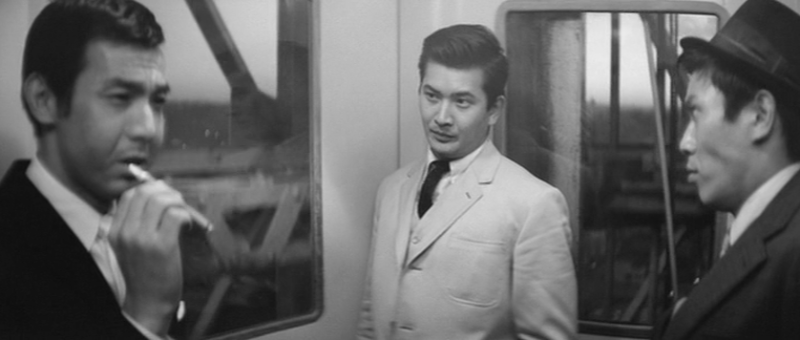
Tokyo Drifter (東京流れ者, Seijun Suzuki, 1966)

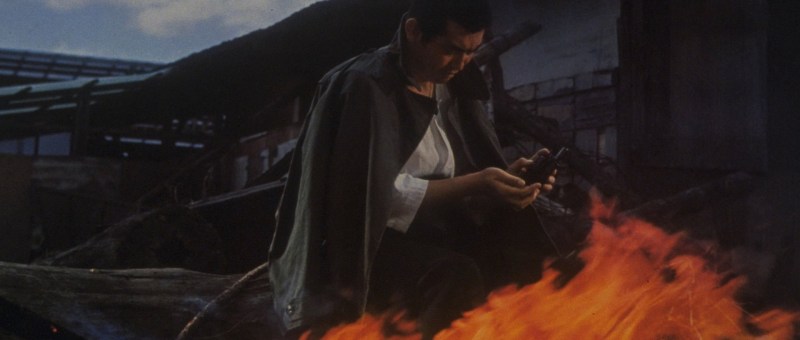
“Money and power rule now, honour means nothing” according to the new bread of upstarts gangsters in Seijun Suzuki’s Tokyo Drifter (東京流れ者, Tokyo Nagaremono). In many ways, what separates Nikkatsu’s youthful crime movies from Toei’s yakuza epics is that the nobility of Toei’s heroes is rarely questioned. In a Toei movie, it’s the world that’s wrong because the code is good and should be obeyed just as the hero obeys it, but in a Nikkatsu picture nihilism rules. The code isn’t right either, in fact it’s just another tool to manipulate and the hero, while noble, is wrong to follow it. 

That is in essence how Tetsu (Tetsuya Watari) will end up a Tokyo drifter, caught between the old world and a new consumerist Japan in which even the yakuza is attempting to corporatise and reform its image. His old boss, Kurata (Ryuji Kita), has done just that only he’s had to take out a sizeable loan from another former gangster turned real estate agent, Yoshii (Michio Hino), to do it. Realising his weakness, the upstart Otsuka gang sees an opportunity and stages an elaborate ruse that allows them to get their hands on Kurata’s valuable building and take out Yoshii at the same time though it results in Yoshii’s secretary (Tomoko Hamakawa), also the girlfriend of one of the Otsuka gang, getting caught in the crossfire. 

Tetsu describes his relationship with Kurata as like father and son and is sure he would never betray him. To preserve their new image, Tetsu does not fight back when ambushed by Otsuka goons and even puts himself on the hook for the secretary’s murder, but as much as Kurata insists he wouldn’t betray one of his “kids” to make things easier for himself perhaps he will if the situation calls for it. A defector from Otsuka’s gang, Shooting Star (Hideaki Nitani), tries to warn Tetsu that his faith in ideals like duty and loyalty is misplaced but Tetsu refuses to believe him. “Don’t shatter my dreams” Tetsu pleads, claiming that he cannot be around someone with “no sense of duty”.

Tetsu even feels sorry for Shooting Star, attributing his melancholy air to his having lost his sense of purpose in his disillusionment with post-war gangsterism. He might have a point in Shooting Star’s world weariness, but fails to realises that Shooting Star does in fact have a sense of duty and is in some ways the film’s only truly free man in forging it for himself from basic humanitarian values if tinged with a degree of cynicism. Though the pair clash, Shooting Star claims that he wants to save Tetsu from the pain of his inevitable betrayal and the disillusionment that will eventually come with it rendering him a perpetual wanderer and exile from mainstream society. 

Both men are in a sense lost amid the rapid social changes of their era, unable to move on from the post-war past into the new society even after breaking with the yakuza code in order to live by their own. In Suzuki’s complex colour scheme, Shooting Star is always clad in a forest-like green which echoes his freedom, while Otsuka is represented by a bloody red, and Tetsu dressed in an innocent powder blue suit until the final confrontation in which, along with his equally innocent love interest Chiharu (Chieko Matsubara) who had previously been associated with the colour yellow, is dressed in a pure white while all around him are now in black as representatives of those who have succumbed to the amoral capitalism of the the contemporary society. 

Suzuki even has Tetsu walk down an arched corridor reminiscent of a church into an abstract space expanding the stage at the club to lend this moment of existential struggle a little more theatricality. In a sense what Tetsu does is an act of suicide, severing his ties to the yakuza world by smashing Kurata’s glass and killing at least the image of him as a father figure to become a new man or perhaps a wandering ghost who no longer has a home and must even give up his romance with Chiharu in an acknowledgement of his exile. On Otsuka’s death, it’s almost like an alarm is switched off in the sudden shift from red to white in the giant statue standing behind Chiharu, the survivors united in white but rather than the wedding suggested by the colour of their clothes the atmosphere is funereal as Tetsu accepts he can no longer stay in this temporary space and must enter another sort of purgatory as lonely wander comforted only by his newfound freedom.


Tokyo Drifter screens at Japan Society New York on Feb. 4 as part of the Seijun Suzuki Centennial.

Original trailer (English subtitles)

Graveyard of Honor (仁義の墓場, Kinji Fukasaku, 1975)

“Like hell you’re free” the “hero” of Kinji Fukasaku’s Graveyard of Honor (仁義の墓場, Jingi no Hakaba) coolly snaps back in squaring off against a rival gang in a crowded marketplace. Perhaps a familiar scene in the jitsuroku eiga, a genre Fukasaku had helped usher into being and later solidified in the hugely influential Battles Without Honour and Humanity series. A reaction against the increasingly outdated ninkyo eiga and their tales of noble pre-war gangsterdom, the jitsuroku or “true account” movie claimed a higher level of authenticity, inspired by the real lives of notorious gangsters and depicting the chaotic post-war period as it really was, a Graveyard of Honor. 

Based on another true crime novel by Battles Without Honour and Humanity’s Goro Fujita, Graveyard of Honour charts the slow self-implosion of reckless gangster Rikio Ishikawa (Tetsuya Watari). In keeping with the jitsuroku mould, Fukasaku opens in documentary mode, onscreen text giving us Rikio’s pregnant birthdate of 6th August, 1924 before giving way to the voices of, we assume, real people who actually knew him when he was child. They describe him alternately as shy, an oversensitive crybaby, and an evil genius in waiting who was always different from the others and had a lifelong ambition to become a yakuza. They wonder if it was the chaos of the post-war world which turned him into a “rabid dog” but note that he was in fact just as crazy before the war and after.

A cellmate during his time in juvenile detention recalls that Rikio would often liken himself to a balloon, intending to rise and rise until he burst but his trajectory will be quite the opposite. A mess of contradictions, he repeatedly tells his remarkably understanding boss Kawada (Hajime Hana) that whatever it is he’s done this time it was all for the gang but all he ever does is cause trouble, picking fights with the rival area gangs in an obsessive need for masculine dominance over his surroundings. His trip to juvie was apparently down to getting into a fight defending Kawada’s honour, implying that he was “the sort of kid who genuinely respected his godfather”, yet it’s in transgressing this most important of unwritten yakuza rules that he damns himself. Beaten up as punishment for setting fire to the car of a gang boss he felt slighted him, Rikio is asked for his finger but gets so drunk psyching himself up that he eventually turns on his own side and is exiled from the capital for a decade. 

That gang boss, meanwhile, Nozu (Noboru Ando), is currently running for political office in Japan’s new push towards democracy. He eventually loses but only by a small margin, bearing out that in this extremely difficult post-war environment, the yakuza is still a respected, if perhaps also feared, force providing services which ordinary people are sometimes grateful for in that they provide a buffer against other kinds of threat. Meanwhile, the first of Rikio’s gang raids is undertaken against so called “third country nationals” a dogwhistle euphemism for Zainichi Koreans, Chinese, Taiwanese, and other citizens from nations colonised by Japan during in its imperialist expansion who entered the country as Japanese citizens but have now been “liberated” only to face further oppression while those like Rikio accuse them of looking down on and taking revenge against the Japanese for the abuse they suffered as imperial subjects. When both sides are arrested a racist policeman allows the yakuza to escape, thanking them for helping him round up all the Chinese businessmen who will now go to jail for illegal gambling allowing the local gangs to seize their turf. 

The greatest irony is, however, that the American occupation forces may be the biggest gang of all, willingly collaborating with Kawada in peddling blackmarket whiskey (amongst other things) from the local base. The yakuza is also in collaboration with the local sex workers who use their connections with American servicemen to facilitate yakuza business. When Rikio starts a fight with a rival gang in a local bar that threatens to spark a war, it’s the Americans who are called in as neutral third party mediator, Nozu being unable to fulfil that role in having an affiliation with Kawada. The Americans, however, merely issue a loudspeaker announcement for the gang members to disperse or face possible arrest, keeping the peace if somewhat hypocritically. 

Rikio, meanwhile, continues to flounder. Exiled from his gang, he becomes addicted to hard drugs and gets a problematic minion of his own, Ozaki (Kunie Tanaka), not to mention contracting tuberculosis. In a particularly morbid moment, he has his own gravestone carved, perhaps detecting that the end is near or at least that an ending is coming for him. In another somewhat inexplicable turn of his life, though a common trope in jitsuroku, he eventually marries the sex worker who fell in love with him after he raped her, presumably touched by his concern after he burned a hole in her tatami mat floor. Wearied by grief and already out of his mind, a final act of nihilistic craziness sees him approach his former boss for the turf and capital to form his own gang, crunching his late wife’s bones as hardened gang members look on in utter disbelief. 

Rikio’s desire for freedom, to be his own boss, is elusive as the red balloon we often see floating away away from him, free in a way he’ll never be. “Don’t these young people respect the code anymore?” Kawada exasperatedly asks on hearing that Rikio has broken the terms of his exile and returned only a year into his sentence. But Rikio’s tragedy may in a sense be that he understood the code too well. On the side of his tombstone he writes the word “jingi”, honour and humanity, full in the knowledge that such concepts in which he seems to have believed no longer exist in the cruel and chaotic post-war world which forces even true believers to betray themselves in a desperate bid for survival. “We all live by a code” his friend echoes, “there’s just no way around the rules”. 

A case of printing the legend, Fukasaku’s take on the life of Rikio Ishikawa may not quite be the “true account” it claims but is in its own strange way a tale of frustrated gangster nobility, a cry baby’s failure to become the man he wanted to be in the complicated post-war landscape. Capturing the confusion of the era through frantic, handheld camera Fukasaku nevertheless takes a turn for the melancholy and mediative in his shifts to sepia, the listless vacant look of a drugged up Rikio somehow standing in for the nihilistic emptiness of a life lived in honour’s graveyard. 


Original trailer (English subtitles)

A True Story of the Private Ginza Police (実録・私設銀座警察, Junya Sato, 1973)

By the early 1970s the ninkyo eiga (pre-war tales of noble yakuza) had begun to fall from favour. Modern audiences were perhaps unconvinced by the romanticism of the honourable gangster caught between personal loyalty and his inner humanity, real life thugs are rarely so high minded after all. The cinema industry may have been in decline, but the consumerist revolution was well underway, the economic miracle was nearing completion, and there was perhaps a readiness to reckon with the recent past from a position of relative safety. The jitsuroku eiga did just that, providing a more “realistic” depiction of the yakuza life based on the recollections of real life gangsters and incorporating the aesthetics of reportage with the use of stock footage, newspaper montage, narratorial voiceover, and high impact text recording the names of characters along with the times of their deaths. 

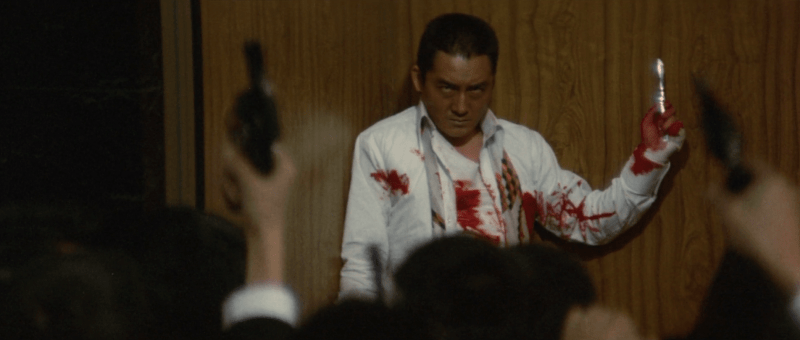
Released in the same year as Kinji Fukasaku’s Battles Without Honour and Humanity which has perhaps become the jitsuroku archetype, Junya Sato’s A True Story of The Private Ginza Police (実録・私設銀座警察, Jitsuroku: Shisetsu Ginza Keisatsu) paints an even bleaker picture of the immediate post-war era as one in which chaos and inhumanity rule. The pre-credits sequence follows demobbed soldier Watarai (Tsunehiko Watase) who finds himself in a bombed out warehouse where a woman is drinking around an open fire with a US serviceman. Standing motionless he stares at an upper balcony where another woman is having sex with a black GI. It seems this woman is known to him, perhaps his wife or in any case a woman he thought he was coming back to. She is not overjoyed to see him, breaking down in tears while he spots a baby girl crying in the corner who also happens to be black. Unthinkably he takes the child and throws her into a flooded area of the floor below, chasing the mother when she goes after the baby, strangling and then bludgeoning her to death with a rock. 

All of this has happened in the first five minutes. There will be no heroism here, no noble act of resistance only shame and desperation. These are men brutalised by war who’ve come home to a land in ruins where the enemy is now in charge, ruling their streets and sleeping with their women. They are humiliated and resentful, many of them still in uniform likely because they simply have no other clothes. Sato introduces us to the later gang members in turn beginning with a scene which echoes those of the Battles Without Honour series as Iketani (Noboru Ando) is chased and beaten by an angry mob in the chaos of the marketplace after being accused of stealing. Masaru (Tatsuo Umemiya) meanwhile is beaten by GIs who come to the rescue of a sex worker he tries to rape, offended when she tells him she doesn’t go with Japanese customers dismissing him as “just another defeated soldier”. Iwashita (Hideo Murota) uses his service revolver to commit an armed robbery to get money to gamble. Only the gang’s later leader, Usami (Ryoji Hayama), is introduced without a wartime record, named only as a pre-war gangster. The gang is forged when they meet by chance in a gambling den and bond over a grenade, mounting a military operation against the Korean street gang who hassled Iketani by bombing their HQ. 

A few months later they’ve become the “Private Ginza Police Force” of the title, now all in smart suits, loud shirts, and sunshades. They have their eyes set on ruling the area, taking down rival gangsters the Nakane brothers through cunning and trickery, turning an underling by threatening his family. But there is no honour among thieves and the gang is only a temporary arrangement intended to last only as long it’s useful. Iketani goes his own way, starting a small business running black market goods from China, bribing the police to turn a blind eye while Usami runs a conventional protection scam targeting the Chinese owner of a cabaret bar, Fukuyama (Asao Uchida), run as a front for black market smuggling. The problems start when Iketani learns that Fukuyama has been colluding with a government accountant to misappropriate money intended to be used for subsidies. 

This world is infinitely corrupt, from the easily bribed policemen to the civil servants out for all they can get and those who merely make use of them like Fukuyama and Iketani. While the guys get rich opening gambling clubs in Ginza, a wide scale famine creates a shantytown of starving poor at Ueno station where six die per day from hunger. Iketani is in someways the “noble” thug, he looks after his guys and pays attention to their lives, perhaps even claiming that his black market activities are a public service but it’s still every man for himself and if he’s assuming post-war chaos is on its way out he is sadly mistaken. Having got him hopped up on heroine and used him as a ghostly assassin, the gang jokingly refer to Watarai as a zombie, somehow surviving every bizarre death experience that comes his way including being buried alive, but they are walking dead too, soulless men who left their humanity on the battlefield. Fearing the game may be up, Masaru suggests one last hurrah blowing their ill-gotten gains on sake and women. “I’ll show you how rape is done,” Usami deliriously exclaims”, “how we used to do it on the continental front.” Meanwhile, Masaru throws notes all around the room screaming “Rejoice! There will be no tomorrow” sending all into a Bacchanalian frenzy as they cram as much cash as they can grab inside what little clothing they still have on.

All moody, anarchic jazz score and canted angles, Sato’s post-war Tokyo is a world of constant anxiety, a maddening no man’s land of fire and rubble inhabited by ghosts of men who died long ago for whom the war never ended. In true jitsuroku fashion, the picture ends on a note of fatalistic nihilism, the screen filled with red as the narrator cooly informs us what became of our heroes as they find themselves consumed by the futility of their lives of violence.


Original trailer (no subtitles)

The Dragon of Macao (マカオの竜, Mio Ezaki, 1965)

Dragon of Macao DVD coverNikkatsu’s “borderless” action was famously internationalist, but as Japan’s place on the world stage began to change in the mid-60s, it also betrayed a slight anxiety in the nation’s new status as a burgeoning economic power in the Asian sphere. The Dragon of Macau (マカオの竜, Macao no Ryu), while indulging in the genre’s characteristically xenophobic vision of China as an exporter of criminality, is another attempt to cash in on James Bond cool as its suave, British passport-carrying hero tries to wrestle a precious gem away from fiercely amoral “pirates” while protecting a betrayed young woman trying to avenge the death of her parents at the hands of duplicitous gangsters.

Set in the bustling port town of Yokohama, the film opens with the harbour patrol forcibly boarding a ship to look for smuggled gold. However, it turns out that the two men they’re searching are members of the patrol themselves on an undercover mission trying to expose organised crime while the guys dressed as policemen are actually members of a gang trying to steal a precious diamond. Fearing the operation blown, the gangsters’ plant offs the lot of them and makes off with the loot.

Meanwhile, “Dragon of Macau” Ryu (Akira Kobayashi) lurks about on the harbour while rival gangster Tsukada (Asano Sano) tries to get the police onside and convince them that someone else is targeting his operation though the police are apt to wonder if he staged the whole thing himself to get rid of the undercover agents. The truth, however, is that ambitious harbour punk Aizu (Jo Shishido) is after a precious diamond known as the “Himalyan Star” which is rumoured to be cursed seeing as everybody who’s come into contact with it has ended up dead.

Unsurprisingly, Aizu gets his hands on the gem from a Chinese broker, Chen, who warns him that two gangsters, Gordon and Boomerang, will do “anything” to get their hands on it. Ryu later turns up a bar run by Tsukada and gets into a bar fight with a series “damn foreigners”, sailors who’d had too much to drink and started hassling the staff. The “damn foreigners” quip is especially ironic seeing as we later discover Ryu is a British citizen who seems to have grown up in Hong Kong after being rescued by a British vessel when the boat he and his parents were travelling on was torpedoed during in the war. Introducing himself to Tsukada, Ryu says that he works for the aforementioned “Gordon”, presumably an imperialist Brit engaged in shady colonial shenanigans out of Hong Kong. The truth about “Ryu” at least turns out to be slightly different, but for the moment he’s a Bond-inspired unflappable agent of cool complete with a fancy white three-piece suit and a collection of gadgets (a cigarette lighter blowtorch, pistol that dispenses matchstick flares, and a tiny nail gun) that would be the envy of any cold war spy.

Not to be outdone, however, Aizu has his own share of surprises including the tiny dagger hidden in the cigarette which permanently hangs from his lip. Temporarily entering this land of intense amorality, Ryu plays along but retains his nobility and remains permanently one step ahead as he attempts to get his hands on the Himalayan Star and return it to its “rightful” owners. Aizu’s main gambit is weaponising women – Aizu’s sister is a plant working at Tsukada’s bar and apparently also his mistress, while he also makes use of another young woman, Nami (Yukiyo Toake), whose late father was a patron of his. She believes Tsukada is responsible for the deaths of her parents and is participating in the plan as revenge, but eventually falls for Ryu’s suave nobility and refuses to betray him when faced with Aizu’s continuing duplicity.

A few narrative machinations later, we’re told that Ryu is “a person without a motherland” but also that he has always been a force for “good” or at least order in that he wants the gemstone not for himself but to get it away from the gangsters and back to its “official” owners (which sort of ignores the fact that the stone was “stolen” from the eye of a Buddhist statue which is presumably why people think it’s “cursed”, and that his primary motivation is avoiding a giant insurance payout). Having fallen for Nami, he leaves her a message that he’d have liked to take her back to Macau but is unsure she’d be happy with someone like him, asking her to look after another young woman who came all the way from Hong Kong to warn him that Gordon and Boomerang have finally taken each other out.

Perhaps in contrast to Nikkatsu’s other international crime dramas, the “threat” turns out to be wholly homegrown in Aizu’s rapidly individualist stance that “life is cruel”, “mercy is for fools”, and those who stand in one’s way must be eliminated. The solution comes, paradoxically, from destabilising internationalism at the hands of a man who is both Japanese and not, speaks several languages, and works as an agent for colonising imperial powers to whom he eventually exiles himself, job done. A rip-roaring spy drama complete with modern day pirates and an extremely ineffectual police presence, The Dragon of Macau is a surprisingly complex effort from Nikkatsu’s “borderless” action strand which makes the case for Japan as a part of wider world rather than a isolated island fearful of losing out in an increasingly globalised environment.


Man with a Shotgun (散弾銃の男, Seijun Suzuki, 1961)

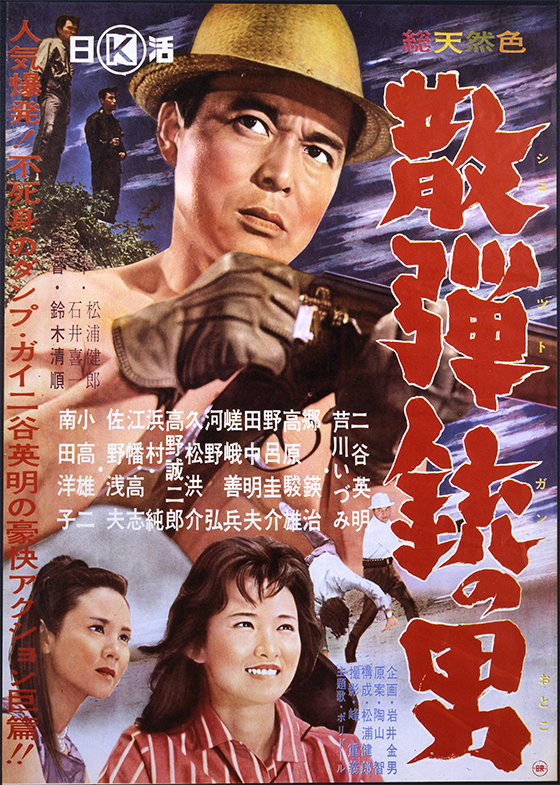
Man with a Shotgun 1961Nikkatsu’s “Borderless Action” seemingly opened a portal to a world entire to be found within Japan itself. Man with a Shotgun (散弾銃の男, Shotgun no Otoko) is, as the title suggests, another tale of a wandering, gun toting hero though this time one less of aimless flight from failure, responsibility, or rejection than of revenge. Hideaki Nitani gets a (relatively) rare chance to strut his stuff as the lead in a full colour picture, perhaps incongruously starring as one of Nikkatsu’s singing cowboys but he does certainly lend his characteristic sense of gravitas and authority to an otherwise underwritten role.

Ryoji (Hideaki Nitani) rocks up at at rickety bridge looking for a nearby shrine only to be warned off by a grumpy old man in a van. You don’t want to go up there, he tells him, there’ll be trouble if you do. Ryoji is, he claims, a hunter and so he’s not afraid. After all, he’s still in Japan – it’s not as if the entire place is infested with lions and tigers. Then again it’s not exactly game he’s come to hunt.

When he reaches the shrine, Ryoji finds himself in a strange mini kingdom presided over by mill owner Nishioka (Akio Tanaka). The few locals who still live in the village mingle uncomfortably with the migrant work force who people the mill while Nishioka dominates the local economy by owning the only bar in town which is also the only place his largely male workforce have to blow off steam. After getting roughed up by three of Nishioka’s henchmen on the way into town, Ryoji makes the first of many enemies when he stands up to fellow drifter Masa (Yuji Kodaka) when he threatens to throw a man’s daughter to the sex starved labour force unless he pays his debts. The sheriff, an ineffectual local, gets himself seriously wounded meaning the position becomes temporarily open. Nishioka, originally a “benevolent” dictator, is in danger of becoming less so when it is suggested he also form a police force given that the state authorities can’t be bothered with such a remote little village. Ryoji doesn’t quite want to stand for that and volunteers only for Masa to do the same, but the argument is eventually settled to one side of their continued male posturing.

As far as westerns go, Man with a Shotgun leans heavily towards colonial romance and adventure rather than your typically arid, dusty world of saloons and ranches. Lush and green, the small mountain town smacks more of the jungle as does Nitani’s idiosyncratic costume which arrives somewhere between chic safari and fashionable cowboy. Claiming to be a “hunter” Ryoji wanders around with self satisfied smugness, certain that he’s bringing justice to this lawless town all while he makes investigations into the matter which sent him wandering in the first place. Of course, while he’s here, there are other damsels in distress including Setsuko (Izumi Ashikawa) – the younger sister of the sheriff’s late wife, apparently raped and killed by “drifter” bandits.

“Drifters” turn out to be the scapegoated big bad as the migrant workforce quickly take over this little town, making trouble in the bar and hassling the locals, only the locals don’t seem to mind as much as they say they do. There’s trouble at the mill, but not quite the kind that might be imagined. Nishioka has his sticky fingers in some nasty business which also involves not just migrants but actual foreigners and illegal activity on a grand scale. As it turns out, some people are in on the action and some aren’t, and Nishioka is currently making a few calculations as to how to “eliminate” a few inconveniences – something to which he thinks Ryoji and his sparring partner Masa might turn out to be the perfect solution.

Like many a Nikkatsu hero Ryoji is a noble sort, something which engineers for him a happier ending than many get even if it has to be bittersweet to hint at possible followup instalments where Ryoji takes names and fights crime in other small towns. Nevertheless, given the choice he opts for the cool guy conclusion of firing into the air and casting his burdens away rather than damning himself forever in becoming what he hates. Shooting in colour even if not quite with Nikkatsu’s A-list, Suzuki doesn’t get much scope to flex his muscles but does make pointed use of painted backdrops coupled with location shooting, as well as doing everything he can to bring out Nitani’s cowboy cool and adding in a number of B-movie western cliches from letters delivered by a knife thrown into a door to the constant refrains of the title song. Still even if it largely lacks Suzuki’s anarchic touch save for the stylishly composed and absurdly humorous bar room brawls, there’s plenty of fun to be to had with Ryoji and his shotgun as they protect the innocent and seek justice in an often unjust world.


Available as part of Arrow’s Seijun Suzuki: The Early Years Vol. 2 Border Crossings box set.

Original trailer (English subtitles)

The Warped Ones (狂熱の季節, Koreyoshi Kurahara, 1960)

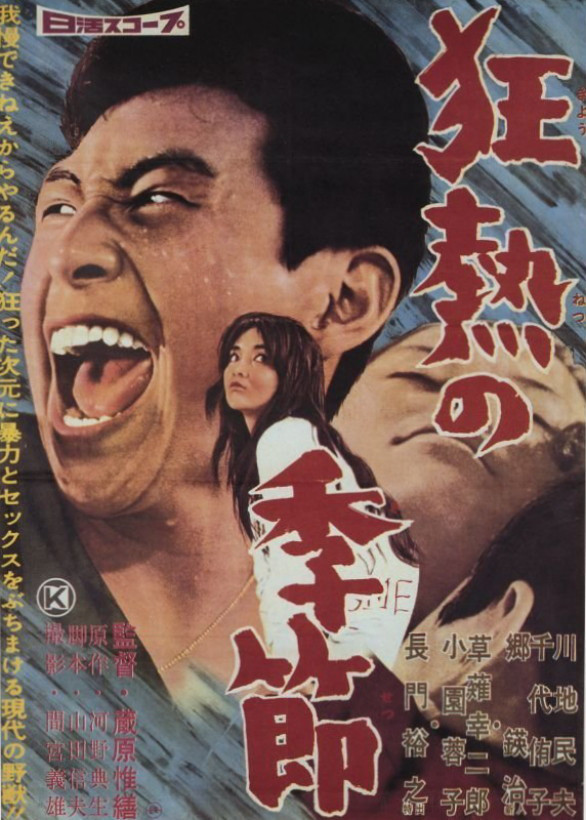
warped ones posterYouth was at an intense point of crisis in the Japan of 1960. The old pre-war ways were out, but what was youth supposed to do now – a question which found no answers. Whereas the intervening 15 years since the end of the war had been filled with somber soul searching and an intense dedication to forging a way through, the young of the late ‘50s were losing interest in rehashing the past and becoming keener to voice their concerns over what some saw as an undue influence wielded by the Americans. 1960 saw the biggest public protests in public memory as the citizens of Tokyo – many of them students and young people, took to the streets in protest of Japan’s continued reliance on America for military protection and the various comprises and complicities they felt that entailed.

Meanwhile, in cinema rebellious youth had become a bone of contention – the so called “Sun Tribe” movies of the mid 50s, inspired by the novels of Shintaro Ishihara, had painted an unflattering picture of decreasing morality among the young. Rising economic prosperity had given birth to a class of overindulged, privileged young men and women who frittered their parents’ money away on fast cars, drugs, jazz, and promiscuous (often violent) sex. The bright young things of the early ‘60s, young people who lived without morality or purpose, terrified the older generations who feared their kids too might wind up devotees of the sun tribe and reject the world they had strived so hard to rebuild.

The Sun Tribe movies were so controversial that the studio, Nikkatsu, was eventually forced to halt production but Japan’s rebellious youth was a subject which refused to go quietly. Koreyoshi Kurahara’s The Warped Ones (狂熱の季節, Kyonetsu no Kisetsu), released in 1960, revised the myth of the Sun Tribe by looking at it from the other side – these were no ennui filled elites, the crazed youth of the Warped Ones are poor boys and dropouts living by their wits and caring nothing for the rules of a society which has continually rejected them.

Akira (Tamio Kawaji), a petty teenage delinquent, gets caught pickpocketing in a jazz club and is sent for a spell in a reform school. Inside he meets another young man in a similar situation, Masaru (Eiji Go), and decides to team up with him after they’re released. Meeting up with fellow delinquent Yuki (Yuko Chishiro) – a casual prostitute hooking foreigners, the three decide to have some fun. Boosting a car and heading to the beach, they spot additional spice in the very reporter who got Akira arrested in the Jazz bar out for a promenade with his fiancée. The trio drive fast at Kashiwagi (Hiroyuki Nagato), knocking him flying before Yuki jumps out and grabs the girlfriend, Fumiko (Noriko Matsumoto), and bundles her into the car. Driving to a secluded spot, Masaru and Yuki pair off while Akira rapes Fumiko and then cruelly abandons her with only the “kindness” of pointing her towards a local police station.

Akira is the new kind of delinquent so feared by traditional society. He has no job or intention of forging a career – he lives on the thrill of petty crime, giving full vent to each and every urge his adolescent body conjures. His friendship with Masaru is perhaps his only redeeming feature but it’s unclear how far this really runs even if his only particular code makes the idea of any non transactional action with Yuki off limits. Masaru’s romance by contrast does appear to be deep and genuine – he can get past Yuki’s life as a casual prostitute and is even willing to support her when she falls pregnant with a child that is most likely not his. To does this, Masaru considers joining a gang which is something Akira’s individualism will not permit him to do. “Only people who don’t listen to jazz join gangs” he opines superciliously. His is a life of freestyle joys and hedonistic pursuits in which his will is all and his body his only instrument.   

Kurahara opens with a heady, swirling shot of the ceiling in the jazz club Akira likes to frequent while the score dances wildly in the background. Akira’s head is filled with the sound of “good” jazz. He moves, breathes and lives his own symphony. His world is indeed noisy – cramped tenements with paper thin walls and and the ever present rumble of passing trains give his life its own kind of oppressive rhythms, echoing the inescapability of his dead end existence. The music is his escape and the only thing keeping him “sane”, only “sane” means his self destructive tendencies become externalised as a cruel and sadistic game of revenge on the society which refuses to accept him. Akira is indeed “warped”, life is an absurd joke to him, but he is far from alone and his alienation has very real causes which lie not in the evils of Jazz music and American individualism but in a stratified, high pressure society which leaves its restless young with little to survive on save the instant gratification of their baser urges.


Opening (English subtitles)

https://youtu.be/9r-SjBgIB7s