Phantom of the Toilet (トイレの花子さん, Joji Matsuoka, 1995)

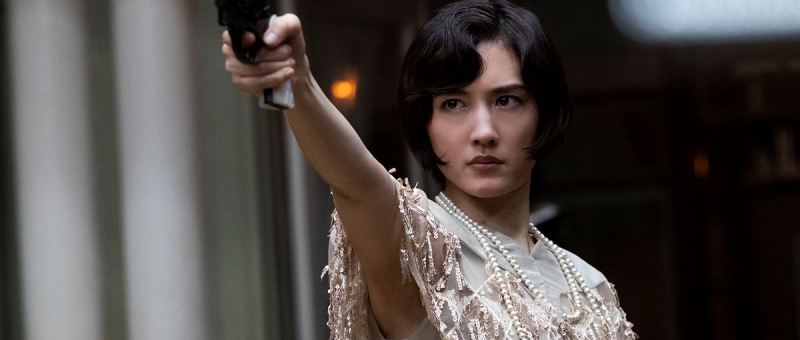
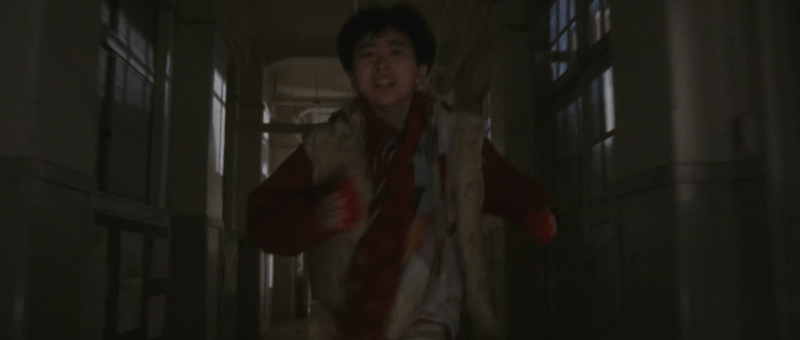
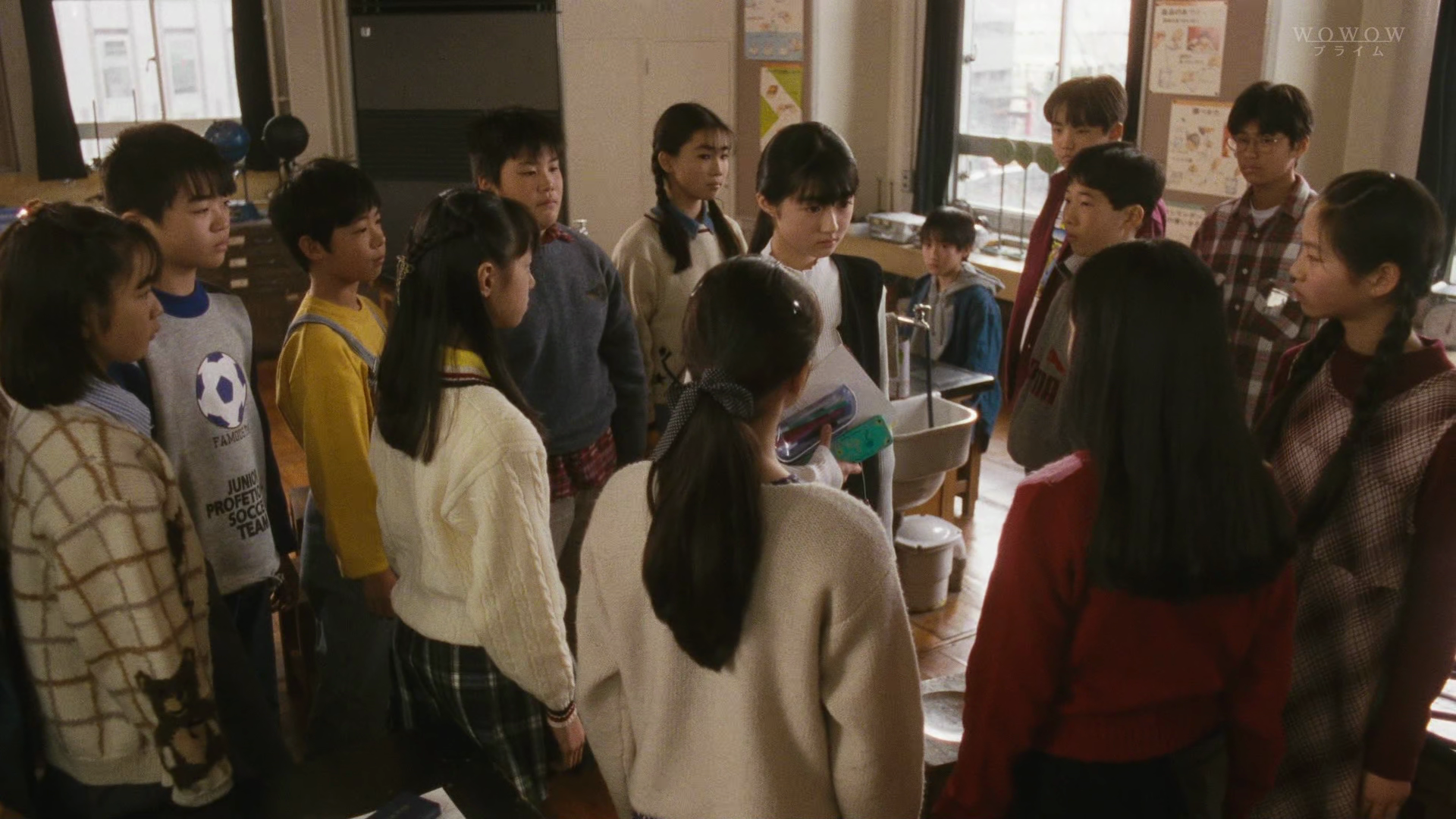
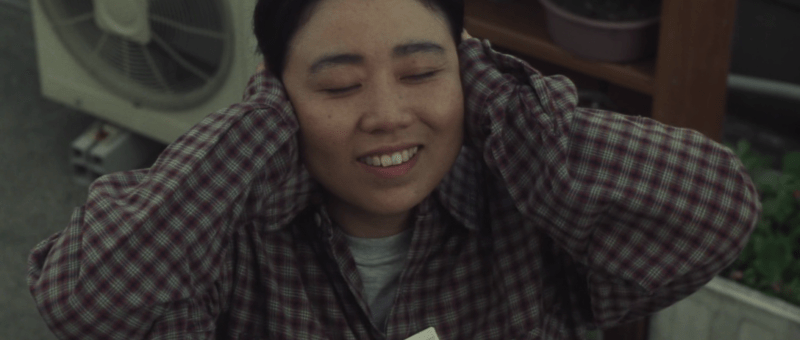
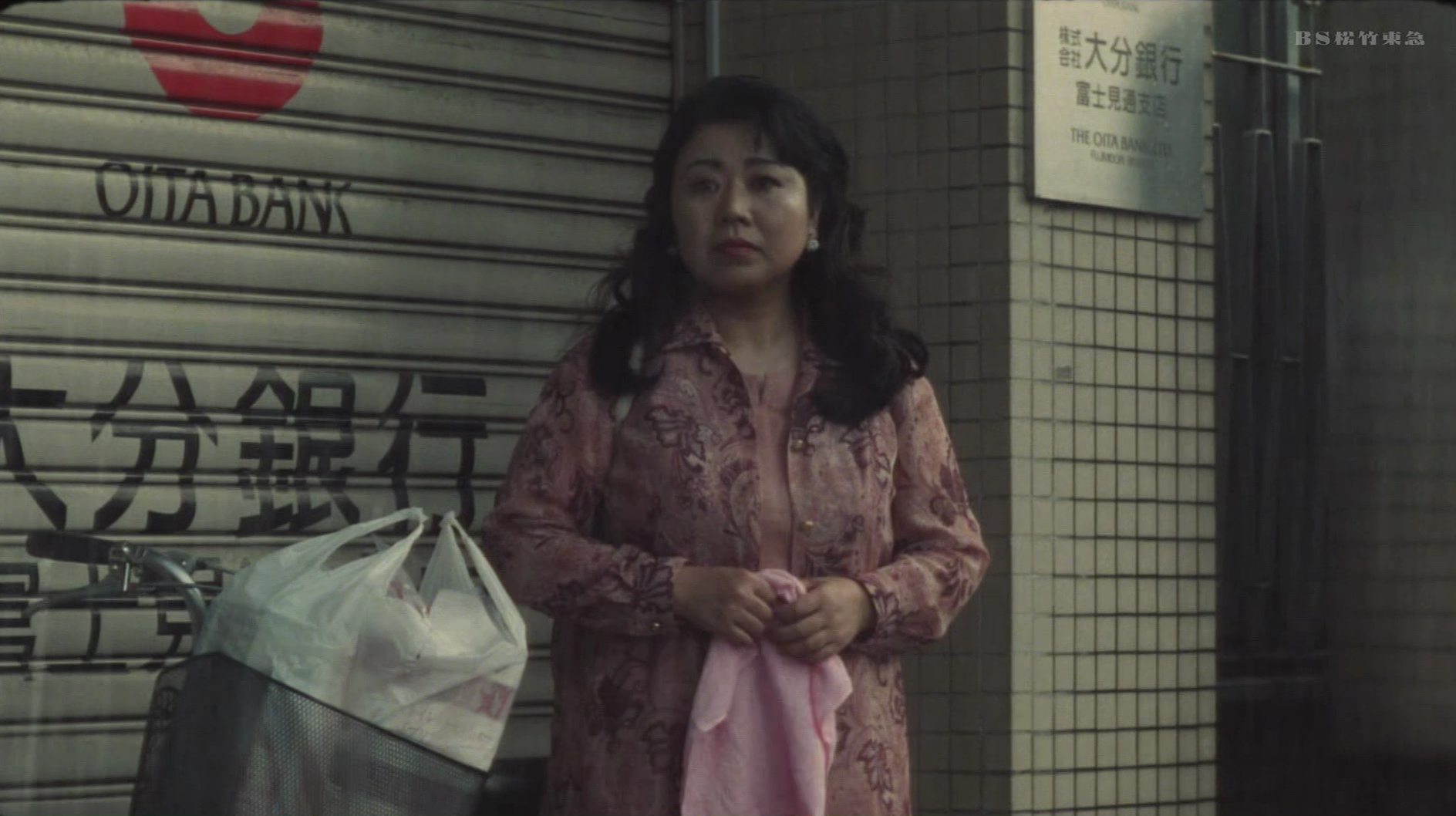
A transfer student quickly becomes the magnet for the anxieties of her classmates amid an ongoing spate of serial murders of primary school children in Joji Matsuoka’s kids adventure movie Phantom in the Toilet (トイレの花子さん, Toiret no Hanako-san). Loosely inspired by the classic urban legend about the ghost of a little girl who haunts school toilets, the film is less a horror movie than a tale of bullying, mass hysteria, and the ways in which childish emotions can spiral out of control.

Natsumi’s (Ai Maeda) no stranger to that herself. A tomboy, she’s largely excluded from the group of popular girls at her school and exists in a rather liminal space. Her older brother Takuya (Takayuki Inoue) is in the year above, but predictably doesn’t like being bothered by his little sister at school and is for some reason embarrassed by the fact his widowed father is a milkman. Nevertheless, he’s incredibly earnest and righteous and volunteers for various things at the school like the student council. Natsumi’s problems begin when the popular girls insist on doing a Ouija board to find out the identity of a serial killer who’s already killed two children their age from different schools. Natsumi doesn’t realise that it’s a trick the other girls are playing on her, but the Ouija board says the killer is Hanako, the toilet ghost, and Natsumi is the next victim.

Meanwhile, a new girl joins their school in Takuya’s class and is immediately resented by the popular girls because she’s pretty and clever, so obviously they turn against her. Chief among the complaints against Saeko (Yuka Kono) is that she used the cubicle at the end of the girls’ toilets which supposedly belongs to Hanako, because obviously she doesn’t yet know this bit of school lore. After a series of odd things happen, including the murder of the school’s pet goat, everyone comes to the conclusion that Saeko must be possessed by Hanako and is planning to murder them all. Even Natsumi has her doubts, but eventually decides to defend Saeko while Takuya, who seems to have a crush on her, eventually gives in to peer pressure despite his promises to protect her and vision of himself as someone who does the right thing.

To that extent, it isn’t really Hanako that haunts the children so much as the idea of her is misused as a means of social control. A silly rumour soon gives way to mass hysteria as the popular girls bring more of the children over to their side to gang up on Saeko while the teachers are largely absent or oblivious. While in another film the kids might band together to look for the killer of the other children and thereby protect themselves and each other, instead they become ever more paranoid and the outsider figure of Saeko becomes the focus of all their negative emotions from the jealousy of the other girls to the uncertainness of Takuya who doesn’t know what to do with his confusing feelings for Saeko. In a touching moment, he replies via writing on the blackboard rather than speaking when Saeko uses it to communicate with him after losing her voice, but later ends up shouting at her to go away and leave him alone. “Silence means you agree,” one his classmates points out when Takuya attempts to abstain from an otherwise unanimous vote to subject Saeko to a kind of test akin to a ducking stool to prove whether or not she really is Hanako. Only Natsumi remains on her side.

Meanwhile, the real child killer hovers in the background like an abstract threat before finally invading the school like a refugee from a slasher movie. Swinging his scythe around, his crazed moaning may prove too prove frightening for younger audiences while not even Natsumi’s father and their teacher can stop him from murderous wandering. In the end, the “real” Hanako surfaces but as a more benevolent figure who calls the kids back to the school and creates a more positive sense of mob mentality as they all shine their torches on the killer as if confronting him with what he is and what he’s done. The curse itself is lifted as the other kids rally round to save Saeko and finally accept her as one of them. A charming exploration of a 90s childhood from Grandpa playing Nintendo shogi to the looming anxieties of stranger danger, the ultimate message is one of solidarity and friendship as Hanako helps the kids let go of their petty disagreements to confront the real monster and save each other.


Trailer (no subtitles)

The Hitman: Blood Smells Like Roses (ザ・ヒットマン 血はバラの匂い, Teruo Ishii, 1991)

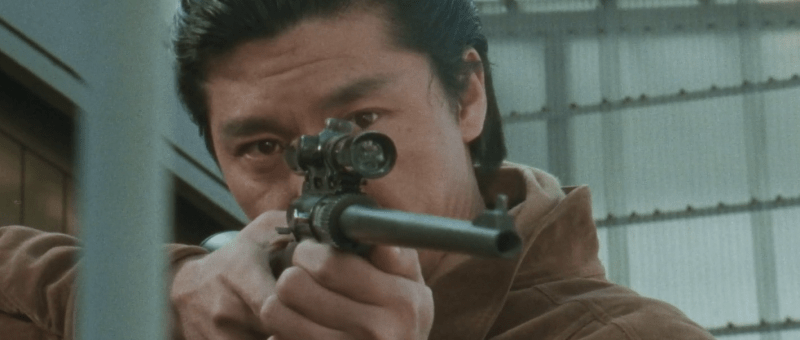
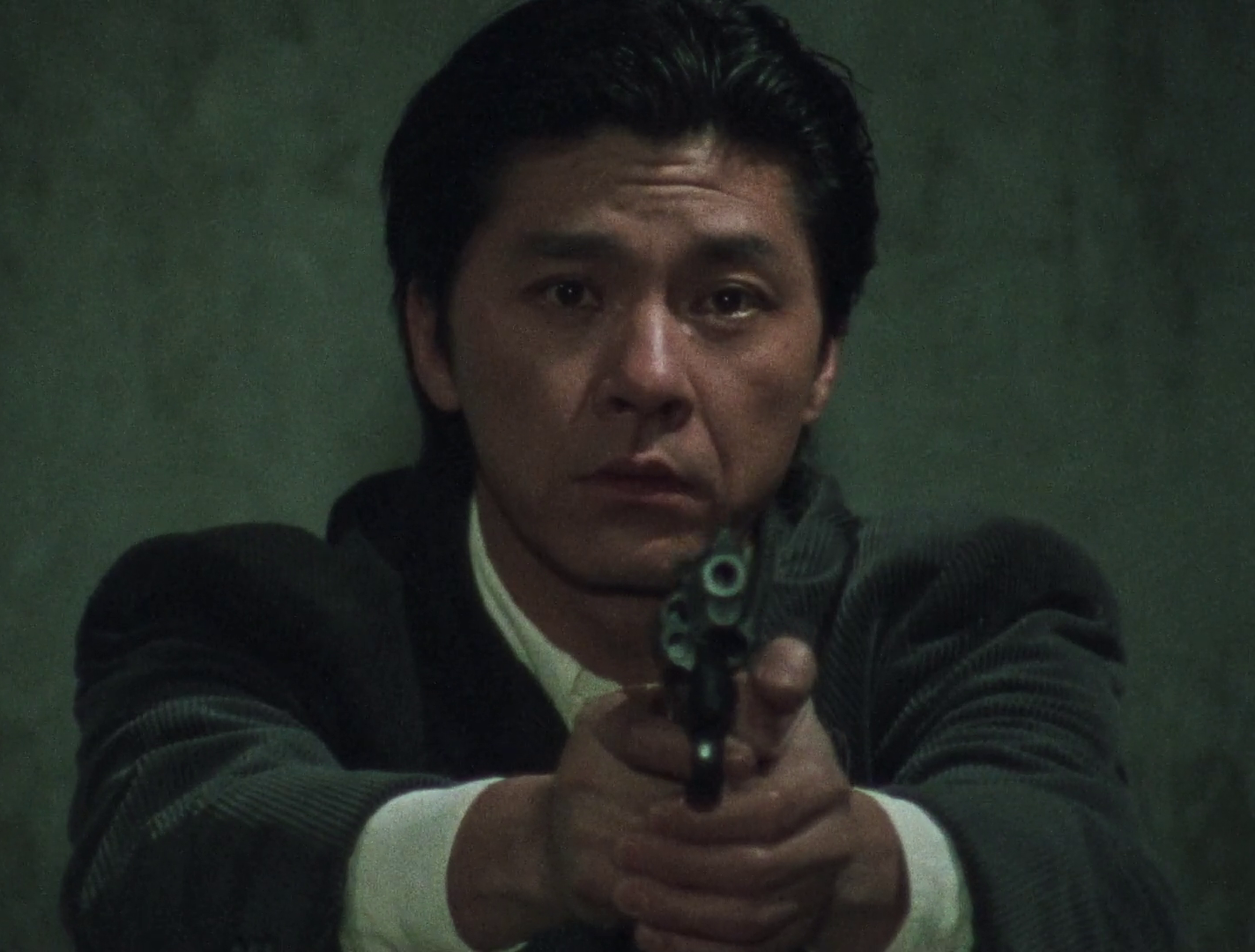
After his fiancée is killed during a yakuza shootout in a restaurant, a former spy in training plots revenge in Teruo Ishii’s Hitman: Blood Smells Like Roses (ザ・ヒットマン 血はバラの匂い, The Hitman: Chi wa Bara no Nioi). Ishii has been in retirement for 12 years before making the film but steps right into the zeitgeist with his bubble-era nightclub opening in which a yakuza goon pretends to be the son of a stockbroker to seduce a young woman he intends to press into prostitution, while looking back to classic noir and the borderless action past.

The young woman is rescued, though not soon enough to escape harm, by the titular hitman, Takanashi (Hideki Saijo), though he does not intervene to save her, only to take out the trio of yakuza who were one side of the gun battle in which his fiancée Reiko (Mikiko Ozawa) was killed. Reiko’s innocence is emphasised by her position as a teacher at a Christian school which is directly contrasted with the sleazy world of contemporary Shinjuku in which Takanashi becomes involved with a series of women. The Asia Town that he strays into is another international space with its samba bars and Filipina hostesses, while Takanashi is later sent to track a boat coming in from the Philippines which is thought to be smuggling guns. 

That’s a tip off he receives from Nakatsuka (Kiyoshi Nakajo), an old mentor from the defence academy who now works for the Cabinet Intelligence and Research Office, the nation’s primary intelligence authority. Nakatsuka is also seen meeting with the police chief who tells him that the yakuza have been complaining that police are encouraging the gang war rather than trying to stop it. So much the better, Nakatsuka says, let them massacre each other then take them all out right before the election to manipulate public opinion. If the election goes their way, the police chief will have additional budget to hire more policemen. Thus Takanashi also becomes a kind of pawn in cynical political machinations conducted by Nakatsuka and CIRO who are helping him both out of friendship and sympathy and because it is useful for him to make use of Takanashi and his desire for revenge. Only veteran policeman Uchino (Tetsuro Tanba) smells a rat, but even he later lets Takanashi go after making a moral judgement that justice has been served and Takanashi hasn’t really done anything wrong.

And so Takanashi tries to avenge Reiko by setting the gangs against each other in a recreation of the original gang war. He’s first frustrated and then aided by Shinjuku party girl Rumi (Natsumi Nanase) who steals his briefcase and gives it to the yakuza, and also be her friend Hisako (Yuki Semba) whom he meets after ducking into a soapland to escape the police. Hisako’s apartment is well furnished with even the modern convenience of an exercise bike, while Rumi’s feels empty, like a hideout with its bare floors and sparse decor. The walls are decorated with posters for Casablanca and Bonnie and Clyde that bring home and older noir past that Takanashi is echoing in his quest to avenge Reiko’s death at the hands of a crime-ridden society. We’re told that he gave up his place at the defence academy and became a truck driver when his parents objected to their marriage, but now fulfils his destiny in tackling the yakuza threat head on.

Meanwhile, as a kind of counter to Rumi, Hisako, and Yasuda’s girlfriend, Kumasa’s woman Beniko (Kimiko Yo) who is very much involved in policy decisions and actively fights back in defence of Kumasa who is otherwise a bit useless. The film is sleazy from its opening rape sequence to the soapland escapade and inexplicable closing credits which consist of a number of raunchy gravure shots backed by a power ballad that otherwise have little to do with the rest of the film, but is perhaps less cynical that it appears or at least seems to edge away from nihilism towards something that appreciates that a more emotional, poetic kind of justice is possible and valid. Takanashi is allowed to complete his quest, though it incurs additional casualties, and then leave the scene having achieved a kind of closure and brought the cycle to an end leaving the rest to Nakatsuka and Uchino who now seems to have crossed over to Nakatsuka’s side if perhaps lamenting that he may be working far too hard to a achieve a justice that now seems surprisingly easy to enact.

Every Trick In The Book (鳩の撃退法, Hideta Takahata, 2021)

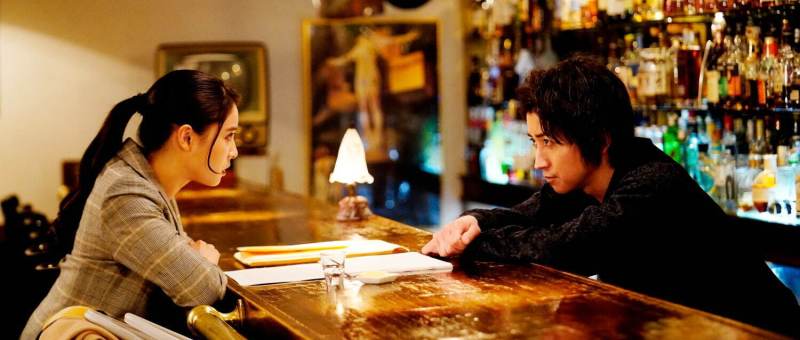
A down on his luck writer finds himself at the centre of a mystery only how much is truth and how much “fiction”? Based on the novel by Shogo Sato, Hideta Takahata’s Every Trick in the Book (鳩の撃退法, Hato no gekitai-ho) ponders the possibilities of literature as the hero seems to create a fictional world around him in which it is largely unclear whether he is solving a real world mystery or simply imagining one based on his impressions of the strange characters he encounters through the course of his everyday life.

That everyday life is however eventful just in itself. Tsuda (Tatsuya Fujiwara) once won a prestigious literary prize and was destined to become a popular author but hasn’t written anything of note for some time and in fact now largely works as a driver ferrying sex workers around on behalf of his shady boss. The mystery begins when he approaches a man, a rare solo reader in an overnight cafe, and promises to lend him a copy of Peter and Wendy by JM Barrie only to later discover that the man went missing along with his wife and the daughter he had explained was fathered by another man. 

Like many of his subsequent encounters it isn’t entirely clear if this meeting really took place or at least as Tsuda said it did or is only part of the novel he is beginning to write. The man, Hideyoshi (Shunsuke Kazama), asks him if it’s a novelist’s habit to begin imagining backstories for everyone he sets eyes on and there may well be some of that even as Tsuda is fond of claiming that amazing things happen around us every day to which we are mostly oblivious. Still, Tsuda probably didn’t expect to be pulled into the orbit of local gangster Kurata (Etsushi Toyokawa) after accidentally passing on counterfeit currency he found by chance. It’s true that most of what’s happening to him is the result of a series of bizarre coincidences or cosmic confluence which has accidentally united this collection of people in an unintended mystery which Tsuda intends to solve in either literal or literary terms. 

“It’s all a novelist can do” he later claims in trying to write a better ending for “characters” he has come to like than the one he assumes they “actually” met. But then his editor Nahomi (Tao Tsuchiya) chief worry is that, like his previous novel, Tsuda’s story will contain too much of the “literal” truth which could cause his publishers some legal problems. Part of the reason Tsuda left the industry is apparently because his last book was inspired by a real life affair which was then considered somewhat hurtful and defamatory. For that reason it comes as quite a blow to Nahomi as she begins to investigate and discovers that much of Tsuda’s story lines up with “real” places and events, but then again as he says if you can draw connections between known facts then you begin to see a “hidden” truth which may in its own way be merely his invention. 

The film’s Japanese title translates more literally as something like “how to fend off a dove” which does indeed have its share of irony especially considering the meaning the dove symbolism turns out to have in the film but perhaps also hints at the essential absurdity of trying to fight back against something that is otherwise harmless and in fact represents peace. Tsuda may be onto something and nothing, embracing the bizarre serendipity of a writer’s life while trying to recover his creative mojo but embellishing it with more danger and strangeness than it actually has to offer. Then again as his editor discovers, there really is an incinerator it seems anyone can just walk up and use to burn whatever they want including dead bodies, while people in general are full of duplicities all of which keeps the “fake” money circulating as people use it to try to buy things that can’t really be bought. Hideyoshi calls them “miracles”, embracing the strange serendipity of his life as an orphan longing for a family to call his own and unexpectedly finding one which is “real” in someways and “fiction” and in others. Then again, if you believe in something does it really matter if it’s “real” or not? Hideyoshi and Tsuda might say it doesn’t, the publishing company’s lawyers might feel differently, but it seems there really are amazing things going on around us every day if only you stop to look. 


Original trailer (English subtitles)

Baian the Assassin, M.D. (Part 1) (仕掛人・藤枝梅安, Shunsaku Kawake, 2023)

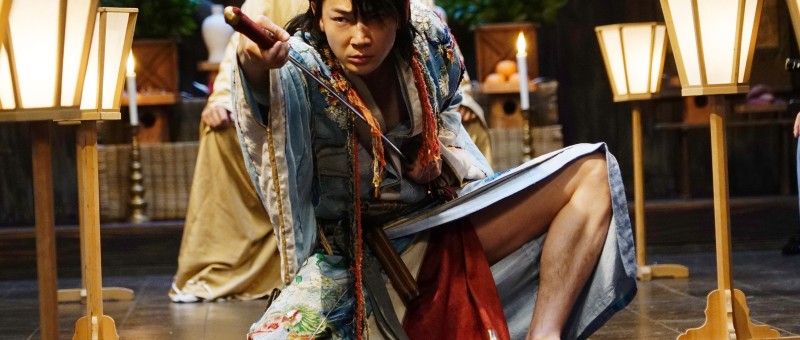
A traumatised assassin takes it upon himself to get rid of a few villains on realising there’s something not quite right with his latest contract in Shunsaku Kawake’s classic jidaigeki homage, Baian the Assassin, MD: (Part 1) (仕掛人・藤枝梅安, Shikakenin Fujieda Baian). The titular hero is the protagonist of a series of novels by Shotaro Ikenami which have spawned several previous adaptations on the big and small screens. Produced in celebration of Ikenami’s centenary the film, one of two, harks back to the golden age of period drama if with a more contemporary sensibility. 

Baian (Etsushi Toyokawa) is ostensibly an acupuncturist though by night he uses his needles to kill rather than to heal. Hired to take out the second wife an inn owner, Omino (Yuki Amami), his suspicions are raised on realising that he had also been the assassin who killed the man’s first wife two years earlier. He blames himself in part for having agreed to assassinate a woman in the first place, and remains conflicted even after accepting the job wondering if Omino is next in the firing line or if she was actually the one who had the other woman killed in order to usurp her place. 

The film makes clear from the outset what a difficult place Edo could be for a woman as Baian carries out an assassination on a boatman who had raped a samurai’s wife and then blackmailed her into further sexual favours only for her to hire an assassin and then kill herself confessing all. Omino had apparently been the stepdaughter of a gang leader who sexually abused her and then died leaving her with no support and nowhere to turn except to sex work. Maybe no one could blame her for taking advantage of a besotted client to escape her terrible circumstances though getting rid of his wife would obviously be a different matter. Omon (Miho Kanno), a maid Baian takes a liking to while investigating, admits something similar that as a widow with a young son realistically speaking there is nowhere else that could she work to support him except on the fringes of the sex trade. Then again, as she says the previous mistress was strict but it was because she cared, whereas Omino is just mean and self-interested. She’s fired all the old staff and brought in pretty young women who are quite obviously being expected to entertain their male customers in more direct ways. 

In any case, Baian soon finds himself drawn into a wider series of plots when his friend Hiko (Ainosuke Kataoka), a skewer maker who assassinates people with poison darts, is tasked with taking out first a lascivious carpenter and then a rogue samurai who has supposedly raped and kidnapped the daughter of his lord which obviously turns out not quite to be the case. Rape and kidnap are depressingly common in Edo-era society where it is largely women who suffer under a patriarchal society with intensely oppressive social codes that demand female purity. In a post-credits sequence, we come to understand that Hiko too is seeking vengeance for the death of a woman who killed herself and her child after being raped by bandits. Meanwhile, Baian reveals that he had a mild hatred of women himself born of pain in having been abandoned by his mother who left with another man and took only his sister with her after his father’s death. He had to overcome that resentment in order to fulfil himself as a doctor treating women’s bodies but struggles when he realises that someone involved in the case is closely linked with his own traumatic past and death may be the only way to save them. 

Both he and Hiko end up breaking the assassin’s code but only in defence of justice, which might sound odd considering the nature of their work. Nevertheless, they each have their scruples and don’t like to think of themselves as having been used or inadvertently killed someone who didn’t really deserve it. As Baian puts it, the greatest villains may really be “well-meaning weak cowards” though perhaps corrupt lords can’t really complain about falling victim to their own tactics. With noticeably polished production values and atmospheric cinematography, Kawake pays tribute to classic jidaigeki and eventually sets his heroes back on the road awaiting the next battle for justice in the distinctly unjust feudal era. 


Baian the Assassin, M.D. (Part 1) screened as part of this year’s Camera Japan.

Original trailer (English subtitles)

Punk Samurai (パンク侍、斬られて候, Gakuryu Ishii, 2018)

Gakuryu Ishii began his career under the name Sogo as a representative of the youth voice, in fact still a college student when invited by Nikkatsu to film a feature-length version of his Panic High School short though they paradoxically saddled him with the more experienced Yukihiro Sawada as a co-director in case his voice turned out to be more youthful than anticipated. In any case, he went on to make his name with a series of anarchic punk films such as Burst City and The Crazy Family before retreating from filmmaking in the early 2000s. When he returned in 2012 with Isn’t Anyone Alive?, he did so under a new name, Gakuryu, as if signalling a new phase in his artistic career that seemed to have left punk behind.

Like 2015’s That’s it, Punk Samurai is billed as a kind of return to Ishii’s anarchic roots while also harking back to surreal samurai movie Gojoe. Even so, Punk Samurai isn’t really a punk samurai film even in its irreverence towards the genre so much as an ironic jidaigeki comedy which eventually positions its hero’s nihilistic outsider status as his saving grace in a “fake” world where nothing has true meaning. “This world might be fake, but I’m alive” he insists, claiming not to ask anything of it, simply stating that he is “different” because he belongs to no group and has been a lonely a wanderer.

Nevertheless, Kake (Go Ayano) had wanted to join a clan so desperately that he spun a tale of dangerous cult rebellion to a naive retainer of a useless lord whose inability to rule has ruined his fiefdom. After killing a pilgrim he believed to be a member of the Bellyshaker Party, Kake is taken in by the Kuroae where he is enlisted by duplicitous councillor Naito (Etsushi Toyokawa) who seizes on the idea of the Bellyshaker threat as a means of undermining his rival, Ohura (Jun Kunimura), to seize the reins from overly serious lord Kuroae (Masahiro Higashide). 

The Bellyshaker cult believes that this “fake” world exists within a giant tapeworm and seeks escape though being excreted by it into the “real” world as a means of achieving some kind of spiritual enlightenment. Their furious belly shaking is deliberately meaningless in an effort to antagonise he tapeworm to such a degree that it gives it spasms to “spew” the believer into a more authentic existence. Not even the cult leader believed this to be true, and as Kake later suggests the appeal lies in a kind of Manichaeanism that allows the believer to believe nothing is their fault it’s just that this “fake” world is wrong. In the end, the conflict comes down to a battle between “monkeys and idiots”, while even an enlightened ape (Masatoshi Nagase) finds his revolution failing and is left with no option other than to retreat to the Heavens. 

The world is indeed in disarray, Kuroae is constantly plagued by his own poor decision making, or failure to make decisions at all, while there are constant allusions to the decline of his clan from persistent famine to military weakness after having made most of his foot soldiers redundant as part of an austerity programme. Many of the recruits to the “fake” Bellyshaker cult resurrected by Naito with the assistance of former devotee Chayama (Tadanobu Asano), who has two telepathic servants who speak for him, are in fact refugees from Kuroae who fled its disorder. Kake prides himself on being an outsider but in reality had wanted to join the clan, and there is perhaps something in the sudden collapse of the world around him along with a return to blue skies the moment his rebellion is ended. 

Yet for all its weirdness and incomprehensibility, for much of is running time Punk Samurai is a typical jidaigeki comedy about a useless lord, his clever underlings, and a chaotic ronin if one that also hints at the absurdist meaninglessness of the hierarchical samurai society. Only in its closing moments does the film truly embrace its punk spirit with psychedelic kaleidoscope backgrounds, electric swords, and the true slash down of the social order as Kake’s life comes full circle proving that even in this “fake” and meaningless world there are some things from which there is no escape.


Punk Samurai is released on blu-ray in the UK on 13th March courtesy of Third Window Films.

Original trailer (English subtitles)

You’ll Fall For Me (君は僕をスキになる, Takayoshi Watanabe, 1989)

Two mismatched friends find themselves caught up in an ironic love square in Takayoshi Watanabe’s infinitely charming Christmas rom-com, You’ll Fall for Me (君は僕をスキになる, Kimi wa Boku wo Suki ni Naru). A bubble-era nonsense comedy filled with surreal humour and zany gags along with genuine heart, the film pits friendship against love but not only of the romantic kind as the two women each consider acts of selflessness in knowing that pursuing, or preventing the other from pursuing, their romantic destiny will necessarily cause each of them pain. 

Beginning in the summer the film opens with a bizarre incident in which mousy pudding-obsessed librarian Tomoko (Yuki Saito) thinks she sees her neighbour across the way, Chika (Kuniko Yamada), jump off the roof of a nearby building only it turns out to be a strange practical joke. Chika certainly has a flair for the dramatic along with an unusual personality that has made her something of an outcast at her office job while even her friendship with Tomoko seems somewhat one-sided with her constant refrains of “you’re my best friend!” which are generally met by a blunt reply from Tomoko of “we’re not friends”. In any case, Chika’s current dilemma is that she doesn’t have a date lined up for Christmas Eve and thinks she’s jinxed because she always seems to get dumped right before the big day, while Tomoko is rather shy and it seems had no expectations of getting a boyfriend anyway. 

Their prospective suitors are a couple of salarymen, the feckless son of a CEO, Kyosuke (Masaya Kato), and his nerdy best friend Junpei (Senri Oe) who like Tomoko is a spectacles wearer. The pair have a typical meet cute when they bump into each other at a crossing and knock each other’s glasses off, each ending up with the wrong pair and not realising until it’s too late. Meanwhile, at the office, Kyosuke is being pressured by his father (Jo Shishido) to embrace adult responsibility and meet a prospective candidate for an arranged marriage who looks suspiciously like Chika though Kyosuke never looks at the photo. To get him off his back, he says he’s dating a woman from the company. Because he’s just that popular, a stage event is organised at which Kyosuke is supposed to announce who it is he has his eye on but he scandalises just about everyone by naming Chika who wasn’t really in the running. 

In the opening scenes, however, the guys had been indulging in a bit of 80s excess dribbling champagne from a helicopter some of which had rained down on Tomoko as if anointing her from above. She ends up having a second meet cute, this time with Kyosuke, who accidentally hypnotises her to think she’s a dog leading her to then attack him. A similar thing happens to Chika who is looked after by Junpei after having too much to drink on a date with Kyosuke at a nightclub where Tomoko had also agreed to go on an awkward date with Junpei. Inconveniently, the entirely mismatched Kyosuke ends up falling for the mousy charms of Tomoko who at this point doesn’t know that he’s “dating” Chika.

While the film presents an interesting picture of women in the workplace at the height of the bubble era, it also subtly undermines the prevailing consumerist culture of the age while preserving the romanticisation of Christmas. They two women each want to find a boyfriend to spend Christmas Eve with partly for reasons of social status and partly because they are simply quite lonely, Chika in particular very invested in her friendship with Tomoko while she, much more introverted, seems continually exasperated but despite herself allows Chika to dominate her existence. After becoming aware of their romantic conflict, the two women end up spending Christmas Eve together at a nice restaurant prioritising friendship over romance until one of them realises the other is unhappy and after discovering a note from their suitor asking them to meet in a local park chooses to spend the rest of the evening alone so her friend can go get her man. 

Then again, there’s a clear idea that Tomoko in particular is undergoing a kind of transformation signalling her shift away from Junpei by deciding to get contacts, putting on lipstick, and dressing in a slightly less mousy fashion while Chika’s attempt to become the sort of woman that Kyosuke would date by dressing and acting more like the other women in the office largely backfires. Meanwhile Kyosuke and Junpei are also changing, Kyosuke giving up his womanising ways and becoming more serious in his pursuit of Tomoko while Junpei comes to appreciate the vulnerable force of nature that is Chika. The film takes its title from Kyosuke’s attempt at hypnotising Tomoko into falling in love with him only to find that he’s the one who’s fallen under her spell as they move towards the anticipated Christmas Eve climax accompanied by the now classic song by Tatsuro Yamashita. Faced with the choice, the women do indeed choose friendship over love but discover that it isn’t really a choice at all because they both just want their friend to be happy even if it means a lonely Christmas for themselves as the ironic role reversal of the closing coda makes clear.


Original trailer (no subtitles)

Tatsuro Yamashita – Christmas Eve

My Brother, the Android and Me (弟とアンドロイドと僕, Junji Sakamoto, 2022)

“You’re a real weirdo, aren’t you?” the lonely hero of Junji Sakamoto’s existential psychodrama My Brother, the Android and Me (弟とアンドロイドと僕, Ototo to Android to Boku) is constantly told not least by his exasperated and unsympathetic boss but on another level may be the most human of them all longing for a sense of connection in a world which seems to have rejected him to the point that he is no longer sure whether or not he actually exists. Quite clearly drawing inspiration from Mary Shelly’s Frankenstein, the Modern Prometheus as well as its many film adaptations though most obviously the 1931 Universal Horror classic, Sakamoto’s oblique chronicle of crippling loneliness presents a man estranged from himself but looking for comfort in his reflected image. 

Sakamoto opens the film in true gothic fashion, his hero Kaoru (Etsushi Toyokawa) a dark and mysterious figure obscured by an oilskin coat amid the ever falling rain illuminated only by the light of an ominous moon. As we discover he works as a university professor but says nothing to his students other than making an apology for his poor handwriting, sometimes writing with both hands at once as he recreates complex algorithms on an old-fashioned chalkboard. The students all mock him, not least because of a curious neurological condition which prevents him from fully controlling his right leg with the consequence that he is often compelled into strange, jerking movements or else to hop on one foot from place to place. In truth, his errant right leg is a symptom of Kaoru’s sense of displacement in that he does not quite feel it to be his own and experiences only pain when his right heel is in contact with the floor. 

It’s this problem with his leg that seems to most irk his boss who later invasively barges in to the gothic western-style mansion/disused hospital where he lives in the company of his nephew, a psychiatrist, who probably means well but offers little more than platitudes in insisting that Kaoru’s leg has simply been left off his internal schematics so all they need to do is mentally reconnect it. His boss meanwhile bizarrely states that Kaoru needs to get well “so that cracked roads can be fixed”, ironically treating his body like a machine that needs to be repaired so that it is optimised for work rather than out of care for another human being who may be in pain. Having barged into Kaoru’s office, he’d discovered his secret project in a highly complex, lifelike robotic arm which was a problem for him because he was supposed to be working on a robot that fixes potholes which seems almost ironic in its banality. In any case, Kaoru also has the rather unfortunate habit of entirely ignoring the person talking to him as if they weren’t even there which is in itself an ironic inversion of the way others see, or more to the point don’t see, him. Kaoru’s boss describes him as creepy because he has no presence, you’re never sure if he’s there or not, but can immediately sense the “giant” presence of his other self, the lifelike android he’s building in his spare time. 

The android is in its way his Frankenstein’s monster, an ironic attempt to rebirth himself constructed in the ruins of his family’s abandoned obstetrics hospital. By chance, he meets a young woman (Yuki Katayama) who closely resembles himself and carries her into his laboratory like the Bride of Frankenstein but treats her only with tenderness and sympathy while attempting to fend off his estranged half-brother (Masanobu Ando) constantly hassling him for money to pay for medical care for the father who abandoned him. His mother had instructed him to find his other self which is perhaps what he’s been doing if caught between the Id and Superego of his brother and father. Constant fire imagery including the repeated motif of a burning body in a conventional fireplace keys us in to Kaoru’s positioning as a “modern Prometheus” whose duty it is to keep the fire in while giving birth to himself as manifested in a perfect manmade creation that others may find frightening or uncanny though the android itself has done nothing wrong because it is in essence the embodiment of Kaoru’s frustrated humanity. Featuring sumptuous gothic production design with sci-fi sheen, Sakamoto’s steely, fragmentary drama finds a man in search of himself while also a perpetual exile but discovering a sense of warmth in the uncanniness of a reflected image. 


My Brother, the Android and Me streams in the US until March 27 as part of the 14th season of Asian Pop-up Cinema

International trailer (English subtitles)

Love Letter (ラブレター, Shunji Iwai, 1995)

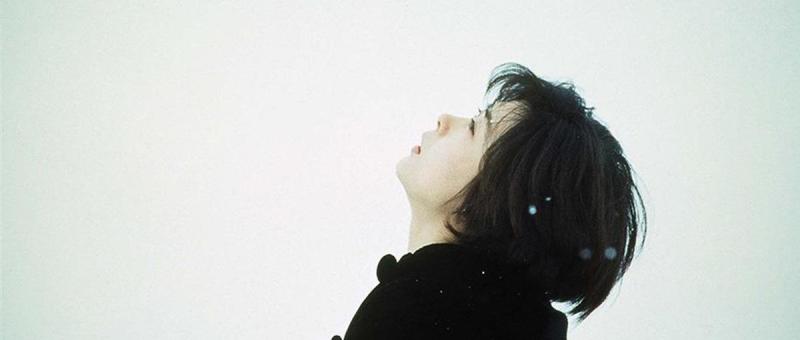
“People are forgotten so easily” a widow laments after an insensitive comment from a family friend, yet there is perhaps a difference between forgetting and letting go as exemplified in the distance between two accidental pen pals in Shunji Iwai’s profoundly moving romantic melodrama, Love Letter (ラブレター). A huge hit and pop culture phenomenon throughout Asia on its 1995 release, Iwai’s first theatrical feature bears many of the hallmarks of his enduring style in its soft focus, ethereal lighting and emphasis on nostalgia as the two women at the film’s centre each restore something to the other through their serendipitous correspondence. 

Iwai opens with a memorial service for Itsuki, the late fiancé of the heroine, Hiroko (Miho Nakayama), who passed away two years previously in a mountain climbing accident. Hiroko has since started a relationship with his friend Akiba (Etsushi Toyokawa) who avoided attending the memorial out of misplaced guilt and gave up mountaineering soon after Itsuki’s death. Akiba is keen to move their relationship forward, but fears that Hiroko is still stuck in the past unable to let go of her love for Itsuki. On a visit to Itsuki’s mother (Mariko Kaga), she finds an old address in his middle school year book for a home that apparently no longer exists and decides to mail him a letter saying nothing more than “How are you? I’m fine” of course expecting no reply. What she didn’t know, however, is that there were two Itsuki Fujiis in her Itsuki’s class, the other being a woman still living at the same address to whom Hiroko has accidentally mailed her correspondence. Confused, the other Itsuki (also played by Miho Nakayama) mails back and eventually finds herself recalling memories of the male Itsuki as an awkward, diffident teen she may have entirely misunderstood. 

Played by the same actress the two women are each in a sense trapped in an eternal present, unable to move forward with their lives. While Hiroko is consumed by grief and fearful of committing to her new relationship with Akiba lest she betray the memory of Itsuki, Itsuki is still struggling to come to terms with the traumatic death of her father 10 years previously who passed away from pneumonia after contracting the common cold leaving her with persistent health anxiety. Meanwhile, she is also struggling to move on from her family home which is in an increasingly perilous state of disrepair. She and her mother (Bunjaku Han) want to move into a modern apartment, while her grandfather (Katsuyuki Shinohara) prefers to stay even though it seems that the house will soon have to be demolished. 

Through their accidental correspondence, both women are forced to deal with recent and not so recent loss, Itsuki in some senses having forgotten the boy who shared her name while Hiroko remains unable to forget. Through his trademark ethereal lighting and frequent use of dissolves, Iwai hints at a sense of perpetual longing for the nostalgic past. The letters may not have been from the late Itsuki in a literal sense but were perhaps a message from him, connecting the two women and eventually freeing each of them as the love letter of the title is finally delivered ironically enough hidden inside a copy of Remembrance of Things Past. 

This sense of grief-stricken inertia is perfectly reflected in the snowy vistas of the lonely northern town of Otaru, thrown into stark contrast with the intense heat of the furnace in Akiba’s glassblowing workshop, or the gentle warmth of the old-fashioned stove in Itsuki’s room as she types replies to Hiroko’s handwritten letters. As Hiroko eventually reflects, they each knew a different Itsuki and have each in a sense both lost him if restoring something one to the other through the exchange of memories that grants Hiroko the understanding she needs to let go and Itsuki the poignant realisation of a youthful missed connection. A bittersweet meditation on love, loss, grief, and memory, Iwai’s epistolary drama has its own sense of magic and mystery in the strange power of this serendipitous connection leading to a tremendous sense of catharsis as a long delayed message finally makes its way home bringing with it a shade of melancholy regret but also possibility in the new hope of forward motion.


Love Letter screens at the BFI on 22/28 December as part of BFI Japan.

Original trailer (no subtitles)

I Never Shot Anyone (一度も撃ってません, Junji Sakamoto, 2020)

“You don’t know the pain of being forgotten” laments an ageing actress attempting to move the heart of a heartless conman in Junji Sakamoto’s comedy noir I Never Shot Anyone (一度も撃ってません, Ichido mo Uttemasen), more as it turns out a melancholy meditation on age and disappointment than hardboiled farce. Sakamoto’s elderly heroes live in a world of night in which their dreams of youth never died, but are confronted with the realities of their lonely existences when the sun rises and exposes the shallowness of their escapist fantasy.

74-year-old Susumu Ichikawa (Renji Ishibashi) was once a promising novelist but veered away from the realms of literary fiction towards the allure of hardboiled noir, no longer permitting his wife Yayoi (Michiyo Okusu) to read his drafts claiming that she would find them too distressing. His publisher (Koichi Sato) meanwhile is more distressed by the quality of the prose than the content, partly because his novels are simply dull but also because they are far too detailed to be mere imagination and as each one seems to be based on a recent ripped from the headlines case he’s staring to worry that Susumu is the real life legendary hitman said to be responsible for a series of unsolved suspicious deaths. 

On the surface, it might be hard to believe. At home, Susumu is a regular old gent who reads the paper after breakfast and locks himself away in his study to write for the rest of the day but his wife complains that he stays out too late at night little knowing that he leads something like a double life, dressing like a shady character from a post-war noir and even at one point likening himself to Yves Montand in Police Python 357. He speaks with an affected huskiness and is fond of offering pithy epithets such as “women come alive at night” while reuniting with two similarly aged friends in a bar run by a former hitman nicknamed “Popeye” (pro wrestler Jinsei Shinzaki) who seems to have some kind of nerve damage in his hands he’s trying to stave off through obsessive knitting. 

What Susumu seems to be afraid of, however, is the sense of eclipse in his impending obsolescence. The guy who ran the local gun shop whom he’d known for 30 years recently passed away, while the guy from the Chinese herbalist apparently went home to die. His publisher’s retiring, and Popeye’s going to close the bar because his mother’s ill so he’s going back to his hometown. Susumu and his wife didn’t have any children and he perhaps feels a little untethered in his soon-to-be legally “elderly” existence while the now retired Yayoi is also lonely with her husband always off in another world he won’t let her share. His friend Ishida (Ittoku Kishibe) once a prosecutor and now a disgraced former mob lawyer working as a security consultant/fixer is estranged from his only daughter, while former cabaret star Hikaru (Kaori Momoi) never married and spends her days working in a noodle bar. They are all scared of being forgotten and fear their world is shrinking, living by night in order to forget the day. 

Perhaps you can’t get much more noir than that, but there’s a definite hollowness in Susumu’s constructed hardboiled persona that leaves him looking less like Alain Delon than a sad man in an ally with only a cigarette for a friend. Even his new editor is quick to tell him that no reads noir anymore, Susumu is quite literally living in the past battling a “hopeless struggle” as someone puts it against the futility of life by living in a hardboiled fantasy. We see him looking at target profiles for an investigative reporter proving a thorn in the side of yakuza and big business, and threaten a heartless conman (Yosuke Eguchi) whose investment frauds have caused untold misery, yet he’s not really a part of the story and his life is smaller than it seems or than he would like it to be. Perhaps in the end everyone’s is even if Susumu is as his new editor describes him “one step away from being insane”. Never quite igniting, Sakamoto’s lowkey tale of elderly ennui is less rage against the dying of the light than a tiny elegy for lives unlived as its dejected hero steps back into the shadows unwilling to welcome an unforgiving dawn.


I Never Shot Anyone screened as part of this year’s Camera Japan

Original trailer (no subtitles)

Ito (いとみち, Satoko Yokohama, 2021)

“Ye can’t hear my silence!” the timid young heroine of Satoko Yokohama’s Ito (いとみち, Itomichi), an adaptation of the Osamu Koshigaya novel, finally fires back, reminding us that silence too is means of communication. The film’s Japanese title, Itomichi, refers to the groove in shamisen player’s nail caused by the friction of the strings, but also perhaps to the path of the heroine of the same name as she makes her way towards self actualisation, figuring out the various ways there are of connecting with people as she begins to step into herself while coming to terms with the past. 

As we first meet Ito (Ren Komai) she’s trapped in a boring history lesson about local famines, reminded by the teacher to raise her voice while reading from the textbook but reluctant to do so firstly because she has an unusually strong local accent and often speaks in dialect and secondly because she is intensely shy. When she’s finished, the teacher even jokes that listening to her read is a little like classical music though it doesn’t seem much like a compliment. Even so, it’s particularly apt as Ito, like her late mother, has a talent for playing the Tsugaru shamisen and has even won numerous competitions yet she’s barely touched her instrument recently, perhaps developing a slight complex about the bumpkinishness of her intensely local way of life, especially as her father Koichi (Etsushi Toyokawa) is a university professor researching the traditional culture of the local area. 

Pointing out that talking is Ito’s weak spot, Koichi reminds her that she can communicate with others through her music even if he later admonishes her to use her words if she has something to say. Her refusal to pick up her shamisen is then a kind of withdrawal if of a particularly teenage kind. Hoping to get over her shyness, she finds herself quite accidentally applying for a part-time job at a maid cafe in the city, an incongruity in itself but one that helps her begin to open up to others. Then again, a maid cafe might not be the best environment selling as it does an outdated conception of sexual politics. Koichi later makes this argument pointing out that a maid cafe is not so different from a hostess bar while another maid, Tomomi (Mayuu Yokota), takes issue with the false chivalry of some of the middle-aged men who frequent the establishment who set up a club to “protect” Ito after she is inappropriately touched by a belligerent customer. To Tomomi the very idea that women need “protection” from men against men is inherently sexist and wrongheaded while the fact that they all rally round to protect the shy and vulnerable Ito also speaks volumes about their ideals of womanhood explaining why it is they’re in a maid cafe where the waitresses call their customers “master” and indulge their every whim in the first place. Even so, Ito’s colleagues are also quick to reassure her that she is in no way at fault, the customer’s behaviour was unacceptable and against the spirit of their establishment.

Yet as the manager points out “moe moe” is also a “means of communication” not perhaps intended to be taken literally. Ito does not exactly discover how to use her words, but through interacting with her colleagues at the cafe begins to come into an acceptance of herself no longer seeing her accent and dialect as uncool or old fashioned giving herself space to breathe as she makes new friends guided by her cafe mentor Sachiko (Mei Kurokawa) and finally getting up the courage to speak to another lonely young woman whom she’d been on awkward nodding terms with seeing as they catch the same train home from school. As Ito’s grandmother (Yoko Nishikawa) reveals, she learned how to play the shamisen with her eyes and ears proving that communication comes in many forms. Ito’s name which she had previously found old-fashioned and embarrassing appropriately enough means threads or here strings of a shamisen which become in their own ways channels to connect with other people which as the slightly dubious owner of the cafe (Daimaou Kosaka) points out is the most important thing of all. 

As Ito rehearses her maid routine with a video of her mentor, grandma outlines her thoughts about shamisen on camera for Koichi’s eager students, handing her knowledge down for the next generation. Literally finding her groove again, carving a niche in her fingernail, Ito rediscovers her love for music while gaining the confidence to stand on stage and be herself encouraged by all her friends and family. A beautifully pitched coming-of-age tale celebrating the local culture of Yokohama’s hometown Aomori, from which leading actress Ren Komai also hails, Ito is a warm and loving tribute not only to Tsugaru shamisen but to friendship and community brokered by a wealth of communication and a willingness to listen even to silence. 


Ito screened as part of the 2021 Osaka Asian Film Festival.

Images: (C)2021『いとみち』製作委員会