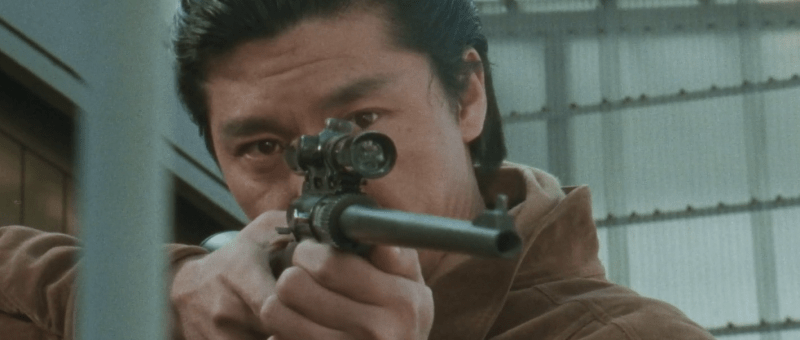
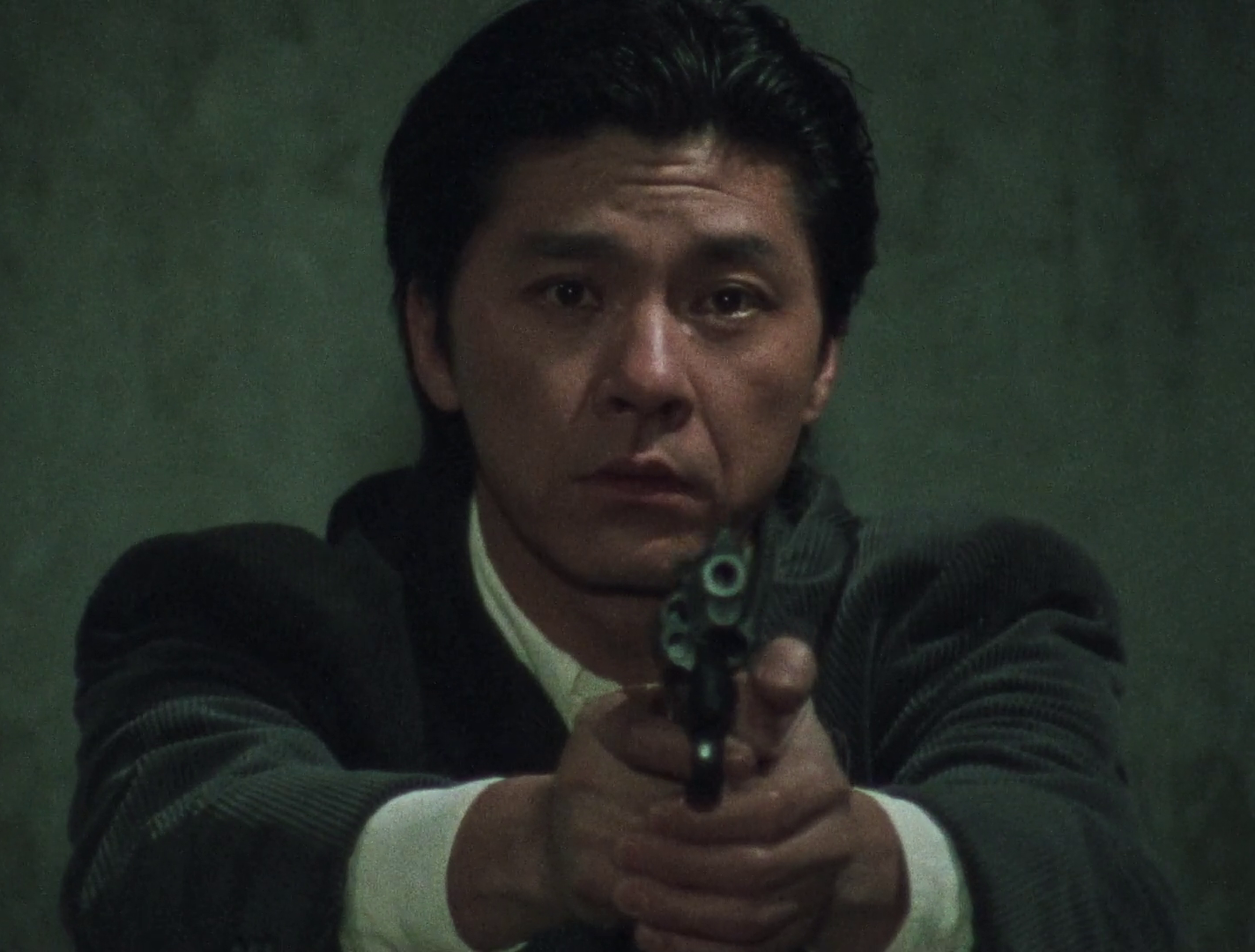
The Hitman: Blood Smells Like Roses (ザ・ヒットマン 血はバラの匂い, Teruo Ishii, 1991)

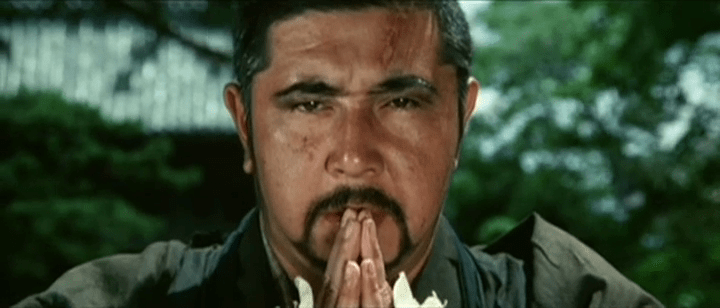
After his fiancée is killed during a yakuza shootout in a restaurant, a former spy in training plots revenge in Teruo Ishii’s Hitman: Blood Smells Like Roses (ザ・ヒットマン 血はバラの匂い, The Hitman: Chi wa Bara no Nioi). Ishii has been in retirement for 12 years before making the film but steps right into the zeitgeist with his bubble-era nightclub opening in which a yakuza goon pretends to be the son of a stockbroker to seduce a young woman he intends to press into prostitution, while looking back to classic noir and the borderless action past.

The young woman is rescued, though not soon enough to escape harm, by the titular hitman, Takanashi (Hideki Saijo), though he does not intervene to save her, only to take out the trio of yakuza who were one side of the gun battle in which his fiancée Reiko (Mikiko Ozawa) was killed. Reiko’s innocence is emphasised by her position as a teacher at a Christian school which is directly contrasted with the sleazy world of contemporary Shinjuku in which Takanashi becomes involved with a series of women. The Asia Town that he strays into is another international space with its samba bars and Filipina hostesses, while Takanashi is later sent to track a boat coming in from the Philippines which is thought to be smuggling guns. 

That’s a tip off he receives from Nakatsuka (Kiyoshi Nakajo), an old mentor from the defence academy who now works for the Cabinet Intelligence and Research Office, the nation’s primary intelligence authority. Nakatsuka is also seen meeting with the police chief who tells him that the yakuza have been complaining that police are encouraging the gang war rather than trying to stop it. So much the better, Nakatsuka says, let them massacre each other then take them all out right before the election to manipulate public opinion. If the election goes their way, the police chief will have additional budget to hire more policemen. Thus Takanashi also becomes a kind of pawn in cynical political machinations conducted by Nakatsuka and CIRO who are helping him both out of friendship and sympathy and because it is useful for him to make use of Takanashi and his desire for revenge. Only veteran policeman Uchino (Tetsuro Tanba) smells a rat, but even he later lets Takanashi go after making a moral judgement that justice has been served and Takanashi hasn’t really done anything wrong.

And so Takanashi tries to avenge Reiko by setting the gangs against each other in a recreation of the original gang war. He’s first frustrated and then aided by Shinjuku party girl Rumi (Natsumi Nanase) who steals his briefcase and gives it to the yakuza, and also be her friend Hisako (Yuki Semba) whom he meets after ducking into a soapland to escape the police. Hisako’s apartment is well furnished with even the modern convenience of an exercise bike, while Rumi’s feels empty, like a hideout with its bare floors and sparse decor. The walls are decorated with posters for Casablanca and Bonnie and Clyde that bring home and older noir past that Takanashi is echoing in his quest to avenge Reiko’s death at the hands of a crime-ridden society. We’re told that he gave up his place at the defence academy and became a truck driver when his parents objected to their marriage, but now fulfils his destiny in tackling the yakuza threat head on.

Meanwhile, as a kind of counter to Rumi, Hisako, and Yasuda’s girlfriend, Kumasa’s woman Beniko (Kimiko Yo) who is very much involved in policy decisions and actively fights back in defence of Kumasa who is otherwise a bit useless. The film is sleazy from its opening rape sequence to the soapland escapade and inexplicable closing credits which consist of a number of raunchy gravure shots backed by a power ballad that otherwise have little to do with the rest of the film, but is perhaps less cynical that it appears or at least seems to edge away from nihilism towards something that appreciates that a more emotional, poetic kind of justice is possible and valid. Takanashi is allowed to complete his quest, though it incurs additional casualties, and then leave the scene having achieved a kind of closure and brought the cycle to an end leaving the rest to Nakatsuka and Uchino who now seems to have crossed over to Nakatsuka’s side if perhaps lamenting that he may be working far too hard to a achieve a justice that now seems surprisingly easy to enact.
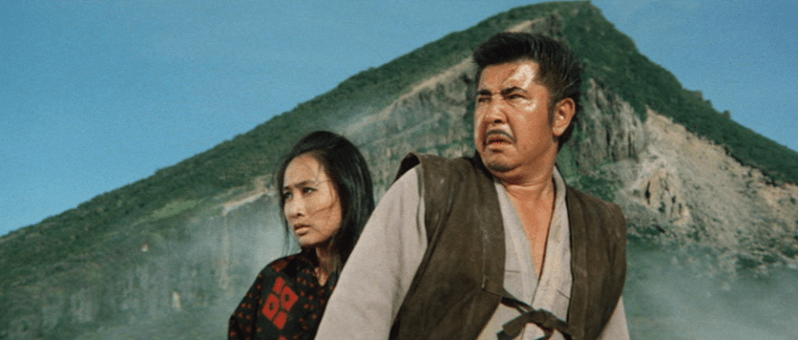
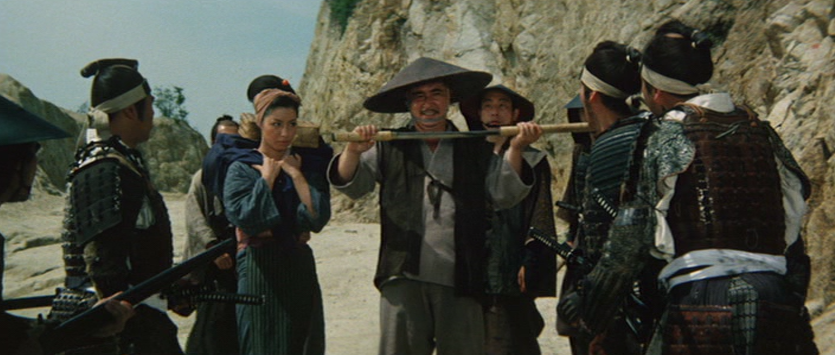
Killer’s Mission (賞金稼ぎ, Shigehiro Ozawa, 1969)

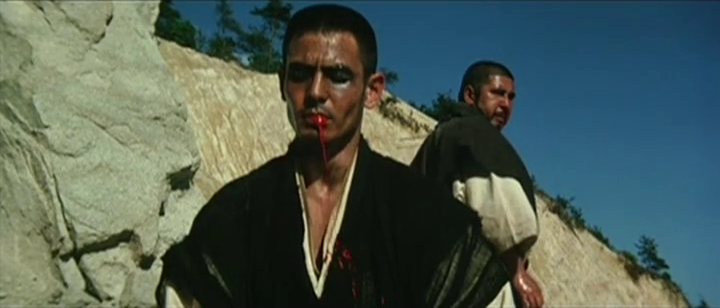
According to the title card at the beginning of Shigehiro Ozawa’s Killer’s Mission (賞金稼ぎ, Shokin Kasegi), none of the events it depicts have been recorded in history because the shogunate decided to erase them all in fear of the effect they may have on the nation’s geopolitical stability. Nevertheless, it gives some very concrete dates for its historical action, even if they may not make complete sense while foreshadowing the political turbulence of the following century. 

What it essentially attempts to do is tell a James Bond-style tale of political intrigue in a feudal Japan in which perpetual peace has begun to create its own problems. Here played in a cameo appearance from Koji Tsuruta, the Shogun Ieshige was weak in part because he was in poor health and had a speech impediment which led him to be rejected by his retainers. The problem here, however, is with Satsuma which has been on bad terms with the Tokugawa shogunate since the Battle of Sekigahara after which they took power. Satsuma will in fact be at the centre of the conspiracy to overthrow the government in the following century, but for the purposes of the film have fallen foul of a rumour that the plan to do an arms deal with some Dutch sailors who sailed South to Kyushu after being rebuffed in Edo. 

A civil war is feared and in the interests of maintaining peace, Ieshige sends his trusted spy Ichibei (Tomisaburo Wakayama) to protect Satsuma official Ijuin Ukiyo (Chiezo Kataoka) in the hope that he will be able to talk his young and naive lord out of doing the deal. Ostensibly a doctor by trade, Ichibei has a series of spy gadgets such as hidden blades and collapsible guns stored in a secret room at his surgery which he then carries in a black leather utility belt. He keeps the nature of his mission close to his chest, but often double bluffs by simply telling people he is a shogunate spy or otherwise adopting a disguise as he does in a moment of meta comedy impersonating the signature role of his brother Shintaro Katsu by posing as a Zatoichi-style blind masseur. 

As if to signal the cruelty of the feudal world, Ichibei comes across the corpses of suspected spies abandoned outside Satsuma territory while his enemies meditate on their ancient slight and consider taking the deal in the hope of avenging their defeat and overthrowing the Tokugawa. They are warned that creating unrest and sowing division may be exactly what foreign powers like the Dutch crave, but aren’t particularly bothered, preferring to take their chances with them rather than curry favour with the Shogun and possibly destabilising the entire society along with it. 

Of course, much of this is anachronistic with the Dutch sailors appearing in a distinctly 19th century fashion carrying weapons which are also too advanced for the era as are Ichibei’s folding pistols. Through his travels, he runs into a female Iga spy who too can do some nifty ninja tricks and has a gadget of her own in a comb which can shoot poison darts, though luckily it’s one of the poisons Ichibei has already developed an immunity to. Ichibei is fond of crying that you kill him he’ll simply come back to life, barrelling through the air with feats of improbable human agility and generally behaving like some kind of supernatural entity with a secondary talent for violent seduction. 

Though ironic and often darkly comic, there is an unavoidable poignancy in the inner conflict of Ijuin who knows his clan is about to do something very foolish but is torn between his duty to obey them and that to act in their best interests, eventually backed into a corner and left with no real way out of his predicament. As Ichibei points out, it’s difficult to keep the peace, especially when restless young samurai spot opportunities to cause chaos and the outside world knocks on the door of a closed community. Even so, Ozawa ends on a romantic image of a beach at sunset somehow undercutting the violence and tragedy with the restoration of an order that might itself be imperfect in its peacefulness.


Wicked Priest 3: A Killer’s Pilgrimage (極悪坊主 念仏人斬り旅, Takashi Harada, 1969)

Three years on from his arrest at the end of the previous film, Shinkai (Tomisaburo Wakayama) returns for more lecherous adventures across Japan in Wicked Priest 3: Killer’s Pilgrimage (極悪坊主 念仏人斬り旅, Gokuaku Bozu: Nenbutsu Hitokiri Tabi). This time he finds himself mixed up with revolutionary pirates planning to overthrow the government with weapons smuggled in from Singapore, but it isn’t so much politics that bothers Shinkai as injustice as he tries to help the townspeople defend themselves against politicised bandits and a weird new religion while dealing with the fallout from the last time he found himself enacting justice. 

As usual however the film opens with an odd prologue in which a randy Shinkai is invited to the home of a man who tells him there’s a strange local custom in which women soon to be married think it good luck to be deflowered by a passing stranger and even better if he’s a monk. Of course, Shinkai nearly gets a little more than he bargained for before heading off towards the central fishing village which is at this time of the year home to only women and old men with all the husbands and sons off chasing tuna for the foreseeable future. Taking a liking to a widow named Omine (Hiroko Sakuramachi), Shinkai’s plans are scuppered when she realises that he’s the man who killed her admittedly no good, violent drunk of a gambling husband. Being the charmer that he is, Shinkai manages to talk her round only her brother-in-law Ryuji (Tatsuo Terashima), who’s supposed to marry her sister Otae (Eiko Ito), is hellbent on revenge. Meanwhile, the town is invaded by cruel pirates who commandeer the local well and keep the villagers prisoner. 

“Helping people is my duty,” Shinkai had told the man who weirdly wanted him to sleep with his daughter and true enough he’s never been one to turn away from those in need even if he’s not all that keen on taking responsibility for them. He feels bad for Omine that he ended up killing her husband even if he thinks her husband brought it on himself because of his behaviour, and even after encountering Ryuji tries to talk him down from his revenge rather than simply fighting him even though Ryuji still refuses to forgive him even after Shinkai is nearly fed to sharks in his place by the cruel leader of the pirates. He is later saved by Yamanami (Minoru Oki), a fugitive on the run for killing a politician in Tokyo presumably as part of his revolutionary activities but has become disillusioned with the gang whom he thinks have lost sight of their cause and are now no better than bandits. Shinkai had claimed he could see Yamanami was a good man because of his all-seeing monk eyes, and later praises him as someone who held fast to his beliefs while bravely standing up to his sociopathic gang boss. It isn’t so much that Shinkai has much opinion on their political stance and desire to overthrow the government, only about the way they conduct themselves, callously throwing dynamite around and hassling the local women. Yamanami asks his boss what the point of winning is if everyone resents you, but his boss simply tells him to think about winning first and ideological purity later. 

In a bizarre subplot, meanwhile, Shinkai also finds himself squaring off against a weird sex cult/fake religion on an island connected with the pirates who are also planning to sell off the village women as payment for their Singaporean weapons. Once again, the randy monk becomes a staunch defender of women, saving Otae from becoming the weird priest’s sex slave and shutting down the trafficking plot by indulging his strange love of eye gouging. Meanwhile he’s still being pursued by Ryotatsu (Bunta Sugawara), the blind monk from the previous two films. Blow for blow, there may not be as much action for the warrior monk despite his heroic attempt to reach the well while under fire and eventual descent on the bandit hideout in a single-handed bid for justice, but there is something in Shinkai’s demands for a just world despite his lasciviousness that overcomes his fixation on women even if this time it seems as if the sun may have set on his travels. 


Sword Devil (剣鬼, Kenji Misumi, 1965)

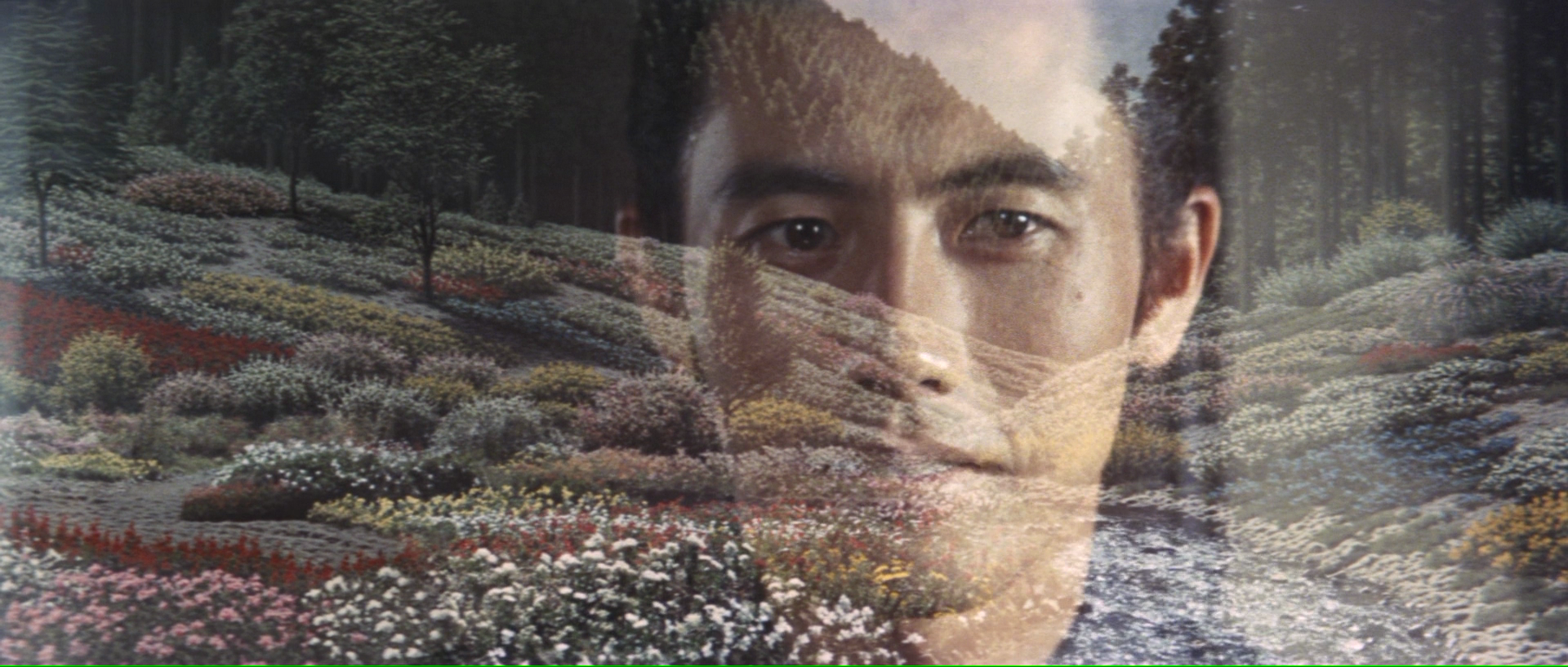
An orphaned son’s attempts to overcome his cursed destiny are poisoned by the duplicities of the samurai society in third part of Kenji Misumi’s loose “Sword Trilogy”, Sword Devil (剣鬼, Kenki). Perhaps unfairly dismissed by some as a mere genre craftsmen, Misumi was also an intense visual stylist, a quality very much on show in this vibrant drama which pits the beauty of the natural world against the samurai order but eventually finds its hero succumbing to cruelties of his age unable to outrun himself or his destiny. 

In the prologue which opens the film, shot in an arty theatrical style, a young peasant woman formerly a maid to the late Lady Makino gives birth to a “stranger’s” child after having been promoted and given a place in the women’s quarters as a reward for her loyalty in continuing to serve her mistress in the depths of her “madness”. Lady Makino claims that Kin’s kindness brought her back to reality and is keen to ensure she continues to be taken care of after her death, but also asks her to take charge of her precious pooch hoping that she will treat it “as herself”. This is perhaps why it is rumoured that the child, given the name “Hanpei” which ironically is in part inspired by the dog-like “Spot” coupled with a suffix which implies a lowly rank, is in fact the product of a taboo union between the maid and the dog (rather than admit he is almost certainly the illegitimate son of Lord Masanobu). For some reason this bizarre rumour persists throughout the boy’s life, cast out as he is from the palace and raised in an ordinary village as the son of a low-ranking samurai who appears to be kind and loving, worried enough about Hanpei’s (Raizo Ichikawa) future to advise him to find a special skill that will allow him to support himself and perhaps overcome some of the persistent prejudice against him after the old man’s death. 

The skill he perfects, however, continues to set him apart from his fellow men in that he chooses the cultivation of flowers. A particularly snotty neighbour describes Hanpei’s art as “annoying”, though others are impressed enough by his skill to marvel that they have such a man in their clan while also pointing out that in these times of peace becoming a samurai florist might be much more useful than perfecting the art of the sword. Ironically, however, it drags him back towards the court and intrigue when he’s invited to craft a flower garden to cheer up the present young lord who seems to be succumbing to the same “madness” as his mother. The trouble starts when the garden is completed to the lord’s satisfaction but marred by the sudden and apparently unexpected arrival of a bumblebee which damages the lord’s tranquility and provokes a violent outburst in which he begins to hack at the flowers hoping to punish the one which “rudely” invited the bee to the garden. Hiding behind a tree, Hanpei perfectly aims a rock at the lord’s head to prevent him destroying his precious work and is spotted by his chief retainer, Kanbei (Kei Sato), who earmarks him for future use in his nascent conspiracy. 

Hanpei finds himself at the centre of intrigue, increasingly seduced by promises of advancement that he might be “titleless” no more and perhaps in fact escape his lowly position as the son of a dog. He ingratiates himself by, like his mother, being one of the few servants willing to bear the lord’s violent rages in volunteering to accompany his horse even though he has none of his own and has to run along behind thereby demonstrating his slightly supernatural athletic ability that gives further credence to his canine origins. In similar fashion he learns by observation, captivated rather than appalled on witnessing an old ronin practicing his sword technique by cutting in half a butterfly in the forest. Preoccupied by his lowly status and consequent lack of sword skills, Hanpei is reassured by the man’s explanation that there’s nothing more to it than draw, strike, and sheath but takes yet another step towards the samurai dark side in accepting the gift of a sword. Later he breaks it, meaning to break with the cruel path on which fate has set him, only to pick up another, supposedly cursed sword to which he was attracted because of its “evil spirit”.

Osaki (Michiko Sugata), a kind and innocent woman seemingly attracted to Hanpei because of his difference in his gentle sensitivity in contrast to the rough men around her, refuses to believe the rumours he has become an assassin working for Kanbei because no one who loves flowers like he does could be a coldblooded killer. This is in fact what he has become, sent, like a dog, after Kanbei’s enemies killing without even knowing who it is who must die only to be remorseful on discovering he has killed someone known to him. There is division and sedition within the court caused by the lord’s madness, Kanbei and his associates keen to rule in his stead while keeping his mania secret from the shogun while others, a small group of lower samurai rebels, prefer to depose him in favour of his adopted heir. Hanpei is once again a pawn, taking no side in this debate but unthinkingly doing Kanbei’s dirty work in the service of his sword. He hopes that by taking the “evil” instrument in his hands he might double his bad luck to overcome his unhappy destiny, gazing at his distorted face in its reflection, but discovers himself merely outcast once again as the villagers begin to realise he is an obstacle to their rebellion and responsible for the assassinations of their loved ones. 

The ironic conclusion finds the hero’s planned flower garden, a shared endeavour with love interest Osaki, rendered a bloody graveyard, men cut down like weeds as Hanpei’s quick draw philosophy makes a mockery of their fancy samurai fencing. The poisonous samurai legacy, infected with madnesses literal and figural, destroys everything, all beauty and grace falling under Hanpei’s “evil” sword as he finds himself, quite literally, chased out of town like a stray dog condemned to wander exiled from human society. 


The War in Space (惑星大戦争, Jun Fukuda, 1977)

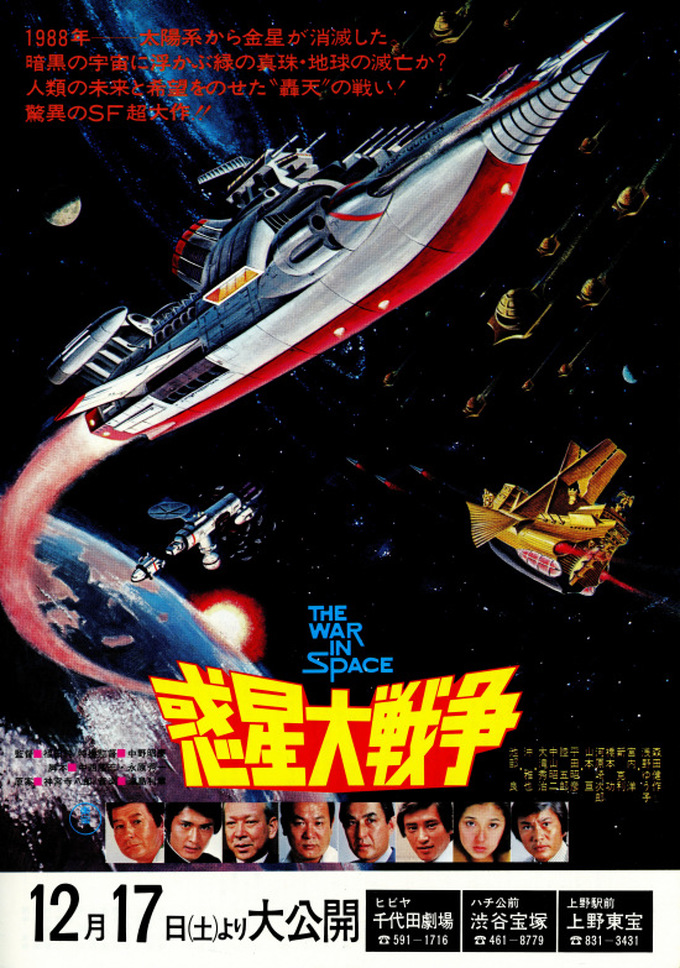
War in Space posterThe tokusatsu movie had been Toho’s signature line since the mid-‘50s, but 25 years later it was more or less played out. The late ‘70s saw the studio diversifying into other types of populist cinema while trying to find new directions in a rapidly changing industry. 1977’s The War in Space (惑星大戦争, Wakusei Daisenso), technically a “sequel” to Ishiro Honda’s Gorath from 1962, very much exemplifies the decline while trying to meld a fairly standard Star Trek-esque tale of interplanetary conflict with Star Wars-inspired fantasy.

In the distant future of 1988, the United Nations Space Force in Japan has been having trouble contacting the space station because of continued electromagnetic interference. Miyoshi (Kensaku Morita), a former team member making an unexpected return from America, tells them that they’d been having the same problem over there and not only that, there had been a worrying increase in UFO sightings across the nation. Making brief contact with the space station confirms their fears when the pilot suddenly starts screaming about a giant Roman spaceship approaching at speed before contact is lost once again. It seems that the Earth is now under attack from an extraterrestrial invasion, and the electromagnetic interference appears to be coming from Venus.

Miyoshi reconnects with his mentor, Takigawa (Ryo Ikebe), and tries to persuade him to resume an old research project to develop a high powered spaceship known as Gohten, but he remains reluctant. Part of the reason for his lack of enthusiasm is that Miyoshi had been his best student and Takigawa still bears him some resentment for his abrupt decision to leave for America rather than staying to contribute to Japan’s future while his feelings are further complicated by the fact that Miyoshi had been in a serious romantic relationship with his daughter, Jun (Yuko Asano), whose heart was broken when he left. A Space Force employee, Jun is now engaged to fellow officer Muroi (Masaya Oki) who is glad to see his old friend Miyoshi return, but also a little anxious.

With the Earth facing imminent destruction, however, there’s little time to worry about past heartache. Takigawa finds himself forced into restarting the Gohten project when he realises that the “Venusians” can pose as regular humans by possessing their bodies. As usual, everything rests on the team pulling together to finish the mammoth project in a record three days before the aliens obliterate their base just like they’re doing to most of the Earth’s major cities. Eventually, the team realise that the aliens aren’t from Venus at all, but from another major solar system and led by a man calling himself “Commander Hell” (Goro Mutsumi) who, for some reason, is dressed like a Roman emperor. Like the Romans, their aim is colonisation. They’ve worn out their home planet and are looking to move, but want somewhere kind of the same so they’ve set their heart on one three away from the sun, like the Earth. 

Aside from the classical trappings, War in Space was apparently rushed out to cash in on the success of Star Wars and even includes a scene which seems to anticipate Leia’s capture by Jabba the Hut in Return of the Jedi when Jun is kidnapped and forced into hotpants while chained to a Chewie-esque furry minotaur carrying a giant axe, which might be mixing their classical metaphors somewhat as Jun and Miyoshi, arriving to rescue her, attempt to escape from Commander Hell’s ship. Takigawa and co. make their way to Venus to try and take out Commander Hell’s base, but are faced with a terrible choice. The reason Takigawa didn’t want to finish the Gohten project is that the ship is armed with a terrifyingly powerful, universe destroying bomb which he worries it was irresponsible of him to invent. Hypocritically, he now knows he’ll have to use it but is hoping that in doing so it will be destroyed along with everything else except perhaps the Earth.

Unlike in Star Wars, it’s the good guys who blow up a planet to save their own though at least no one seemed to be living there, only Commander Hell’s evil minions. Bowing out with a slightly more bombastic evocation of the original tokusatsu messages about the dangers of irresponsible science, War in Space is a fairly generic exercise in genre but has its moments in its bodysnatching spy aliens, groovy ‘70s production design, and charmingly earnest sincerity.


Original trailer (no subtitles)

Espy (エスパイ, Jun Fukuda, 1974)

espy posterBy 1974 the Toho SFX movie was perhaps long past its heyday though Jun Fukuda’s Espy (エスパイ) was far from the last. Clearly influenced by popular spy franchises such as James Bond as well as more serious cold war spy dramas, Espy is a jet setting tale of superpowered assassins, international conspiracy, and love as an unexpected source of salvation, but as much as it embraces its hippyish message of total communication it also moves further into the realms of exploitation, skewing closer to Nikkatsu’s ’70s output than the more child friendly supernatural adventures of ages past.

The world is at breaking point. A small conflict in a tiny East European nation known as Baltonia threatens to spark a third world war. A UN delegation is currently en route to a conference in which they hope to settle the conflict in a peaceful way but all hope is lost when a sniper equipped with X-ray vision takes them all out with maximum precision.

Meanwhile, back in Japan, test driver Miki (Masao Kusakari) gets into trouble on the course when he swerves to avoid some pigeons. The car spins out of control but just at the last minute, Miki turns it around through his dormant psychic powers which brings him to the attention of the IPPG – the International Psychic Power Group. Following the assassination of the UN delegation, all eyes are on Japan where the prime minister of Baltonia is due to meet the US president in what is hoped will be a bold new development in international relations but the IPPG have reason to believe an attempt will be made on the prime minister’s life and only their ESP equipped team can stop it.

Espy takes the essential components of both the spy thriller in its international conspiracy set up, and the B-movie science fiction adventure in its presentation of the good and evil possibilities of advanced technologies or in this case innate superpowers. The Espy team are pitted against the Anti-Espy who have similar powers but are committed to using them to harm mankind. The leader of the Anti-Espy, Ulrov (Tomisaburo Wakayama), sees himself as a superior being to regular Earthlings and, believing that humans have overpopulated the planet which they continue to damage, is convinced the best solution is a mass cull. He plans to do this by helping the “lesser” humans destroy themselves by provoking a third world war or a hundred mini conflicts in which thousands will die.

Ulrov’s arguments tie in nicely with Toho’s trademark environmentalism and ambivalent attitude towards scientific development, but they go against the prevailing sense of humanism which is to be found in the studio’s genre output. In Ulrov’s fascistic view of the world, he and the other ESPers are a superior race whose existence is threatened by weaker humans and their reckless disregard for the planet as a whole. Due to a traumatic childhood incident, he believes that humans are cruel beasts who lust for blood and talk of peace with hearts filled with hate. He may have a point, but his message conflicts with the positive movement for peace which is advanced by the Baltonian PM who doesn’t want a world in which peace is brokered and balanced but one of true unity.

Espy is, however, of its time and fails to fully live out its peace and love ideals. Team member Maria (Kaoru Yumi) is kidnapped by Anti-Espy and taken to Ulrov’s lair where she is forced to dance lasciviously in front of fellow team member Tamura (Hiroshi Fujioka) with whom she shares an especially strong connection. Tamura’s arms and legs are cuffed as he communicates telepathically with Ulrov, semi-hypnotised by Maria’s strange dance. Maria is then approached by a large dark-skinned man wearing only a loincloth who proceeds to tear open her shirt at which point she snaps out of her trance, frees Tamura, and rips out the attacker’s tongue.

Meanwhile, new recruit Miki has failed in his mission and killed a man for the first time sending him into a kind of depression. Though Miki was introduced as the protagonist, he is in fact absent for most of the film though his journey is among the strangest as he reminisces about a foreign girl he was friends with as a child and enjoys an unusually strong bond with his intrepid dog, Caesar, who teaches the gang a few lessons about unconditional love. Maria is severely traumatised by her attack while Tamura reconsiders his sense of self worth having temporarily lost his powers, but eventually the team realise that their psychic abilities are nothing more than a manifestation of a great love. Ulrov later has the same epiphany but the team’s decision to consider him possessed by something “inhuman” is a worrying one. They don’t want to accept that it was humans who made him that way because it would be too sad, but not to do so is a failure to recognise humanity’s darkness as well as its light.

Espy bites off a little more than it can chew in failing to deal with some of the more interesting ideas it raises though it makes the most of its meagre budget to present an exciting spy thriller voyaging from Japan to Turkey and Switzerland. Skewing more towards Nikkatsu’s brand of exploitation action, Espy is definitely among the more adult orientated of Toho’s SFX adventures but its messages are broadly the same in its insistence on human interconnectedness as the ultimate superpower. 


Lone Wolf and Cub: White Heaven in Hell (子連れ狼 地獄へ行くぞ!大五郎, Yoshiyuki Kuroda, 1974)

lone-wolf-and-cub-white-heaven-in-hell-japanese Ogami (Tomisaburo Wakayama) and his son Daigoro (Akihiro Tomikawa) have been following the Demon Way for five films, chasing the elusive Lord Retsudo (Minoru Oki) of the villainous Yagyu clan who was responsible for the murder of Ogami’s wife and his subsequent framing for treason. The Demon Way is never easy, and Ogami has committed himself to following it to its conclusion, but recent encounters have broadened a conflict in his heart as innocents and seekers of justice have died alongside guilty men and cowards. Lone Wolf and Cub: White Heaven in Hell (子連れ狼 地獄へ行くぞ!大五郎, Kozure Okami: Jigoku e Ikuzo! Daigoro) moves him closer to his target but also further deepens his descent into the underworld as he’s forced to confront the wake of his ongoing quest for vengeance.

Ogami and Daigoro have made it to Snow Country, meanwhile Lord Retsudo is receiving a dressing down from a superior over his total failure to eliminate the Lone Wolf or his Cub. It seems Ogami has already despatched all three of Retsudo’s sons, and so now Retsudo pledges his daughter, Kaori (Junko Hitomi), skilled in the use of daggers and every bit as fine a warrior as her defeated brothers, in the mission to end the Ogami threat.

Things do not go to plan and Retsudo is forced to approach his one remaining son. An illegitimate child born to a concubine, disavowed, and hidden away in the mountains, Hyoe (Isao Kimura) is not well disposed to his estranged father’s request to save the Yagyu clan to which he feels only rage and resentment. Sending his father away, Hyoe nevertheless decides to take on Ogami in the hope of embarrassing the Yagyu by taking him out first. Possibly having spent too much time alone, Hyoe’s plan involves a number of strange rituals beginning with resurrecting three of his men as emotionless (yet intelligent) zombies meant to terrify Ogami and his son into submission.

Throughout the series, we’ve seen Ogami’s world darken as the straightforward missions of eliminating corrupt lords eventually gave way to more morally dubious assignments with the tragic story of Oyuki and later the assassination of an entire family in order to preserve the legitimate arm of a historical clan. Along the way, Ogami has met “true samurai” and villainous cowards, but his encounters with honest men and women have only served to shake his heart as he guides his young son onwards bound for hell by way of death or violence.

The pair have never been afraid before, but Hyoe’s plan hinges on pushing Ogami’s mind into those dark places, preventing him from fighting back against his supernatural soldiers. Death has always surrounded them, but the price of Ogami’s vengeance is brought home to him when Hyoe’s forces unceremoniously wipe out the entire population of an inn where Ogami and Daigoro are staying whilst hovering in some nearby trees to remind them that this is all really their fault and the longer they keep on down this path, the more the innocent will suffer. The zombie trio threaten to destroy Ogami’s human emotions – joy, sorrow, pleasure, and anger, leaving him only with fear. Unbowed, Ogami faces Hyoe but the pair have more in common than they thought and so round one ends in a stalemate.

White Heaven in Hell, though not intended as a conclusion to the series, neatly brings things full circle as Ogami visits his wife’s grave, recalling his familial tragedy and reinforcing his bond with Daigoro. All of the films have, in some way, dealt with functional and dysfunctional family, each commenting on the unusual relationship between Ogami and his son. Finally meeting face to face, Retsudo takes Ogami to task for the loss of his children which Ogami throws right back at him – after all, all he did was defend himself against a threat Retsudo himself instigated. Ogami eventually tells him that he hopes Retsudo becomes so lonely that he goes completely mad. Retsudo’s pointless manoeuvring has cost him dearly in the loss of each of his legitimate children, eventually forcing the acknowledgement of his illegitimate son and daughter whose hatred of him also leads to their undoing. So great is Hyoe’s loathing of the Yagyu, that his last ditch attempt at revenge is in trying to convince his own sister, Azuma, to bear his child and create a new line to finish them off once and for all.

Kenji Misumi declined to return for this instalment, claiming the series had become too much like a Western which is a little ironic as White Heaven in Hell leaves the arid deserts behind for the frozen ice plains of the north. Yoshiyuki Kuroda, making his first and only contribution to the series, had a strong background in horror cinema which might explain the sudden appearance of the supernatural elements in what has been, up to now, a fairly grounded exercise even if somewhat outlandish. This is also the only script with which original creator Kazuo Koike was not not involved and bears the least relation to the then ongoing manga. Still, the action is undoubtedly innovative as the baby cart’s wheels are swapped for skis and Ogami faces off against an entire army of enemies on a snow covered hillside. Kuroda sticks more closely to Misumi’s aesthetic than Saito had done though steers away from the painterly cinematics in favour of showcasing the snow covered terrain, driving Ogami deeper into hell as his heart freezes over but denying him the vengeance that has become his life’s work. White Heaven in Hell is the last outing for Ogami yet refuses to close the circle, his quest may be a never ending one, plunging both himself and his son into an inescapable cycle of violence and regret as the Demon’s Way stretches on endlessly towards an uncertain destination.


Original trailer (subtitles in German for captions only)

https://www.youtube.com/watch?v=tfmwNpfQPG4

Outlaw: Kill! (無頼 殺せ, Keiichi Ozawa, 1969)

outlaw killGoro, Goro, Goro – will you never learn? Maybe he will because this is the last film in the series! Appropriately titled Outlaw: Kill! (無頼 殺せ, Burai Barase), this sixth and final film in the Outlaw series sees Goro once again moving to a new town and trying to lead a more honest life but unfortunately he’s wandered in at just the wrong time because a local gang boss has just been sent to prison after defeating a group of assassins leaving a dangerous vacuum and leading, therefore, to the outbreak of a turf war.

Goro’s first fight is with a gang of thugs who were hassling an elevator girl in a department store – the girl being Yumiko, played by Chieko Matsubara, becoming Goro’s love interest once again. Luckily or unluckily, Goro runs into an old friend from his prison days who is also one of the gang bosses involved in the turf war. After his friend promises him that he will incur no debt from him and he won’t get in the way of Goro finding a proper job, Goro agrees to move in with him and his wife – who only turns out to be the sister of elevator girl Yumiko which is not even the most predictable coincidence in this whole saga.

Despite his protestations about not getting involved in local gang politics, Goro’s attachment to his friend and his growing family means he can’t altogether avoid getting pulled back into the messy gangster world of violence and betrayal. Things end up going just about as well as they ever do and Goro is only able to clean up some of the chaos in this disputed area by creating even more counter chaos.

The format is becoming tired by the time we reach Outlaw: Kill! and it’s true that the film revisits exactly the same narrative beats as all of the other films, though it does so in a fairly exciting fashion. That said, there’s much less nuance here – we get that Goro sees himself as a lonely drifter who doesn’t deserve happiness, a self hating yakuza who is engaged on a long and hopeless walk to the grave. Perhaps it’s just because everyone’s getting older, but now it’s less about never having had a home or a proper place to belong than it is about the (im)possibility of building your own family. Goro’s friend, Moriyama, is married and going to be a father which Goro thinks is a nice thing, broadly, but also worries about what is means for a yakuza who may be killed at any second to have a wife and a child dependent upon him. Goro, being the noble sort of fellow he is, has decided that romance is irresponsible if you’ve already pledged your heart to the outlaw’s creed.

Once again directed by Keiichi Ozawa, Kill! sticks to the formula of his other offerings in the Outlaw series but opens with stylish series of colour filter stills rather than the action filled title sequences of the previous films. The fight scenes are exciting and actually quite bloody but perhaps not as innovative as some of those seen earlier in the series. In an interesting mix of old and new, Ozawa stages his final fight in a club but this time it’s a very contemporary night spot filled with guys and girls dressed in stylish, colourful outfits whilst a hippyish rock band play a cover of a famous pre-war ballad. Swooping around, notably shooting one sequence through a transparent floor/ceiling, Ozawa seems to be pushing forward more, breaking with the traditional ‘50s aesthetic for a new and crazy, youth counter-culture inspired moment which looks forward to the Stray Cat Rock series much more than back to the now ancient ninkyo eiga or sun tribe films.

Maybe Goro’s had his day too as Kill! ends in pretty much the same way as all but one of the previous films with Goro staggering away from the destruction he has wrought into a barren and snow filled landscape. Doomed to be a wanderer forevermore, Goro is a relic of the cruel post-war world which never gave him a break but his story’s now old hat. A man without a home is left forever alone, marching onward to the next confrontation or the final relief of a lonely grave.


Outlaw: Kill! is the six and final ( 😦 ) film included in Arrow Films’ Outlaw: Gangster VIP The Complete Collection box set (which is region free on DVD and blu-ray and available from both US and UK).

English subtitled original theatrical trailer: