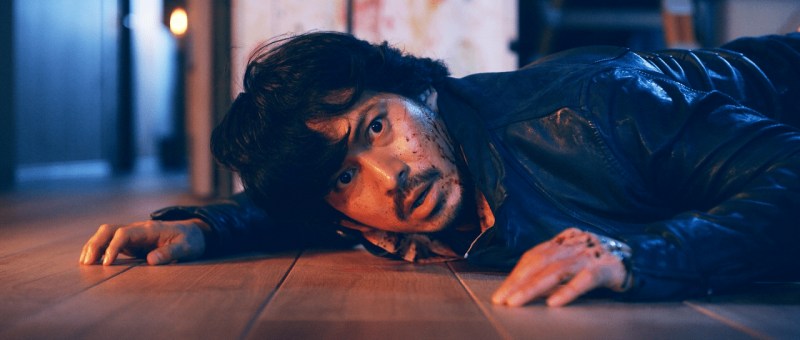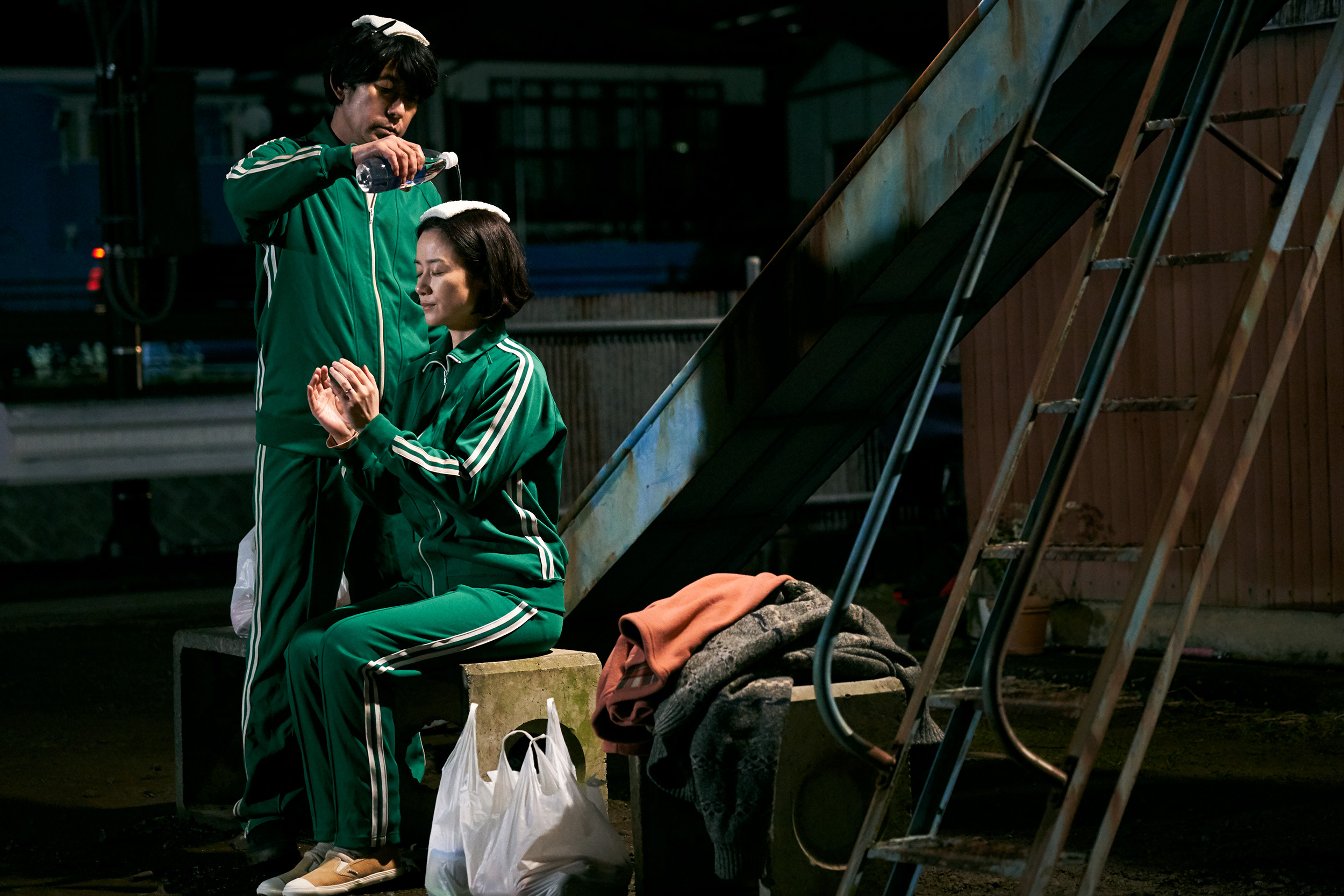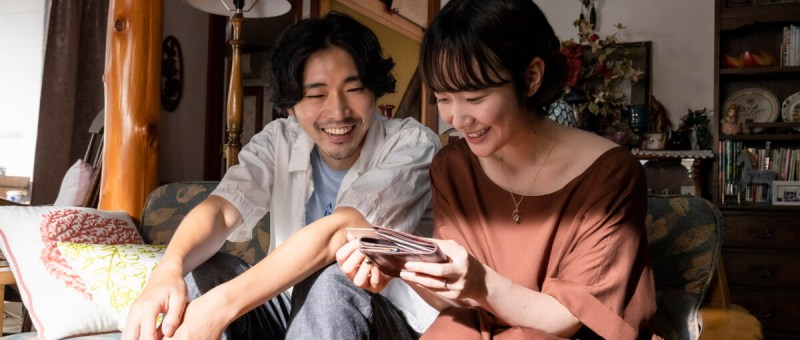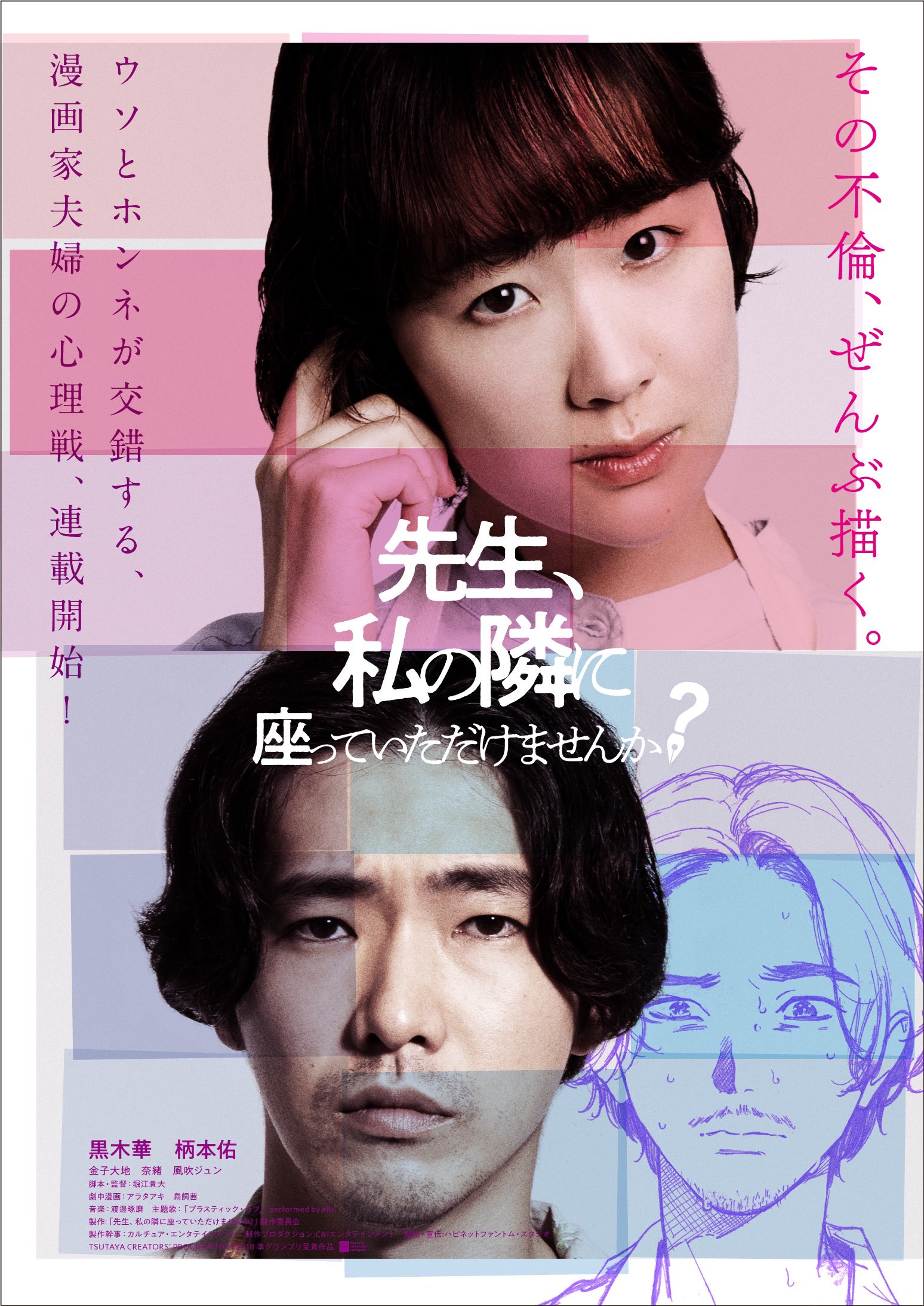
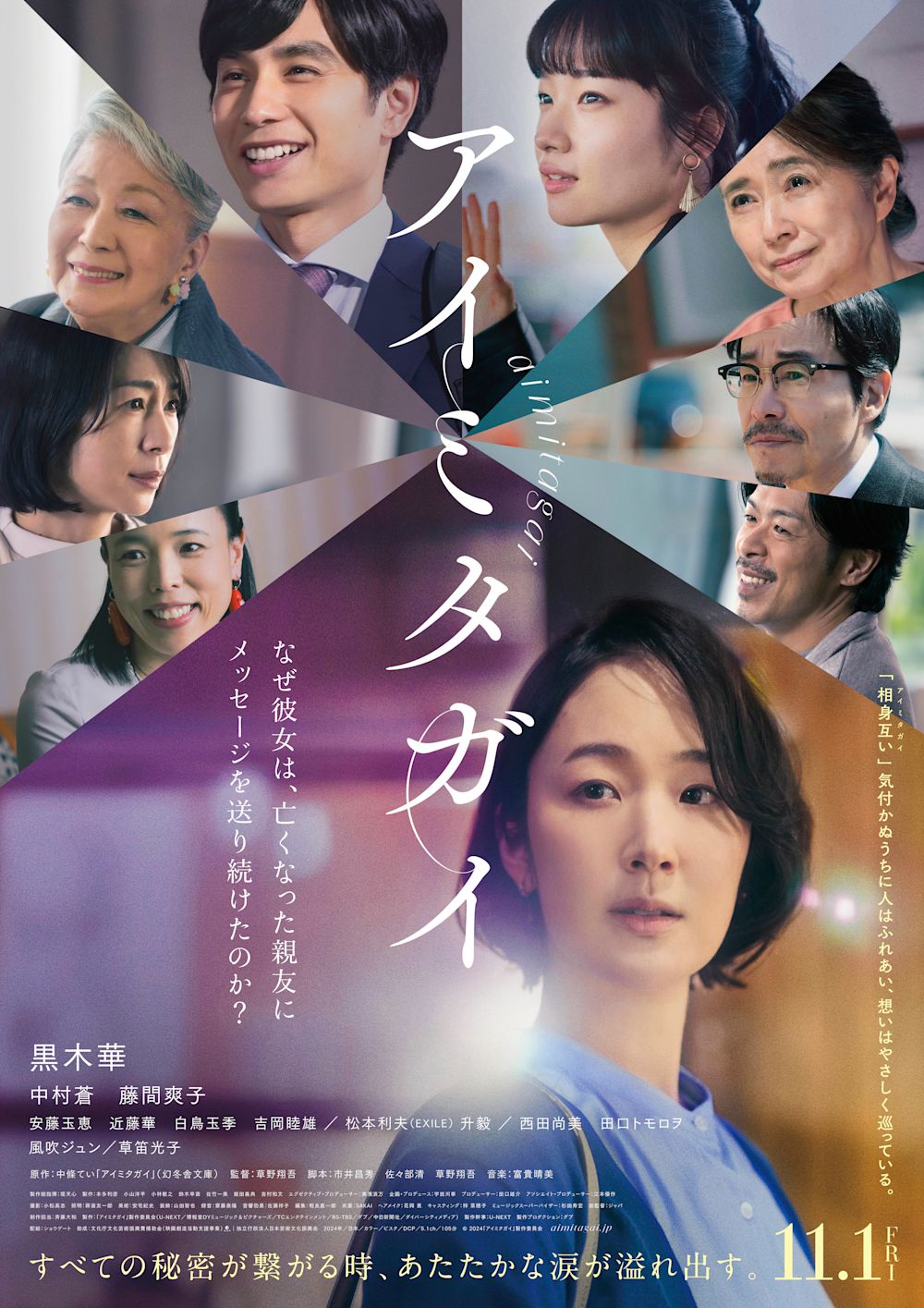
Aimitagai (アイミタガイ, Shogo Kusano, 2024)

When we say, “what goes around comes around”, we usually mean it in a bad way that someone is only getting what they deserve after behaving badly themselves. But the reverse is also true. The smallest acts of kindness people do without thinking can have quite profound effects on the world around them because, in the end, we are all connected. A bereaved father remarks that he thought novels that only had kind-hearted characters were unrealistic, but now he wants to believe that kind of world could exist after realising the impact his late daughter’s kindness had on those around her.

It was Kanami (Sawako Fujima) who saved Azusa (Haru Kuroki) in middle school when she was being bullied for coming from a single-parent family and the pair remained firm friends ever after until Kanami was suddenly killed in an accident while working overseas. Kanami’s loss leaves Azusa struggling to move forward with her life while mired in grief and uncertainty. Having lost her mother some years previously, she has never really dealt with the trauma of her parent’s acrimonious divorce and has a rather cynical view of marriage despite working as a wedding planner where her unmarried status sometimes causes her clients anxiety though it obviously has very little do with her ability to do her job. She’s always been clear with her long-time boyfriend Sumito (Aoi Nakamura) that marriage isn’t something she sees in her future, though he seems to want more commitment, while she repeatedly describes him as “unreliable” and is hesitant to take the next step with their relationship whether it involves getting married or not.

In that sense it’s really Azusa’s inability to surrender herself to the concept of what her grandmother (Jun Fubuki) calls “amai-tagai”, or mutual solidarity, which they experience first-hand while visiting her as another old lady nearby comes rushing in saying her house is on fire. It’s not so much reciprocity as a generalised idea of having each other’s backs, that people help each other as needed without keeping score in much the same way as Azusa was saved by Kanami and as she later realises by Komichi (Mitsuko Kusabue) whose piano-playing soothed her spirit though Komichi intended to play in secret, allowing her music to blend in with the six o’clock chimes as a daily act of atonement for having played the piano for boys who were going off to war many of whom never returned. It is then Azusa who saves Komichi in turn by telling her that she felt comforted by her music and that she does not believe that she has no right to play it simply because of the ways it was misused in the past. 

What Azusa fears is that by getting married she would essentially be cutting herself off from her paternal grandmother who, aside from her aunt (Tamae Ando) who is also Komichi’s housekeeper, is the only other family member she seems to have a meaningful connection with. Unable to let go Kanami, she keeps sending her messages little knowing that her mother is actually reading them and feeling both sorry and grateful that her daughter had such a good friend who like her is also struggling to continue on without her. She and Kanami’s father (Tomorowo Taguchi) find solace in the letters they receive from children at an orphanage where Kanami used to donate cakes and sweets after visiting there on a job. The photos she took are on display at their bathrooms, Azusa said because Kanami wanted them to be in a place where the children felt free to embrace their feelings privately without fear of embarrassment. 

The photographs, letters, and belated gifts are all examples of the ways in which what Kanami sent around is still going around and will continue to do so long after she herself is gone. Through realising the reality of “aimi-tagai”, Azusa learns that the world can also be a kind place, Sumito might be more “reliable” than she thought, and it might not be such a bad idea to trust people after all. Based on the novel by Tei Chujo, the film’s interwoven threads of serendipitous connections and the unexpected results of momentary acts of kindness prove oddly life-affirming if only in the ways in which each realise that Kanami is always with them even if physically absent.


Aimitagai screened as part of this year’s Toronto Japanese Film Festival.

Trailer (no subtitles)
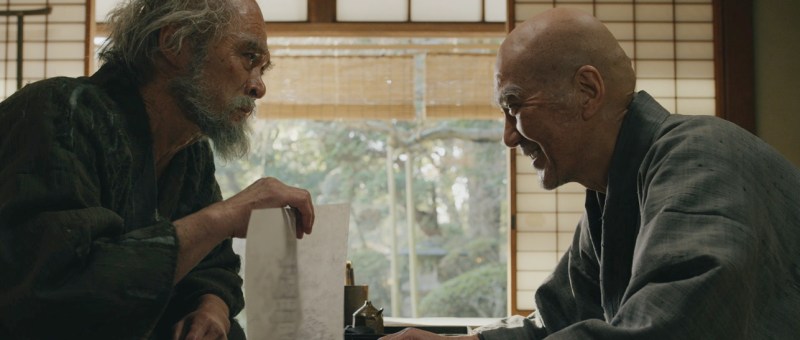
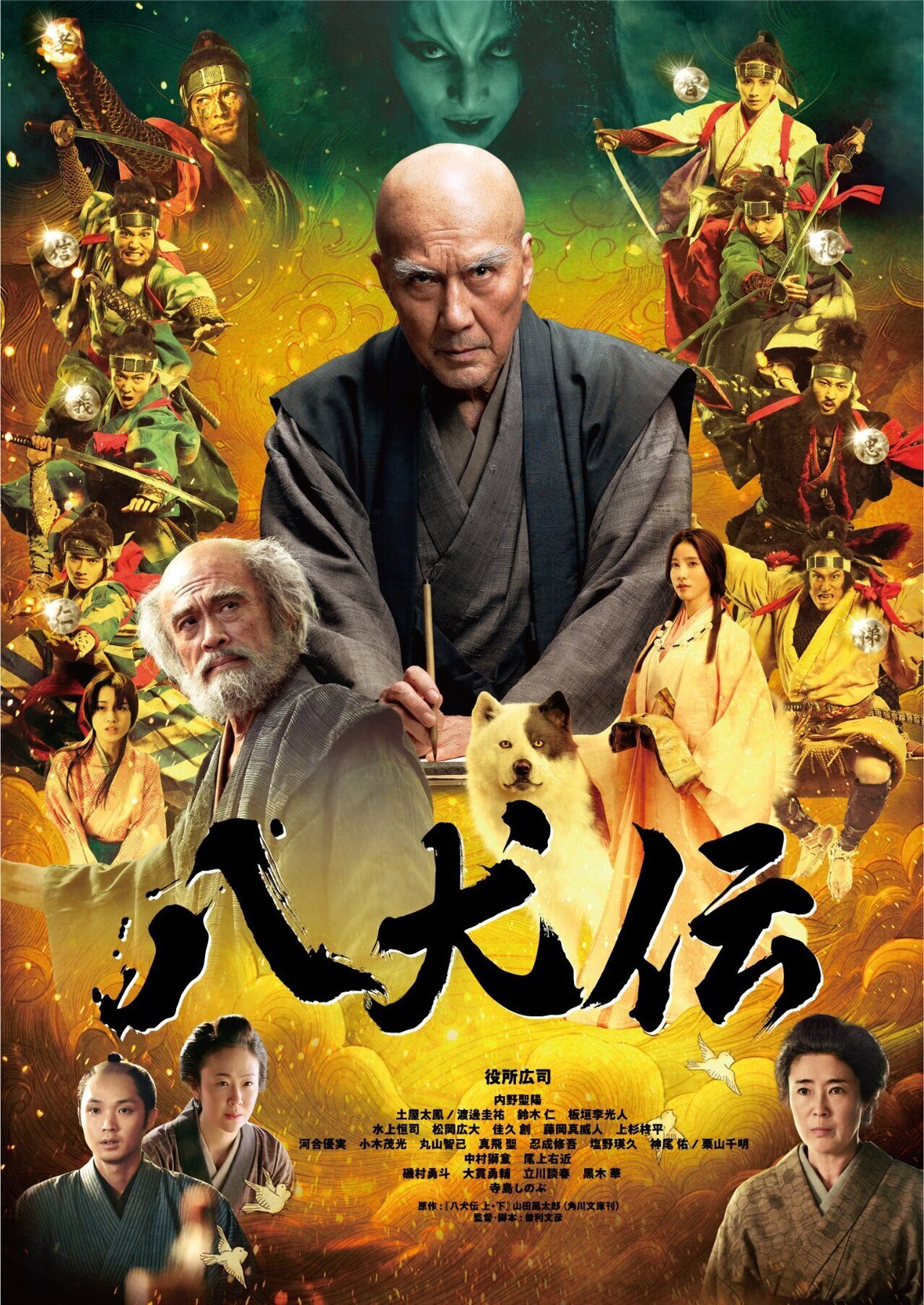
Hakkenden (八犬伝, Fumihiko Sori, 2024)

Kyokutei Bakin thinks he’s a hack who writes inconsequential pulp that will be forgotten faster than yesterday’s headlines. He’d never believe that people hundreds of years later would still be talking about his work. Yet he may have a point in his conviction that people crave simple stories where good triumphs over evil specifically because the real world is not really like that and a lot of the time the bad guys end up winning. But does that mean then that all his stories are “lies” and he’s irresponsible for depicting the world not the way that it is but the way he wants it to be? 

Fumihiko Sori’s Hakkenden (八犬伝) is on one level an adaptation of the famous tale probably most familiar to international audiences as The Legend of the Eight Samurai, and also a story of its writing and the private doubts and fears of its author. In dramatising the tale, Sori plays fantasy to the max and revels in Bakin’s outlandishness. An unusually picky Hokusai (Seiyo Uchino), Bakin’s best and he claims only friend and unwilling collaborator, points out that his use of guns is anachronistic because they didn’t come to Japan until 60 or 70 years after the story takes place but Bakin doesn’t care. He says people don’t notice things like that and all they really care about is that good triumphs in the end, so he’ll throw in whatever he feels like to make a better story. In any case, the tale revolves around magical orbs, evil witches, dog gods and good fairies, so if you’re worrying about there being guns before there should be, this isn’t the story for you. 

Hokusai is also shocked that Bakin has never been to the place where the story is set, but as he tells him it all happened long ago and far away so going there now would be pointless. Even so, Hokusai needs to see what he draws which is why he spends half his life on the road costing him relationships with his family. Whatever else anyone might say about him, and he admits himself to being a “difficult” person, Bakin is very close to his family even if his wife yells at him all the time for being rude to influential people and not making any money when he could have just taken over her family’s clog-making business rather than carry on with this writing malarkey. His biggest ambition is that his son become a doctor to a feudal lord and thereby restore their samurai status which on one level points to a kind of conservatism that doesn’t matter to Hokusai and singles Bakin out as a tragic figure because the age of the samurai is nearing its end anyway. 

In his fantasy, however, he hints at and undoes, up to a point, injustices inflicted on women in the romance between Shino (Keisuke Watanabe) and Hamaji (Yuumi Kawai) who is almost forced into a marriage with a wealthy man because of her adoptive parents’ greed but is finally revealed to be a displaced princess and returned to her father who is thereby redeemed for having accidentally killing his other daughter in a mistaken attempt to control her after accidentally promising her in marriage to a dog god without really thinking about what he was saying. A neat parallel is drawn in a brief mention of Hokusai’s artist daughter Oi and Bakin’s daughter-in-law Omichi (Haru Kuroki) who did not receive an education and is almost illiterate but finally helps him to complete the story by transcribing it in Chinese characters he teaches her as they go after he loses his sight.

As his literary success increases, Bakin’s own fortunes both improve and decline. He becomes wealthier and moves to nicer houses in samurai neighbourhoods, but his son Shizugoro’s (Hayato Isomura) health declines and he never opens his own clinic like he planned while remaining committed to the idea that his father is actually a great, unappreciated artist. In a way, completing the story gives Bakin a way to say the world could be kind and just even if it has not always been so to him. He needs to maintain the belief in a better world in order to go living even if he feels it to be inauthentic while his life itself is a kind of fiction. On a trip to the theatre, he ends up seeing Yotsuya Kaidan and is at once hugely impressed and incredibly angry. The world that Nanboku sees is the opposite of his own. People are selfish and greedy. The bad are rewarded and the innocent are punished. Yet perhaps this is the “reality” of the way the world really is, where as his work is a wishful fantasy. All he’s doing is running away from the truth. But then, as his son’s friend tells him, if a man devotes himself to the ideal of justice and believes in it all his life, then it becomes a reality and ceases to be fiction. There is something quite poignant about the dog soldiers coming to take Bakin to the better world he dreamed of where bad things happen but good always triumphs in the end, which has now indeed become a reality if only for him.


Hakkenden screens 13th June as part of this year’s Toronto Japanese Film Festival.

Original trailer (no subtitles)

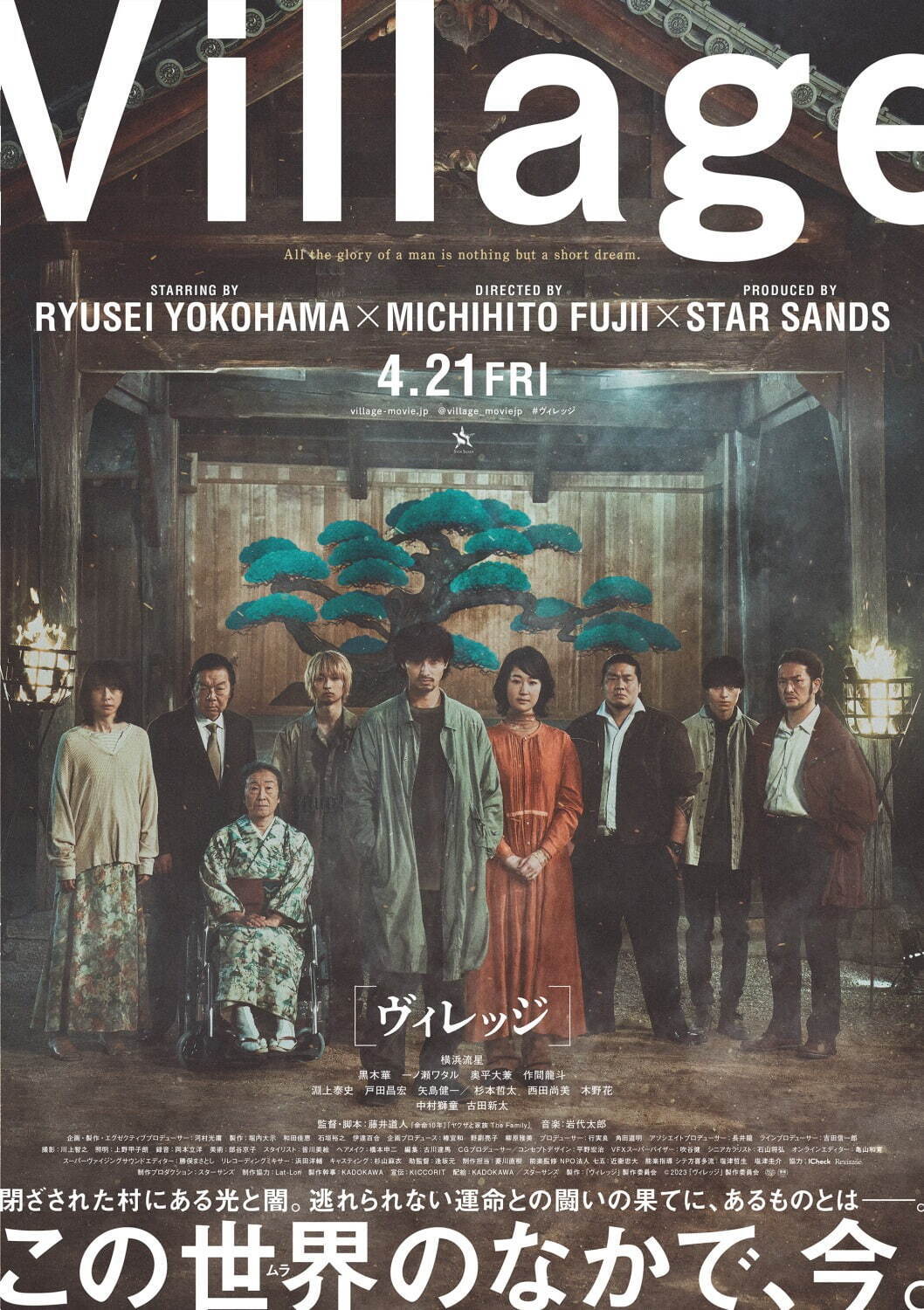
The Village (ヴィレッジ, Michihito Fujii, 2023)

The toxicity of life in small-town Japan is manifested in a giant recycling plant in Michihito Fujii’s poetic drama, The Village (ヴィレッジ). Closely aligned with the noh play quoted in the opening title card, the film charts a young man’s simultaneous blossoming and corruption as he finds himself at the service of a demonic mayor and fighting for his place in a village that doesn’t need him but requires a sacrifice. 

In the opening scenes, mist rises over the mountain accompanied by noh recitation before we eventually arrive at a noh recital. These two images would seem to signal a kind of innate Japaneseness which has been corrupted by the presence of the recycling plant despite the economic benefits it’s brought to the area. The mayor, and boss of the plant, Ohashi (Arata Furuta), wants to extend it out across the other mountains in the region and boasts that though there may have been resistance at first now everyone is grateful to them for everything they’ve done for the village. 

Yu’s (Ryusei Yokohama) father was the last holdout against the plant and apparently ended up killing a man in an altercation thereafter taking his own life and burning down their family home. Because of the stigma surrounding his father’s actions, Yu has been ostracised by his community and is used as a perpetual kicking bag not least by Ohashi’s thuggish son Toru (Wataru Ichinose) at his job at the plant. His mother has also turned to drink and developed a pachinko problem which has resulted in massive debts to yakuza loanshark Maruoka (Tetta Sugimoto) who’s press-ganged Yu into working at the illegal dumpsite which is how the plant really makes its money.

But his life begins to change when childhood friend Misaki (Haru Kuroki) returns to the village having apparently suffered a breakdown in Tokyo. Misaki’s resurfacing reinforces the purgatorial atmosphere as if everyone here were already dead. Having been away so long, only she immediately embraces Yu and simultaneously bonds with him in their outsider status. Encouraging him at work and at home, Yu gradually becomes more confident but equally dependent on the plant for his newfound status. When he’s suggested as the host of a TV documentary some of the locals object given his family background, but in contrast to his father’s opposition Yu is slowly seduced by the plant and the new life it offers him which seems almost too good to be true like a dream he is sure to be awoken from. In this, he mimics the man in the noh play who falls asleep in an inn and is transported to a world in which he is an emperor. He lives there happily for 50 years only to wake up again back in the inn and realise that really life is just a dream. 

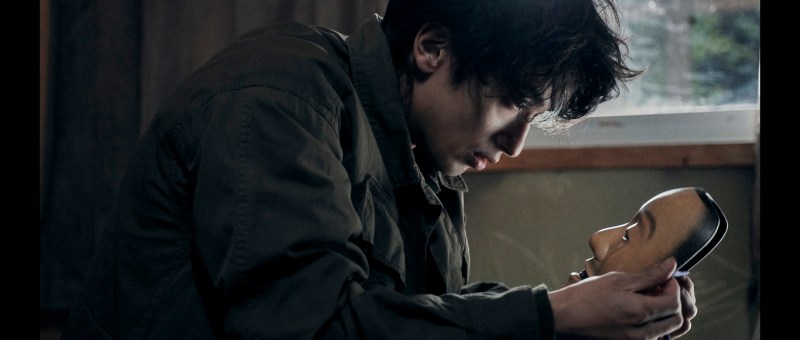
Misaki hands him back his noh mask as means of separating himself from the world around him. She says that it forces you to confront yourself, and also perhaps implies a deeper connection with an idealised vision of pre-modern Japan uncorrupted by the greed and cynicism of a man like Ohashi who claims that “position is all that matters.” Toru had told Yu that the village didn’t need him, Misaki and Ohashi say it does though for different reasons. Yet Ohashi darkly suggests that it also needs a sacrfice, and in an odd way just as his father before him it may be Yu who sacrifices himself even at the cost of his idealised life. His encroaching cynicism is directly contrasted with the idealism of Misaki’s younger brother Keiichi (Ryuto Sakuma) who like he once was is meek and diffident yet certain in his idealism and unwilling to along with the lies and wrongdoing that increasingly define village life. Eventually, he leaves the village altogether.

Yu meanwhile achieves his destiny in bringing things full circle, conducting a kind of purification ritual that aims to rid the village of Ohashi’s corruption as symbolised by the giant rubbish tip which is slowly consuming the landscape. Yu’s problem was that he tried to make his life on top of all this filth and toxicity only to realise what the price of that new life might be. Conjuring the strange and oppressive atmosphere of small-town life where past is always present and petty prejudices die hard, Fujii spins a poetic tale of fatalism and redemption amid the misty mountains and ancient chants of a slowly dying village.


Trailer (English subtitles)

18×2 Beyond Youthful Days (青春18×2 君へと続く道, Michihito Fujii, 2024)

Screenshot

Apparently inspired by a real life viral blog, the latest from the prolific Michihito Fujii, 18×2 Beyond Youthful Days (青春18×2 君へと続く道, Seishun 18×2 Kimi e to Tsudzuku Michi) is in many ways in dialogue with Shunji Iwai’s Lover Letter which itself makes an appearance in the film in a allusion to a love that as the hero says never quite even began. Even so, the he, as the heroine had, undertakes a journey not so much to find himself as to recover the young man he once was before romantic heartbreak and professional strife left him emotionally numb and filled with despair.

Jimmy (Greg Hsu Kuang-han) says he’s on a journey with no destination, and perhaps, he is though it’s clear there is an end point in sight only one he’s reluctant to go to. It’s never quite clear to what extent the film intends its big reveal to be quite so obvious, though it seems clear enough that this is a tale of lost love and a circular journey towards a new beginning. After being kicked off the board at the games company he started, Jimmy catches sight of an old postcard soaked in the perfume of a girl he once new perhaps ironically called the flow of time. It does indeed call him back to the past, sending him on a trip to Japan where he too encounters various people who help him to reaffirm himself during a solo trip towards the nexus of his emotional pain.

Back in Tainan 18 years previously, he developed a crush on a young Japanese woman, Ami (Kaya Kiyohara), who rocked up at the karaoke bar he was working at the summer before uni and asked for a job having lost her wallet. Ami is four years older than him and perhaps sees his clumsy attempts at courtship as childish even as he earnestly brushes up his Japanese to be able to converse with her but otherwise treats him warmly if keeping him at arms length. In his own recollections, Jimmy was a clueless teenager who never really picked up on the pregnant hints Ami was leaving him in her sometimes cryptic comments and confusing behaviour but nevertheless went into a massive sulk on hearing she planned to return to Japan wasting precious time with her and almost ruining the memories of their tentative relationship by allowing it to end on a sour note.

The 36-year-old Jimmy is only a little wiser, a lonely, melancholy man who appeared to have little aside from the work that been taken away from him. This apparent mid-point of his life, a double 18 split in the middle, affords him the opportunity for self-reflection as many of those he meets along his way remind him. What he’s doing in a way is travelling on the flow of time, heading back into the past in order to travel through it and out the other side as he later says leaving this moment of youth behind to move into a more settled adulthood and an end to his frustrated inertia. 

As in Love Letter, he ends up deep in frosty snow country reflecting the emotional coolness of his adult self in contrast with the tropical temperatures of Tainan and sunniness of his memories of the summer with Ami. What he discovers is also a kind of love letter as yet undelivered but waiting for him at the destination he was afraid to approach as a kind of closure that will allow him to begin moving forward while carrying his memories with him rather than remaining trapped inside them. Reflecting that the people we meet along the way each leave something of themselves behind in our hearts, Jimmy is finally able to recognise himself and discover a way forward in reaccepting the memories of his summer that never quite blossomed into love as warm and comforting rather than the chilly sadness of the pure white vistas of snow country on Ami’s postcard. Travel doesn’t as much broaden his horizons as remove them, leaving him with an endless, meandering journey open to the possibilities of life and a spirit of adventure born of a lost but not forgotten love.


18×2 Beyond Youthful Days screened as part of this year’s Nippon Connection

Trailer (English subtitles)

The Asadas! (浅田家!, Ryota Nakano, 2020)

There’s a kind of irony at the centre of Ryota Nakano’s The Asadas! (浅田家!,Asada-ke!) in that its photographer hero makes a name for himself photographing his family yet at times neglects them or appears curiously insensitive, perhaps even selfish in the pursuit of his dreams. Inspired by the life of photographer Masashi Asada, the film is at once a celebration of the family and an advocation for the tangibility of a photograph as a repository of memory that can bring comfort even in the absence of its subject.

The first part of the film is narrated from the perspective of Masashi’s (Kazunari Ninomiya) much more conventional older brother Yukihiro (Satoshi Tsumabuki) who is generally exasperated by and a little resentful of the family’s indulgence of Masashi, a seeming free spirit who acts on impulse and gives little thought to the consequences of his actions. People frequently describe both Masashi and his father Akira (Mitsuru Hirata) as “not normal,” and there is something unconventional in their family setup with Akira a househusband in a small town in the 1980s while his wife Junko (Jun Fubuki) supports the family with her career as a nurse. It’s Akira who first gives Masashi a camera and his dream of becoming a photographer which he eventually achieves through taking amusing pictures of his family in various scenes casting them as firemen, racing drivers, or even gangsters. 

Masashi attempts to get the photos published as a book, but is quickly dismissed and told that no one wants to buy his personal family photo album. Though the publisher may have a point that in general people value photos of their own family but not those of others, the family photo itself is treated as a triviality as if it had no real worth. The same could be said of Masashi’s work, that some do not take it seriously because the subject is his own family. Yet Masashi finds new value in it in his ability to capture the essence of a moment in family life through a staged photograph such as that he designs for the family of a little boy who is dying of a brain tumour.

In the back of his book, eventually published by an eccentric woman who runs a small press and decides to take a loss because she found the photos so funny, Masashi pledges to travel anywhere to take similar photos for other families which of course means he is often separated from his own whom he then rarely photographs much to his father’s disappointment. After leaving for university, he had barely contacted them for two years while after travelling to the zone of the 2011 earthquake and tsunami he abruptly drops out of contact with his long suffering girlfriend Wakana (Haru Kuroki) after becoming immersed in the task of cleaning up the orphaned photos found among the wreckage. 

Of course, there are those who object to his work thinking that there are more important things to do while so many people are still missing, but as he discovers recovering the photos gives people a sense of comfort and healing as if they were getting back a little bit of the past that had been taken from them and most particularly if the people in the photographs are no longer here. A little girl who’s lost her father is alarmed and resentful that she can find no photos of him, realising that he was rarely in the ones they took as a family and wondering if that meant he didn’t really love them hinting at an ironic sense of parental absence in that parents often take the photos of their children so do not appear themselves but still leave their imprint in a sense of absence in which every photograph also contains the invisible presence of the photographer.

And then sometimes the reverse is true. A grandmother comes looking for pictures of her grandchildren, but ironically finds pictures only of herself. The triviality with which the family photo was regarded seems almost offensive for something that can offer such comfort and warmth in a time of profound grief as a tangible link to a past that will never return. Masashi makes his family’s unrealised dreams come true through his photos, bringing them joy if also a little anxiety in a creating a perfect record of their unconventional family while Nakano does something similar capturing of the essence of a happy family life filled with equal parts laughter and tears.


The Asadas! screens Feb. 24 as part of Family Portrait: Japanese Family in Flux

Original trailer (Traditional Chinese / English subtitles)

Okiku and the World (せかいのおきく, Junji Sakamoto, 2023)

“Where does Edo’s poop go?” it’s a question a child might ask but the rest of us somehow gloss over. In the modern world, if we were suddenly confronted with a lot of problematic poop, we’d have to pay someone to come and take it away and that person might then get paid twice for selling it on. In old Edo, however, manure merchants had to buy their raw materials (well, aside from those they could produce themselves) in the hope of selling them on to peasant farmers desperate for fertiliser. Junji Sakamoto’s Okiku and the World (せかいのおきく, Sekai no Okiku) takes a wry look at this circular economy in the dying days of the feudal era and in the end asks us if a samurai’s shit is really any better than anyone else’s.

In a sense it might be, given that historically samurai are better fed but even they are beginning to feel the pinch these days. Sakamoto opens in 1858 which is the year the Treaty of Amity and Commerce between Japan and the United States was signed opening the door to trade with other nations after two centuries of isolation. It is also 10 years before the Meiji Restoration and the eventual abolition of the samurai. Okiku (Haru Kuroki) is just one woman struggling with this moment of social change. Her samurai father Genbei (Koichi Sato) has been kicked out of his clan for challenging corrupt authority, so now she supports him teaching calligraphy at a local temple while the pair live in a rundown tenement in a forgotten corner of the city. 

Fittingly enough, Okiku’s name and the film’s title with it is written in hiragana, but the character usually used to write it is that for chrysanthemum which is also of course a stand in for Japan itself. Genbei muses on what the world is, defining it as an expanse of skies and lamenting that those who have only just realised that the world is vast are ironically unable to look past their small corner of it amid the chaos of the bakumatsu era and what he describes as continual “unrest”. But then politics have little relevance to those living in this particular corner of the world or for those who quite literally shovel the shit day in day out just to be able to shit themselves. 

Chuji (Kanichiro) and Yusuke (Sosuke Ikematsu) are manure men who purchase excrement from local communities and fine samurai houses to sell on to provincial farmers, transporting it by boat to a silo out in the country they occasionally bulk out with mud seeing as they’re paid by weight. Yusuke rails against his subjugation, revealing that at one particularly low point he was asked to wipe a samurai’s bum while otherwise constantly humiliated by their doorman who really does seem to think his shit’s better than anyone else’s. But as Yusuke points out, samurai or common man everyone eats and shits even if he describes himself as a literal bottom feeder who is nevertheless essential to the Edo-era economy. Without men like him, the samurai wouldn’t eat either because they’d have no crops to buy. Chuji may berate him for being all mouth and no trousers, but times are changing. Even he later mounts resistance by flinging his produce at a now powerless samurai. 

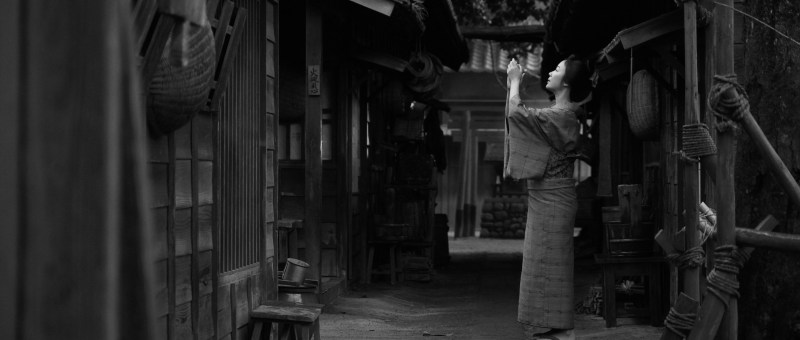
Okiku meanwhile has been rendered mute, her voice silenced by the cruelties of the feudal order leaving her struggling to rediscover her place. She has fallen in love with Chuji, but they think they come from worlds even as they witness them merging and realise there is only one vast expanse under an unending sky. In a decade’s time, it won’t mean anything that Okiku is a samurai’s daughter and Chuji an illiterate peasant but for the moment every step towards each other is transgressive and requires courage in breaking an unthinkable taboo. Sakamoto homes in on the muddiness of this “hopeless shitty world”, the unending drudgery and nihilistic futility of feudalistic life but finally offers his shit-shovelling heroes a new sense of possibility amid the ever expanding vistas of a new society. Presented as a series of black and white vignettes each except the last ending in a moment of vibrant colour, the film finally discovers a sense of serenity as Okiku prepares to reenter the world having finally come to understand her place within it.


Okiku and the World screened as part of this year’s Nippon Connection.

International trailer (English subtitles)

It Comes (来る, Tetsuya Nakashima, 2018)

According to a duplicitous folklorist in Tetsuya Nakashima’s anarchic horror film It Comes (来る, Kuru), monsters aren’t real. People made them up so they wouldn’t have to face an unpleasant reality. Farmers who had more children than they could feed invented a monster who came to claim their infants rather than have to live with the reality that they left them in the in the forest to die. As it turns out this monster may actually be “real”, but undoubtedly fuelled by the loneliness of a neglected child whose parents are burdened by their own particular legacy of parental toxicity. 

The mother of soon-to-be-married Hideki (Satoshi Tsumabuki) more or less says as much when he brings his fiancée to meet the family at a memorial service for his late grandfather. “Maybe it’s her upbringing” she snidely suggests, remarking that Kana (Haru Kuroki) is “a little gloomy” (which seems like an odd criticism to make of a guest at what is effectively a reenactment of a funeral). A strangely beaming Hideki keeps reassuring his fiancée that she’s “perfect” while she continues to worry about whether she’s a good fit seeing as she never knew a “real” family having been raised by a mother she regards as neglectful. But even at the couple’s wedding it’s clear that Hideki mostly ignores her, so obsessed is he with being the centre of attention. “Is it ever not about you?” one of the fed up guests eventually heckles, but it evidently never is. After setting up his “perfect” life in a “perfect” luxury flat and having a “perfect” baby, Hideki sets up a blog about being the perfect dad and barely helps with their small daughter Chisa driving Kana slowly out of her mind with his narcissistic self-obsession and thinly veiled emotional abuse. 

When the ghosts start coming, we might wonder if they reveal the truth or effect a distorted reality that leans in to otherwise unspoken dark thoughts, but Hideki really is as someone puts it all lies. When he’s persuaded to visit an “exorcist” she simply tells him to treat his wife and daughter properly to make the monster go away sending Hideki into a small moment of rage implying that he really does know what he is rather than having “forgotten” a cruel alter ego. In his charmed life, we might even wonder if he made some kind of deal with the devil which would explain his rather vacant smile though as it turns out it’s more like he’s cursed by a forgotten childhood encounter with an ancient forest spirit which hints at a deeper, older evil going all the way back to those farmers and the children they abandoned. 

Then again, it seems as if Hideki was rather spoiled as a child leaving him craving both attention and approval, while Kana is still struggling with resentment towards the mother she mainly had to parent herself and is afraid of becoming. Hideki snaps at her that she shouldn’t lose her temper with the baby because children remember, though as it turns out neither of them can really give their full attention to Chisa because of the realities of parenthood which among other things include constant anxiety and feelings of inadequacy. The parents are effectively haunted while cursed by their own toxic parental legacies that they will inevitably pass on to their daughter whether they mean to or not. 

It’s much the same for occult writer Nozaki (Junichi Okada) brought in to help solve the case with the help of his girlfriend, Makoto (Nana Komatsu), a bar hostess with psychic abilities. He once persuaded an old girlfriend to have an abortion because he was afraid of becoming attached to something he might eventually lose, and may be in a relationship with Makoto partly because she is unable to bear children for reasons connected to her frustrated love for her icy exorcist sister Kotoko (Takako Matsu) who like Nozaki wilfully distances herself from others to protect herself from the pain of loss. But as another shaman tells him, in a land of darkness where you no longer know right from wrong pain is the only truth. 

Nakashima shoots with a thinly veiled irony, vacillating between the ridiculousness of demonic spirits wreaking havoc in a well-appointed Tokyo apartment and the concession that there are indeed monsters in the world and as another infected suggests, they are we. Once again set at Christmas much like World of Kanako, Nakashima’s familial horror juxtaposes the season of goodwill with supernatural violence even as Kotoko marshals every power at her disposal from her roots in Okinawa shamanism to Buddhism and Christianity to hold back the latent evil born of a little girl’s loneliness. Meanwhile, he draws inspiration from classic J-horror and particularly the work of Nobuo Nakagawa in his green mists and swamp-based set piece in which Nozaki finds himself mired in a lake of life and death. Kotoko’s wounded eye and fear of mirrors hark back to Yotsuya Kaidan and the betrayed ghost of Oiwa, herself a victim of a man whose self-involved quest for approval cost her her life. At heart an interrogation of the parental bond the film eventually comes down on the side of family as Nozaki reclaims his frustrated paternity while a little girl dreams of nothing more sinister than a land of omurice. 


It Comes screened as part of this year’s Japan Foundation Touring Film Programme.

International Trailer (English subtitles)

Under the Stars (星の子, Tatsushi Omori, 2020)

“The time of realisation comes and then that person changes” according to the words of a new religion guru. The sentiment is true enough, even if the meaning is slightly different from that which she’d intended. Young Chihiro, however, the heroine of Tatsushi Omori’s adaptation of the novel by Natsuko Imamura Under the Stars (星の子, Hoshi no Ko), is indeed approaching a moment of realisation as she begins to question everything about the world around her as it had been presented throughout the course of her life. 

As a baby, Chichiro (Mana Ashida) had suffered from severe eczema which had left her in terrible pain and her parents suffering with her in witnessing her distress. On the advice of a colleague, Chichiro’s father (Masatoshi Nagase) decides to try using “Venus Blessed Water” which is apparently full of cosmic energy that can cure all ills. Chihiro begins to recover and her parents become devotees of the cult which produces it eventually alienating her older sister, Ma (Aju Makita), who is unable to reconcile herself with the outlandish beliefs they advance and rituals they conduct. 

For Chihiro, however, the cult is all she’s ever known so it is in that way “normal” and it’s never really occurred to her to question it even after her sister’s mysterious “disappearance”. But as she approaches the end of middle-school, a few well placed questions from her classmates give her pause for thought wondering if her parents’ claims about the miracle water could possibly be true or if, as her best friend Watanabe (Ninon) wonders, they are simply being scammed. After all, if water could solve all the world’s problems it would either be ridiculously expensive or completely free and if you could stay healthy by placing a damp towel on your head then everyone would be doing it. Her parents claim they don’t get colds because the water boosts their immune system, but perhaps they’re just lucky enough to be the kind of people who don’t often get that kind of sick or the fact that they obviously spend almost all their time in the bubble of the cult reduces their exposure. 

Her crunch point comes when her handsome maths teacher (Masaki Okada) on whom she has a crush spots her parents doing the ritual in a park and exasperatedly points them out as complete nutcases. When she eventually tells him who they are, he inappropriately calls her out in front of the entire class by telling her to get rid of her “weird” water while subtly undermining her religious beliefs with advice about how to avoid getting colds or other potentially dangerous seasonal viruses. Omori presents the cult neutrally, hinting that the discrimination Chihiro is facing as a member of a “new religion” may be unfair while the beliefs of traditional religions may seem no stranger to the unfamiliar and to criticise them so directly would be deemed unacceptable in any liberal society. In a sense perhaps we all grow up in a kind of cult only latterly questioning the things our parents taught us to be true. Chihiro’s uncle Yuzo meanwhile had once tried to use science and experience to undermine her parents’ beliefs, he and Ma swapping out their holy water for the tap variety to prove to them that they are being duped only for them to double down and refuse to accept the “truth”. 

Uncle Yuzo and his family eventually offer Chihiro a place to stay in the hope of getting her out of the cult but are also of course asking her to betray her parents by leaving them. She remains preoccupied by the fate of her sister, particularly hearing rumours about the cult supposedly disappearing those who turn against them, but is torn between her growing doubts and love for her parents while privately suspicious about the fate of a child much like herself kept locked up by his mum and dad who say he’s terribly ill and unable to speak (which doesn’t exactly support the cult’s claims of universal healing), but who knows what might actually be true.

Shoko (Haru Kuroki), the wife of the guru Kairo (Kengo Kora), is fond of reminding the younger members that they are not there of their own free will which is of course true whatever the implications for fate and determinism because they are children whose parents have forced them to attend which might explain their sense of resentment or what she implies is “resistance” to their spiritual messaging in urging them to make an active choice to accept the cult’s teachings. Chihiro is coming to a realisation that she may be on a different path than her parents but delaying her exit while they too are possibly preparing her for more independent life. Lighter than much of Omori’s previous work despite its weighty themes, Under the Stars is also in its way about the end of childhood and the bittersweet compromises that accompany it. 


Under The Stars streamed as part of this year’s Nippon Connection.

Original trailer (no subtitles)

Images: (c) 2020 “Under the Stars” Production Committee

Sensei, Would You Sit Beside Me? (先生、私の隣に座っていただけませんか?, Takahiro Horie, 2021)

An under-confident mangaka tries to save her moribund marriage through a passive aggressive attempt at “realism”, but then is that really what she wants? What is she really up to? Takahiro Horie’s anti-rom-com Sensei, Would You Sit Beside me? (先生、私の隣に座っていただけませんか?, Sensei, Watashi no Tonari ni Suwatte Itadakemasenka?) is more complicated than it first seems, a tale of romantic revenge, of a woman’s determination to reclaim her independence, or perhaps even a slightly cynical not to mention sexist story of a betrayed wife’s attempts to rekindle her moody husband’s creative mojo in the hope of reigniting the spark in their marriage. What transpires is however a literary game of cat and mouse as a suddenly alarmed husband attempts to get ahead of the game through the transgressive act of reading his wife’s diary. 

A successful manga artist, Sawako (Haru Kuroki) has just completed a long-running series assisted by her husband of five years, Toshio (Tasuku Emoto) who was once a bestselling mangaka himself but hasn’t worked on anything of his own since they got married. Toshio appears to be prickly on this subject, and is in something of a bad mood while Sawako’s editor Chika (Nao Honda) waits patiently for the completed pages. Seemingly suspecting something, Sawako asks Toshio to escort Chika back to the station with the intention of following them only she’s interrupted by a phone call from the police to the effect that her mother (Jun Fubuki), who lives out in the country, has been in an accident and broken her ankle. Sawako and Toshio decide to go and stay with her while she recovers, though a change of scene seems to do little to relieve the pressures on their marriage. 

Indeed, on their first night there Toshio remarks that it’s been a while since they’ve slept in the same room which might go some way to explaining the distance in their relationship. Aside from that, Toshio superficially seems much more cheerful perhaps putting on a best behaviour act for his mother-in-law who makes a point of telling her daughter how “great” her husband is and how she’s almost glad she broke her leg because it’s brought him to stay. Her gentle hints to Sawako to let her know if there’s something wrong elicit only a characteristic “hmm” while she otherwise makes only passive-aggressive comments which suggest she fears her marriage may be on the way out. Having long been resistant to the idea of learning to drive even though she grew up in the country, Sawako starts taking lessons at a nearby school cryptically explaining to Toshio that perhaps she’d better learn after all because she’ll be stuck when he leaves her. 

Sawako’s “driving phobia” as she first describes it appears to be a facet of her underlying lack of self-confidence. She simply doesn’t trust herself to take the wheel and cannot operate without the safety net of someone sitting next to her. Having not got on with the grumpy old man she was originally assigned, Sawako gains the courage to take her foot off the brake thanks to a handsome young instructor, Shintani (Daichi Kaneko), who makes her feel safe while slowly giving her the confidence to trust in herself. The implication is that Toshio has been unable to do something similar in part because he’s so wrapped up in his own inferiority complex over his creative decline complaining that nothing really moves him anymore. When Chika advises Sawako choose a more “realistic” subject for her next series, she passively aggressively decides to go all in with a clearly autobiographical tale of adultery that suggests she is well aware her husband and editor are having an affair behind her back while the heroine experiences a passionate reawakening thanks to her handsome, sensitive driving instructor. 

Of course, Toshio can’t resist reading her “diary” and obsessing over how much of it is “true”. Perhaps Sawako intended just this effect, driving her husband out of his mind with guilt and jealousy indulging in a little revenge whether in fantasy or reality. The irony is that there are at least three “senseis” floating around including Sawako herself with the eventual decision of who, if anyone, she wants to sit beside her the unanswered question of her “revenge” manga. Her real revenge, however, may lie in her determination to grab the wheel, reclaiming agency over her life along with a new independence born of her ability to drive and therefore decide its further direction while toying with Toshio’s inner insecurity in order to effect a plan which is far more insidious than it might first seem. Filled with twists and turns, Horie’s cynical love farce eventually cedes total control to its seemingly mousy heroine as she gains the confidence to go solo or hand-in-hand as it suits her towards a destination entirely of her own choosing. 


Sensei, Would You Sit Beside Me? screened as part of this year’s New York Asian Film Festival.

International trailer (English subtitles)

Every Day a Good Day (日日是好日, Tatsushi Omori, 2018)

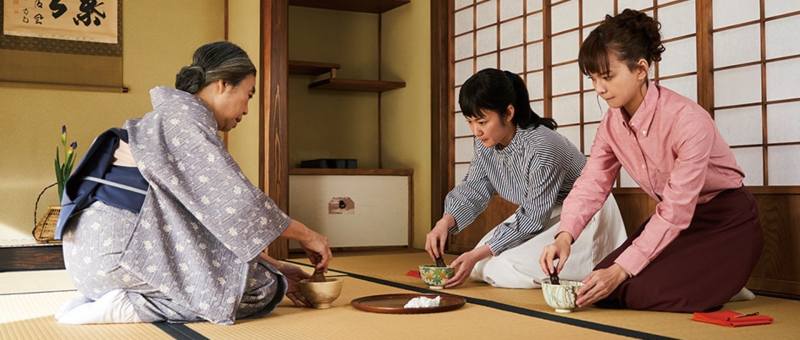
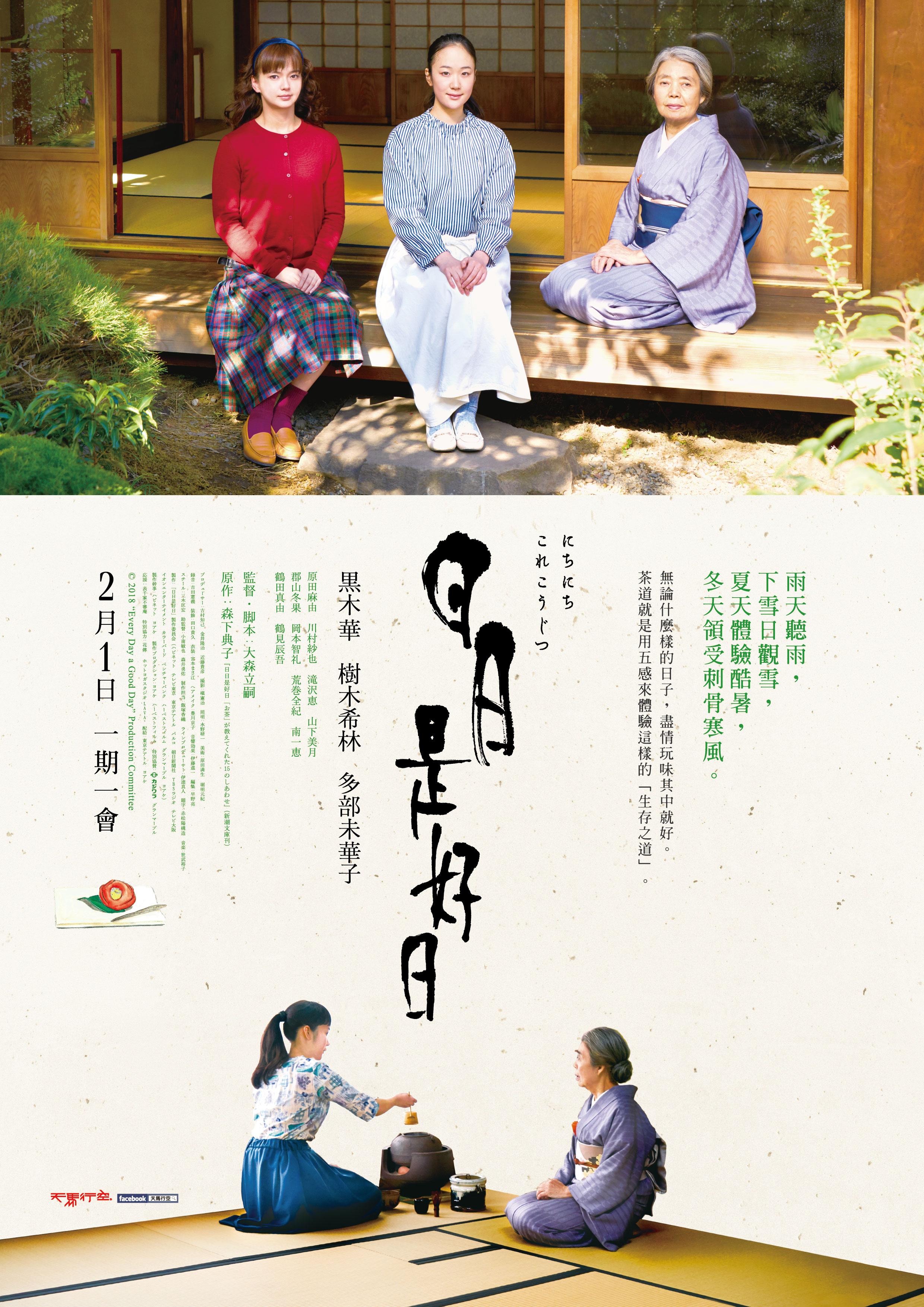
Everyday a good day posterTatsushi Omori burst onto the scene in 2005 with the extremely hard-hitting and infinitely controversial The Whispering of the Gods before going on to build a career on chronicling the unpalatable facets of human nature. He does have his lighter sides as the delightfully whimsical Seto and Utsumi proves, but even so he might be thought an odd fit for directing an adaptation of a series of autobiographical essays detailing one woman’s personal growth over a 20 year period spent perfecting the art of the Japanese tea ceremony. Every Day a Good Day (日日是好日, Nichinichi Kore Kojitsu) is, however, like much of his previous work, a story of youthful ennui and existential despair only one in which it turns out that the world is basically good once you agree to embrace it for what it is.

The film opens in 1993 with the heroine, Noriko (Haru Kuroki), a confused college student unsure of the forward direction of her life. Often ridiculed by her family for being clumsy and neurotic, Noriko compares herself unfavourably with her glamorous cousin Michiko (Mikako Tabe) who has come to the city from the country to study and appears to have her whole life already mapped out with a confidence Noriko could only dream of. A turning point arrives when she’s talked into accompanying Michiko to learn tea ceremony from a kindly old lady, Mrs. Takeda (Kirin Kiki), who lives nearby. Despite regarding tea ceremony as something fussy and old fashioned that only conservative housewives aspire to learn, Noriko begins to develop a fondness for its formalist rigour and continues dutifully attending classes for the next 24 years.

“Carry light things as if they were heavy, and heavy things as if they were light” Noriko is told as she clumsily tries to carry an urn from one room to another, though like much of Takeda-sensei’s advice it serves as a general lesson on life itself. Mystified by the entire process, Noriko and Michiko make the mistake of trying to ask practical questions about why something must be done in a particular way only for Takeda-sensei to admit she doesn’t know, it simply is and must be so. To look for that kind of literal meaning would be a waste of time.

Of course, she doesn’t quite put it that way. As Noriko later realises, some things are easy to understand and need only be done once. Other things take longer and can only be understood through a weight of experience. Just as she was bored out her mind by La Strada at 10 but moved to tears at 20, the discrete pleasures of the tea ceremony are something only fully comprehended when the right moment arrives. What was once empty formalism becomes a framework for appreciating the world in all its complexity, embracing each of the seasons as they pass and learning to live exactly in the moment in the knowledge that a moment is both eternal and transient.

Noriko continues to feel herself out of place as she witnesses those around her progress in their careers, get married, or go abroad while she remains stuck, unable to find a direction in which to move. Even tea ceremony occasionally betrays her as new pupils arrive, depart, and sometimes wound her newfound sense of confidence by quickly eclipsing her. Nevertheless, the calm and serenity of ritualised motion become a place of refuge from the confusing outside world while also offering a warmth and friendship perhaps unexpected in such an otherwise ordered existence.

Over almost a quarter of a century, Noriko’s life goes through a series of changes from career worries to romantic heartbreak, learning to love again, and bereavement, while tea ceremony remains her only constant. She may not yet have discovered the path to happiness, but perhaps has begun to reach an understanding of it and believe that it might exist in some future moment – as Takeda-sensei says, there are flowers which bloom only in winter. In any case, what she’s learned is that sometimes it’s better not to overthink things and simply experience them to the best of your ability while you’re both still around. Every day really is a good day when you learn to slow down and truly appreciate it, living in the moment while the moment lasts in acknowledgement that it will never come again.


Every Day a Good Day was screened as part of the 2019 Udine Far East Film Festival.

Original trailer (English subtitles)