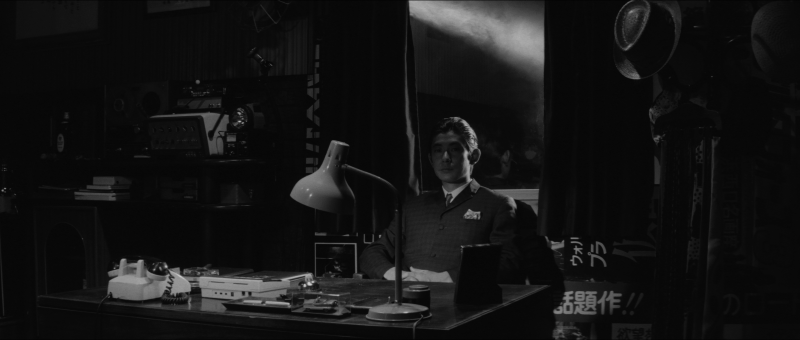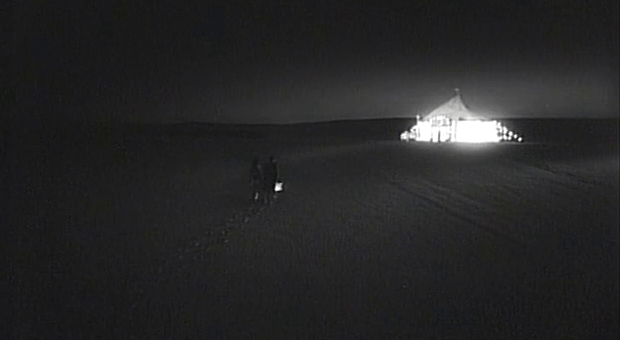
Scent of a Spell (魔性の香り, Toshiharu Ikeda, 1985)

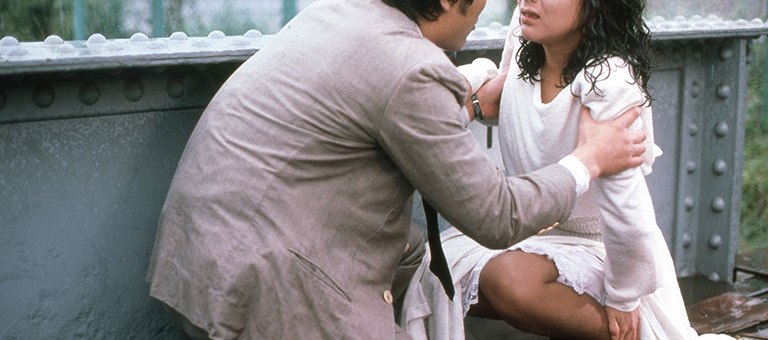
Esaka (Johnny Okura) feels like someone’s watching him. He has this sense of being observed by some otherworldly force along with a generalised feeling of uneasiness. But his paranoia seems to melt away after rescuing a young woman, Akiko (Mari Amachi), whose attempted suicide he witnesses during a rainstorm on his way home. He takes her in and one thing leads to another. For a time, they’re blissfully happy but then something starts to nag at him. Is Akiko really who she claims to be, or a demonic force of monstrous femininity?

It’s this malevolent quality to which the title of Toshiharu Ikeda’s noirish romance Scent of a Spell (魔性の香り, Masho no Kaori) alludes. Esaka is captivated by a hint of mystery and his own white knight syndrome, bewitched by Akiko but also perhaps growing tired of her and fearful of romantic commitment. He has after all been married before and his friend’s comments seems to suggest the cause of marital breakdown may either have been his womanising or his wife’s baseless jealousy. Akiko tells him that she’s on the run from an abusive husband prone to jealous rages and that though she has escaped from Osaka to Tokyo he always manages to track her down. Her sense of being pursued and Esaka’s of being watched seem to perfectly align while he seems to appreciate the fact that she needs him and he is quite literally sheltering her from danger.

Nevertheless, there are cracks in Akiko’s story beginning with the fact the bridge she threw herself off wasn’t the kind to pose a serious risk to life. The drop is only a few feet and though she resolutely refuses to be taken to a hospital because her husband might find her, she may be exaggerating the extent of her injuries. Meanwhile, she seems to have something of a jealous streak becoming irritated when Esaka talks to the proprietress of a local bar, thereafter apparently submitting herself to the attentions of his over-friendly colleague. Perhaps she had a reason to be annoyed given that she didn’t previously know any of these people and he inadvertently excluded her from the conversation, but it’s difficult for Esaka to know if she’s actually being unreasonable or he’s overreacting to a threat to his male pride and autonomy.

It’s this threat to his freedom that’s inflamed when he overhears another man talking to the lady behind the counter at a cafe he regularly goes to about his own girlfriend who is also named “Akiko” written with the character for “autumn”. Though there must be dozens of women with this not all that uncommon name combination in the city, it plants the seed of doubt in him that perhaps his Akiko and the other are the same and she’s two-timing him with this other guy while he’s at work. It also adds to his feeling that she has some kind of malevolent supernatural quality as if she were deliberately targeting lonely men for nefarious reasons. When the man from the cafe is found dead at home having been bludgeoned to death, he can’t help but feel that Akiko must have been involved and possibly intends to harm him too.

Of course, this may just be his fear that she will hurt him emotionally and his growing paranoia is a defence mechanism designed to protect himself against her abandonment or an infringement on his freedom. Or, alternatively, Akiko really is a dangerously crazed and jealous woman and letting her into his life will mean not a moment’s peace until it’s over. Even so, the pair of them discover intimacy in connection in their raw, desperate love making. Every time Esaka’s doubts rise to the surface, Akiko seduces him or he her and he momentarily forgets. In this, the film may have a latent misogyny as a final twist suggests that in the end all women are prone to fits of jealous rage not to mention cunning and trickery directed against each other as much as men who are also, to be fair, faithless liars and cheats. Akiko’s tragic backstory suggests something similar, that she is the inheritor of a legacy of compromised maternity and paternal betrayal. In any case, Esaka is not quite the hero he imagined himself to be either and in the end cannot save Akiko who may also in a way be choosing to sacrifice herself for love of him. Echoing the ending of In a Lonely Place, Ikeda casts their romance as fatalistic tragedy and bathes the noirish closing scenes in a heavenly golden light that suggests true love ends only in futility.


Scent of a Spell is released in the UK on blu-ray 17th February courtesy of Third Window Films.
The Stairway to the Distant Past (遙かな時代の階段を, Kaizo Hayashi, 1995)

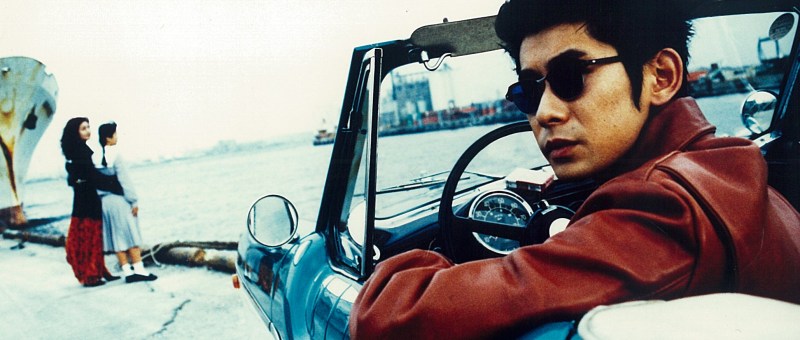
If The Most Terrible Time in My Life was channeling Nikkatsu Noir, Stairway to the Distant Past (遙かな時代の階段を, Harukana Jidai no Kaidan wo) sees Hayashi channel Fukasaku for a full-on confrontation with the legacies of the post-war era just as PI Maiku (Masatoshi Nagase) is forced to confront and attempt to cure the corrupted legacies of his own origins all while trying to save the city of Yokohama from drifting off to “another hell.” This time shooting in colour, Hayashi conjures a sense of mythic dread in the purple haze that hangs over a hidden city and the eerie blue of the path to get there.

But before all that, Maiku has fallen on such hard times his beloved car’s been repossessed and he’s stuck finding lost dogs for wealthy yet eccentric clients. Meanwhile, leader of New Japs gang Kanno (Shiro Sano) is running for political office while two of his underlings decide to freelance in order to take over the lucrative river trade which no one, not even the Taiwanese gang otherwise apparently in the ascendent, has ever dared to touch in fear of the mythic “White Man” who’s controlled the area since the post-war era with a ruthless efficiency that has seen any man challenge him not live to tell the tale. In the midst of it all is bigoted, and apparently pretty corrupt, policeman Nakayama (Akaji Maro) who first blackmails Maiku into helping him investigate a theft and smuggling ring on the river then apparently makes a deal with the White Man’s underlings who in turn blackmail him over his gambling debts but also claim they can make him chief of police if he chooses to play along.

Nakayama is a symbol of the rot in the contemporary city though he is in fact merely spineless, greedy, unpleasant and prejudiced. He asks Maiku for help because he’s hamstrung by the rules of policing which prevent him from doing the nefarious things he asks Maiku to do all of which leads to some pretty tragic consequences and a pair of orphaned children. The New Japs are perhaps a sign of further corruption still to come as Kanno tries to go legit as a politician but only as a means of increasing his influence and earnings. 

The river becomes a kind of nexus, the shore line between contemporary Japan and the “distant past” of the post-war era. Nakayama discovers that no one is technically policing it because it’s outside of everyone’s jurisdiction, while the White Man seems to have been in a position of unassailed power for half a century. As he later says, he’s the only one “living in the past” and perhaps quite literally so as Maiku has to transcend a literal stairway while guided by some kind of local prophet in order to travel to his world and finally risk his life to confront him. At the same time, Maiku is threatened by his own point of origin in the unexpected return of his mother, a now middle-aged stripper known as Dynamite Sexy Lily (Haruko Wanibuchi), who abandoned him and his sister and when he was just a child. 

Her name, along Maiku’s own, are perhaps hangovers from the Occupation era now even more out of place in a changed Japan. Making full use of the colour palate, Hayashi repeatedly flashes back to a pair of Lily’s red shoes as if signalling the unreality of the hidden city and the superimposition of past and present. His flashbacks to the late 1940s echo the cinematography of Fukasaku’s jitsuroku epics with their frenetic chases through black markets, but towards the conclusion the canted angles make it through to our era too and most particularly in the White Man’s lair, a blue-tinged industrial labyrinth that recalls the post-apocalyptic visions of a city still in ruins.

“Yokohama’s changed a lot,” Lily is told on her return and in fact several times after that. She likes it a little better now, the White Man no so much complaining that this city no longer has a place for him as if foreseeing his own eclipse and the oncoming end of an era. But then again, perhaps only the names have changed. All we’re left with is new gangsters with no code, and the White Man did at least stick to the rules even if he did so with ruthless authority. As for Maiku, his passage to the underworld seems to have brought him new clarity. His outfit now a little more sophisticated and mature, less an affectation borne of watching too many movies than an expression of himself. Nevertheless, Yokohama remains a small-town city, a cosy place with a generally friendly and easy going population albeit one with darkness hovering around the edges.


The Stairway to the Distant Past screens 18th/19th October at Japan Society New York.

Original trailer (no subtitles)

The Most Terrible Time in My Life (我が人生最悪の時, Kaizo Hayashi, 1994)

A Yokohama PI finds himself investigating a case of tragic brotherhood against the backdrop of a burgeoning gang war in Kaizo’s Hayashi’s retro crime movie The Most Terrible Time in my Life (我が人生最悪の時, Waga Jinsei Saiaku no Toki). In the first of three films featuring detective / cinema projectionist Maiku Hama (yes, that is his real name), Hayashi harks back to the Nikkatsu borderless action films of the 1960s along with classic noir while also exploring contemporary attitudes towards those not born in Japan. 

The force destabilising the local equilibrium is a gang that calls itself the “New Japs” and was founded by Zainichi Koreans who had acquired Japanese citizenship and now accepts members from other nations colonised by Japan who’ve also naturalised. The implication is that they’re agitating because the society still doesn’t fully accept them, something echoed by Maiku’s (Masatoshi Nagase) first client, a mister Kim, who says the police aren’t interested in his case because he’s a foreigner while when he actually encounters him Lieutenant Nakayama (Akaji Maro) does indeed make some quite prejudiced remarks. Hanging out in a mahjong parlour, Maiku comes to the aid of the waiter, Hai Ping (Yang Hai-Ping), newly arrived from Taiwan when he’s hassled by a racist customer noticing that the waiter’s actually carrying a knife under his shirt and might be about to ruin his life. 

Maiku loses a finger in the process (they sew it back on later), leaving Hai Ping to show up at his office with an improbably large amount of money Maiku refuses and then agrees to take when he hires him to find his brother De Jian (Hou Te-Chien) who came to Japan two years previously and has been missing ever since. Hai Ping’s relationship with De Jian speaks to Maiku because he’s also caring for his 16-year-old sister, their parents being absent from their lives just as Hai Ping and his brother were abandoned and then drifted into gang crime as a means of survival. He discovers that De Jian has married a Japanese woman of Chinese descent who like them was separated from her family which explains why she doesn’t speak any Chinese but was trotted out in a cheongsam as an exotic beauty when she was a sex worker which is how De Jian met her and got himself into trouble with gang when they ran away together. 

They are all in their way displaced people trying to get a foothold in Yokohama but finding varying degrees of success. A turf war is apparently about to break out between the Taiwanese and Hong Kong gangs, though we never actually see the one from Hong Kong only the New Japs and the Taiwanese who don’t actually fight but engage in vendettas with Hai Ping who is actually ordered to kill his own brother to prove his loyalty and atone for his crime. Maiku figures this out quite quickly and again tries to stop new his friend from making a huge mistake but not even he can prevent the fatalistic inevitability of the collision of all these competing honour codes and the implosion of a more literal kind of brotherhood in the face of that represented by the gang. 

Despite the film’s title, which in a meta touch flips around on the marquee of the cinema where Maiku has his office which is currently screening The Best Years of Our Lives, Maiku will have some far worse times in his life in subsequent films but the Yokohama we encounter here is a lived-in neighbourhood with its collection of quirky characters and strange goings on. The tone is humorous and ironic as Maiku’s friends have to chase a dog to get his finger back or Maiku’s taxi driver friend reads magazines while driving and changes hats in line with his role, but it has an underlying noirish sense of sadness for the world’s cruelty in the unfolding tragedies Maiku is powerless to prevent. Shooting in a crisp black and white, Hayashi pays tribute to Borderless action with a cameo from Jo Shishido as Maiku’s father figure while allowing Maiku to inhabit a world slightly out of time or existing only in the movies in which detectives are always hardboiled and the only way to be happy is to abandon all your hopes and dreams before the world can destroy them.


The Most Terrible Time in My Life screens 12th/18th October at Japan Society New York.

Original trailer (No subtitles)

Circus Boys (二十世紀少年読本, Kaizo Hayashi, 1989)

“There’s bad cheating and good cheating,” according to a little boy who will later become “a magician of words and juggler of lies,” in Kaizo Hayashi’s ethereal fable, Circus Boys (二十世紀少年読本, Nijisseiki shonen Dokuhon). Set in early showa, though the early showa of memory in which many other times intertwine, the film positions the transient site of a circus tent as a roving home for all who need it or are seeking escape from the increasingly heightened atmosphere of the early 1930s. Yet where one of the titular boys chooses to stay and earnestly protect this embattled utopia, his brother chooses to leave and seek his fortune in the outside world.

In fact, it’s Jinta (Hiroshi Mikami) who first becomes preoccupied with their precarious position realising that they’ve been hired to look cute riding the elephant, Hanako, but will soon age out of their allotted role and if they can’t master some other kind of circus trick there may no be a place for them in the big tent. For this reason he’s been training in secret with the idea that he can pass off the skills he’s perfected as innate “talent” so the circus will want to keep him on. Wataru (Jian Xiu), his brother, doesn’t quite approve of his plan. After all, aren’t they essentially tricking the people at the circus into thinking they’re something they’re not? But Jinta assures him it’s like “magic,” the kind that will allow them to stay in their circus home which later comes to seem a place of mysticism or perhaps make-believe on its own.

Thus Wataru walks a fine line. His name means “to cross over,” but he never does. He tries to walk the tightrope before he’s ready and is unbalanced by a storm. Jinta breaks his fall, but also in the process his own ankle. Along with it go his dreams. His foot never heals, and he’ll never fly the trapeze with Wataru like he planned though he keeps his injury a secret from his brother. While Wataru flies with new girl Maria (Michiru Akiyoshi), Jinta becomes a clown, a position he’d previously looked down on and later leaves the circus altogether using his talent for magic and performance to become a snake oil salesman tricking what appear largely to be poor farming communities into buying things like miracle soap and coal that burns for a whole month. This is clearly bad cheating, though he tries to convince himself it’s not while essentially remaking the world around him through his lies. 

But he retains his integrity in other ways. After being press-ganged into a yakuza-like guild of street pedlars, he gently excuses himself when invited to dine with a boss and confronted by an odd situation in which his wife has purchased another young woman to be his “plaything.” In a comment on contemporary patriarchal norms, the young woman is referred to as “Omocha,” which literally means “toy,” but also sounds a like a woman’s name because it begins with the character “O” which was used as a polite prefix for female names until the practice faded out after the war. The boss of course treats her like a doll, and even the wife refers to her as an “erotic instrument” she got as a way of managing her husband’s sexual appetites fearing he’d otherwise be seeing sex workers and bring a sexually transmitted disease into their home (and also possibly because she simply doesn’t want to sleep with herself any more than she has to). Referred to only as Omocha the woman has almost no agency and finds a kindred spirit in Jinta (whose name contains the character for “humanity”) because like him she also escapes the hardships of the world through lies and fantasy. “Can two lies make one big truth?” Jinta muses, breaking the codes of Guild as he prepares to rescue another man’s plaything, only it may be more like she rescues him. 

Meanwhile, Wataru tries to save the circus even after their ringmaster dies with visions of Jinta on his mind. They plan a wall of death to bring back the crowds, but Wataru’s plan backfires with tragic consequences and it becomes clear he can’t protect their circus family even if it brings back veteran trapeze artists Koji (Yukio Yamato) and Yoshiko (Maki Ishikawa) who agree there’s no other place for them out in the big wide world. The sense of the circus as a safe space was echoed on Maria’s arrival when Jinta had cruelly said she looked a little foreign with the ringmaster assuring her that in here they’re all artists and do not classify people in terms of their race, appearance or nationality. Its unreality, however, is reinforced by the constant backing of Wataru’s shadowplay which sometimes shows things the way people wish they were rather than the way they are. Omocha is later seen holding one of these puppets just as she and Jinta decide to die to free themselves of this hellish existence before Jinta’s surrogate brother figure Hiroshi (Shiro Sano) is forced to kill them for breaking the rules of the guild.

In the ambiguities of the final sequence, we might ask ourselves if they are actually dead and the glowing circus tent they see on the horizon is a path to the afterlife or a kind of heaven represented by the utopia to be found inside it. Then again, perhaps Jinta is merely rediscovering the way home, a prodigal son who now understands he already had a place to belong and there is a place to which he can return. The Great Crescent Circus is now the Sun & Crescent Circus, reflecting the way the two boys inhabit the world like and dark, idealism and cynicism, but comprise two parts of one complete whole. Hayashi waxes self-referential, playfully including a reference to his first film in that the movie playing at the cinema Jinta passes is The Eternal Mystery with Black Mask on his way to rescue Bellflower while indulging in an intense nostalgia for a lost world of travelling shows and hidden magic. Shooting in a beautifully balanced monochrome, he lights on scenes of heart-stopping beauty that are somehow poignant and filled with melancholy but ends with a moment of resolution in which, one way or another, Jinta reaches the promised land as he said with magic.


Circus Boys screens 12th October at Japan Society New York.

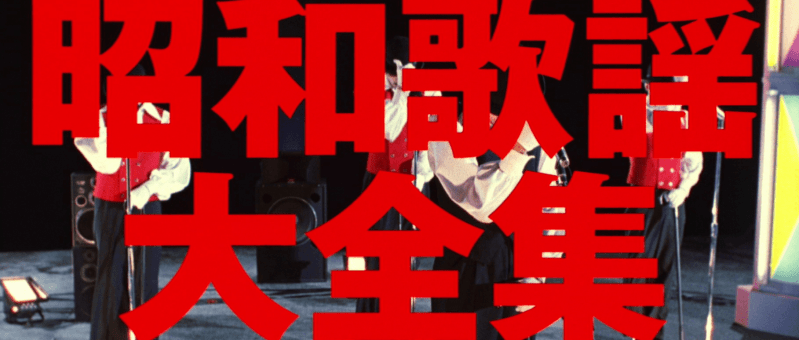
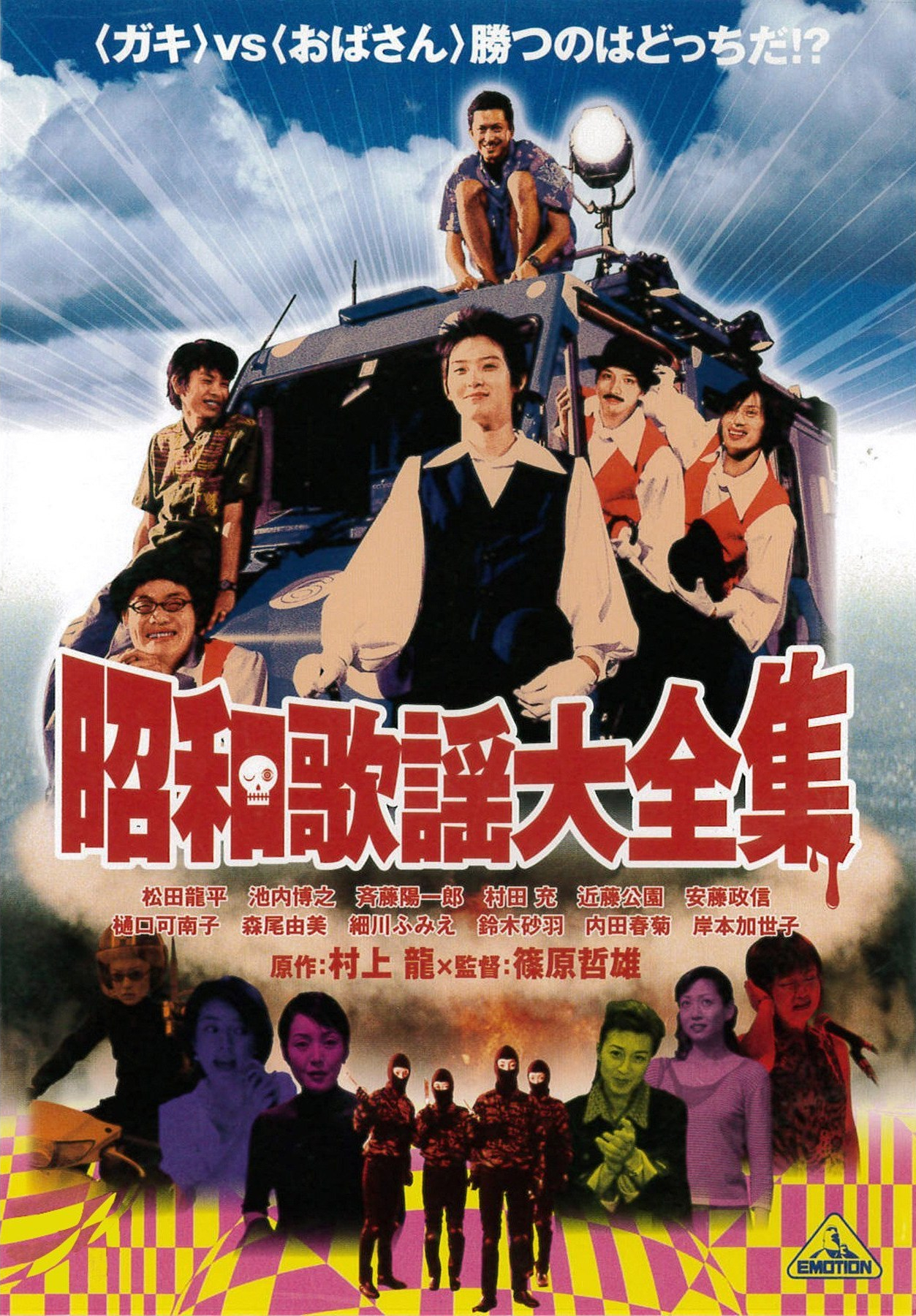
Karaoke Terror (昭和歌謡大全集, Tetsuo Shinohara, 2003)

karaoke terror poster.jpgEver since its invention karaoke has provided the means for many a weary soul to ease their burdens, but there may be a case for wondering if escapism is a valid goal in a society which seems to be content in stagnation. The awkwardly titled Karaoke Terror (昭和歌謡大全集, Showa Kayo Daizenshu), adapted from the book Popular Hits of the Showa Era by Audition’s Ryu Murakami, pits two very different groups of karaoke enthusiasts against each other – aimless adolescent males, and jaded middle-aged women. Despite the differences in their ages and experiences, both enjoy singing the wistful bubblegum pop of an earlier generation as if drunk on national nostalgia and longing for the lost innocence of Japan’s hopeful post-war endeavour to rebuild itself better than it had been before.

We open with the slackers and a voice over from the presumed “hero” of the film, Ishihara (Ryuhei Matsuda), who informs us that he can’t really remember how he met most of the guys he hangs out with but that he always knew the one of them, Sugioka (Masanobu Ando), was a bit cracked in the head. In a motif that will be repeated, Sugioka catches sight of a middle-aged woman just on the way back from a shopping trip and decides he must have her but his attempts to pick her up fail spectacularly at which point he whips out his knife and slashes her throat.

Meanwhile, across town, a middle-aged woman, Hemmi (Kayoko Kishimoto), offers to let a co-worker share her umbrella but the co-worker misinterprets this small gesture of courtesy as romantic interest and crudely asks her “how about a fuck?” to which Hemmi is quite rightly outraged. Rather than apologise, the co-worker shrugs and says his “direct” approach works six times out of eight and some women even appreciate it. Once she manages to get away from her odious aggressor, Hemmi ends up stumbling over the body of the woman murdered by Sugioka and realises she knows her. The murdered woman was one of six all named Midori who were brought together for a newspaper article about the lives of middle-aged divorced women and have stayed “friends”. Outraged about this assault not just on their friend and their sex but directly against “women of a certain age” who continue to be the butt of a societal joke, the Midoris decide they want revenge and hatch a plan off Sugioka, but once they have, the slackers hit back by offing a Midori and so it continues with ever-increasing levels of violence.

Which ever way you slice it, you can’t deny the Midoris have a point and Hemmi’s continuing outrage is fully justified. When the boys rock up at a mysterious general goods store out in the country looking for a gun, the proprietor (Yoshio Harada) is only too happy to give it to them when they explain they need it for revenge and that their targets are middle-aged women. The proprietor has a lot to say about ladies of a certain age. In fact he hates them and thinks that bossy, embittered, unproductive women “too old” to fulfil their only reason for existence will be the only ones to survive a nuclear apocalypse that even the cockroaches cannot overcome. The boys appear timid and inexperienced but ironically enough can’t take their eyes off the middle-aged woman from across the way and her sexy dance routines. They feel entitled to female deference and cannot accept a woman’s right to decline. The Midoris are sick of being “humiliated”. They’ve fallen from Japan’s conformist path for female success in getting divorced or attempting to pursue careers. They’ve lost their children and endured constant ridicule as “sad” or “desperate”, made to feel as if their presence in the workplace past a certain age was “inappropriate” and the prices they have paid for their meagre successes were not worth the reward. They strike back not just at these psychotic boys but at a society which has persistently enacted other kinds of violence upon them.

Meanwhile, the boys remain boys, refusing adulthood and responsibility by wasting their time on idle pursuits. Truth be told, karaoke performances involving dance routines and elaborate costumes is not a particularly “cool” hobby by the standards of the time but it appears that none of these men have much else in their lives to invest themselves in. With the economy stagnating and the salaryman dream all but dead, you can’t blame them for their apathy or for the rejection of the values of their parents’ generation, but you can blame them for their persistent refusal to grow up and tendency to allow their insecurities to bubble over into violence.

As it turns out, adolescent males and middle-aged women have more in common than might be thought in their peripheral existences, exiled from the mainstream success which belongs exclusively to middle-aged and older men who’ve been careful to (superficially at least) adhere to all the rules of a conformist society. Neither group of friends is especially friendly, only latterly realising that “real” connections are forged through direct communication. Their mutual apathy is pierced only by violence which, ironically, allows their souls to sing and finally shows them just what all those cheerful songs were really about. Darkly comic and often surreal, Karaoke Terror is a sideways look at two diametrically opposed groups finding unexpected common ground in the catharsis of vengeance only for their internecine warfare to graduate into world ending pettiness.


Original trailer (English subtitles)

The greatest hits of the Showa era:

Koi no Kisetsu – Pinky & Killers

Hoshi no Nagare ni – Akiko Kikuchi

Chanchiki Okesa – Haruo Minami

Shiroi Cho no Samba – Kayoko Moriyama

Linda Linda – The Blue Hearts

Sweet Memories – Seiko Matsuda

Kaze Tachinu – Seiko Matsuda

Minato ga Mieru Oka – Aiko Hirano

Sabita Knife – Yujiro Ishihara

Hone Made Aishite – Jo Takuya

Kimi to Itsumademo – Yuzo Kayama

Mata Au Hi Made – Kiyohiko Ozaki

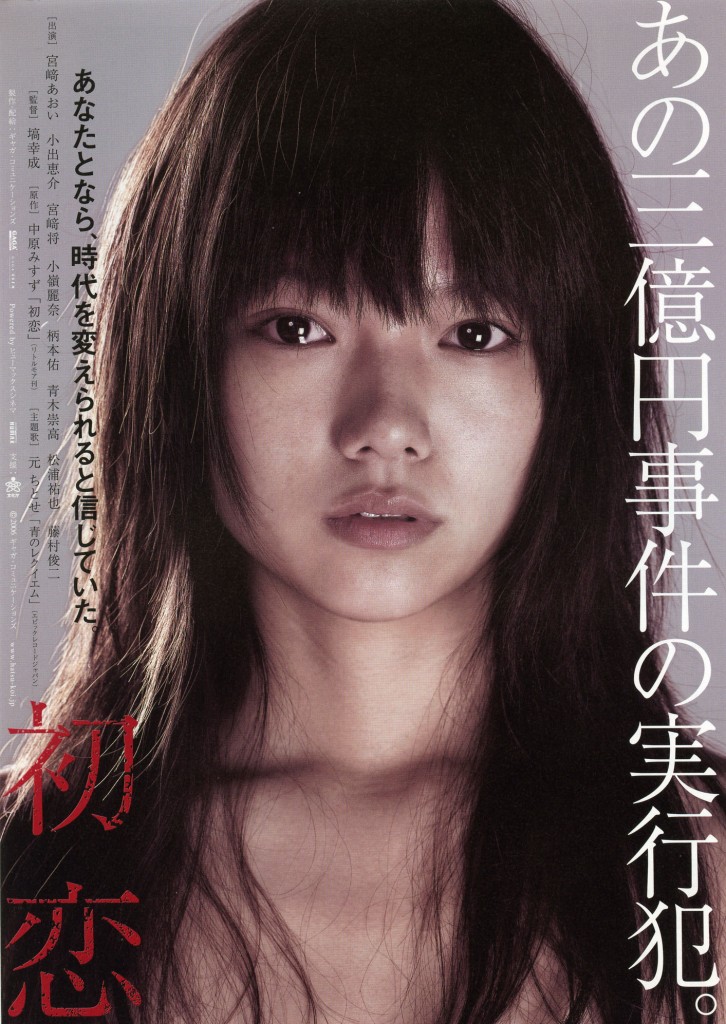
Hatsukoi (First Love) (初恋, Yukinari Hanawa, 2006)

hatsukoiThe 300 Million Yen Affair is one of the most famous and intriguing unsolved mysteries in Japan, not least because the missing cash has been lying dormant somewhere, apparently untouched, ever since that fateful day back in 1968. Seeing as the true story has never been discovered, the crime has taken on legendary status and become the focus of many kinds of fiction. Misuzu Nakahara’s fictionalised autobiography is just one of these as she retroactively claims responsibility for the robbery as a teenage girl in love with a detached revolutionary.

Misuzu (Aoi Miyazaki) begins her tale a couple of years before the crime as she lives a lonely and introverted life in the house of her uncle, her father having died and her mother apparently absconded with her older brother in tow but leaving her behind. It’s her 16th birthday, but no one cares. Soon enough she starts hanging around a shady jazz bar before another woman convinces her to come inside and join their group of layabout beatniks – a group which is actually lead by her estranged older brother, Ryo (Masaru Miyazaki). These are the heady days of students protests – against the old order, against the ANPO treaty, against the war in Vietnam, against just about everything. Misuzu grows closer to one of their number, the quiet and mysterious Kishi (Keisuke Koide), who has a proposition for her….

Hatsukoi (AKA First Love, 初恋) is a film which is thick with period detail from the authentically smokey, sweaty jazz bar and its counterculture denizens to the nostalgic atmosphere and 1960s street scenes. However, evoking Misuzu’s own sense of ennui, director Yukinari Hanawa opts for a detached, dispassionate tone which is entirely at odds with the otherwise searing, youth on fire tension of the time period. Misuzu is always on the edges of things, younger than the other members of the group she feels as if she’s merely being permitted to stay and listen rather than invited to participate. Nevertheless, even if it’s the case that Misuzu is a by nature a passive person, the film pushes the intense nature of the social revolution going on all around her into mere background, squandering its power to bring out the sense of passion that the film feels as if it needs.

At heart, the robbery is something of a mcguffin as the real story is the true love tragedy hinted at in the title. Misuzu and Kishi grow closer through their plotting of the crime which is born of his desire to commit a different kind of revolutionary act. The money is intended to pay the bonuses of Toshiba employees and Kishi feels the best way to make a protest against economic inequality and the power of large corporations is to hit them in the finances. Misuzu plays her part well enough and the robbery comes off OK despite minor hitches allowing only a brief honeymoon period for its would be Bonnie and Clyde before history begins to move forward and eventually rips them apart. For Misuzu the robbery becomes the defining event of her youth and the birth of the love that she seemingly cannot let go. After this the jazz club is over, the protest movement dies as do some of the protestors, or else they move on to more conventional lives. Not quite a coming of age, but a death of youth before it had hardly begun.

Some injuries never heal, says the kindly old man who teaches Misuzu how to drive. A prescient remark if ever there was one. Misuzu seems locked within this brief period of her youth, before her friends died, left, or disappeared once the turbulent atmosphere of protest and revolution gave way to the consumerist 1970s and everyone forgot about the necessity for social change in the hurry to make money.

Hatsukoi becomes less a about the first love itself than about the period that surrounds it. The love was lost, but so was the bubble in which Misuzu had begun to define herself as a young woman. What Hatsukoi lacks is a sense of personal tragedy, of a soul crushing, spiritual death which locks each of the group members into their own tragic fates and seems somehow dictated despite their insistence on defining themselves in the new, youth centric world. Often beautifully photographed, Hatsukoi’s air of desolation and cold, detached tone weaken its ability to engage making its painful end of youth journey all seem rather dull.


Hatsukoi was released with English subtitles on blu-ray in Taiwan, and on DVD in Hong Kong though both editions now appear to be OOP.

Unsubtitled trailer:

https://www.youtube.com/watch?v=k-HTlxRwQPg