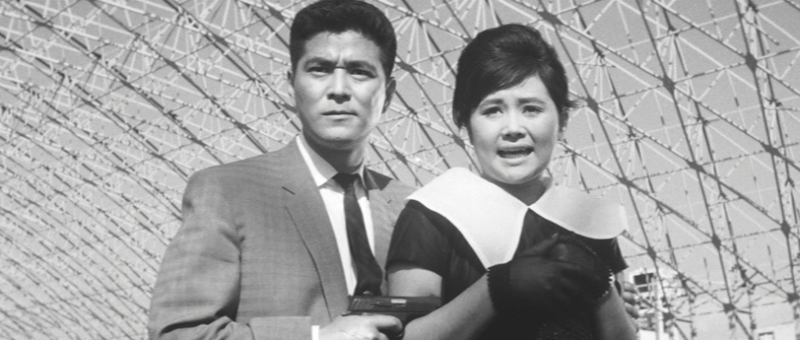
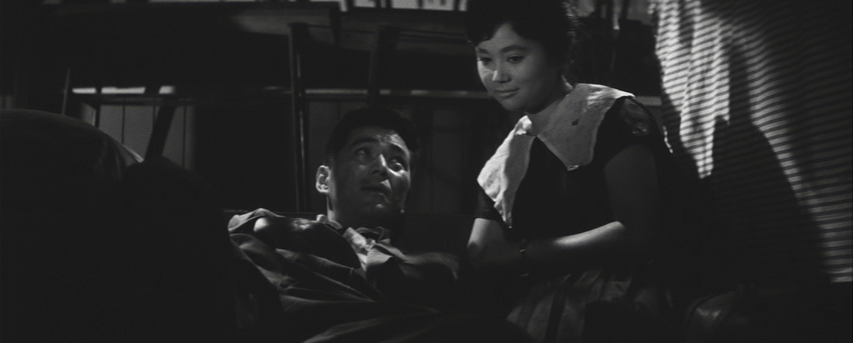
Procurer of Hell (地獄の饗宴, Kihachi Okamoto, 1961)

By 1961, the Japanese economy had largely recovered and the nation was emerging into an era of rising prosperity, but there were also those who were left behind or could progress into the new Japan. Shot with Okamaoto’s trademark irony, Procurer of Hell (地獄の饗宴, Jigoku no Kyoen) is a darkly comic tale of one such man who could have quit while he was ahead and started a new life if only he hadn’t been so greedy or perhaps so hung up on revenge. 

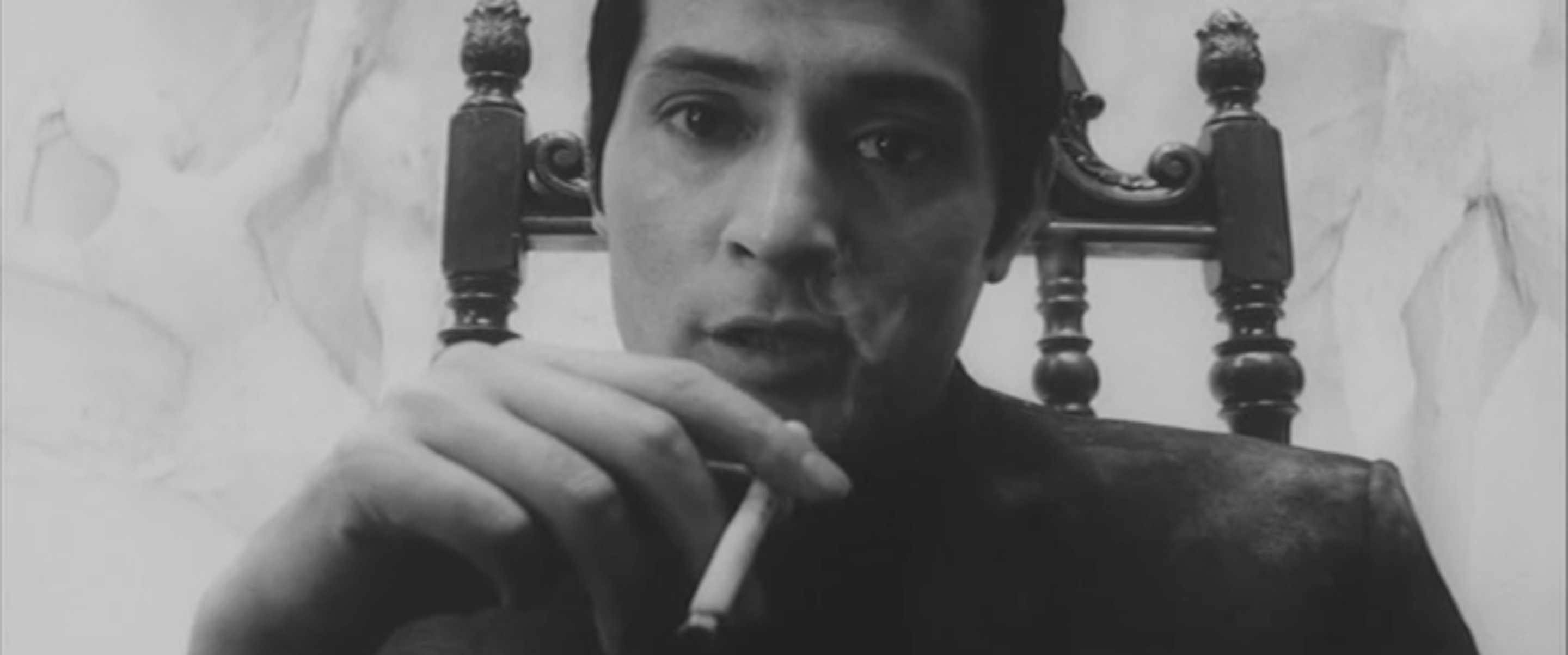
In a sign of the newly international society, Tobe (Tatsuya Mihashi) runs a shady business that claims to provide “English lessons” with blonde women are that are in reality appointments with sex workers. He also peddles pornographic images and dabbles in blackmail. When he finds a roll of film at the station, he gets it developed and discovers it contains photographs of his sergeant during the war, Itami (Jun Tazaki), who raped the Chinese woman he wanted to marry back in Manchuria. Tobe was unable to help her after getting his hand impaled on a tree branch from which he could not free himself. The scar he still bears on his hand is a mark of his corruption and a reminder of the moment which seems to have soured him on humanity and turned him into a cynical and amoral man. He decides to use the photographs to torment and blackmail Itami to get the money to help a widowed single mother he’s interested in secure a better future for herself by taking over a coffee shop from the owner who plans to retire.

As such, he does it for “good” reasons and Kazuko (Junko Ikeuchi) and her son Saburo represent for him a better future in the new Japan in which he would own a photo studio and live a law-abiding life. Saeko (Reiko Dan), Itami’s secretary with whom he was also having an extra-marital affair, is in other ways his opposite number and the representative of the dark side to which Tobe is drawn. Like him, she tries to play the situation to her advantage by playing the innocent before finally throwing her lot in with Tobe and suggesting he help her double-cross Itami so they can run off with the money he embezzled from his company before faking his own death in a convenient train crash. That Tobe extracts sexual favours from Saeko in return for giving her the photos and negatives interferes with the supposed nobility of his quest and apparently pure-hearted love for Kazuko and her little boy, while Saeko gradually shifts from exploited victim to calculating conspirator manipulating Tobe just as he believes himself to be manipulating her.

In any case, it remains true that he could have just settled for the money he needed for the cafe and walked away from this overly complicated situation involving Itami’s legal wife and associates who have actually embezzled the money and want the pictures back because they need Itami to be dead for their plan to work, but he doesn’t. He becomes fixated on getting his fair share of the ill-gotten gains much more than helping Kazuko or getting his revenge against Itami, which wasn’t really much of a revenge anyway considering what Itami had actually done during the war. But on the other hand, Itami seems to have become a rather powerless figure having married into his wife’s family to work in their business while she plots to have him confined to a psychiatric hospital to keep him out of her way. Saeko too is manipulating him. She has no real feelings for Itami and only wants the money, masterminding this whole scheme to get her hands on it with no intention of fleeing abroad with him. Similarly, she plays the victim with Tobe, telling him that Itami paid for her brother’s school fees and that she wants the photos back to avoid her brother or Mrs Itami finding out it about it and feeling hurt.

But while they’re fixating on the 150 million yen embezzled from the business, there are crowds of angry people turning up at the building society Itami runs complaining that their savings have disappeared and wanting to know if they’re going to get the houses they’ve been promised. Tobe walks through the May Day protests calling for better working conditions and higher wages, pointing to the ways this society is still veering off course in deliberately leaving some-people behind by rooting the new economic prosperity in exploitation. Tobe’s assistant wants to join the protest, but Tobe tells him they don’t really belong with the workers because of their nature of their business. The blackmail scam is his revenge not only on Itami but on everything that’s happened to him since the war and this ridiculous post-war society that he nevertheless hopes to join through these immoral means. The song of the canary he buys for Saburo begins to haunt him as a symbol of the wholesome life he might lead, but that life cannot really be won that way. He and Saeko are really two of a kind, she apparently brought low by her unexpectedly genuine feelings for him as even the police, picking him up for something else, leave them bleeding in the street surrounded only by emptiness and futility mere feet from the hospital in their own relentless pursuit of the “real” criminals.


Wild Ducks and Green Onions (カモとねぎ, Senkichi Taniguchi, 1968)

Outside of Japan, Senkichi Taniguchi is most likely best known as the director of Toshiro Mifune’s debut film Snow Trail, or else as the screenwriter of one of Akira Kurosawa’s lesser known works The Silent Duel. Yet throughout the 1960s, he also made a series of silly comedies including Wild Ducks and Green Onions (カモとねぎ, Kamo to Negi), an absurd crime caper revolving around a gentleman thief’s attempts to plot the perfect crime while assisted by two bumbling henchmen and a young woman with a hidden agenda.

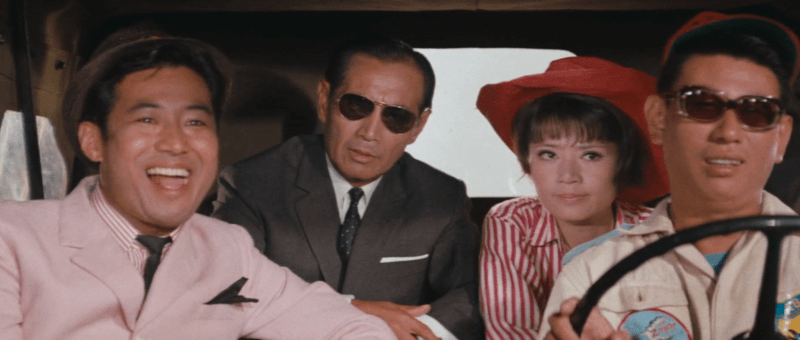
The film’s Japanese title is likely inspired by a proverb, “a duck comes carrying an onion” which means something close to “there’s a sucker born every minute” though it might be up for debate who exactly is the sucker here. In any case, dapper mastermind Nobukichi (Masayuki Mori) has plotted the perfect heist which involves rigging a speedboat race by nobbling the propellers on two of the four boats and then betting accordingly. So far so good, but the enigmatic Mami (Mako Midori) has been watching their every move and is able to swipe the bag containing the money before henchmen Yosuke (Hideo Sunazuka) and Kyuhei (Tadao Takashima) can return it to their boss who for once has agreed to an equal split. The guys eventually track her down, but she tells them she spent the money on bail for her husband but it turns out he left the police station with two other women and hasn’t been seen since. The gang then determine to track him down to get the money back, but become involved in several other scams along the way. 

Despite having been able to rob them blind, all the men seem to be under the impression that Mami is a brainless airhead though she later reveals herself to speak fluent English and in fact comes up with a few scams of her own that are better than Nobukichi’s whom the guys refer to as “Cap’n”. Nevertheless, the guys only tolerate her because they need to find her husband though all’s not quite as it seems. Kyuhei in particular seems to have a rather misogynistic streak and is somewhat jealous that Nobukichi gets to have Mami to himself though he remains a perfect gentleman, sleeping on the sofa and giving her the bed. But it’s Kyuhei’s lascivious nature that eventually gets them into trouble when he tries to drag a reluctant Yosuke into a cinema screening pink films only to be pulled aside by some kind of anti-delinquency brigade who read off some unconvincing statistics stating that 80% of young male sex offenders are fans of pink films. 

This annoys them so much they decide to scam the organiser, Tomiko (Hisano Yamaoka), by appealing to her vanity and tricking her association, which is dedicated to conservative family values, into watching (and apparently enjoying) a porn film on school premises believing it to be an “educational movie”. Tomiko in some senses represents the forces of order against which the gang are rebelling, though she’ll get her revenge in time. In any case, they find a more worthy target after travelling to a seaside town and encountering the daughter of a man who has been poisoned by industrial pollution while the local factory insists everything is within “safe limits” and they aren’t the cause of the sickness spreading across the area. 

Conducting another expert heist to steal the secret documents to prove otherwise, Nobukichi could make a lot of money blackmailing the factory owner but instead gives the report to the man’s daughter so she can pursue justice and compensation for her father much to the chagrin of Mami and proving that it isn’t all about the money after all. Then again, he has another document that, once translated by Mami, reveals the factory has actually been producing Napalm for the Americans which is a bit of a grey area as far as the constitution is concerned. This time, they play a nasty trick on the heartless factory owner (Eijiro Tono) though he is hardly remorseful and in fact was too greedy to pay their blackmail money despite the vast sums it would cost him if the news ever got out. 

Despite its silliness and absurdity, the film takes an ironic swipe at serious issues of the day such as scandals like the Minamata disease and Mary Whitehouse-esque social campaigners ranting about a decline in morals while simultaneously enjoying the platform that protesting them grants them. In some ways, the gang themselves exist as a kind of rebellion against the salaryman society with their various scams presented as silly games targeting faceless or ridiculous figures who can either afford to lose the money or were ripe for a comeuppance though in the end, crime doesn’t really pay either and the gang find themselves hoist by their own petards, robbed of enjoying their ill-gotten gains by unexpected twists of fate. Very much of its time the film has a kind of charm in its whimsical score and pastel colours but has lingering darkness in its threats of unexploded bombs and hidden Okinawan torture facilities in a society increasingly ruled by amoral capitalists.


The Lost World of Sinbad: Samurai Pirate (大盗賊, Senkichi Taniguchi, 1963)

Seemingly drawing influence from the series of Arabian fantasy films from Hollywood, Senkichi Taniguchi’s Lost World of Sinbad: Samurai Pirate (大盗賊, Dai Tozoku), sees the director reunite with Toshiro Mifune who had made his debut in the director’s Snow Trail which could not be more different from this crowd-pleasing adventure movie. The film is loosely based on the life of 16th century merchant Luzon Sukezaemon who eventually fled to Cambodia after all his possessions were seized by Hideyoshi Toyotomi and he was condemned on some trumped up charges.

The film’s opening scenes perhaps reflect this incident as Luzon (Toshiro Mifune) is branded a pirate and set to be burned at the stake, narrowly escaping after bribing an official with drugs. Resentful, Luzon decides he might as well become a pirate after all as he’s pretty sick of Japan and fancies seeking his fortune on the open seas only his ship is quickly destroyed in a storm and all his crew killed while the treasure he was carrying is seized by the fearsome Black Pirate (Makoto Sato). Washing up in a mysterious place aesthetically a mashup between South East Asia and the Middle East, Luzon is cared for by a hermit and then becomes embroiled in intrigue on finding out that the tyrannical king has been seizing local women in exchange for unpaid taxes and imprisoning them within his harem.

Luzon’s dreams are for riches and status so his sudden discovery of a love of justice is a bit of a surprise, but then he’s also most interested in the princess Yaya (Mie Hama) because he spotted one the necklaces from his treasure chest around her neck which suggests she might have a lead on the Black Pirate. Princess Yaya is engaged to a prince from the Ming kingdom which threatens a wider kind of geopolitical destabilisation should anything go wrong with this marriage which is a distinct possibility seeing as the corrupt Chancellor (Tadao Nakamaru) has been colluding with an evil witch to kill the king and seize the kingdom.

Rather than a pure pirate movie the film contains fantasy elements such as the presence of a Western-style castle which is clearly modelled on the one from Disney’s Snow White along with a weird hermit whose powers are weakened every time he sees an attractive woman. It is not, however, the kind of tokusatsu the English title bestowed by the US release implies as it contains no real monsters instead focussing its special effects on the magic used by the witch, who can turn people to stone with her eyes, and the hermit who can turn himself into a fly or disappear in a puff of blue smoke. Despite the prominent inclusion of SFX master Eiji Tsuburaya these effects are repeated several times are really the only ones featured in the film. 

In any case, what’s in play is famous merchant Luzon’s redemption arc in which he recovers the treasure but gives it back to the people, symbolically abandoning his dreams of wealth and status for something a little more community minded in vowing to sail the seven seas pursuing justice throughout the world. Having been a victim of authoritarianism in Japan, he rises up against tyranny abroad while teaming up with a group of local bandits and several times proudly proclaiming himself as Japanese though in a movie conceit everyone speaks his language including the Black Pirate who is later exposed as a snivelling fool tricked by the Chancellor on the promise of a chance to marry the Princess Yaya. Most of the derring do is reserved for the final sequence in which Luzon and the bandits storm the castle to defeat the evil chancellor but the screenplay also packs in genre elements such as trap doors and secret dungeons which keep Luzon busy as he does his best to overthrow an oppressive regime if only to put the rightful king back on the throne in the hope that might be better. Taniguchi certainly makes the most of his elaborate sets and costumes, creating a sense of tempered opulence along Middle-Eastern themes while adding a touch of the mythic in the attempt to weave a legend around the real life figure of Luzon Sukezaemon as a bandit revolutionary selling dreams of freedom on the sea as a pirate more interested in justice than money in otherwise corrupt society.


The Age of Assassins (殺人狂時代, Kihachi Okamoto, 1967)

“Hey, what’s going on around here?” a sidekick asks directly to camera at the conclusion of Kihachi Okamoto’s characteristically anarchic conspiracy-thriller-cum-spy-spoof The Age of Assassins (殺人狂時代, Satsujinkyo Jidai). Sparked by Bond mania, the late 1960s saw a marked trend in B-movie espionage parody though Okamoto’s take on the genre is darker than the norm even if embracing his trademark taste for absurdist humour leaving us wondering who our hero really is and which side, if any, he’s really on in the confusing geopolitical realities of 1967 Japan. 

As we first meet him, the hero is bumbling professor of criminal psychology Shinji Kikyo (Tatsuya Nakadai) who has extreme myopia and a persistent case of athlete’s foot not to mention a prominent mother complex. Unbeknownst to him, he’s one of three targets picked not quite at random by Rudolf von Bruckmayer (Bruno Lucique), former Gestapo chief, who is interested in hiring some assassins trained by the megalomaniac psychiatrist Mizorogi (Hideyo Amamoto) who’s been turning his mentally distressed patients into hyper-efficient killing machines (sometimes literally) under the rationale that all great men throughout history have been in a certain sense “crazy”. Mizorogi is also in charge of a eugenicist project titled “The Greater Japan Population Control Council” which believes that Japan is already overpopulated but they have to ensure that “the lives of people who might become useful in the future must not be destroyed before they’re born.” Therefore, “the people who will be useless should be asked to bow out”, the assassin calmly explains shortly before Shinji is saved by the divine energy of his late mother as her bust falls from a shelf and knocks the killer out. 

The central conceit plays into a real anxiety about the post-war baby boom expressed in earlier films such as Yuzo Kawashima’s Burden of Love while attacking the capitalistic philosophy that regards some people as more useful than others. By the late 1960s, Nazis had begun to make frequent appearances in these kinds spy spoofs as comedy villains usually crazed to the point of being little real threat. Mizorogi too is eventually exposed as exalting the “mad” interested more in the art of chaos and the impulse to murder than in any greater political goal. Indeed, the central MacGuffin turns out to be less to do with a grand conspiracy to create some kind of super society than the very B-movie-esque missing diamond known as Cleopatra’s Tear.

Okamoto piles each of these subplots one on top of the other as if he were making it up as he goes along suddenly undercutting what we thought we knew with an unexpected reversal. Shedding his glasses and shaving his scraggly beard, Shinji shifts from myopic professor to suave super agent using profiling and psychology to stay one step ahead while encountering plots by spiritualist cults, overly cheerful self defence force officers in the middle of training exercises, and eccentric assassins. From a modern standpoint, it might seem uncomfortable that each of the killers is manifesting disability in order to seem non-threatening, a female operative concealing a deadly weapon behind an eyepatch, while her poetry-obsessed colleague stores his in a fake crutch, but then again they are each pawns of a game being played by the crazed Mizorogi. Aided by female reporter Keiko (Reiko Dan) and car thief sidekick Otomo Bill (Hideo Sunazuka), Shinji seems to bumble from one bizarre episode to another but may actually be far more in charge of the situation than we might have assumed. 

Among the most visually striking of Okamoto’s late ‘60s pictures and once again making great use of animation, Age of Assassins features high concept production design, Mizorogi’s asylum lair a maddening corridor of Omega-shaped passages with ornate cell bars on either side behind which we can see a room full of men often engaged in what seems to be a military exercise regime while the plaster effigies of human form seem to be bursting from the walls. As in all of Okamoto’s films the central message lies in the absurdity of violence suggesting in a sense that the dog-eat-dog ethos of contemporary capitalist consumerism is in itself a kind of internecine madness countered only by Shinji’s rather childish mentality crafting his various gadgets out of household objects while attacking this elitist individualism with nothing more sophisticated than a vegetable peeler. 


Original trailer (no subtitles)

Big Shots Die at Dawn (顔役暁に死す, Kihachi Okamoto, 1961)

“Assassins make the world an unfit place to live in” according to a random gas station attendant clueing our errant hero in to the fact his small-town home is now a “den of yakuza” and unlikely tourist hotspot. An early, delightfully absurdist yakuza romp from Kichachi Okamoto, Big Shots Die at Dawn (顔役暁に死す, Kaoyaku Akatsukini Shisu) is part Nikkatsu parody, part ironic western, and all cartoonish fun as a prodigal son returns to find his father murdered and his uncle on the throne. Sound familiar? 

Jiro (Yuzo Kayama) has been working for the forestry commission in Alaska and has not returned to his small-town home of Kuraoka in some time which is why he didn’t even know his father, the mayor, was dead let alone that he was apparently assassinated in a manner which strongly anticipates the Kennedy assassination though the film was released in 1961. He also had no idea his father, a widower, had remarried and his family home is now occupied by his stepmother Hisako (Yukiko Shimazaki), a former secretary who scandalously lounges around in her underwear all day. His uncle Imamura (Eijiro Yanagi) is now the mayor, and as he explains to him, the town is a hotbed of gangster activity apparently a consequence of his attempt to turn it into a tourist hotspot. In trying to find out who killed his father, Jiro finds himself quite literally in the middle of a petty yakuza gang war aided and abetted by corrupt police. 

Quite clearly influenced by American cinema, Big Shots Die at Dawn situates itself in the new frontier of small-town Japan in which a war is being fought over the spoils of the post-war era. Uncle Imamura’s legacy is apparently a children’s theme park with the distinctly pregnant name Dreamland. Apparently a man who just loves the children but was unable to have any of his own, he’s also opened a pre-school for the local kids. Meanwhile, in the yakuza-backed casino, obsessive gamblers brush their teeth at the tables while local kingpin Goto (Akihiko Hirata) attempts to fend off the incursion of the rival Handa gang. Jiro’s return puts the cat among the pigeons as both sides attempt to use him as a way to take out the other.

The dark heart of small-town Japan is however present in the greed and double dealing which extends even to the police, a corrupt officer offering to sell Jiro a key piece of evidence he had concealed in the hope of profit. Just about everyone tries to sell the evidence to someone else at one time or another, leveraging an idea of justice alongside greed and self-interest. Meanwhile, Yoshiko (Kumi Mizuno), a quasi-love interest and former girlfriend of a fallen foot soldier, reports that she gave the police valuable evidence that her fiancé’s death wasn’t a suicide but they ignored her.

Jiro’s come to clean up the town, but the showdown takes place incongruously in the children’s theme park complete with its cutesy mascot characters and adverts for chocolate in the background making plain that these venal gangsters are really just boys playing war, taking pot shots at each other from tiny trains. What could be a dark comment on a loss of innocence is more cartoonish irony from Okamoto who shoots in extreme closeup with intentionally humorous composition and slapstick choreography. Nevertheless the message is unmistakable as we piece together the connections between small-town government and organised crime underpinned with a rather creepy all for the kids justification. 

Then again, the world has its share of misogyny, everything coming down to the incursion of transgressive femininity as one duplicitous woman manipulating her feminine wiles becomes the common link between each of the warring factions, as if this is all her fault and Jiro’s return is a way of clearing up the pollution her arrival provoked. Nevertheless as even he says, his father, and implicitly his father’s generation, must share some of the blame. Filled with stylish action sequences, car chases, self-consciously cool dialogue, and scored with a mix of moody jazz and dreamy childlike melodies, Okamoto’s cartoonish takedown of the zeitgeisty youth movie is very much in keeping with Toho’s spoofier side but chock full of charm even if its hero’s particular brand of smugness occasionally borders on the insufferable. 


Sandakan No. 8 (サンダカン八番娼館 望郷, Kei Kumai, 1974)

Sandakan 8 posterSome might argue that Japanese cinema has often been reluctant to examine the nation’s traumatic 20th century history with the proper rigour, but even if subtle and coming from unexpected angles there have been many and varied attempts to ask questions about the lingering consequences of feudalism. Sandakan No. 8 (サンダカン八番娼館 望郷, Sandakan Hachiban Shokan: Bokyo), inspired by a true life account of a woman unwittingly sold into sexual slavery as a child at the turn of the century, is not only a condemnation of socially approved people trafficking and its role in building the short-lived Japanese empire but a mild provocation of the contemporary society which refuses to engage with its traumatic past.

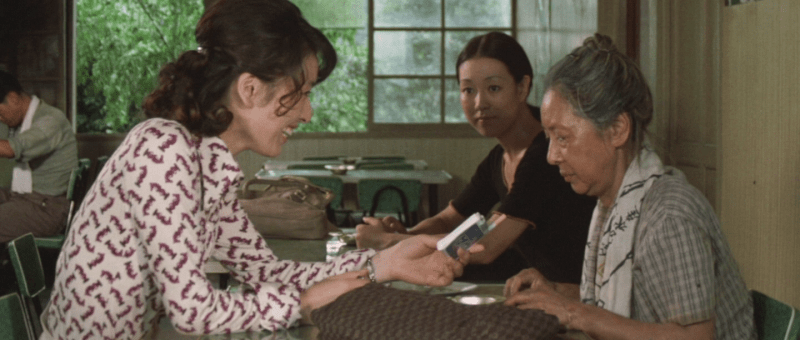
In the contemporary era, graduate student Keiko Mitani (Komaki Kurihara) is engaged in researching the “karayuki-san” – Japanese women who were sold into sexual slavery throughout Asia in the early 20th century. Almost forgotten, the karayuki-san are a taboo subject and even those still living in the areas from which women and girls were sent away are unwilling to speak of them. By chance, however, Keiko runs into an old woman in a cafe who speaks with a standard Tokyo accent and tells them that she spent most of her life “abroad”. Quickly realising she doesn’t mean she was a diplomat’s wife, Keiko wonders if the woman might be have been a karayuki-san and delays her return to Tokyo in order to find out.

There is something, it has to be said, ironically exploitative in Keiko’s determination to get the old woman, Osaki (Kinuyo Tanaka), to open up about a subject on which she so obviously does not want to be drawn. A visit to Osaki’s home reveals her to be living in a run-down hovel on the edge of town which is filled with stray cats whom Osaki feeds because “they’re all abandoned, but still they have to live”. Keiko gets herself brownie points by reacting politely to Osaki’s reduced living situation, eventually staying three weeks during which time she gradually teases out Osaki’s sad life story. Finally asking if there wasn’t anything Osaki might have liked to know about her, Keiko’s hypocrisy is fully brought home to her when Osaki admits that no one was more curious about Keiko than she was but that “people have reasons for not confiding in others” and if it’s something you need to ask about then it’s probably something that the other person may not want to share. In any case, Osaki seems to have known Keiko had an ulterior motive but does not regret sharing her story and has no worries about what Keiko might do with it as long as she makes sure to tell the truth.

The truth, in a sense, seems to be something the villagers feel themselves well acquainted with which is why Osaki lives in a shack on the edge of town. Tricked into sexual slavery as a child by an amoral people trafficker who lured her with promises of money to be made overseas, Osaki found herself in Borneo and a prisoner of “Sandakan No. 8” which was one of 10 numbered brothels on the island largely catering to Japanese travellers overseas, facilitating the expansion of the Japanese empire as accidental emissaries and ports of call. When Osaki was a child, Japan was a poor country and it was considered normal to sell one’s daughter in order to feed a family. Working overseas carried with it a kind of cache though no one, except perhaps her brother, seems to be fully aware of what Osaki is going to and she herself has not in any way chosen or consented to become a sex worker. When she eventually returns to Japan, she finds herself unwelcome in her brother’s house, which her money paid for, because of the shame associated with those who have “worked away”. Even 50 years later, she finds herself living alone, all but disowned by her only son, on the outskirts of her childhood village ostracised by the “respectable” townspeople who don’t for a second believe Osaki’s quick introduction of Keiko as her daughter-in-law.

The daughter-in-law deception is only one heartbreaking aspect of the complex relationship between the two women who are each, in a sense, hiding something from the other but end up forming a genuine connection anyway. Intensely lonely and having lived a life filled with suffering, Osaki is willing to pay for company with her story while Keiko is, not quite deliberately, using her loneliness against her in an attempt to earn her trust and get her to reveal her secrets. Nevertheless, Keiko is able to mine a rich and deep seem of 20th century trauma through the tragic story of just one woman which reaches out to hundreds like her some of whom rest in a graveyard in the forests of Borneo with their backs forever to Japan. The enemy is, once again, poverty more than it is patriarchy or even feudalism, a problem less of the essence in the rapidly improving post-war economy, but as Kumai is keen to point out, this system of state sanctioned people trafficking (finally outlawed only once Japan’s status on the world stage began to rise) had far wider implications than it might be thought which still echo into the present day and perhaps beyond if not for the efforts of women like Keiko who do not wish to forget.


Original trailer (no subtitles)

Oh, Bomb! (ああ爆弾, Kihachi Okamoto, 1964)

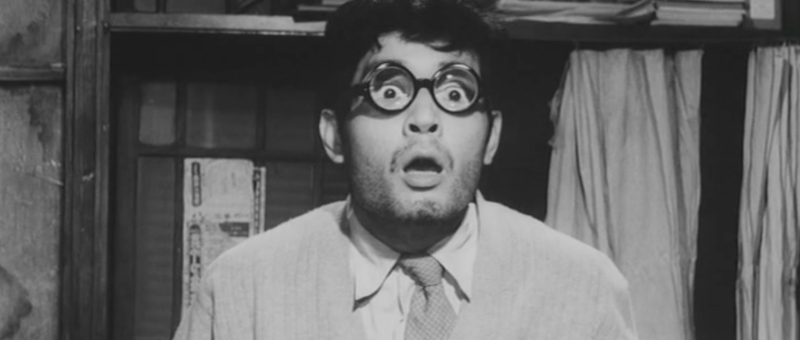
vlcsnap-2016-07-12-23h44m56s789Being stood up is a painful experience at the best of times, but when you’ve been in prison for three whole years and no one comes to meet you, it is more than usually upsetting. Sixth generation Oyabun of the Ona clan, Daisaku, has made a new friend whilst inside – Taro is a younger man, slightly geeky and obsessed with bombs. Actually, he’s a bit wimpy and was in for public urination (he also threw a firecracker at the policeman who took issue with his call of nature) but will do as a henchman in a pinch. Daisaku wanted him to see all of his yakuza guys showering him with praise but only his son actually turns up and even that might have been an accident.

His mistress has moved on, his wife got religion, and the clan has gone legit and formed a corporation. That last bit might have been OK except Daisaku isn’t the president, he’s the Chairman, and the new top dog is a pen obsessed political candidate who runs under the slogan that pens can save Japan and violence is the enemy! Taro and Daisaku come up with a way to get revenge on the usurper by sneaking a bomb into one of his beloved writing implements but it’s far from plain sailing in this typically anarchic Okamoto world.

Okamoto casts his ironic tale as a musical, cartoon style slapstick comedy with frequent digressions into musical interludes which take inspiration both from Hollywood movie musicals and classical Japanese drama. Daisaku may only have been inside for three years but he’s a man out of time with behaviour and attitudes more suited to the pre-war world than the modern era. Consequently he often breaks into theatrical rhythms inspired by noh or kabuki with their characteristic chant style recitative and stylised movements. Younger characters sing in the vernacular of the day with Taro and Daisaku’s son belting out a popular hit, and the office workers suddenly breaking into a musical set piece themed around the idea of overtime in which the men and women of the office bicker about balancing the books. Similarly, the would be mayor, Yato, takes his cues from ‘20s gangsters so he naturally dances the charleston before breaking into a tango when he gets some unwelcome news.

Rhythm is the key as the film continues to respond to its various musical fluctuations in highly stylised approach which takes advantage of Okamoto’s innovative editing techniques. Apparently inspired by a Cornell Woolrich story, this is nominally a noir inflected crime story of an ousted gangster trying to rub out his rival and get his old life back, but Okamoto neatly deconstructs the genre and turns it inside out with a hefty serving of irony on the top. Daisaku is an old guy and his era has passed, but Yato isn’t real enough to represent the future either which seems to either belong to bumbling bomber Taro, or Daisaku’s hardworking and straightforward son.

The plot to blow up Yato using his favourite prop becomes progressively more ridiculous as the pen ends up everywhere but where it’s supposed to be and threatening to explode at any second (to great comic effect). Things get even darker when Yato is talked into considering the orchestration of an “accident” for his mayoral rival involving a golf ball which once again causes everyone a lot of bother (though not the kind that was intended).

Daisaku has brought some of his old fashioned habits out of jail with him, quickly corrupting his old friend the chauffeur (who ultimately proves incorruptible even if grateful to have been reminded of the happiness he already shared with his wife, poverty or no) and allowing Taro and his crazy bomb plots access to the criminal mainstream, but ultimately he proves more of a loveable rogue living in the past than a criminal mastermind. Yato, by contrast, is a darker figure with his hypocritical campaign slogans and lack of personal integrity. Daisaku may be deluded in many ways but he never pretends to be anything other than he is, unlike the would be dictator.

Filled with Okamoto’s idiosyncratic touch of absurd irony, Oh, Bomb! (ああ爆弾, Aa Bakudan) is one of his most amusing and formally ambitious pieces of work. Mixing classical theatrical techniques with modern movie musicals, jazz rhythms, expressionist sets and unpredictable editing, he once agains creates a crazy cartoon world in which anything is possible but somehow it’s all quite good natured even when you’re talking about bank robbery and possible assassination plots. Hilarious fun but also intricately constructed, Oh, Bomb! ranks among Okamoto’s most charming masterpieces and is urgently in need of a reappraisal.