Heinosuke Gosho made his name before the war as a master of “shomingeki” – often humorous but generally naturalistic portraits of lower middle class life. Becoming synonymous with a Chekhovian mix of laughter and tears later dubbed “Goshoism”, he continued into the post-war era as one of its most prominent humanists, less directly sentimental than Kinoshita but with no less faith in human goodness. Always ahead of the curve, he was among the first Japanese directors to break with the studio system, setting up his own production company (along with director Shiro Toyoda, cameraman Mitsuo Miura, and writers Jun Takami, Junji Kinoshita, and Sumie Tanaka), Studio Eight, after becoming embroiled in the industrial disputes which engulfed Toho in the late ‘40s. Gosho’s participation was apparently more out of a sense of loyalty to his mistreated colleagues than it was political conviction, but in any case he found himself unable to continue working in a system which prevented him from expressing himself to the fullest of his intentions.
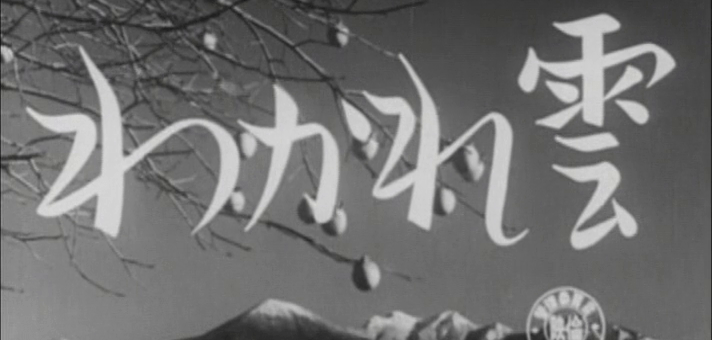
1951’s Dispersed Clouds (わかれ雲, Wakaregumo) was the first film released by Studio Eight, distributed by Shin Toho (the “new Toho” set-up by those same colleagues Gosho had supported in the ‘40s). In a sense it addresses similar themes to other post-war films making use of the familiar “cloud” metaphor, but these clouds are dispersing in more positive directions in that they are wilfully floating away from the traumatic past towards a brighter, more compassionate future, as perhaps was Gosho as he embarked on a new phase of his career.
The heroine, Masako (Keiko Sawamura), is a woman caught between old worlds and new. Very much of the post-war era, she is a university student who intends to work after graduation and values her independence but nevertheless is also looking back towards a childhood she feels she was denied, gradually coming to understand that it was she who denied herself in her resentful mistreatment of her young step-mother in mourning of the birthmother she lost at only six years old. The cloud from which she originally disperses is a group of five fellow students with whom she has gone on a walking holiday exploring rural Japan – an increasingly common pastime in the post-war era but one perhaps still a little unusual for five young women travelling alone. Accompanying her friend into a local photography shop in search of an extra roll of film for her camera, Masako receives the unwanted attentions of the storeowner and makes a speedy escape only to fall ill outside the station and cause the gang to miss their train. Irritated, Masako tells the others to go on without her while she stays in a nearby inn convalescing from what is apparently light pneumonia but also, it has to be admitted, an intense bad mood.
Masako’s friends are keen to help her, but also exasperated. “You never accept the kindness of others” they lament to her passive aggressive desire not to bother them on their trip, while later plotting how best they can help her seeing as she wouldn’t accept their money if they tried to give to her so she’ll be able to pay for the doctor after they’ve left. They never really consider waiting for Masako to recover, resolving to continue on with their holiday, but do check in on her from time to time from the road with the offer to join them later seemingly open. Meanwhile, they’re all swooning over the improbably handsome country doctor, Minami (Yoichi Numata), who swoops in to treat Masako with a no-nonsense yet caring bedside manner.
Only six years older than Masako, Minami is a certain young man who has found his forward path in life. He has his own small practice which is woefully ill-equipped to cater for the entire town (he can’t admit Masako because he is already overflowing with patients sleeping on the floor), but dreams of building another clinic in an even smaller village further up the mountain where they don’t even have electricity. Despite her friends’ giggling, Masako is in too much of a mood to notice Minami much from her sick bed but later takes a liking to him though mostly in flight when her hated step-mother Tamae (Taeko Fukuda) finally arrives to take her back to Tokyo.
While at the inn, Masako bonds with the kindly maid, Osen (Hiroko Kawasaki), who brought her to there in the first place after noticing her in distress at the station. The innkeeper, who has a flighty modern daughter of her own, is not best pleased that Osen has brought sickness into the house and even less so that it’s a young woman whom she is not convinced is the right kind of clientele (her attitude changes when Tamae arrives laden with expensive gifts). Osen, who lost a husband in the war and daughter in infancy, takes to the young woman with maternal warmth – something which Masako has been seeking ever since losing her birth mother. A woman without a child and a child without a mother easily slip into a familial relationship, but rather than jealous Osen is only sad when she sees how much Tamae is trying and failing in the same role while Masako resolutely rejects her out of nothing more than childish resentment.
Masako, self aware to a point, describes herself as “spoiled, nervous, and selfish” and seems to want to change without knowing how. She tells Minami that she dislikes people in general because they’re all liars and can’t be trusted. Nevertheless, she finds herself hanging around Minami’s clinic in order to avoid Tamae and half convinces herself she is in love with him. An ill-advised five mile hike to the next village to find the earnest young doctor provokes an awkward encounter between the two in which it becomes perfectly obvious that Minami is devoted to his practice, sees Masako only as a patient, and is not really interested in her newfound desire to pursue a deeper union. He tells her, politely, that she is too much trouble and would only be an inconvenience. He doubts that she, a middle-class woman from Tokyo, will be able to adjust to the privations of life in the mountains and is perhaps unconvinced that she has acquired the sufficient maturity to try after just one night of having fun “helping people”.
Masako is not wounded by his words but is enlightened by them on discovering that Minami has lost people too – his brother and friends in the war, but where her childhood loss has made her self-involved and resentful, his grief has made him generous and openhearted. Minami has dedicated himself to the wellbeing of all mankind, which might or might not mean that he has little time for deeper individualised connections, but in any case though she doesn’t realise it herself what Masako is seeking isn’t Minami or a romance but a path back into the world as someone less closed off and unforgiving. Thanks to Osen’s warmth and Minami’s generosity she is able to escape her sense of self-imposed inertia and let her mother go.
Because of this she gives to Osen the precious silver spoon she had treasured as a keepsake from her mother, remarking that she doesn’t need it anymore, while Osen then gives her the rather ironic gift of a spoon case she’d knitted as a present. Though the ending is positive with Masako preparing to leave the transitory space of the mountain town to return to Tokyo “healed”, it is also filled with a quiet anxiety for the older Osen who has, in a sense, been bereaved twice in losing another daughter and being left all alone, knowing that Minami will soon be off to his own bright future. Osen made her new start some time ago after reaching the forward-thinking conclusion that she wasn’t happy with the idea that women must have soft hands. She declares herself happy in a calm sort of way, but is also filled with regrets from the past in having chosen to marry the man chosen for her over the one she loved and finding only unhappiness. Her counselling of Masako not to make the same mistake is perhaps one of the things that sends her, mistakenly, off towards Minami, but unlike the younger woman Osen seems primed to remain in the liminal space of the mountain town unable to leave the past behind in order to move forward in a more positive direction.
“This world is not so easy” Masako is repeatedly told, but in true Gosho style, it needn’t be so hard if only you learn to live generously with a forgiving heart. The rather mercenary relationship between the innkeeper and her flighty but shrewd daughter is directly contrasted with the innocent yet melancholy one between Osen and Masako, but perhaps neither is really more positive than the other only different. In any case, Osen and Masako, like any parent and child, must eventually part. Masako boards the train into the future smiling brightly, a cloud dispersing from the whole, unburdened by the traumatic past and floating defiantly forward on a path of her own choosing resolved to live for others rather than fixating on her personal pain.




 Windows on Worlds