Ordinary Heroes (千言萬語, Ann Hui, 1999)

ordinary heroes posterThroughout her long career, Ann Hui has become adept at making subtle political points through addressing the struggles of the recent past. Ordinary Heroes (千言萬語) was released in 1999, just two years after the handover which signalled the end of British colonial rule. The Chinese title of the film is taken from a Teresa Teng song heard on a car radio and means “thousands of words, tens of thousands of languages” – a sentiment which could apply to the work of the activists as they work tirelessly to little effect, but the English title perhaps hints more closely at the film’s essential purpose as a tribute and pean to these ordinary people who dared to stand up to authority to fight for what they thought was right.

After a brief prologue from the street performer (Mok Chiu-yu) – inspired by the real life figure Ng Chun Yin, who will become the Brechtian narrator of the ongoing drama, Hui cuts to a title card reading “to forget”, only to open with the words “I remember”. The heroine has, however, forgotten her former life for reasons of which we aren’t yet sure. Sow (Loletta Lee) is a young woman and former activist being cared for by her friend, Tung (Lee Kang-sheng) who has been nursing a longterm crush on her ever since she pickpocketed him when he was in high school. Sow, however, had been involved with an activist, Yau (Tse Kwan-ho), who later married someone else, but remains committed to the cause, as hopeless as it might seem.

The cause is that of the Yau Ma Tei boat people. A historic community of former fisherman, the Yau Ma Tei boat people live off the shore of Hong Kong in what was constructed as a typhoon shelter after a fierce storm destroyed almost an entire fleet in 1915. During the 1950s, the community moved away from fishing and became a a kind of tourist spot and centre for petty crime. With their own distinctive accents, clothing, and isolated way of life the boat people were not always welcome on land but also faced an additional problem in that many of their wives were refugees from the mainland and technically illegal migrants forbidden from setting foot on Hong Kong proper. Though the government instituted an amnesty for the children of boat people, it took advantage of the women who came forward to get official birth certificates, deporting them back to mainland China and separating them from their families.

The boat people find few friends, but an Italian Catholic priest and, incongruously enough, committed Maoist, Father Kam (Anthony Wong) becomes a staunch defender, living with the boat people and providing education for the children as well as ministering to his flock. Yau and Kam work together to advance the cause of the boat people while Sow assists Yau and Tung follows Sow whilst also becoming close to Kam and influenced by his peculiar ideology. Kam, often to be found strumming his guitar and singing the Internationale, becomes a figurehead for the movement, even committing to a hunger strike in an attempt to get the authorities’ attention.

Structuring her tale in a non-linear fashion, Hui weaves the complex narrative of political descent in ‘70s Hong Kong, splitting her focus between the single issue activism of Yau and Kam and the wider leftist movement as recounted in the street theatre of Ng Chun Yin. Ng, a longterm leftist activist, was the founder of the Trotskyist Revolutionary Marxist League who later went to China to deliver a true Marxist, democratic revolution but ended up betraying his cause and being kicked out of his own movement. Such obviously left-wing agitation was, perhaps, difficult in the early 70s when news of the cultural revolution had discredited Chinese communism, especially as many residents of Hong Kong had arrived as refugees from the oppressive regime, but there are those who continue to believe in and fight for the values that they believe should be present North of the border.

Sadly these hopes are crushed by the Tiananmen Square incident in 1989 after which it was impossible to argue for the moral superiority of the Chinese state over the colonial government. The bursting of a political bubble runs in parallel with the sad love story of Sow and Tung who find themselves at odds with each other, never quite in the same temporal space. Hui signals the closing coda with another title card, this time reading “to not forget”, as Sow and Tung are forced to acknowledge their painful pasts as they look forward to an uncertain future. Forgetting and not forgetting become the central themes as the boat people plead for recognition, while there seems to be an active choice in play to decide to forget these “ordinary heroes” and the various sacrifices they made in the name of social justice as Hong Kong begins to look forward to its own uncertain future as one master is swapped for another and the silent majority sit idly by, opting for the consumerist revolution over the human one. Ng, in his opening statement, talks about heroes with unfulfilled missions. Tung and Sow find themselves at a new dawn with their illusions shattered, filled with thousands of words and nothing at all to say. 


Screened at Creative Visions: Hong Kong Cinema 1997 – 2017

Original trailer (Cantonese, no subtitles)

Teresa Teng’s Thousands of Words

PTU (Johnnie To, 2003)

PTU_PosterMissing gun thrillers have become a mainstay of Asian cinema from Kurosawa’s Stray Dog right up to the Jiang Wen starring The Missing Gun. Less than a year after Lu Chuan’s existential drama, Johnnie To takes a typically ironic look at the same problem as an arrogant yet incompetent officer gets into a disagreement with a gang of thugs and loses his gun just as a particular moment of chaos is about to strike the local gang scene. Set over the course of a single night, To’s film has an ambiguous attitude to its central collection of street cops and detectives as they attempt to recover the missing firearm before it causes more harm than they are able to contain.

A gang of petty thugs led by local bigwig “Ponytail” marches into small restaurant and commandeers the best table, forcing the young man already sitting at it eating his dinner to move further back. A short time later, Officer Lo (Lam Suet) gets into an altercation with a young man outside and then marches in and commandeers Ponytail’s table, forcing the group onto the table behind, and the young man from before onto a tiny perch near the kitchen. Only a few minutes later, Lo gets a call and leaves but is followed by some of Ponytail’s guys while Ponytail stays behind is knifed in a shock execution attempt which threatens to permanently unbalance the precariously held equilibrium of the local underworld scene.

When Lo the leaves the restaurant, he discovers that the first guy who he arrogantly disrespected has thrown yellow paint all over his car but his real problem occurs when Ponytail’s guys start chasing him and he decides to play along, only to slip on a banana skin halfway through his big moment. When he wakes up surrounded by cops, he realises he’s missing his gun and that he has a big problem. Sympathetic nighttime beat cop Mike (Simon Yam) agrees to help him find it out of a sense of solidarity, managing to get his by the book colleague to agree to give them until dawn to sort it all out.

To opens the film with a news report of an event earlier in the evening in which a police officer was killed during a robbery. Some of the PTU guys react with gallows humour only to be shot down by the fairly humourless Mike who reminds them that one of their own died today and they ought to have some respect. That is perhaps why he decides to help Lo, whom all of the other police officers regard as something of a ridiculous embarrassment. A rare leading role for To favourite Lam Suet, Lo is a genial figure of fun whose ongoing self aggrandisement mixed with pure panic at the thought of all his dodgy dealings coming out if he has to report his gun stolen makes for entertaining viewing, especially as his incompetencies are usually of the amusing rather than dangerous kind.

Yet “good guy” Mike is not exactly the beacon of fairness that he first seems. His resentment at being shouldered with a straight laced rookie from HQ, tonight of all nights, is more than just irritation with playing babysitter. Concerned that HQ may have sent a spy to look in on his very own night watch, Mike keeps the rookie in the back away from the less palatable parts of his evening which include getting information out of suspects through torturing their friends, and nearly kicking a guy to death in an alleyway. King of the night, Mike knows each and every dodgy spot and is perfectly primed to track down Lo’s gun through his thorough knowledge of the local gang scene.

Taking the tripartite structure common to many of To’s films, PTU makes full use of the director’s familiar world view in which all outcomes are the result of random acts of fate and unforeseeable coincidence. Thus, Lo slips on a banana skin, an insignificant young man turns out to be of pivotal importance, and everyone keeps thinking their phone is ringing but it turns out to be someone else’s. The gun, the great Mcguffin in all this, is revealed to be an irrelevance, resolving itself in due course just as the real chaos – the all out gang war between two rival Triad clans, brings the evening to a close. At the end of this extremely long night, Lo, Mike, a female police detective investigating Ponytail’s murder, and just about everyone else has their own version of what really happened, but, as to be expected, none of them quite tally with the events we have just witnessed.


Screened at Creative Visions: Hong Kong Cinema 1997 – 2017

Original trailer (Cantonese with English subtitles)

Echoes of the Rainbow (歲月神偷, Alex Law, 2010)

echoes of the Rainbow posterThe tragedy of childhood is that you can’t quite see it on the ground. Looking back the truth is plainer but it’s also painful, containing all the warmth of those times but also the regrets and irreconcilable longings. Alex Law’s small scale personal tale of inevitable tragedies mixed with intense nostalgia, Echoes of the Rainbow (歲月神偷, Shui Yuet Sun Tau), is deeply sincere and more than earns its turn for the sentimental in its never wavering feeling of authenticity as it paints a picture of a rapidly disappearing Hong Kong and a childhood lived in a big brother’s shadow.

Eight-year-old “Big Ears” (Buzz Chung) lives with his cobbler father (Simon Yam) at the end of a long, run-down street of shopkeepers. Amusingly enough, Big Ears’ uncle (Paul Chun) lives at the other end of the street where he cuts hair so the family kind of has the full run of the place, head to toe. While Big Ears whiles his time away daydreaming,  putting a fish bowl on his head and pretending to be an astronaut or indulging in his favourite hobby – kleptomania, his big brother Desmond (Aarif Lee) is busy doing everything right. A tall, strong teenager with more than a passing resemblance to Bruce Lee, Desmond is a track and field star and academically gifted student at the prestigious Diocesan Boys’ School. Big Ears loves everything about his big brother, including his sort of girlfriend Flora (Evelyn Choi).

Law sketches the everyday lives of this ordinary family with the sort of details which randomly recall themselves years later – the tear on his father’s T-shirt from where it hits the end of his chisel, the taste of Autumn Moon Cake, the random conversations with passersby. The small community on this run-down street more is like an extended family in and of itself as the families take their meals on tables outside, each overhearing each other’s conversations and interfering in various family dramas. Big Ears quips that his mum (Sandra Ng) is known as “Mrs. Outlaw” because she’ll talk her way into or out of anything and has a talent for talking people around to her way of thinking, but the warmth and love between his parents is never shaken. Even in the midst of an encroaching tragedy, Mr. Law takes the time to design a pretty pair of ultra comfortable shoes for his harried wife who often complains about her corns.

Seen through little Big Ears’ eyes, the film avoids the bigger picture or any political concerns save for the presence of the corrupt colonial forces as represented by Sergeant Brian who speaks fluent Cantonese but stresses that English is essential for “getting on” in Hong Kong. Sergeant Brian is also going to get one whole box of the moon cakes Big Ears wanted all for himself and his mum has been paying for in instalments for the last few months, but the reason for his visit is a rise in the protection money the local police takes from shopkeepers. If the Laws can’t pay it (and they can’t, really) they’ll be evicted. Not that Big Ears would know, but business is bad and the family is spending most of its income on Desmond’s expensive school fees so it’s doubly galling to them when his grades and athletic success begin to decline.

Big Ears is a naughty little boy, but often gets away with it because he’s just so darn cute. His pilfering habit goes largely undetected even though he steals quite ostentatious items like a glowing goblet souvenir from a movie starring his favourite actress whose picture he also sells with a fake signatures attached, a British flag from a nearby base, and even a pottery statue of the Monkey King from an actual temple. Desmond has this theory about about double rainbows that are an inversion of each other – something that could easily work for himself and his brother with Desmond’s essential goodness contrasting nicely with Big Ears’ roguish adventures whilst also speaking for the enduring bond between the brothers.

Even before the literal typhoon rips through Big Ears’ idyllic childhood home, there are signs of trouble on the horizon – firstly in Desmond’s melancholy love story with fellow tropical fish enthusiast Flora who turns out to come from an entirely different world filled with all the ease and possibility so absent from the Law’s, and then in Desmond’s gradual slowing down. The respective catch phrases of Big Ears’ parents signify the twin pillars of the age with his father’s insistence that “nothing is more important than the roof” as he works steadily to keep one over his boys, and his mother’s instances that life is “half difficult, half wonderful” but “you have to keep believing”. Earning a right to melodrama through fierce authenticity, Echoes of the Rainbow does not negate its tearjerking premise but rings it for all of its joy and sorrow, revelling in nostalgia but also in a kind of hopefulness born of having weathered a storm and survived to witness the birth of new rainbows lighting up the sky.


Screened at Creative Visions: Hong Kong Cinema 1997 – 2017

Original trailer (English subtitles)

Mad World (一念无名, Wong Chun, 2016)

Mad World_posterThroughout the aptly titled Mad World (一念無明), the central character frequently asks if he is really the one who is “abnormal” or if everyone else is merely operating under some misguided notion of “normality”, either deluding themselves that they meet it or actively masking the fact that they don’t. The first feature from Wong Chun, Mad World is not only the story of a man attempting to live with mental illness in a society which is unwilling to confront it, but also a discourse on the various ills of modern life from the ageing population and breakdown of the “traditional” family to the high pressure nature of “successful” living. Carefully nuanced yet pointed, Wong Chun’s vision is at once bleak and hopeful, finding victory in the courage to move on in self acceptance rather than in a less ambiguous discovery of a more positive future.

Tung (Shawn Yue) has spent the last year institutionalised after being arrested in connection with the death of his mother (Elaine Jin). The doctors and courts have both absolved him of any blame, but Tung has also been diagnosed with bipolar disorder and is being released into the care of his estranged father, Wong (Eric Tsang), rather than simply released. When Wong picks Tung up at the hospital, the disconnect and anxiety between them is palpable, as is Wong’s embarrassment when he takes Tung back to the tiny room he inhabits in a low rent lodging house sharing a kitchen and a bathroom. Father and son will be sleeping on bunk beds with any idea of privacy or personal space firmly rejected.

Wong, a man in his 60s who’d all but abandoned his family for a career as a long-distance truck driver crossing the border into China, is ill-equipped to cope with caring for his son on several different levels. Perhaps a man of his times, he’s as ignorant and afraid of mental illness as anyone else, quickly getting fed up with Tung’s frequent crying fits and even stooping so low as to simply ask him why he can’t just be normal like everyone else. However, after getting more used to Tung’s new way of life, Wong does his best to get to grips with it, buying a number of books about depression and joining a support group for people who are caring for those with mental health needs.

Tung continues to struggle, finding it difficult to reintegrate into to society when society actively excludes those who don’t quite fit in. Attending a friend’s wedding shortly after having been discharged, Tung spots a few unpleasant social media posts referring to him under the nickname “Mr. Psychosis” while guests in the room mutter about the “nutjob” who must have just escaped the “loony bin”. Tung doesn’t do himself any favours when he grabs the mic and interrupts the groom’s speech to take the audience to task for their indifference, but the hostility he faces is entirely unwarranted. Later, experiencing another setback, Tung finds himself the subject of a viral video when he stops into a convenience store and guzzles Snickers bars in an attempt to improve his mood. It’s not long before someone has correctly identified him as the guy who was accused of killing his mother and put in a mental hospital, literally sending him right back to square one in terms of his recovery. To make matters worse, Tung can’t get any of his old contacts to look at his CV because they all have him branded as a dangerous madman and interviewing for new jobs never gets very far after they ask why there’s a one year gap in his employment history. 

Employment does seem to be a particular source of anxiety with frequent mentions of mass layoffs and even managerial suicides in the high pressure financial industries. Even before the events which led to his hospitalisation, Tung was undoubtedly under a lot of stress – planning a life with his fiancée, Jenny (Charmaine Fong), which adds the financial pressures of mortgages and saving to start a family. The sole carer for his elderly mother, Tung is also on the front line for her cruel, sometimes violent mood swings which, according to Wong, are a lifelong phenomenon rather than a symptom of the dementia she is also afflicted with. Tung lashes at out Jenny when she suggests putting his mother in a home where she can be better cared for, exhibiting a streak of unpredictable, frustrated violence of his own which also deeply worries him.

Tung may have inherited this impulsive volatility from his mother, in one sense or another, but his longstanding feelings of low self worth are as much to do with his parents’ seeming disregard for him as they are to do with anything else. His mother, unhappy in her marriage, blames her eldest son for trapping her in dead end existence while continuing to worship the younger one, Chun, who went to an Ivy League US university and has since left them all far behind. Constant, unfavourable comparisons to the golden boy only raise Tung’s levels of stress and resentment at being obliged to care for the woman who constantly rejects and belittles him after the “good” son and the “bad” husband both abandoned her. Wong “left” his wife because he couldn’t cope with her difficult personality and complicated emotional landscape, but now faces a similar dilemma with the son he had also left behind.

Hong Kong is, indeed, a maddening world as Tung and Wong find themselves crammed into a claustrophobic share house filled with similarly stressed and anxious people predisposed to see danger where there is none. Tung’s condition finds him semi-infantilised as the wiser than his years little boy from next-door becomes his only friend until his mother finds out about Tung’s condition and orders her son not to see him. Wong Chun’s central premise seems to be that the world will drive you crazy, but if there were more kindness and less hostility perhaps we could all stave off the madness for a little longer. Anchored by strong performances from Yue and Tsang, each playing somewhat against type, Mad World is a remarkably controlled debut feature which subtly underlines its core humanitarian message whilst taking care never to sugarcoat its less pleasant dimensions.


Screened at Creative Visions: Hong Kong Cinema 1997 – 2017

Original trailer (English subtitles)

Paradox (殺破狼・貪狼, Wilson Yip, 2017)

paradox posterLouis Koo, possibly the hardest working actor in Hong Kong, has played his fair share of heroic (and not so heroic) cops but you’d be hard pushed to describe him as an action star. Proving nothing if not his dedication, Koo gives it his all as the lead in Paradox (殺破狼・貪狼), the latest in the SPL franchise directed by Ip Man’s Wilson Yip. Yip also directed the first in the series but stepped away for the second, though there is no narrative continuity with any of the films and, confusingly enough, the SPL tag seems to have been dropped from the international title altogether. In any case, what Paradox shares with instalments one and two is a series of intensely kinetic action scenes built around a storm of three incompatible personality types coupled with a quest narrative as Koo searches for clues in the disappearance of his 16 year old daughter.

Yip begins the film inside the memories of Hong Kong cop Lee Chung-Chi (Louis Koo) as he remembers the golden time when his daughter was young and worshipped her dad, crawling into his bed in the morning with a video camera ready for a whole day of birthday fun. Lee buys a cute a silver bracelet with a teddy bear charm but it’s the 16 year old Wing-Chi (Hanna Chan) he gives it to. Lee and his daughter are in a restaurant, not at home, and the air between them is tense. A boy turns up and Wing-Chi introduces him as her boyfriend but if Lee is annoyed things are about to get worse. The pair want to get married because Wing-Chi wants “to keep the baby”. Lee barely reacts save for abruptly stepping away from the table. When he returns he seems as if he’s composed himself, but in reality he has already made a catastrophic error of judgement which will force his daughter away from him.

Wing-Chi goes to Thailand to visit a friend and disappears. Lee goes to look for her, breaking out his best investigator skills and teaming up with local cop Chui Kit (Wu Yue) who is soon to be a father himself, but what he finds there leads him onto a dark path of paternal guilt, regret, and suffering whilst wading through the corruption and cruelty of the Thai underworld.

Though the narrative is, in a sense, unimportant, Yip homes in on the nature of fatherhood and the sometimes difficult or conflicted position a father finds himself in when trying to protect his child. Lee may think he’s “doing the right thing” when he clamps down on his teenage daughter’s plans to start a family of her own way ahead of schedule, but then again perhaps this was not his decision to make and ruining three lives to suit himself is nothing more than selfishness masquerading as love. It is his own actions which send his daughter into the path of danger, and then later decide her fate on a split second decision.

Later, Kit’s father-in-law (Vithaya Pansringarm) faces a similar dilemma when he’s threatened by government big wigs and fears his own daughter (and unborn grandchild) may be in danger if he does not play along. Lee’s quest to find Wing-Chi runs in parallel with that of the local mayor to win re-election, only the mayor has a bad heart which causes him to collapse before an important rally. Shady fixer Cheng (Gordon Lam) decides the mayor needs a heart transplant (seemingly unaware of the complexity of the operation and the time needed for recovery) which all links back to a dodgy American ex-pat (Chris Collins) who operates a large scale meat factory as a front for illegal organ trafficking.

The stories of Kit and Lee are linked by the curious use of the classic Chinese pop song The Moon Represents My Heart made famous by Teresa Teng. The song with its constant references to the “heart” which is also visually represented by the cheerful cards around the mayor’s bed perhaps over does things in the metaphor stakes but does its best to tug at the heartstrings in its insistence on a fathomless love in this case of fathers for their children. Koo’s rage only intensifies the more desperate he becomes as his quest hits continual dead ends punctuated by the discovery of various unpleasant characters lurking not just in the backstreets but in the police stations and political institutions of Pattaya.

The action scenes are visceral and kinetic though Koo makes the most impact when acting with stone cold efficiency, leaving the most memorable sequences to rising star Wu and Tony Jaa whose extremely brief appearance as a psychic / extremely buddhist cop may disappoint those deceived by his top billing into expecting his role to be more than a cameo. Nevertheless, Paradox delivers what it promised in Koo’s unexpected metamorphosis into an ultra cool action star whilst sending his moody cop on a dark journey of the soul as he confronts the depths of his own complicity in the corruption which is consuming him.


Screened as the opening film of Creative Visions: Hong Kong Cinema 1997 – 2017

Original trailer (English subtitles)

Co-stars Louis Koo and Wu Yue recorded a new version of The Moon Represents My Heart especially for the film

Teresa Teng’s The Moon Represents My Heart

Chasing the Dragon (追龍, Jason Kwan & Wong Jing, 2017)

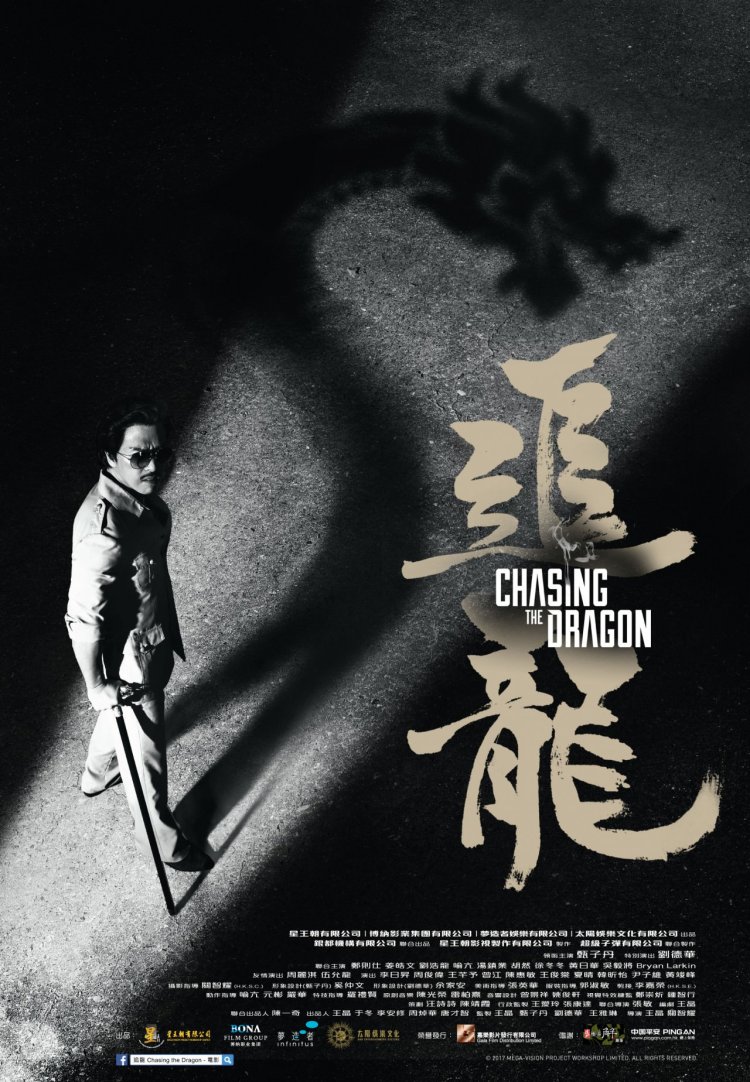
chasing the dragon posterWhen it comes to Mainland China anything goes so long as you set your movie before 1949. In Hong Kong it seems the same thing is true only the cut off date is 1997. Wong Jing and Jason Kwan’s surprisingly glossy Chasing the Dragon (追龍) follows two giants of 1960s Hong Kong in Crippled Ho whose life was previously brought the screen in 1991’s To Be Number One, and crooked (but only in a nice way) policeman Lee Rock who is played by Andy Lau – the very same part he inhabited in a series of films over 25 years ago. Marking a first time collaboration between martial arts superstar Donnie Yen and veteran leading man Lau, Chasing the Dragon firmly points its finger at the rotten roots of colonial corruption which, apparently, allowed such lawless times to endure in order to reap their copious rewards.

In 1963, Crippled Ho (Donnie Yen) smuggles himself into Hong Kong from the Mainland along with three of his friends and his little brother Peter. The boys find it hard to get honest work and are largely existing as hired muscle – or rather they’re supposed to get paid $30 to stand at the back make the local gangster’s gang look more impressive than it really is. One fateful day they get hired by Will, Grizzly Bear’s fixer, to hang around at a supposed confrontation with rival gangster Comic only this time the fight, which has been organised to put a damper on the birthday celebrations of crooked police chief Ngan, breaks out for real. Crippled Ho and the guys are skilled fighters who’d really rather avoid getting involved so they steal some police uniforms and try to escape by blending in but they’re caught by vicious British cop Hunter (Bryan Larkin) and nearly beaten to death before being rescued by the less corrupt Lee Rock (Andy Lau).

This first confrontation sets the tone for the remainder of the film as Crippled Ho, a vicious, ruthless, and ambitious gangster is repeatedly plagued by Hunter – the typically racist, corrupt, incompetent, greedy, and amoral sort which seems to define British officialdom across the Empire. Empire is the big enemy here (though it’s easy enough for one Empire to stand in for another) as pictures of the Queen reign supreme and men like Hunter think they can do whatever they like because colonial life is cheap. Lee Rock knows his place with the system and is content to play it. He warns Ho that pretty much anything goes, but the Brits are off limits because it’s the authorities that are bankrolling this illicit economy and any attempt to bite the hand that feeds threatens to bring the entire system crashing down.

As revealed in Ho’s opening voice over, ’70s Hong Kong was a haven of corruption in which the authorities collaborated with the Triads partly as a way of appeasing them but also as a way to make money. Unlike his incorruptible buddy, Lee Rock is as corrupt as they come – setting himself a target of $500 million and becoming actively involved in the drugs trade. He does, however, have his limits and makes sure to always play within the “rules”. The rules go awry when Rock decides to try deposing an unpredictable gang leader in favour of a more stable one and gets trapped inside Kowloon Walled City only for Ho to come to his rescue in answer of their debt of loyalty.

Despite their positions at opposite ends of the spectrum, Lee Rock and Crippled Ho generate a genuine brotherhood during the ten years which see their ascent to the top of the Hong Kong criminal tree. The launch of ICAC in 1974 which aims to eradicate corruption across the board threatens to bring the party to an end with its obvious desire for efficacy in refusing to hire the same old stooges who will do nothing, and actually arresting some of the most notorious abusers of power. Wong and Kwan end the film with a frankly ridiculous statement that thanks to ICAC and the retreat of the British, corruption has now been completely eradicated from Hong Kong along with colonial rule. Yet, in keeping with censorship guidelines, both Rock and Ho are allowed to appear in an epilogue sequence in which they have an emotional conversation revealing the ways crime has not paid for them in the way they hoped it might.

Dripping with period detail and thankfully reining in some of the more outlandish elements and unwise comedy Wong is often known for Chasing the Dragon is also a surprisingly bloody affair as ears are sliced off, severed heads appear in boxes, and the gang engage in a series of action packed set pieces many of them set in the famed Walled City. Yen and Lau play two sides of the same game while their intense bond is shaken by the need for revenge and a suspicion of betrayal. Wong Jing redeems himself with the assistance of the ever reliable Kwan in a star studded tale of corrupt yet noble criminals daring to rebel against oppression by embracing its amoral rules.


Currently on limited release in UK cinemas.

International trailer (dialogue free)

Manhunt (追捕, John Woo, 2017)

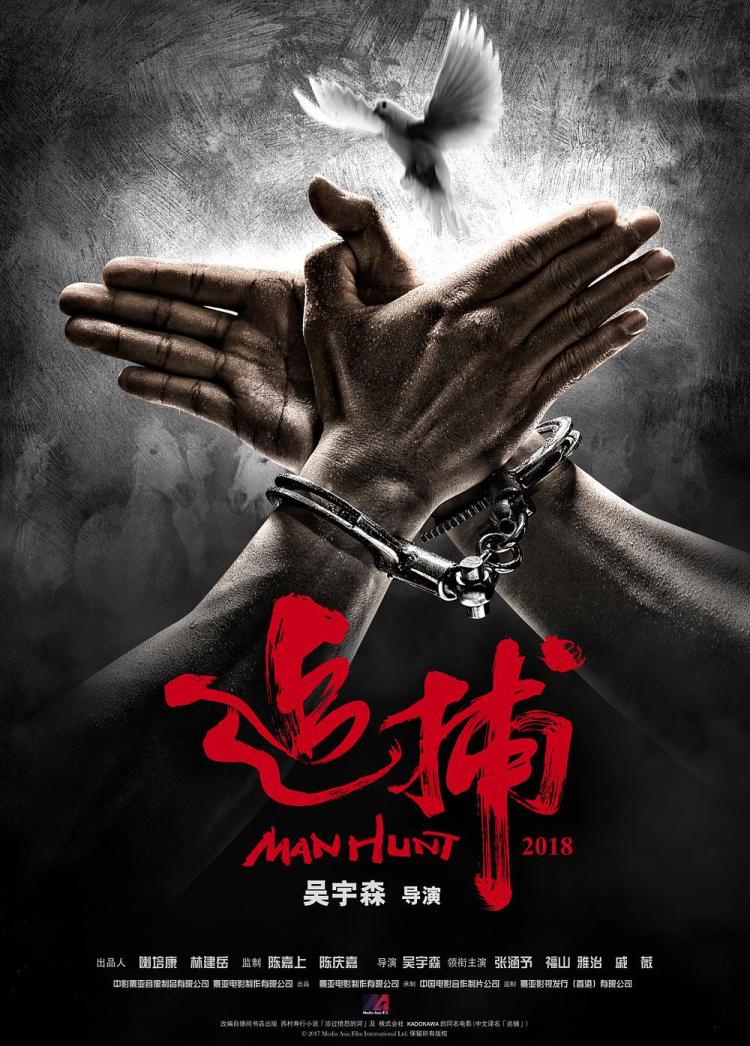
Manhunt30 years ago John Woo was one of Hong Kong’s most bankable directors. The father of heroic bloodshed, Woo’s bullet ballet sent shockwaves through action cinema not only in his home country but around the world. Unsurprisingly Hollywood came calling and Woo was one of the first Asian directors to enjoy mainstream US success with ‘90s hits Broken Arrow and Face/Off before his overseas career began to stall and he eventually returned to Hong Kong directing period epics Red Cliff and The Crossing. Manhunt (追捕, Zhuībǔ) is intended as a kind return to source as Woo gets back into the groove of his beautifully choreographed ‘80s action hits but intentionally or otherwise he sails dangerously close to self parody with a mix of Big Pharma conspiracy and wrong man thriller.

Chinese corporate lawyer Du Qiu (Zhang Hanyu) is a trusted employee of a Japanese pharmaceuticals company but is shortly to be transferred overseas, much to CEO Sakai’s (Jun Kunimura) displeasure – Du knows too much about the company’s less than transparent operations. Sakai sets up a honey trap to convince Du to stay but before it can spring Du is accosted by another woman, Mayumi (Qi Wei), who wants to talk to him about a difficult case three years previously in which an employee ended up committing suicide. After talking with Mayumi, Du goes home but the next thing he remembers is waking up in bed next to a dead woman. Du does the right thing and calls the cops, but the cops are working for Big Pharma and soon he finds himself on the run while maverick police chief Yamura (Masaharu Fukuyama) and two female assassins (Ha Ji-won & Angeles Woo) try to track him down.

Manhunt is inspired by the 1976 film starring Ken Takakura which was one of the first non-native movies to open in China following the Cultural Revolution. Woo apparently made the film as a kind of tribute to the actor after he passed away in 2014, but he takes his cues from the source novel by Juko Nishimura rather than the Takakura film and the 2017 Manhunt shares little in common with the 1976 version other than a general plot outline involving a man on the run and unethical practices in the pharmaceuticals trade. Du Qiu is not a stuffy, by the book, prosecutor but a compromised employee of a shady organisation who is oblivious to his own complicity in its extremely unpalatable way of doing business.

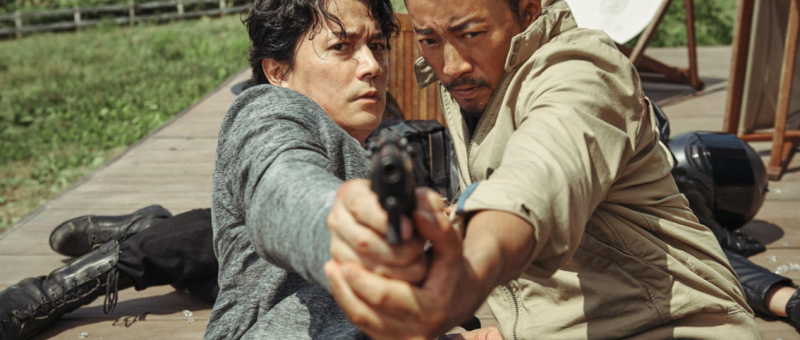
Despite this, Du Qiu is just as lucky as Takakura’s Morioka in that everyone he meets immediately wants to help him. Even sworn enemies with their hearts set on revenge eventually wind up joining team Du as they each descend on the pharmaceuticals research laboratory where the deadly secrets will be revealed. Woo returns to his heroic bloodshed roots in allowing dogged policeman Yamura and the increasingly confused Du to form an odd couple buddy duo which begins with spiky one liners and ends with becoming one as each places his uncuffed hand on the same pistol to take down a few bad guys through the power of togetherness.

Woo’s action credentials remain unchanged as he races from set piece to set piece from the opening surprise massacre to Du’s subway chase escape, jet ski race, and mansion showdown before getting anywhere near the endgame of the research lab. Perfectly choreographed, the sequences bear out Woo’s distinctive sense of humour while also poking fun at his back catalogue through a series of homages including an entire coop full of white doves just waiting for their chance to fly.

Set entirely in Japan, Manhunt shifts between Japanese and Mandarin though it has to be said that the film suffers from its reliance on English which is often poorly delivered and deliberately stylised to ape classic action movie one liners the like of which have been out of fashion for two decades. Woo neatly sends himself up with an opening discussion of “old movies” allowing one of the film’s two female assassins to develop an odd fascination with Du which leads to her eventual awakening from company brainwashing, but he also pays his dues with the theme music to Sato’s 1976 version playing over the first scene of mass bloodshed. Woo may have slipped into self parody with his deliberately over the top theatrics, but he has fun doing it and his gleeful self skewering proves extremely hard to resist.


Screened at the BFI London Film Festival 2017.

International trailer (dialogue free, English captions)

The White Girl (白色女孩, Jenny Suen & Christopher Doyle, 2017)

white girl posterFollowing their Hong Kong Trilogy, first time feature director Jenny Suen and veteran cinematographer Christopher Doyle get back together for another love letter to the “Pearl of the Orient”. With 2047 always in the back of the frame, The White Girl (白色女孩) is the story of a Hong Kong that was and will be as seen through the space which connects the two. In 2047 the mantra of One Country, Two Systems which has been applied to Hong Kong and surrounding territories since the 1997 handover will come to an end with Hong Kong simply becoming another region of China. With this starting point in mind, Suen and Doyle are left wondering what will happen in the next five years as they watch elements of the city begin to die or be eroded both by the passage of time and by the growing proximity of the 2047 deadline.

The White Girl (Angela Yuen), as she’s called, lives in Pearl Village where they still do things the old fashioned way. Living with her fisherman father, The White Girl dresses in long, dark clothing, and wears sunshades with a large floppy hat which hides her face and gives her a mysterious air of anonymity and otherworldliness. She does this because her father has told her that she is allergic to the sun, as her late mother was, so that she will never stray too far from him. Now a grown woman, The White Girl is beginning to think differently. She no longer takes her medication and has discovered a chest containing her mother’s clothes and a walkman with a tape inside featuring her mother singing her trademark song. Defying her father by walking around the town dressed only in her mother’s vintage white camisole and nickers, The White Girl who once felt invisible is seen by everyone including a new visitor to the village, Sakamoto (Joe Odagiri), a runaway Japanese artist squatting in local ruin.

Pearl Village, like Brigadoon, is a place that doesn’t quite exist. An example of the traditional Hong Kong fishing village which has all but died out, Pearl Village is a timeless place which seems to exist across eternity encompassing all eras and filled with a melancholy nostalgia. The White Girl longs to know the truth about her mother, putting on her very 1960s cheongsam and listening to her sing on her ‘80s walkman before walking to a pay phone to ring a DJ to ask him to play her mother’s song and then listening to it on a portable transistor radio. There are no mobile phones or computers and the major source of info in the village is the little boy, Ho Zai (whose name, in different characters, also means “oyster”), who keeps his ear to the ground and knows everything which goes on in the land that he regards as his.

What Ho Zai has discovered is that the village chief is about to sell them out. Creating controversy with the censor’s board, Ho Zai remarks on a destructive bridge project which will damage the beauty of his village, destroying wildlife and killing the beautiful dolphins which live in the sea off the coast. The “tourists” who come to the village (there is no real reason for a tourist to ever come here) are really developers who’ve come to hear the village chief’s plans which include bulldozing the beautiful mangrove forest Ho Zai loves so much to build a luxury mall.

Also on the list for eradication is the ruined mansion, built in the Chinese/British colonial style, in which Sakamoto is currently living. The White Girl regards the “ruins” as her palace but warns Sakamoto that the villagers believe it to be haunted. Sakamoto brands himself its ghost which touches a nerve with The White Girl whose pale skin and vacant aura have seen her also branded a “ghost”, leaving her feeling alone and invisible, trapped in her tiny, timeless world. Sakamoto, a temporary visitor to the unchanging village, is a literal outsider observing all around him from inside the ruins via the in built camera obscura and finding himself strangely drawn to The White Girl who reminds him of himself.

The White Girl will attempt to save her palace and succeed, but only for a time as her closing monologue tells us. In having spent so long not wanting to become invisible and insisting she is no ghost, she speaks to us as the ghost of a dying a world, occupying a liminal space between past and present where memory and dream collide. Her deeply felt non-romance with the Japanese visitor is destined to remain unfulfilled but that is its point, as she tells us, we exist in the space between us. Pearl Village is a place of endless longing in which familiar music wafts in on the breeze, haunted by its own future and existing within the shadow of an inescapable fall. Beautiful and ethereal, The White Girl is just as elusive as its heroine, lingering like a half remembered dream which ended far too soon leaving only melancholy and irresolvable longing in its place.


Screened at the BFI London Film Festival 2017.

Original trailer (English subtitles)

The Monkey King (西游記之大鬧天宮, Cheang Pou-soi, 2014)

Monkey King (donnie yen) posterEverybody knows the story of The Monkey King. His “journey to the west” has been reimagined by everyone from Tsai Ming-liang to Akira Toriyama but, all power to them, no one has yet had the courage to stuff Donnie Yen into a monkey suit to fully recreate the legend. Cheang Pou-Soi’s The Monkey King (西游記之大鬧天宮) rectifies this problem but makes up for it by adding a lot more to the already overcrowded arena. Based on a few early chapters of the story, this first of three Monkey King films could best be classified as an origin story as it retells the events which eventually see Sun Wu-kong imprisoned underneath Five Finger Mountain for 500 years.

Basically, a long, long time ago there was a war between gods and demons after which a fragile truce was formed. The demons were defeated and exiled from Heaven which is repaired thanks to the sacrifice of Princess Nuwa (Zhang Zilin) who transforms herself into crystal tears, one of which births a strange divine creature who has a long and arduous journey ahead of him. Emerging from his crystal egg, The Monkey King (Donnie Yen) returns to lead his people before being discovered by a monk who seeks to train him and make sure he remains on the path of the light. Now renamed Sun Wu-kong, The Monkey King finds himself summoned to the heavenly court where he causes a bunch of trouble and becomes swept up in the Demon King’s ongoing plot for revenge.

A super high budget production, The Monkey King is a live action/animation hybrid even beyond that of any recent Chinese fantasy blockbuster. Utilising green screen for the majority of backgrounds, Cheang also adds in a menagerie of strange creatures including supernatural dragons before the final fight develops into a complete CGI fest as a giant cow and super powered monkey duke it out for the rights to define their world. Rendered in 3D the battles are a whirl of brightly coloured mythic action but it’s often a confection too sweet to be to be truly satisfying, backed up only by a very variable quality of animation.

The film’s true standout element is in the surprisingly nuanced performance of Yen who completely becomes The Monkey King right down to his animalistic gestures. This being a family film he’s much more of a recalcitrant fun lover than someone who likes to cause trouble, but nevertheless trouble is usually what you get if The Monkey King pays you a visit. He is, however, hampered by the slightly incongruous obviousness of his monkey suit given the more abstract designs afforded to other characters. Despite the inherent strangeness of his appearance, Yen is afforded the opportunity to do some quality acting alongside killer fight sequences even if he’s often let down by the lacklustre script and production design.

The origin story of The Monkey King is a necessarily long and complicated one but even so, Cheang seems to have decided that coherence is unnecessary when his audience knows the story so well already. Consequently, the potential romance between Son Wu-kong and the fox spirit Ru-xue is inadequately backed up given its importance to the central narrative whereas other characters appear for such little screen time that they almost seem like excuses to add yet another famous name to the poster. Meandering from one episode to another, the film makes little attempt to maintain engagement between its large scale set pieces, becoming over reliant on its parade of well known personages.

Despite the gravitas offered by Chow Yun-fat and the intense villainy of Aaron Kwok’s poisonous antagonist, The Monkey King remains a fairly silly exercise, a visual sugar rush which seems primed to put viewers off their tea whilst leaving them with a slight headache to boot. Playing best to small children and family audiences, The Monkey King’s only selling point is in the surprising (and almost unrecognisable) performance of Yen as its titular hero whose good hearted japes are sure to be appreciated by the young of heart everywhere. The Monkey King will return, but hopefully with a little more maturity as his quest nears its iconic destination, or at least with a little more finesse.


Original trailer (English subtitles)

Look Out, Officer! (師兄撞鬼, Lau Sze-yue, 1990)

look out officer BD 1The thing about classic Hong Kong comedies is, they were made for a very specific time and place as a quick populist diversion not intended to have much of a life beyond their original release. Despite the thrown together, sketch show-style progression from one tenuously related set piece to the next held together by quick fire comedy, they could also be surprisingly subversive as in this 1990 comedy starring a young Stephen Chow. Look Out, Officer! (師兄撞鬼) is a silly buddy cop comedy and supernaturally tinged procedural but it also satirises the Hong Kong government’s response to the growing “boat people” crisis in which, as is declared in the film, those who’ve come from Vietnam for “economic reasons” will be regarded as illegal immigrants and deported. 

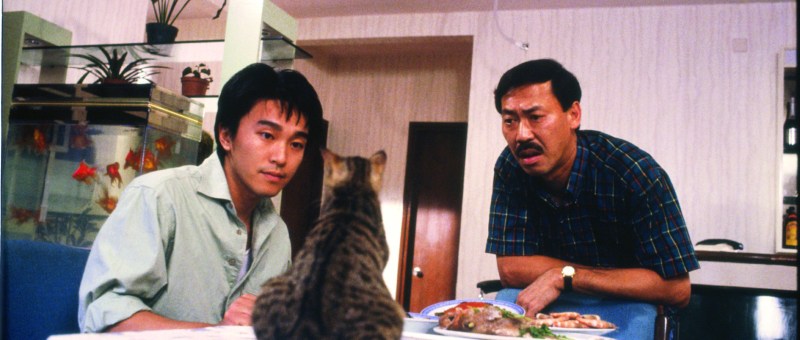
The film begins with two policeman as one berates the other for stopping to burn “ghost money” on the street, describing his need for ritual as like that of an old woman. The first policeman, Biao (Bill Tung), then gets a message on his pager to check out an abandoned warehouse. Piling into the police car, Biao and religious cop Chin (Stanley Fung) arrive but don’t find anything suspicious. Chin decides to leave while Biao wants to investigate further. Poking around, Biao finds himself directly above some kind of large scale drugs lab into which he heroically jumps and beats up most of the grunts waiting below before the head gangster turns up and throws him out of a window. Biao’s body lands directly on the top of Chin’s car who has returned after having second thoughts and wanting to make sure his partner is OK.

The “official” explanation is that Biao has killed himself because of his excessive gambling debts. Up in heaven he gets put on trial (alongside recently deceased dictators Ceausescu and Marcos) and the judges find that his death is indeed suicide despite his protestations. Eventually they agree to let him go back to Earth as a ghost to prove he was murdered and take revenge on the killer. Biao gets assigned a “saviour” whom he will know thanks to an unusual birthmark. The “saviour” turns out to be rookie cop, Sing (Stephen Chow), who is not exactly top of his graduating class but aided by Biao’s supernatural powers he just might be able to find the real killer after all.

As it turns out Chin dabbles in Taoist magic (to make his arms longer, for no particular reason) as do the gangsters who seem to have demonic forces on their side. Biao never saw the face of the man who killed him because he had him in a headlock, but he does remember his terrible body odour thanks to being shoved under his armpits. Victory in the final battle relies on conjuring a unique charm which consists of equally stinky ingredients including virgin’s urine, cat poo, and flatulence neatly bringing several of the film’s running jokes together into one satisfying punchline.

Running gags there are a plenty from the grumpy old cleaner at the police station they’ve nicknamed the 1000 year old virgin who likes to mop up the men’s toilets while they’re busy so she can assess the policemen’s “capabilities” for herself, to the cat who keeps defecting on the altar, and Sing’s general weediness. The supernatural procedural runs in tandem with the usual romantic comedy subplots including Chin’s over protective attitude to his grown up daughter who inevitably ends up in a relationship with Sing thanks to Biao’s supernatural wingman-ing. One of the “charms” Baio has been given to help him in his quest is a “lewd” spell which suddenly makes the victim randy for the first person they see. Biao uses this to get his own back on Chin for leaving him behind by making their austere superior officer suddenly come over all goey only to have her snap out of it and accuse him of sexual harassment.

The humour maybe distinctly lowbrow, but there is a degree of satire lurking in the background as Sing is sent into a “massage parlour” with a codeword in Vietnamese only to discover that all the girls in the place can understand it and immediately parrot back the recent ordinance of Vietnamese immigration. Later, a Vietnamese man threatens to commit suicide over the cruel and inhumane treatment he has received as a Vietnamese immigrant trying to make a life in Hong Kong, fearing he may be forcibly deported and will be killed if he has to go back to Vietnam losing everything he’s tried to build in Hong Kong.

When Biao eventually gets back to heaven they don’t want to let him in even though he’s cleared his name because heaven has a quota and he doesn’t meet the criteria. All is not lost, however, because you can buy your way in as an immigrant with ”special investor” status. In heaven, it seems, everything is fine so long as you have money. As above, so below. Another characteristically nonsensical, juvenile comedy from Shaw Brothers, Look Out, Officer! is as silly and of its time as one would expect but it is undeniably entertaining and unexpectedly moving in its final moments.


Remake of Philip Chan & Ricky Lau’s Where’s Officer Tuba? (1986)

Celestial Pictures trailer (English/traditional Chinese subtitles)