The Romantic President (피아노 치는 대통령, Jeon Man-bae, 2002)

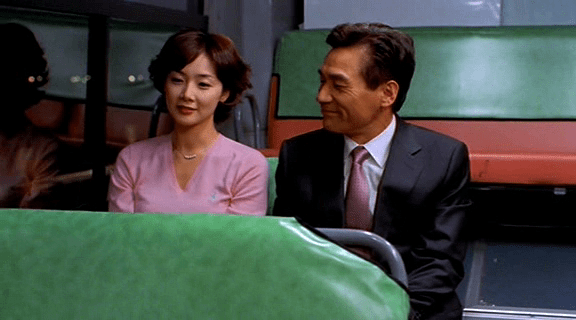
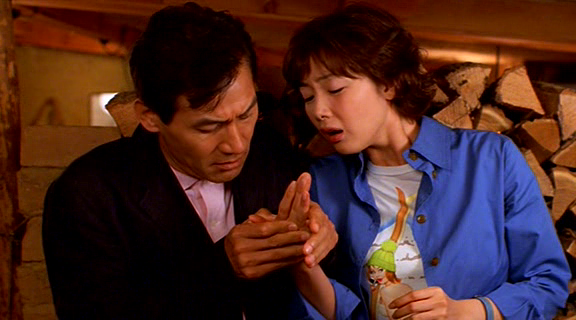
A pure-hearted politician finds himself falling for an uncompromising teacher in Jeon Man-bae’s nonsense comedy Romantic President (피아노 치는 대통령, Piano chineun daetongnyeong). This president is indeed “romantic” in the sense that he is an idealised vision of a political leader. The film doesn’t go into his politics at all and it’s ambiguous where he belongs on the political divide. Instead, he is depicted as a man of integrity who is good and kind. In short, the kind of political leader that might not really exist in real life.

Min-wook (Ahn Sung-ki) first appears in disguise having gone undercover to talk to a group of homeless people living at the station. While talking to them, he himself is harassed by a policeman overstepping the bounds of his authority. The policeman calls the men “trash” and says that they disgust ordinary people. Little knowing who he is, the policeman bullies Min-wook who then identifies himself by striking the same pose as on as his campaign photo.

Something similar happens later when Min-wook decides to take a day driving a taxi in order to get closer to the people he is supposed to be serving. All of which marks him out as someone who is genuinely interested in the lives of the electorate and how to make them better. Though references are made to other political scandals, Min-wook seems to be held to a different standard and is a figure of integrity and incorruptibility. This is, however, why his romance is so dangerous in that It complicates his image and the secrecy involved because of his position makes it seem like he’s done something wrong or that there is an illicit quality to his relationship with schoolteacher Eun-soo (Choi Ji-woo). However, at the film’s conclusion, Min-wook admits that the “piano-playing president” was a persona he constructed for the purpose of winning the election, which is to say inauthentic. He has been lying all along, but his romance with Eun-soo has made it impossible for him to continue with the subterfuge. Only by being his true self can he gain romantic fulfilment even if it comes at the cost of his political career.

For her part, Eun-soo may also be harbouring a secret that paints her as something of a political rebel and possible extremist. She has failed to keep a job for more than six months because of her eccentric behaviour and intense interest in teaching in which, like Min-wook, she is invested in her pupils lives and wants to do what she can to make them better. On arrival at her new school she poses as a pupil to find out the class gossip and then becomes determined to save Young-hee (Im Soo-jung) who has become a delinquent little knowing she is the president’s daughter. No one else is willing to go against the Blue House with the consequence that Young-hee has become drunk on power, rebelling in the hope that someone will push back. Eun-soo is that person and soon earns Young-hee’s trust precisely because of the genuine interest she takes in her that is undaunted by her father’s position.

Young-hee too responds to authenticity and gradually becomes more authentic herself through her interactions with Eun-soo. Nevertheless, at the same time, the film suggests that society remains judgemental and is not always prepared to recognise an individual’s authentic identity. Eun-soo’s roommate is a transwoman who is repeatedly deadnamed and then eventually outed by the invasive press when Eun-soo’s relationship with Min-wook is exposed. Nevertheless, Eun-soo strives to protect her friend while accepting that she may have to deny her feelings to protect Min-wook’s position.

Despite all the silliness and zany antics, the film has a degree of earnestness at its heart in which it believes that it shouldn’t be wrong to express one’s true feelings. Authority figures can fall in love too, and it’s better for everyone if they do, otherwise you end up with the toxic combination of power and unhappiness that causes the policeman to abuse his authority to bully the homeless. Even so, the irony is that on becoming Min-wook’s official partner, Eun-soo must again play another role, radically altering her appearance to conform to the image of the president’s wife. Nevertheless, once authentically embraced, their love is accepted by the wider society which is then itself improved as a result.


Trailer (English subtitles)

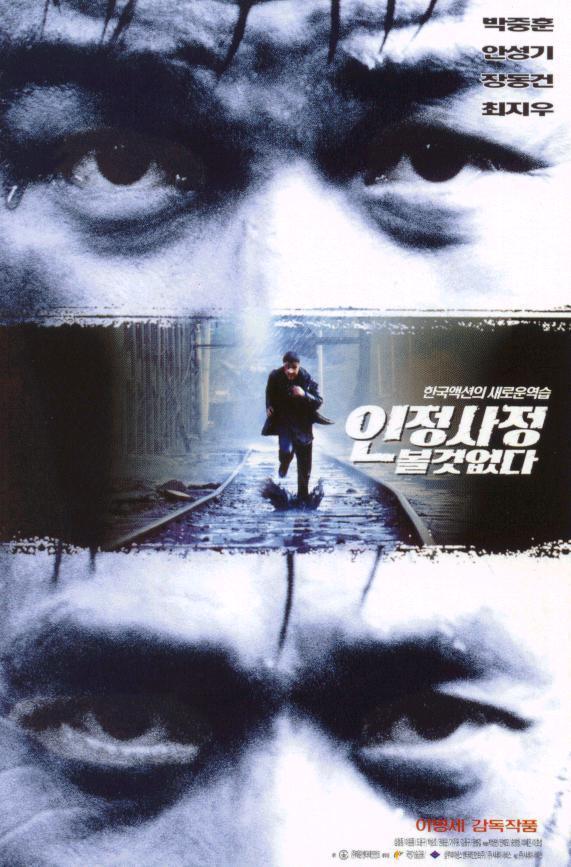
Nowhere to Hide (인정사정 볼 것 없다, Lee Myung-se, 1999)

Nowhere to hide poster

One of Korea’s foremost visual stylists, Lee Myung-se’s work has often been under appreciated at the time of its release. His desire to experiment finds fertile ground in the intensely kinetic ode to the police procedural, Nowhere to Hide (인정사정 볼 것 없다, Injeongsajeong bol Geos Eobsda). A tale of cops and robbers, Nowhere to Hide follows a cop who talks too much on the trail of a silent assassin who is, in fact, an expert at hiding in plain sight through the art of disguise. Moving quickly from one intense, beautifully choreographed set piece to the next, Lee draws inspiration from the crime-tinged tragedies of old Hollywood and beyond whilst embracing those of his home nation in the classic twin pairing of actors Ahn Sung-ki as the enigmatic assassin, and Park Joong-hoon as the bullheaded cop hot on his trail.

Lee opens in black and white with Inspector Woo (Park Joong-hoon) in full on gangster mode as he wanders through a ruined landscape, pausing only to tie his shoelace while the pulsing, punkish music continues in the background, before he walks in on an entire room of besuited gangsters and calmly sits down to introduce himself. Sometime later, Sungmin (Ahn Sung-ki), in sunshades and trench coat, patiently bides his time before committing a dramatic murder and making off with a mysterious briefcase.

What follows then is a game of cat and mouse as Woo chases the ghost of Sungmin through dingy back allies and neighbourhood dive bars, taking his more serious partner, Kim (Jang Dong-kun), whose more primary motivations include his family or more particularly his little girl, along for the ride. Woo lives only for his work, drawing more thrill from the chase than he is likely to admit. Through his pursuit of Sungmin, Woo draws closer to a side of himself he hoped to avoid, burying his natural rebelliousness in service of the law. We see him brutally interrogate suspects, even at one point trussing one up like a prize pig and suspending him between two desks in the middle of the police station. It is, in this sense, Woo who is left with “nowhere to hide”. As a young man, he had a violent streak which might well have led him into crime if his father had not pointed him towards the police, but he can no longer claim to be very much different than the quarry he pursues. His true nature has been laid bare by his opposing number.

Woo’s rage and unpredictable energy are tempered by Kim’s evenhandedness, but after a job goes wrong and Kim kills a suspect by mistake he starts to fall apart. Suddenly Woo cannot rely on Kim to save him from himself and then tragically fails to save Kim during another operation, leaving him open to serious injury. His quest is now as much one of vengeance and personal feeling as it is of justice.

Sungmin, by contrast, says not one word in the entirety of the film. A felt presence more than a seen one, he slips in and out of personas, escaping from the scene in various disguises as a figure more of legend than of reality. A close relationship with a bar hostess girlfriend is Woo’s way in to Sungmin’s world, correctly identifying a weakness and pressing it, pursuing a more concrete route to the centre of Sungmin’s existence than simply tracking him through the shady netherworld in which he lives.

The two men run from and mirror each other as pictures of action and stillness, resistance and urgency. Through a relentless pursuit of capture or escape, neither can evade the shadow of himself, each moving closer to their true selves as repressed elements surface and threaten to destroy the whole. Woo and Sungmin are each on a mutually destructive pursuit of the self as much as they are for their own, self defined goals.

Lee frames all of this within his characteristically ironic world view, painting the drama as comedy imbued with its own kind of cartoonish slapstick. Throwing in cinematic homages from a brief nod to Battleship Potemkin to an ending plucked straight out of The Third Man, Lee mixes freeze frames with an odd jump dissolve technique which lends his intensely beautiful choreography an impressionistic, fleeting quality. Two men chase the shadow of the other, engaged in a desperate game of hide and seek, but when the game is up neither may like what they see.


Screened at London Korean Film Festival 2017.

Robbery sequence (dialogue free)