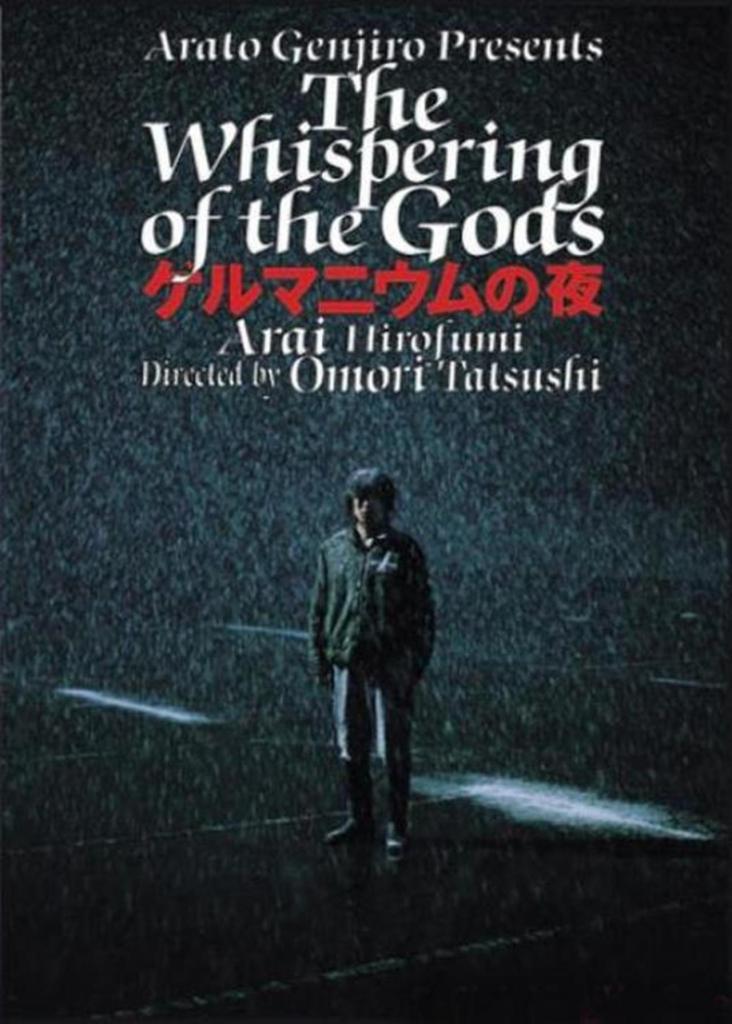
The Whispering of the Gods (ゲルマニウムの夜, Tatsushi Omori, 2005)

whispering of the godsIf you’ve ever wondered what it’s like to live in hell, you could enjoy this fascinating promotional video which recounts events set in an isolated rural monastery somewhere in snow covered Japan. A debut feature from Tatsushi Omori (younger brother of actor Nao Omori who also plays a small part in the film), The Whispering of the Gods (ゲルマニウムの夜, Germanium no Yoru) adapted from the 1998 novel by Mangetsu Hanamura, paints an increasingly bleak picture of human nature as the lines between man and beast become hopelessly blurred in world filled with existential despair.

Rou (Hirofumi Arai) has returned to the religious community where he was raised but his reasons for this seem to have everything and nothing to do with God. He claims that he “kind of killed some people” and also says he’s a rapist, but there’s no way to tell how much of what he says is actually the truth. After opening with a sequence of bulls trudging through snow, we see Rou listening to a priest read from the bible, but we also see that Rou is giving the priest a hand job whilst looking resolutely vacant. Later, after expending some pent-up anger by thrashing around some with junk and kicking a dog, Rou has a heart to heart with a novice nun, Kyoko, which quickly results in a forbidden sexual relationship. Forbidden sexual relationships, well – “relationships” isn’t quite the right word here, perhaps transactions or just actions might be more appropriate, are very much the name of the game in this extremely strange community of runaways and reprobates each keen to pass their own suffering down to another through a complex network of abuse and violence.

An early scene sees Rou throw a metal pipe across his shoulders in an oddly Christ-like pose. He’s certainly no Messiah, he wants to take revenge on these people by being the very worst of them, but ultimately he does come carrying a message. Using the same tools against them as they’ve used against him all his life, he exploits the loopholes of religiosity to expose its inherent hypocrisy. He confesses sins he may or may not have committed as well as those he plans to commit. In giving him unconditional absolution for an uncommitted sin, has the priest just given him a free pass to balance the celestial books by going ahead and violating a random nun? As well as well and truly messing with the resident priest’s head, Rou’s rampant sexuality also exposes the latent longings present within the nuns themselves who are supposed to control their sexual urges, brides of Christ as they are, yet they too covertly indulge themselves in receiving satisfaction from the various kinds of strange sexual behaviour currently on offer.

Life on the farm is nature red in tooth and claw as one particularly brutal scene sees a male pig castrated with a pair of garden shears during a failed act of copulation. Later a pig will lie in neatly dissected pieces, dripping with blood and fluid. There’s no romance here, just flesh and impulse. Forming a kind of friendship with a younger boy, Toru, who is also being abused by the priests at the compound, Rou offers to take revenge for him but it seems the boy just wanted to confide in someone, to begin with. Later, Rou will take a kind of action and Toru offers to repay him by continuing the behaviours he has learned through a system of perpetual manipulation, unwittingly drawing Rou even more deeply into the spiral of abuse and hypocrisy that he set out to destroy.

Omori opts for a straightforward arthouse aesthetic which matches the bleakness of the environment and barrenness of spirituality found in this supposedly Christian commune. In fact, Omori had to go a roundabout route to get this film shown given its controversial nature which saw him set up a temporary marquee theatre to avoid having the film cut to get an Eirin certificate before getting it into more mainstream cinemas in his desired version. What it has to say about the base essence of humanity is extremely hard to take, though no less valid, and its picture of a hellish world filled with nothing but despair punctuated by guilt filled sexual episodes and violence in which there is nothing left to do but continue shovelling shit until you die is an uncomfortably apt metaphor for contemporary society.


Mangetsu Hanamura’s source novel does not appear to be available in English but actually seems to be even more disturbing than this extremely depressing film – more info over at Books From Japan.

Unsubbed trailer:
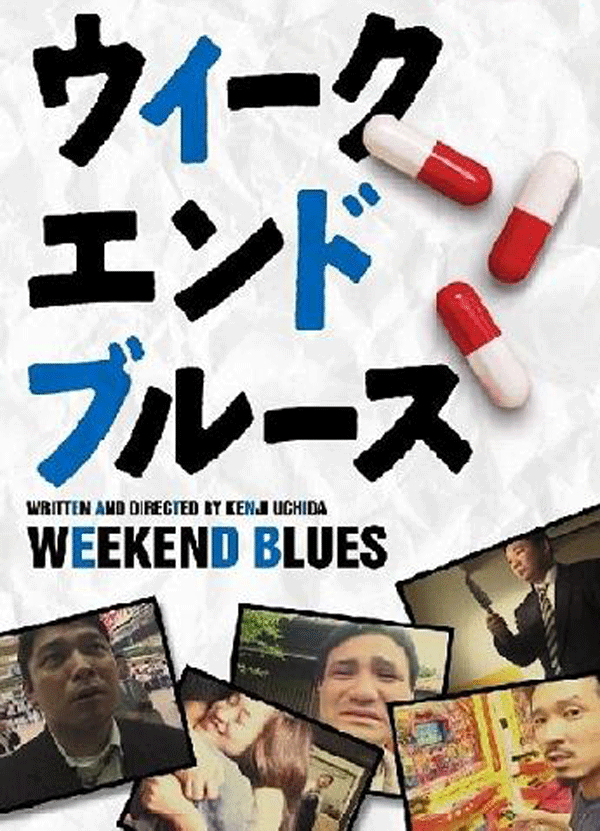
Weekend Blues (ウィーク エンド ブルース, Kenji Uchida, 2001)

weekend bluesKenji Uchida travelled to America’s San Fransisco State University to study filmmaking before returning to Japan and making this, his debut film, Weekend Blues (ウィーク エンド ブルース) which later went on to claim two awards at the prestigious Pia Film Festival for independent films earning him the scholarship which enabled his next film, A Stranger of Mine. However, Uchida’s film, though resolutely his own, individual creation, plays much more like the Japanese indie movies of the time and particularly those of the similarly considered, if drier, Nobuhiro Yamashita than it does to late 20th century American indie or the mumble core movement.

As in his later work, Uchida builds around a finely constructed farce only this time the central conceit is a bout of amnesia suffered by the central character, Kensuke, who is a depressed salaryman still reeling from his ex-fiancé’s sudden exit from his life. He takes solace in his one solid relationship – that with his committed slacker friend, the similarly named Kenji. However, on visiting Kenji’s apartment one Friday night he discovers Kenji has gone and got himself a girlfriend. Kensuke gets extremely drunk and also tries some of the weird drugs that Kenji has got from somewhere or other before accompanying Kenji’s new squeeze, Ayumi, on her way home.

That’s the last thing Kensuke remembers before waking up in a faraway town. On returning to Kenji’s flat he’s shocked to learn it’s actually Sunday already and he has absolutely no idea what’s been going on for the past 48 hours.

Jumping to the natural conclusion that the drugs are to blame, the two Kens descend on the dealer who seems to be some kind of man scientist researching a formula to give the “wimpy” men of today some of their caveman swagger back. Ironically named “samurai” the drugs themselves are more of a Mcguffin but provide a key into this world of nervous, unambitious, soon to be middle-aged men who’ve each had their girlfriends poached from under their noses by the more socially successful. A parade of jilted lovers passes by until we reach the more psychotic set who’ve decided to embrace some decidedly dodgy methods in order to ensure they won’t be humiliated and run out on ever again.

Uchida also adds another level to the amnesia based shenanigans with a sideline in internet dating where everybody is lying to everyone and presenting version of themselves that’s very much idealised. Kenji has told his prospective girlfriend that he’s a successful high earner despite the fact he doesn’t actually have a job at all, but at least his interest in the new woman has persuaded him to try and get back into the employment market so his full scale frauds can be demoted to gentle half-truths before things (hopefully) start to get more serious. In turn, his new lady love, Ayumi, may not be all she seems either.

Kensuke’s larger philosophy lies in a need to be needed. Now that his fiancée has left him, discovers he was no longer necessary to her anymore, Kenji feels himself a man without purpose and the prospect of simply continuing like this for another fifty years is beginning to frighten him. Again there’s a wider question here about interconnectedness (which is also the heart of any farce) in the supposedly “connected” world in which you can pick up a true love fantasy by lying about yourself on the internet – even if the mutual misrepresentations end up spinning their own pretty web of deceit in their own sweet time

Uchida’s first film is a necessarily low budget, indie effort but makes no apologies for itself or claims of being anything more than it is. That said, the performances are universally strong and the direction often interesting even given the obvious budgetary constraints. A very modern kind of farce which also looks back the salaryman comedies of the ‘60s, Weekend Blues is a good indication of Uchida’s future direction whilst also succeeding as an enjoyably off the wall comedy in its own right.


Death Powder (デスパウダー, Shigeru Izumiya, 1986)

death powderCyberpunk, for many people, is a movement which came to define the 1980s and continues to enjoy various kinds of resurgences and rebirths even into the new century. Beginning the the ‘60s and ’70s in dystopian science fiction afraid of the impact of advancing technologies in society, it’s not surprising that the genre began to actively embrace influences from the East and especially that of the more technologically advanced and economically superior Japan. However, when Japan made its own cyberunk cinema, the “punk” element is the one that’s important. These movies sprang from the punk music scene and often star punk bands and musicians as well as featuring high energy punk rock inspired scores.
Death Powder (デスパウダー) is among the first of these tech themed experimental films and is the only feature to be directed by folk singer and poet Shigeru Izumiya who had also starred in Sogo Ishii’s massively influential Burst City in 1982. Hugely indebted to Blade Runner, it takes that film’s noir stylings and terminology to create an experimental surrealist film loosely themed around two bounty hunters in search of a “replicant”.

After beginning with a chase sequence past neon signs and through a contemporary Tokyo where the faces of passersby have been pixelated out, the story focuses in on the pair of street punk robot hunters, Kiyoshi and Noris, who have been charged with investigating a gang hideout which used to belong to an artist who keeps trying to come back. However, when the duo arrive they find that the reason the artist, Harima (played by Izumiya himself), keeps trying to attack the place is that they’ve been holding his girlfriend, Guernica – an android, in the basement. After Guernica is killed in the resultant fighting, her body turns into a kind of powder which Kiyoshi later snorts. This “Death Powder” allows Guernica to colonise his body producing changes in both his mind and physiology.

This is what passes for a plot summary, though in keeping with the best of cyberpunk film making from Japan the narrative is irrelevant. One character even says to another “Like life itself, this makes no sense” – that being the point in a sense, creating meaning from the meaningless. Though it starts off with a Blade Runner-esque aesthetic bearing all of the hall marks which would come to be associated with cyberpunk from the neon signs, darkened streets and noir tinged atmosphere right down to the shades and trilbies costuming, the film quickly moves into the experimental realm with strange robotic sperm flying across the screen and melting vistas of city scenes and memories.

Kiyoshi begins to merge with Guernica’s consciousness, inheriting her memories and what may or may not be android fears and emotions. He “remembers” a flashback sequence featuring the very strange figure of Dr. Loo – a rock god mad scientistic who built Guernica for some undisclosed reason and then passed her on to Harima on whom it, apparently, depends whether not not she can become human which requires showing her love that transcends human love and will become “memories”. Like the replicants in Blade Runner she has a limited four year lifespan but when she dies her body will become a powder which gives life to other things.

Guernica is a created being, devoid of human flesh, but can she become human through experiencing human emotions and can she overcome death by downloading her experiences into another being’s consciousness? All fundamental questions found in cyberpunk explorations of what in means to be human in a world of advancing technology but once again Death Powder offers no clear answers so much as a surrealist and experimental exploration of the individual changes undergone by the individual rather than the society in the face of increasing mechanisation.

The borders between life and death, consciousness and unconsciousness, man and machine have all become so hopelessly blurred that concept of reality itself has become corrupted and no longer carries any kind of currency. While it may not have the raw and sophisticated artistic power of Tsukamoto’s later Tetsuo the Iron Man which has come to define the genre, Death Powder is a surprisingly accomplished low budget cyberpunk body horror extravaganza which places sensory experience ahead of narrative. Undoubtedly hugely influential yet now little seen or remembered, Death Powder is an essential addition to the cyberpunk canon and one which deserves to be as widely distributed as the classics which later followed it.


Opening sequence of the film (very trippy but dialague free until right near the end. Fast forward to around four minutes in for the nighttime chase through Tokyo!):

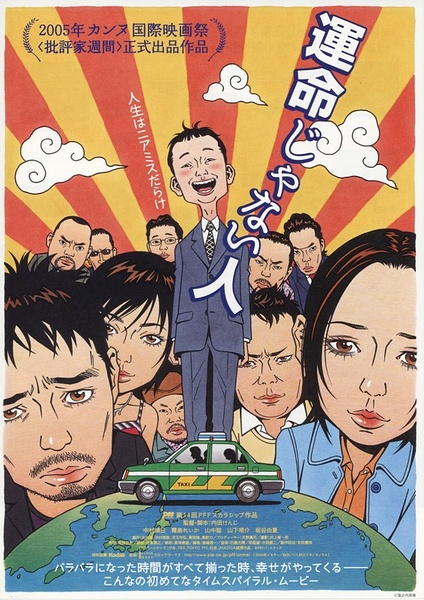
A Stranger of Mine (運命じゃない人, Kenji Uchida, 2005)

stranger of mineSometimes life throws you a pretty crazy night but unbeknownst to you the whole world has gone crazy too. For the disparate group of people at the centre of Kenji Uchida’s A Stranger of Mine (運命じゃない人, Unmei Janai Hito) , this proves to be more than usually true. A cute romantic encounter may end up going in a less than cinematic direction while ex-girlfriends, detectives and even the yakuza all conspire to frustrate the lovelorn dreams of a nice guy businessman who never even realises the total chaos which is ensuing all around him.

The film begins with a sad scene of a woman, Maki, carrying large bags and forlornly dropping a key through a letter box. She pawns what looks like an engagement ring and thinks about what to do next. Whilst sitting alone in a restaurant, a man asks her to join him and she is overjoyed to find some company. The man is Kanda, a small time detective and childhood friend of businessman Miyata who is also broken hearted as his girlfriend has left him. The girlfriend, “Ayumi”, is not all she seems and is already mixed up with yakuza boss Asai. Mix in a MacGuffin of some missing money and one ordinary night among millions just got very complicated indeed!

Uchida starts out with a fairly standard indie rom-com approach as the two brokenhearted jilted lovers Maki and Miyata are brought together by Kanda’s machinations but just as we think we’re about to head into some kind of Before Sunset scenario our perspective shifts and we find out just why it is that Kanda seems to be acting so manically. In fact, he’s been looking out for his friend all along but it’s getting kind of complicated at his end and the one thing he 100% does not want is for the rather innocent Miyata to figure out that he’s at the centre of dangerous mob caper because his ex-girlfriend, whom he still think is an angel, is really not the innocent flower he thought she was.

Just another night in the city, the point of view shifts around these five characters whose lives intersect like cogs turning some giant, unseen machine. We’re shown one set of events only to have our understanding of them undercut by seeing them again from another angle. Everything is a coincidence, or maybe nothing is, but each of these five characters wade into each other’s story leaving a drama filled wake with only poor Miyata seemingly oblivious to what’s really going on.

A Stranger of Mine plays like an extremely complex farce in which fate conspires to have some fun with five ordinary people and Uchida mines the situation for all the (sometimes dark) humour it can offer. Loosely split into three sections divided by title cards bearing the names of the characters, the film takes inspiration from classic Hollywood screwball comedies and film noir whilst adding a more modern, non-linear approach as Uchida plays and replays his scenes to make us see that things are not always the way they look at first glance.

While obviously a low budget, independent effort, A Stranger of Mine offers surprisingly high production values and boasts excellent performances from its tightly composed cast. The script is fiendishly complicated and exacting yet Uchida pulls it off with a keenly observed eye. Though improbable, the events are never implausible and play out with a kind of off beat inevitability that further underlines the film’s mildly ironic, comic tone. Gleefully playful, A Stranger of Mine may appear a little slight on the surface, but just as its multi-layered narrative suggests, the perspective only deepens on a closer look.


Unsubtitled trailer:

http://www.youtube.com/watch?v=BZNZL7zCxhU

Attack! Hakata Street Gang (突撃!博多愚連隊, Sogo Ishii, 1978)

hakataSogo Ishii (now Gakuryu Ishii) was one of the foremost filmmakers in Japan’s punk movement of the late ‘70s and ‘80s though his later work drifted further away from his youthful subculture roots. Perhaps best known for his absurdist look at modern middle class society in The Crazy Family or his noisy musical epics Crazy Thunder Road and Burst City, Ishii’s first feature length film is a quieter, if no less energetic, effort.
Like his other films from the period, Attack! Hakata Street Gang (突撃!博多愚連隊, Totsugeki! Hakata Gurentai) is fairly light on actual plot but broadly follows a group of low level street punks who get themselves into trouble after accidentally shooting the son of a yakuza boss in the leg and leaving him to bleed to death. In trouble with both the law and the gangs the guys find themselves in the midst of a turf war they are ill equipped to handle.

Very clearly an early effort, Attack! Hakata Street Gang is an ultra low budget production filmed on the real streets starring Ishii’s friends rather than professional actors. It can’t claim to any level of aesthetic beauty and, in truth, is not particularly interesting in terms of look or style but is filled with Ishii’s characteristic energy and runs fast even given its brief 67 minute run time.

Generally, Ishii sticks to a naturalistic representation of the street punk world. Taking his cue from the realistic action genre pioneered by Fukasaku et al not long before the film’s release, Ishii employs a similar approach to the fight scenes shooting from the middle of the action and often from low angles. Full of handheld camera and shakey, unfocused shots Attack! Hakata Street Gang is filled with the kind of youthful freshness that was very in vogue at the time.

Ishii does not appear to want to offer any kind of critique of this extremely masculine, violent world but solely to capture it on film. The street punks themselves are not particularly well drawn but there is a notably strange set of characters including an ultranationalist and his younger brother with learning difficulties who wears an SS helmet and rides around on a pushbike with a large nazi flag flying on the back. Nicknamed “manji” (the word for the Japanese “swastika”) the boy is obsessed with warfare and dangerously gets hold of one of the guns his older brother has adapted from a toy to be able to fire real bullets. He’s more of a plot point than anything else but still offers a convincingly weird sample of modern street life.

Also in keeping with the recent brand of cool action dramas, the film has an energetic score which is perhaps more jazz fusion or blues rock than outright punk which gives it more of a nihilistic, sophisticated tone than the full on noise explosion of some of Ishii’s later efforts. By the time the guys have taken their final stand by capturing hostages and occupying the local kindergarten (literally kids with guns) it’s pretty clear that there is no way back for this collection of down and out street rats.

Perhaps more interesting as an early work of a master than in its own right, Attack! Hakata Street Gang is an energetic and youthful exploration of a little seen late 1970s subculture. Literally playing fast and loose, Ishii’s debut is in many ways a statement of intent and none the worse for it.


Trailer for the Sogo Ishii The Punk Years 1976 – 1983 box which includes this film (though unfortunatly does not include any subtitles).


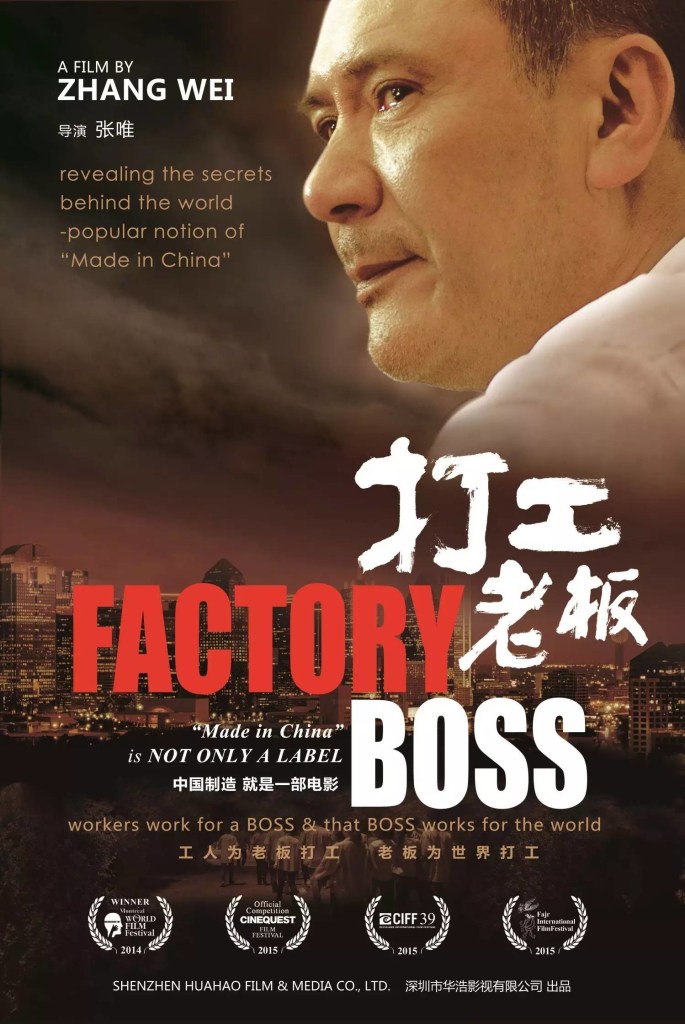
Factory Boss (打工老板, Zhang Wei, 2014)

factory bossGenerally speaking, capitalists get short shrift in Western cinema. Other than in that slight anomaly that was the ‘80s when “greed was good” and it became semi-acceptable to do despicable things so long as you made despicable amounts of money, movies side with the dispossessed and downtrodden. Like the mill owners of nineteenth century novels, fat cat factory owners are stereotypically evil to the point where they might as well be ripping their employees heads off and sucking their blood out like lobster meat. Zhang Wei’s Factory Boss (打工老板, Dagong Laoban) however, attempts to redeem this much maligned figure by pointing out that it’s pretty tough at the top too.
Shenzhen used to have over 1000 toy factories, but following the worldwide financial crisis, there are barely 100 left. Dalin is one of the lucky ones still holding out, if just barely. The employees haven’t been paid in a couple of months and there are debts outstanding which are only being held at bay thanks to a series of promises. The boss, Lin Dalin, has negotiated a massive deal to manufacture a large order for an American company which just might save them but he’s also biting off a little more than he can chew. The workforce are starting to get antsy – they’ve already burnt a car on the forecourt and some are talking about a walkout. To get this order through he’ll have to ask for even more from his already over stretched employees.

Just around this time, a young, ambitious reporter has developed a bee in her bonnet about workers’ rights at the local factories and has taken an undercover job at Dalin hoping to expose some of its shortcomings to the outside world. What she finds is worse than she’d ever imagined – faulty ventilation systems, air thick with the sickening smell of melting plastic, illegal “overtime” schedules, no breaks, shortened lunch times and a culture of shame and bullying intended to cow workers into playing along.

The film encourages us to see Lin as a generally “good” person. It says he wasn’t like this prior to the financial collapse and that it’s the current environment that has turned him into a ruthless exploiter of the “tools” at his disposal – i.e. his employees. Following on from the communist system, factories are still run like work groups where the employee base becomes a surrogate family with everyone living in shared workers accommodation on the complex. The workers also get lunch at the factory (but this comes out of their final pay).

Lin, like a feudal lord, sees himself as a paternal figure who has a duty to protect these people, but this means ensuring the factory’s survival. This is how he justifies his increasingly exploitative behaviour to himself, that if the factory goes under all of these people, and some of them are now old having worked there for 25+ years, will lose their jobs and with all the other factories in the same position, they will be left with nothing.

However, though Lin never behaves in an extravagant or intimidating fashion, it is also true that he lives all alone in a mansion drinking imported wine and chatting to his daughter via a shiny macbook while she studies overseas. He complains there’s little profit in his business these days, but he doesn’t seem to be tightening his own belt while his employees worry about their futures.

One of Lin’s friends has sold his local factory and relocated to Burma where the labour is even cheaper and there are even fewer labour laws. Lin is reluctant because he wants to make his nation great again and reverse the meaning attached to the phrase “Made in China” whilst also helping to build a better future for the people under his care but he is also at the mercy of market forces.

Thanks to a late in the game change of sympathies from our lady reporter, we’re pointed towards the real villains which would be the international corporations who manufacture in China because it’s cheaper but are squeamish about the country’s treatment of the working classes. These companies say they enforce strict conditions and make personal factory inspections, but their commitment is only really halfhearted. They know the reason why the labour is so cheap, but they drive the prices down anyway preaching against sweatshops but knowing, economically speaking, that there is no Earthly way these targets can be met on time and on budget with workers’ rights fully respected to the degree stated in their own mission statements. As soon as labour laws are revised in China and wages necessarily rise, they will simply switch to using cheaper labour forces in less developed parts of the world.

To be frank, this is just capitalism. A business is a business and each will constantly be looking to maximise their own profit margin. They will push and push until they feel resistance, and then they will push some more to find out how much their opponents will push back. No matter which way you spin it, the little guys will pay. Yes, Lin too is a victim, but it’s a little rich to pretend the consequences for a man like him are the same as they are for his employees. China has moved from the “Iron Rice Bowl” system of guaranteed lifetime employment to the relative insecurity of global capitalist society but its modernisation has been so rapid that the base line workers have been left with the rawest deal – poor pay and conditions coupled with the constant pressure of possibly being let go or being forced into exploitative arrangements just to keep a job which barely feeds you.

Factory Boss is an interestingly constructed look at the little seen life of the everyday factory which has a healthy level of naturalistic feeling detail. Zhang does however fall into a slightly didactic approach, particularly in his hagiographic depiction of Lin, and some of the later monologues appear oddly theatrical in contrast to the straightforward nature of the rest of the film. He catches China in the midst of its transformation, trapped in a moment of indecision as it finds itself cast in the role of middle man offering its services in the service of the enterprise of others while the individual dreams of men like Lin who long to set up on their own are crushed by forces beyond their control. Redeeming the figure of the fat cat is a nice a idea and Zhang certainly succeeds in casting Lin as a decent man corrupted by circumstance but his central message that the middle man needs love too and the real mean daddies are greedy corporate overlords is one which, true as it may be, can’t help feeling a little trite.


Reviewed as part of the Asia House Film Festival 2016.

Chokolietta (チョコリエッタ, Kazama Shiori, 2014)

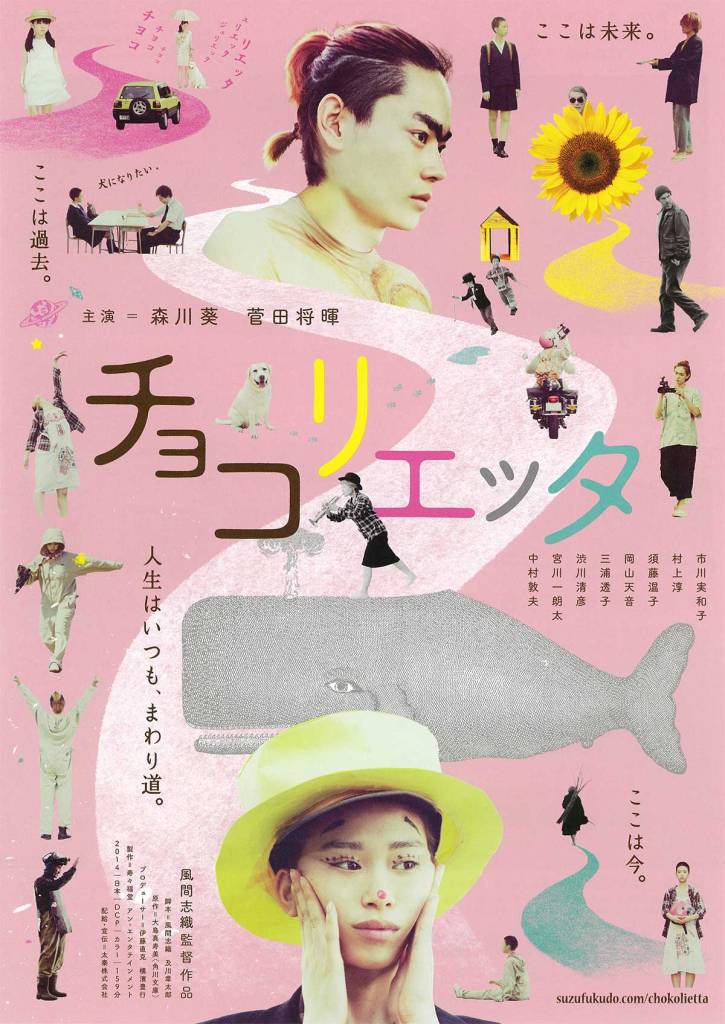
ChokoliettaWhen examining the influences of classic European cinema on Japanese filmmaking, you rarely end up with Fellini. Nevertheless, Fellini looms large over the indie comedy Choklietta (チョコリエッタ) and the director, Shiori Kazama, even leaves a post-credits dedication to Italy’s master of the surreal as a thank you for inspiring the fifteen year old her to make movies. Full of knowing nods to the world of classic cinema, Chokolietta is a charming, if over long, coming of age drama which becomes a meditation on both personal and national notions of loss.
The story begins in the summer of 2010 when five year old Chiyoko (Aoi Morikawa) is involved in a car accident that results in the death of her mother. Flash forward ten years and Chiyoko is a slightly strange high school girl and a member of the film club. Her parents, as far as she knows, were both big fans of Federico Fellini – in fact the family dog is named “Giulietta” after Fellini’s muse and later wife Giuletta Masina. As a child, Chiyoko also received the strange nickname of “Chokolietta” from her mother which also seems to be inspired by the star. Sadly, their Giulietta has also recently passed away removing Chiyoko’s final link to her late mother and once again forcing her to address the lingering feelings of grief and confusion which have continued to plague her all these years.

At this point Chiyoko goes looking for the DVD of La Strada they watched in film club last year which leads her to the now graduated Masamura Masaoka (Masaki Suda). Masaoka is an equally strange boy with possible sociopathic tendencies though he does own a large collection of classic DVDs and the pair settle down to return to the world of Fellini. Eventually Masaoka convinces “Chokolietta” to star in a movie for him and the two take off on a crazy road trip recreating La Strada where Masaoka stands in for the strong man Zampanò and Chiyoko plays the fragile Gelsomina.

Thankfully, the partnership between Chiyoko and Masaoka is not quite as doom laden and filled with cruelty as that between Gelsomina and Zampanò. Though Masaoka often talks of the desire to kill and Chiyoko the desire to die, both appear superficial and are never presented as actual choices either will seriously act on. Masaoka is cast in the role of the strong man but he more closely resembles The Fool as he gently guides Chiyoko onto a path of self realisation that will help her finally learn to reach a tentative acceptance with the past and begin to move forward rather than futilely trying to remain static. Of course, he’s also forcing himself into a realisation that he doesn’t have to play the role he’s been cast in either and so it doesn’t follow that one has to behave in the way people have come to expect simply because they expect it.

Technically speaking the bulk of the story takes place in a putative future – around 2020, or ten years or so after the death of Chiyoko’s mother in 2010. 2010 is also a significant date as it’s the summer before the earthquake and tsunami struck the Japan the following March causing much devastation and loss of life as well as the resultant nuclear meltdown which has continued to become a cultural as well as physical scar. The journey the pair make takes them on a fairly desolate route past no entry signs into ghostly abandoned shopping arcades still strewn with the remnants of a former, bustling city life but now peopled only by a trio of silent, stick bearing men. This is a land of ghosts, both literal and figural but like most things, the only way out is through.

Taking a cue from Fellini, Chiyoko has frequent visions of her her deceased mother and fantastical sequences such as boarding a whale bus like the whale in Casanova or suddenly seeing Gelsomina and an entourage of dwarfs trailing past her. Her world is a fantastical one in which her daydreams have equal, or perhaps greater, weight to the reality. Her now empty indoor dog house comes to take on a symbolic dimension that represents an entirety of her past her life as if she herself, or the dog she claimed to want to become, had been hiding inside it all along. The film returns to La Strada in its final sequence only to subvert that film’s famous ending as where Zampanò’s animalistic, foetal howling spoke of an ultimate desolation and the discovery of a truth it may be better not to acknowledge, here there is a least hope for a brighter future with the past remaining where it belongs.

However, Chokolietta runs to a mammoth 159 minutes and proves far too meandering to justify its lengthy running time. Truth be told, the pace is refreshingly brisk yet the central road trip doesn’t start until 90 minutes in and there are another 30 minutes after it ends. It’s cutesy and fun but runs out of steam long before the credits roll and ultimately lacks the necessary focus to make the desired impact. That said there are some pretty nice moments and a cineliterate tone that remains endearing rather than irritating all of which add up to make Chokolietta an uneven, if broadly enjoyable, experience though one which never quite reaches its potential.


Unsubtitled trailer:

Bonus – here’s an unsubtitled trailer for La Strada (which is possibly the most heartbreaking film ever made).

Also the other two Fellini movies mentioned in the film:

Casanova

and Amacord (original US release trailer)

Kuro (はなればなれに, Daisuke Shimote, 2012)

poster2All these years later, it’s easy to forget just how revolutionary the wheezy, breezy youthfulness of the French New Wave was. Kuro proves that there’s life in this whimsical, summer seaside feeling yet as three misfits find themselves holing up at a disused small hotel to think about what they’ve done until they learn to grow up a little.
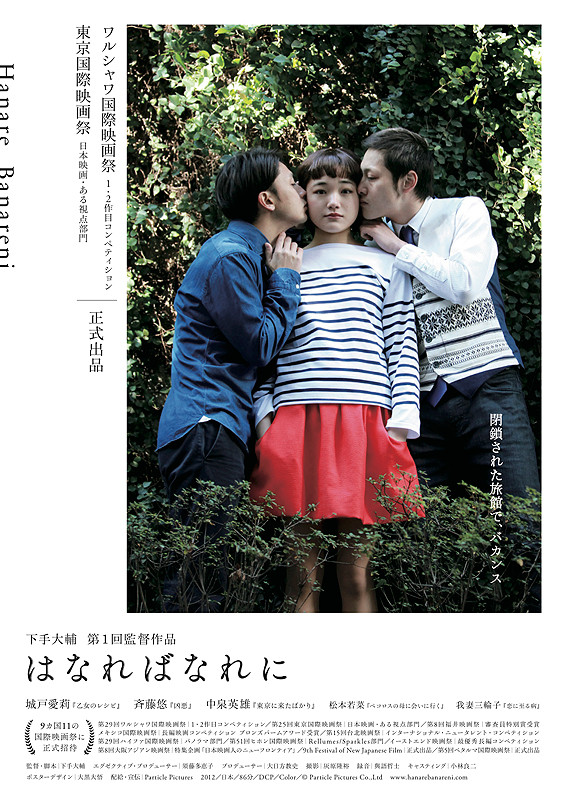
Kuro starts our story as she mournfully chows down on some of the pastries at the bakery she works at whilst treating a customer in a very disdainful way. She wanted to be a baker but her boss never really lets her do anything and when they argue about her guzzling half the stock she quits in a fit of pique. Roaming around the city doing absurd things like partying with a jazz band before running off with their change can or messing around with a sharp suited guy in a hotel room she meets womanising stage actor Gou who’s had a tiff with his actress wife after paying to much attention to the new girl. He flirts with and eventually semi-kidnaps Kuro for a road trip where they meet photographer Eito who has also had a tiff with his woman over having neglected to file the marriage papers at city hall. He’s heading up to an old hotel his uncle used to own where he was meant to spend his honeymoon and invites Gou and Kuro to join him.

Kuro’s original Japanese title, はなればなれに “Hanarebanare ni” literally means “scattered pieces” and was, coincidentally, the same title used for Godard’s 1964 masterpiece Bande à part. First time director Daisuke Shimote wears his influences on his sleeve with an atmosphere that recalls early period Godard which is all whimsy minus Godard’s slightly arch, confrontational irony. Leading lady Kuro, played by Airi Kido, has a definite touch of Anna Karina running through her from the way her retro haircut neatly frames her child-like face to her striped top and colourful red skirt. Taking her cue from Karina’s innocent insouciance, her absurd, pixyish pranks take on a cute and quirky quality which is backed up by a youthfully punkish disregard for the normal order of things.

Kido dances with the jazz band like Karina dancing in the bar in Vivre sa Vie and the gang even fake die in a water gun and finger shoot out a la Franz and Arthur in Bande à part. There’s also something of Tati in the intricate way Shimote sets up what are actually quite small and simple jokes like the Wii tennis match that suddenly turns into an entirely different kind of “virtual” game. At this point, the photographer who’s been perpetually on the sidelines, observing, finds himself joining in and experiencing his very own Natasha at the dance moment which, perhaps, finally allows him to break through something that’s been causing a rift in his personal life.

Through their season at the sea, each of these disparate characters comes to a kind of personal realisation that leaves them, well, more or less the same but much more settled. Kuro learns that sometimes you just have to buckle down and do as you’re told, Gou perhaps learns to be nicer to his wife and Eito maybe realises that you don’t know what you’ve got until it’s leaving you. Each of the characters is quite depressed, in the best new wave tradition, or just filled with ennui but perhaps you can’t have these kinds of absurd adventures in any other mood. That said, the heavier side of new wave surrealism with its nihilistic overtones is almost entirely absent leaving the atmosphere light and bright with the feeling that everything will (probably) be alright in the end.

Light on conventional narrative and high on sight gags and surrealist humour, Daisuke Shimote has crafted a charming and amusing new wave inspired ensemble comedy that, yes, wears its influences on its sleeves but isn’t afraid to bring its own moves to the dance floor. It might seem a little bit like a curveball from someone who’s spent so much of his previous life studying the work of Ozu with his formalist compositions and inclusory tatami mat viewpoint, but then Ozu was also a master of subtlety who could make peeling an apple into one of the most profoundly moving scenes in cinema history and Shimote is able to harness a similar fastidiousness here only in more of a comedic bent. Charming, whimsical, absurd but absolutely internally consistent, cinematically literate and beautifully made Kuro is one of the most impressive feature length debuts of recent times and hints at a promising career for its still inexperienced director.


Bonus videos of people (mostly Anna Karina) dancing in Godard films:

Hazy Life (どんてん生活, Nobuhiro Yamashita, 1999)

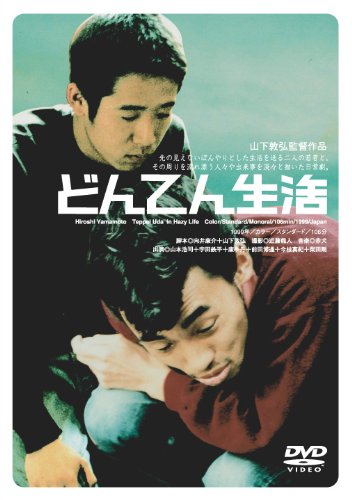
51GlvZf-iiLStarting as he meant to go on, Nobuhiro Yamashita’s debut feature film is the story of two slackers, each aimlessly drifting through life without a sense of purpose or trajectory in sight. His humour here is even drier than in his later films and though the tone is predominantly sardonic, one can’t help feeling a little sorry for his hapless, lonely “heroes” trapped in their vacuous, empty lives.

Kee (Hiroshi Yamamoto), a rocker with a giant quiff, meets Tsutomu (Teppei Uda) outside a pachinko parlour and the two strike up an unlikely friendship. Tsumtomu, a little gormless looking and near silent, ends up moving into Kee’s apartment where his main “job” appears to be copying videotapes of the amateur porn (sorry, “erotic cinema” movies) made by his friend Todokoro and his girlfriend(?) Akiko. In fact, Kee sometimes “stars” in the films too, which is something he might have wanted to tell Tsutomu before showing him the video. Kee also has a four year old child he doesn’t really get to see who lives with his ex-partner and only knows him as “uncle”.

As in many of Yamashita’s other films, nothing much happens as Kee and Tsutomu kill time whilst worrying and not worrying about the future. Neither of the guys has a proper job or any concrete ambitions, they mostly just eat time playing pachinko, drinking and hanging out with Tadokoro and Akiko. Kee is still mooning over his ex-girlfriend and, though it’s not clear why they split up, his own fecklessness may be the reason he’s not more involved in his child’s life even if he clearly would like to be. Tsutomu has developed a bit of a crush on Akiko but he never really tries to do very much about it (though he does have the good grace to turn down Kee’s invitation to become a star in one of the videos).

In constrast to his later work, Yamashita injects a number of fantasy sequences which seem to take place entirely within Tsutomu’s mind. Mostly they’re quite gentle – making a bunch of money at Pachinko and taking Akiko out for a slap-up meal or the poignant final scene of all the characters together as they enjoy a picnic under the cherry blossoms like one big happy family. However, there is one very unexpected scene which occurs after Tsutomu is caught shoplifting (which he does very badly) offering only the excuse that he’s forgotten his wallet and was too lazy to go back and get it. This fairly shocking scene of violence is one that does not typically re-occur in Yamashita’s later work and is notable for its extreme bloodiness and direct contrast to the overall tone. Perhaps intended to show Tsutomu’s inner frustrations (he spends much of the rest of the film asleep), this scene becomes one of the most intriguing in the film.

Hazy Life is a “zero budget” affair and makes no attempt to hide that. Shot on low quality equipment and committed to a “natural” look, it makes no claim to aesthetic prettiness though it does display Yamashita’s gift for interesting compositions this time working within a 4:3 frame. The fantasy sequences themselves are presented as reality bar one use of double exposure which is in general out of keeping with Yamashita’s naturalistic style as is the brief use of time-lapse photography.

Not uninteresting, but perhaps more interesting as a taste of things to come rather than as a feature in its own right. Hazy Life is just that, hazy and somewhat meandering as Kee and Tsutomu muddle through life with an air of mild depression and no particular hope in sight. “what day is it?”, “I don’t know”, “Well never mind – at least we’re alive”. This late conversation more or less sums the entire film and it’s poignantly sweet, fantasy sequence ending adds another layer of pathos to this subtly humorous look at laid-back modern life at the bottom of the heap.


Bicycle Sighs (自転車吐息, Sion Sono, 1989)

utJ5fVVtDUtt2rlbYWNjvqTFrytThese days we think of Sion Sono as the recently prolific, slightly mellowed former enfant terrible of the Japanese indie cinema scene. Hitting the big time with his four hour tale of religion and rebellion Love Exposure before more recently making a case for ruined youth in the aftermath of a disaster in Himizu or lamenting the state of his nation in Land of Hope what we expect of him is an energetic, sometimes ironic assault on contemporary culture. However, his beginnings were equally as varied as his modern output and his first feature length film, Bicycle Sighs (自転車吐息, Jidensha Toiki), owes much more to new wave malaise than to post-punk rage.

Loosely speaking, Bicycle Sighs is a kind of coming of age film where three teenagers experience a bout of anxiety about the future near the end of the ‘80s. Shiro (played by Sono himself), Keita and their female friend Katako have remained behind in their small town after all of their friends have moved on, mostly to universities. Life for them carries on much as before as they continue their part time paper rounds and messing about around town. Shiro, the more arrested of the pair of boys, becomes fixated on the idea of finishing a film they started making in high school whereas Keita wants to finally get into college himself and study to be a doctor.

As might be inferred from the English language title, there’s a sort of latent nostalgia for an era of innocent, aimless bicycle riding – of time spent with now absent friends and an adulthood that was far enough away not be worth worrying about. The bicycles themselves take on a symbolic quality and actually end up undergoing two different kinds of “funerals” during the film, once by burial and another by fire. This all seems like a pointer towards a bonfire of innocence but in actuality nothing very serious happens to any of the young people in the film save the usual occasions of heart break and disillusionment.

The 8mm sections filmed for the film within a film segments are often the most impressive, taking on an authentic sort of youthful exuberance. The “First Base” movie that the guys are making is a typical high school scenario in which the friends are enjoying a game of baseball but start discovering their game invaded by “invisible runners”. Later they start to be able to see one of them only he’s wearing a Godzilla mask and carrying a briefcase. Eventually he leaves the game trailing a long line out behind him. When Shiro tries to finish the film it develops into a great sci-fi style conspiracy where the kids uncover a plot in which their own “invisibility” is the ultimate aim.

Bicycle Sighs is a picture of youth in disarray (a theme Sono would often come back to). They’re each in search of their identity, some wanting to move back and others forward but all stuck in a limbo land of frustration. Sono packs in avant-garde inspired symbols like flags with the various Japanese characters for “I” emblazoned on them or another character taking to the streets alone on new year’s eve (also the eve of his own birthday) to wish happy new year to an empty town. There’s a great deal of interesting material in Bicycle Sighs, but ultimately its messages are a little oblique and somehow Sono never manages to bring everything together in a meaningful way. Nevertheless, some of his later skills shine through, particularly in the 8mm scenes, and there’s enough going on to please most attentive viewers even if it seems a little derivative at times.


You can actually get this on UK iTunes with English subtitles (for the moment anyway)