Avalanche (雪崩, Mikio Naruse, 1937)

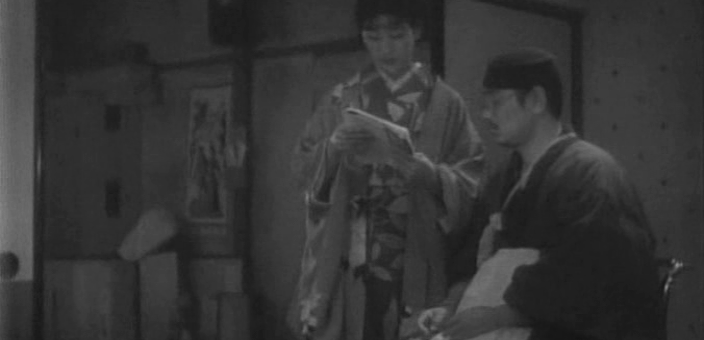
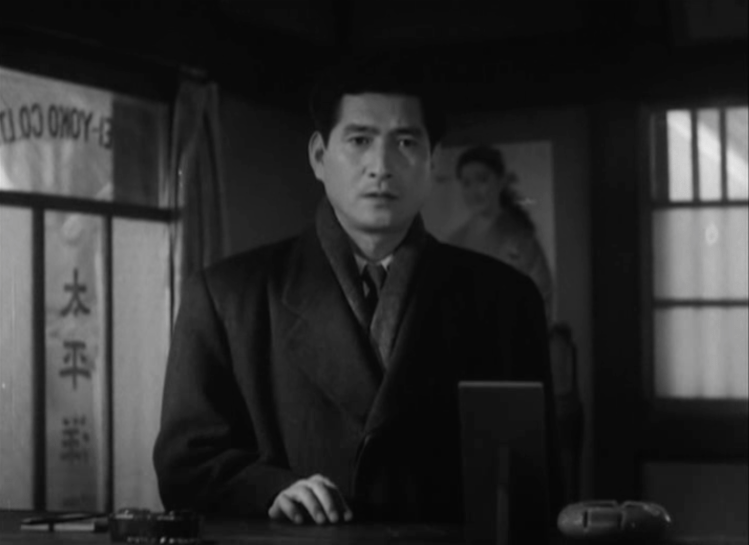
Naruse Avalanche title cardDespite his broadly progressive outlook, it would perhaps be unfair to describe Mikio Naruse as a political filmmaker. Yet filmmaking in the late 1930s was an inherently political act if only by omission. 1937’s Avalanche (雪崩, Nadare), adapted in collaboration with left-wing intellectual Tomoyoshi Murayama from a serialised novel by the quietly anti-authoritarian Jiro Osaragi, seems to be almost in dialogue with its times as its hyper-individualist “hero” engages in a series of discussions with his humanist father about the new philosophies which for him at least spell the future.

Naruse opens, however, with the heroine – sweet and innocent bride Fukiko (Noboru Kiritachi ), dressed in kimono and sporting a traditional married woman’s haircut as she gazes lovingly on her wedding photo sighing softly that a year has gone by already. Flashing back, we realise that Fukiko eloped with wealthy scion of the Kusaka family, Goro (Hideo Saeki), who apparently forced the disapproving parents to accept the union by persuading Fukiko to accompany him to a hotel in Nagoya from which they were collected by Goro’s kindly father (Yo Shiomi). Though Fukiko remains deeply in love with Goro, it is obvious to everyone else that the marriage is not happy. Having reconnected with childhood sweetheart Yayoi (Ranko Edogawa), Goro wants a divorce, justifying his actions with the rationale that it will be better for Fukiko to end things now rather allow her to suffer years of a loveless marriage that is destined to end in separation.

Goro’s father, a little fed up with his wayward, increasingly psychopathic son, feels differently. He thinks that Goro has made his bed and must now accept his responsibility, committing to caring for Fukiko as a husband should regardless of whether or not he has romantic love for her. Goro, however, insists that this is a matter which only concerns himself and rejects any responsibility towards Fukiko, insisting that would be cowardly and dishonest to go on living with a woman he doesn’t love under the pretence that he does. Exasperatedly pointing out that one lives as a member of a society and cannot always be free to do as one pleases, Goro’s father tries to awaken him to social responsibility by reminding him that he only thinks he has the luxury of choice because he is the heir to the wealthy Kusaka family and would likely feel differently if he were just a regular salaryman. Goro doesn’t quite deny it, but (ironically) also condemns the hypocrisy of social propriety, avowing that he will not live a life of lies like those respectable married couples with lovers on the side.

Goro’s father asks if he’s not being overly literal, seeing as life is rarely as black and white as he’s painting it for the purposes of his argument but Goro counters that his father is “bound by old morality” of which he believes himself to be free. Later, trying to win back the heart of Yayoi, he reveals himself to be a hyper-individualist who believes that the only true path to happiness lies in indifference to the suffering of others. It seems that Goro’s decision to elope with Fukiko was part rebound, his ego bruised by a minor rejection by Yayoi who is also in love with him and had always believed that they would marry only to find herself disillusioned with the institution of marriage. Her sickly brother Keisuke (Akira Ubukata) worries that she turned down Goro because of him, knowing that should he die she would need to find someone to marry into their family and continue its name – something impossible for the oldest son of a noble family like the Kusakas.

That was not, however the reason. Yayoi resents her lack of options, that when a woman’s marriage is arranged people say “it’s settled” as if an unmarried woman is a problem in need of a solution. She resents that she is obliged to entrust her future to a stranger, wondering how it is she is supposed to trust one man for the rest of her life. It is this feeling that created distance between herself and Goro despite her obvious love for him. He accuses her of being “condescending” and hiding her true feelings, blaming her for the predicament they now find themselves in despite the fact that it appears to be entirely his own fault. Yayoi thinks it’s now too late for them, immediately sympathising with Fukiko who has been unfairly dragged into an awkward situation, but Goro scalds her again by insisting that she thinks too much about others when they need to be “strong” and think only of themselves.

Yayoi is half won over by Goro’s frighteningly fascist world view, but finds herself conflicted. She recognises her privilege and originally feels nothing but guilt because of it, that lack of purpose has left her with nothing but emptiness. Goro has her wondering if she’s got things backwards, that she ought to embrace the fact that she is allowed the luxury of life without worry. Putting it to Keisuke he partially agrees, affirming that happiness is only possible when one wilfully ignores the suffering of others. Yet Yayoi is dragged back towards humanism, remembering the “people left behind in the darkness” but fearful that Goro’s philosophy may win her over in the end.

Goro seems to be a perfect encapsulation of the growing evils of the age in his hyper-individualist desire to disregard the thoughts and feelings of others. The opening text, taken from Jiro Osaragi’s novel, paints Goro as the “hero” as it over-explains the film’s title by insisting that the “avalanche” we are talking about is “some sudden unknown force” present in this “precarious world” which can knock even the strong willed off their feet. The “hero” of Naruse’s film, by contrast, is clearly Goro’s kind hearted father who finds an unexpected fan in Fukiko’s dad (Sadao Maruyama) who claims to hate rich people and had no intention of marrying his daughter to one but thinks Goro’s father is one of the good ones and proves that there were some good things in the old feudal system.

Strangely reactionary as it may be, he has a point. Goro’s father is the soul of benevolent paternalism. He worries for his “desperate” son, and laments that the misfortune of the younger generation is “knowing things without understanding them”. He baits Goro, making him a mild ultimatum that if he wants to go on with his “immoral” philosophy then he’ll have to do it on someone else’s dime. Cowardly, Goro relents and chooses his wealth over his freedom but his psychopathy only deepens. To get back at his dad, he decides on a double suicide with Fukiko, before realising that there is no need for him to actually die so long as it looks like he meant to and he makes sure Fukiko goes first. This is the avalanche the film has been building to, but it’s not the one the titles teased in that it drags Goro back from an abyss towards something more human. He gives up on his plan when Fukiko, innocent as she is, is overcome with emotion on realising that she has been “wrong” about his feelings for Yayoi seeing as he has chosen to die with her. Is it love, or perhaps innocence, or just pure communication that is that “sudden unexplained force” which knocks Goro off his feet and drowns him in human feeling?

It’s a strangely “upbeat” ending for a Naruse film considering Avalanche’s overriding darkness, providing an awkward resolution as Yayoi, in an abrupt closing scene, claims something like independence in stating that she intends to remain with her brother rather than waiting for Goro or looking for a marriage. As such it reads as a rebuke of the fascistic ideology which played into, if not quite aligning with, militarist austerity as its various heroes find themselves once more returned to more responsible philosophies and authentic human connections. Cutting against the grain of the times, Avalanche is nevertheless a strange piece which seems entirely at odds with the opening statement, allowing the hero to find salvation rather than destruction in the sudden onrush of emotion.
Red Beard (赤ひげ, Akira Kurosawa, 1965)

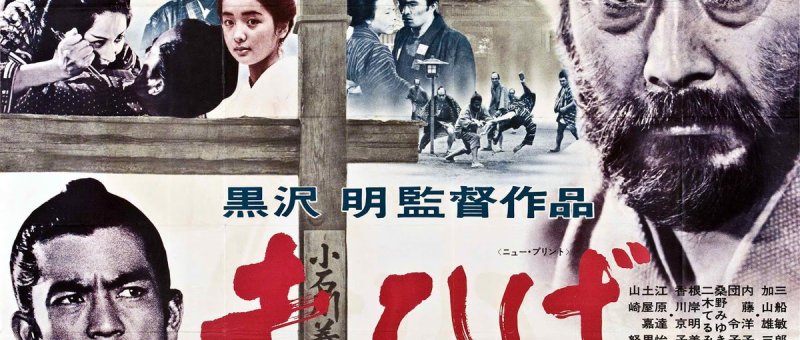
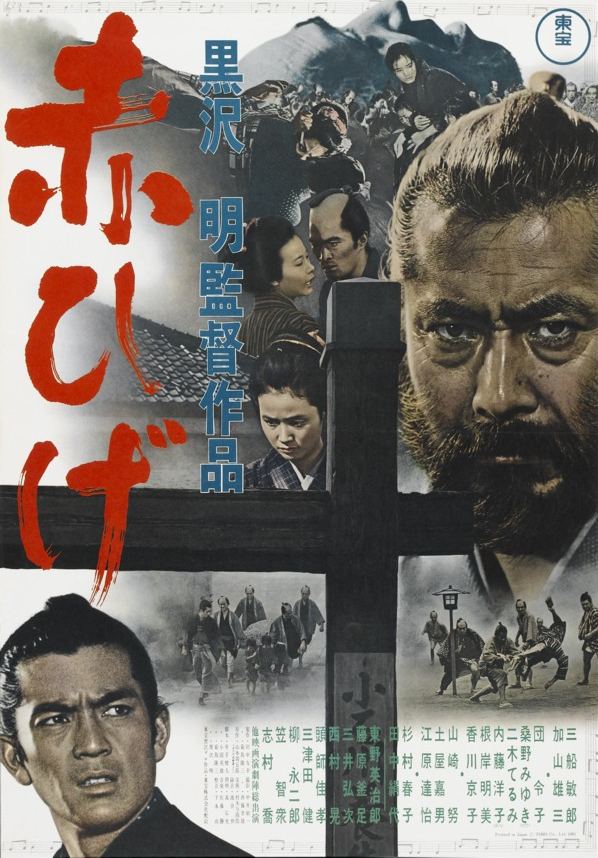
Red Beard posterAkira Kurosawa may be the most familiar golden age director of Japanese cinema to international audiences, but he was in many senses somewhat atypical. Where many of his contemporaries were eager to tell the stories of women, Kurosawa’s films are resolutely male and where many were keen to find the good among the bad, Kurosawa was often keen on the reverse. Nevertheless, that does not mean that he did not see goodness, merely that it was something which needed to be rooted out and fought for rather than simply permitted to exist. His final collaboration with Toshiro Mifune, Red Beard (赤ひげ, Akahige) finds the director at his most optimistic, fully embracing his natural tendency towards humanism even while making plain that goodness can often be hard to find, especially within yourself, and there may be no real cure for injustice but you have to treat the symptoms anyway.

The tale begins at the close of the Tokugawa era as a young doctor, Yasumoto (Yuzo Kayama), pays a courtesy call to the Koishikawa public clinic presided over by an old friend of his father’s, Doctor Niide (Toshiro Mifune) – otherwise known as “Red Beard”. Yasumoto, having just graduated from studying under the Dutch in Nagasaki, had only intended to make a brief visit on his way home and is therefore shocked to realise that he has been tricked into accepting a position at a hospital for the poor.

Our introduction to the Koishikawa clinic is through the eyes of Yasumoto as he receives a tour from another doctor who loudly remarks that he is glad that Yasumoto has now arrived because that means he can finally be free of this wretched place. Yasumoto’s nose wrinkles on smelling the “rotting fruit” of the poor waiting for afternoon appointments, while one of the patients complains about the “sterility” of the environment and his plain hospital clothes before a genial inpatient, Sahachi (Tsutomu Yamazaki), explains the reasoning behind such austerity and praises the attention to detail of head doctor Red Beard who has thought carefully about the best way to ensure his patients experience the best of care.

Yasumoto is extremely displeased by his predicament. He had believed himself on track to become a royal doctor working for the Emperor and being sent to poor clinic seems like a poor joke. He is indeed extremely full of himself, refusing to surrender his medical notes from Nagasaki as if he had made some great discovery and hoped to profit from it. Hoping Red Beard will fire him, Yasumoto behaves like a petulant child – refusing to wear his uniform, deliberately stepping into areas he knows are out of bounds, refusing to see patients, and just generally being unpleasant to have around. Red Beard is stoic and patient, though it gradually becomes apparent that perhaps Yasumoto has been sent here deliberately for a humbling everyone believes he had coming to him. Asked to perform the most routine of tasks, Yasumoto is forced to realise that the medical knowledge of which he was so proud is mostly book learning. He doesn’t know how to diagnose a living patient, has never been present at an operation, and has never sat with someone while they died knowing there was nothing more he could do for them. Reluctantly, he has to accept that the advice he received from the other doctors on his first day, that there was much to be learned here for those who wanted to learn it, was as true as it could be.

The first half of the film is indeed Yasumoto’s humbling as he begins to come around to the mysterious workings of Red Beard who gradually leads him to understand his first duty as a doctor is help those in need. Then again, Red Beard is an unwilling mentor. He is fully aware of the corruptions of the world in which he lives but has made a decision with which he remains conflicted to bend them to his advantage. Enraged to discover his government funding is being cut, Red Beard deliberately over charges the local lord whom he, amusingly enough, puts on a diet as he snorts like a piggy short of breath thanks to his unhealthy life of luxury. He also blackmails another local lord to save a young mother who turned a knife on an abusive husband, and later uses his medical knowledge to unfair advantage to take out a whole gang of yakuza. Red Beard isn’t sure he’s in a position to become anyone’s role model, but that only seems to make Yasumoto respect him more.

Nevertheless, there is darkness too in Red Beard’s philosophy. The real enemy here and perhaps everywhere is poverty and the selfishness which enables it. Most of the diseases Red Beard treats in his clinic are a direct result of impoverished living, mostly those of malnutrition and overwork as well as the necessity of living in cramped, unsanitary conditions. Yasumoto, a young man of means, has a puffed up sense of self and a natural ambition that tells him he is destined for the court and so he looks down on these unfortunate people as something other, something that does not concern him and is not worthy of his attention. He won’t put on his uniform out of spite, but eventually relents when Sahachi explains to him that the uniform marks him out as member of the clinic meaning that ordinary people who cannot afford to pay a doctor know that he is someone they can ask for help when no one else will help them.

As Red Beard says, there may be no real cures for disease. All they can do is fight poverty and mask their ignorance. Yasumoto learns by experience. He discovers the rampant injustice of his society in the sad stories that he hears. A “mad” woman who became a serial killer after years of childhood abuse, a woman who rejected a good father out of fear and allowed a bad mother to marry her to a bad man who was also her mother’s lover, a little girl adopted by a cruel madam who turned in on herself when she tried to press her into sex work at only 12 years old, a sex worker suffering with syphilis but too valuable to be released and sent home. This world is built is built on female suffering which is not, perhaps, something which Red Beard is in much of a position to treat.

The mad woman tries to hang herself and Red Beard wonders if it would have been kinder let her die, while the mother of a family who decided on group suicide asks him what the point was in saving her. The world is not an easy place to live in, but Red Beard’s prescription is refreshingly simple. One heals oneself by helping others, as he proves to Yasumoto through making him both doctor and patient to a wounded little girl who then passes her new found humanity on to another needy soul eventually reformed by kindness alone. Day by day, Red Beard goes to war against selfishness and indifference, treating the symptoms in order to undermine the disease which has infected his society in the hope that it might eventually decide to cure itself.


Original trailer (No subtitles)

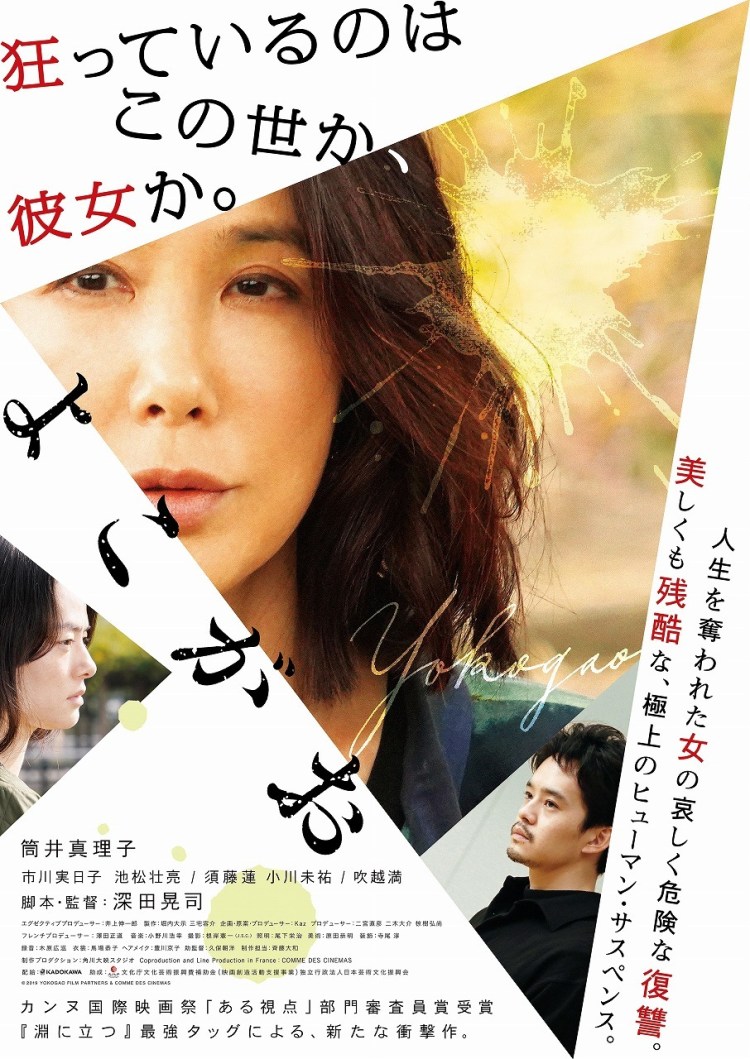
A Girl Missing (よこがお, Koji Fukada, 2019)

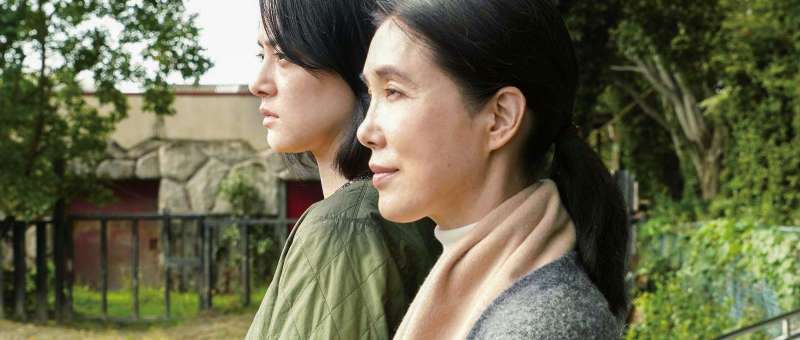
A Girl Missing poster 1In Harmonium, Koji Fukada explored the death of the family unit as a harried father found the foundations of his home eroded by a mysterious “stranger” with whom he shared an unspoken connection. A Girl Missing (よこがお Yokogao) pushes a little deeper in demonstrating how profoundly the foundations of a life can be shaken by frustrated connections, misunderstandings, and unspeakable desire. Probing deeper still, it wants to ask us on what foundations we’ve chosen to build our selfhoods, why it is that we don’t know ourselves without those tiny markers that tell us where we stand, and if it is really possible to rediscover a sense of self if we somehow go missing from our own lives.

Beginning in the mysterious second timeline, Fukada opens with the heroine changing her identity through the time-honoured fashion of a haircut. Calling herself Risa, she brushes off the hairdresser’s suggestion that they’ve met before, but she hasn’t chosen this salon because of its reputation or proximity to her home. Flashing back some months, we see the same woman looking a little softer and apparently working as a homecare nurse known as Ichiko (Mariko Tsutsui) to an elderly woman dying of stomach cancer. Ichiko’s colleagues worry that she’s becoming too emotionally involved with the Oishi household, helping the two daughters – uni student Motoko (Mikako Ichikawa) and high schooler Saki (Miyu Ogawa), study in cafes in her off hours, but she enjoys playing mother and does after all like to help. Meanwhile, she’s also happily engaged to a doctor (Mitsuru Fukikoshi) with a young son and looking forward to starting a brand-new family life of her own.

All that is derailed, however, when Saki goes missing in a suspected abduction on her way home from cram school. Thankfully, she’s found alive, unhurt, and apparently relatively well adjusted a few days later and anyone would assume the drama to be over, only it turns out that the suspect is Ichiko’s own nephew whom she briefly introduced to Saki at a cafe on the night in question. Feeling tremendously guilty and confused though she herself had nothing to do with the incident, Ichiko feels she must confess and make a formal apology to the Oishis but Motoko stops her fearing that the family will fire Ichiko and she’ll never see her again. Ichiko decides to trust Motoko and keep quiet, but it will prove to be a bad decision not least because it is in such sharp contrast to her otherwise straightforward and honest character.

The film’s Japanese title, “Yokogao” or “profile” reminds us that it is not possible to see the entirety of any one thing, only a single facet and more often that not the facet that it particularly wants you to see. Ichiko is guileless, innocent, and naive in her innate kindness. She doesn’t see how her relationship with the Oishi girls could eventually become problematic because, as a nurse, she’s used to doing what needs to be done when it needs doing. What we see of her is a woman about to marry “late” by the standards of her society into a readymade family, an intensely maternal figure looking for people who need mothering. Meanwhile, Saki’s disappearance exposes cracks in the Oishi household, Motoko’s grumpy response of “would you rather it was me?’ to her mother’s wails of “why her?” beginning to explain some of her seeming disaffection with her family.

Yet as much as there may be a maternal component in her desperation to keep Ichiko in her life, we can infer from all her plaintive looks that there is another kind of desire in play, one which she seems to regard as unspeakable. Ichiko, oblivious, does not quite realise the depth to which her accidental rejections wound the troubled young woman but equally could not anticipate the casual cruelty of her petty revenge. Upset that Ichiko is not catching her drift, Motoko leaks her connection to the case to the papers, and then tells them a secret shared in confidence to pour salt on the wound. Instantly regretful and caught in the white heat of passion, Motoko fails to realise the extent to which her desire to return the hurt done to her will only wound her more in ensuring Ichiko disappears from her life for good.

Ichiko then does something much the same, reinventing herself as “Risa” she lives in an empty apartment overlooking Motoko’s with the sole aim of taking revenge against the woman who pretended to be her friend and then betrayed her. But Ichiko does not understand why Motoko did what she did, and so her own revenge is also a misplaced act of self harm which causes her to absent herself from herself, assuming another identity better disposed to cruelty but finding it an awkward fit.

Fukada places emotional repression at the heart of all. Ichiko, despite her kindness, keeps others at a distance without entering into true intimacy with anyone, while Motoko apparently struggles to articulate perhaps even to herself the truth of her own feelings, childishly hitting back when slighted and unable to bear the possibility that she is in love with someone who cannot return her feelings. Forever at odds, they see each other only in profile. The desire for revenge destroys them both, but despite the pain and inescapability of regret, they have to find new ways of going on, making little nicks on their identities to help them remember who they really are. A melancholy tale of frustrated desires, A Girl Missing flirts with constructed identities polluted by social toxicity but leaves its heroines on (slightly) firmer ground in having at least taken what control they can over the forces which destabilise them.


A Girl Missing was screened as part of the 2019 London East Asia Film Festival.

Original trailer (no subtitles)

The Actress and the Poet (女優と詩人, Mikio Naruse, 1935)

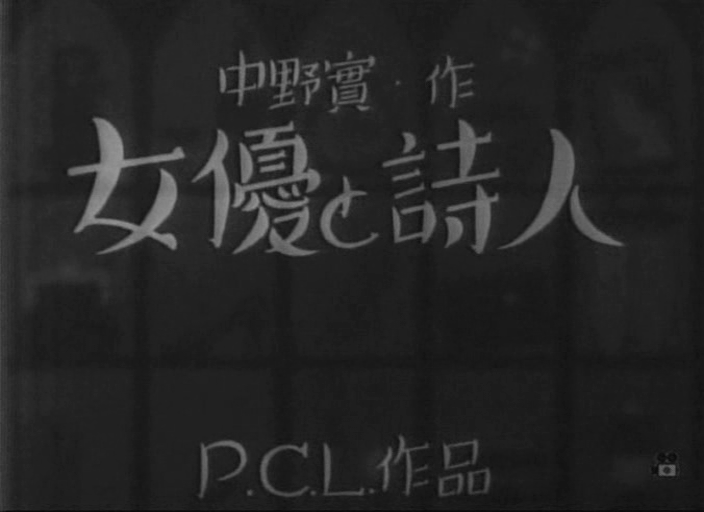
Actress and the Poet title cardAmong the directors most closely associated with the golden age of Japanese cinema, Mikio Naruse is not usually remembered for his sense of humour but his pre-war work often saw him making uncomfortable forays into the shomin-geki comedy. The Actress and the Poet (女優と詩人, Joyu to shijin), Naruse’s second film after leaving Shochiku for P.C.L, is among the more successful but also tinged with characteristic irony that says this is funny because it’s not funny at all.

The generic shomin-geki setup finds us in a small community of suburban houses where mild-mannered poet Geppu (Hiroshi Uruki) lives with his successful actress wife Chieko (Sachiko Chiba). Amusingly enough, and in a motif which will be repeated, the film opens with an high impact scene of a woman screaming after being threatened with a knife, but thankfully it turns out that Chieko and her friends are simply rehearsing for a play. The actors dispatch Geppu to fetch them some cigarettes, which brings him into contact with his no good “friend” Nose (Kamatari Fujiwara), a struggling writer who is absolutely sure his latest work is going to win a big prize which is why it’s not a big problem that he’s so behind on his rent that he’s been coming and going through the upstairs window so he doesn’t attract the attention of his landlady.

When we first meet Geppu he’s wearing a pinny and cheerfully hanging up the washing. A young man passes by on a bicycle and seems surprised, asking if he himself really did all that laundry to which Geppu somewhat improbably replies that it’s all second nature when you’ve been in the army. Even though this is obviously a very “normal” day for Geppu, the questions keep coming. Ohama (Haruko Toda), the nosy woman from next-door, remarks that everyone in the neighbourhood loves Geppu because he’s just so nice but he’s also become a hot topic with the ladies at the bathhouse because no one’s quite sure what it is he “does”. In the modern parlance, Geppu is a basically househusband who dabbles in “poetry”, or as Ohama later explains “songs for children”.

In this fiercely modern environment, it’s Chieko who wields the financial power while her husband appears not to mind trailing behind. She wears kimono but often with luxurious furs which might lead to us ask why they live in this modest suburban house rather than in the bright lights of the city, but even so the marriage appears to be a happy and progressively equal one. In fact, as we later discover, there’s never been a cross word between Geppu and his wife, which is a problem because Chieko’s latest role involves a marital tiff and she’s struggling to get to grips with it because she doesn’t know what it’s like to fall out with your spouse. To figure it out she gets Geppu to read lines with her in a situation which eventually repeats in their real life when Nose bamboozles Geppu into letting him stay in the upstairs room rent free, leading to an almost identical fight watched calmly by Nose and Ohama who think they’ve got ringside seats to a play they could never afford to see.

Nose’s intervention unbalances the couple’s relationship in that it forces Geppu to reassert his masculinity. “A promise between men is a serious thing”, Geppu affirms “I can’t just go back on it because my wife says no”. Chieko reminds him, however, that this is technically her house – she pays all the bills, while his “writing” career is good only for the odd box of sponge cake. She doesn’t like it, perhaps understandably, that he’s “invited” a ne’er do well to come and live with them without even bothering to talk to her about it. She tries to put her foot down, but Geppu remains as irritatingly passive as ever only slightly putout to have his subjugated status suddenly used against him.

Naruse ends the picture with a comic sequence in which Chieko sees the light. Thanks to her real life argument with her husband, she’s figured out how to perfect her performance but she’s apparently so method that she also begins to embrace her role as a conventional wife off stage too. Rather than Geppu letting her sleep in and cooking the breakfast himself, this time it’s Geppu wrapped up in a futon while Chieko chops veg downstairs. Nevertheless, there is a minor irony in this moment of domestic bliss in that it directly follows the news that the nice young couple who just moved in across the road have committed double suicide because of his embezzlement and subsequent debts. Neatly underlining the consumerist trends of the age, the couple wanted to die in their own home even if it was only “theirs” for a few moments. Meanwhile, Ohama and her insurance salesman husband are busy having a blazing row next-door which just goes to show that old-fashioned marriages aren’t so happy either.

Chieko superficially plays the conventional wife, engaging in a little role-play with her husband while Nose listens on from the stairwell, but theirs remains a very modern marriage in which she is free to fulfil herself outside the home and her husband is seemingly unbothered (to a point at least) by the mild censure of the local ladies who both love him for his niceness and perhaps dislike him for it too. Naruse undercuts the conventionally “happy” ending in which traditional gender roles are restored and the family rebalanced by ending on a note of irony as the home of Ohama, a traditional wife dominating her henpecked husband in a comic yet socially accepted fashion, is thrown into violent discord while all is peaceful in the decidedly modern house of Geppu.


Going the Distance (かぞくへ, Yujiro Harumoto, 2016)

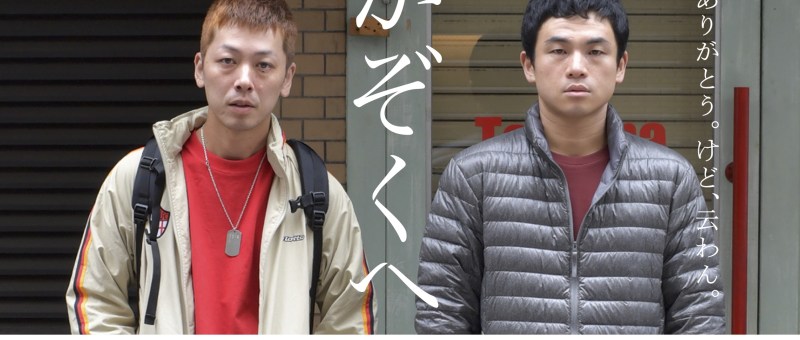
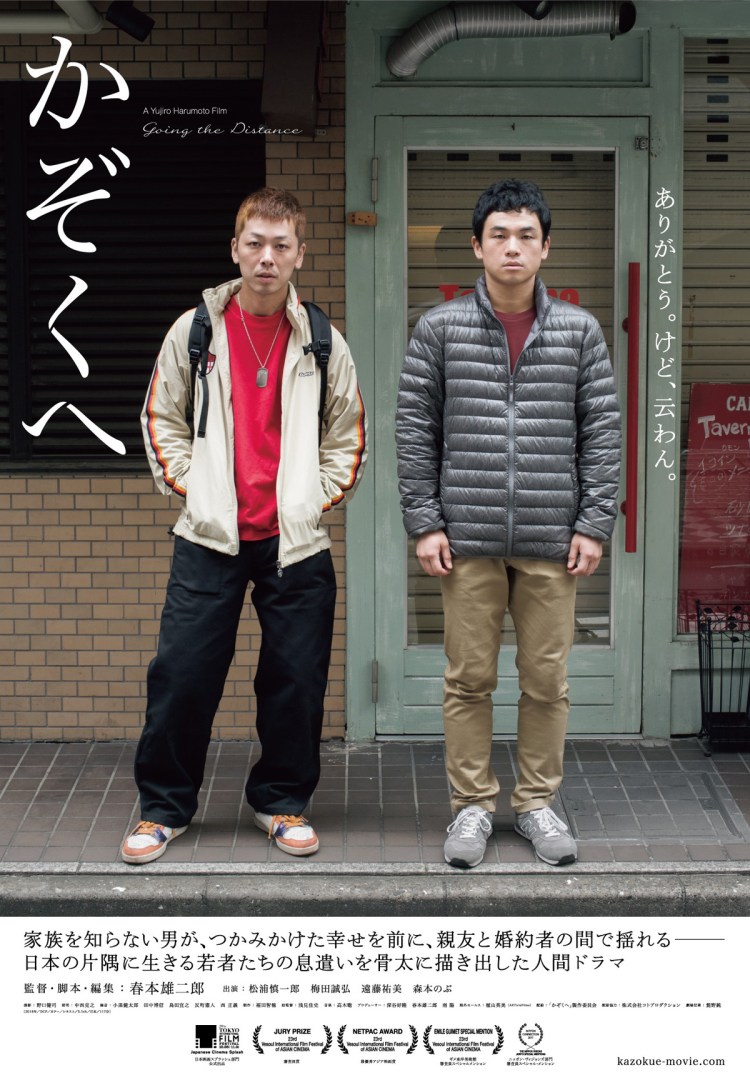
going the distance posterThe “family drama” is often regarded as Japanese cinema’s representative genre, but in the consumerist atmosphere of the late 20th century the family itself became an increasingly discredited concept. Nevertheless, it remains true that discriminating against those who have no family is the last acceptable prejudice with orphans in particular unfairly viewed as somehow untrustworthy, rejected by mainstream society, and denied both work and the possibility of starting a family of their own. The hero of Yujiro Harumoto’s debut feature Going the Distance (かぞくへ, Kazoku e) thinks he has everything finally back on track with a steady job and an engagement to a middle-class secretary, but his good heart coupled with his precarious social status seem set to ensure his new start is a non-starter.

Raised in an orphanage in the Goto Islands, Asahi (Shinichiro Matsuura) now lives in Tokyo with this fiancée Kaori (Yumi Endo) for whom he has given up his boxing career to work as a trainer in a gym. Though Kaori, superficially at least, does not care that Asahi is a man with no family, she is a little preoccupied about how it’s going to look that his “family table”  at the reception will be largely unoccupied because he’s only planning on inviting his “brother” from the orphanage, Hiroto (Masahiro Umeda), and his wife.

Hiroto still lives in Goto and works as a fisherman. Hoping to help him out, Asahi sets him up with a man from his gym, Kita (Nobu Morimoto), who is opening a restaurant specialising in super fresh fish. The meeting goes extremely well and earns Hiroto a hefty contract that convinces him he needs to take out a loan to get a bigger boat. Unfortunately, however, Kita turns out to be a crook and Hiroto ends up well out of pocket, not only for the loan but for all the fish he never gets paid for.

Feeling intensely guilty and somewhat responsible, Asahi wants to do everything he can to put things right for Hiroto, even suggesting to Kaori that they postpone the wedding so that he can give part of the money they’ve saved to help take care of his debts. As predicted, Kaori is not happy about the idea, not least because she’s repeatedly explained to Asahi that she needs to get married as soon as possible because she wants her grandmother, who is suffering with dementia, to be able to attend the wedding while she’s still well enough to know what’s going on.

Unbeknownst to Asahi, one of the reasons Kaori is so keen on her grandmother attending is that her mother almost certainly won’t. Despite telling Asahi that her mother is lukewarm on the idea but coming round, the truth is that she won’t even talk to her, rudely rejecting the invitation and vowing that she’s no interest in seeing her daughter throw her life away on a man with no family and no prospects. In fact, Kaori’s mother crassly makes a point of sending her omiai photos for potential arranged marriages to more “suitable” men – ones from “good families” matching her own class background. Kaori wastes no time in calling her a “bigot”, accusing her of indulging in an outdated and offensive prejudice against the orphaned that regards them as untrustworthy because they have no history and are not anchored to anyone who might be held responsible for their actions.

Yet, despite her anger towards her mother Kaori is not quite free of those same prejudices, snapping back at Asahi that he wouldn’t understand what she’s going through because he had no parents of his own. She keeps the drama a secret from him to avoid having to admit that her family oppose the marriage solely because he is an orphan, partly wanting to spare his feelings and partly aware that Asahi is a good and noble man who might choose to absent himself rather than force her to choose between the man she loves and her family.

Meanwhile, Asahi does something similar in refusing to confide in Kaori about everything that’s going on with Hiroto, partly out of guilt and embarrassment, and partly out of shame in knowing that he is on some level betraying her by choosing to save Hiroto rather than prioritise their marriage. He wants to make things right, put them back to the way they were before, but he has an impossible choice – either reject his responsibility to his brother who is also a good and kind man and would not want to cause him trouble in his relationship, or neglect his new responsibilities to his soon-to-be-wife.

Unfortunately, the couple elect to go on deceiving one another, intending to protect but causing only more harm. It may be the case that they’ve rushed into marriage because of Kaori’s grandmother’s precarious health and Asahi’s hopes for a solid family foundation, but their previously happy relationship is eventually eroded by a gradual disillusionment born of refusing to rely on each other, continuing to fight separate battles rather than combine their efforts to fight them together. Faced with the realisation that he may have ruined his relationship by his own foolishness in trying to help a friend with a problem that was really none of his responsibility, Asahi begins to reject Hiroto, giving up on the idea of “family” in its entirety in mistaken resentment towards his brother for a series of decisions that were entirely his own. Nevertheless, what he discovers is that true family isn’t always about blood ties but about people who will always be there for you no matter what you do. Asahi wasn’t quite as alone as he thought he was, but only by admitting his mistakes, accepting his responsibilities, and finally allowing himself to confide in and rely on others can he truly begin to build a family anchored by something deeper than blood.


Going the Distance was screened as part of the 2019 Five Flavours Film Festival.

Original trailer (English subtitles)

Flowers of Evil (惡の華, Noboru Iguchi, 2019)

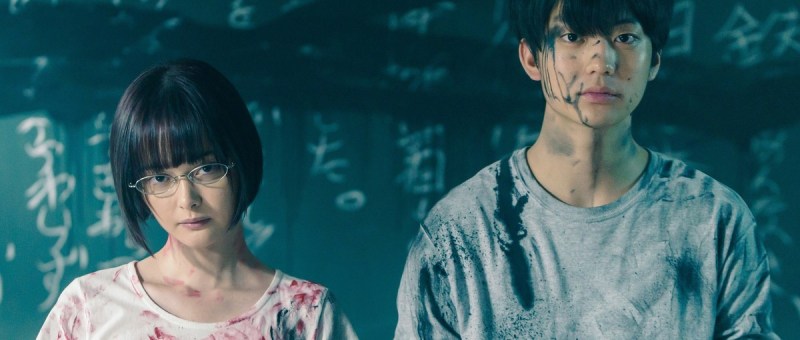
Small-town ennui is something familiar to many who’ve found themselves feeling somewhat out of place in the place they’ve always been, but rebellions usually take less obvious forms than the nihilistic rejection of bourgeois respectability enacted by the conflicted hero at the centre of Noboru Iguchi’s Flowers of Evil (惡の華, Aku no Hana). Iguchi is best known as a director of made for export splatter exploitation, so it might come as a surprise to his fans to see him take on the admittedly dark but largely gore-fee adaptation of Shuzo Oshimi’s coming-of-age manga.

Takao (Kentaro Ito), a “regular” high school boy, likes to read “difficult” books such as the poetry collection by Charles Baudelaire from which the film takes its title. He feels himself somewhat above his surroundings, but superficially conforms to the ordinary world around him. Like many of his classmates, he’s developed an adolescent crush on the school’s prettiest girl, Nanako (Shiori Akita), but unlike his friends views her as his “muse”, a pure and untouchable figure of unspeakable desire. Nipping back to the classroom alone to retrieve a forgotten book, he spots Nanako’s gym bag lying on the floor and cannot resist opening it, burying his face in her clothes. Panicked after hearing someone nearby, he takes the bag home with him.

Everyone immediately knows that a “pervert” is responsible for the theft, they just don’t know who it is. Except for the class’ resident strange girl, Sawa (Tina Tamashiro), who apparently witnessed Takao’s descent into perversion in real time. She makes him a deal – write an essay all about what a big pervert he is and she’ll kept his secret in friendly complicity seeing as she is a kind of “pervert” too. Sawa, who is much more obviously “different” than Takao and completely unafraid of embracing it, is convinced that their town is entirely inhabited by “Shit Bugs”, and they are the only elevated beings. Uncomfortable with her own desire, Sawa’s behaviour becomes increasingly intense when Nanako unexpectedly expresses an interest in Takao, apparently impressed that he was so “upfront with his feelings” and willing to stand up for Sawa when she was accused of being a (but not the) thief.

Takao tells Sawa that he just wants to be “normal”, to be the kind of man Nanako could desire. Just another confused teenage boy, he doesn’t yet know who he is or what he feels and is, in a sense, consumed by the sense of emptiness that comes of lacking self-knowledge. He masks his sense of intellectual inferiority by feigning sophistication, spending his free time in second hand bookshops reading the accepted canon with a typically teenage obsession with death and despair. But as he is later forced to admit, he did so largely in order to feel superior. He doesn’t truly understand much of what he read and lacks the maturity to accept his confusion. Nanako challenges him in more ways than one – by calling him on his wilful repression of his desires, and by confronting him about his obsession with Flowers of Evil, a “difficult” book which try as she might she can’t understand. She doesn’t “get” Baudelaire, and she doesn’t “get” Takao because of it, but Takao doesn’t “get” Takao either because he thinks he’s a book filled with blank pages, that if you open the cover there’s really nothing interesting there, just a giant void of emptiness.

Three years after stealing the gym bag, Takao describes his new environment as infinitely grey as if devoid of any sense of life, whereas the climactic summer is coloured by a vibrant greenery he claims to be equally oppressive. Fed up with small-town life, both Takao and Sawa long for a mythical “beyond” on the other side of the mountains which trap them within the claustrophobic environment of their provincial existence. They kick back against small-town conservatism with childish shows of resistance which culminate in a very public act of self-harm dressed as societal attack, but remain unable and unwilling to address the real cause of their frustration in their adolescent inability to accept that desire itself is not “perverse” or somehow sullying some grand romantic notion of pure and innocent love.

Unable to process his desires, Takao remains unable to progress into adulthood and become, as Sawa later chides him, a “regular human”. Normality is, however, what he eventually chooses, reverting to the anxious bookworm he always was only having moved forward in learning to let something go, whereas Sawa perhaps feels that she has no other option that to accept her own “perversion” and be exiled by it. Takao discovers an internal “beyond” and tries to share it with Sawa, but she is looking for something else and cannot join him in the “regular” world to which he is always going to return. Iguchi dedicates the film to all those who are or were tormented by youth, allowing his tortured hero to find his path towards an integrated selfhood, but resists the temptation to belittle his suffering as he strips himself bare to exorcise the emptiness inside.


Flowers of Evil was screened as part of the 2019 Five Flavours Film Festival.

Original trailer (no subtitles)

Under Your Bed (アンダー・ユア・ベッド, Mari Asato, 2019)

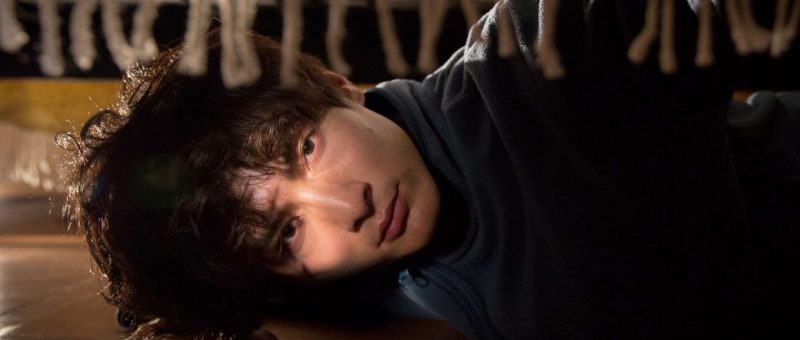
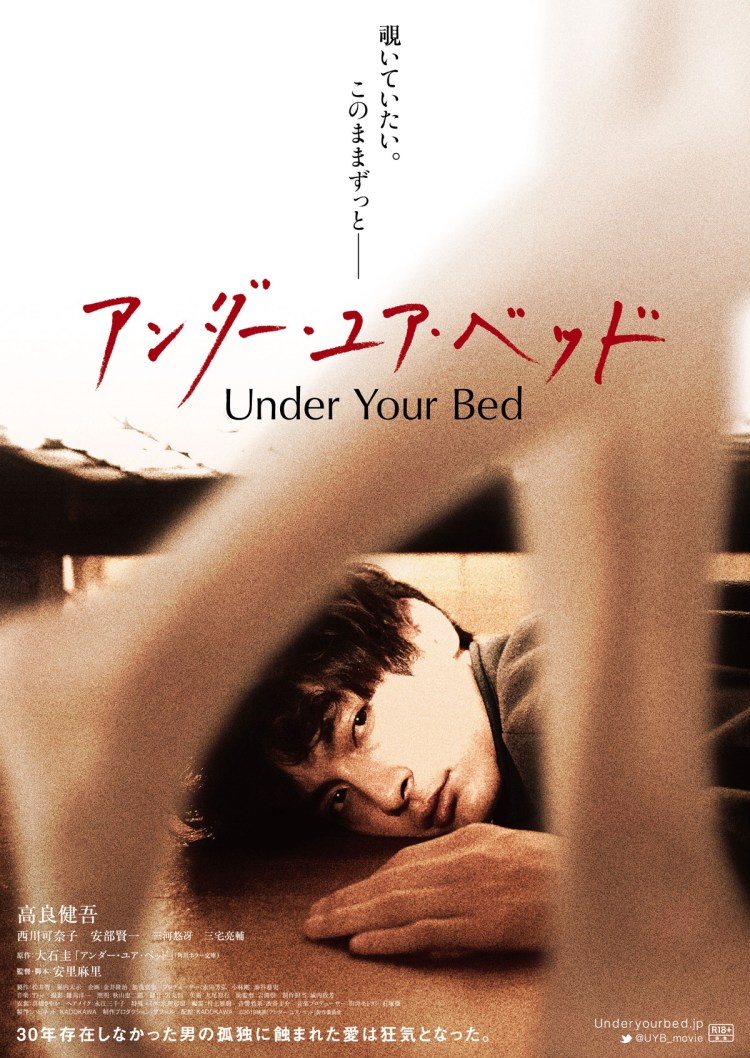
Under Your Bed poster 1Japanese cinema has something of a preoccupation with invisible men, but there’s rarely been as empathetic an exploration of benign alienation as Mari Asato’s Under Your Bed (アンダー・ユア・ベッド). Asato’s lonely stalker is a creep and a voyeur, but his problem is his innate passivity born of defeatism in which he has, despite his tendency to fantasise, already accepted that he lives in a kind of other world unable to touch his fellow humans from whom he remains painfully separated as if by a sheet of invisible glass.

Tropical fish enthusiast Mitsui (Kengo Kora) is one of those people who tend to be forgotten. He doesn’t feature in his high school graduation photo, and nobody, not even his parents, has ever noticed. Harbouring intense feelings of worthlessness linking back to a childhood memory of abandonment after almost dying when his father left him sitting in a hot car, Mitsui has no friends or much of a life to speak of and regards himself as a kind of non-person invisible to others. Longing to be seen, he treasures the precious memory of the only time he has ever heard someone else call his name which occurred 11 years previously when he was a university student.

Mitsui deeply believes that this memory is the only thing that gives his life meaning. Hiring a private eye to track down the woman in question, Chihiro (Kanako Nishikawa), he quits his job and opens a tropical fish store in the town where she lives, apparently now married with a baby. What he discovers, however, is that this Chihiro is quite different from the one of 11 years previously. Hoping to figure out why he begins watching her intensely, swiping a key to the house after she drops into the fish shop by chance and he offers to set her up with a tank full of colourful guppies. What Mitsui eventually discovers is that Chihiro is also living a somewhat invisible life as a victim of domestic violence unable to escape the tyrannical control of her respectable salaryman husband.

Facing a dilemma, Mitsui doesn’t so much want to rescue Chihiro as preserve his peculiar level of access to her even if seeing her subjected to such degrading and inhuman treatment quite obviously disturbs him. Mitsui can’t swoop in and save her because he’d blow his cover and lose the fragile connection to her life he’s convinced himself he has. Never daring to hope he could get her attention through an act of white knight salvation, he nevertheless fantasises about a different version of himself – one that is capable of providing comfort and protection rather than simply sitting and watching while others suffer.

Ironically enough, however, his passive presence seems to make a difference. Shifting to a brief voice over from Chihiro, we discover that the flowers Mitsui has been sending with a card wishing her happiness are the only thing that’s been keeping her going. What some might regard as a cause for concern has given Chihiro strength in proving that there’s someone else out there who cares about her. Yet this change or at least potential restoration also endangers Mitsui’s plan as Chihiro’s growing conviction that she can protect herself, spurred on by the invisible support of the flower sender and others, threatens to dissolve the fragile fantasy world he’s constructed.

Mitsui is forced to wonder if his obsession is equal parts delusion, that perhaps the very events which define his life are part fabrications. His intense conviction that he is a forgettable person is borne out when he realises that Chihiro not only does not recognise him, but apparently does not even remember anything that passed between them 11 years previously. To her, he is probably just a random guy she had coffee with one time, whereas to him she is the woman who changed his life by showing him what true happiness could feel like simply by saying his name. Spotting another invisible person like himself reminds Mitsui what he looks like from the outside and of the potential dangers of those like him when he finds out that the man later went out and stabbed his boss’ wife because she gave everyone except him a holiday souvenir. Yet there is a strange kind of positivity in Matsui’s gentle acceptance of his invisibility. Resenting nothing, it’s not revenge he wants but recognition and though he may eventually figure out that what he really desired was something more, all he needs is the possibility that Chihiro may one day say his name again.

An invisible man, Mitsui longs to “seen” but lives a bug-like existence, hiding in the places no one thinks to look. Proudly telling us that the guppies in his shop are the 34th generation of the guppies his mother once gave him, Mitsui reveals that he flushes the subpar males, with whom he inevitably groups himself, away in order to preserve the beauty of the whole rather than allow it to descend on a path towards mediocrity. Like his beloved fish, Mitsui remains trapped within an invisible tank unable to reach beyond the glass, resigned to looking but not touching. Nevertheless, his presence is eventually felt, unseen but recognised and finally rewarded with a single long-awaited word.


Under Your Bed was screened as part of the 2019 London East Asia Film Festival.

Original trailer (no subtitles)

An Inn at Osaka (大阪の宿, Heinosuke Gosho, 1954)

inn at osaka cap 2Heinosuke Gosho may be most closely associated with the Chekhovian interplay between laughter and tears, but what are you to do when life is so unutterably miserable that levity seems almost offensive? By 1954, many might have assumed that society was on the way to recovery, that the promises of the new democracy so proudly affirmed in the post-war constitution would be available to all paving the way for a freer and fairer society. Of course, that wasn’t quite the case and many found themselves trapped on the periphery of the burgeoning economic miracle in which unemployment was high and the bitterness of the times had led many to believe that human decency was a luxury they couldn’t afford.

Made a year after his renowned masterpiece Where Chimneys are Seen, An Inn at Osaka (大阪の宿, Osaka no Yado) is a much less cheerful affair in which suicide and degradation linger permanently on the horizon. The hero, Mita (Shuji Sano), has been exiled from Tokyo, demoted to the Osaka office after slapping his boss in argument over immoral business practices. Much reduced in circumstances, he has been unable to find a lodging house that suits his budget, the local barman lamenting that these days most of the hotels in the area have been co-opted by sex workers. Just at that moment, a dishevelled old man pops up and says he knows of a good place where the rent is reasonable and the innkeeper kind. As you might expect, it turns out that he works there. The innkeeper is his sister and though she is not particularly nice, the place is warm and friendly with three kindly maids – Orika (Mitsuko Mito) who is constantly pressed for money by her no-good husband, Otsugi (Hiroko Kawasaki) who is forced to live apart from her son, and “modern girl” Oyone (Sachiko Hidari) who is much younger and having a fling with the inn’s other longterm resident, Noro (Jun Tatara), a sleazy gentleman who likes to throw his weight around because he co-signed the loan on the hotel.

In one sense, the city of Osaka itself is being painted as a “fall” from sophisticated Tokyo, an earthier place where people do what they have to to survive. This Mita learns to his cost when drunken geisha Uwabami (Nobuko Otowa) picks up his “luxury English-made blanket” and peels off a thread which she burns to expose its smell. Wilier than the innocent Mita she tells him he’s been had, lamenting that it’s “Osaka’s shame” that they wilfully trick people from Tokyo. Mita is irritated, slightly hurt and embarrassed to have been deceived, but affirms that it hasn’t damaged his views on Osaka because in the present society everyone is being cheated by someone somewhere. In any case, he allows himself to be bamboozled by the innkeeper’s brother (Kamatari Fujiwara) into tracking down the teenage girl who sold it to him, Omitsu (Kyoko Anzai), who seems upset, explaining that she bought the blanket in good faith and has been tricked herself. During their visit, Mita notices that they’re in the middle of some sort of shamanistic ritual over the sickbed of her ailing father and feels pity for her but stops short of cancelling the debt there and then.

Not cancelling the debt even though he can see Omitsu never meant to trick him and cannot afford to pay him back, is part of his rather sanctimonious rebellion against the immoralities of the post-war society. He feels wronged and thinks that getting the money back for the blanket will somehow put things right, but like many of his attempts to help those in need it eventually backfires. Mita is a good man, compassionate and honest, but he’s also disappointingly conservative in ways he hasn’t quite realised. Uwabami, who has fallen in love with him, later chides Mita that he is like a star looking down on everything from above. He doesn’t quite understand what she means, failing to grasp that what she’s telling him is that though she can see that he cares, he has a tendency to view himself as somehow “better” than the world around him and lives in silent judgement of those he believes to be fundamentally different from himself.

After a brief argument, Uwabami confesses that she feels trapped and miserable in her impossible geisha existence, just trying to make enough money to survive when too old to ply her trade. She can’t quit because she’s responsible for her whole family – her younger brother has just been laid off from his railway job and his children will go hungry without her money. She provokes Mita a little, chastising him for not caring about her on a human level only for Mita to counter that he likes her but they live in “different worlds”. Disappointed, she laments that she thought they were the same, realising that Mita’s conception of the world is defined by ideas of middle-class respectability and that he views her as occupying a lower order, forever walled off from “decent” people like himself. Though he treats her warmly and regards her as a friend, there can never be anything more between them than that.

Omitsu later shows him something similar. Having scraped together some of the money to pay him back, she arrives at the inn only for Mita to try to refuse it. Otsugi offers her some sewing work for Noro who later takes advantage of her, gossiping with the maids that she was a “bargain”. To make matters worse, Omitsu gets caught on the way out and is berated by the innkeeper for bringing the hotel into disrepute. Mita starts to feel guilty. This is, after all, largely his fault – he pushed her about the blanket out of pettiness and brought her to the inn where she has debased herself to get back the money he took from her. He tries to return it but it’s already too late. “Why do you always insist on being good?” she asks him, partly offended that he won’t take her money because he now thinks it’s tainted by immorality. “I just want to trust in people” he tells her, beginning to realise that his well-meaning gesture is both patronising and futile because if he’d really cared about helping Omitsu, he could have done it before.

Mita is good person, but like everyone else he’s flawed and human. He genuinely wants to help, for the world to be better than it is, but in his goodness allows himself to be self-involved and insensitive. The reason he didn’t get fired from his job even for so great a transgression as slapping the boss, is that his grandfather founded the company. In an effort to break with the past, he decides to sell his grandfather’s expensive French pocket watch, but retains the chain as if unable to definitively sever the connection to his privilege. To prove that he’s done it for symbolic and not financial reasons, he spends the money taking Otsugi and Orika on a day trip to Osaka castle after Orika declines his offer of money of which she is in desperate need.

“Money’s everything, what happened to humanity?” Mita asks himself, still not quite aware of his position within the system. Mita refuses to conform to the demands of the post-war era as exemplified by his boorish boss who sneeringly asks if he’s a “socialist” while dismissing him as an “intellectual” and doing illicit backroom deals to get ahead, but he does so largely passively and with little more than resentment. At his farewell dinner, he reflects that had he not come to Osaka he might have quit his job but now he’s determined to stay and try to make things better. There might be something a little sanctimonious in his new found fire born of living among the poor now he’s on his way back to Tokyo, but he has perhaps awakened to his failings and is resolving to do better.

Meanwhile, the innkeeper finds the strength to break with the odious Noro, but unlike Mita decides to throw herself into the abyss of modernity by turning the hotel in a rent by the hour kind of place complete with Western beds and tacky decor. She too feels there are two kinds of people, refusing Otsugi time off to see her son, barking that “a dog doesn’t forget what it owes its master”, while Otsugi remains powerless, aware she’s entirely out of options as a young widow in the cruel post-war economy. Orika too gives up on changing her life after finding herself unable to separate from her no-good, drunken, violent, husband, while Oyone alone seems excited by the new job possibilities at the inn, and Omitsu, despite having coldly exclaimed that she’d do whatever it takes to survive, throws herself into “honest” work, unable to attend Mita’s leaving do because now her life is one of ceaseless industry which provides her no opportunity for rest. “None of us can say we’re really happy”, Mita laments, “let’s have the dignity to laugh in the face of unhappiness”. Everybody’s tired, everybody’s disappointed and afraid, but they haven’t lost their humanity and when there’s really nothing else, all you can do is laugh. 


Short clip (no subtitles)

Case of the Disjointed Murder (不連続殺人事件, Chusei Sone, 1977)

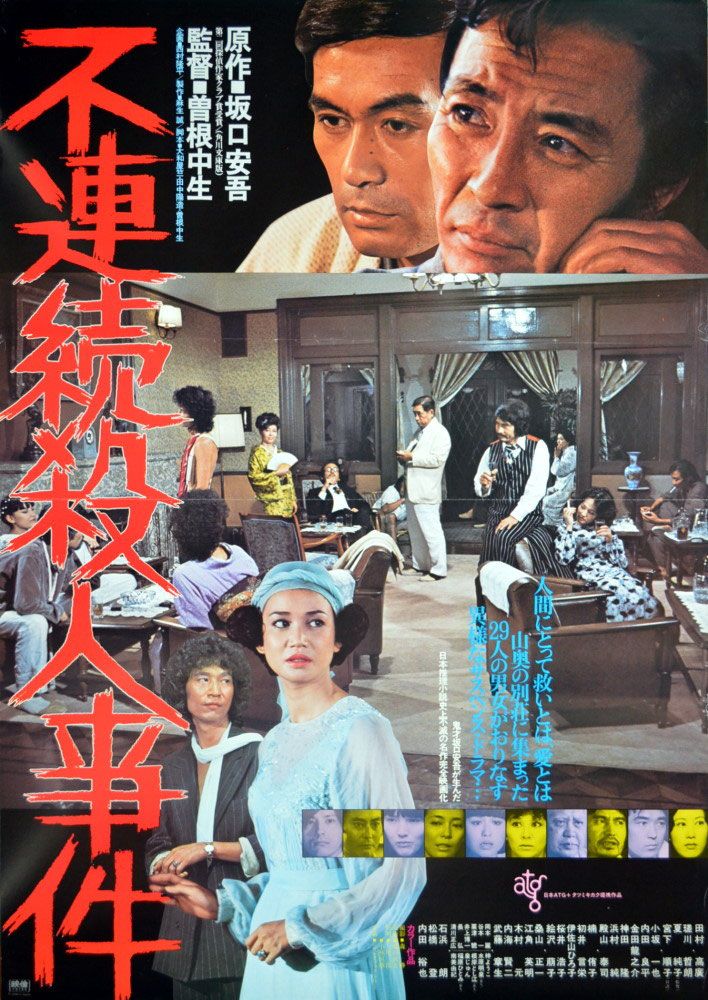
Case of the disjointed murders posterJapanese cinema of the 1970s fell hard for the prestige murder mystery. Following the success of The Inugami Family, an early and unexpected hit thanks to Kadokawa’s “innovative” marketing strategy, multi-cast detective dramas dominated the box office for the rest of the decade. Meanwhile, ATG had been known for serious and high-minded avant-garde cinema throughout the 1960s but its brand of left-leaning, politically conscious, arthouse-fare was tantamount to box office poison in the increasingly consumerist post-Asama-Sanso world. ATG’s Kindaichi-centric Death at an Old Mansion, updated to the present day, pre-dated Ichikawa’s series for Toho by a whole year and perhaps signalled their resignation to shifting into the mainstream. By 1977, that transition was perhaps complete with former Nikkatsu Roman Porno director Chusei Sone’s adaptation of a classic serial penned by Ango Sakaguchi, an author of the “Buraiha“ school well known for chronicling post-war aimlessness.

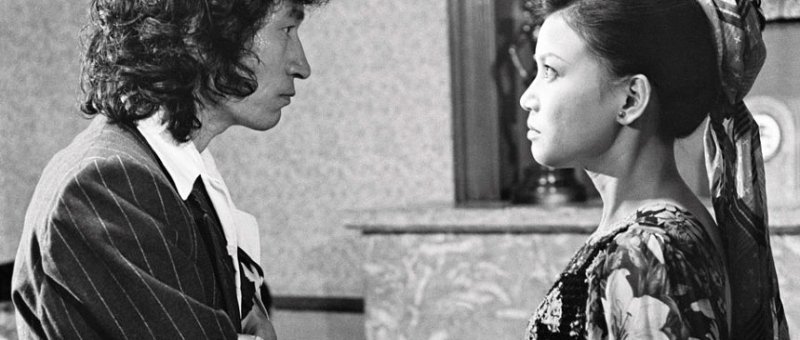
Set in the summer of 1947, Case of the Disjointed Murder (不連続殺人事件, Furenzoku Satsujin Jiken, AKA Unrelated Murder Cases) is a classic country house mystery in which a series of high profile writers are invited to a mansion owned by a wealthy family, the Utagawas. Only, as it turns out, many of the letters of invitation are forgeries or have been doctored so that several unexpected guests have arrived including dissolute artist Doi (Yuya Uchida) whose presence is particularly awkward because he is the former husband of the host Kazuma’s (Tetsuro Sagawa) new wife Ayaka (Junko Natsu). Soon enough, one of the guests is murdered, and then another, and still more, seemingly for no real reason. Amateur detective Kose (Kazuya Kosaka), one of the “unexpected” guests, tries to piece the crime together to prevent its expansion but finds himself outflanked by a lack of material evidence.

Sakaguchi’s original tale ran as a newspaper serial which promised a cash prize for anyone clever enough to identify the murderer(s) before the truth was revealed as it eventually is in true country house mystery fashion with the detective explaining everything in a lengthy monologue while all the interested parties sit around a dinner table. The gamified nature of the serial is perhaps the reason for the large cast of characters comprising of Utagawa family members, the literary house guests, and staff all of whom become mixed up in the ongoing crime drama which Kose comes increasingly to believe is engineered rather than random as it might originally seem.

The “supposed” random chaos of the the “unconnected” murders is a key part of Sakaguchi’s interrogation of post-war anxiety. For a time it seems as if these mostly quite unpleasant people have taken the opportunity of being trapped within a claustrophobic environment to air out their own grievances with each other in an atmosphere already tainted with violence and resentment. Meanwhile, the moral corruption of the Utagawa household continues to come back to haunt them in the sexual transgressions of the late grandfather who apparently fathered several illegitimate children in addition to those from multiple marriages. The half-siblings bring additional strife into the Utagawa home in Kazuma’s incestuous desire for his half-sister Kayoko (Hitomi Fukuhara) who returns his affections and even hopes to marry her brother, while he has also transgressed by “buying” Ayaka from her venal first husband Doi.

As in most Japanese mysteries, however, the motives for murder turn out to be banal – simply monetary greed and seemingly nothing more even if backed up by a peculiar kind of romanticism. Such unbound desire for riches is perhaps another symptom of the precariousness of the post-war world in which individual survival is all in a chaotic environment where financial security is more or less impossible for those not already born into wealth. Kose begins to solve the crimes through the “psychological traces” the killer(s) leave behind, the various ways in which “scenes” are calculated and contrived but fail to entirely mask the truth which lies behind them.

Which is to say that the mechanics behind the killings ultimately become secondary to their psychological import in which Kose analyses superficial relationships to uncover the depths which underpin them and their implications for a conspiracy of crime. This persistent amorality in which human relationships and connections are subverted for personal gain is yet another example of post-war inhumanity in which the corruption of the war has destroyed the “innocence” of pre-modern Japan and provoked nothing more than a moral decline born of a confused anxiety and a generation struggling to adjust itself to a new reality.

Death at an Old Mansion aside, the ‘70s mystery boom had a peculiar obsession with post-war crime in the comparative comfort of the economic miracle. 30 years on, society was perhaps ready to ask more questions about an intensely traumatic moment in time but equally keen to ask what they might say about another anxious moment of social change only opposite in nature. No longer quite so burdened by post-war regret or confusion, some began to wonder if consumerism was as dangerous as poverty for the health of the national soul, but nevertheless seem content to bask in the essential cosiness of a country house mystery in which the detective will always return at the end to offer a full and frank explanation to a roomful of compromised suspects. If only real life were so easy to explain.


Original trailer (no subtitles)

Eternal Heart (不壊の白珠, Hiroshi Shimizu, 1929)

Eternal Heart still 1

Hiroshi Shimizu is most often remembered for his sensitive depictions of childhood, but his career, which spanned more than 160 films many of which are presumed lost, was much more varied than might be assumed. His earliest completely extant feature, 1929’s Eternal Heart (不壊の白珠, Fue no Shiratama, AKA Undying Pearl), is a case in point. Set in the heady days of early Showa long before militarism took hold, Eternal Heart bears early witness to Shimizu’s distrust of romantic solutions as its wounded protagonists are forced to accept that they have lost out in the great game of love and there’s nothing they can do about it except learn to endure their sadness.

The heroine, Toshie (Emiko Yagumo), is an earnest young woman working as a typist. She has developed a crush on a nice young man, Shozo (Minoru Takada), who works at the same company but unfortunately for her, her “modern girl” sister Reiko (Michiko Oikawa) has taken a liking to him too. To Reiko, Shozo is just one of the guys she likes to string along, but to the seriously minded Toshie he’s the only man she’ll ever love. Plucking up the courage, Toshie writes a cryptic note asking to talk to Shozo about something important and has it sent to him in the interoffice mail to avoid the embarrassment of giving it to him directly. In a spectacular case of bad timing, however, she discovers that Shozo has proposed to Reiko. He thinks the letter is about the possible marriage and that perhaps Toshie is worried he’s not a suitable person to become her brother-in-law, never dreaming that Toshie herself meant to declare her love to him. Hugely embarrassed, Toshie does not handle the situation well but agrees to put a good word in with her mother, after all she does think that Shozo is the best of men and so could never speak ill of him.

The marriage is agreed and Toshie tries to make her peace with it, only to have some kind of episode at the wedding party that leaves Shozo feeling guilty, as if he might have somehow alienated his new sister-in-law. Meanwhile, Toshie also receives the solicitous attentions of the company’s boss, Katayama (Arai Atsushi), a middle-aged widower with three children who makes a clumsy pass at her in the coach home but later apologises and embarks on a more appropriate style of courtship.

The irony is that Shozo and Toshie are actually perfectly suited, only he never saw her because he was distracted by her sister’s modern sparkle. It would be easy enough to see the contrast between the two women as one between tradition and modernity, Toshie the perfect exemplification of traditional Japanese values and her sister the avarice of the flapper generation, but the distinction is more nuanced than it might at first seem. Despite her presentation as a “traditional” woman, Toshie is more progressive than her sister in that she has made a free choice to be a working woman and takes her job seriously, quickly becoming irritated by those who don’t, whereas Reiko is never in search of direct independence only of the freedom to move between one man of means and another. Toshie wants real love, but also her independence and perhaps does not feel that one must necessarily conflict with another.

While the relationship between Shozo and Reiko sours as she becomes bored with his niceness and lack of consumerist avarice, Toshie finds herself filled with hostility towards her former object of affection and consenting to date Katayama partly in romantic rebound. Though he eventually turns out to be a little nicer than that first unpleasant incident in the taxi might have suggested, Toshie cannot escape the sense of social inferiority which keeps her in a subordinate position to a man who ought, in her view it seems, to be her equal if they were married. On an abrupt visit to his family home, she finds herself waiting in the hallway where Katayama’s precocious son (Shoichi Kofujita) mistakes her for the new maid, while his daughters and nieces, dressed in the modern style, openly mock her for being a career woman, suggesting that “typist” is a synonym for “loose woman” while Katayama fails to help the situation by countering only that “some of them are decent”. In response, Toshie calmly and confidently reaffirms that she is proud of her job and ashamed of nothing, only for the kids to chime in with a show of banging a keyboard as if it were something that a baby could do for amusement and little more than noisemaking.

Toshie leaves humiliated, but seemingly continues seeing Katayama at least superficially. It’s at this point she re-ecounters Shozo, who now has something important he wants to discuss with her. Having married Reiko believing her to be playful and innocent, Shozo has awoken to her coquetry and figured out she’s been going on drives with the moustachioed man we saw her glare at on the train on her honeymoon. The implication is that Reiko is only dating the other guy, whom she knows to be married with children, because he has a fancy car – something Shozo showed no interest in getting even if he had the money because like Toshie what he wanted was love. Shozo is understandably hurt and angry but wants to reconcile. Toshie vows to help him, overcoming her timidity to head into one of the modern bars frequented by her sister to convince her to come home, which she does but only to collect her things. Reiko claims that it’s Shozo who is being “selfish” for asking about her life before their marriage. In that she might have had a point, but it’s not something Shozo particularly cared about and he is not in that sense jealous only confused and embarrassed. Reiko refuses to accept her role as a wife, but unlike Toshie she never means to be independent and decamps to the home of her married lover, presumably intending to live off him until something better comes along.

In that sense, Reiko’s “modernity” is not so much the problem as her innate selfishness which the modern world perhaps enables. Reiko, amoral, claims her individuality by reserving the right to do as she pleases ignoring both social convention and other people’s feelings. She married Shozo because he was kind of a catch only to grow bored with him and wonder if she might do better. Toshie, meanwhile, nurses her broken heart with as much grace as she can manage, desperately trying to save her sister’s failing marriage in order to preserve Shozo’s happiness more than to avoid the scandal of marital breakdown. Despite his disillusionment with Reiko’s Westernised “modernity” Shozo finds himself considering emigrating to America in order to escape his heartbreak, resolving that a separation would be “socially unacceptable” and hoping that Reiko will continue to live as “Mrs. Narita” at least superficially even in his absence. Toshie loses Shozo twice. Having married her sister there was no longer any way for her be with him other than as a relative, but now she must watch the pearl her sister cast aside sail away from her never to be seen again. United only in heartbreak they part, Toshie selflessly reflecting on Shozo’s sadness rather than her own, but in even in the midst of her disappointment she stands stoically alone, independent and self-possessed like truly “modern” woman.