Dreams on Fire (ドリームズ・オン・ファイア, Philippe McKie, 2021)

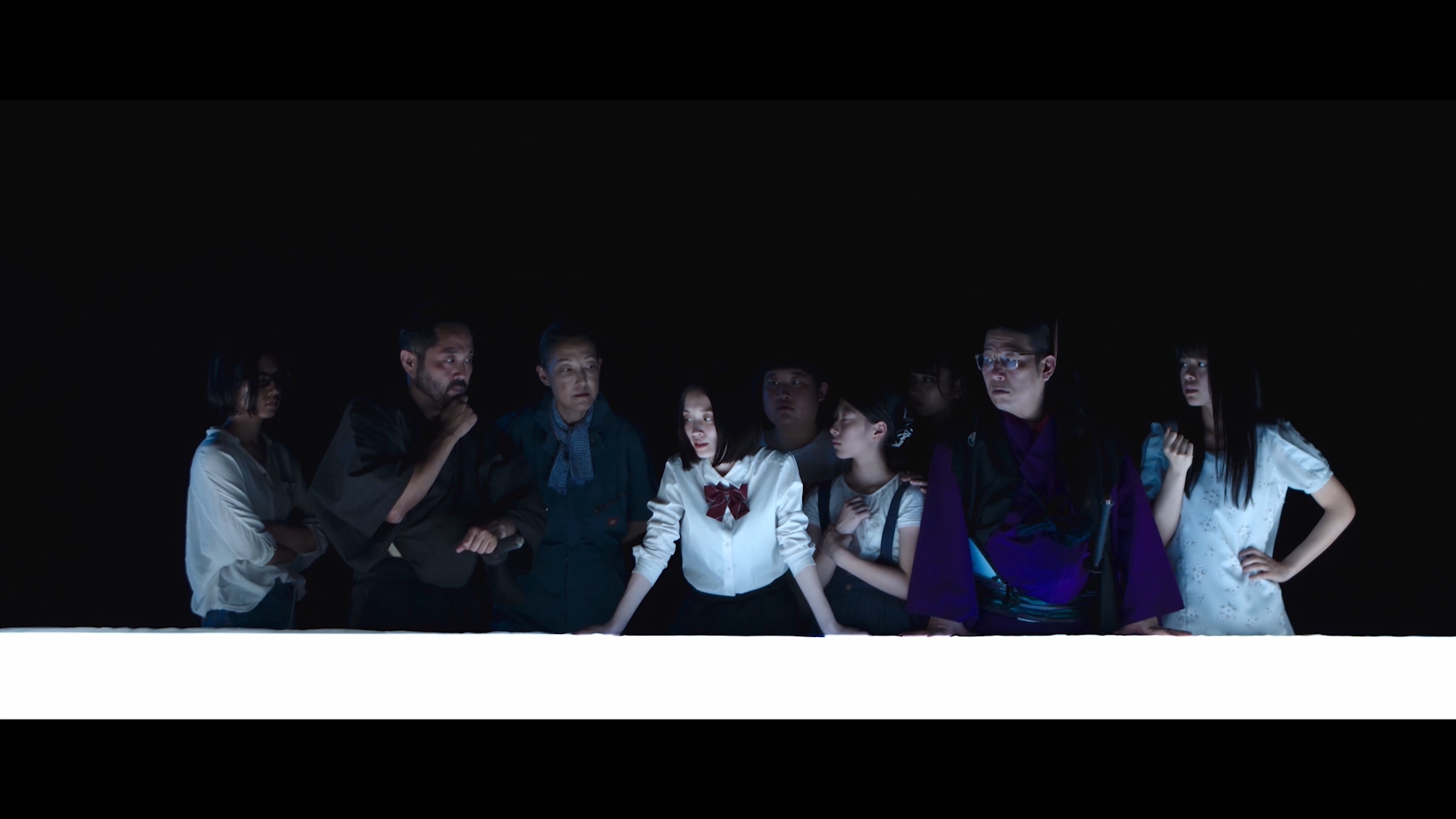
“A dancer must always be careful” the heroine of Philippe McKie’s Tokyo odyssey Dreams on Fire (ドリームズ・オン・ファイア) is warned, though her passage may prove smoother than that of many small town girls coming to the big city in search of fame and fortune. Nevertheless, her progress will take her through the unseemly underbelly of the entertainment industry rife with exploitation and duplicity to the relatively comforting world of fringe subcultures where mutual support is a way of life and failure merely another kind of opportunity. 

As a young girl, Yume (dancer and model Bambi Naka in her first leading role), whose name literally means “dream”, is captivated by an avant-garde dance performance and determines to become a dancer herself though her authoritarian father (legendary butoh dancer Akaji Maro) does not approve of her artistic ambitions and attempts to forbid her from leaving for Tokyo but she defies him and leaves anyway. Once there, however, she finds herself struggling to survive living in tiny cubical rooms and able to support herself only by working on the fringes of the sex trade in a cosplay hostess bar dressed as a schoolgirl. She pursues her dancing dream by visiting underground hip hop clubs but receives the first of many setbacks when she’s voted out of a dance off in the first round in favour of a talented child in an improbably snazzy outfit. 

Nevertheless, as the first of her teachers, who happened to see and admire her performance, tells her the humiliation of losing only smarts so much because you care which is the kind of pain you can easily repurpose for motivation. This is a motif which will be repeated in Yume’s life which proves nowhere near as dark or depressing as one might assume though it’s true she continues to experience setbacks and disappointments while occasionally doubting her vocation as a dancer in the face of seemingly constant failure but always rescued by another hopeful who saw and liked her performance even if the judges might have preferred someone else. 

Yet as she finds out, dance talent isn’t all it takes in the contemporary arts scene. An audition she might otherwise have booked is lost at the last moment when she confesses she’s not got many followers on social media, the interviewer patiently explaining that she might be a better dancer than anyone in their current troupe but their business is built on “image” and dependent on their online reach so someone with no profile is of not much use to them though they’d love to see her again once she’s successfully built her “brand”. Conversely, a client at another job working the floor show at an S&M-themed bar gets her a job coaching an aspiring underground idol who apparently can’t dance for toffee, but once she gets there Yume quickly realises the young woman’s lack of aptitude is a result of her exploitative treatment at the hands of the idol industry. Apparently not allowed to change her outfit even if it smells she’s been instructed not to eat to keep her weight down which of course leaves her lightheaded and low in energy, an unhelpful combination for learning complicated dance routines. On the way out, Yume hears the other members of the band bullying her though there’s nothing she can do to help. 

Meanwhile, she finds it increasingly difficult to weigh up the degrees of exploitation she’s willing to accept from her increasingly manipulative boss at the hostess bar (Masahiro Takashima). Her first friend, Sakura (AV actress Okuda Saki), had taught her the ropes cautioning her never to let anyone touch her in ways that make her uncomfortable but herself quits abruptly in embarrassment after a customer brings up her past as an AV star thereafter disappearing without trace. Sakura had explained in an ironic paradox that she wasn’t in hostessing for the money but was essentially lonely, introducing Yume to the first of her experiences of the more unusual aspects of the Tokyo subculture scene in a metal bar where she fondles a lizard over drinks but is herself perhaps slightly lost in an internalised and unwarranted shame because of her past in the porn industry. This seems to be a fate Yume is keen to avoid, eventually telling her exploitative manager where to go rather than consent to his control after narrowly escaping a dangerous encounter with “important” yakuza clients. 

Going by “Asuka” at the club and eventually assuming the dancer name of “Karasu” (crow), Yume searches for an identity while continuing to pursue her dream but perhaps unrealistically meets only good and supportive people outside of the exploitative Kabukicho bar world discovering in her various subcultures from fetish clubs to the dance studio only dreamers like herself eager to see others succeed. Capturing the neon night life of the contemporary city, McKie’s camera perhaps leans too far towards the ethnographic in its slight exoticisation of the underground Tokyo scene even if admittedly seen through the eyes of country girl Yume but also allows her to find within it freedom and self-actualisation while her talent takes her in new, sometimes unexpected directions, as she continues to pursue her dream in an atmosphere of positivity and mutual support.


Dreams on Fire streams from 6th March as part of the Glasgow Film Festival.

Soirée (ソワレ, Bunji Sotoyama, 2020)

“You can run but not from yourself” a gruff but sympathetic farmer explains to a fugitive young couple, astutely perhaps understanding the quality of their flight. Less a lovers on the run romantic fantasy than a gentle character study in trauma and insecurity, Bunji Sotoyama’s Soirée (ソワレ) finds its two wounded youngsters struggling to find safety and security in an increasingly indifferent society in which they are perhaps expected to care for an older generation they may feel has long since abandoned them. 

Aspiring actor Shota (Nijiro Murakami) for instance has been participating in a spate of “It’s Me!” scams targeting the older generation in which they are convinced that their grandson has been involved in some sort of trouble and is in desperate need of money. We can see by the ambivalent look on his face that he hates himself for his “role” in this sordid piece of modern day drama but also that it plays into his self-destructive conviction that he is no good and cannot achieve conventional success. His need for slapdash, quick fix solutions is further driven home by the coach at his acting class who gives him a very public dressing down for coming in unprepared, insisting that he’ll never move anyone until he gets some real life experience and engages with the text. 

While Shota takes an envelope from an anxious grey-haired old lady, Takara (Haruka Imou), a withdrawn young woman working at a nursing home, gently brushes another’s hair only for her to suddenly disappear while Takara hums a comforting lullaby. We witness her nervousness at the unexpected ring of the doorbell and the panic attacks when some of the older gentlemen mistakenly grab at her, later realising they are each responses to a deep-seated trauma as revealed by a letter telling her that her estranged father who had been in prison for long term abuse is about to be released. 

The pair eventually meet when Shota returns to his hometown with an acting troupe hired to put on a play at the home though things get off to an ominous start when one of the old ladies suddenly collapses while working with the actors, the head of the troupe rather cynically musing on DNR orders and the desires of some absentee children to keep their parents alive in order to continue receiving their pension. These contradictory impulses, Takara’s warmth and compassion towards the elderly people in her care and Shota’s wilful exploitation of their weakness, is brought home when Takara’s father suddenly returns, barges his way into her home asking for a fresh start claiming to have paid his debt, and then proceeds to rape her all over again. Discovered mid-act by Shota who had come to collect her for the local festival, Takara eventually stabs her father with a pair of dressmaking scissors in order to protect him, the pair thereafter finding themselves on the run. 

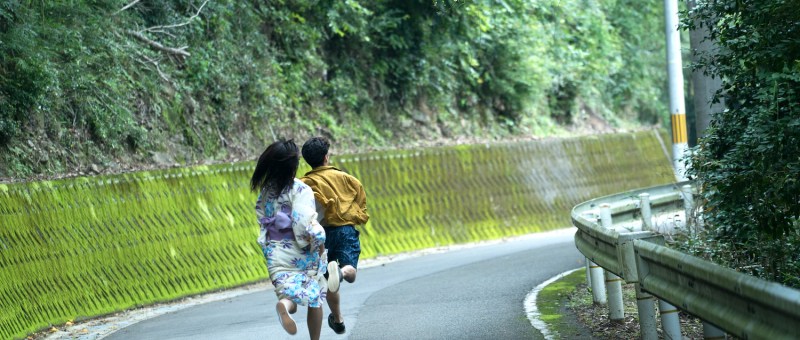
Coming to her senses, Takara intends to hand herself in but is convinced by Shota to make a run for it. “Why do the ones who struggle most get hit worst, why do the weakest always lose?” he ironically asks her, “We weren’t born to be hurt”. Yet their contradictory qualities are only further highlighted as they try to chart a new course for themselves. The pair find temporary refuge with a pair of plum farmers who take pity on them thinking they are a young couple eloping as apparently they once were, only Shota later makes a half-hearted attempt to rob them which he quickly gives up on being challenged by the sympathetic husband. In the next town, Takara determines to look for work while Shota tries to make money through bicycle races and pachinko, chastened by her admonishment on finding employment that it’s possible to support oneself without cheating others. 

Somewhat tritely, Shota tries to tell her that God never burdens you with more than you can bear, while the older woman at the plum farm also offers that plums are all the sweeter for their suffering during a harsh winter dangerously playing into a notion of internalised shame that told Takara she would blossom into the kindest soul who ever lived once her suffering was over only to leave her feeling empty and despoiled as if she somehow deserved everything that happened to her. Shota’s troubles are by comparison small, his conservative brother irritatedly telling him he should accept he has no talent and get a real job, while he too perhaps thinks he is empty inside and therefore incapable of moving anyone just as his director told him. Finding salvation in mutual acceptance they begin to see the “way out” only for their essential connection to be threatened by its very existence. 

A melancholy character study through the legacy of trauma and toxicity of internalised shame, Sotoyama’s occasionally ethereal drama takes on the qualities of a fable through the repeated allusions to princess Kiyohime and her doomed love for the wandering monk Anchin yet he is careful enough to hold out a ray of hope for each of the wounded lovers in their apparently fated connection even as they struggle to find refuge in an often hostile society.


Soirée streamed as part of the 2021 Japan Foundation Touring Film Programme.

Original trailer (English subtitles)

Our 30-Minute Sessions (サヨナラまでの30分, Kentaro Hagiwara, 2020)

“I want to move on” a grieving young woman explains, though perhaps ironically heading in the wrong direction. A youthful take on learning to live with loss, Our 30-Minute Sessions (サヨナラまでの30分, Sayonara made no 30-bun) finds a group of college hopefuls shattered by the unexpected death of a charismatic friend leaving them each lost, moving on in one sense but treading water in another uncertain what to do with the unfulfilled potential of their adolescent memories. Yet, through ghostly intervention, what they eventually realise is that nothing’s ever really lost, the echoes of those memories merely add to the great symphony life and all you can do in the end is learn to play along with it. 

That’s something introverted college student Sota (Takumi Kitamura) has however struggled with, unable to emerge from the trauma of losing his mother at a young age. As we first meet him, he’s subjected to a painful group interview for a regular salaryman job at which they ask about the memories he’s made with his university friends but rather than come up with a convincing lie, Sota honestly tells them he has no friends and that’s a good thing because it means he’s free to dedicate himself to work 100%. As expected, he gets a rather brutal rejection text before he’s even reached the lift, pausing only to rudely but perhaps accurately decline an invitation to join a WhatsApp group with the other hopefuls for the reason that it’s “pointless” because they’re unlikely to meet again. 

Sota doesn’t like to share his space with other people, but after noticing a walkman abandoned at a disused swimming pool finds himself a permanent host to Aki (Mackenyu), recently deceased lead singer of up-and-coming college band Echoll. Unlike Sota, Aki is charismatic and outgoing, every inch the rock star but less cocky than aggressively caring. It pains him that the thing he left unfinished has fallen apart in his absence and that all his friends seem to have given up their dreams and aspirations in life. For unknown reasons it seems that when Sota presses the play button on the walkman, it allows Aki to take over his body for the length of a single side of a cassette tape temporarily lending him the swagger and verve hitherto missing in his life even if he claimed not to particularly have missed them. 

In fact, Sota quite enjoys the arrangement because it means he doesn’t quite exist for the time the tape is playing, other people are no threat to him in his literal invisibility. Yet over time, a conflict obviously develops especially as the main thrust of Aki’s mission is healing his former girlfriend’s broken heart. Having lost her love of music, Kana (Sayu Kubota) has spent the last year largely inside working her way through a book of daily soup recipes that only her mother tastes. She claims she’s “moved on”, but in reality has done anything but caught in a kind of limbo unable to let go of her guilt and memories of lost love while conflicted as she bonds with the shy and introverted Sota himself it turns out also a frustrated musician.

A poignant reminder of Aki’s unfinished business as he and his friends attempt to find a degree of accommodation with loss the Japanese title translates more closely to “30 minutes to goodbye”, but there’s also something in the Japanese for playback (再生) equating to “again life” as it grants the late singer a temporary resurrection if one that lasts only the length of a set list. Perhaps a hipsterish affectation, the love of the outdated analogue recording mechanism, besides its practical advantages, provides a tangible proof of life albeit a fallible one in which every attempt to replay necessarily weakens integrity. Yet as a veteran later puts it, no matter how many times the tape is erased and overwritten, traces of previous recordings remain becoming in a sense just one of many layers that add depth and richness to the quality of the whole. 

The bandmates begin to realise that starting over doesn’t mean forgetting Aki or betraying his memory, they don’t have to leave him behind but can in a sense take him with them in the memories they share while Sota eventually begins to see the joy in human interaction and the power of connecting through music shedding his introversion in the knowledge that not all friendships are inauthentic and even if someone makes an early exit they leave traces of themselves behind on which others can build. A stylistically interesting take on the band movie with a fantastic soundtrack of convincing college rock hits, Our 30-Minute Sessions is a classic coming-of-age drama but one dedicated perhaps less to the art of moving on than to that of moving forward adding new notes to an ever expanding symphony of life.


Our 30-Minute Sessions streamed as part of the 2021 Japan Foundation Touring Film Programme.

Original trailer (no subtitles)
his (Rikiya Imaizumi, 2020)

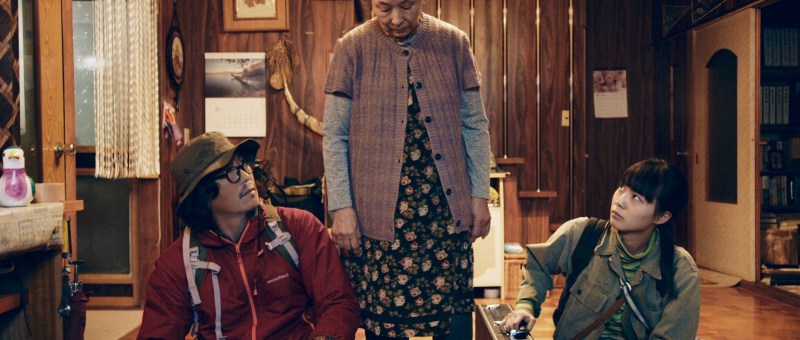
Though Japanese society is often regarded as comparatively liberal, that liberality can sometimes reflect a superficial politeness and respect of discretion more than true acceptance. Though several prefectures have now made local provision for same sex unions, Japan lacks a basic anti-discrimination law at the national level protecting the rights of LGBTQ+ people and has often been slow to accommodate social change especially when it comes to the organisation of the family unit. The journey of the two men at the centre of Rikiya Imaizumi’s his, a sequel to the TV drama of the same name set some years earlier, perhaps travels at a rapid pace from internalised homophobia to the acceptance of identity and foundation of a home but mirrors the path of society at large as it edges its way towards the truly liberal in which all are free to live in the way they choose. 

Beginning with an ending, Imaizumi opens in the “past” as Shun (Hio Miyazawa), now an isolated young man living alone in the country, dwells on ancient heartbreak as his first love Nagisa (Kisetsu Fujiwara) abruptly breaks up with him as they prepare to graduate from university. We subsequently discover that Shun got a regular salaryman job but remained in the closet only for rumours to circulate around him at work forcing him to endure the casual homophobia of his co-workers at the compulsory nomikai all the while denying his true identity. This seems to be the reason that he’s taken up the offer of cheap rural housing designed to bring the young back to the depopulated countryside and has been largely keeping himself to himself, growing his own produce and deliberately keeping the locals at arms’ length. All that starts to change, however, when Nagisa suddenly turns up on his doorstep with his six-year-old daughter Sora (Sakura Sotomura) in tow. 

Though not exactly overjoyed, Shun allows the pair to stay but remains conflicted unsure what it is Nagisa wants from him and also fearful of his new life being derailed should the local community discover what it is that he’s so obviously in hiding from. Nagisa, meanwhile, apparently broke up with him for the same reasons, afraid to continue into his adult life as an openly gay man eventually travelling to Australia where he drifted into a relationship with a Japanese woman, Rena (Wakana Matsumoto), working as an interpreter with whom he later conceived a child and formed a conventional family. Struggling with himself he tried to maintain the facade through casual relationships with men, but discovered that he couldn’t make it work and unlike Shun decided the only way out of his predicament was to embrace his sexuality and attempt to live a more authentic life with the man he never stopped loving. 

Having pursued contradictory solutions to the same problem, the two men find themselves still in some senses at odds even as they reunite in their obvious love for each other. Nagisa envisages for them a family life raising Sora together and with the help of his sympathetic, supportive lawyer intends to have his conviction vindicated by a verdict in law but his former wife, while not openly hostile if obviously hurt and feeling humiliated in having been deceived, wishes to retain custody of her daughter even though she was not the primary caregiver. The court battle opens a veritable can of worms in a fiercely patriarchal, conformist society, Nagisa’s lawyer reminding him that he has an uphill battle because society inherently believes that women are better suited to childrearing. Rena’s lawyer throws the homophobic book at them, describing the relationship between the two men as “eccentric”, implying it cannot be other than harmful to Sora not least because of the bullying and social stigma she may face as a daughter raised by two fathers. Even the judge agrees that the situation is “not exactly normal”, though in this he may have a point in the fact that Nagisa had been a househusband and his wife the breadwinner, still an extraordinarily unusual family setup in a society in which women are expected to shoulder the domestic burden sacrificing their careers in the process. 

Indeed, it’s this same paradox that Nagisa’s female lawyer eventually throws back at Rena, that she cannot claim to adequately care for her daughter while working especially as she is a freelancer whose hours are often unpredictable. Rena had been reluctant to involve her family because of the shame of admitting her marriage has failed and for the reason it has but is later forced to ask her mother for childcare assistance only to receive a curt “I told you so” which speaks volumes as to the quality of their relationship. Meeting in a coffeeshop Rena looks at her mother looking askance with mild though unvoiced disgust at two men holding hands, reflecting both on her unforgiving austerity and her relationship with her granddaughter. The two women obviously differ when it comes to childrearing philosophy, Rena not wanting her daughter to suffer in the same way she has suffered because of her mother’s unforgiving conservatism and is extremely worried on being called to the school and told that Sora, who had previously been so cheerful and outgoing, has become sullen and withdrawn. 

Yet Sora is perhaps the force which allows each of her parents to accept themselves for who they are and embrace their true identities. Worried that she might be a burden to her mother who often drinks and appears to resent her for interfering with her work, Sora wonders why everyone can’t just get along and live together happily. She sees nothing “weird” in her father’s new relationship, though perhaps fails to understand why the four of them might not be able to live together as a family. Supported by Sora, Shun begins accept himself for himself, eventually coming out to the community and finding them entirely unbothered by his revelation bearing out the commonly held belief that small rural communities are often far more liberal than the famously conservative capital. Filled with a sense of love and mutual support, his presents a perhaps idealistic view of the modern society but an infinitely hopeful one as the three adults resolve to be kinder to themselves and others as they move forward together into a happier, more authentic existence. 


his streamed as part of the 2021 Japan Foundation Touring Film Programme.

Original trailer (English subtitles)

Tokyo Bay (東京湾, Yoshitaro Nomura, 1962)

Yoshitaro Nomura is most closely associated with the thriller and particularly with its lower end as a purveyor of B-movie noir, yet look a little closer and his films are perhaps not really about crime at all but about the complicated relationships between people in the ever changing post-war society. Just as Stakeout is really about a policeman’s marriage, Tokyo Bay (東京湾, Tokyowan) is less concerned with the radiating corruption of the smuggling ring at its centre than with frustrated male friendship and the wartime legacy.

Opening with an aerial pan over post-war Tokyo, a title card informs us that this is just one frame in the “intense struggle for existence” in a city of 10 million before we arrive at the titular bay and a boat which is presumably carrying drugs later passed from one hand to another. The fixer, Takeyama (Kei Sato), talks to a man in a car and instructs him to be in front of the Taiyo building before 10am to pick up a golf bag from his contact. Gazing up at a post-war construction site, however, the man, Saeki (Jun Hamamura), is shot in the head and killed by a bullet piercing the roof of his car, Nomura suddenly switching to a disorientating POV shot as he twists in a sudden death spiral. 

As it turns out, Saeki was a plant, an undercover cop with the drugs squad sent to expose the smuggling ring the shadowy owners of which will predictably turn out to have Chinese connections in another echo of post-war cinema’s continuing Sinophobia. Two officers are assigned to the case, the young and earnest Akine (Jiro Ishizaki), and the veteran Sumikawa (Ko Nishimura) who acts largely on a series of inexplicable policeman’s hunches. Their major lead, however, comes as a stroke either of dumb luck or dark fate as Sumikawa, dodging into a dodgy mahjong parlour while tailing Takeyama, runs into an old army buddy, Inoue (Isao Tamagawa), who just happens to be a left-handed sniper perfectly matching the profile of the man they’ve been looking for. 

While Sumikawa keeps tabs on his old friend, somehow feeling he has something to do with all this but ambivalent in his torn responsibilities, Akine travels to Inoue’s hometown of Onomichi and sympathetically concludes that he was merely “rather unfortunate”. His life derailed by the war, Inoue returned to discover the girl he hoped to marry had married someone else. Giving evidence at Inoue’s trial for pulling a knife on her husband, the young woman remarks that she never promised him anything and did not consider their relationship to be serious, merely treating him with the politeness due to someone about to leave for war. In any case, she asks, even if she had been in love and intended to wait for him, as an orphaned woman there were only two choices open to her to survive, marriage or sex work, what else could she have done?

Back in Tokyo, Sumikawa begins to catch up with his old friend, realising that his romantic disappointment set him on a dark course of bad relationships and a drift towards crime but that he seems to have turned himself around. He is now happily married to a woman he describes as “simple” who seems devoted to him and if he did this, he did it to start again. His one last job intended to take him back to Onomichi, a pleasant coastal town the bay of which he describes as far more beautiful than that of the grimy, industrial Tokyo and largely untouched by urban corruption. Sumikawa feels himself torn, not least on account of the debt that exists between the two men because Inoue once saved his life, but also knowing that he may have to arrest this man and destroy his attempt to return to a more innocent world leaving his wife alone. Disapproving of the nascent relationship between his younger sister Yukiko (Hiromi Sakaki) and his partner, Sumikawa worries Akine may be becoming the kind of man who cares more for making an arrest than friendship, a conflict presumably weighing on his mind, even as he agrees he’s a good man and a good police officer. Yukiko meanwhile fires back that Sumikawa’s wife left him not because he is a policeman but because he is selfish and arrogant, and more to the point incapable of understanding a woman’s feelings. 

Nevertheless, he’s acutely aware of the effect his actions or inactions may have on Inoue’s wife Yoshiko (Kyoko Aoi), especially as it’s suggested she may need a degree of looking after. Inoue, careful to admit nothing, reveals that the man who carried out the hit may not have known he was killing a police officer but may have assumed the target was fair game being, like themselves, a denizen of the underworld. Largely a MacGuffin, the smuggling ring is not as important as one might assume, the two men locked into a cycle of guilt and retribution each marked by wartime trauma and in a sense unable to claim their place in the post-war society. Twin betrayals lead to a fateful, train-bound showdown shot with fraught claustrophobia as each man engages in an intense struggle for his survival but also perhaps already defeated in a shared sense of fatalistic nihilism. Trekking through the half-constructed streets of the post-war city with shaky handheld Nomura hints at the radiating corruption exemplified by the growth of the trade in drugs, but perhaps one corruption is merely the result of another which may in turn be far less easy to cure. 


Farewell: Comedy of Life Begins with a Lie (グッドバイ~嘘からはじまる人生喜劇~, Izuru Narushima, 2019)

“You wrote that a man should be pure and honest” a conflicted editor reminds his friend, “yes”, he replies, “but that was fiction.” Osamu Dazai is not particularly remembered for his sense of humour, but Farewell: Comedy of Life Begins with a Lie (グッドバイ~嘘からはじまる人生喜劇~, Goodbye, Uso kara Hajimaru Jinsei Kigeki) adapted from a play by Keralino Sandrovich (Crime or Punishment?!?) inspired by his final and in fact unfinished novel Goodbye is a dark-hearted farce grafting ‘30s screwball comedy onto an ironic satire of heartless post-war capitalism through the prism of one man’s emotional cowardice. 

As the black and white newsreel-style opening informs us, literary magazine editor Tajima (Yo Oizumi) made a bit of money on the black market amid post-war chaos but is beginning to feel conflicted about his Tokyo existence especially after receiving a postcard from his small daughter Sachiko in provincial Aomori whom he hasn’t seen since her infancy. His problem is that he’s an inveterate womaniser with several mistresses on the go at once who ironically all already know that he’s a married man, to that extent “honest” at least, but remain unaware of each other. Suddenly wanting to reform his image and become a proper father to his little girl, he’s realising he ought to sort out his problematic love life but Tajima is also the sort of man who can’t bear unpleasantness and is too frightened to break up with his lady friends in case they cry. His writer friend, Rengyo (Yutaka Matsushige), comes up with a cunning ruse – find a pretty woman to pretend to be his long absent wife returned and the mistresses will most likely retreat voluntarily. Tajima decides to do just that on catching sight of a beautiful lady through a peephole in the gents at a bathhouse only she turns out to be someone he already knows, manly black-markeeter Kinuko (Eiko Koike) who secretly loves dressing up in the latest fashions. 

Kinuko is in a sense everything Tajima is not. An abandoned child, she’s learned to take care of herself and is strong both physically and emotionally. She agrees to help him with his nefarious plan because he offers to pay her handsomely, feeding her well in her copious desire for food which perhaps indicates her strong desire to live in a society where many are starving. She’s a black-marketeer because that’s all that’s left for her to be and perhaps has made her peace with exploiting the desperation of others in the knowledge that they also need the service she provides. In any case, she won’t let herself be trampled, frequently getting into fights with male dealers and later throwing Tajima off a balcony when he follows some bad advice from Rengyo and attempts to seduce her in the hope that then he wouldn’t have to pay her for participating in his scheme to rid himself of extraneous women. 

Yet it’s also clear that it’s women who are most at the mercy of the times, Tajima’s first mistress being a heartbroken war widow (Tamaki Ogawa) making a living as a florist who later attempts suicide after saying “Goodbye” to Tajima and the possibility of romantic salvation from post-war hopelessness (though her involvement with him does perhaps eventually lead her to that). The second mistress is a young painter (Ai Hashimoto) who approached him for work on the magazine attempting to support herself while her brother (Sarutoki Minagawa) remained in a Siberian labour camp, and the third is a self-assured doctor (Asami Mizukawa) looking perhaps for company though seemingly aware that Tajima is a weak-willed, unreliable man. His wife, Shizue (Tae Kimura), meanwhile, has become fed up with waiting for him to accept his male responsibility as a husband and father and unbeknownst to him his plans to keep her looked after may have backfired. 

Yet strangely Kinuko finds herself falling for the “pathetic” Tajima without quite knowing why while he perhaps begins to accept that maybe what he needs is a capable woman to look after him because he is after all too cowardly to look after himself. He’s fond of saying that the war changed everything for everyone, but she points out that her life has always been one of scrappy survival and now perhaps they are all equal in that. The post-war world however seems to be in permanent decline, an associate of Tajima’s (Gaku Hamada) eventually becoming accidentally rich, buying a suburban mansion, dressing in a garish white suit and snarling with a mouth full of gold teeth as he advances that money is everything and can even love can be bought. In this at least it turns out he may be wrong. Taking a “detour” allows Tajima to shed his commitment phobia and finally say “Goodbye” to post-war limbo in embracing both a desire to live and the possibility of enduring love. 


Farewell: Comedy of Life Begins with a Lie streamed as part of the 2021 Japan Foundation Touring Film Programme.

Original trailer (no subtitles)
The Water Magician (瀧の白糸, Kenji Mizoguchi, 1933)

“As long as I breathe, I’ll remember my debt to you” avows a young man to his unexpected benefactor becoming one of many claiming they will never forget her kindness though in his case he actually means it. Kenji Mizoguchi would later become known for tragic tales of female suffering, but his central themes were established early on and very much in evidence in 1933 silent The Water Magician (瀧の白糸, Taki no Shiraito) in which a truly good woman tries to use her independent success to improve the lives of those around her but finds herself cruelly betrayed by a greedy and self-interested patriarchal society. 

Tomo Mizushima (Takako Irie) goes by the stage name Taki no Shiraito, which means something like white threads of the waterfall, particularly apt seeing as she is a “water magician” with a troupe of itinerant players. A beautiful woman who can make the water dance, she has her share of followers and is financially independent if subject to the vagaries of the show business existence. Her life changes one day when she is travelling in a horse-drawn coach that is embarrassingly overtaken by a fast running rickshaw man. The passengers are irate, wondering what they’re paying for, while the driver ignores their pleas not to spare the horses. Tomo decides to use her feminine appeal and then her financial power to convince him to speed up, but he ignores her too until he eventually decides to gallop forward recklessly while the passengers shake inside until the coach’s axle finally snaps and leaves them stranded. A gallant young man, the driver grabs Tomo and throws her on his horse to get her to the next town. She faints on the journey and only comes round after the coachman has left but discovers herself in possession of a complicated law book she assumes is his.  

Tomo cannot stop thinking about the dashing young man, only identified as “Kin” (Tokihiko Okada). She is surprised to reencounter him asleep on a bridge though he seems not to remember her. After finding out that he is an unluckily orphaned former samurai who was fired from the coach for breaking the axle and endangering the passengers, she resolves to use her financial power to help him achieve his dreams of studying law in Tokyo. Tomo does this because she is in love and asks for nothing in return except a future promise of romantic union to which the young man does not exactly agree but does take her money and vows to live up to the faith she has shown in him. 

Alone once again Tomo tries to contend with the world around her while dreaming of Kinya, sending him her savings for his upkeep while the troupe continues to suffer especially during the traditional dry spells of the heavy winter. The troupe’s leader makes the decision to get involved with dangerous loanshark Iwabushi (Ichiro Sugai), a huge hulking man with a mean look and lecherous temperament. While Tomo dreams of Kinya, two romances mirror each other in the failed relationship of the cruel knife thrower Minami (Koju Murata) and his terrorised wife Gin (Kumeko Urabe), and the innocent young love of the beautiful Nadeshiko (Suzuko Taki) and the barker Shinzo (Bontaro Miake). Gin also borrows money from Tomo which she was reluctant to surrender because she saved it for Kinya, claiming she needs it to visit her sick mother in Tokyo and vowing once again never to forget Tomo’s kindness but later skipping out with a stagehand to escape Minami’s control. Nadeshiko and Shinzo, however, are forced to flee on learning that Minami plans to sell her to Iwabushi to settle his private debts. The couple regret leaving Tomo who has always supported them in the lurch, but she helps them escape, ushering them out the back towards a waiting boat and handing them still more money asking only that they be happy and stay together always. 

That’s not perhaps a power that’s in their keep, but the youngsters keep it as best they can and eventually attempt to protect her in the way she has protected them. The world, however, is cruel. With work thin on the ground Tomo finds herself unable to go on funding Kinya as she’d promised, and is only shamed by his well-meaning letter explaining that he’ll try to find a way of supporting himself until his studies are finished so she needn’t worry. She cuts a deal with Iwabushi and sells her body on Kinya’s behalf, but he is in league with Minami who sets his goons on her to retrieve the money seconds after she’s obtained it. 

Her hopes are at least repaid on discovering that her love is true to his word, has never forgotten her, and is well on the way to achieving his dreams as person of note. “Chance and fate, that’s all there is” Kinya had lamented on their second meeting, but he couldn’t know how right he’d be. Tomo’s dreams are fulfilled only their negation. Kinya must do his duty even if it does her harm, yet he too feels responsible and wants to share her burden though that, ironically, would only destroy everything for which she has sacrificed so much. “The river flows on as it always has and always will” the Benshi adds in solemn contemplation of this romantic tragedy, somehow inevitable in its cruelty. Tomo finds herself at the mercy of her times in which money is all, goodness is a weakness, and love too fragile to survive. The woman who made the water dance floats away on a river of tears, a victim of a cruel and unforgiving society.


Big Shots Die at Dawn (顔役暁に死す, Kihachi Okamoto, 1961)

“Assassins make the world an unfit place to live in” according to a random gas station attendant clueing our errant hero in to the fact his small-town home is now a “den of yakuza” and unlikely tourist hotspot. An early, delightfully absurdist yakuza romp from Kichachi Okamoto, Big Shots Die at Dawn (顔役暁に死す, Kaoyaku Akatsukini Shisu) is part Nikkatsu parody, part ironic western, and all cartoonish fun as a prodigal son returns to find his father murdered and his uncle on the throne. Sound familiar? 

Jiro (Yuzo Kayama) has been working for the forestry commission in Alaska and has not returned to his small-town home of Kuraoka in some time which is why he didn’t even know his father, the mayor, was dead let alone that he was apparently assassinated in a manner which strongly anticipates the Kennedy assassination though the film was released in 1961. He also had no idea his father, a widower, had remarried and his family home is now occupied by his stepmother Hisako (Yukiko Shimazaki), a former secretary who scandalously lounges around in her underwear all day. His uncle Imamura (Eijiro Yanagi) is now the mayor, and as he explains to him, the town is a hotbed of gangster activity apparently a consequence of his attempt to turn it into a tourist hotspot. In trying to find out who killed his father, Jiro finds himself quite literally in the middle of a petty yakuza gang war aided and abetted by corrupt police. 

Quite clearly influenced by American cinema, Big Shots Die at Dawn situates itself in the new frontier of small-town Japan in which a war is being fought over the spoils of the post-war era. Uncle Imamura’s legacy is apparently a children’s theme park with the distinctly pregnant name Dreamland. Apparently a man who just loves the children but was unable to have any of his own, he’s also opened a pre-school for the local kids. Meanwhile, in the yakuza-backed casino, obsessive gamblers brush their teeth at the tables while local kingpin Goto (Akihiko Hirata) attempts to fend off the incursion of the rival Handa gang. Jiro’s return puts the cat among the pigeons as both sides attempt to use him as a way to take out the other.

The dark heart of small-town Japan is however present in the greed and double dealing which extends even to the police, a corrupt officer offering to sell Jiro a key piece of evidence he had concealed in the hope of profit. Just about everyone tries to sell the evidence to someone else at one time or another, leveraging an idea of justice alongside greed and self-interest. Meanwhile, Yoshiko (Kumi Mizuno), a quasi-love interest and former girlfriend of a fallen foot soldier, reports that she gave the police valuable evidence that her fiancé’s death wasn’t a suicide but they ignored her.

Jiro’s come to clean up the town, but the showdown takes place incongruously in the children’s theme park complete with its cutesy mascot characters and adverts for chocolate in the background making plain that these venal gangsters are really just boys playing war, taking pot shots at each other from tiny trains. What could be a dark comment on a loss of innocence is more cartoonish irony from Okamoto who shoots in extreme closeup with intentionally humorous composition and slapstick choreography. Nevertheless the message is unmistakable as we piece together the connections between small-town government and organised crime underpinned with a rather creepy all for the kids justification. 

Then again, the world has its share of misogyny, everything coming down to the incursion of transgressive femininity as one duplicitous woman manipulating her feminine wiles becomes the common link between each of the warring factions, as if this is all her fault and Jiro’s return is a way of clearing up the pollution her arrival provoked. Nevertheless as even he says, his father, and implicitly his father’s generation, must share some of the blame. Filled with stylish action sequences, car chases, self-consciously cool dialogue, and scored with a mix of moody jazz and dreamy childlike melodies, Okamoto’s cartoonish takedown of the zeitgeisty youth movie is very much in keeping with Toho’s spoofier side but chock full of charm even if its hero’s particular brand of smugness occasionally borders on the insufferable. 


That Night’s Wife (その夜の妻, Yasujiro Ozu, 1930)

Most closely associated with his late career family dramas, Yasujiro Ozu has acquired a reputation for geniality which may in a sense be slightly unfair. He was always an astute chronicler of his times, often choosing to view them through the frame of family, and was never as blind to the issues of the day as some would have it. Ozu’s ‘30s work, that which survives at least, is in a sense fiercely political in its critique of the inequalities of the depression-era society. One of his early crime movies, the silent That Night’s Wife (その夜の妻, Sono yo no Tsuma) insists that justice must be done but does so with compassion in its full and total empathy for a man driven to extremes by the depth of his paternal love. 

Indeed, the early part of the film is tense noir chase as the hero, desperate father Shuji (Tokihiko Okada), attempts to evade a police dragnet to make his way home after robbing a bank to get money to pay for his sick daughter Michiko’s (Mitsuko Ichimura) medical care. Meanwhile, loyal wife Mayumi (Emiko Yagumo) has been patiently waiting at home tending to the child who refuses to sleep because she only wants her father and constantly asks where he is. Shuji eventually makes it back and tells his horrified wife what he has done, agreeing that he will turn himself in to the police once Michiko is well, but he’s already out of luck. The taxi he darted into was being driven by an undercover cop (Chishu Ryu) who installs himself in the apartment but agrees to wait until the doctor comes in the morning before taking Shuji in. 

Out of keeping with the rest of Ozu’s career but very much in the vein of his depression-era silents, That Night’s Wife concerns a poor but happy family mustering what little resources they have in the face of despair. Filled with tension as the policeman waits impatiently, the camera pans around the one room apartment where the family live and finds it to be a homely, bohemian space, apparently an artist’s studio with foreign film posters and travel souvenirs hanging from the walls. By all indications a starving painter, Shuji is a poor man brought to ruin by accidental tragedy. His daughter is deathly ill and doctors cost money. We can see that, by the standards of the time, he is a very hands on father beloved by his little girl and is obviously willing to sacrifice himself and his future to ensure her survival

It’s Mayumi, however, to whom the film’s title refers and in her role as wife rather than mother. The doctor (Tatsuo Saito) worries that she has not slept in the last few days, how could she when her child is so ill, but it’s she who eventually picks up the gun to protect the family by disarming the policeman and, essentially, keeping him hostage until the morning when, she claims, Shuji will willingly go with him after confirming Michiko’s survival. The world is turned upside down, no one quite plays the role they’ve been assigned. The loving father, an effete artist, turns unconvincing master criminal, the loyal wife gangster’s moll, and the policeman a calm and compassionate guardian deeply moved by the family’s predicament but also knowing that the law must be served. 

In a typically Ozu touch, the policeman pretends to be asleep with the intention of letting Shuji escape, but he once again makes an atypical choice. He refuses to run, swearing off “crazy ideas” but unrepentant in his crime. Shuji determines to pay his debt to society so that he can return home as a redeemed father and hold his daughter as a man unburned by his transgression. The message isn’t so much that crime doesn’t pay as that crime must be paid for. Shuji is acquitted in the moral courts of the audience’s hearts and not even the policeman blames him for what he has done which is all he could do as a father in an oppressive and indifferent society. A strange complicity develops between the two men who are restored to their original roles, both acknowledging that of the other and sorry for what they each know must happen next but already resigned. The father saves his family only through accepting his exile from it, but unlike Ozu’s wandering fathers of the 1930s, seems destined to return after redeeming himself in the eyes of a society which had long since abandoned him. 


Currently streaming in the UK via BFI Player as part of Japan 2020. Also available to stream in the US via Criterion Channel.

Lady Sen and Hideyori (千姫と秀頼, Masahiro Makino, 1962)

Son of cinema pioneer Shozo Makino, Masahiro Makino is most closely associated with the jidaigeki though he also had a reputation for highly entertaining, innovatively choreographed musicals some of which starred post-war marquee singing star Hibari Misora. The somewhat misleadingly titled Lady Sen and Hideyori (千姫と秀頼, Sen-hime to Hideyori), however, is pure historical melodrama playing fast and loose with the accepted narrative and acting as a star vehicle for Misora to showcase her acting talent in a rare dramatic role in which she neither sings nor engages in the feisty swordplay for which her otherwise generally lighthearted work at Toei was usually known. 

Lady Sen (Hibari Misora) is herself a well-known historical figure though Hideyori (Kinnosuke Nakamura) will not feature in the film beyond his presumed demise (his body was never found leading to various rumours that he had actually survived and gone into hiding) during the siege of Osaka in 1615. Born the granddaughter of Tokugawa Ieyasu (Eijiro Tono) who would later defeat the Toyotomi to bring Japan’s Warring States era to an end, Sen was sent to the Toyotomi as Hideyori’s future wife at seven years old (he was only four years older than she was and 21 at the presumed date of his death) and therefore perhaps far more Toyotomi that Tokugawa. In contrast to other portrayals of Sen’s life which centre on her understandable identity conflict and lack of agency in the fiercely patriarchal feudal society, Misora’s Lady Sen is clear in her loyalty to her husband whom she dearly loved and feels her father and grandfather who were directly responsible for his death are her natural enemies.  

Old Ieyasu and his son meanwhile do at least appear to care about Sen’s welfare, loudly crying out for a retainer to save her during their assault on the castle offering unrealistic rewards to any who manage a rescue. Unfortunately, however, having retrieved his granddaughter Ieyasu immediately marries her off to someone else demonstrating just how little control Sen has over her own destiny and how ridiculous it might be that she should have any loyalty to the family of her birth. His decision backfires on two levels, the first being that Dewa (Tetsunosuke Tsukigata), a lowly retainer responsible for Sen’s rescue from the falling castle, has taken a liking to her himself and fully expected to become her husband as a reward. While originally annoyed and hurt to think that perhaps she has rejected him because of the prominent facial scarring sustained while he was rescuing her, Dewa finally realises he just wants her to be happy only to be offended on realising that they’ve rerouted her bridal procession past his home which he takes as a personal slight. Nevertheless, in contrast with real life (Sen’s marriage to Honda Tadatoki was apparently amicable and produced two children though only one survived to adulthood) Sen’s relationship with her new husband is not a success, in part because she resents being used as a dynastic tool and in part because she remains loyal to Hideyori. In consequence, she makes full use of her only tool of resistance in refusing to consummate the marriage with the result that her new husband, Heihachi (Kantaro Suga), slowly drinks himself to death. 

Her other act of rebellion is however darker, striking down an old man who made the mistake of telling her with pride how he informed on retreating Toyotomi soldiers after the siege. Determining to become an “evil woman” she deliberately blackens the Tokugawa name by killing random commoners, chastened when confronted by a grieving widow but banking on the fact her relatives will not move against her and will therefore gradually lose public sympathy for failing to enforce the law against one of their own. The spell is only broken by the arrival of a former Toyotomi retainer (played by Misora’s frequent co-star in her contemporary films Ken Takakura) who reminds her of her loyalty to her husband’s legacy and prompts her retreat into religious life as a Buddhist nun mirroring the real Lady Sen who entered a convent after her second husband died of tuberculosis. Like most of Misora’s film’s Lady Sen ends with a softening, a rebuke to her transgressive femininity which in this case has admittedly turned worryingly dark her murder spree apparently a form of resistance to the entrenched patriarchy of the world around her and most particularly to her continued misuse at the hands of her father and grandfather. Despite the absence of large-scale musical numbers, Makino makes space for a fair few dance sequences along with festival parades and well-populated battle scenes but makes sure to place Misora centre stage as if countering the continual marginalisation of Lady Sen and all the women of feudal Japan. 


Clip (English subtitles)