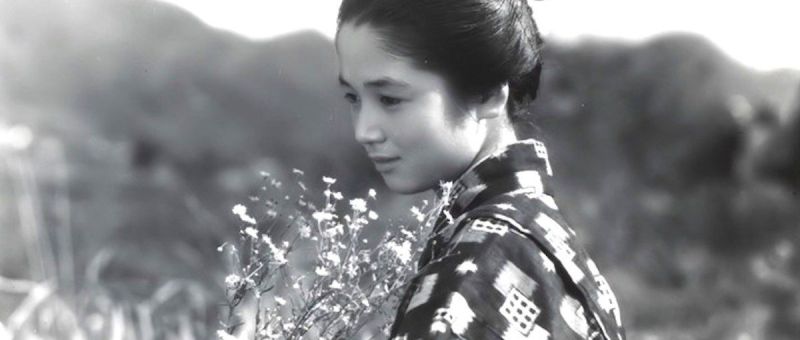
She Was Like a Wild Chrysanthemum (野菊の如き君なりき, Keisuke Kinoshita, 1955)

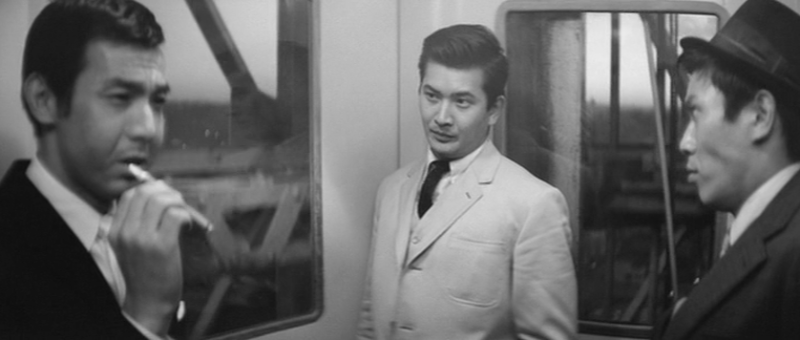
She was like a wild chrysanthemum dvdForemost among the post-war humanists, Keisuke Kinoshita had a somewhat complex relationship with the past, by turns decrying the restrictions of latent feudalism and pining for the lost innocence of an idyllic pastoral Japan untouched by mid-century trauma. She Was Like a Wild Chrysanthemum (野菊の如き君なりき, Nogiku no Gotoki Kimi Nariki) manages to do both at once, lamenting the passing of time and a clear division between then and now while railing against the unfairness of the society which keeps young lovers apart in insisting that broken hearts are merely something that must be endured.

In the contemporary era, 73-year-old Masao (Chishu Ryu) is taking a boat back to his hometown though he no longer has any family there, his brother’s adopted son having inherited the family estate but seemingly rejected it. The local kids treat his abandoned family home as a haunted house. He tells us that he’s going back the way he came, it may be old fashioned to travel by river like this but there was no train back in his day. Masao feels his age. His grandson has just entered college and his mind is no longer what it was. He finds himself lost in sentimental memories, which is what has brought him back here, to the place which stole from him the only thing he ever loved.

Flashing back almost 60 years to the late Meiji-era when Masao (Shinji Tanaka) was but a boy of 15 preparing to leave home to study at high school, the older Masao recalls the happiest time of his life, now ensconced in a nostalgic cameo frame, when he lived with his sickly mother (Haruko Sugimura) and 17-year-old cousin Tamiko (Noriko Arita) with whom he had quietly fallen in love. Though it is not exactly unusual for cousins to marry, especially among the gentry, the closeness of the two youngsters has begun to cause gossip in the village especially as they are no longer children if not quite grown up. Still stuck somewhere between awkward adolescent attachment and the dawning realisation of a greater love, Masao and Tamiko resent the attempts made to keep them apart, but are largely powerless to resist the world in which they live.

That would be, in a largely feudal context, that Tamiko is more or less a “poor relation”, somewhere between servant and beloved daughter, not quite a member of the family, but resented by the maids. As such, she is no match for Masao who will be expected to marry someone of his mother’s choosing. The issue is not so much that the pair are cousins, or the slight squeamishness that they have been raised more or less as siblings, but an anxiety that something dreadful may be about to befall them which should be stopped before it becomes an unsolvable problem.

Masao’s mother tells Tamiko that women must learn “housework” like cleaning and dressmaking which might be a thinly veiled way to excuse the fact that she is using her as an unpaid maid, but it does at least remind us that she must marry someone, someday. At 17, Tamiko is at the age where her marriage becomes a matter for consideration, whereas at 15 Masao will leave home to pursue his education. They know their time together is limited, but still they dare to hope, the proximity of an ending giving them the courage to give tentative voice to their feelings.

Meanwhile, the danger they face is entirely homegrown and as much political and avaricious as it is conservative. The problem is that Masao’s older brother and his wife have no children. The sister-in-law intensely resents Tamiko’s presence, fearing she will somehow end up marrying Masao and getting her hands on the estate. To prevent that happening, she flags up the villagers’ gossip with Masao’s mother, who had been content to let them be because they were “only children” but is beginning to be swayed by the possibility of scandal or social censure. She decides to send Masao away to school ahead of schedule, hoping the whole thing will blow over, but Tamiko is so distraught that the sister-in-law eventually has her sent back to her parents where she receives an offer of marriage from the son of a wealthy family.

Too heartbroken to do much else, Tamiko spends most of her time in bed and flatly rejects the idea of marriage while the rest of her family desperately try to persuade her. Even Masao’s mother who professes to love her as a daughter tells her in no uncertain terms that she could never consent to her marrying her son. Only Tamiko’s melancholy grandmother who regards her own marriage to a man she truly loved as the thing which has given her life meaning, stops for pause, not objecting to the proposal but disappointed with her children’s insensitivity and aware of the dangers in the sacrifice Tamiko would be making if she agreed to marry more or less against her will.

The cruelty of the times is brought home by two near identical sequences, one a funeral procession in bright sunlight and the other a solemn moonlight wedding. The youngsters pledge themselves to each other, but are torn apart by forces beyond their control. In this, Kinoshita perhaps presages a greater tragedy still to come at the hands of implacable authoritarianism, suggesting that this rigid adherence to tradition at the expense of human feeling leads only to an eternal heartbreak and chaos born of resentment. If the relatives had simply let them be, let nature take its course and love find its way, then all of this sadness and regret could have been avoided. Masao apparently lived an ordinary life, suffered in the war, but married and had children, all while living with unutterable regret. His love has lasted 60 years, along with the memory of innocent wild flowers and the tranquility of his rural childhood in a Japan now long gone, inhabited solely by the ghosts of memory. “Only crickets sing by her grave”.


Original trailer (no subtitles)
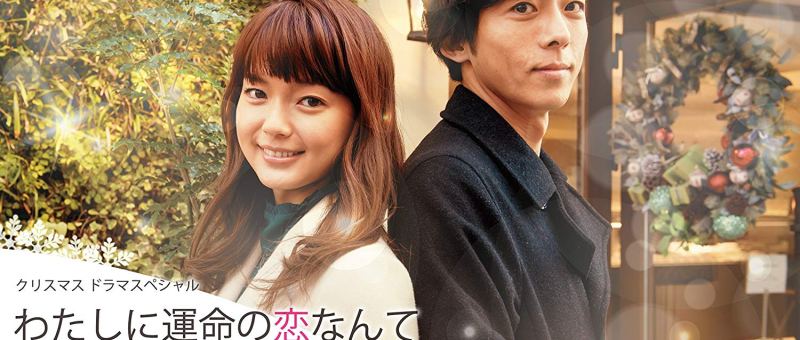
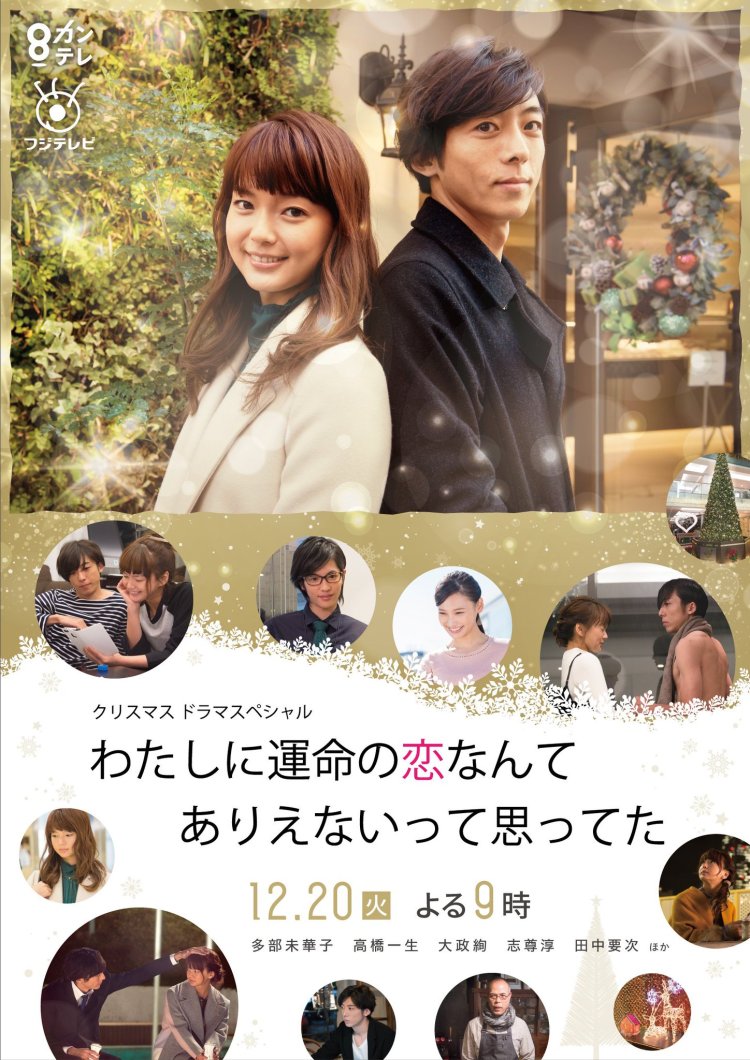
My Long Awaited Love Story (わたしに運命の恋なんてありえないって思ってた, Takafumi Hatano, 2016)

My Long Awaited Love Story posterChristmas is synonymous with romance in Japan, but should you really rush into love just to get a pretty picture under the bright lights of a shopping mall holiday display? Perhaps not, but rom-coms are not generally the best place to look for realistic dating advice. “Realistic dating advice” is what the lovelorn heroine of My Long Awaited Love Story (わたしに運命の恋なんてありえないって思ってた, Watashi ni Unmei no Koi nante Arienaitte Omotteta) ends up giving when she runs into a socially awkward CEO with a crush on an employee, but in true rom-com fashion finds herself falling for him instead.

27-year-old Riko (Mikako Tabe) has given up on love, at least in the “real” world. Ironically enough, her job is writing romantic storylines for dating sims at which she is apparently very successful which is why she’s been hired as a consultant by a tech firm looking to branch out in the hope of capturing the female market. The problem is that the more she observes “real” guys in the world all around her, the more they disappoint. The handsome “prince” at a coffee shop says all the right things but then claims to have forgotten his wallet. The clingy cutie has another girl on the line, and the domineering Type-A hunk crumbles in front of a strong woman. Riko knows that Hollywood-style meet cutes don’t happen in everyday life, but finds herself repeatedly running into them only for something to burst her bubble unexpectedly.

At the meeting for her new game, the assembled team being almost entirely female which, when you think about it, is a little bit depressing because it means the boss has used it to get all the women off the floor, Riko is taken by the handsome, sensitive Midoritani (Jun Shison) but gets a rude awakening when another guy turns up and immediately makes it clear he hates all her ideas. According to him, women who play dating sims must be ugly or stupid, the sort of people unwilling to see reality, retreating into a frothy fantasy land to escape their unhappy lives. Thoroughly fed up, Riko sets him right, only to realise this man, Kurokawa (Issey Takahashi), is actually the president of the company.

They haven’t exactly hit it off, and Riko is further enraged when she overhears him giving an interview to a women’s magazine in which he claims to be “supporting women”, parroting all the words she threw at him to make himself sound progressive. Gently teasing him about his obvious crush on Momose (Aya Ohmasa), a pretty employee, however brings them a little closer and earns her an apology. Kurokawa takes some of her advice, tries out a tactic from a game she wrote, finds it kind of works, and eventually asks her to teach him the ways of love. Despite feeling under confident in her own love life as an unattached 27-year-old, she agrees.

Gradually we discover that Riko’s taste for romantic fantasy is a clear eyed choice designed to keep her “safe” from heartbreak because it’s not real and the idealised 2D guys from her games are never going to let her down. Annoyingly, Kurokawa was right up to a point, but you can’t deny that the world Riko lives in is in itself disappointing, a fiercely sexist society in which the men are timid children and the women socially conditioned not to make the first move. Kurokawa’s courtship of Momose, it has to be said, borders on harassment considering he’s the boss and she’s much younger than he is. Early on, Riko outs herself as a youthful devote of shojo manga, given unrealistic ideas about romance from idealised stories of innocent love filled with charming, handsome princes and infinite happy endings. Riko wanted to fall in love like that, which is to say, unrealistically without fully engaging with all the difficult bits of being in a relationship.

Needless to say, she begins to fall for Kurokawa who, for all his awkwardness, has a good a heart and the willingness to learn. Thanks to him she gets the courage to humiliate a bunch of high school bullies at a reunion, but still struggles with the idea of opening herself up to “real” love and the possibility of heartbreak. When Kurokawa has a crisis and calls her, she knows where he’ll be but sends Momose instead, either out of a sense of awkwardness or perhaps just afraid to face him in such an emotional state. A professional humbling and the miracle of Christmas conspire to convince them both that you’ll never be happy hiding your feelings and if you want “real” love you’ll have to accept the risk of getting hurt. That’s reality for you, but it can probably wait until after the festive season.


Currently available to stream via Viki.

Teaser trailer (no subtitles)

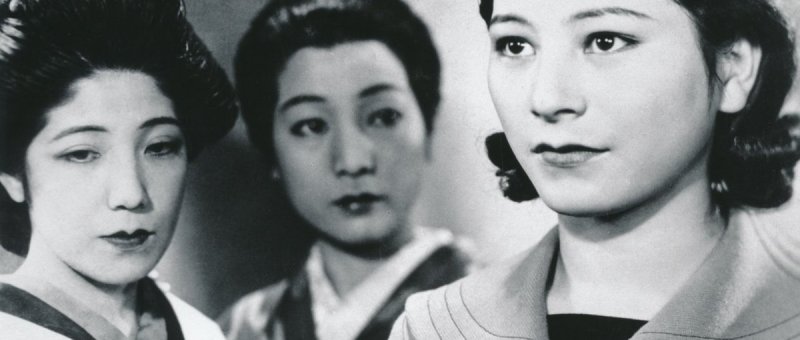
The Girl in the Rumor (噂の娘, Mikio Naruse, 1935)

vlcsnap-2019-12-21-23h50m32s752The world was changing in 1935, but not everyone was swept away by the fickle tides of modernity. The heroine of Naruse’s 1935 drama The Girl in the Rumor (噂の娘, Uwasa no Musume) is like many of his leading ladies betrayed by the world in which she lives, yet she’s also an encapsulation of the conflicts of the age, at once fiercely traditional and personally progressive while her “modern girl” sister is as selfish and judgemental as any of the bright young things who serve as extreme examples of the risks of Western individualism.

Kunie (Sachiko Chiba), an unmarried young woman, works in her family’s sake shop which is currently struggling to make ends meet. While the guys in the barbers opposite complain that the place has gone downhill since grandpa’s days, the old man himself has begun to worry that there’s something not quite right about their produce. In order to keep the shop going, there’s some talk that Kunie may marry the son of a wealthy family, but her father Kenkichi (Ko Mihashi) is against the idea. He married into his wife’s family and the marriage was intensely unhappy so he is mindful that the same fate doesn’t befall his daughter. His wife now long dead, Kenkichi is free to be more open about his longstanding affair with a bar owner, Oyo (Toshiko Ito), which produced a daughter, Kimiko (Ryuko Umezono), who was raised by Kenkichi and his legal wife and has no idea her birth was illegitimate. Kimiko, unlike her sister, has become a “modern girl”, dressing in Western fashions, listening to jazz, and staying out late going to parties. The trouble starts when Kunie decides to take her sister with her to the omiai for moral support and it becomes obvious that Sato (Heihachiro Okawa) is a bit of a “modern boy” who has lots more in common with the vivacious Kimiko and decides to break protocol by telling the go-between that he’d rather have her instead.

This move comes as a total blindside to the girls’ uncle who arranged the meeting. “The marriage proposal’s turned into something really weird” he tells Kenkichi over the phone while the two men try to work out what the best course of action is. The uncle seems to think it might be a good move to carry on the negotiations with Kimiko instead, after all Kunie is basically running the store so it would be more convenient to keep her around. Kenkichi is unconvinced. He knows Kimiko doesn’t really approve of all this old fashioned arranged marriage business, and to be honest he doesn’t seem to like her much so isn’t keen on talking to her about it but can’t rely on his usual trick of getting Kunie to do it because he doesn’t want to hurt her feelings by letting her know that Sato doesn’t fancy her and has asked her sister out instead.

Kimiko certainly is a “modern girl” and superficially proto-feminist. She mocks her sister’s traditionalism and criticises her for blaming “their” mother for the failure of their parents’ marriage, thinking that she is simply unable to move past the patriarchal mindset and used to blaming everything on the woman. Little knowing that Oyu is her mother, she rejects Kunie’s plan to have her come and live with them as new maternal presence, claiming that she has only contempt for mistresses and thereby exposing herself as being, ironically enough, more judgemental than her superficially conventional sister. Kunie may be “traditional” in her outlook, but she is also empathetic and understanding. It seems her mother may not have been an easy woman, and what she most wants is to repair her family by bringing Oyo into the fold in her “rightful” place at her father’s side. Despite her insistence on her own freedom, however, Kimiko is childishly moralistic, directing her anger with an oppressive system back on the people constrained by it. Yes Kenichi’s life is one of socially condoned hypocrisy, but there’s no point in blaming him or Oyo for trying to find happiness where they can.

Blame them she does, however, and her sister with them. Kimiko meets Sato by chance and starts dating him in the non-serious manner of young people of the time only for the Satos to become worried and again push the idea of a marriage. Having been spotted with Sato in the street by Kunie, Kimiko’s confession is cruel and cutting, delivered almost with glee as she reveals that her uncle and father have been avoiding telling her that Sato turned her down because he liked her sister more. Kunie had professed that she wasn’t all that bothered about the marriage because she had become convinced that she “couldn’t have a happy marriage anyway”, but her tears suggest a deeper hurt than having her hopes for the business dashed and being wounded by her sister’s callousness. Nevertheless, she wants nothing but her sister’s happiness and so if she seriously wanted to marry Sato for the “right” reasons, she would of course support her.

Kimiko however remains selfish and implacable. Kenkichi, hoping to teach her a lesson, brings Oyo into the home and reveals to Kimiko that she is a mistress’ daughter. It does not go well. Kimiko refuses to engage with Oyo, while Kenkichi also asks for an apology on behalf of Kunie who has only ever tried to protect both Kimiko and Oyo by trying to reunite their family, but Kimiko leaves in a huff shouting that she has no need of mothers or fathers or families or anything else. A rapprochement is brokered between the women only when Kenikichi is made to pay for his failure as a patriarch. It turns out grandpa was right after all, he’d been tampering with the sake and now the police want a word with him. With the arrival of Oyo, tacitly accepted by Kimiko’s final return to the home, the family is in some senses restored but also broken. The gossips in the barbers across the way lament the end of the Nadaya Sake store, callously speculating on what will replace it, while all Kunie can do is look on in consternation and disappointment.


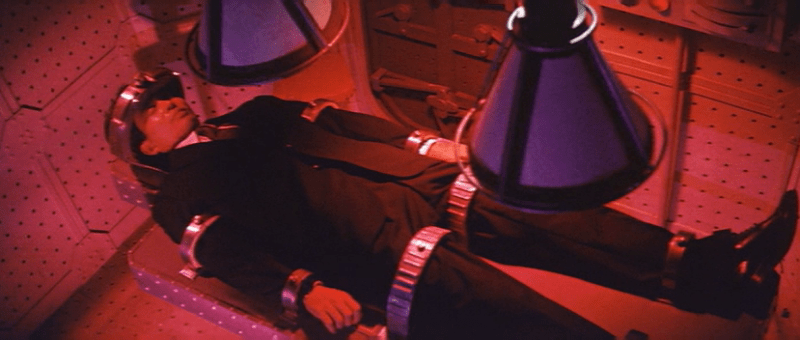
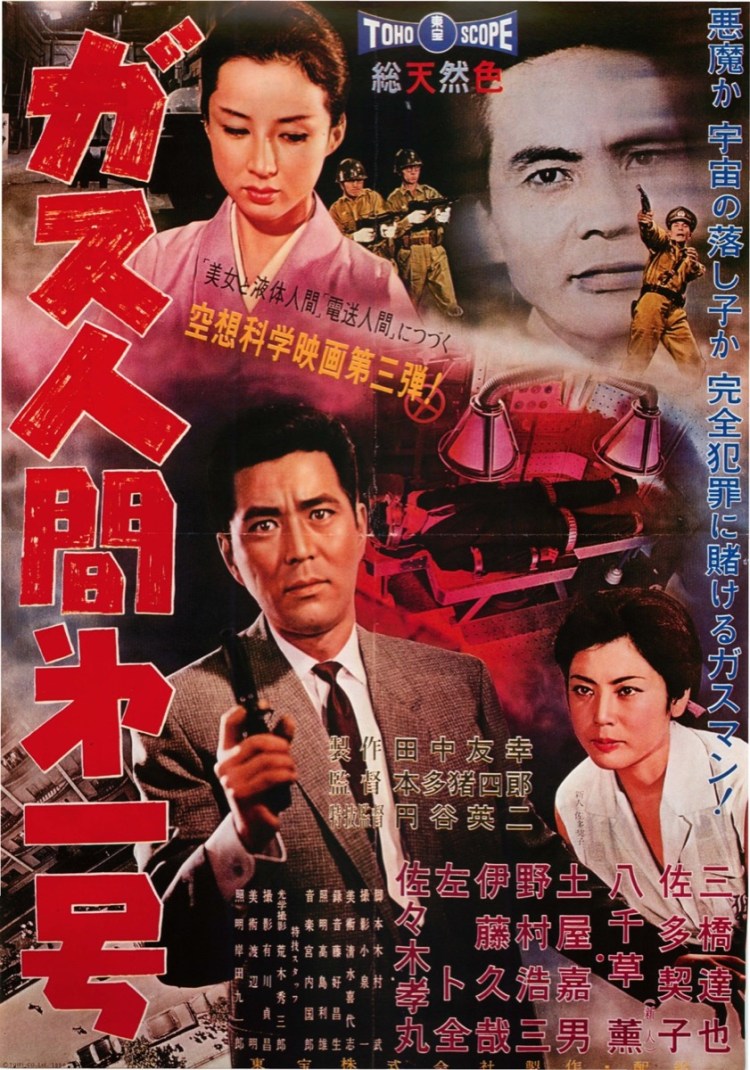
The Human Vapor (ガス人間第一号, Ishiro Honda, 1960)

The Human Vapour poster“The world is full of hysteria towards things they don’t understand” admits the strangely chatty “villain” at the centre of Ishiro Honda’s The Human Vapor (ガス人間第一号, Gas Ningen dai Ichi-go). Third in a loose trilogy of “mutant” films put out by Toho beginning with The H-Man and followed by The Secret of the Telegian, The Human Vapor is at once the most futuristic and the most traditional in that it’s no longer wartime guilt or nuclear anxiety which has corrupted our increasingly amoral hero but unwise ambition in which desperation to win the space race has produced a new and dangerous threat we may not be able to contain.

Honda opens with an exciting bank heist which on later consideration might not make much sense, filled as it is with shots of a faceless man pointing a gun at terrified staff while the vault doors open seemingly on their own. Earnest policeman Okamoto (Tatsuya Mihashi) is on the case, chasing a suspect car down a narrow country road only for it to crash and be discovered empty with no trace of the driver to be found. Okamoto’s feisty reporter girlfriend Kyoko (Keiko Sata) is dismayed to find out he has no leads, but later picks up on his mention of a buyo dancer, Fujichiyo (Kaoru Yachigusa), who lives near the scene and might have something to do with the case. 

Chasing Fujichiyo takes Okamoto to a library, where he becomes further convinced she is in contact with the mysterious bank robber. A strange and isolated woman, Fujichiyo is apparently from a noble, wealthy family but lives alone in a small cottage with only a single male servant where she devotes herself entirely to perfecting the art of traditional Japanese dance. We discover that Fujichiyo has been in poor health, which is why she hasn’t given a public performance in some time. Okamoto posits that the bank robber is bankrolling her comeback, though he never seems to have much of an explanation why she would need him when she has access to her own resources.

He is however correct, though it seems Fujichiyo was not aware that the money was stolen otherwise she might have been more careful in using it. In a contrast with genre norms, honest cop Okamoto never falls for Fujichiyo but does become oddly invested in her sad love story while sparking with his cheerful reporter girlfriend who ends up doing much the same. In fact, Kyoko is the only one doing much investigating but largely finds herself having to do it in spite of the (generally useless) men around her, including an unpleasant younger colleague who mocks all her ideas but does nothing much of anything on his own.

In any case, smirking villain Mizuno (Yoshio Tsuchiya) later makes himself known to the police in a selfless gesture of love in order to clear Fujichiyo’s name and get her released from police custody. He does this by taking the police to a bank and demonstrating how he was able to get in the vault without a key which involves his curious ability to turn himself into a gas. When Fujichiyo is not released, he takes matters into his own hands and frees all the prisoners in the cells, but Fujichiyo refuses to leave, insisting that she has no intention of running away and prefers to stay until the police affirm her innocence by releasing her.

Mizuno’s intention to bypass the law is one of the many signifiers of his increasing danger, that now believes himself “above” the rest of humanity and therefore no longer subject to their laws. He later tells the police exactly that, sitting them down for a mini audience to explain himself during which he recounts his history as an SDF pilot discharged on a diagnosis of lung cancer after which he took the boring job in the library and fell in love with Fujichiyo. A shady doctor, Sano (Fuyuki Murakami), later approached him claiming to be working for Japan’s space programme and suggested that his fighter pilot background made him a perfect fit for becoming an astronaut. Mizuno agreed to participate in his research to “change the existence of the human body” in preparation for life in space, but when Sano’s weird experiments turned him into a “gas man”, the doctor committed suicide in horror leaving Mizuno just another lonely victim of a mad scientist.

Like many other “mutant” heroes, the change in Mizuno’s body has also changed his soul though his love for Fujichiyo remains unchanged. It seems he’s only committing these crimes to fund her ambition of performing traditional buyo dance on the contemporary stage, while she though obviously devoted to her art finds it difficult to accept the man that he’s become. He promises to give her the world, sacrificing anyone that gets in his way. She remains conflicted, not wanting to accept his offer if it involves that kind of cost, and defending him to her colleagues only with the rationale that he is “different from what they are accustomed to”. While some advise caution, that perhaps Mizuno is not as dangerous as they think despite already having killed and should be given the chance to reform, others take a harder line eventually opting to use a different kind of gas to counter him.

Kyoko pleads with Fujichiyo as one woman in love to another, trying to protect Okamoto while advising her to pull Mizuno back from the brink by cancelling her performance, but precisely because of the understanding that exists between them she cannot. Sadly, as many point out, no one is really interested in buyo dance – the only audience members in attendance are there for the drama and the possibility of seeing the gas man in action. “You and I have finally won” Mizuno tells Fujichiyo on completion of her dance, as if this performance was all that ever mattered to either of them. But their victory leaves them with nowhere else to go, and the world unready to accept the latent threat a gas man represents. Fujichiyo makes her choice, one perhaps informed by her art and her love, while the authorities can only wait outside for the vapours to disperse.


Original trailer (No subtitles)

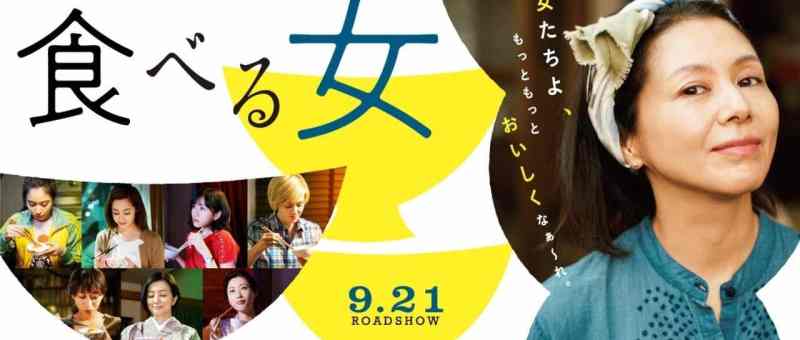
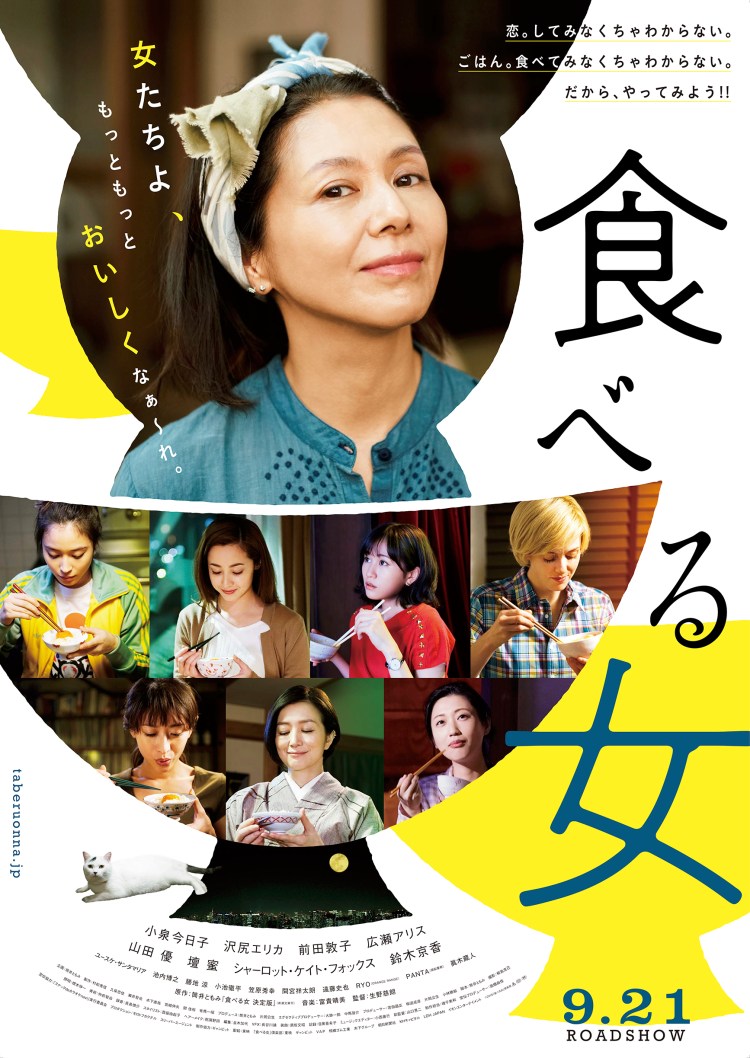
Eating Women (食べる女, Jiro Shono, 2018)

Eating Women poster 2“Comfort cinema” may be a slightly maligned genre, disregarded for its throwaway pleasures, but it can often be much more subversive than it’s given credit for. Jiro Shono’s adaptation of Tomomi Tsutsui’s novel Eating Women (食べる女, Taberu Onna), refusing to unambiguously reinforce contemporary social norms, it actively undercuts them as it pushes its lonely heroines towards more positive paths of self-fulfilment while remaining unafraid to embrace the sometimes taboo idea of female desire as something entirely normal.

The heroine, however, is someone who’s decided to live without it. Food writer and bookstore owner Atsuko (Kyoko Koizumi) lost the love of her life at 29 and has lived alone ever since. She does, however, have a very committed group of female friends who get together once a month to enjoy a tasty dinner she and her friend Mifuyu (Kyoka Suzuki), who runs the local restaurant, cook for them. Unlike Atsuko, Mifuyu is a sexually liberated older woman, complaining once again that both of her (young, male) apprentices have quit after she seduced them. Keiko (Erika Sawajiri), Atsuko’s editor, has hatched on a different solution in affirming that she has already achieved financial independence and has no real desire for male companionship, preferring to embrace her freedom to live as she chooses while Tamiko (Atsuko Maeda), an assistant TV producer and the youngest of the group, is facing the opposite dilemma – her boyfriend has proposed to her, but she’s unconvinced because he’s just too “nice” to make her heart beat faster.

Though at different points of their lives, the women are always there to support each other while permitting themselves the indulgence of fully enjoying beautifully cooked meals taken with good company. Meanwhile, across town, an American woman, Machi (Charlotte Kate Fox), seems to be content to play the role of a 50s housewife to a grumpy salaryman husband (Hiroyuki Ikeuchi) who barges in through the front door and roughly forces himself on her before retreating to the bedroom. The problem in their marriage is, apparently, that Machi can’t cook, providing mostly Western-style microwavable dinners which fail to excite her husband who tells her he’s been having an affair with someone who can make good food. Heartbroken, Machi runs into Mifuyu and eventually ends up living in one of Atsuko’s spare rooms where she slots right in with the other gourmet women as she begins to learn to cook under Mifuyu’s gentle guidance.

It is not, however, a pathway towards regaining her husband or “fixing” a perceived fault so that she can be a “proper” wife, but a way for Machi to rediscover life’s small pleasures along with a sense of independence, rejoicing in her own success as she enjoys a meal she cooked herself made with ingredients that she earned the money to pay for. Tamiko’s barfly friend Akari (Alice Hirose) begins to discover something similar on her own, repeatedly dumped by snooty salarymen boyfriends who objected to her preference for minced meat over whole steak. Akari had a habit of thinking of herself in terms of the meat – quick, cheap, and simple, but finally finds love with a gentlemanly colleague after she gains the confidence to share with him her real self by embracing her love of mince without embarrassment.

The only “misstep” is perhaps in Keiko’s tale in which her bid for solo independence is eventually negated by her loneliness, implying that in the end she did need male companionship after all. Indeed, only Atsuko who rejects sex in favour of vicarious maternity is allowed to live life alone, though conversely Mifuyu’s free spirited pursuit of younger men is never judged negatively nor is she encouraged to settle down even while she ironically advises Tamiko to do just that, and pointedly tells Keiko that she’s running out time to find anyone halfway decent. Yet all of that aside, the ladies are an accepting bunch, emphasising that love is love and refusing to judge others, making sure to offer support to all who need it. We’re never the same people as yesterday, Atsuko writes in her book, we just need to be ourselves. Above all, however, she seems to say you have to be kind to yourself, embracing life’s small pleasures such as the simple joy of well cooked food made with love, and the rest you can figure out later.


Original trailer (no subtitles)
The Dragon of Macao (マカオの竜, Mio Ezaki, 1965)

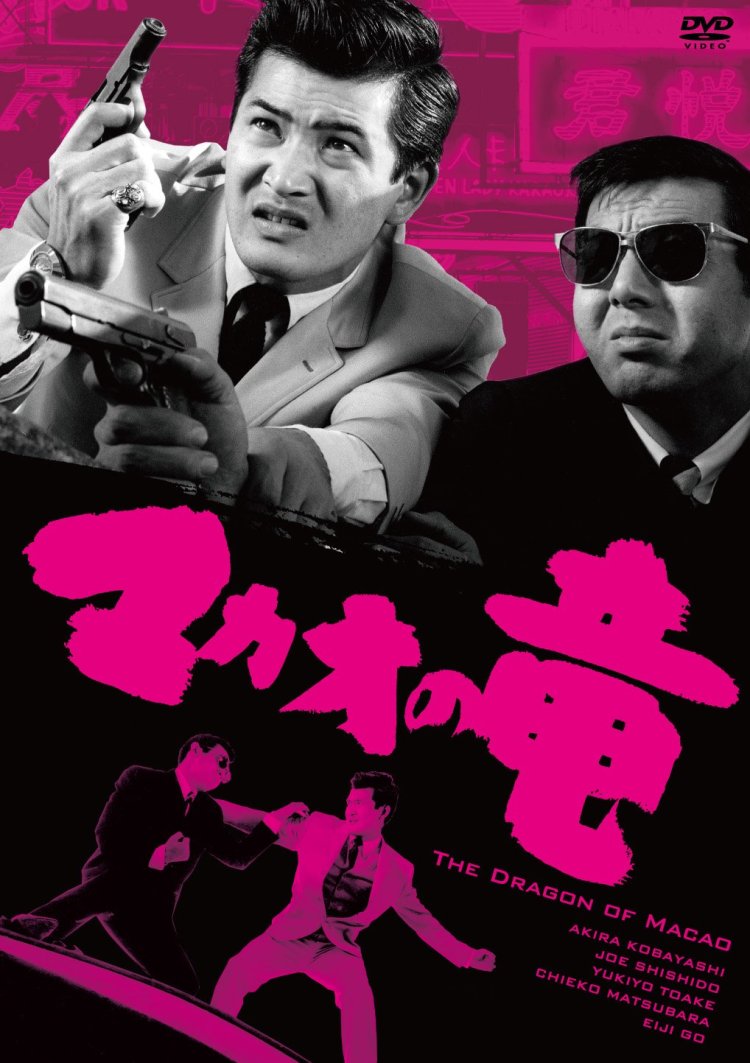
Dragon of Macao DVD coverNikkatsu’s “borderless” action was famously internationalist, but as Japan’s place on the world stage began to change in the mid-60s, it also betrayed a slight anxiety in the nation’s new status as a burgeoning economic power in the Asian sphere. The Dragon of Macau (マカオの竜, Macao no Ryu), while indulging in the genre’s characteristically xenophobic vision of China as an exporter of criminality, is another attempt to cash in on James Bond cool as its suave, British passport-carrying hero tries to wrestle a precious gem away from fiercely amoral “pirates” while protecting a betrayed young woman trying to avenge the death of her parents at the hands of duplicitous gangsters.

Set in the bustling port town of Yokohama, the film opens with the harbour patrol forcibly boarding a ship to look for smuggled gold. However, it turns out that the two men they’re searching are members of the patrol themselves on an undercover mission trying to expose organised crime while the guys dressed as policemen are actually members of a gang trying to steal a precious diamond. Fearing the operation blown, the gangsters’ plant offs the lot of them and makes off with the loot.

Meanwhile, “Dragon of Macau” Ryu (Akira Kobayashi) lurks about on the harbour while rival gangster Tsukada (Asano Sano) tries to get the police onside and convince them that someone else is targeting his operation though the police are apt to wonder if he staged the whole thing himself to get rid of the undercover agents. The truth, however, is that ambitious harbour punk Aizu (Jo Shishido) is after a precious diamond known as the “Himalyan Star” which is rumoured to be cursed seeing as everybody who’s come into contact with it has ended up dead.

Unsurprisingly, Aizu gets his hands on the gem from a Chinese broker, Chen, who warns him that two gangsters, Gordon and Boomerang, will do “anything” to get their hands on it. Ryu later turns up a bar run by Tsukada and gets into a bar fight with a series “damn foreigners”, sailors who’d had too much to drink and started hassling the staff. The “damn foreigners” quip is especially ironic seeing as we later discover Ryu is a British citizen who seems to have grown up in Hong Kong after being rescued by a British vessel when the boat he and his parents were travelling on was torpedoed during in the war. Introducing himself to Tsukada, Ryu says that he works for the aforementioned “Gordon”, presumably an imperialist Brit engaged in shady colonial shenanigans out of Hong Kong. The truth about “Ryu” at least turns out to be slightly different, but for the moment he’s a Bond-inspired unflappable agent of cool complete with a fancy white three-piece suit and a collection of gadgets (a cigarette lighter blowtorch, pistol that dispenses matchstick flares, and a tiny nail gun) that would be the envy of any cold war spy.

Not to be outdone, however, Aizu has his own share of surprises including the tiny dagger hidden in the cigarette which permanently hangs from his lip. Temporarily entering this land of intense amorality, Ryu plays along but retains his nobility and remains permanently one step ahead as he attempts to get his hands on the Himalayan Star and return it to its “rightful” owners. Aizu’s main gambit is weaponising women – Aizu’s sister is a plant working at Tsukada’s bar and apparently also his mistress, while he also makes use of another young woman, Nami (Yukiyo Toake), whose late father was a patron of his. She believes Tsukada is responsible for the deaths of her parents and is participating in the plan as revenge, but eventually falls for Ryu’s suave nobility and refuses to betray him when faced with Aizu’s continuing duplicity.

A few narrative machinations later, we’re told that Ryu is “a person without a motherland” but also that he has always been a force for “good” or at least order in that he wants the gemstone not for himself but to get it away from the gangsters and back to its “official” owners (which sort of ignores the fact that the stone was “stolen” from the eye of a Buddhist statue which is presumably why people think it’s “cursed”, and that his primary motivation is avoiding a giant insurance payout). Having fallen for Nami, he leaves her a message that he’d have liked to take her back to Macau but is unsure she’d be happy with someone like him, asking her to look after another young woman who came all the way from Hong Kong to warn him that Gordon and Boomerang have finally taken each other out.

Perhaps in contrast to Nikkatsu’s other international crime dramas, the “threat” turns out to be wholly homegrown in Aizu’s rapidly individualist stance that “life is cruel”, “mercy is for fools”, and those who stand in one’s way must be eliminated. The solution comes, paradoxically, from destabilising internationalism at the hands of a man who is both Japanese and not, speaks several languages, and works as an agent for colonising imperial powers to whom he eventually exiles himself, job done. A rip-roaring spy drama complete with modern day pirates and an extremely ineffectual police presence, The Dragon of Macau is a surprisingly complex effort from Nikkatsu’s “borderless” action strand which makes the case for Japan as a part of wider world rather than a isolated island fearful of losing out in an increasingly globalised environment.


Sakura Guardian in the North (北の桜守, Yojiro Takita, 2018)

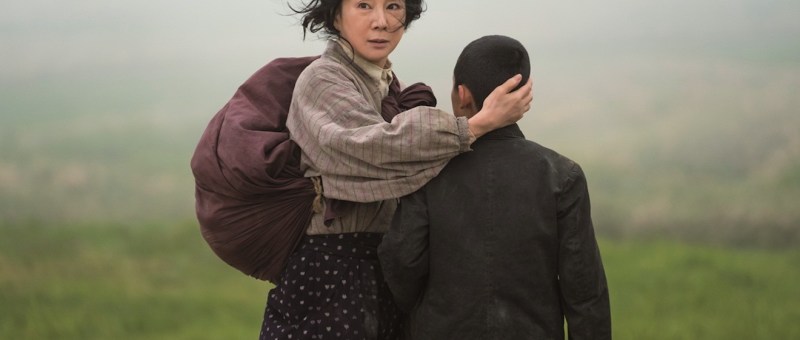
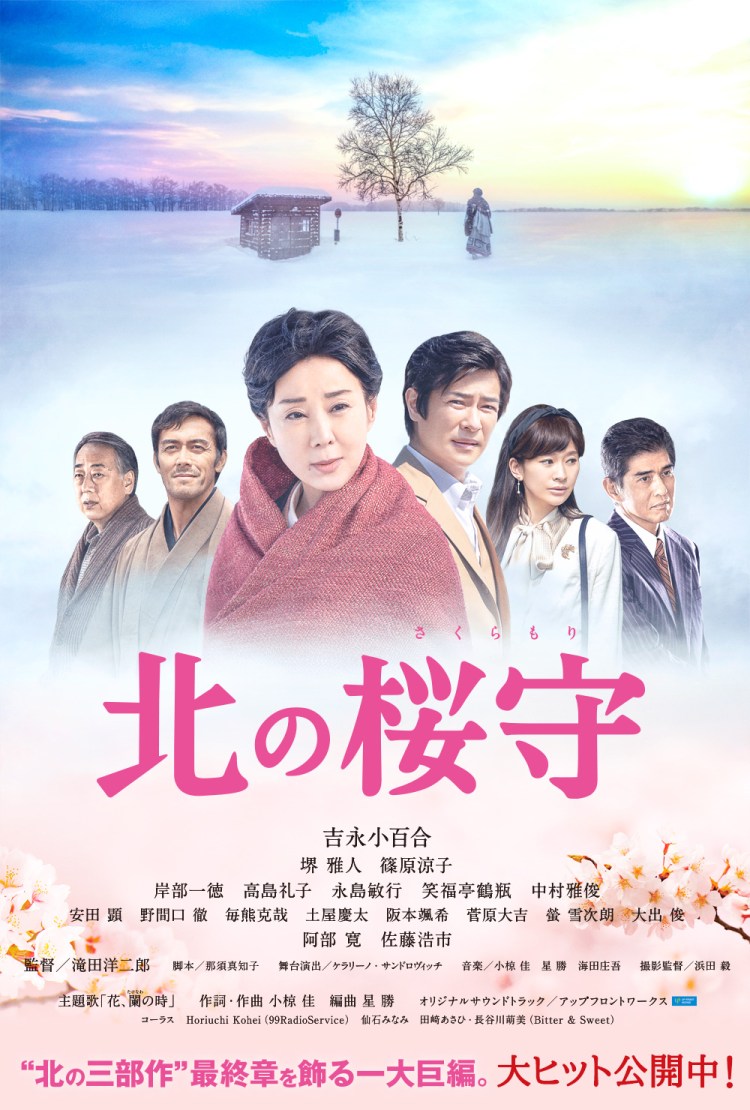
Sakura Guardian in the North posterStill a major marquee star and one of the few golden age actresses regularly playing leading roles in box office hits, Sayuri Yoshinaga has for one reason or another become somewhat synonymous with a brand of quietly patriotic tales of wartime endurance and maternal suffering. Sakura Guardian in the North (北の桜守, Kita no Sakuramori), apparently the conclusion of a loose trilogy of “Northern” films which began with Year One in the North in 2005 and led on to Junji Sakamoto’s A Chorus of Angels in 2012, sees her once again engage with post-war trauma as a mother eventually driven out of her mind by the inability to come to terms with the weight of tragedy.

The tale begins on Sakhalin in spring 1945. Despite the intense cold of the frozen North, Tetsu (Sayuri Yoshinaga) – mother to two young sons, Seitaro and Shujiro, has carefully nurtured cherry trees grown from seeds brought from the mainland ensuring that they blossom even here. The family’s happiness will however be short lived. Dad Tokujiro (Hiroshi Abe) is sent off to the war while Tetsu and the children are eventually forced to evacuate to escape the Russian invasion, planning to wait for Tokujiro in Abashiri on the north coast of Hokkaido.

Flashing forward to 1971, we find ourselves in Tokyo with Shujiro (Masato Sakai), now a grown man married to the Japanese-American daughter of an LA hot dog entrepreneur, Mari (Ryoko Shinohara). Having made something of himself in the New World, Shujiro has returned to Japan to open the first branch of his father-in-law’s convenience stores. His plans are disrupted when he gets an unexpected call from Abashiri about his mother, whom he hasn’t seen since she told him to leave her behind and seek his fortune 15 years previously. The public housing shanty town where Tetsu ran her restaurant is being torn down but she’s showing no signs of leaving, and not only that, she’s begun to act strangely.

This Shujiro finds out for himself by visiting her and witnessing Tetsu talk to her own reflection as if it were a long lost friend. His sudden decision to bring his mother back with him to Tokyo without talking to his wife, who has never even met her mother-in-law, places a strain on his marriage on top of the already heavy burden of the store but Shujiro is determined to make it work. Tetsu, however, finds its hard to adjust. Used to living in small country towns where everyone knows everyone, she doesn’t realise you can’t just walk off from stores shouting “put it on my tab”, and annoys the neighbours by starting a smoky fire outside trying to cook rice the old fashioned way. With Shujiro busy with work, the burden falls disproportionately on the patient but exasperated Mari who is forced to apologise when Tetsu walks off in someone else’s shoes after trying on city-style outfits at a department store, and looks on in horror as her new mother-in-law starts an intense conversation with a cherry blossom tree.

Tetsu’s down home charm does, however, begin to give Shujiro some business inspiration as he ponders why his top American hotdogs aren’t selling now the novelty’s worn off. As his staff tell him, maybe they need to think a little more “Japanese” – more fresh veggies and innovative toppings, less ketchup and mustard. Shujiro has another idea – the original Japanese “convenience” food, onigiri, made with rice cooked in a pot and roughly shaped by a loving mother’s hands.

Rice, however, despite its ubiquity in the comparatively comfortable world of 1971 brings with it traumatic memories. Starving after the war, white rice was something Shujiro and Tetsu could only dream of, getting their first taste of it in many moons only when cooked to place on a funeral altar. Meanwhile, rice was also the only reason they survived after running into a slightly dodgy young man who gave them “jobs” helping him to smuggle it for sale on the black market. Shinji (Koichi Sato) helped them in other ways too, eventually putting up the money for Tetsu’s homely eatery, and would have married her if she were not on the one hand loyal to the memory of her absent husband, and so troubled by survivor’s guilt as to believe that she is “a person who does not deserve happiness”.

To punish herself for perceived failures, Tetsu has lived a life of austerity – working hard in the restaurant, dressing in simple ragged clothes, and eating only enough not to starve. She forced Shujiro away to make something of himself, but never spent any of the money he sent home to her nor answered any of his letters. Shujiro, by contrast, has swung the opposite way – determined to live a life of luxury and becoming unforgiving with it. Mari sees an ugly side to him when he’s visited by one of the boys who used to bully him (Ken Yasuda) for being a refugee and a black-marketeer back in Abashiri now fallen on hard times. Superficially polite, Shujiro humiliates him with undignified zeal while wilfully planning to exploit his workforce, quickly silencing an employee who tries to point out violations to the labour code.

Yet like Tetsu, who is somewhat unstuck in time, he begins to find a softer side of himself as the pair of them journey back into the past and revisit the sites of their shared traumas. Yojiro Takita stages Tetsu’s internal confusion somewhat incongruously as an avant-garde stage play offering occasional background info on the exodus from Sakhalin, an experience Shujiro is seemingly shut out from as he tries to reconnect with his mother only to lose her again but rediscovering a better version of himself before he was hardened by the burden of his memories and the hardships of the post-war era. Tetsu keeps the cherry blossoms in bloom in the North, cultivating beauty as a means to connect with her loss, and eventually finding a kind of resolution in the returned ghosts of her past given life once again by the strength of her devotion.


Singapore trailer (English / Simplified Chinese subtitles)

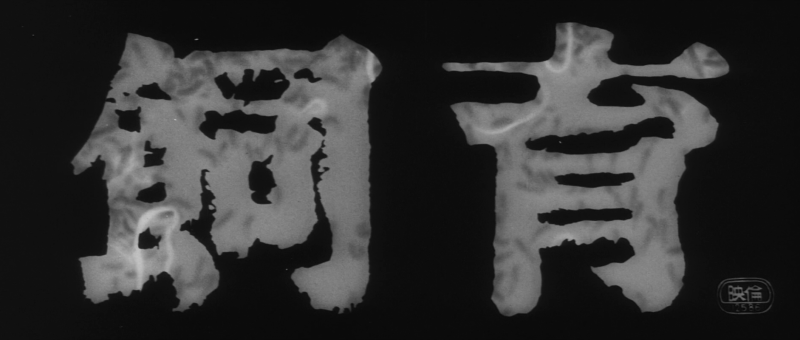
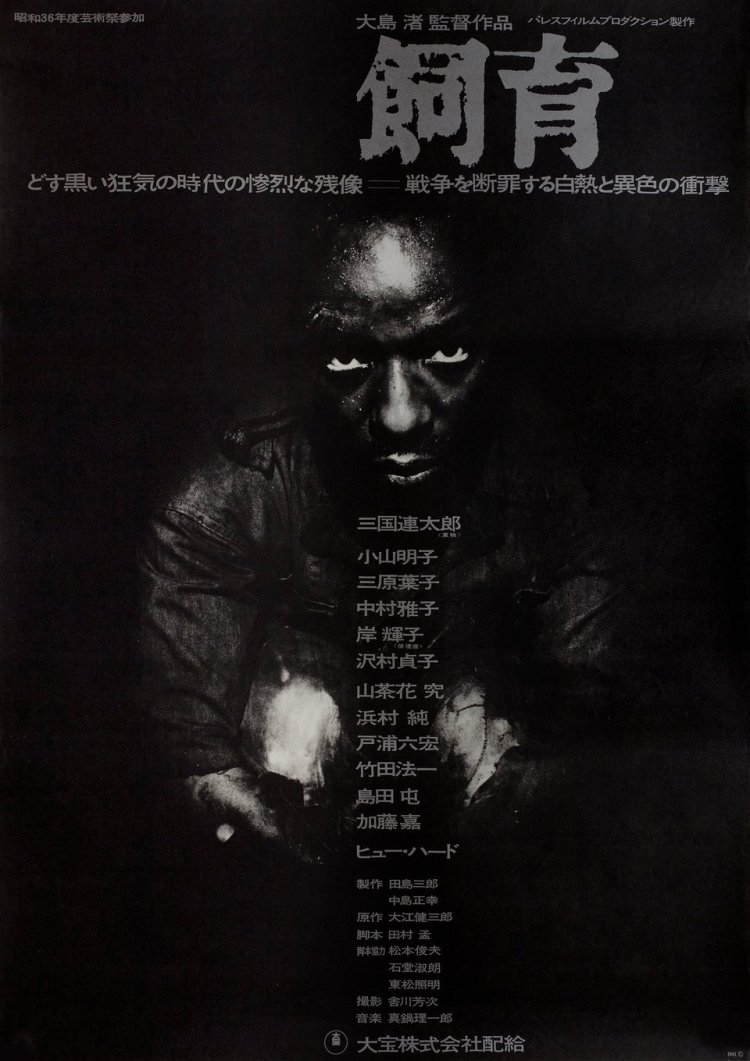
The Catch (飼育, Nagisa Oshima, 1961)

The Catch poster1960 was a turbulent year for many, not least among them Nagisa Oshima who dramatically broke his contract with Shochiku after the studio withdrew Night and Fog in Japan on grounds of sensitivity after the leader of Japan’s Socialist Party was murdered by a right-wing assassin live on TV. 1961’s The Catch (飼育, Shiiku), an adaptation of a novel by Kenzaburo Oe, was Oshima’s first post-studio picture and as uncompromising as anything else he’d worked on up to that point. Unlike many other filmmakers of the post-war generation who had been keen to use the corruption of the war as an excuse for a failure of humanity they now thought could be repaired, Oshima suggests that the rot was there long before and all the war did was give it justification.

In the summer of 1945, a small village captures a black American airman (Hugh Hurd) shot down over a nearby forest. They are originally quite jubilant about their act of heroism, believing that they will eventually be rewarded by the authorities, but are then irritated by their new responsibility. They are already low on food, and now they’ll have to feed this full grown man or risk being branded as amoral war criminals. Predictably, nobody wants to be saddled with looking after him until the authorities arrive with further instructions or knows what to do now, so in time-honoured fashion they tie him up in a shed and hope for the best. Only latterly when one of the children points it out do they realise that they should probably remove the bear trap attached to the airman’s foot which may already be infected seeing as he seems to be in a considerable amount of pain and is running a high fever.

It goes without saying that villagers are extremely racist, using quite pointed racial slurs and dehumanising language to describe their captive, even when others stop to remind them that he is after all human too even if he’s an enemy. Just as their sons and husbands are overseas fighting, and dying, bravely for the emperor so was this man valiantly risking his life for his country. Shouldn’t he be accorded some respect just for that? Wouldn’t they want that for their sons too?

Sadly thoughts are thin on the ground, as is food. Jiro (Toshiro Ishido), a young man shortly to enlist, wants a bag of rice off his dad to take into town to buy a woman, but his dad doesn’t have any because he’s already in debt to the immensely corrupt village chief (Rentaro Mikuni). Jiro eventually satisfies himself with a sexually liberated high school girl evacuated from the city and thereafter disappears – the first of many negative events to be randomly blamed on the captive airman. Meanwhile the village chief is responsible for a series of problems because of his out of control need for sexual dominance which sees him apparently abusing his daughter-in-law (Masako Nakamura) and attempting to assault a young widow (Akiko Koyama) with two children evacuated from the city and otherwise undefended in the village.

The rot here is feudalism, the idea that gives free rein to the village chief to misuse his position for his own satisfaction – extracting sexual favours from the women and controlling the men economically. Because he’s the village chief no one really questions his authority or his orders, so when he says all the problems are new and caused by the “black monster” they’ve brought into the village then everyone believes it to be true. The airman, who cannot be responsible for any of these crimes because he is still recovering and locked up in the shed, becomes a scapegoat for every bad thing that has ever happened in the village. More than an embodiment of the war, he is a symbol of all the external pressures that the village would like to pretend are the reasons it has turned in on itself.

Yet the airman is only one kind, the deepest kind, of other. The village hasn’t quite even integrated its evacuees who also constitute a secondary community. The young woman’s two starving children are repeatedly caught with their fingers in other people’s rice jars and receive little sympathy from the villagers, but their crimes only expose the fact that the man who has sheltered them, and also owns the shed where the airman is kept, has been keeping quiet about people thieving his potatoes. He knows it’s not the widow because there are simply too many taken to feed a small family of three, which means that there are probably several “thieves” among the villagers, content to betray their neighbours in thinking that the wealthy farmer won’t miss a measly few root vegetables.

Predictably, rather than deal with the problem, everyone obsesses over the idea that the corruption is born only of the airman and if they could just eliminate him everything would go back to “normal” – i.e. the feudal past in which everyone does what the village chief says and lives in superficial harmony without complaining about their reduced status as lowly peasants forced to live in penury by an unfair and essentially corrupt system. To cure the discord between them, they decide that the airman must be killed, no longer caring about the censure they may face from the authorities. Only two young boys stick up for him, remaining sane amid the madness all around them in insisting that the airman is a person too, is unrelated to the village drama, and deserves his dignity and respect. Sadly, however, the madness has already taken hold.

On learning that the war is over, the villagers refuse to reflect on their behaviour and seek only to bury the past, superficially smoothing over their barbarity with convenient justification. They receive the news that the American authorities do not trust the Japanese with surprise and hurt, despite the fact they are living proof of the reasons why they would be foolish to do so. We gave him white rice while we ate potatoes, he had goats milk, they say, what more could he have wanted? The answer is self evident, but it’s already been forgotten. The villagers start blaming each other, and eventually settle on another scapegoat – a deserter, as if another death could tie all of this into a neat bundle to be burned away on a funeral pyre as if it never existed at all. The evacuees are invited to leave, and the villagers start thinking about the harvest festival, as if the evil has been excised and everything is returning to the way it’s supposed to be, but this “peace” is brokered on the back of secrecy and an abnegation of responsibility. A grim exposé of man’s essential cruelty and selfishness, The Catch rejects the tenets of post-war humanism to suggest that the corruption of feudalism has not and may never be eliminated at least as long as a nation remains content to bury its past along with its shame.


Short clip (English subtitles)

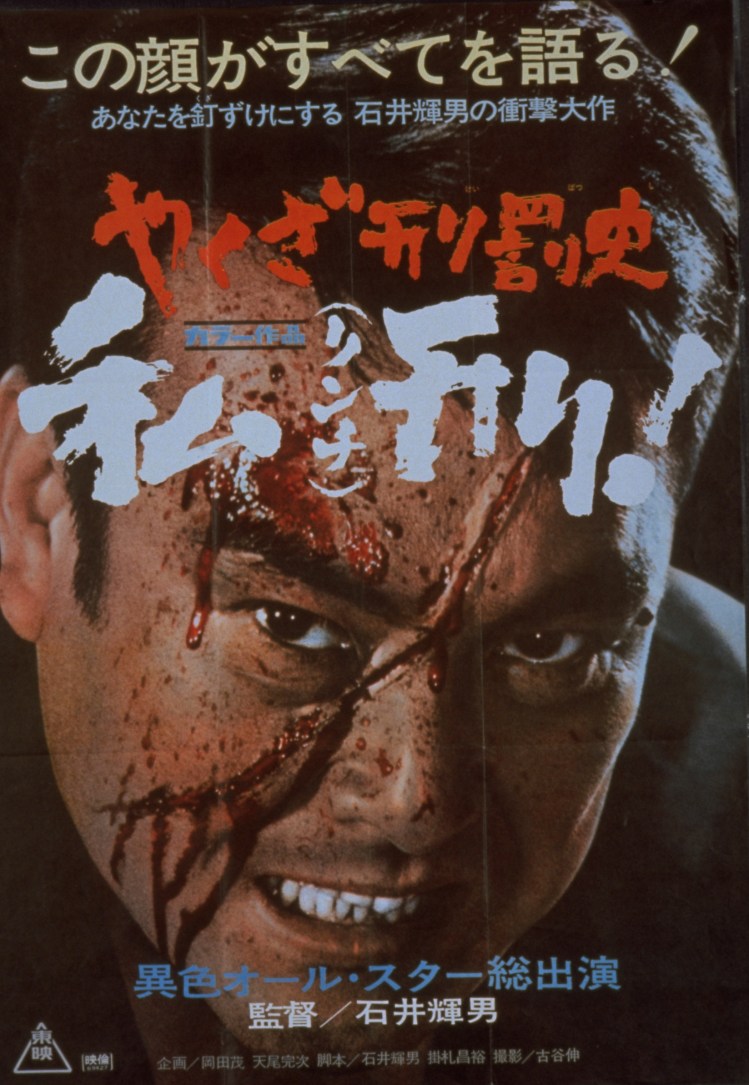
Yakuza Law (やくざ刑罰史 私刑!, Teruo Ishii, 1969)

yakuza law posterOne of the things that (supposedly) separates the “yakuza” from regular thugs is that they have a “code”. That code means many and various things, but in their grand mission to justify their existence it often means that they stand up for the little guy, all too often oppressed by the powers that be. Of course, a lot of people might feel themselves to be oppressed by yakuza thugs who like to throw their weight around and generally cause trouble for small business holders, but that’s beside the point. Teruo Ishii’s Yakuza Law (やくざ刑罰史 私刑!, Yakuza Keibatsushi: Lynch!) goes one step further and asks if the yakuza are themselves “oppressed” by their own code, or at least the various ways it is used and subverted by all who subscribe to it.

Set in three distinct time periods, Yakuza Law is also fairly unique in that the vast majority of those on the receiving end of its violence are male. The yakuza is an extremely homosocial world after all. Each of the three tales presented is preceded by a title card featuring the particular “laws” the unhappy gangsters are about to break and what kind of punishment they might expect for doing so.

The first and earliest, set in the Edo era, is a typical giri/ninjo tale that places the ideal of the yakuza code against the need to preserve a personal vision of justice. The “rules” here are that a yakuza does not steal and he does not fool around with married women. Our hero, Tsune (Bunta Sugawara), takes the heat for a nervous underling, Shinkichi (Hiroshi Miyauchi), who crumbled in the heat of battle, but incurs the wrath of his boss while a devious footsoldier, Viper (Renji Ishibashi), hides in the bushes and then stabs a corpse numerous times to make it look as if he’s done good service. Viper, not content with his ill-gotten gains, sets up Tsune and his superior Tomozo (Ryutaro Otomo) by implicating them in a gambling scam while Tsune falls for the boss’ girl Oren (Yoshiko Fujita) who is also desperately trying to protect the feckless Shinkichi.

The problem with all of this, it would seem, is not so much that the yakuza “law” has been broken but that’s it’s being misused in all quarters and is clearly in conflict with basic humanity. The boss uses the code to manipulate his underlings and keep a firm grip on his power, while Viper bends it to his own nefarious ways and a third underling, Shohei (Shhinichiro Hayashi), rests on the sidelines playing a little each way but remaining loyal to his brothers even as the axe falls on his head. The punishments meted out are suitably gruesome, escalating from finger cutting to eye gauging and ear removal in a senseless and counterproductive lust for violence which does eventually blow back on the boss who pushes his authority too far over too small a cause.

In tale two, however, which takes place in 20th century pre-war Japan, the “crime” is causing trouble and the punishment exile, but again the problem is not the code but the men who subvert it. Thus, hotheaded foot soldier Ogata (Minoru Oki) sets the cat amongst the pigeons by starting a gang war on his own and is sent to prison for three years during which time his gang prospers because of the movement he started. Even so, they aren’t keen to have him back when he gets out and immediately exile him from their territory. He sticks around waiting for his girl, Sayo (Masumi Tachibana), but she gets picked up by the evil boss who wants her for himself and delays her departure so that Ogata can be captured. Believing he’s dead, she hooks up with another goodhearted yakuza, Amamiya (Toyozo Yamamoto), who saves her from the bad guys only to have a romantic crisis when Ogata suddenly resurfaces. Amamiya and Ogata are, however, both “good” yakuza which means they both really love Sayo and want the best for her, each respecting the other for the old love and the new as they team up to kick the corrupt yakuza out of town and make sure she’s permanently safe whoever it is she eventually ends up with.

By the third tale we’ve reached the contemporary era, but we’re no longer in a traditional “yakuza” world so much as one seemingly ripped from a spy spoof in which the cardinal rule is that if you undermine the organisation you will be eliminated. More thugs than yakuza, this kind have no code and will stoop to the lowest kind of cruelty solely for money. Debonair, 007-esque international hitman Hirose (Teruo Yoshida) accepts a job from shady gangster Shimazu (Takashi Fujiki) to assassinate his boss, only Shimazu offs him first and then frames Hirose (which he finds very irritating). Hirose spends the rest of the picture teaching him a lesson while Shimazu tries to eliminate his competition in increasingly inhuman ways (including having someone crushed into a cube while trapped inside a luxury car).

Bar the third episode which isn’t really even about “yakuza”, what Ishii seems to be saying is that the yakuza are also oppressed because they are forced to live with fragmented integrity, torn between giri and ninjo in their adherence to an arcane set of values which are often overly enforced at the cost of true “justice”. To be fair, that is the idea behind every other yakuza film, but Ishii does is add a more cynical edge in suggesting the issue isn’t the code and conflicting value systems but individualised corruption (which is itself perhaps a kind of “ninjo”) in those who deliberately misuse the “noble” idea of the code for their own ends – something which has intensified since the Edo era though is apparently not a result of post-Meiji internationalism. All of that aside, despite the brutality of the title, Yakuza Law is fairly tame outing for Ishii which tempers its lust for blood with cartoonish irony as its deluded heroes battle themselves in service of a code which has never and will never truly serve them.


Available on blu-ray from Arrow Video in a set which also includes a new audio commentary by Jasper Sharp and a vintage interview with Teruo Ishii, as well as a booklet featuring new writing by Tom Mes.

Original trailer (no subtitles)
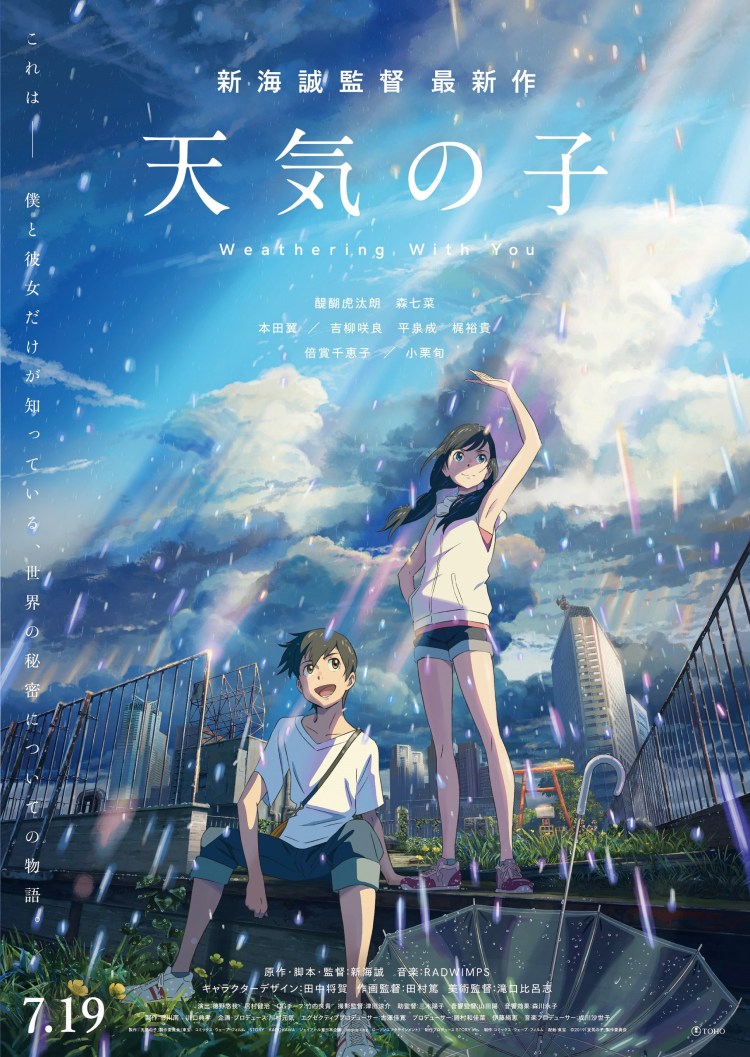
Weathering with You (天気の子, Makoto Shinkai, 2019)

weathering with you poster 2Some might say much of life is learning to weather the storm, but when the storm is literal as well as metaphorical it’s easier said than done. Following his 2016 mega hit Your Name, Makoto Shinkai’s Weathering with You (天気の子, Tenki no Ko) opts for much of the same but grafts an additional layer of anxiety onto the lives of his precarious teen heroes who are left largely adrift, betrayed by corrupt adult society and plagued by doubt and despair in a world which, it seems, is trying to drown them in existential hopelessness.

16-year-old Hodaka (Kotaro Daigo) has run away from his parochial island home for the bright lights of Tokyo. Beyond disconnection from his parents and small-town ennui, he never gives much of a reason why he’s so determined not to go back, but tries to make a go of it in the city with all the prideful naivety of an adolescent young man. What he discovers is that, because of laws in place to protect him, he can’t support himself honestly as an independent teen, ironically placing him firmly at risk in shady Kabukicho but it turns out that you can’t even get a job as a host in a sleazy bar without proper ID. Just when he’s hit rock bottom, Hodaka is given new hope when a friendly employee at McDonalds decides to gift him a burger just because she can see that he’s hungry.

Hodaka describes the BigMac as the best meal he’s ever tasted, because he’s tasting kindness in an environment which has turned out to be far more hostile than he’d anticipated. He tries to repay that kindness when he spots the girl out in Kabukicho being manhandled by a gangster trying to coax her into a love hotel, threatening him with a gun he picked up from the rubbish bin outside a club. The girl, Hina (Nana Mori), ends up saving him again, but the rescue originally backfires because of Hodaka’s problematic adoption of the gun. He regains Hina’s sympathy by throwing it away, allowing a genuine connection to arise between them, especially when he discovers that Hina has an unusual power – she can stop the rain with the power of prayer.

It’s the height of summer, but it hasn’t stopped raining since Hodaka arrived in Tokyo. In fact, it’s just about time for Obon when the departed souls of long gone relatives are able to return. Hina apparently became linked with the sky after praying at a shrine during her mother’s illness, but if the gloominess of the heavy skies and constant rain is a reflection of her unhappiness, it’s one belied by superficial cheerfulness even though her life is just as hard as Hodaka’s. In addition to trying to support herself on the kind of money you can make as a teenage part-timer, she’s also responsible for her younger brother Nagi (Sakura Kiryu) which is why, perhaps, she was tempted by that gangster’s offer of big bucks to be made in Kabukicho.

Hodaka too looks for familial connections, moving in with a middle-aged man who saved his life during the storm that brought him to Tokyo. Like Hina, Keisuke (Shun Oguri) is also drowning in grief, in his case for a beloved wife killed in an accident, while dealing with separation from his daughter who has been taken in by her grandmother in disapproval of Keisuke’s scrappy lifestyle. It’s working for Keisuke’s occult-themed magazine that leads Hodaka to recognise Hina as a “Sunshine Girl”, but also to learn that such “weather maidens” were once common in ancient Shinto Japan and mostly met a bad end. A fortune teller makes it clear that exercising the kind of power that Hina has is likely to deplete her capacity for life, a mild irony in that it’s the inability to feel alive that these rains seem to symbolise.

Ironically enough, both teens met their destiny because they were chasing the light – Hina drawn to a rooftop shine illuminated by an improbable ray of sunshine in the rain, and Hodaka longing to find his place in the sun and resolving to live inside the light that Hina casts. Eventually, Hodaka is forced to make a decision and comes to the conclusion that he can accept Hina for all that she is, that she doesn’t need to be the “Sunshine Girl”, she can feel what she feels and the world will cope. He will weather the storm along with her.

Meanwhile, the spectre of real world climate change looms in the background. Hodaka’s decision necessarily means he has chosen to drown the world to save his love. Faced with the gradual submergence of the city of Tokyo, an old woman waxes philosophical, remembering that back in Edo most of this land was underwater so perhaps it’s just going back to the way it’s supposed to be. Hodaka is swayed but unconvinced. Still young, he is very invested in the idea that he has changed the world, for good or ill, seizing his agency as path out of his despair. But Shinkai’s messages are mixed. Hina continues to pray, but Hodaka comes to the conclusion that the world has always been messed up so perhaps all you need to do is learn to live in it and the rest will figure itself out. As much as it’s true that the problems of climate change should not rest on the young, who are blameless, it is perhaps irresponsible to advocate cautious indifference. Hodaka remains wedded to the idea that he’s made a choice and his choice has changed the world, while beginning to realise that changing the world is not his responsibility, or at least not his alone and not in that way. He has, however, found a way at least to live with all his choices, undefeated by the rain.


Original trailer (English subtitles)