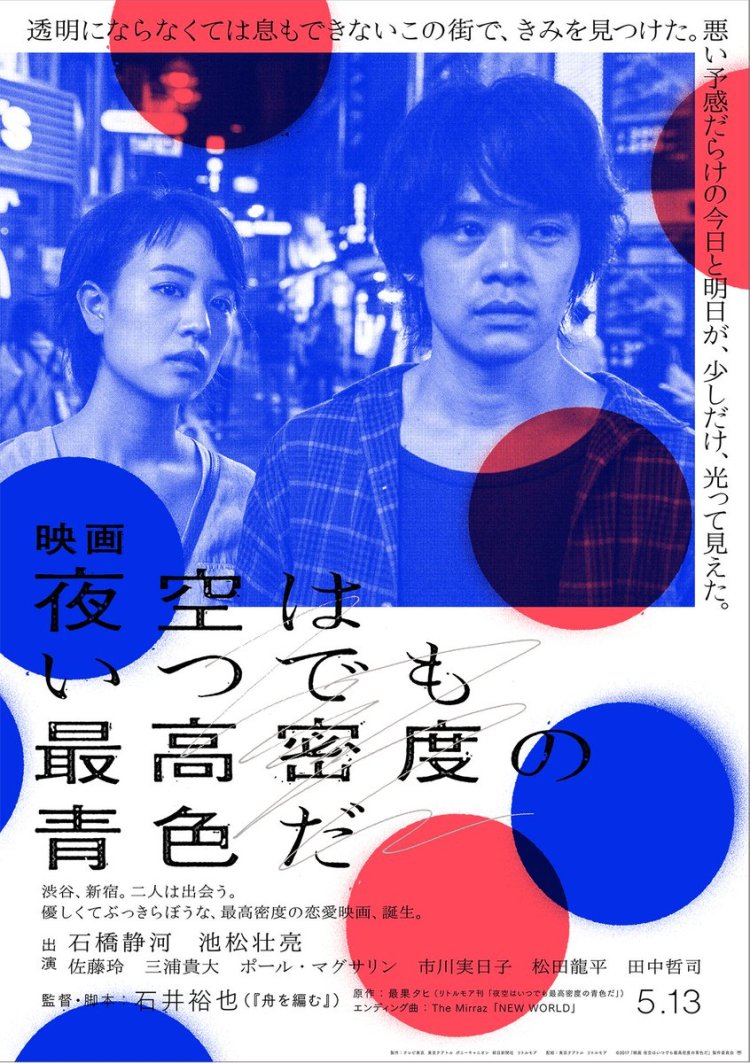
The Tokyo Night Sky is Always the Densest Shade of Blue (夜空はいつでも最高密度の青色だ, Yuya Ishii, 2017)

tokyo night sky posterLearning to love Tokyo is a kind of suicide, according to the heroine of Yuya Ishii’s love/hate letter to the Japanese capital, The Tokyo Night Sky is Always the Densest Shade of Blue (夜空はいつでも最高密度の青色だ, Yozora wa Itsudemo Saiko Mitsudo no Aoiro da). This city is a mess of contradictions, a huge sprawling metropolis filled with the anonymous masses and at the same time so tiny you can find yourself running into the same people over and over again. Inspired by the poems of Tahi Saihate, The Tokyo Night Sky is at once a meditative contemplation of city life and an awkward love story between two lost souls who somehow find each other in its crowded backstreets.

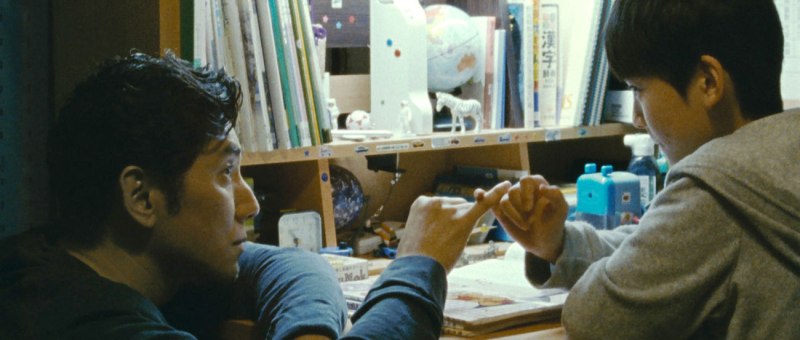
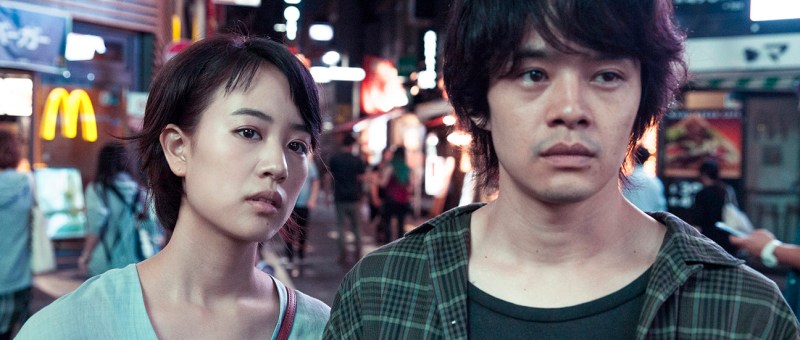
The heroine, Mika (Shizuka Ishibashi), works as a nurse by day and supplements her income by night as a bar tender in a “girls bar” (basically a normal bar where all the bartenders are female and you have to pay an entrance fee on top of your overpriced drinks). Depressed and anxious, she wanders the city with a poetic interior monologue expressing her constant loathing for its indifferent soullessness. Meanwhile, Shinji (Sosuke Ikematsu) is a casual day labourer working on various projects in the run up to the 2020 Olympics. He describes himself as odd and is over sensitive about being blind in one eye. Unlike his friends and colleagues, Shinji prefers literature to parties and solitude to company.

The two first catch sight of each other in a crowded bar where Mika is trying to buy time before having to head back to a dull double date with her drunken friend and the lewd guys she’s invited to come along, and Shinji is trying to read away from the noise and chaos of his lodging house. They meet again when one of Shinji’s colleagues suggests going to the girls bar, and then seem to be constantly running into one another for no particular reason.

Though romance would seem to be the natural outcome of the “pointless miracle” of their repeated meetings, the process is a slow one. It’s obvious the pair share a deep, innate understanding of each other but they each have various problems which conspire to keep them apart. Shinji, describing himself as odd and assuming he’s annoying, is prone to nervous babbling which Mika correctly guesses is less down to a love of his own voice than a fear of awkward silence. For her part Mika is anxious all the time, brittle and insecure she instinctively rejects attempts at intimacy but somehow warms to Shinji responding to his confession of oddness with a comforting “well then, you’re just like me.”

The pair advance and retreat as they wander around the city they both claim to hate but as much as they keep each other at a distance their lives begin to overlap and run in parallel. Mika receives a text from an ex (Takahiro Miura) with a confused declaration of love while Shinji receives one from an old high school classmate (Ryo Sato) with much the same effect. Mika insists that love makes you boring, that you’ll never find someone who is prepared to love the most pitiable part of you, and that there is no such thing as love on this planet, but her protestations point more towards a kind of soul-searching and buried hope than they do of active rejection.

Ishii marries the romantic undercurrent with an ambivalent portrait of the stratified city. Mika, a nurse by profession, needs to take a second job to make ends meet while the more traditionally working class Shinji is a sensitive intellectual relegated to dangerous and insecure employment. As a day labourer he gets no employment benefits like sick pay or insurance – hence when he’s injured on the job he avoids letting anyone know for as long as possible because it means both loss of wages and a doctor’s bill. An older friend (Tetsushi Tanaka) has ruined his back through long years of overwork and is now left with nothing while a Filipino migrant worker (Paul Magsign) pines for home and the wife and child waiting for him there.

Shinji’s anxieties are partly economic – trapped in insecure employment which may well, as his older friend points out, dry up once the Olympics rolls around but the greater problem is inertia. During their journeys around the city, Shinji and Mika run into the same busker (Yoshimi Nozaki) who is always singing the same strange song about her underarms sweating which seems to echo their shared anxiety. Yet the song she offers them also provides a note of hope as she enthusiastically reaches the “Ganbare!” chorus, cheering the pair of frightened lovers on and encouraging them to pursue their dreams and desires rather than waiting around for something to happen.

Waiting has been Mika’s problem. Saddled with intense abandonment issues stemming from childhood trauma, Mika is always sure something bad is about to happen. Shinji partly shares her anxiety often claiming that he has “a bad feeling” about something or other but conversely, he begins to believe that the “something” could be good as well as bad. Rather than try and argue with her, Shinji concedes most of Mika’s points, nobody knows what will happen in the future, nobody can make any promises, and everything ends someday but that’s OK – it’s only life.

Ishii’s Tokyo is a soulless place filled with the melancholy and the empty but there’s beauty here too, if only people would look up from their smartphones every now and then to see it. Mika is afraid of being swallowed by the city and becoming one of its faceless masses but her listlessness and depression stand for the city itself as she refuses and rejects the process of living with all of its attendant risks. Ishii paints the city in all the colours of the night, but for all of its beautiful sadness it’s also a place of noise and chaos where existence is exhausting and the price of living high. It is, however, also a place of ordinary miracles offering hope to the hopeless if only they are willing to accept it.


The Tokyo Night Sky Is Always the Densest Shade of Blue was screened at the 17th Nippon Connection Japanese Film Festival.

Original trailer (no subtitles)

Gukoroku – Traces of Sin (愚行録, Kei Ishikawa, 2017)

gukoroku posterGenerally speaking, murder mysteries progress along a clearly defined path at the end of which stands the killer. The path to reach him is his motive, a rational explanation for an irrational act. Yet, looking deeper there’s usually something else going on. It’s easy to blame society, or politics, or the economy but all of these things can be mitigating factors when it comes to considering the motives for a crime. Gukoroku – Traces of Sin (愚行録), the debut feature from Kei Ishikawa and an adaptation of a novel by Tokuro Nukui, shows us a world defined by unfairness and injustice, in which there are no good people, only the embittered, the jealous, and the hopelessly broken. Less about the murder of a family than the murder of the family, Gukoroku’s social prognosis is a bleak one which leaves little room for hope in an increasingly unfair society.

When we first meet Tanaka (Satoshi Tsumabuki) he’s riding a bus. Ominous music plays as a happy family gets off but the real drama starts when another passenger irritatedly instructs Tanaka to give up his seat so an elderly lady can sit down. He snorts a little but gets up only to fall down next to the steps to the doors and subsequently walk off with a heavy limp. The man who told him to move looks sheepish and embarrassed, but as soon as the bus passes from view Tanaka starts walking normally, an odd kind of smirk on his face in thought of his petty revenge.

In one sense the fact that Tanaka faked a disability is irrelevant, the man did not consider that Tanaka may himself have needed a seat despite looking like a healthy man approaching early middle age. Perhaps, he’ll think twice about making such assumptions next time – then again appearances and assumptions are the lifeblood of this mysteriously complicated case.

Tanaka has a lot on his plate – his younger sister, Mitsuko (Hikari Mitsushima), has been arrested for neglecting her daughter who remains in intensive care dangerously underweight from starvation. In between meeting with her lawyer and checking on his niece, he’s also working on an in-depth piece of investigative reporting centring on a year old still unsolved case of a brutal family murder. Tanaka begins by interviewing friends of the husband before moving onto the wife who proves much more interesting. Made for each other in many ways, this husband and wife duo had made their share of enemies any of whom might have had good reason for taking bloody vengeance.

The killer’s identity, however, is less important than the light the crime shines on pervasive social inequality. As one character points out, Japan is a hierarchical society, not necessarily a class based one, meaning it is possible to climb the ladder. This proves true in some senses as each of our protagonists manipulates the others, trying to get the best possible outcome for themselves. These are cold and calculating people, always keeping one eye on the way they present themselves and the other on their next move – genuine emotion is a weakness or worse still, a tool to be exploited.

The key lies all the way back in university where rich kids rule the roost and poor ones work themselves to the bone just trying to keep up. There are “insiders” and “outsiders” and whatever anyone might say about it, they all secretly want in to the elite group. Here is where class comes in, no matter how hard you try for acceptance, the snobby rich kids will always look down on those they feel justified in regarding as inferior. They may let you come to their parties, take you out for fancy meals, or invite you to stay over but you’ll never be friends. The irony is that the system only endures because everyone permits it, the elites keep themselves on top by dangling the empty promise that someday you could be an elite too safe in the knowledge that they only hire in-house candidates.

Gradually Tanaka’s twin concerns begin to overlap. The traces of sin extend to his own door as he’s forced to examine the legacy of his own traumatic childhood and fractured family background. The reason the killer targeted the “happy” family is partly vengeance for a series of life ruining wrongs, but also a symbolic gesture stabbing right at the heart of society itself which repeatedly failed to protect them from harm. Betrayed at every turn, there’s only so much someone can take before their rage, pain, and disillusionment send them over the edge.

Despite the predictability of the film’s final twist, Ishikawa maintains tension and intrigue, drip feeding information as Tanaka obtains it though that early bus incident reminds us that even he is not a particularly reliable narrator. Ishikawa breaks with his grim naturalism for a series of expressionistic dream sequences in which hands paw over a woman’s body until they entirely eclipse her, a manifestation of her lifelong misuse which has all but erased her sense of self-worth. There are no good people here, only users and manipulators – even the abused eventually pass their torment on to the next victim whether they mean to or not. Later, Tanaka gets on another bus and gives up his seat willingly in what seems to be the film’s first and only instance of altruism but even this small gesture of resistance can’t shake the all-pervading sense of hopeless loneliness.


Gukoroku – Traces of Sin was screened at the 17th Nippon Connection Japanese film Festival.

Original trailer (no subtitles)

The Long Excuse (永い言い訳, Miwa Nishikawa, 2016)

long excuse posterSelf disgust is self obsession as the old adage goes. It certainly seems to ring true for the “hero” of Miwa Nishikawa’s latest feature, The Long Excuse (永い言い訳, Nagai Iiwake) , in which she adapts her own Naoki Prize nominated novel. In part inspired by the devastating earthquake which struck Japan in March 2011, The Long Excuse is a tale of grief deferred but also one of redemption and self recognition as this same refusal to grieve forces a self-centred novelist to remember that other people also exist in the world and have their own lives, emotions, and broken futures to dwell on.
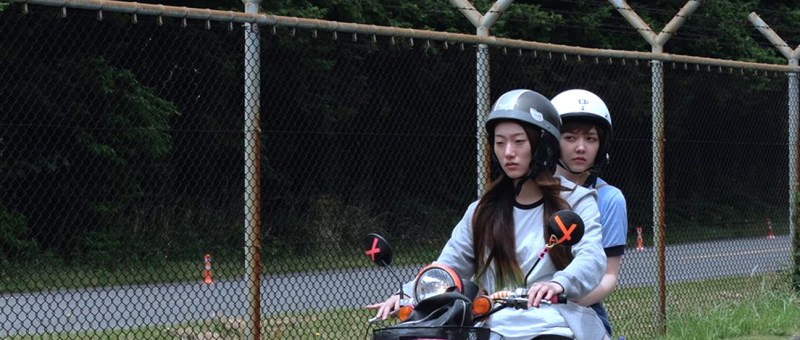
Sachio Kinugasa (Masahiro Motoki) is a formerly successful novelist turned TV pundit. As his hairstylist wife, Natsuko (Eri Fukatsu), gives his hair a trim he angrily turns off the television on which one of the programmes he appears on is playing and returns to petulantly needle his wife about perceived slights including “deliberately” using his real name in front of important publishers “to embarrass him”. Upset but bearing it, Natsuko takes all of this in her stride though her husband is in a particularly maudlin mood today, reminding her once again about his intense feelings of self loathing. Shortly after finishing Sachio’s haircut, Natsuko throws on a coat and grabs a suitcase – she’s late to meet a friend with whom she is going on a trip. Sachio barely waits for the door to close before picking up his phone and texting his mistress to let her know that his wife is away.

Later, Sachio figures out that at the moment his wife, her friend Yuki (Keiko Horiuchi), and a busload of other people plunged over a guard rail on a mountain road and into a frozen lake, he was rolling around in his marital bed with a much younger woman. Now playing the grieving husband, Sachio seems fairly indifferent to his recent tragedy but writes an improbably literary funeral speech which boils down to wondering who is going to cut his hair, which he also makes a point of checking in the rear view mirror of the funeral car, now that his wife is gone.

So self obsessed is Sachio that he can’t even answer most of the policeman’s simple questions regarding the identification of his wife – what was she wearing, what did she eat for dinner, is there anything at all he can tell them to confirm the identity of his wife’s body? The answer is always no – he doesn’t remember what she wore (he was busy thinking about texting his mistress), ate dinner separately, and didn’t even know the name of the friend Natsuko was going to meet. The policeman tries to comfort him with the rationale that it’s normal enough to have grown apart a little over 20 years, but the truth is that Sachio was never very interested in his wife. As a funeral guest points out, Natsuko had her own life filled with other people who loved her and would have appreciated the chance to pay their respects in the normal fashion rather than becoming mere guests at Sachio’s stage managed memorial service.

Sachio’s lack of sincere reaction to his wife’s passing stands in stark contrast to the husband of her friend, Yoichi (Pistol Takehara), who is a wailing, broken man and now a widowed single father to two young children. Yoichi is excited to finally meet Sachio about whom he heard so much from “Nacchan” his wife’s best friend and the children’s favourite auntie. Sachio knew nothing of this important relationship in his wife’s life, or much of anything about her activities outside of their home.

When Natsuko left that last time, she paused in the doorway somewhat finally to remind Sachio to take care of the house in her absence but neither of these two men know how to look after themselves from basic household chores like using the washing machine to cooking and cleaning, having gone from a mother to a wife and left all of the “domestic” tasks to their women. Eventually feeling low, Sachio decides to respond to Yoichi’s suggestion they try to ease their shared grief by taking the family out for dinner, only he invites them to a fancy, upscale place he goes to often which is neither child friendly nor particularly comfortable for them seeing as they aren’t used to such extravagant dining. Yoichi, otherwise a doting father but often absent due to his job as a long distance truck driver, neglects to think about his daughter’s dangerous crab allergy and necessity of carrying epinephrin just in case, never having had to worry about something as basic as feeding her.

Hearing that Yuki’s son Shinpei (Kenshin Fujita) is quitting studying for middle school exams because he needs to take care of his sister, Sachio makes the improbable suggestion that he come over and help out while Yoichi is away on the road. Becoming a second father to someone else’s children forces Sachio into a consideration of his new role but his publicist cautions him against it. Whipping out some photos of his own, he tells Sachio that kids are great because they make you forget what a terrible person you are but that it’s just the ultimate act of indulgence, basking in adoration you know you don’t deserve. Sachio frequently reminds people that he’s no good, almost making it their own fault that he’s hurt them through his constant need for external validation and thinly disguised insecurity. Sachio’s personal tragedy is that his attempts at self-deception largely fail, he knows exactly what he is but that only makes it worse.

The Long Excuse, such as it is, is the title of Sachio’s autobiographical story of grief and an attempt to explain all of this through a process of self discovery and acceptance. Though appearing indifferent to his wife’s death, Sachio’s reaction is one informed by his ongoing self delusions in which he tries to convince himself to ignore the issue and attempt to simply forget about it and move on. Yoichi, by contrast, feels differently – he can’t let his wife go and wants to keep her alive by talking about her all the time but his bighearted grief is too much for his sensitive son who has more than a little in common with Sachio and would rather hit the pause button to come back to this later. The best way out is always through, however difficult and painful it may turn out to be. Making The Long Excuse is Sachio’s way of explaining himself and learning to reconcile the person he is with the one he would like to be, and even if he’s still talking to himself he’s at least moving in the right direction.


The Long Excuse was screened at the 17th Nippon Connection Japanese Film Festival.

Original trailer (English subtitles)

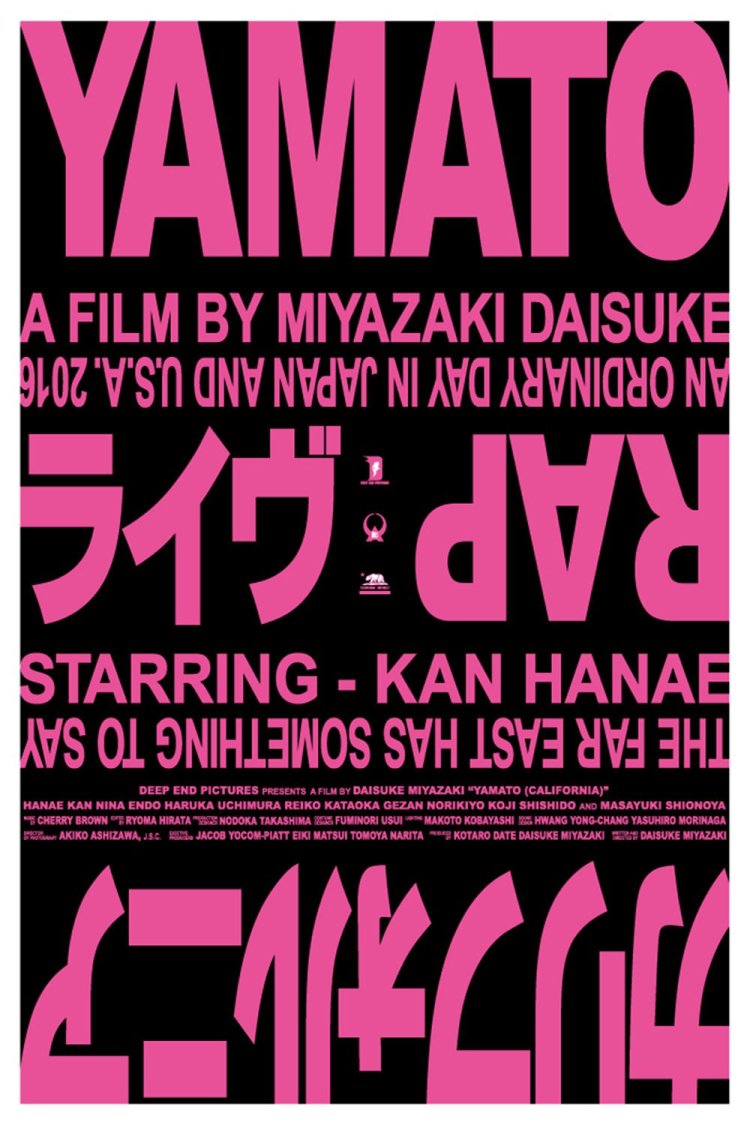
Yamato (California) (大和(カリフォルニア), Daisuke Miyazaki, 2016)

yamato (california) posterWhen you think of the American military presence in Japan, your mind naturally turns to Okinawa but the largest mainland US base is actually located not so far from Tokyo in a small Japanese town called Yamato which is also the ancient name for the modern-day country. The US has been a constant presence since the end of the second world war prompting resistance of varying degrees from both left and right either in resentment at perceived complicity in American foreign policy, or the desire to reform the pacifist constitution and rebuild an independent army capable of defending Japan alone. Daisuke Miyazaki’s second feature, Yamato (California) (大和(カリフォルニア) dramatises this long-standing issue through exploring the life of hip-hop enthusiast and Yamato resident Sakura (Hanae Kan) who idolises an art form born of political oppression in a country which she also feels oppresses her as a Japanese citizen living on the other side of the fence from land which technically still belongs to the US government.

As the camera pans around a ruined landscape which turns out to be a junkyard, it eventually finds Sakura as she sits alone atop a pile of rubbish rapping about her existential misery, the hopelessness of her life, and her constant anxiety. Sakura has left high school but has no hopes, aspirations or plan. She works part-time at the eel restaurant owned by a family friend but he rarely has enough custom to need her help. Still living at home with her single mother (Reiko Kataoka) and older brother Kenzo in a cramped apartment where space is divided by a series of hanging sheets, Sakura is put out to learn that the half-Japanese daughter of her mother’s American G.I. boyfriend will be coming to stay. When Rei (Nina Endo) finally arrives, Sakura makes a point of ignoring her but the two eventually bond over a shared love of hip-hop and an awkward sense of recognition.

Tellingly, Rei’s (late) mother was from Okinawa – another reminder of the wider American presence, but her long absent father, Abby Goldman, is as distant a protector as America itself. Communicating only through handwritten letters, Abby is neither seen or heard but somehow believed in like an invisible god. Strangely, Rei asks Sakura what her father was like as if she’d never met him only for Sakura to awkwardly answer that he was somewhere between a bother, a friend, and a father but that she’s also grateful to him for introducing her to her beloved hip hop. Later she takes her mother to task on this same issue, Abby hasn’t visited in years and doesn’t even provide for them anymore yet he dispatches the daughter he rarely sees himself for them to care for instead. Abby, like America, offers little and takes much, at least in Sakura’s increasingly hotheaded assessment.

Sakura is quite clearly in a state of depression. Sullen and angry, she lashes out at all around her but is mostly at war with herself and understandably anxious about her future. Her mother and brother both understand this about her and are patient and understanding, naturally cheerful people faced with adversity. With no work to go to and the prospect of finding any slim, Sakura spends her time perfecting her rap technique and hanging out alone in an abandoned trailer in the woods. Despite dressing in the accepted rapper style of loose grey tracksuit bottoms and a hoodie Sakura is a poor fit for the world she’s chosen. Lyrical writing more suited to performance poetry or, as she later puts it, the avant-garde, doesn’t gel with the aggressive, mostly male posturing she sees from her peers yet Sakura is determined to make her way into this arena as a means of self-expression rather than any deluded idea of fame and fortune.

Rei, her American friend, eventually sparks an epiphany following a fiery argument during which she accuses Sakura of being nothing more than an American copycat, adopting a foreign art form to mask an insecurity in her own fragile identity. Rei, trying to get through to her knew friend, has pushed too deep and hit all the wrong nerves leading to a surreal sequence which finally sets Sakura off on a voyage of self discovery and results in a concerted vow of “independence” but also of rejoining the world, accepting others rather than refusing to engage, and stepping forward together but on an equal footing with no leaders and no followers.

Miyazaki’s balanced view does not shy away from the less pleasant aspects of his own society from the protest group which wanders through the frame carrying banners calling for the immediate expulsion of migrants from Asia, to a group of yankees throwing rocks at the homeless, and Kenzo’s straightforward remark that he’s only interested in meeting Rei if she’s pretty – according to him mixed-race Japanese girls often aren’t. Grey mixes with green as brutalist shopping malls break through the vegetation leaving even an errant pagoda entirely intact in the central square. Like Sakura’s own soul this is a land of contradictions and uneasy cross-pollinations but it doesn’t need to be as defeatist and unimaginative as a dated shopping mall, wasei hip-hop just might be the next big thing.


Yamato (California) was screened at the 17th Nippon Connection Japanese Film Festival.

Original trailer (dialogue free)

Happiness (ハピネス, SABU, 2016)

happiness still“Memories are what warm you up from the inside. But they’re also what tear you apart” runs the often quoted aphorism from Haruki Murakami. SABU seems to see things the same way and indulges an equally surreal side of himself in the sci-fi tinged Happiness (ハピネス). Memory, as the film would have it, both sustains and ruins – there are terrible things which cannot be forgotten, no matter how hard one tries, while the happiest moments of one’s life get lost among the myriad everyday occurrences. Happiness is the one thing everyone craves even if they don’t quite know what it is, little knowing that they had it once if only for a few seconds, but if the desire to attain “happiness” is itself a reason for living could simply obtaining it by technological means do more harm than good?
A man gets off a country bus carrying a large, mysterious looking box. He stops into the only visible building which happens to a be a “convenience” store housing a wizened old woman who tells the man to just take the bottle of water he is trying to buy because once she gets rid of everything in the shop she can finally die and escape her misery. The man leaves the money anyway and exits the shop, only to make a swift return, take a large helmet studded with old-fashioned round typewriter keys out of his box and place it on the old woman’s head. After the man makes a few adjustments the old woman is thrown into reverie, remembering a time when she was just a small child and her mother greeted her when she arrived home all by herself. Overwhelmed with feeling her mother’s love, the old woman comes back to life and rediscovers a zest for living which she’d long since given up.

So begins the strange odyssey of Kanzaki (Masatoshi Nagase) who finds himself in one of Japan’s most depressed towns where everyone hangs around listlessly, sitting in waiting rooms waiting for nothing in particular, passing the time until it runs out. Suggesting one of the women in the strange waiting area might like to try on the helmet, Kanzaki gets himself arrested but after the police try it out too he comes to the attention of the mayor who invites him to stay hoping the “happiness machine” can help revitalise the dying community and stop some of the young people blowing out of town looking for somewhere less soul-destroying to call home. Kanzaki’s request to access the town census, however, hints at an ulterior motive and it’s as well to note that a happiness machine could also be a sadness machine if you run it in reverse.

SABU’s long and varied career has taken him from men who can’t stop running to those who can’t start, but the men and women of Happiness are impeded by forces more emotional than physical manifesting themselves through bodily inertia. Like many towns in modern Japan, the small village Kanzaki finds himself in is facing a depopulation crisis as the old far outweigh the young and the idea of the future almost belongs to the past. Those who don the happiness helmet regain access to a long-buried memory which reminds them what it feels like to live again. Almost reborn they start to believe that true happiness is possible, that they were once loved, and that their lives truly do have meaning. Yet they can experience all of this joy only because of the intense collective depression they’d hitherto been labouring under. Happiness is only possible because of sorrow, and so the two must work in concert to create a kind of melancholy equilibrium.

Melancholy is a quality which seems to define Kanzaki, inventor of a machine he says can make people happy. As it turns out, his motives were not exactly all about peace and love but a means to an end, his own sorrows run deep and his solution to easing them is a darker one than simply becoming lost in his happy memories. Turning his own machine against itself, he forces a man to relive what he claims is the worst night of his life – one which he could not forget, and one which plagues him every night before he tries to go to sleep. Showing him happy memories too only seems to deepen the pain, though the explanation they eventually offer for his subsequent actions makes him a victim too, betrayed by those who should have protected him and eventually taking his revenge on innocents whose only crime was to be a happy family in front of a man from an unforgiving one.

Painting his world in an almost comforting green tint which can’t help but recall the dull but calming colours of a hospital, SABU channels Roy Andersson by way of David Lynch in his deadpan detachment which becomes humorous precisely because of its overt lack of comic intent. The clues are planted early from a flash of Kanzaki’s wedding ring but refusal to answer question about his family to his hangdog expression and general air of someone who carries a heavy burden, but SABU neatly changes gear surreptitiously to explore what the true explanation is for Kanzaki’s strange machine and improbable arrival in such a small, uninteresting town. Memory is a cruel burden, offering both joy and sorrow, but there can be no happiness without suffering and no life without a willingness to embrace them both the same.


Happiness was screened at the 17th Nippon Connection Film Festival.

Busan trailer (no subtitles)

Her Love Boils Bathwater (湯を沸かすほどの熱い愛, Ryota Nakano, 2016)

her love boils bathwater

The “hahamono” or mother movie has gone out fashion in recent years. Yoji Yamada’s World War II melodrama Kabei or Keisuke Yoshida’s more contemplative examination of modern motherhood My Little Sweet Pea might be the best recent examples of this classic genre which arguably reached its golden age in the immediate post-war period with its tales of self-sacrificing mothers willing to do whatever it took to ensure the survival or prosperity of their often cold or ungrateful children. After “Capturing Dad” Ryota Nakano turns his attention to mum, or more precisely the nature of motherhood itself in a drama about family if not quite a “family drama” as a recently single mother is busy contending with financial hardship and a sullen teenage daughter when she’s suddenly caught off guard by a stage four cancer diagnosis.

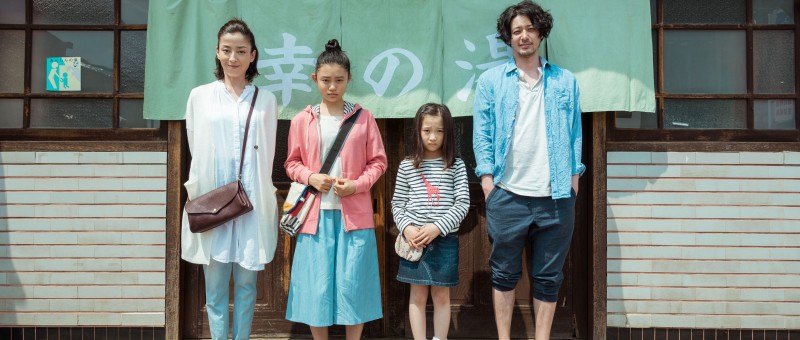
Futaba (Rie Miyazawa) is an outwardly cheerful woman, the sort who’s always putting a brave face on things and faces her challenges head on, proactively and without the fear of failure. Her husband, Kazuhiro (Joe Odagiri), ran off a year ago and no one’s heard from him since. Having closed the family bathhouse Futaba works part-time at a local bakery and cares for her daughter Azumi (Hana Sugisaki) alone but when she collapses at work one day Futaba is forced to confront all those tell signs that something’s wrong she’s been too busy to pay attention to. Inevitably it’s already too late. Futaba has stage four cancer and there’s nothing to be done but Futaba is Futaba and so she has things to do while there’s still time.

Some people colour the air around them, instantly knowing how to make the world a better place for others if not quite for themselves, except by extension. Futaba is one such person – the personification of idealised maternity whose instinctual, altruistic talent for love and kindness knows no bounds or boundaries. Yet at times her love can be a necessarily tough one as she negotiates the difficult process of trying to get her shy teenage daughter to stand up to the vicious group of bullies who’ve been making her school life a misery. Faced with an accelerated timeframe, Futaba needs to teach her little girl to be an independent woman a little ahead of schedule, knowing that she won’t be around to offer the kind of love and support she’ll be needing during those difficult years of adolescence.

Not wanting to leave her entirely alone, Futaba tracks down Kazuhiro only to find he’s now the sole carer for the nine-year old daughter of the woman he left her for who may or may not be his. Futaba decides to take the pair of them in but little Ayuko is just as sullen and distanced as her older half-sister as she struggles with ambivalent emotions towards the mother who abandoned her with a “father” she hardly knew. Futaba’s big idea is to reopen the family bathhouse to be run as a family where everyone has their place and personal responsibility, working together towards a common goal and supporting each other as they inevitably grow closer.

Unlike the majority of hahamono mothers, Futaba’s love is truly boundless as she tries not only to provide for her own children but for all the neglected, lonely, and abandoned people of the world. Bonding with the little girl of the private investigator she hires to find Kazuhiko, trying to comfort Ayuko as she deals with the fact that her mother is probably never coming back, even taking in a melancholy hitchhiker whose made up backstory she instantly sees through – Futaba is the kind of woman with the instant ability to figure out where it hurts and knows what to do to make it better even if it may be harder in the short-term.

Like the majority of hahamono, however, Her Love Boils Bathwater (湯を沸かすほどの熱い愛, Yu wo Wakasu Hodo no Atsui Ai) can’t escape its inevitable tragedy as someone who’s given so much of themselves is cruelly robbed of the chance to see her labours bear fruit. Nakano reins in the sentimentality as much as possible, but it’s impossible not to be moved by Miyazawa’s nuanced performance which never allows Futaba to slip into the trap of saintliness despite her inherent goodness. She is evenly matched by relative newcomer Sugisaki in the difficult role of the teenage daughter saddled with finding herself and losing her mother at the same time while Aoi Ito does much the same with an equally demanding role for a young actress moving from sullen silence to cheerful acceptance mixed with impending grief. Yet what lingers is the light someone like Futaba casts into the world, teaching others to be the best version of themselves and then helping them pass that on in an infinite cycle of interdependence. Hers is a love of all mankind as unconditional as any mother’s, sometimes tough but always forgiving.


Her Love Boils Bathwater was screened at the 17th Nippon Connection Film Festival.

Original trailer (turn on captions for English subtitles)

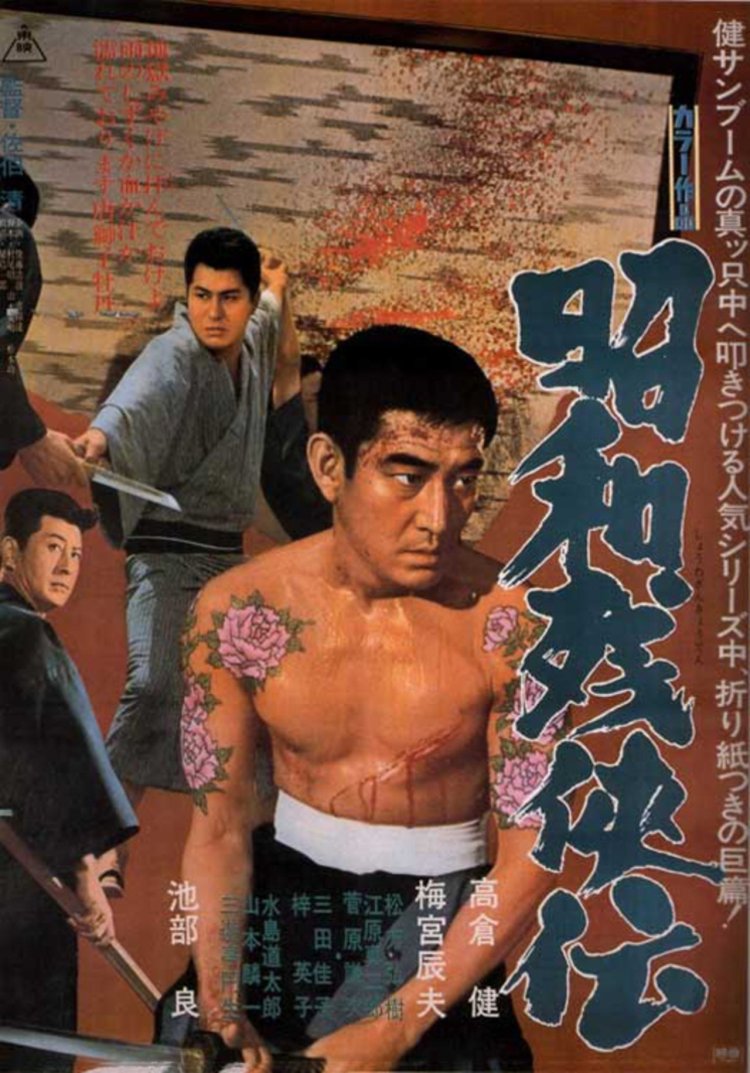
Brutal Tales of Chivalry (昭和残侠伝, Kiyoshi Saeki, 1965)

brutal tales of chivalry posterBrutal Tales of Chivalry (昭和残侠伝, Showa Zankyo-den) – a title which neatly sums up the “ninkyo eiga”. These old school gangsters still feel their traditional responsibilities deeply, acting as the protectors of ordinary people, obeying all of their arcane rules and abiding by the law of honour (if not the laws of the state the authority of which they refuse to fully recognise). Yet in the desperation of the post-war world, the old ways are losing ground to unscrupulous upstarts, prepared to jettison their long-held honour in favour of a dog eat dog mentality. This is the central battleground of Kiyoshi Saeki’s 1965 film which looks back at the immediate post-war period from a distance of only 15 years to ask the question where now? The city is in ruins, the people are starving, women are being forced into prostitution, but what is going to be done about it – should the good people of Asakusa accept the rule of violent punks in return for the possibility of investment in infrastructure, or continue to struggle through slowly with the old-fashioned patronage of “good yakuza” like the Kozu Family?
Here is where we find ourselves in the 21st year of the Showa Era (1947) – the small marketplace in Asakusa is rife with black marketeers and illegal goods, but it’s still the only mechanism by which people are able to survive. The market is overseen by the elderly patriarch of the Kozu Family, Gennosuke (Tomosaburo Ii), who does his best to ensure a kind of “fairness” in its operation, at least in as far as yakuza rules extend. His territory is currently under threat from a rival gang – the Shinsei (literally “new truth”) who obey no such rules and are growing ever more ruthless in their quest to control the local area. Their big idea is to build an entirely new marketplace with a roof to make it a permanent and pleasant place for traders to do business – they will finance this through a kind of crowdfunding paid for by the merchants themselves who will also be paying protection money and kickbacks to the Shinsei. Everyone approves of the covered market project, even the Kozu, but if it means letting the Shinsei assume control is it a price worth paying?

This is a question which faces prodigal son Seiji (Ken Takakura) who returns from the war to find his city in ruins, Gennosuke murdered by the Shinsei, that he is now the new head of the Kozu, and that the woman he loved has been given away in a dynastic marriage to man from another minor clan. Before he died, Gennosuke was able to dictate two important instructions – that Seiji was to take over, and that the gang should proceed on a note of peace, avoiding violence or aggression where possible, leading by example rather than attempting to crush their new rivals. Seiji, having just returned from one battlefield is intent on following Gennosuke’s orders but how far can he really survive on the moral high ground when his opponents are content to fight dirty from down below?

The “Showa” era spanned some 60 years of turbulent Japanese history but in 1965 it was just under 40 years old and already beginning to generate the complicated feelings of nostalgia which are still attached to it today. Showa is right there in the Japanese title as if it were an age already passed but it’s clear in 1965 that something has shifted, one age has or is beginning to give way to another. The desperation of the post-war world with its empty, rubble strewn vistas and population filled with hunger and despair has ebbed away now that Japan is back on the world stage following the 1964 Olympics and the economy has as last begun to pick up. The young no longer fixate on the rights and wrongs of empire building, war and surrender but have begun to turn their attention towards the American occupation, social justice, and foreign conflicts. The young of 1947 were middle-aged in 1965, no one would begrudge them romanticising their youth, and so even if the world of Brutal Tales of Chivalry is a bleak one it still contains a kind of nostalgia for the kind of honourable gangster inhabited by Takakura who embodies traditional values some may feel are under represented in modern society.

Yet, for all that, there’s something subtly subversive in the film’s eventual suggestion that pacifism will only go so far and that one side or another must be banished from the battlefield through violence if peace is ever to prosper. Still, the struggle is a noble one in which honour is defined by strength of character and the selfless desire to ensure the well-being of others as much as it is to a blind observation of arcane rules and obsolete, meaningless ritual. The first in a long running series, Brutal Tales of Chivalry helped established Takakura’s iconic presence which eventually became synonymous with the “ninkyo eiga” as a personification of idealised Japanese masculinity, tough but caring even if passion is often repressed or redirected into violence. Remnants may be all that’s left of “chivalry” in the new Showa era, but there’s a degree of beauty in this brutality that refuses to die even as its era passes.


Now available on Region A blu-ray from Twilight Time (limited to 3000 copies only)

Original trailer (no subtitles)

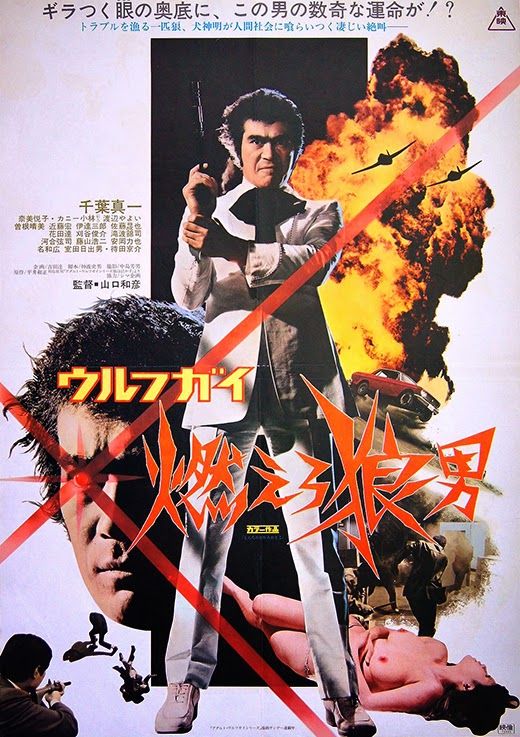
Wolf Guy (ウルフガイ 燃えよ狼男, Kazuhiko Yamaguchi, 1975)

Wolf Guy posterUniversal’s Monster series might have a lot to answer for in creating a cinematic canon of ambiguous “heroes” who are by turns both worthy of pity and the embodiment of somehow unnatural evil. Despite the enduring popularity of Dracula, Frankenstein (dropping his “monster” monicker and acceding to his master’s name even if not quite his identity), and even The Mummy, the Wolf Man has, appropriately enough, remained a shadowy figure relegated to a substratum of second-rate classics. Kazuhiko Yamaguchi’s Wolf Guy (ウルフガイ 燃えよ狼男, Wolf Guy: Moero Okami Otoko, AKA Wolfguy: Enraged Lycanthrope) is no exception to this rule and in any case pays little more than lip service to werewolf lore. An adaptation of a popular manga, Wolf Guy is one among dozens of disposable B-movies starring action hero Sonny Chiba which have languished in obscurity save for the attentions of dedicated superfans, but sure as a full moon its time has come again.
Chiba plays Inugami (literally “dog god”, in Japanese folklore an Inugami is a vengeful dog spirit which can possess people in times of emotional extremity), a melancholy reporter with a reputation for getting himself into trouble who comes across a strange scene in the street in which a white suited man begins raving about a tiger before being gored to death by invisible forces. The police, dragging in Inugami for questioning, can’t come up with anything better than demons to explain such strange events but Inugami’s interest is piqued – more so when he runs into a shady paparazzo who tips him off to similar crimes all targeting a rock band run by a prominent talent agency.

Wolf Guy is not the most coherent of films, it explains itself piecemeal as it goes along and mostly through Inugami’s own world-weary voiceover. Despite this immediate access to Inugami’s psyche, he remains aloof, brooding, and distant. Literally a lone wolf, Inugami is the last of his kind – the little boy saved from a massacre in the black and white still frames of the opening sequence. Yamaguchi chooses not to engage with this theme on much more than a surface level though he maintains a low-level anger towards corrupt authority and those who attempt to wield power from the shadows, targeting the different or the weak.

Through this deeply held feeling of alienated otherness, Inugami comes to feel an intense kinship with the wronged woman at the centre of the curse. Miki (Etsuko Nami) is even more a victim of this intense authoritarianism than Inugami himself. A working class nightclub singer in love with a politician’s son, Miki becomes a problem for her potential father-in-law, one which he solves with gang rape and infection with syphilis. Dumped, alone, infected, and also hooked on drugs, Miki’s mental state is understandably volatile but her troubles are not yet over. The mysterious tiger and Inugami’s wolf man attributes bring the pair to the attentions of a shady group intent on harnessing these unique supernatural powers for themselves with no regard for the “human” cost involved.

Inugami sympathises with Miki out of a shared hatred for “humans” who can treat each other in such inhumane ways. Humans massacred his family and when he tries to go home, the sons of the men who did it seem to know who he is and want to finish the job. Lonely and afraid, Inugami starts to wonder if humans and his own kind will ever be able to live together in harmony. Though he does begin to form brief romantic relationships, none of them end well. It’s almost a running joke that he’s irresistible to every woman in the film, but as much as they run to him they run to death – his love is toxic and even the invulnerability conferred by the moon is unable to save the women in his life from the violence of mortal men. Yet for all his sadness and internalised rage, the Wolf Guy is a hippy hero, the kind who throws away his gun and chooses to retreat in peace rather than fight on in a pointless and internecine quest for vengeance.

Rather than a story of humanity overturned by overwhelming, irrational emotional forces, Wolf Guy presents a hero perfectly in tune with his emotional life even if imbued with Chiba’s iconic coolness. This is not a “werewolf” story, Chiba never transforms nor does he lose himself at the sight of a full moon – rather it strengthens, sustains, and protects him. This almost new age idea gels well with the generally psychedelic approach filled with groovy ‘70s guitar, whip pans, zooms and crazy action though the film certainly goes to some dark places including an extremely unsettling surgery scene followed by an equally disturbing one of healing body horror in which exposed intestines rearrange themselves neatly inside the stomach cavity which then begins to knit itself together again. An eccentric, essentially disposable offering, Wolf Guy makes no real attempt at coherence but is willing to embrace just about every kind of madcap idea which presents itself. Strange, absurd, and all the better for it Wolf Guy is one wild ride but also has its heart in the right place as its melancholy hero heads out into the mountains, a self-exile from a cruel and unforgiving world.


Wolf Guy is released on Dual Format DVD & Blu-ray in the US and UK on 22nd/23rd May 2017 courtesy of Arrow Video.

Arrow release EPK video


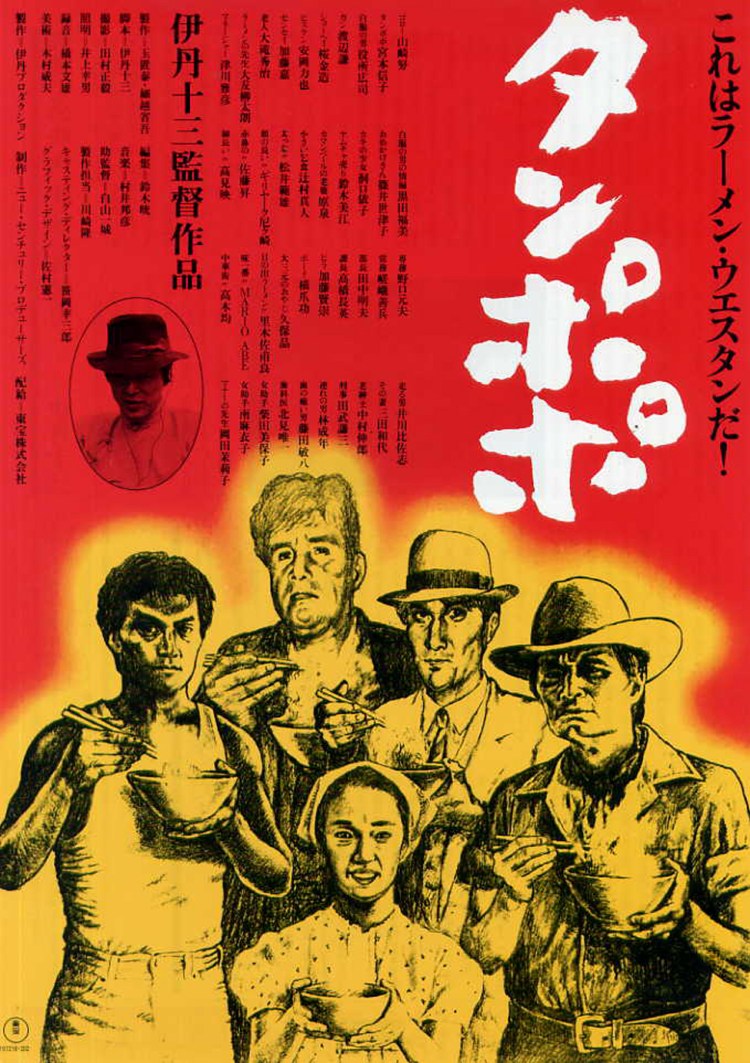
Tampopo (タンポポ, Juzo Itami, 1985)

tampopo posterSome people love ramen so much that the idea of a “bad” bowl hardly occurs to them – all ramen is, at least, ramen. Then again, some love ramen so much that it’s almost a religious experience, bound up with ritual and the need to do things properly. A brief vignette at the beginning of Juzo Itami’s Tampopo (タンポポ) introduces us to one such ramen expert who runs through the proper way of enjoying a bowl of noodle soup which involves a lot of talking to your food whilst caressing it gently before finally consuming it with the utmost respect. Ramen is serious business, but for widowed mother Tampopo it’s a case of the watched pot never boiling. Thanks to a cowboy loner and a few other waifs and strays who eventually become friends and allies, Tampopo is about to get some schooling in the quest for the perfect noodle whilst the world goes on around her. Food becomes something used and misused but remains, ultimately, the source of all life and the thing which unites all living things.

Goro (Tsutomu Yamazaki), a middle-aged man with a fancy hat, and his truck mate Gun (Ken Watanabe), younger, tight white jeans and colourful neckerchief, have become ramen experts thanks to their road bound life. Taking a break during a heavy rain storm, the pair run into a little boy being beaten up by three others and, after scaring the assailants off, escort him into the ramen restaurant where he lives with his widowed mother, Tampopo. Goro and Gun get the stranger in town treatment, but decide to sit down and order a bowl each anyway before a getting into a fight with another diner. Despite her skills as a home cook, Tampopo’s ramen is distinctly second-rate which explains why her business isn’t taking off. Goro and Gun spend some time helping her figure out where she’s going wrong leading Tampopo to beg them to stay, or at least come back when they have time, and teach her what it takes to make the perfect bowl.

Essentially a hybrid between a western and a sports movie, Tampopo has its fair share of training montages as the titular heroine tries to improve her stamina by taking intensive runs, carrying heavy pots of water from one place to another, and constantly trying get her cooking time down to three minutes. The lone woman on the “ranch” that is her restaurant, Tampopo may not be contending with boisterous cattle, threatening neighbours, or disapproving townsfolk but she is being mentored to become her own master as much as anything else. Goro is her strong and silent teacher, but, like Shane, he’s a man not meant to be tied down and is essentially teaching her how to survive alone however painful it may be for him to leave.

This is a fairly radical idea in and of itself. Tampopo’s goal is not another marriage and a man to mind the ranch, but the creation of a successful business which will support both herself and her son built on genuine skills and a lot of hard work. Goro, a ramen aficionado, takes charge but ropes in a few other “experts” to help him including a ramen loving former doctor now living on the streets, the private chef of a wealthy man the gang saved when he almost choked on mochi, and the guy Goro fought with in the beginning who also happens to be a childhood friend of Tampopo nursing a lifelong crush on her.  From each of these men, as well as friendly (or not) rivalry with local competitors, Tampopo learns everything she needs to succeed including the confidence in herself to carry it through.

Whilst Tampopo and co. are busy figuring out the zen of ramen, Itami wanders off for a series of strange vignettes examining more general attitudes to food beginning with Koji Yakusho’s white suited, cinephile gangster who vows bloody murder on anyone daring to eat noisy snacks during the movie. The gangster and his moll eventually retreat to a hotel room where they find new and actually quite strange ways of using food to enhance their pleasure but their story leads us to others in the hotel from a young man stuck in a business meeting who shows up his less cultured colleagues with his culinary knowledge and either doesn’t know or doesn’t care that you’re supposed to order the same as your boss lest you be implying his choice of dish is “wrong”, to a group of young women taking a class in the proper way to eat spaghetti. The instructor (played by veteran actress Mariko Okada), goes to great lengths to explain that it’s considered very uncouth to make any kind of noise whilst eating pasta, only for a westerner of undisclosed nationality to loudly slurp his noodles half way across the room.

While these two episodes showcase the ridiculousness of food etiquette, others take a more surreal direction such as in the strange episode of an old lady who likes to sneak into the local supermarket and torment the clerk by squeezing the fruits, cheeses, and pastries while he chases her round the shop. Here appetites are to be indulged, even if they’re strange, rather than suppressed in favour of someone else’s idea of the proper way to behave. Yet that doesn’t mean that food is something throwaway, to be consumed without thought – in fact, it’s the opposite as Goro’s tutelage of Tampopo shows. Skills alone are not enough, achieving the zen of cookery is a matter of touch and sensitivity, of shared efforts and interconnected strife. Like a dandelion blowing in the wind, Tampopo’s ramen shop gives as it receives, generously and without pretension.


Available now in the UK/US courtesy of Criterion Collection!

Original 1985 trailer (English subtitles)

Hamon: Yakuza Boogie (破門 ふたりのヤクビョーガミ, Shotaro Kobayashi, 2017)

hamon posterConventional wisdom states it’s better not to get involved with the yakuza. According to Hamon: Yakuza Boogie (破門 ふたりのヤクビョーガミ Hamon: Futari no Yakubyogami), the same goes for sleazy film execs who can prove surprisingly slippery when the occasion calls. Based on Hiroyuki Kurokawa’s Naoki Prize winning novel and directed by Shotaro Kobayashi who also adapted the same author’s Gold Rush into a successful WOWWOW TV Series, Hamon: Yakuza Boogie is a classic buddy movie in which a down at heels slacker forms an unlikely, grudging yet mutually dependent relationship with a low-level gangster.

Ninomiya (Yu Yokoyama), a classic slacker, makes ends meet by acting as a kind of liaison officer between the normal world and the yakuza one. His contact, Kuwahara (Kuranosuke Sasaki), is a scary looking guy but as yakuza go not so bad to work with. Following the government’s organised crime crackdown, Ninomiya finds himself at more of a loose end and so when an elderly film director, Koshimizu (Isao Hashizume), comes to him and asks to meet a yakuza first hand, Ninomiya sets up a meeting. Yakuza and movies can be a dangerous mix but somehow or other Koshimizu manages to charm the pair and even gets Kuwahara’s boss, Shimada (Jun Kunimura), to invest some of his own money.

Unfortunately, this is when things start to go wrong. Koshimizu’s pretty “daughter” is really his mistress (as Kuwahara suspected) and the wily old bugger has taken off for the casino paradise of Macao with both the beautiful woman and suitcase full of yakuza dough. Kuwahara is now in a lot of trouble and ropes in Ninomiya to help him sort it out but in their pursuit of Koshimizu they eventually find themselves caught up in a series of turf wars.

Yakuza comedies have a tendency towards unexpected darkness but Hamon’s key feature is its almost childish innocence as Ninomiya and Kuwahara go about their business with relatively few genuinely life threatening incidents. Though the pair bicker and argue with Ninomiya always secretly afraid of his big gangster buddy and Kuwahara fed up with his nerdy friend’s lack of know how, the relationship they’ve developed is an intensely co-dependent one which fully supports the slightly ironic “no me without you” message. Eventually growing into each other, Ninomiya and Kuwahara move increasingly into the other’s territory before finally re-encountering each other on more equal footing.

These are less rabid killers than a bunch of guys caught up in a silly game. Shady film director Koshimizu turns out to be some sort of cartoon hero, perpetually making a sprightly and unexpected escape despite his advanced age while the toughened gangsters hired to keep him locked up find themselves one hostage short time after time. Ninomiya’s worried cousin Yuki (Keiko Kitagawa) keeps trying to talk him into a more ordered way of life which doesn’t involve so much hanging round with scary looking guys in suits, but Ninomiya is reluctant to leave the fringes of the underworld even if he seems afraid for much of the time. Kuwahara is a yakuza through and through, or so he thinks. This latest saga has left him in an embarrassing position with his bosses, not to mention the diplomatic incident with a rival gang, all of which threatens his underworld status and thereby essential identity.

Still, all we’re talking about here is having a little more time for solo karaoke, not being bundled into the boot of a car and driven to a remote location. Filled with movie references and slapstick humour this is a yakuza tale inspired by classic cinematic gangsters rather than their real world counterparts but it still has a few things to say about human nature in general outside of the fictional. An odd couple, Ninomiya and Kuwahara couldn’t be more different but besides the fact they don’t quite get along, they make a good team. No me without you indeed, solo stakeouts are boring, even if you do bicker and fuss the whole time it’s good to know there’s someone who’ll always come back for you (especially if you tell them not to) ready to take the wheel.


Hamon: Yakuza Boogie was screened at the 19th Udine Far East Film Festival.

Original trailer (no subtitles)