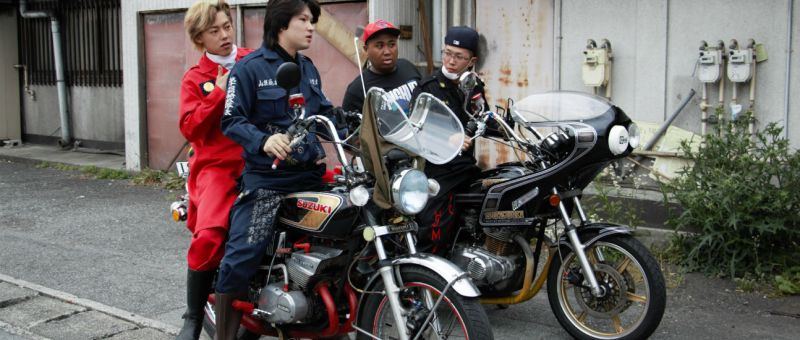
 Eiji Uchida’s career has been marked by the stories of self defined outsiders trying to decide if they want to move towards or further away from the centre, but in his latest film Love and Other Cults ( 獣道, Kemonomichi), he seems content to let them linger on the margins. The title, neatly suggesting that perhaps love itself is little more than a ritualised set of devotional acts, sets us up for a strange odyssey through teenage identity shifting but where it sends us is a little more obscure as a still young man revisits his youthful romance only to find it as wandering and ill-defined as many a first love story and like many such tales, one ultimately belonging to someone else.
Our lovelorn hero and narrator, Ryota (Kenta Suga), observes the heroine from afar as he tells us her story, which is also his story in a sense. Ai (Sairi Itoh), a neglected child, drifts aimlessly in an uncaring world forever seeking a place to belong but finding no safe space to drop anchor. Ai’s mother, as drifting and aimless as her daughter, attempts to find salvation through religion but her quest for self-fulfilment drags her from one spiritual fad to the next all the while pulling little Ai along with her. The pair finally end up in a cult commune where Ai is a favourite of the leader – a Westerner called Lavi (Matthew Chozick) who preaches free love but only for himself.
Eventually, the cult is raided by the police, Lavi flees, and Ai is “rescued” but the next stage in her odyssey is no less disruptive than the last as she finds herself adrift in the mainstream world. Dropped into a regular high school, Ai tries to play the regular high school girl but can’t shake the cult member inside her. Semi-adopted by an ordinary family, her life gains some normalcy but it is short-lived and before long Ai finds herself in another sort of commune altogether before ending up in teenage prostitution followed by the porn industry.
If girls like Ai end up in AV, boys like Ryota end up in gangs. So it is that Ryota gets mixed up with two equally lost wannabe gangsters in Kenta (Antony) – an outsider by virtue of non-Japanese heritage, and the blond-headed Yuji (Kaito Yoshimura) who’s watched too many movies. Kenta is the de facto head of a little band of petty delinquent kids but he’s getting bored with gangster stuff and yearns for something more real while Yuji trails around after the lollipop sucking local chieftain (Denden). Ryota looks on casually without striking out in either direction, pining for Ai but either unwilling or unable to install himself as a permanent part of her reality.
As Ryota puts it, they’re all just looking for a place to belong. They don’t care where or what that place is, but what they long for is a sense of belonging born of owning their own identities. What may be a typical teenage problem of figuring oneself out takes on a larger dimension given the general instability of the world these youngsters find themselves in. Another in the long line of recent films losing faith with the family, Love and Other Cults finds no room for a familial solution to social woes. Ai has been so definitively let down that her very idea of family is so hopelessly warped as to permanently remove the possibility from her future.
Neglected in favour of her mother’s ongoing and inconclusive search for meaning, Ai’s major attachment is to unclear spirituality but even this becomes horribly misused thanks to her involvement with a shady cult. Having become the favourite of cult leader Lavi, Ai is used to trading herself for affection and security and so when she finds herself semi-adopted by the kindly family of a friend she attempts to use these same familial mechanisms to secure her position only to end up ruining the whole thing. Re-encountering Lavi (now an AV producer) again as an adult, Ai is still unable to see the way that she has been used and misused, quickly resuming her childhood role but without the spiritual pretence.
Ryota and Ai meander aimlessly outside of each other’s orbit, neither finding the place they feel they ought to be. Tellingly, the only real story which obeys narrative rules is that of depressed thug, Kenta, who finds an unlikely soul mate in a chance encounter with a photography loving deep-sea diver, Reika (Hanae Kan). Kenta and Reika are kindred spirits whose place to belong presents itself randomly and without warning yet is found all the same. There is no cult in this love, only mutual salvation. Ai and Ryota, however, are each trapped in their respective quests for fulfilment, disconnected, visible to each other only in brief, fragmented episodes and set to drift eternally yet always in search of a place to call home.
Love and Other Cults was screened as part of the 19th Udine Far East Film Festival.
Original trailer (English subtitles)
 Hiroshi Nishitani has spent the bulk of his career working in television. Best known for the phenomenally popular Galileo starring Masaharu Fukuyama which spawned a number of big screen spin-offs including an adaptation of the series’ inspiration The Devotion of Suspect X and
  The world of shojo manga is a particular one. Aimed squarely at younger teenage girls, the genre focuses heavily on idealised, aspirational romance as the usually female protagonist finds innocent love with a charming if sometimes shy or diffident suitor. Then again, sometimes that all feels a little dull meaning there is always space to send the drama into strange or uncomfortable areas. Policeman and Me (PとJK, P to JK), adapted from the shojo manga by Maki Miyoshi is just one of these slightly problematic romances in which a high school girl ends up married to a 26 year old policeman who somehow thinks having an official certificate will make all of this seem less ill-advised than it perhaps is.
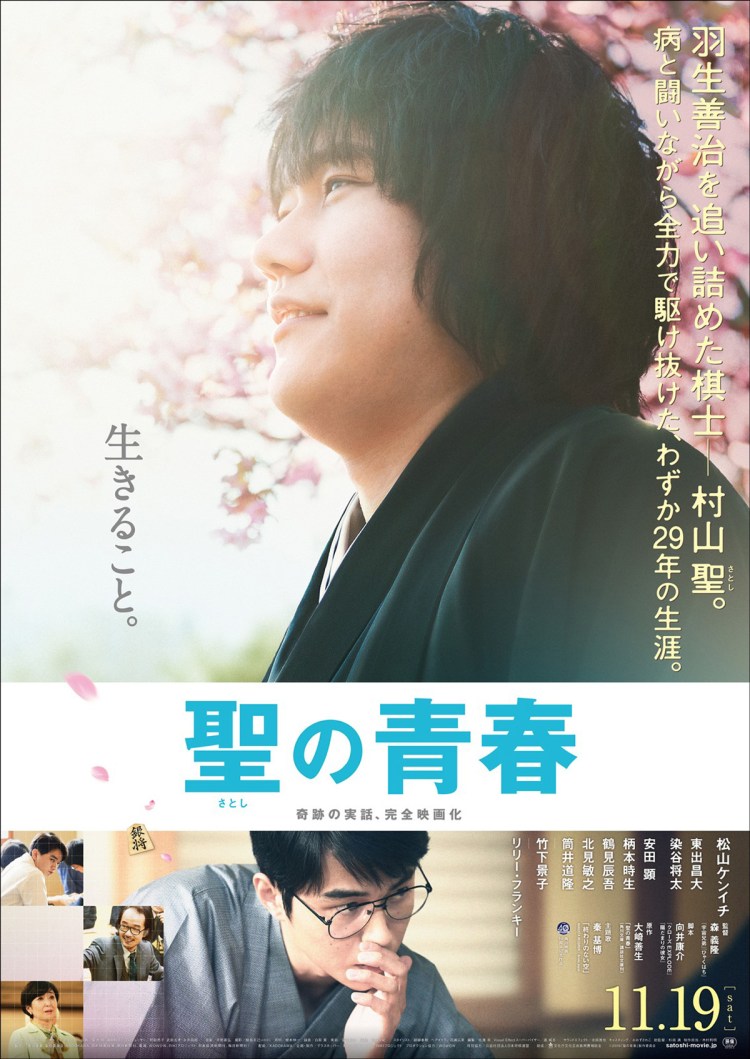 There’s a slight irony in the English title of Yoshitaka Mori’s tragic shogi star biopic, Satoshi: A Move For Tomorrow (聖の青春, Satoshi no Seishun). The Japanese title does something similar with the simple “Satoshi’s Youth” but both undercut the fact that Satoshi (Kenichi Matsuyama) was a man who only ever had his youth and knew there was no future for him to consider. The fact that he devoted his short life to a game that’s all about thinking ahead is another wry irony but one it seems the man himself may have enjoyed. Satoshi Murayama, a household name in Japan, died at only 29 years old after denying chemotherapy treatment for bladder cancer in fear that it would interfere with his thought process and set him back on his quest to conquer the world of shogi. Less a story of triumph over adversity than of noble perseverance, Satoshi lacks the classic underdog beats the odds narrative so central to the sports drama but never quite manages to replace it with something deeper.
 Every keen dramatist knows the most exciting things which happen at a party are always those which occur away from the main action. Lonely cigarette breaks and kitchen conversations give rise to the most unexpected of events as those desperately trying to escape the party atmosphere accidentally let their guard down in their sudden relief. Adapting his own stage play titled Trois Grotesque, Kenji Yamauchi takes this idea to its natural conclusion in At the Terrace (テラスにて, Terrace Nite) setting the entirety of the action on the rear terraced area of an elegant European-style villa shortly after the majority of guests have departed following a business themed dinner party. This farcical comedy of manners neatly sends up the various layers of propriety and the difficulty of maintaining strict social codes amongst a group of intimate strangers, lending a Japanese twist to a well honed European tradition.
 Nobuhiro Yamashita may be best known for his laid-back slacker comedies, but he’s no stranger to the darker sides of humanity as evidenced in the oddly hopeful Drudgery Train or the heartbreaking exploration of misplaced trust and disillusionment of My Back Page. One of three films inspired by Hakodate native novelist Yasushi Sato (the other two being Kazuyoshi Kumakiri’s Sketches of Kaitan City and Mipo O’s The Light Shines Only There), Over the Fence (オーバー・フェンス) may be among the less pessimistic adaptations of the author’s work though its cast of lonely lost souls is certainly worthy both of Yamashita’s more melancholy aspects and Sato’s deeply felt despair.
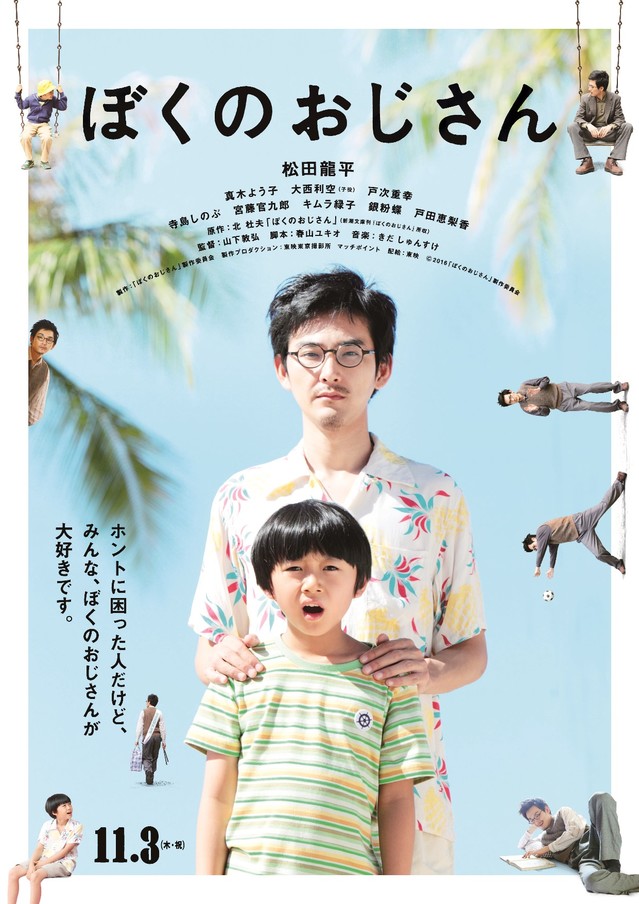 Crazy uncles – the gift that keeps on giving. Following the darker edged Over the Fence as the second of two films released in 2016, Nobuhiro Yamashita’s My Uncle (ぼくのおじさん, Boku no Ojisan) pushes his subtle humour in a much more overt direction with a comic tale of a self obsessed (not quite) professor as seen seen through the eyes of his exasperated nephew. “Travels with my uncle” of a kind, Yamashita’s latest is a pleasantly old fashioned comedy spiced with oddly poignant moments as a wiser than his years nephew attempts to help his continually befuddled uncle navigate the difficulties of unexpected romance.
 Hitoshi One has a history of trying to find the humour in an old fashioned sleazy guy but the hero of his latest film, Scoop!, is an appropriately ‘80s throwback complete with loud shirt, leather jacket, and a mop of curly hair. Inspired by a 1985 TV movie written and directed by Masato Harada, Scoop! is equal parts satire, exposé and tragic character study as it attempts to capture the image of a photographer desperately trying to pretend he cares about nothing whilst caring too much about everything.
 While studying in the US, director Naoko Ogigami encountered people from all walks of life but on her return to Japan was immediately struck by the invisibility of the LGBT community and particularly that of transgender people. Close-Knit (彼らが本気で編むときは, Karera ga Honki de Amu Toki wa) is her response to a still prevalent social conservatism which sometimes gives rise to fear, discrimination and prejudice. Moving away from the quirkier sides of her previous work, Ogigami nevertheless opts for a gentle, warm approach to this potentially heavy subject matter, preferring to focus on positivity rather than dwell on suffering.
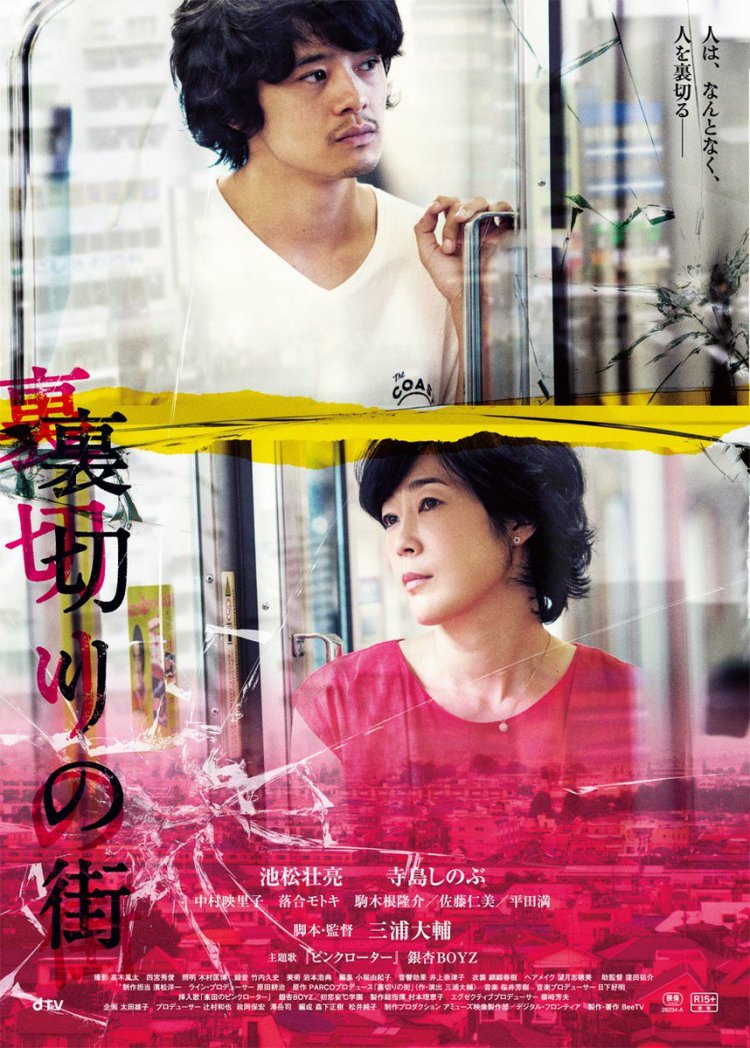 What is it that makes one person betray another? Following
  Windows on Worlds