Blue (ブルー, Hiroshi Ando, 2003)

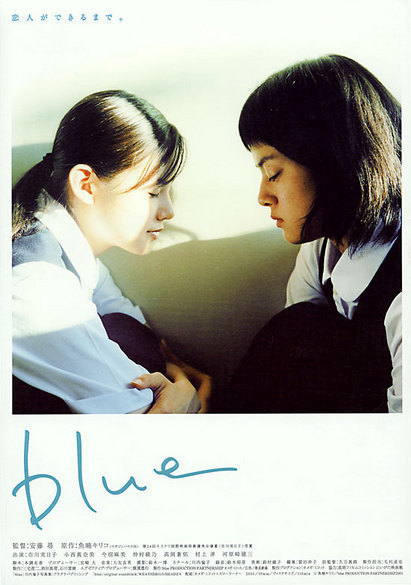
blue03Growing up is hard to do. So it is for the teenage protagonists of Hiroshi Ando’s debut mainstream feature, Blue (ブルー), adapted from the manga by Kiriko Nananan. Like Nananan’s original comic, the cinematic adaptation of Blue is refreshingly angst free in its examination of first love and the burgeoning sexuality of two lonely high school girls. Shot with a chilly stillness which echoes the emptiness of this small town existence, Blue is no nostalgic retreat into cosy teenage dreams but a cold hard look at the messiness and pain of adolescent love.

Kayako’s (Mikako Ichikawa) life changes one day as she sees a fellow pupil at her all girls school being carried into an ambulance and spirited away. Curious yet unknowing, Kayako continues with her day to day existence until she happens to catch sight of another girl from her school, Masami (Manami Konishi), on the local bus. The two become friends after Masami expresses sympathy for Kayako when their teacher humiliates her in class. Masami is repeating the year after completing a long term suspension and has been ostracised by the other girls though no one quite seems to know exactly what happened. Before long Kayako’s feelings for her new acquaintance have transcended friendship but confused and jealous of Masami’s other friends, Kayako is at a loss. Eventually revealing her true feelings she discovers they aren’t unrequited after all, but Masami’s past contains its share of troubles which threaten to place a barrier between the two girls and destroy their growing romance.

Kayako is quiet and a bit of a dreamer. She eats lunch everyday with the same three girls on the rooftop but seems to feel isolated and listless in her small town existence. Masami, by contrast, is chattier and more outgoing but much of the persona she presents to the world is a way of coping with the circumstances which led to her leaving school. Kayako is drawn to Masami because of her outward sophistication – smoking, drinking, listening to foreign music, and reading books about impressionist artists. Later it transpires that at least some of these tastes were acquired from an older man with whom Masami had had an inappropriate relationship and are both a symptom of her desire to import personality traits from others because her own identity is so ill defined, and of wanting to seem much more mature than she really is.

Whilst Kayako is introverted yet solid and growing to be confident in who she really is, Masami, by contrast, appears only half formed but making up for her lack of self esteem with bravado and cheerfulness. It is this lack of certainty which eventually threatens to drive a wedge between the pair as Masami is unable to accept the kind of intimacy that Kayako wants to offer her. Repeating that she is “nothing”, has no future, and is an entirely passive presence simply floating along on the breeze, Masami is unable to make the kind of active choice which Kayako has already made, and may never be in a position to make it entirely of her own volition. Masami is always looking to run away, talking of moving to somewhere like Tokyo with a city’s anonymity, but when it comes down to it she lacks the courage to act.

Ando shoots at a stately pace mostly using static shots and distance takes though his slow pans across empty corridors help to bring out the utter loneliness and emptiness of the girls’ lives. Similarly a mild POV effect takes over panning around school windows as Masami looks for Kayako hoping to make a mends but finds her hurt, conflicted, and unwilling to engage. The two leads each give fantastically nuanced performances despite the plainness of the script and share an intense chemistry lending weight to the emotional resonance of the film. Ando creates a melancholy atmosphere of longing punctuated by fleeting glances and accidental touches, allowing the space and time for the physical performances to come to fruition. A subtly affecting tale of a difficult, yet mutually rewarding, teenage romance Blue has its share of early feature jitters, but makes up for them with an unusual dose of realism perfectly anchored by the strong performances of its leading ladies.

 

Sailor Suit and Machine Gun (セーラー服と機関銃, Shinji Somai, 1981)

sailor-suit-and-machine-gun

For good or ill, Haruki Kadokawa’s entry into the film industry was to have a profound effect both culturally and commercially. Rising from the ashes of the studio system, Kadokawa’s stable of cute and perky idols presented him with the opportunity to build a multimedia empire formed of a union between cinema, books, and music in which each could be used to sell the other.

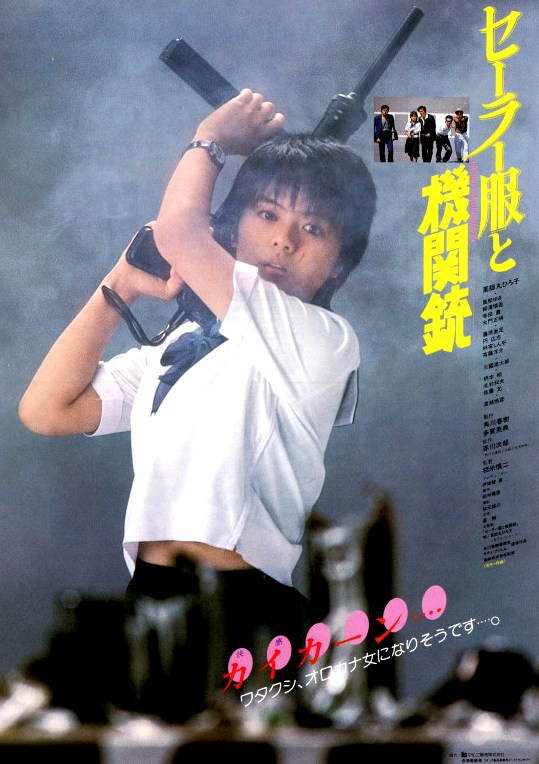
1981’s Sailor Suit and Machine Gun (セーラー服と機関銃, Sailor-fuku to kikanju) was one of his earliest successes and helped to solidify his approach. Featuring one of the biggest idol stars of the 1980s, Hiroko Yakushimaru, in her most iconic role, the film adapts a Kadokawa teen novel as its source material and includes an end credits song with the same title sung by the film’s star. It was a winning formula, but then Sailor Suit and Machine is not just another idol movie. Directed by Shinji Somai whose work is much more well known in Japan than it is abroad, this strange story of a high school girl and her unlikely role as a yakuza boss is both a surreal coming of age tale and an arthouse-influenced character piece which came to become the defining youth movie for a generation of female cinema goers.

Izumi Hoshi (Hiroko Yakushimaru) is now an orphan. Her mother died some time ago and today is her father’s funeral. Thinking herself all alone in the world, Izumi is surprised when an older woman, Mayumi (Yuki Kazamatsuri), suddenly appears with a letter from her father claiming he asked her to look after his daughter if anything should happen to him. More surprises follow when her school is surrounded by black-suited yakuza. Prophetically, the other students are terrified, but Izumi marches straight up them to find out what’s going on. As it turns out, they’ve come for her, an uncle of Izumi’s father was the head of a yakuza clan and now that he’s dead they need a blood relative to succeed him. Izumi’s father out of the picture, the position falls to his daughter, teenage high school girl or not. At first she refuses but realising that with no boss the guys will all have to die, Izumi relents and orders them to live. So begins her long, strange, not altogether successful career as the head of moribund clan of dejected yakuza.

In many ways, Sailor Suit and Machine Gun is a parody of a standard yakuza flick in which rival groups vie for power in the crowded backstreets of a busy city. The idea of a tiny 17-year-old girl heading up an organised crime syndicate and going toe-to-toe with grizzled fifty year old veterans is an inherently absurd one as exemplified by Izumi’s courtesy visit to the area’s most powerful gang boss in which he he more or less laughs her out of the office.

Despite the incongruity, Izumi is a tough kid and more than holds her own in the very male underground world. In her father’s letter to Mayumi, he describes his daughter as tough but naive, an analysis which proves true in her tenure as a yakuza boss. There is a degree of silliness in her actions, playing the role assigned for her as if acting a part in a movie, but as her guys start getting knifed it suddenly doesn’t seem so funny after all. The film revolves around a MacGuffin of some missing heroin which belongs to a gangster named Fatso but is also sought by rival gangs. Out of her depth, Izumi has no knowledge of the whereabouts of the missing drugs or even the reason why anyone would want them. This is a situation that can’t be blustered through and Izumi does not have the ability to navigate it.

The idea of an ordinary high school girl plunged into the criminal underworld is as ridiculous as it’s intended to be. However, Izumi is not quite the ordinary high school girl she first appears. Gangly and boyish, she is supported by three male friends who often flank her as entourage but always recede into the background, bowing to her leadership. Already dominant and possessing obvious leadership potential, Izumi’s bold decision to approach the yakuza at the school gates also hints at her curious and fearless personality, even if it also speaks to her youthful recklessness.

These more masculine qualities of forcefulness and dynamism as opposed the stereotypical image of the cute and submissive school girl are perfectly suited to her new life as a crime boss but for all of that her leadership takes on an oddly maternal quality. A wounded footsoldier remarks that Izumi smells like his mother as she’s awkwardly winding bandages around his torso, and the guys flock around her like they would the family matriarch. Tellingly Izumi later tells Mayumi that part of the reason she rejected her was because of her extreme femininity, something the adolescent Izumi did not quite know what to do with, especially given the maleness of her new environment.

Izumi’s short lived career in the yakuza cannot be termed a success in the normal manner of things, she acts honourably and may win a final victory but it comes at great cost. When Izumi finally picks up the machine gun of the film’s title for the intense finale, she finds herself enjoying it a little too much as the word “fantastic” escapes her lips seconds after letting rip intro a rival gang boss’ office. Rather than the romantic awakening which is the climax of many female centred teen movies, Izumi’s major consummatory event is with her machine gun. As she puts it at the end, Izumi’s first kiss goes to a (deceased) middle aged man and she looks set to become a “foolish” woman, her path into womanhood has been an unusually transgressive and as yet unresolved one.

Somai’s camera is is both slippery and precise as he casts us as voyeur in Izumi’s world, shooting through exterior windows and even at one point from behind the shrubbery. Preferring long takes and often at extreme distances, Somai mixes static camera with unusual fluidity for an effect that’s far more arthouse influenced than your usual teen idol picture. As with many of Kadokawa’s ‘80s movies, the film is steeped in the naivety of the teenage world view as Izumi goes about her new life with a kind of fearless determination despite the inherent violence and unexpected adult sexuality. A deserved classic, Sailor Suit and Machine Gun is the archetypal Kadokawa movie, creating a vehicle for its idol star in the fascinating, iconic presence of its central heroine whilst simultaneously generating an enduring pop culture phenomenon.


Original trailer (no subtitles)

And here’s star Hiroko Yakushimaru singing the title song at her 35th anniversary celebration concert in 2013:

Kids Return (キッズ リタ-ン, Takeshi Kitano, 1996)

kids-returnReview of Kitano’s Kids Return first published by UK Anime Network.


Kids Return (キッズ リタ-ン), completed in 1996, marks Kitano’s return to filmmaking after the serious motorcycle accident which almost claimed his life and has continued to have long term effects both personally and in terms of his career. Once again he remains firmly behind the camera but displays a more contemplative, nostalgic approach than had been present in much of his previous work. The tale of two delinquent slackers in small town Japan, Kids Return has an obvious autobiographical quality and even if the future looks bleak, Shinji (Masanobu Ando) and Masaru (Ken Kaneko), like Kitano himself, are not beaten yet.

Beginning with a sequence of the older Shinji delivering rice and sharing a melancholy reunion with school friend Masaru, Kitano then hops back to their carefree school days of slacking off and intermittently trolling the entire institution. Masaru is the leader of the pair, loud mouthed and violent, always trying to big himself up, while Shinji is the classic sidekick – always following dutifully behind and lost without his friend’s leadership. Their paths diverge when Masaru decides to join a boxing club after someone he’d bullied and extorted money from hires a boxer to get revenge on him. Masaru is hopeless in the ring and lacks the dedication it would take to become a serious althete but Shinji shows promise, eventually knocking Masaru out after being forced into a humiliating duel. Masaru ends up joining the yakuza gang which hangs out in his favourite ramen joint and quickly rises through the ranks. Though both boys look to be going somewhere along their chosen paths, they each squander their given advantages through a series of poor decisions and eventually find themselves right back where they started.

Shinji and Masaru are typical of many young men of their generation and social class. They “go to school” but rarely attend lessons and are often to be found riding their bike around the playground or pranking the other students such as in a particularly elaborate plot where they dangle a stick figure of a teacher down from the roof to the classroom window below, joyfully erecting the “penis” they’ve given it by attaching a torch to the middle section complete with wire brush hair and cotton balls. Such tricks may seem like innocent, juvenile behaviour but a more serious side emerges when an obnoxious teacher’s car is set on fire.

The teachers at the school have already written the boys off as not worth saving. Always referring to them as “the morons”, the school seems reluctant to actually expel the pair and has come to view them as amusing inconveniences more than anything else. None of the teachers is interested in reaching out to Shinji or Masaru and, in fact, they appear to be a cynical bunch with no real interest in the children in their care. At the end of the school year the teachers begin discussing their progress and reveal that only a handful of students will be going to university (and only one to a public, rather than private institution) and that those who are have largely achieved it through their own steam. The education system has nothing to offer these students who have already been judged unworthy of advancement and is in no way interested in providing any kind of pastoral care or social support.

Shinji and Masaru are expected to find their own paths, but the film posits that this idea of total, individual freedom of the modern era is at the root of their problems because it leaves them with too many choices and no clear direction. Failed by education, the pair must find new ways to move forward but the opportunities on offer are not exactly appealing. Masaru, the loud mouth of the pair, ends up on the obvious path of the disaffected young man by joining a gang and finding for himself the familial comradeship of the criminal brotherhood rather than that of a traditional family.

Shinji’s path looks more solid as he begins to train as a serious athlete, honing his skills and perfecting his physique. He is, however, still unable to take control of his own life and repeatedly looks for more dominant male role models to follow. This might have worked out OK for him if he’d stuck with the paternal influence of the coaches, but Shinji is easily led and falls under the influence of an embittered older boxer, Hayashi, who is full of bad advice. Under Hayashi’s tutelage, Shinji learns illegal moves and that he can still drink and eat what he likes because you can just throw it all up again afterwards. When even that doesn’t work, Hayashi begins giving him diet pills which exemplify the quick fix approach he’s taking with his life. Needless to say, his training suffers and his previously promising career is soon on the rocks.

It’s not just the two guys either. Their shy friend with crush on the cafe girl leaves school and gets a good job as a salesman but the aggressive boss makes his working life a misery leading him to take a stand with a colleague and quit to become a taxi driver. No good at that either, he experiences exactly the same treatment and is now unable to earn enough money to support both himself and his wife. In fact, the only success story is the manzai standup comedy duo which Masaru mocked in the beginning. Knowing exactly what they wanted to do and working hard to get there, the pair have built a career and an audience through steadfastly sticking to their guns and refusing to listen to the naysayers. If you have direction, progress is possible, but for Shinji and Masaru who have no strong calling the future is a maze of uncertainties.

The kids have returned, not quite as men but in the first flush of failure, ready to start again. When Shinji asks Masaru if it’s really all over for them already, he tells him not to be silly – it hasn’t even started yet. The town goes on as normal, unchanging, kids goof off lessons and melancholy people waste time over coffee. Perhaps nothing will change for Masaru and Shinji and their aimless days of drifting from one thing to the next, looking for guidance and finding none, will continue but there’s fight in them yet and the possibility remains for them to find their way, as difficult as it may prove to be.


Out now on blu-ray (in the UK) from Third Window Films.

Original trailer (no subtitles)

Bangkok Nites (バンコクナイツ, Katsuya Tomita, 2016)

bangkok-nites“Asia is a paradise for men” though not for anyone else, if Bangkok Nites (バンコクナイツ) is anything to go by. In Tomita’s previous film, Saudade, he explored the intercultural exchange between Thailand and Japan with one character having tried to escape there and failed, and another idly dreaming of running away with his Thai mistress. Five years later he revisits the same idea but from the other side as he weaves a meandering trail through the Japan-centric element of Bangkok’s red light district which eventually leads him on to other neighbouring nations whose landscapes still bear the scars of war and colonialism decades into a supposedly enlightened age.
We begin with Luck (Subenja Pongkorn), caught in reflection against a swanky hotel window overlooking her city. Her client is a Japanese man, clingy in the extreme though it’s unclear if his desire to avoid paying is out of consideration to his wallet or a genuine case of affection. Nevertheless, his whining is too much for Luck who eventually manages to escape the room and get back to work. Employed by a bar on Thaniya Road, an area of Bangkok’s red light district popular with Japanese tourists, Luck’s job involves sitting on a shelf in a large stable area where she and her colleagues wear colour coded badges so the customer can see their rates and services offered at a single glance.

Good friends with a Japanese man who works as a kind of procurer for the club, Luck ends up at a party where she runs into Ozawa (Katsuya Tomita) – a quasi-customer with whom she’d developed a deeper relationship around five years previously but subsequently lost contact. A former Self Defence Force soldier, Ozawa first came to Asia on a peacekeeping mission to Cambodia and has been back and fore ever since. During this most recent stay he’s begun to strike up a friendship with fellow Japanese guys working around the edges of the sex industry and related businesses including the drugs trade. After getting to know each other again, Luck takes Ozawa to her peaceful, rural, hometown beginning a journey which is to have a profound impact on his view of the continent.

There’s something a little sad about the small, sleazy world of the red light district and its collection of melancholy ex-pats eking out a living by exploiting desperate local women. Ozawa hovers on the fringes of this group, obviously a visitor to the brothels of Thaniya Road, but not quite a devotee. The other guys repeatedly refer to Thailand and other surrounding countries as “paradise” or a “utopia” where the women are “easy” and can be had at will and with few strings. One visitor remarks that he can have twenty nights of debauchery in Bangkok for the cost of one fancy night out in Roppongi. Yet for every one like him just trying to blow in and blow out with no fuss, there are a handful who can’t separate a transaction from a romance, becoming overly attached to women merely providing a service who, naturally, are not particularly seeking a long-term relationship with the sort of man who thinks a woman can be bought wholesale.

Luck is the number one on Thaniya Road, though she’s aware her time is limited. The work pays well and she’s been able to acquire an elegant Bangkok apartment as well as a house for her mother and siblings back in the country, but her heart is set on saving enough money to open an upscale European restaurant when she finally leaves the sex trade behind. Taking Ozawa back to her hometown, she explains to him that her life in Bangkok is just what happens to girls from the country. Children are raised by aunts while mothers live in the city, sending money back home, until they swap places and the children head to the city while the women return to raise the children of relatives. Most of her friends are also involved in the local sex trade, catering to foreign travellers with less than romantic ideas about the country and its “exotic” women.

Tomita paints this as another ongoing echo of the colonial past as foreign men come to Thailand for purposes of discreet pleasure, giving little thought to the interior lives of the real breathing women in front of them. Taking Ozawa around her home town, Luck shows him the beautiful European style mansion she grew up in with her mother’s second husband (her step-father and the only positive male input she ever mentions) who was an American working at a local air base. The bases are a relic of the Vietnam war, the legacy of which also rears its head once Ozawa makes his way into Laos where giant bomb craters still scar the landscape like pock marks on the face of the Earth more than forty years later. Ultimately these colonial wars trace themselves back to the first waves of colonisation but when Luck tries to look forwards she only sees the past – her desires are for the European, fancy restaurants and urban sophistication.

Ozawa looks at Luck’s hometown and (thinks he) sees a “paradise”, a calm and peaceful place where people drink and smoke their lives away with no worries. He thinks this ought to be enough, and perhaps he’s right, but women like Luck and her friends are still left with no other choice than to enter the sex industry in order to feed their families while the men bum around smoking, drinking, and whoring with other women. It could be a paradise for Ozawa, but it would only be supported by the private hell of the women all around him.

Tomita shoots in a straightforward style but also adds epic sweeping pastoral shots thanks to drone  camerawork and occasional touches of the surreal such as groups of shadowy figures in the forests who may be real or imagined, perhaps the ghostly spirits of past rebellions. Another figure encountered by Ozawa may also be a manifestation of these long-standing ghosts as he recites patriotic speeches and asks for money to help look after the refugees flooding into the forests thanks to the Vietnam war. Ozawa later meets the descendant groups of the guerrillas in Laos which includes disaffected Filipinos, Japanese, and Thais all looking for alternative ways of living.

Harnessing the power of popular song from classic ‘60s Thai pop to indie folk tunes about sold daughters and karaoke covers of The Carpenters, Tomita demonstrates how even music receives external influence but repurposes and exports it as a form of popular protest. Everyone is looking for an elusive form of paradise which does not exist, but their own actions and desires are often the very thing which prevents them from finding it. Tomita’s four years of research have been put to good use in creating a nuanced, thoughtful dissection of the ongoing effects of colonialism in a land still scarred by war and the painful wounds of the unexamined past.


Reviewed at the 2016 London East Asia Film Festival.

International trailer (dialogue free)

Saudade (サウダーヂ, Katsuya Tomita, 2011)

saudadeReworked from a review first published by UK Anime Network in September 2012.

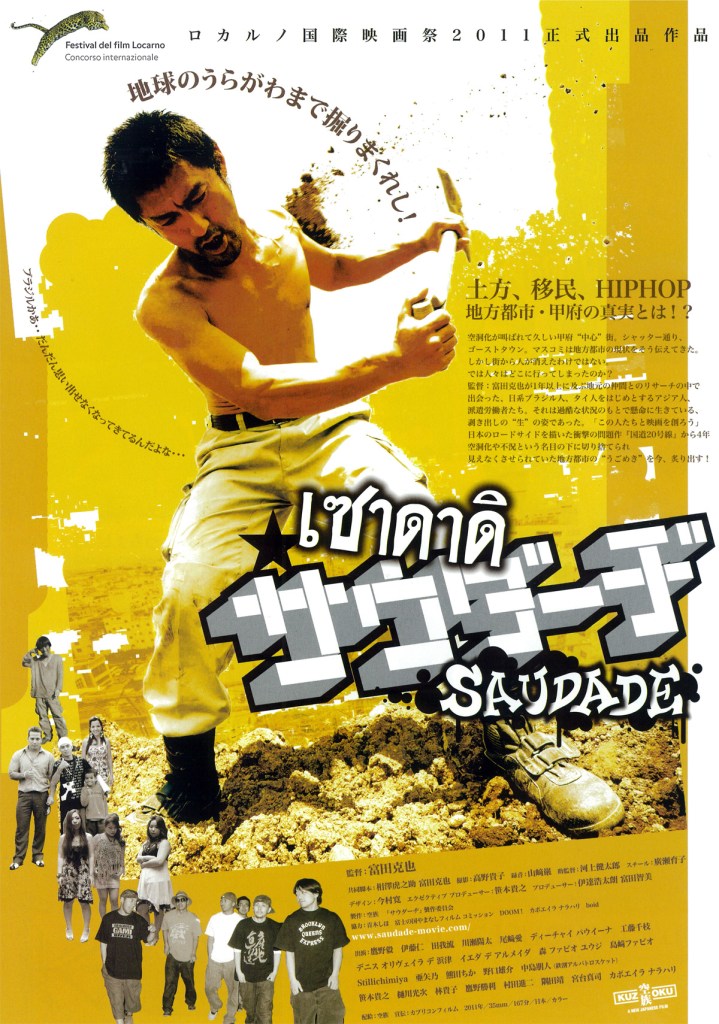
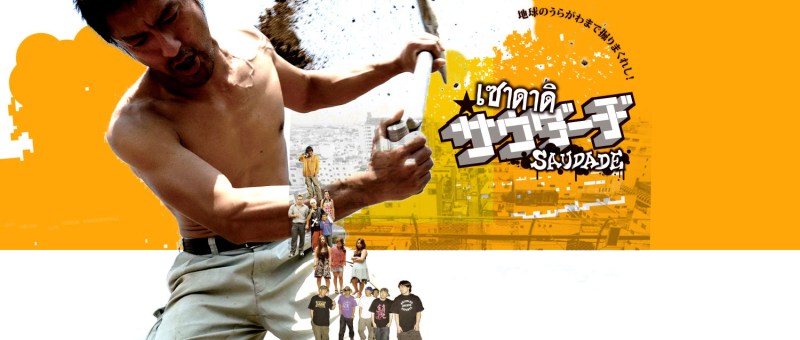
Saudade is one of those words that’s so unique to a particular language that it’s extremely difficult to translate into another. The recent Portuguese film, Tabu, is almost a literal expression of “saudade” itself but offers this brief explanation of it – a feeling of deep yearning or nostalgia for something that is past and can never be regained. Each of the residents in the small town of Kofu (which is, in many ways, a character itself) are all yearning for something, whether for a new life, opportunity or just a simple return to the promise of one’s youth. As the town’s prospects continue to decline its residents continue to long for something different – some kind of progress to lift them out of the tedious downward spiral in which they feel themselves to be trapped.

Seiji works in construction, employed on short term projects – when there is work going that is, something that’s becoming increasingly scarce. Married to a beautician whom he’s come to dislike due to her social climbing ambitions and desire to start a family, Seiji fantasises about running away with his Thai mistress and starting a new life with her in her home country. He’s joined by a new friend, Hosaka, who, coincidentally, has just returned from a long period of time living abroad in Thailand but seems to have his own problems and perhaps serious reasons for his flight and subsequent return. The newest member of the construction crew is the reluctant Amano, a leader of right leaning hip hop group, who has come to blame Japan’s immigrant population for his own inability to find work and progress in life.

There are also, of course, the non-Japanese populations including the Brazilians who came to Japan on the promise of wages ten times those they could earn in their home country but have found only poverty and discrimination. Many have decided to return home, others contemplate moving on – perhaps to the Philippines in search of a better life for themselves and their families. Some have been in Japan so long that although they are proud of their Brazilian heritage they barely remember their home country and feel they have nowhere to go besides Japan. Desperately trying to walk the line between integration and embracing their own culture, the non-native residents must also devote time to trying to gain acceptance from the local population. That’s not to mention the Thais working as hostesses or dancers or elsewhere in the entertainment industries – accepted but perhaps only in that specific context.

In painting a portrait of his own hometown, director Katsuya Tomita shows a side of Japan that is often absent from Western perceptions – blue collar workers trying to keep pace with the economic downturn while old prejudices rear their ugly heads in defence. The fact that most of the actors are non-professionals and residents of Kofu themselves gives the film a new weight, indeed the two main stars are friends of the director from childhood. Tomita spent a year researching his subject matter and many of these actors are simply repeating their former conversations in a new context for the camera. As the city crumbles and people pull away from each other in their search for something better, the tensions of everyday life grow stronger and threaten to tip over into violent intensity.

The film, however, seeks to remind us that we are all the same. We all have saudades for one thing or another – something we strive to reattain even though we know it’s impossible. The non-native residents yearn for home or for the acceptance they once felt, the Japanese for the prosperous Japan they grew up in and all the possibilities it afforded them in their youth. Seiji must know on one level that his dream of running away to Thailand with his girlfriend is an impossible fantasy, yet he continues to long for it with varying degrees of intensity. Amano’s problems are perhaps more to do with his own circumstances than the political stance he gives them – longing to be ‘someone’, admired, respected and perhaps loved even if the reason for that acclaim is something abhorrent.

At 164 minutes Saudade takes its time and, being an ensemble drama, perhaps lacks enough narrative focus to engage the majority of viewers. However, for those with long attention spans the film excels in character detail and in building a truly authentic atmosphere in the depiction of the decaying Kofu. Not always an easy watch, Saudade is an interesting and unflinching look at an all too often unacknowledged aspect of its home country.


Original trailer (English subtitles)

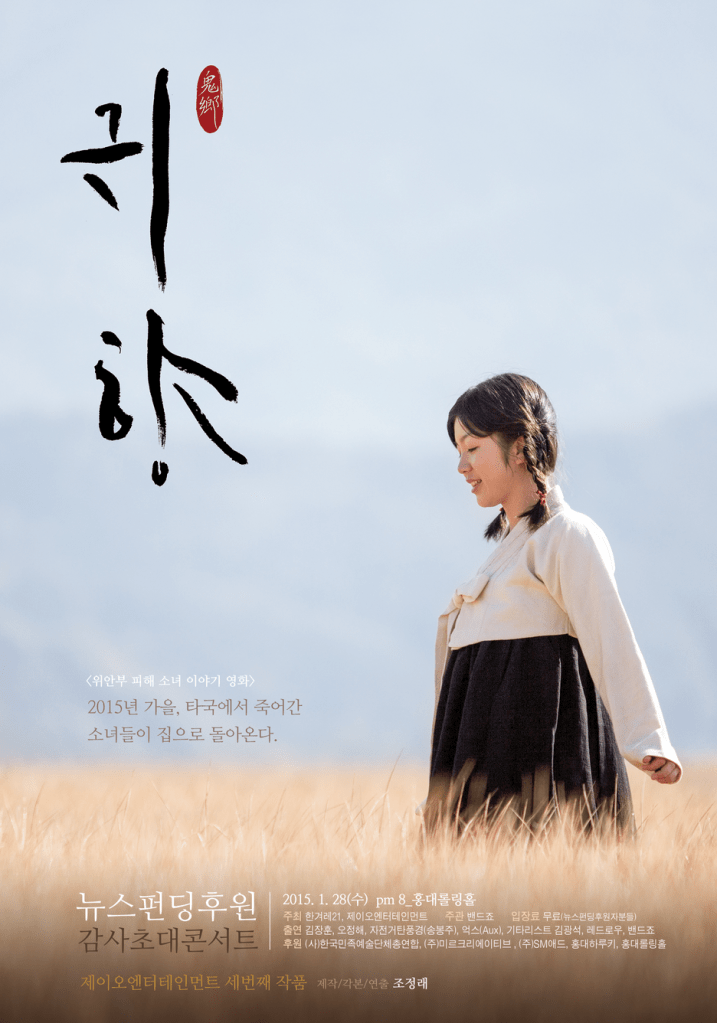
Spirits’ Homecoming (귀향, Cho Jung-rae, 2016)

sprits-homecomingOf all the awful things that happened in the middle part of the 20th century, the trafficking, incarceration, enslavement and forced prostitution of women and girls from across Asia (including at least 65 Dutch women in what is now known as Indonesia) who were abducted for use as “comfort women” by the Japanese military remains one of the least discussed and most controversial. The issue (arguably) runs most deeply in Korea which had been experiencing a prolonged and often brutal era of colonial rule even prior to the intensification of hostilities in the early 1940s. The torment these women faced did not end with the ceasefire as entrenched social attitudes left them not only with a lifetime of physical and psychological trauma but also internalised shame which made it difficult for them to talk about their experiences even to those closest to them. Now more than ever, it is important that this story be told and the long suffering of these women, many of whom are no longer with us, is finally acknowledged.
In 1943, fourteen year old Jung-min (Kang Hana) is an only child living with her cheerful father and stern mother somewhere in rural Korea. Energetic and headstrong, Jung-min thinks it sport to take a handmade amulet from one of her friends in a game despite her friend’s obvious distress. This earns her another switch beating from her disappointed mother who, regretfully, later makes her a similar amulet of her own. However, the amulet does Jung-min little good in the short term as the soldiers finally arrive and take her away with them to an uncertain destination.

Packed into a freight train with other similarly aged girls in the same situation, Jung-min is able to keep her cool and bonds with the girl next to her, Young-hee (Seo Mi-ji), who is already physically ill aside from the additional stress. Far from the shoe factory one of the girls had imagined, this collection of children is bound for a military brothel where they will be required to speak only Japanese, remaining within their tiny rooms which store only a mattress and water bucket, and endure repeated rape and violence at the hands of their captors.

Running parallel to the 1943 narrative is a jump forward to 1991 around the time in which the government finally decides to address the comfort woman issue with calls for registration so that all women affected may apply for any available compensation. Young-ok (Son Sook), now an older woman making a living from textiles and sewing amulets just like Jung-min’s, is only one of these women. Through her friendship with a shaman and her protege Eun-kyung (Choi Ri), Young-ok finds her thoughts returning to the past once again.

The younger Koreans of 1943 had known only the Japanese occupation, were educated in Japanese, and had been taught that they were “true countrymen” as one Jung-min’s friends puts it. Jung-min’s carefree, rural town is almost untouched by politics as Korean is spoken freely, folk traditions permitted, Arirang sung in the fields, and teenage girls wander around freely with no one to say to much about it. All this ends one day when the soldiers arrive, forcibly abducting Jung-min and any other young woman in the area without even a word of explanation to their parents or families. Despite the gradual erosion of their cultural identity, these women are now members of a subjugated nation so far below those of mainland birth that they barely qualify as people at all.

The treatment that these women undergo, many of them only children, is truly horrific from repeated rape to physical violence, starvation, and the ever present threat of death. Only Japanese is to be spoken in the camp which houses women and girls from both Korea and China, watched over by a Korean middle man and a Japanese madam. Allowed out of their fetid rooms for brief periods of respite (or later different kinds of work) the girls attempt to make the most of things, singing folk songs and remembering happier times. There is no real possibility of escape other than that found by one of the girls who has already gone mad after one of the visiting troops brought her own brother with it.

Indeed, there is no true escape even after the war’s end. Seeing the testimony of another former comfort woman on the television and hearing news of the programme to register women affected by wartime atrocity both for purposes of research and possible compensation, Young-ok is motivated to speak out. When she approaches a young man at the post-office to ask for the relevant forms, her nerves fail her, only to overhear the behind the counter conversation about the comfort women programme. It seems, there have been no claimants so far. The man behind the desk is unsurprised but also childishly amused. “You’d have to be some kind of loony to come out with all that kind of thing” he says, “it’s a bit…well…isn’t it?”. Not only have these women suffered immense physical and psychological trauma, they’ve also been forced into internalised shame thanks to conservative social attitudes regarding purity and surrender.

In this way, Spirits’ Homecoming (귀향, Kwihyang) stops being about Japan and Korea but becomes a wider commentary about the place of women in society and, more specifically, what happens to women in time of war. Many of the soldiers remark that the girls remind them of their sisters, yet they still go ahead with the things they do, treating these women as little more than receptacles for the fluids of their lust and rage, not much more sentient than a metal bucket. The Japanese soldiers are fairly one dimensional in their evilness, save for one who has the courage to say no, but his decision to help the girls brings only disaster for all, himself included. Berated as “bitches” for the Japanese army, the girls are denied any kind of agency and, should they outlive their usefulness, are taken off to a “better place” which smacks of the old lie told to children whose beloved dog has been taken to live a happier life “on a farm”.

Nothing can be said or done to repair what was done to these young women or return any of the things which were taken from them, but at least in telling their story there can be a kind of restitution and an end to the ongoing shame which continues to engulf their lives even though they themselves were always blameless. In reality many of these girls never got to come home, a fact which the shamanistic rites at the film’s conclusion intend to rectify, allowing Young-ok a chance to reconnect with a fallen friend whose spirit is finally guided homeward to the peaceful family life of the pre-war years. A necessarily difficult watch, Spirits’ Homecoming is a sensitive treatment of its horrific subject matter which, even if edging towards the sentimental, is resolutely unafraid to lay bare the degree of suffering inflicted on these women not only during the wartime years but throughout the rest of their lives.


Reviewed at the 2016 London East Asia Film Festival.

International trailer (English subtitles)

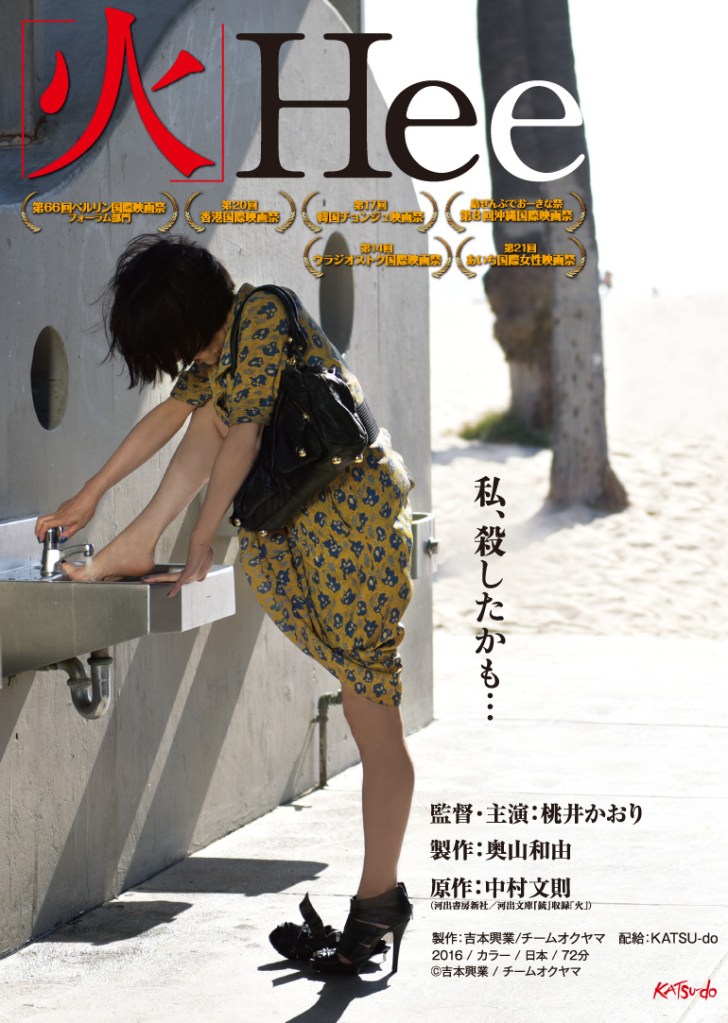
Hee (火, Kaori Momoi, 2016)

heeOne of Japan’s best known actresses with a career spanning over forty years, Kaori Momoi is perhaps just as well known for her outspoken and refreshingly direct approach to interviews as she is for her work with such esteemed directors as Akira Kurosawa, Kon Ichikawa, Yoji Yamada, and Shohei Imamura. One of the few Japanese actors to have made a successful international career starring in Hollywood movies such as Rob Marshall’s Memoirs of a Geisha and international art house fare in Alexander Sukurov’s The Sun, Momoi currently lives in LA and is even reportedly preparing to play Scarlett Johansson’s mother in the upcoming US live action adaptation of Ghost in the Shell. It’s perhaps less surprising then that in choosing to adapt a short story by one of Japan’s best young writers, Fuminori Nakamura, Momoi has chosen to shift the story to LA whilst maintaining its Japanese characters.
We first meet Azusa (Kaori Momoi) as she’s washing her foot in a public sink near a beach. A strange conversation with an American man implies that she’s involved in some kind of sex work and the pair head into a hotel where they’re stuck in a crowded lift with a collection of noisy strangers. Aside from this lift scene which is replayed with slightly different emphasises throughout the film, the narrative, such as it is, is provided by Azusa’s two sessions with passive psychiatrist, Dr. Sanada (Yugo Saso). In the first of these she discusses her feelings of guilt over the death of her family, killed in a fire started (perhaps not) by accident as she carelessly played with matches as a child. Later sessions see her accompanied by an official looking American man, seated in the corner but unable to understand much of what’s going on. Now Azusa is suspected of a violent crime but finds herself confessing to various other moral and criminal transgressions, but then again perhaps “confessing” is the wrong word.

Transposing the story from Japan to LA brings an additional layer of alienation to Azusa’s story as she finds herself alone and set adrift far from home. The slightly rundown, beachside faded glamour of the outside world contrasts neatly with the cool, ordered interior of the psychiatrist’s office where Sanada appears almost indifferent to Azusa’s monologue as he makes coffee in a vacuum pot and stares blankly straight ahead. It’s little wonder why Azusa remarks that perhaps he’s just not suited to this kind of work during her first session and even later states that he’s really just a sounding board for her – she’s monologuing for real, applying the talking cure to herself.

Intercut with Azusa’s monologues and the reoccurring lift scene in which Sanada also appears, Sanada is seen with his own, not quite happy, family. Married to a fellow doctor working at the same clinic, Sanada seems a little uncomfortable with his confident, dominant wife. Conversing in English at home the couple share extravagant meals prepared by their housekeeper with their little daughter but as Azusa’s monologues continue the family scenes become ever more strange and disjointed and Sanada is even seen wolfing down a plate of high grade beef in his pyjamas whilst sitting next to a bright burning fire inside a patio chimney heater. Azusa maintains control, both in the room and out, with Sanada left behind as passive observer.

Expertly played by director and lead actress Momoi, Azusa is a necessarily unreliable narrator as she offers her series of sad stories each of which leads towards a fire. Betrayed by men from her father onwards leading to a failed marriage, inappropriate relationship with another Japanese man in the US, and an ill fated assignation with an American possibly more interested in her daughter, Azusa’s only constant has been the fire but it also seems to spark her madness. It’s impossible to tell how much of what Azusa is saying is “true” at any given time as her oddly circular narratives fracture off yet return to the same point but what she appears to crave from Sanada is the simple act of acknowledgement – of being seen, understood, and respected as a human being.

Reportedly shot in just ten days for a minuscule budget, Hee is anchored by a strong performance from its leading lady but is occasionally undercut by Sanada’s passivity which leaves her without the necessary pushback. The English language actors offer their lines in a slightly surreal manner which adds to the heightened atmosphere of the piece but does not always gel with the other theatrical elements and, at times, proves jarring. Though sometimes too obtuse for its own good, Hee takes an interesting, experimental approach to its material and displays a nice flair for composition even if the cinematography itself remains more conventional. A frustrating, if sometimes fascinating, experience, Hee is the story of woman trapped in flames with only the last remaining hope that we will be able to see through the smoke and heat haze to finally acknowledge her presence.


Reviewed at the 2016 London East Asia Film Festival.

Original trailer (no subtitles)

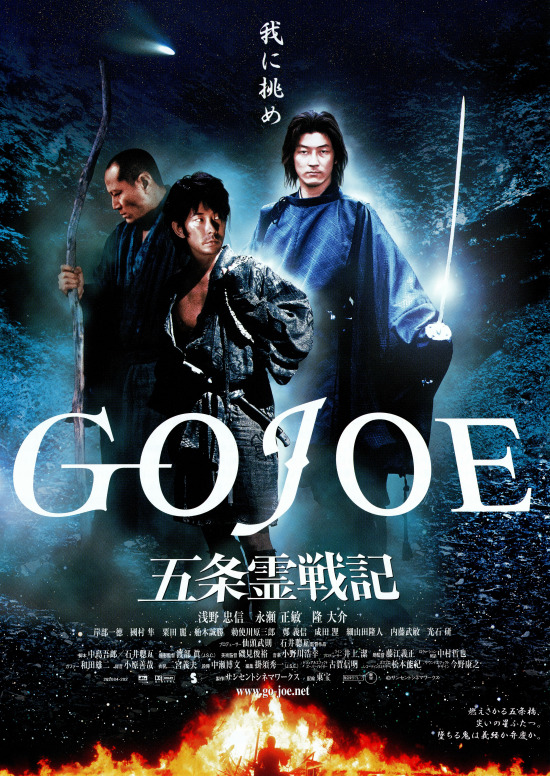
Gojoe (五条霊戦記, Sogo Ishii, 2000)

gojoe-2Not your mama’s jidaigeki – the punk messiah who brought us such landmarks of energetic, surreal filmmaking as Crazy Family and Burst City casts himself back to the Middle Ages for an experimental take on the samurai genre. In Gojoe (五条霊戦記, Gojo reisenki), Sogo Ishii remains a radical even within this often most conservative of genres through reinterpreting one of the best loved Japanese historical legends – the battle at Kyoto’s Gojoe Bridge . Far from the firm friends of the legends, this Benkei and this Shanao (Yoshitsune in waiting) are mortal enemies, bound to each other by cosmic fate but locked in combat.

Following a war between the Heike and Genji clans, the Heike have assumed power sending the Genji into retreat and exile. All should be well, but a mysterious force is taking the lives of Heike guardsmen. Around this time, former bloody warrior turned Buddhist monk Benkei (Daisuke Ryu) has received a prophecy that his path to enlightenment lies in vanquishing the “demon” which is killing soldiers in needlessly bloodthirsty ways. The Heike are not so much afraid of a supernatural threat as they are of a predictable one – the first son of the Genji whom they intended to murder as a child but later set free. Shanao (Tadanobu Asano ), only just come of age, wants his right and just revenge to restore his clan to its rightful place, but this is a dark time and there are more powerful forces at play than traumatised monks and disinherited princes.

The world of the jidaigeki, though often violent, has its own degree of careful order – rules which must be followed, pledges which must be honoured, and causes which must be seen through at any cost. The world of Gojoe is a necessarily chaotic one in which a fragile peace has been forged through violence and trickery but the sins of the past weigh heavy on those trying to forge ahead in the new era.

The Benkei of the legends is fiercely loyal to his lord, but this Benkei is very much a lone wolf, standing apart in his desire to expiate his sins. Though his fellow monk tries to convince him that the prophecy he’s been given is nothing but a delusion, Benkei is determined to find his peace through killing a literal demon rather than tackle the ones inside his mind. Nevertheless, the past is ever present through flashbacks, even at one point revisiting one of the darker elements of the Benkei story – the killing of a child who might be his own.

The “demon” which Benkei seeks turns out to be three orphaned children who have been trained by the remnants of their clan to seek nothing other than revenge. Shanao is more killing machine than man, thinking of nothing other than assuming his rightful role as the head of the Genji and restoring his family honour. When the two meet, each regards the other as “demonic” but Shanao has a point when he asks Benkei if it’s not his own heart which is unquiet. Where Benkei is contained rage, Shanao is calmness and refinement personified.

Benkei is joined for some of his journey by the comparatively more everyman presence of Tetsukichi (Masatoshi Nagase), formerly a master sword maker who’s taken to robbing corpses after growing disillusioned with his craft which often saw his beautiful handiwork in the hands of hypocritical warrior monks. “What’s so great about being alive anyway?” he asks at one point, not long after reminding Benkei that “this hell” is all of his making. Hell this is, Ishii’s world is bathed in fire and blood as petty clan conflict burns the villages of ordinary peasants who are so far removed from this sword bearing society as to be otherwise unaware of it. The peasants have their own problems to deal with as a shaman calls for the brutal beating to death of a pregnant woman supposedly infected by a “demon” and about to give birth to a “demon child”, but even if Benkei is moved to counter this instance of injustice, he is not willing to follow through when it comes to the larger implications of his decision.

The supernatural elements are more a means of cosmological explanation than they are of real threat yet Ishii conjures a dark and creepy world of ominous shadows and ever present danger. Fantasy tinged action allows for giant blood sprays as heads come off with abandon, but the sword fights themselves are both beautifully choreographed and filled with intensity. The final battle between Shanao and Benkei heads off in an unexpectedly experimental direction as swords spark against a starless sky until a cosmic event allows their fierce conflict to erupt into a raging fire, destroying the bridge and everything it stands for. There is no resolution here, only a passage of one state to the next as Benkei and Shanao live on in altered forms. Conducted to the pulsing, warlike drumbeats of a typically exhilarating Ishii score (composed by Ishii’s own band, Mach 1.67), Gojoe is jidaigeki reimagined for the modern era bringing all of the genre’s anxiety and spiritual conflict with it.


Original trailer (no subtitles)

Harmonium (淵に立つ, Koji Fukada, 2016)

harmoniumKoji Fukada first ventured into the family drama arena with the darkly comic satire Hospitalité in 2010 in which frequent collaborator Kanji Furutachi played the decidedly odd “family friend” who quickly took over the household and exposed all of its weaknesses before departing as mysteriously as he arrived. This time Furutachi plays the man of the house, though like his counterpart in Hospitalité, has not been telling the whole truth. Unlike much of Fukada’s previous work, Harmonium (淵に立つ, Fuchi ni Tatsu) abandons the comedy overtones for a truly bleak and tragic atmosphere which seems to speak of the death of the family unit itself.

On a morning just like any other, Toshio (Kanji Furutachi), Akie (Mariko Tsutsui), and their small daughter Hotaru (Momone Shinokawa), take breakfast together around the kitchen table. Akie leads grace while Toshio reads his paper before Hotaru moves on to a story about the baby spiders in the garden and how they collectively eat their mother. After his wife and daughter have left for the day, Toshio lifts the shutter on his workshop only to see a familiar, if long forgotten, face standing behind it.

The two men talk and it’s clear they’re old friends but have not seen each other in a long time. Fresh out of prison, Yasaka (Tadanobu Asano) is dressed in an odd looking suit without a jacket, the top button of his pristine white shirt neatly buttoned up. Toshio offers Yasaka a job in his workshop and a room in his house – all without a word to Akie, but somehow there’s something other than an altruistic desire to help an old friend who’s fallen on hard times at play.

Yasaka moves in and is permanently on his best behaviour but it isn’t until it’s discovered that he has a talent for the harmonium and begins to help Hotaru improve her playing that Akie starts to warm to him. It also helps that he’s interested in her spiritual life at the local protestant church, unlike her husband, and is generally around and available to her. Learning how Yasaka ended up in prison and how he now feels about his crime, Akie comes to feel this melancholy man must be especially worthy to God, and sure enough a mutual attraction begins to arise between the pair.

There’s a kind of debt implied in the relationship between Yasaka and Toshio which has Toshio running scared, trying to keep his old friend sweet lest he call it in. Yasaka’s intentions remain unclear, has he come for revenge or for comfort, to restart his life or to rehash the past? There’s something inescapably odd about his presence with his identical black suit trousered, white shirted figure which simultaneously makes him look like someone who just came out of prison and has been given one outfit to help them get a job, and like a dodgy TV evangelist or cult leader – ever so slightly too buttoned down and contained. At one point he tells Toshio he’s starting to wonder why Toshio has all of this ordinary success and he doesn’t, he could take it if he wanted to. Toshio, it has to be said, is not trying very hard to protect his place at the head of the table.

Like Yoshimitsu Morita in that other landmark of the family drama turned inside out by an unscheduled visitor, The Family Game, Fukada also makes the dinner table the centre of the conversation. We can see right away that this is not a “harmonious” household through the unbalanced seating arrangements – Toshio on one side, barely speaking and reading his paper, while Akie and Hotaru sit together opposite him reciting grace before they eat. There’s an ugly, empty space at the expected fourth position which is soon to be filled by Yasaka, but his presence does little to alleviate the anxiety of three people sitting at a table meant for four. Notably, after an unexpected tragedy occurs in the second part of the film the table itself has been rotated ninety degrees and only half of it is ever used as the lower part is cut off with a small TV showing live footage from another room. The family no longer take meals together, the kitchen is no longer a warm and organised place but a cold and chaotic one.

The sins of the father are visited upon the child. Everyone thinks they’re guilty of something, and that someone else is paying for their wrongdoing (and by implication forcing them to suffer by proxy). The presence of the harmonium – a staple in small churches and parlours of the 19th century, has a strangely religious resonance that perfectly tallies with Akie’s adherence to her Protestant faith which infuses the house even in the absence of crosses or other forms of iconography. Yasaka carries with him a sense of malevolence, like a visiting demon tempting and provoking as he goes, though it ultimately remains unclear if he is even to blame for the tragedy which befalls the family or is simply another victim of it.

Retaining his elegantly composed, static camera, Fukada makes use of unusual and high impact cuts as well as a daring, unannounced jump forward in time. Red becomes a recurrent theme as it alarmingly cuts through the otherwise subdued colour scheme whether as a T-shirt hidden behind a calm white boiler suit, or the reflections of a car window as a particularly dark thought passes through a passenger’s mind. Filled with mismatched pairs and asymmetrical setups, the family find themselves locked into a wheel of repetitions until the final scene which sees them recreate a “happy” family photo in a kind of grim tableau as neglectful father Toshio desperately fights to revive his family. Darker in tone and filled with an almost supernatural malevolence, Harmonium is a tense and unpredictable drama probing at the status of the traditional family in an increasingly uncertain world.


Reviewed at the 2016 London East Asia Film Festival.

UK release trailer (English subtitles)

The Handmaiden (아가씨, Park Chan-wook, 2016)

handmaiden.jpgPark Chan-wook has something of a track record when it comes to bending literary sources in unexpected ways – who else would have thought of adding vampires to Thérèse Raquin and actually managed to make it work? In The Handmaiden (아가씨, Agasshi), his first return to Korean filmmaking after Stoker’s foray into American Gothic, Park adapts Sarah Waters’ Fingersmith – a Dickensian tale of love and the multilayered con, and relocates it to 1930s Korea under Japanese rule.

Ambivalent attitudes to the Japanese is a key element exploited by a ruthless conman posing as “Count Fujiwara” (Ha Jung-woo) in order to seduce a lonely heiress. To complete his elaborate plan, he needs the help of pickpocket extraordinaire, Sook-hee (Kim Tae-Ri), whom he will install as a maid in the household so she can subtly sell the virtues of the dashing nobleman to the innocent flower trapped in a well of opulence.

On arriving at the curiously constructed mansion which is an elegant architectural mix of Korean, Japanese, and English country estate, Sook-hee is quite literally out of place in the upperclass environment a world away from her home in a den of petty of thieves doubling as a baby farm. Another thing she had not quite banked on was that her new mistress, Hideko (Kim Min-hee), would be quite so pretty. A serious spanner is thrown in the works as a mutual attraction builds up between the two women who, for reasons which become apparent, are being pulled in separate directions by other desires.

Park retains Waters’ tripartite structure even if he jettisons the final plot reveal for a less intricate tale of liberation and escape. Beginning with Sook-hee’s narrative he introduces us to the first layer of the con but also to Sook-hee and her down and dirty home in the criminal underworld. Chosen by the Count for her supposed lack of intellect and innocent naivety, Sook-hee is not quite at home among her family either. Both believing the promise that the babies they collect and sell in Japan will be going on to better lives and lamenting the cruelty of the whole business in wanting to mother the lot of them, Sook-hee is soft presence yet she also wants to prove herself as adept at criminality as her legendary, now deceased, mother.

It’s this essential warmth which eventually attracts Hideko’s attention. The much talked about tooth filing scene in which Sook-hee takes out a thimble to soften a lacerating sharpness in her mistress’ mouth is not just notable for the oddly erotic quality born of the obvious suggestive motion, unavoidable intimacy created by the closeness of bodies, and the growing desire of fleeting, furtive glances, but for its essential kindness. Moving into Hideko’s perspective for the second chapter, more is learned about her damaged past filled with cruelty and abuse. Orphaned and brought to Japan as a small child by her pornography obsessed uncle so that he might train her to entertain him with readings of erotic literature before he eventually marries her to inherit the family fortune, Hideko has never known anything as simple as unguarded goodness.

Caught up in a long con, the choice remains whether to blow cover and declare one’s hand or play the thing through to the end, however painful it may be. Park takes a different route than in the original novel which makes both of its heroines the victims of someone else’s avaricious plot of revenge against the cruelty of an unequal world, eventually reinforcing their bond by a shared rejection of their victimhood, but even when their passions eventually erupt the lovemaking begins as a another “con” where Sook-hee takes on the role of the Count, “educating” the assumedly “innocent” Hideko in the ways of desire.

Trapped within an oppressive gilded cage of a prison, Hideko has become the embodiment of desire for her cruel and eccentric uncle and the groups of men he invites to listen to her read erotic literature as if reciting a classical play. Complete with sideshows of sex dolls and theatrical scenery, Hideko is forced to act out the scenes from the books as an actress on the stage for an audience rapt in silence. Unable to escape alone, Hideko is offered new hope by Sook-hee’s straightforward outrage which allows the pair to destroy or repurpose the instruments of their oppression for their own pleasure. This is, in essence, their form of revenge in which they simply remove themselves from an abusive environment leaving the men behind to wonder at what’s gone wrong and later to destroy themselves without any additional help.

Filled with a gothic sense of impossible desires and uncertain judgements, The Handmaiden is unafraid of the genre’s melodramatic roots but is all the better for it. Beautifully photographed, this opulent world of swishing ball gowns and gloved hands is undercut by the ugliness of quisling collaborator Kouzuki and his basement of horrors. Erotically charged but ultimately driven by love, The Handmaiden is another unconventionally romantic effort from Park albeit one coloured by his characteristic sense of gothic darkness.


Reviewed at 2016 London East Asia Film Festival.

Original trailer (English subtitles)