The Mother Tree (怪談乳房榎, Goro Kadono, 1958)

An amoral ronin worms his way into the home of a famous painter with the intention of stealing his wife in Goro Kadono’s eerie tale of ghostly revenge, The Mother Tree (怪談乳房榎, Kaidan Chibusa Enoki). As might be expected, it doesn’t go particularly well for him. He is, though, perhaps a symbol of the latent fear of social interlopers and those displaced within the Edo-era class system. Namihei (Asao Matsumoto) claims that he was let go by his master for being too interested in painting, though is otherwise focused on short-term gains and causing destruction.

Shigenobu (Akira Nakamura) is said to be “the greatest artist in Edo”, and is certainly very much in demand. He is father to an infant son, Mayotaro, and husband to devoted wife Kise (Katsuko Wakasugi). He appears to be a good man, if a little scatterbrained and hugely overworked, which is one reason why he was grateful to take on a pupil. The irony is that both Kise and the family’s maid Hana (Keiko Hasegawa) remark on what a nice guy Namihei is and how glad they are to have him in the household. He’s even good with the baby who apparently likes to be held by him. All of which suggests that he might have actually had talent for painting and could probably have succeeded Shigenobu, in time, if hadn’t been such a terrible person. 

Unfortunately, however, Namihei reminds Shigenobu that he promised to paint a freeze for a temple some distance away and had sort of forgotten about it. An impulsive soul, Shigenobu decides he’d better leave right away if only to shake off this sense of unfulfilled obligation that’s been plaguing him. He entrusts the women of the household to Namihei in his absence and has no reason to fear any harm may come to them while he’s away. Namihei, however, attempts to rape Kise as soon as he leaves. Though she resists him, he threatens to kill her son and she is forced to give in to a prolonged period of sexual exploitation.

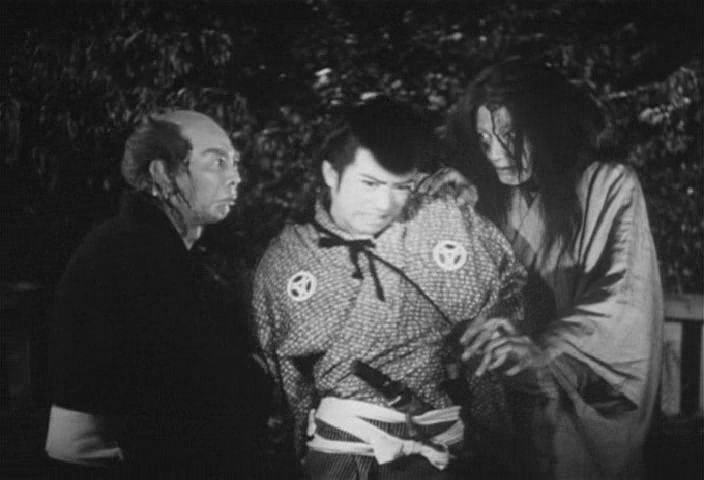
This is actually quite a dangerous move on Namihei’s part considering that the penalty for adultery under Tokugawa law is death, which might be why he finally ends up killing Hana after she witnesses Kise being abused and tries to help her. Namihei evidently doesn’t have a long-term plan for how all this is supposed to pan out and panics on hearing that Shigenobu will be returning much earlier than he expected. The irony may be that Shigenobu intended to paint eyes that might see into the next world and eventually becomes a vengeful ghost after being brutally murdered by Namihei, though was unable to see his treachery. Evidently never having read a ghost story himself, Namihei dumps the body in a pond, which is all but guaranteed to come back and haunt him. “Though you kill me, I will not die,” Shigenobu curses, vowing that he cannot pass on while his dragons lack eyes. 

What might be surprising is that neither of the vengeful ghosts blame Kise for her plight or seek revenge against her. The rage of a vengeful ghost can often be indiscriminate, but both Shigenobu and Hana seem to understand that Kise has been abused by Namihei and only submitted to him out of maternal devotion in the desire to have her son. Namihei’s transgression aims at straight at the concept of motherhood and with it the entire social order. Having displaced Shigenobu, Mayotaro now seems a nuisance to him. He believes he’s conquered Kise by fear and no longer needs this leverage to control her now her husband is dead.

It is mainly fear that causes people to behave in strange ways. Namihei orders their servant Shosuke (Hiroshi Hayashi) to kill Mayotaro, telling Kise that he is to be sent to a noble samurai family that will assist in his social advancement. Kise seems to go along with this, despite having sworn to raise Mayotaro to take revenge. Shosuke is unable to resist after Namihei threatens him with death, but places Mayotoyo by the Mother Tree which had once nourished him. Following her husband’s murder, Kise’s milk had dried up in shock as if echoing this attempt on her maternity which was then restored by the ancient natural authority of the tree. 

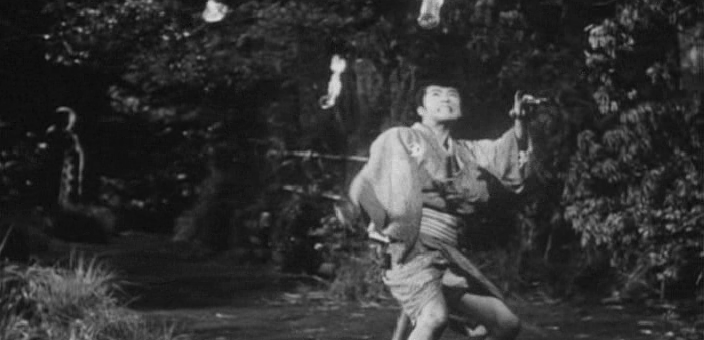
That it’s the Buddhist priest that becomes a figure of moral authority and goodness positions Buddhism as the counter to the amoral nihilism of men like Namihei. Having been struck by Namihei, Kise leaves her son in the priest’s care who will raise him not for revenge but peace and forgiveness. This might run counter to the Shinto-inflected role of the Mother Tree as a symbol of the power of nature, but ultimately suggests that true righteousness is found in Buddhism and its values. Namihei pays for his amoral venality after being tormented by spirits appearing as flaming orbs. Japanese ghosts rarely harm humans directly, but cause them to hurt themselves through fear and madness. That he ultimately kills Kise despite Shigenobu’s telling her to raise their son suggests that she is being punished too, though none of this was her fault and it is really she who puts end to Namihei’s reign of terror. With his death, order is, in a sense, restored as Shigenobu returns to put the eyes on his dragons who can indeed see a better world free of greed or cruelty. 

A Wicked Woman (毒婦高橋お伝, Nobuo Nakagawa, 1958)

The term “dokufu” or “poisonous woman” dates back to the Edo era, but rose to prominence once again in the turbulent society of late Meiji in which such women became fodder for the growing penny dreadful industry. Unlike the later “bad girl” or contemporary examples of “bad women” from elsewhere, the problem with “poisonous women” is that they pollute society as a whole, corrupting those around them through their unbridled transgressions. These notions are of course as much about contemporary notions of femininity and a desire to preserve the social order at all costs as they are about conventional morality and the rule of law, but there are reasons that tales of such independent women incited such a frenzy among both men and women who found themselves floundering in a confusing and rapidly changing society.

Nobuo Nakagawa’s A Wicked Woman (毒婦高橋お伝, Dokufu Takahashi Oden) is inspired by the real life tale one particular “dokufu”, Oden Takahashi, who was in fact the last woman to be beheaded in Japan after being convicted of murdering her lover while suspected of poisoning her husband. Nakagawa does not particularly pay attention to the “real” details of her life but to her pulp persona, somewhat reclaiming her image as an ultra cool revenger who refused to be bound by the restrictive mores of her times or suffer at the hands of the feckless men she nevertheless falls victim to. 

When we first meet Oden (Katsuko Wakasugi), she is being pursued by a large number of policemen whom she manages to outrun, eventually tricking them and escaping by getting a lift from a passing rickshaw driver. The ride is tense, and we worry that Oden will encounter an accident that will bring her to the attention of the police, but the crisis is something quite different. In a staggering coincidence, the rickshaw driver is none other than Oden’s estranged first husband, Jinjuro (Akira Nakamura), once a samurai but now reduced to pulling a cab after ruining himself through drink and debauchery (apparently why Oden eventually left him). Though it’s not exactly a happy reunion, the pair part on good terms while he laments that their small daughter Omitsu still misses her mother, managing to extract a few notes from Oden supposedly for her upkeep.  

Oden meanwhile goes home to husband no. 2, Ryosuke (Asao Matsumoto), who is bedridden with TB and increasingly paranoid about what Oden does outside the house to keep them fed. Operating out of a remote cottage, she puts on a ridiculously elaborate Western outfit and heads to a jewellers where she pretends to look at precious stones for a ring, dropping one on the floor while the salesman’s back is turned and spiking it with the point of her parasol knowing that no-one is going to think of looking there. The assistants aren’t stupid, they know a stone is missing and Oden must have pocketed it but all they can do is search her person, calling in the local bobby, Kazuma. (Juzaburo Akechi), who thinks they may be going too far in forcing this upperclass lady to strip off to prove she’s not a thief. The owner of the store, Osawa (Tetsuro Tanba), looks on knowingly but is intrigued more than anything else, eventually content to let Oden go despite knowing she has the jewel concealed somewhere about her person. 

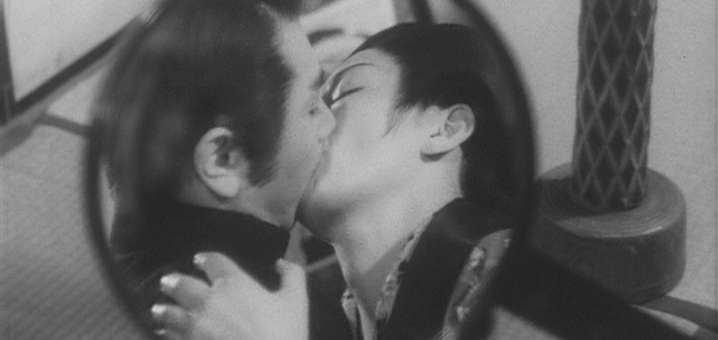
Disaster strikes, however, when Oden runs into Kazuma in the street and he spots her parasol sparkling. He tries to arrest her, but she pleads with him to let her change out of her extremely silly outfit first, playing the poor widow card and eventually seducing the naive policeman. What Oden didn’t quite bank on was actually falling for him for real, drawn in a sense to order and goodness, longing to be caught and restored to the rightful condition of womanliness but fearing she has lost all right to conventional happiness. 

Oden’s relationship with Kazuma is an example of the effects of her “poison” on society at large. Kazuma as we first meet him is earnest and good, a naive young rookie with a strong sense of justice who leaps to defend Oden thinking she is a maligned noble woman unfairly accused of thievery. His superior Kakunosuke (Gen Funabashi), has set him up with his innocent little sister Kozue (Minako Yamada) and it seems the pair will soon marry, but Kazuma is apparently not so much interested in sweetness as he is in Oden’s complicated darkness. He falls obsessively in love with her, perhaps partly out of a desire to save her from her criminal life by bringing her to justice, but also in attraction to all of her transgressive qualities which contradict everything he stands for. 

Nakagawa reframes Oden’s poisonousness as a consequence of her frustrated maternity and a continual failure of masculinity. After re-encountering Jinjuro, Oden finds it increasingly difficult to justify the act of abandoning her child and leaving her with a man she knew to be a violent and feckless drunk. Though Jinjuro appears to have reformed himself through the time-honoured devices of humbleness and hard work, we later find him extorting money from Oden to pay for Omitsu’s medical care only to drink it all himself. Oden tries to visit her daughter, but is after all a stranger in her life. Her attempt to reclaim her maternity, escape the trap of criminality and leave the city with her little girl is the primary motivator for all of her subsequent actions which culminate in an intense desire for revenge against Jinjuro, the architect of all her misfortune. 

All of Oden’s earlier crimes were in some way permissible, taking from those who could afford to lose and doing it with a degree of style. The botched job at the jewellers, however, sees her fall into the hands of Osawa, who turns out to be a violent and sadistic gang boss. Osawa keeps women captive in his basement and whips them for his own enjoyment, forcing Oden to become a procurer tricking vulnerable women into becoming sex slaves. Oden thinks nothing of this, smirking that there must be good money in selling women, willingly complicit in the oppression of those just like her. To free herself from Osawa, she uses Jinjuro, attempting to kill two birds with one stone and finding partial success only for the plan to fall apart when confronted by the face of order in the reappearance of a ruined Kazuma. 

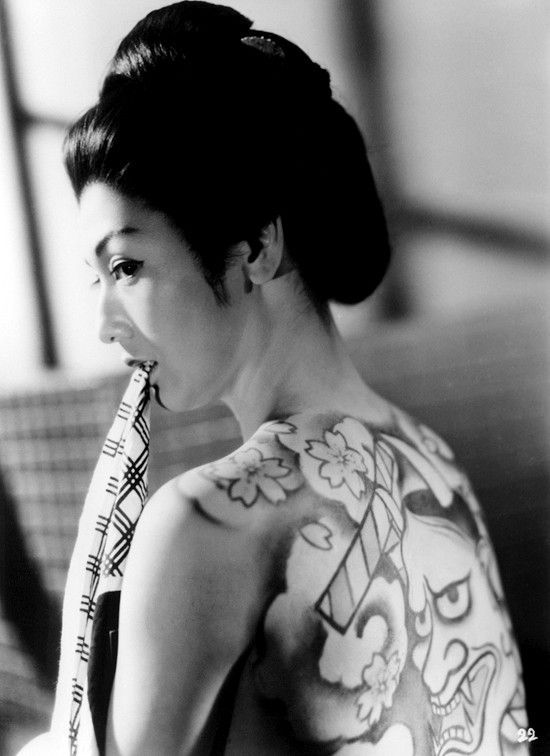
Oden ends her journey in Yokohama, a bustling international port, where she’s the tattooed madame of the Osawa’s Chinese bar and a familiar face at the gaming tables. The suggestion is that this corruption is foreign in origin, Osawa’s top hat and smart suit not to mention plush Western-style bed, suggesting that his savagery is a facet of his seduction by Chinese hedonism and Western individualism. Individualism is again painted as Oden’s sin when she leaves the women locked in a jail cell to escape a fire while cradling her ill-gotten gains, only to tell Kazuma to man up and that money is what she truly loves. But Oden is also victim of her times, betrayed by a failure of masculinity in a patriarchal system. Jinjuro the drunken samurai, Ryonosuke the impotent consumptive, and Kazuma the conflicted young man. The last of these she refuses to “ruin”, setting him free because she truly loves him and does not want to see him dragged into her life of crime, intent on reclaiming her goodness by reassuming the role of a conventional mother living an honest life with her daughter somewhere far away. Her “wickedness” is only really her desire to survive but an independent woman, good or bad, is always a threat to the social order and so she must be stopped lest her inconvenient desire to live a life free of male control become a “poisonous” example to those around her.