Hush! (ハッシュ!, Ryosuke Hashiguchi, 2001)

hushThe family drama is a mainstay of Japanese cinema, true, but, it’s a far wider genre than might be assumed. The rays fracture out from Ozu through to The Family Game and Crazy Family which sought to ask a few questions about where the idea of “family” was headed in a society of rapidly increasing materialism. Ryosuke Hashiguchi comes at the idea from a different angle in 2001’s Hush! (ハッシュ!) as he once again takes the perspective of the gay community and asks if the “traditional family” is about to change – what could, or should, survive if the old, rigid ideas can be remade into something lasting created out of love and acceptance rather than obligation?

As the film begins, Naoya (Kazuya Takahashi) wakes up to find his one night stand already fully dressed and heading out the door, awkwardly, without even stopping to say goodbye. Eventually he hooks up with the kindly Katsuhiro (Seiichi Tanabe) and the two quickly become fairly serious but then a damaged woman, Asako (Reiko Kataoka), enters their lives hoping to use Katsuhiro as a sperm donor, forcing the men to reassess a number of important desires and beliefs, putting strain on their still fledgling relationship. If that weren’t enough drama, a girl at Katsuhiro’s place of work has also developed a crush on him and is prepared to take her unreturned love to some extremely dark places.

The first level of mini stresses Naoya and Katsuhiro have to contend with is their conflicting (if complementary) personalities and attitudes to their sexuality. Naoya is an easy going type with a job at a pet grooming salon. He’s a fully out gay man and a frequenter of city’s gay scene. Katsuhiro, by contrast, is much more mild mannered and innately kind. He works at a scientific research station and is more or less closeted – that is, he doesn’t particularly go out of his way to hide his sexuality from his work mates and family but he doesn’t volunteer the information either. This attitude seems to bother Naoya at various points but being the easy going type he’s apt to let it go most of the time.

However, when Katsuhiro reveals Asako’s offer, Naoya is actively against it. His idea of gay life suggests that relationships are generally short, he prefers the relative freedom of his life as an essentially “single” man rather a husband shackled to a family. Katsuhiro on the other hand perhaps would have liked children, or to be a father figure to someone else’s. Though Naoya has previously expressed boredom and disillusionment with his life spent in clubs and gay bars, he’s still resistant to the idea of settling down, or at least to the belief that a single relationship really can stay the course.

All three of the central characters have, in a sense, been let down by the “traditional” family. Naoya’s father left when he was small, leaving him with a single mother which is something that wasn’t so common when he was a child resulting in a fair amount of social stigma from other people in the community. These days his brassy mother knows about his sexuality and seems OK with it (aside from getting the random idea that Naoya will be wanting a pair of breasts at some point). Katsuhiro’s father was an alcoholic who died when he was just a small boy, his relationship with his brother and his family seems good but he’s afraid to reveal his sexuality to them for fear of disapproval. His brother had an arranged marriage, which doesn’t seem to have worked out so well at least from the sister-in-law’s perspective. Asako has also had a troubled life looking for affection in all the wrong places, feeling that if she had not been neglected as a child perhaps she’d have been a steadier adult. Naoya was running away from the idea of family ties, but Katsuhiro and Asako are actively seeking to repair the ones which never grew into the kind of roots one needs to anchor onself in a society entirely built around familial bonds.

After receiving some surprising medical news, Asako perversely decides that her own salvation lies in becoming a mother. She’s had enough of casual relationships and decided to go a different route so when she spots the kind look Katshiro gives a small child at a restaurant, she decides he must be the one to father her baby. Asako knew that Naoya and Katsuhiro were a couple, but that works out pretty well for her plan so she approaches him and makes her left field offer right off the bat. It will take some figuring out but this literal third way is a neat solution to a series of problems and, being completely new, is safe from the pettiness and misery often found within the traditional family unit. Contrasted with the bitterness displayed by Katsuhiro’s sister-in-law, the unusual arrangement of these three would be parents and their unborn child(ren) is one filled with love, forgiveness and mutual support rather than cold obligation or a simple fulfilment of societal expectations.

Once again Hashiguchi proves himself adept at creating a series of complex, flawed human beings who are nevertheless relatable and often endearing. Hashiguchi’s films tend to run long but he also ensures that even his supporting characters are well enough drawn to maintain interest in the many subplots from Naoya’s abrasive gay bar buddy to Katsuhiro’s unhinged stalker. An interesting sideways look at the state of the modern family, Hush! seems to advocate that just shutting up and going with the flow is not the answer but there are quieter solutions to be found if everyone is willing to listen to the silence.


Original trailer (no subtitles)
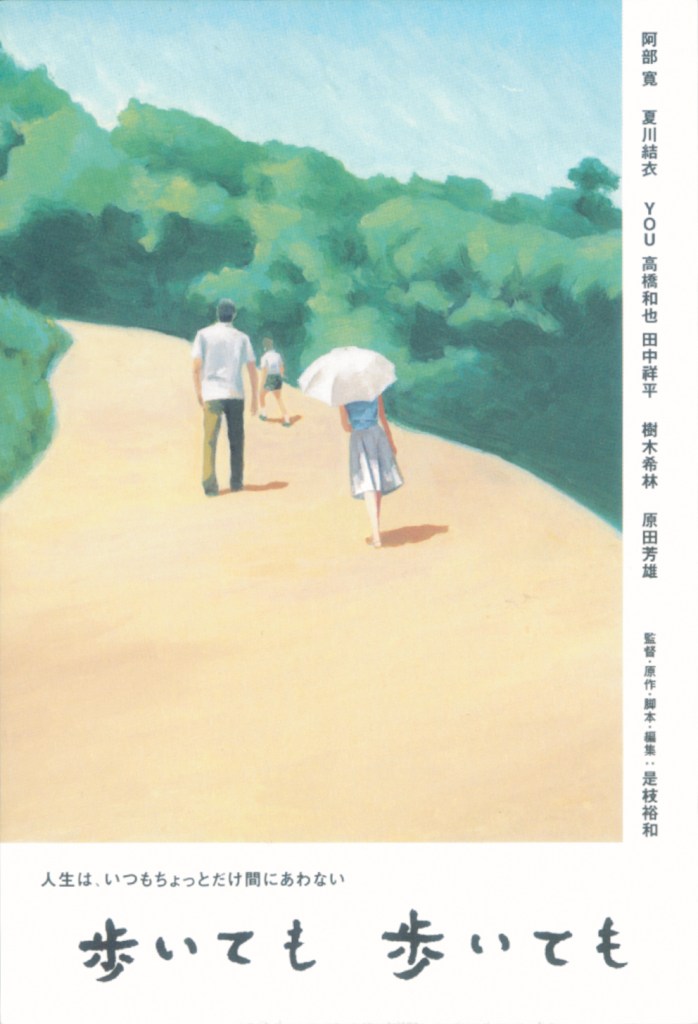
Still Walking (歩いても歩いても, Hirokazu Koreeda, 2008)

still walkingLife is full of choices, but the one thing you can’t choose is your family. Like it or not you’re stuck with them for life and even if you decide you want nothing to do with them ever again, they’ll still be hanging round in the back of your mind for evermore. Koreeda swings the camera back around the fulcrum of Japanese society for this dissection of the fault lines and earthquake zones rubbing up against this very ordinary family.

You’d be forgiven for thinking that some kind of celebration is about to take place at the beginning of Still Walking (歩いても歩いても, Aruitemo Aruitemo) yet the event that is about to bring scattered friends and family members back home is of a more somber nature. As the matriarch Toshiko (Kirin Kiki) peels vegetables with her daughter Chinami (YOU) she seems excited at the prospect of getting the family back together again yet melancholic and perhaps a little nervous.

Younger son Ryota (Hiroshi Abe) is taking the train in with his new wife and stepson. He urges Yukari (Yui Natsukawa) that they should make their excuses and leave in time for the last train but she feels obliged to stay over. It’s clear Ryota is not looking forward to a reunion with his family and also has some current worries over his working situation which are weighing on his mind and which he definitely does not want anyone in the family to find out about.

Ryota has a particularly strained relationship with his difficult doctor father, Kyohei (Yoshio Harada) who doted on his oldest son, Junpei, drowned at sea whilst saving the life of a little boy. Increasingly grumpy that he has no heir for his medical practice, Kyohei refuses to recognise Ryota as a grown man or accept his work as an art restorer as a “real” occupation. Tensions in the family are further brought out by the mild disapproval over Ryota’s choice of wife who was previously married and then widowed and has a young son by her first husband. Toshiko for one still harbours an old fashioned stigma towards second marriages and thinks Ryota could have done better than “buying second hand”. Though seemingly accepting of her new daughter-in-law and grandson, she perhaps treats them a little more like guests than fully fledged members of the family.

Set over the course of two days, Still Walking takes on a sense of Chekovian wit and melancholy as it paints a naturalistic picture of an ordinary family with all of the petty cruelties and indignation that involves. The deceased son, Junpei, has become a virtual saint, forever bathed in golden light by his grieving parents while Ryota remains very much alive yet pushed into the shadows. Feeling himself to raise only feelings of disappointment in his family, he adopts a truculent, defensive air which sees him unwilling to engage leaving the bulk of the work for his new wife who is eager to please her in-laws despite their frequent tactlessness in dealing with herself and her son.

Of course, Ryota and his father aren’t so different at all – both gruff, defensive, grumpy. Kyohei is a difficult man sinking into a miserable old age where he can no longer busy himself with the role which has given his life meaning, that of a respected small town doctor. When bubbly younger sister Chinami mentions having seen a newspaper report which referred to painting restorers as “art doctors”, neither man is very happy with being linked with the other yet there is a certain commonality between them that oddly forces them apart rather than ties them together.

Toshiko by contrast is the long suffering yet largely silent housewife whose maternal grief is the force which now defines her. Seemingly sweet and kind on the outside, there’s a tough core in the middle which gives way to some decidedly biting remarks lightly peppering the atmosphere with ancient resentments. Perhaps feeling a strange sort of kinship with the mystery guest-cum-kicking-boy-of-the-day – Yoshio, the boy who Junpei saved but has not made good on his investment as he’s turned into a slobbish and overweight 25 year old child who can’t seem to settle on one proper career, Ryota asks why his mother insists on inviting him every year knowing how painful it must be for him to come. Toshiko coldly replies that that’s exactly the reason she intends to keep making him visit, she feels wretched inside 24/7 so for one day every year she makes someone else feel dreadful too – will anyone blame her for that?

Grief and loss play a heavy part here, not only of the literal kind, but in the feeling of time wasted and the disappearing moments which can never be recaptured. Chinami’s son and daughter team up with Ryota’s stepson Atsushi to provide a melancholic mirror of the the three Yokoyama children playing in the same fields and staring at the same fleeting flowers as their forebears did years before. Time is always passing, you think there will always be another opportunity for saying something or other, forging a connection or new memory but soon enough the sand in the glass runs through. As Ryota notes, it’s always a little later than you think but you can’t see it until it’s already too late.

Dense with naturalistic detail, Still Walking is a warm if sad look at one ordinary family dealing with the aftermath of tragedy yet offers its own comments on the nature of human connection between fathers and sons, mothers and daughters, and between the living and the dead. A timely reminder of the transience of all things, Koreeda’s most straightforward take on the family drama proves a both profound and moving experience which only deepens with repeated viewing.


I rewatched this recently at an ICA members’ screening where it screened on 35mm but the print actually had an intermission built into it even though the film isn’t all that long – strange experience!

Still Walking is available on DVD and VOD in the UK from New Wave Films and was also released on blu-ray in the US as part of the Criterion Collection.

The film’s Japanese title Aruitemo Aruitemo is taken from the song made famous by Ayumi Ishida – Blue Light Yokohama which turns out to have a surprising significance within the film:


Being Good (きみはいい子, Mipo O, 2015)

Being Goog J poster“Being good”. What does that mean? Is it as simple as “not being bad” (whatever that means) or perhaps it’s just abiding by the moral conventions of your society though those may be, no – are, questionable ideas in themselves. Mipo O follows up her hard hitting modern romance The Light Shines Only There by attempting to answer this question through looking at the stories of three ordinary people whose lives are touched by human cruelty.

The film begins with newbie teacher Okano (Kengo Kora) who is still trying to adjust to the extremely stressful life of a primary school teacher in charge of 38 little guys and girls. As he’s young and he’s only just started he’s filled with enthusiasm and is intent on doing his best to make a difference. On the other hand, he’s a young man with a private life of his own to think about and sometimes he’s just too tired to want to be bothered with a bunch of kids intentionally trying to push his buttons. When he notices one of the pupils hanging around the schoolyard everyday long after he should have gone home, he begins to worry about the boy’s life outside of school.

Strand two also features the life of an abused child as stressed out mother Masami (Machiko Ono) struggles to cope with her three year old daughter Ayane while her husband is frequently abroad on business. Having been an abused child herself, Masami enters a vicious cycle of hating herself for treating her daughter the way she does and resenting Ayane even more for making her feel this way. After becoming friends with a cheerful woman who seems completely at ease with her two rowdy kids, there may be a better way out on offer for Masami and Ayane.

The third tale is a little different than the other two as it encompasses themes of lonely older people in Japan’s rapidly ageing society and the position of those who are different from the norm. Akiko lost her entire family during the war and never had children of her own so she’s all alone now. Every evening while she’s sweeping the steps a young boy says “hello, goodbye” to her as he walks past. One day the boy is in a terrible panic because he’s somehow lost his house key but Akiko calms him down and takes him inside until his mother can come and fetch him.

Okano is full of good intentions. He wants to think himself a “good” person and genuinely wants to look after the young lives placed in his care. However, he is still young, inexperienced and a little bit vain so that the slightest bit of criticism niggles at him. Simply put, he just doesn’t really know what to do and several of his ideas backfire quite spectacularly or appear extremely ill-conceived. Some of this is still about him and his own idea of his being a “good person” rather than an altruistic desire to help the children under his care.

The same, however, cannot be said of the elderly lady who still takes such delight in the falling cherry blossoms which waft down from the school to her small suburban house. Akiko might be lonely, but there’s nothing selfish in the warmth she extends to others. When Hyato’s mother, Kazumi, arrives to fetch him, she’s immediately mortified, convinced that her son must have caused immense levels of trouble for this little old lady. Akiko claims not even to have noticed Hyato’s differences but remarks on how polite he is greeting her every evening and that he’s been the perfect houseguest – in fact she was enjoying herself so much she’s a little sorry Kazumi has turned up so quickly. Kazumi is completely overwhelmed by Akiko’s kindness – it’s the first time she’s ever heard anyone say something nice about her son rather than having people criticise him for being different. In fact, sometimes even she begins to forget how “good” he can be.

In the case of Masami and her daughter Ayane, it’s not that Masami is “bad” person but is responding to a cycle of violence that she finds impossible to escape. Masami doesn’t cope well with stressful situations, dislikes noise and disorder and has impossibly high (and arbitrary) standards for her daughter which result in “discipline” through physical violence. Nevertheless, Ayane loves her mother and, even if Masami recoils when Ayane tries to hug her, reacts with horror to cheerful friend Yoko’s joke of adopting her into their family. Ayane wants to be like her mum, taking delight in wearing a matching pair of shoes even if that means she can’t play with the other kids. As Masami was abused, so she abuses – will the cycle continue with Ayane? Luckily, the pair may have found a more gentle solution in the form of the kindly Yoko who proves far wiser than one would suspect.

As Okano’s sister tells him, when you’re nice to children, they’re nice to others. If everyone could be nicer to their children perhaps we could have a nicer world. The young boy whom Okano is trying to save has come to believe that he’s a “bad kid” – proven by the fact that Santa never comes to their house. He can’t bring himself to talk about his step father to his teachers and Okano’s interventions only make things worse for the boy. He needs someone to show him that he’s not at fault and that the world is not a bad place but it will take more than just “good will” to solve the problem. Sometimes, all you can do is knock on the door.


Reviewed as part of the Japan Foundation Touring Film Programme 2016.

This is the original trailer for the film but in my opinion it contains a few spoilers so bear that in mind if you plan on watching in the near future: