 Tatsushi Omori’s debut feature The Whispering of the Gods proved so controversial that he was left with no choice other than to set up his own temporary cinema to screen it. Five years later he returned with another uncompromising look at modern society which is only a little less grim than its predecessor. A Crowd of Three (ケンタとジュンとカヨちゃんの国, Kenta to Jun to Kayo-chan no Kuni) takes what has become a staple of quirky indie comedy dramas – a small group of disconnected people taking a road trip to look for something better, and turns it into a depressingly nihilistic voyage to nowhere. Never quite achieving the kind of painful, angst ridden atmosphere of disaffected young men desperately trying to break out of a social straight jacket, A Crowd of Three is an oddly cold film, undercut with a pervasive layer of misogyny and hopelessness which makes its ultimate destination somewhere few will wish to travel.
Kenta (Shota Matsuda) and Jun (Kengo Kora) are young men working dead end construction jobs. Growing up together almost like brothers in the same orphanage the pair share an intense bond but also a shared sense of having been badly let down by life even at such a young age. Their main source of relief seems to be in picking up “loose women” from the street by asking random ladies on their own for their ages. One evening Jun picks up Kayo (Sakura Ando) – a melancholy woman with low self esteem who sleeps around because she is insecure about her own plain looks. After Kenta is assaulted by the foreman, he decides to take revenge by smashing up the office and his boss’ car before taking off on a journey north to see his (biological) brother who is currently in prison.
Kayo tags along with the pair after apparently having fallen in love with Jun who is only interested in her for easy sex and occasional cash tips. Despite the fact that the film’s original Japanese title is “Jun, Kenta, and Kayo’s Country”, Kayo is quickly cast aside by the pair of travellers who think it’s funny to throw all of her stuff out of the window and abandon her at a service station in the middle of nowhere. Getting thrown out of cars and left behind in remote places is something which happens to Kayo repeatedly throughout the film as she tries to follow Jun despite his obvious indifference towards her.
Kayo just wants to feel love, but at least as far as the film goes she’s looking for it in all the wrong places. Even if Jun does start to feel something more genuine for her in the end, it’s born of a kind of shared insecurity as he worries about a repetitive strain injury from using the pneumatic drill which turns his hand white at moments of stress. After literally jilting Kayo, Jun takes up with a vacuous bar hostess who does, indeed, recoil from his pale hand. The bar hostess has very ordinary dreams – a big house, wealthy husband, children. She’s even planned out her own death. These are all things which Jun could never give her, a middle school drop out with no family he already fears he has no future but at least he’s not railroaded onto a pre-determined course and is free to choose his destination even if he feels there is nowhere for him to go.
Kenta expresses this early in the film when he states that there are two kinds of people – those who choose how they’re going to live, and those who don’t. The boys feel as if they’re in the no choice category – unceremoniously kicked out of social care and expected to fend for themselves with no education or contacts, reliant on poorly paid temporary work to get by. In a slightly overworked metaphor, Kenta and Jun’s jobs on demolition projects point to their desire to dismantle their world but the more they smash away at it the less progress they make. Kenta’s literal smashing of the car and office belonging to his boss are his final act of choice but again it gets him nowhere. Even talking to his brother who is in prison for the most heinous of crimes, Kenta finds no encouragement but only cold rejection.
A Crowd of Three goes to some very dark places ranging from work place harassment to child abuse and sexualised violence, but it largely fails to capitalise on its grim atmosphere to make any kind of impact aside from the pervasive melancholia. Omori mostly sticks to a straight forward approach with some interesting editing choices and composition but largely relies on the quality performances of his leading players. Far from youth aflame with nihilistic rage, A Crowd of Three is bleaker than bleak and frozen throughout making the battling of its heroes to transcend their difficult social circumstances a forlorn hope of epic proportions.
Original trailer (no subtitles)
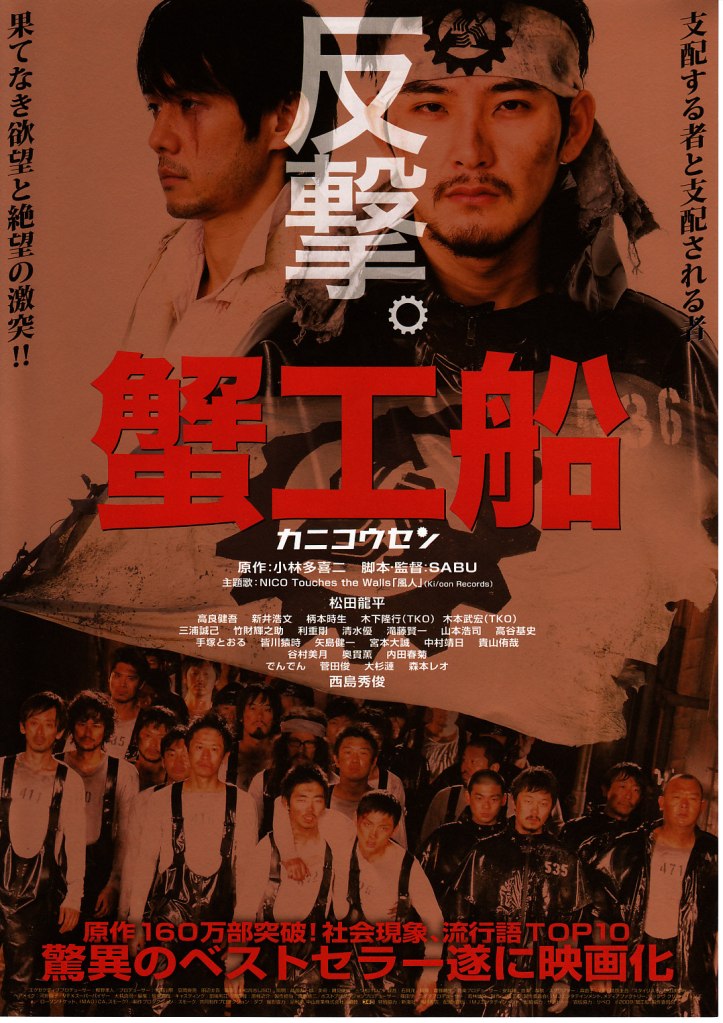 Back in 2008 as the financial crisis took hold, a left leaning early Showa novel from Takiji Kobayashi, Kanikosen (蟹工船), became a surprise best seller following an advertising campaign which linked the struggles of its historical proletarian workers with the put upon working classes of the day. The book had previously been adapted for the screen in 1953 in a version directed by So Yamamura but bolstered by its unexpected resurgence, another adaptation directed by SABU arrived in 2009.
 “Being good”. What does that mean? Is it as simple as “not being bad” (whatever that means) or perhaps it’s just abiding by the moral conventions of your society though those may be, no – are, questionable ideas in themselves. Mipo O follows up her hard hitting modern romance The Light Shines Only There by attempting to answer this question through looking at the stories of three ordinary people whose lives are touched by human cruelty.
 When it comes to the great Japanese artworks that everybody knows, the figure of Hokusai looms large. From the ubiquitous The Great Wave off Kanagawa to the infamous Dream of the Fisherman’s Wife, the work of Hokusai has come to represent the art of Edo woodblocks almost single handedly in the popular imagination yet there has long been scholarly debate about the true artist behind some of the pieces which are attributed to his name. Hokusai had a daughter – uniquely gifted, perhaps even surpassing the skills of her father, O-Ei was a talented artist in her own right as well as her father’s assistant and caregiver in his old age.
 When 21 year old Hitomi Kanehara’s Snakes and Earrings (蛇にピアス, Hebi ni Piasu) was published back in 2003 it took the coveted Akutagawa prize for literature and the country by storm. Its scandalous depictions of the dark and nihilistic sex life of its outsider youngsters outraged and fascinated enough people to get it onto the best seller lists and earn a cinematic adaptation from Japan’s top theatre director Yukio Ninagawa in only his second foray into the world of moving pictures. However, Snakes and Earrings is perhaps that rare instance of an adaptation which clings to closely to its source material as its detached, emotionless and straightforward approach end in something of a miss fire.


 Windows on Worlds