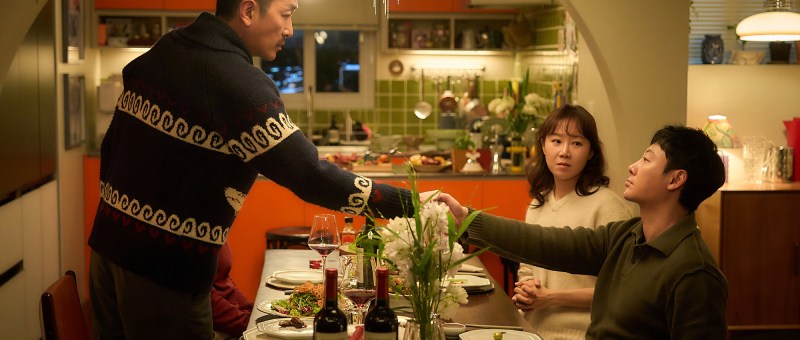

A moribund marriage finds itself haunted in the reflective image of the couple upstairs in Ha Jung-woo’s take on the Spanish film, Sentimental. A very ’70s sex farce, the film is, in other ways, a refreshingly modern examination of contemporary relationships that ultimately comes down on the side of sexual freedom and personal fulfilment rather than encouraging its unhappily married protagonists back into a socially conformist cage of merely settling for an unsatisfying existence.
You can tell Jeong-ah (Gong Hyo-jin) is unsatisfied by the way she accidentally embarrasses the life model at the art class where she teaches part-time to the point he feels he has to cover himself up even though it defeats the purpose of him being there. Her work as a temporary art teacher is also a symbol of her defeated hopes having given up on her creative practice to focus on more practical concerns while her husband, Hyun-soo (Kim Dong-wook), is a struggling film director who is currently on the 48th draft of a project to turn an unsuccessful film pitch into a TV drama that he’s been working on for the last four years.
Neither of them are getting much sleep because the rambunctious nightly lovemaking of the couple upstairs keeps them up at night, but these days Hyun-soo sleeps on a fold up mattress in his office which is full of empty boxes of instant ramen like some student bachelor pad. Though they’re only in adjacent rooms, they communicate through Kakao talk and are otherwise leading separate lives. That might be why Jeong-a is drawn to the self-help YouTube channel run by Soo-kyung (Lee Hanee), her upstairs neighbour, which assures that no one can cure the loneliness inside you and the fastest way to better relationships is to stop expecting too much from other people.
But it’s clear that Jeong-a, at least, is looking for something more which is likely why she decides to invite the upstairs neighbours over for dinner. Hyun-soo isn’t keen on the plan and tries to force her to cancel, then only agreeing to stay an hour while making passive-aggressive comments and veering close to telling the Kims that they can hear everything that’s going on upstairs and they don’t like it. Soo-kyung and her husband Mr Kim (Ha Jung-woo) are, however, the inverse of Jeong-a and Hyun-soo in their hyper-sexualised relationship and apparently solid marriage. They’ve come with something to say too, but while Jeong-a is increasingly receptive to their entreaties and open about her dissatisfaction, Hyun-soo is rude and indignant, resentful of what he sees as a perverse intrusion into his otherwise very “normal” life.
Indeed, part of this is that Mr Kim keeps making subtle digs at his masculinity in needling him about his lack of career success and inability to get this TV drama off the ground after apparently working on it for four years. This is also the root of Hyun-soo’s own insecurities and withdrawal from Jeong-a, unable to see himself as a man in the wake of his dissatisfying career. But Mr Kim is also a contradictory picture of masculinity. A teacher of Chinese characters who really wanted to be a calligrapher, he cuts a fairly authoritarian figure, but is otherwise a modern new man who is domesticated and open with his feelings. The Kims bring a dish to the dinner that Mr Kim has made while he orgiastically tears into pomegranate and suggestively squeezes lemons. He fixes drinks, makes tea, and gets out of the way while his wife does her work.
But at the same time, the film seems to dial back on the inherent queerness of the Kims’ sexual practice by eliding the homoeroticism between Hyun-soo and Mr Kim who is keen to recruit him because his apparently explosive essence. This internalised homophobia is also a manifestation of Hyun-soo’s conventionality and desire for middle-class properness to bring order to his life, if only superficially, by continuing to live in a simulacrum of a marriage that leaves husband and wife unhappy. The recently remodelled flat is full of the signs of aspiration from the posh china to elegant modern decor. But it’s a row about the curtains that most obviously signals the cracks in their relationship. Jeong-a doesn’t want any because she wants a more open and transparent marriage, while Hyun-soo can’t live without them because he craves repression and can’t understand a life without it.
In any case, during their incredibly weird evening with the Kims, the couple hit rock bottom that is also a kind of epiphany liberating them from their misconceptions and the inertia of their married life. Hyun-soo, finally, begins to realise that Jeong-a is right when she says he uses sarcasm to run away from his problems and if he wants to save his marriage, he’ll have to be a little more emotionally honest and open to compromise. Despite his squeamishness, the film seems to come down on the side of the Kims who are living happy and fulfilling lives in embracing their sexuality, while it is Hyun-soo, by contrast, who must learn to open up even if he’s not quite ready to get in the lift.
The People Upstairs screened as part of this year’s LEAFF.
Trailer (no subtitles)





 You can become the King of all Korea and your mum still won’t be happy. So it is for poor Prince Sungwon (Kim Dong-wook) who becomes accidental Iago in this Joseon tale of betrayal, cruelty, and love turning to hate in the toxic environment of the imperial court – Kim Dae-seung’s The Concubine (후궁: 제왕의 첩, Hugoong: Jewangui Chub). Power and impotence corrupt equally as the battlefield shifts to the bedroom and sex becomes weapon and currency in a complex political struggle.
 Windows on Worlds