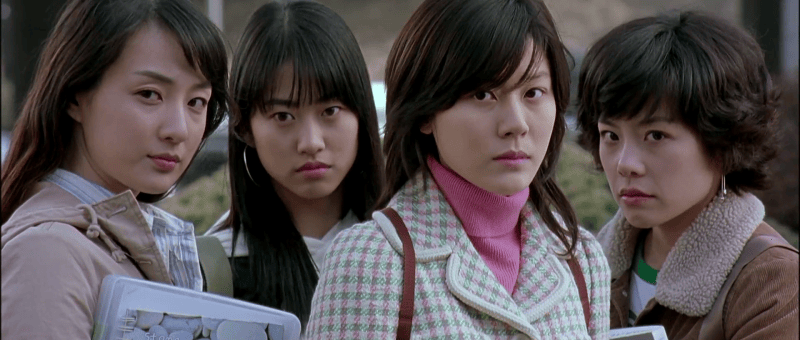
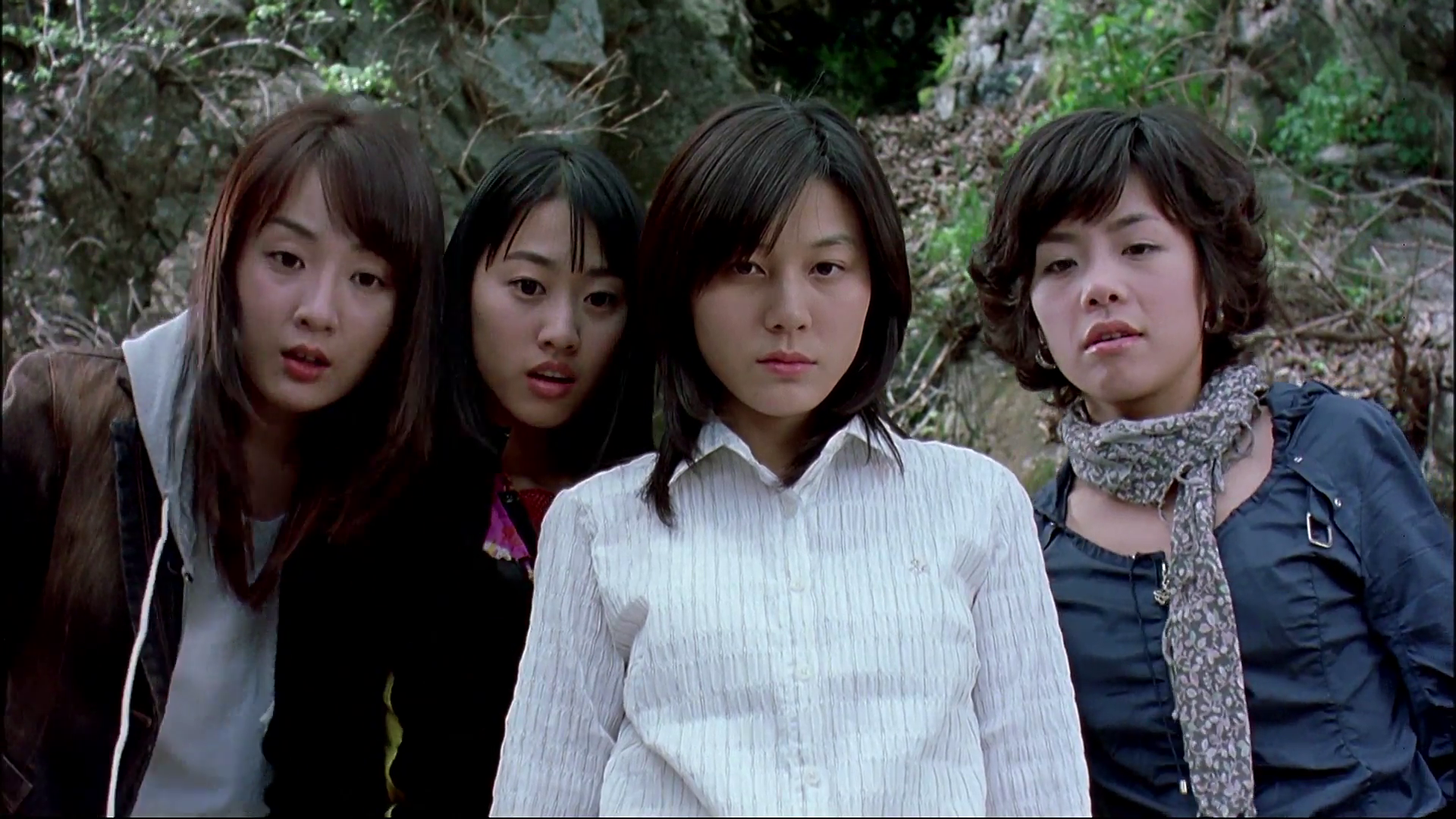
The Ghost (령, Kim Tae-kyung, 2004)

According to her university tutor, the anxiety of our present times stems from the identity crisis that we all feel, yet Ji-won’s (Kim Ha-neul) identity crisis is deeper than even she knows. Having lost her memory following an accident, she takes it as a good opportunity to start again, planning to leave her clingy, widowed mother behind to study overseas. Yet the unremembered past won’t seem to let her go as she’s haunted by a series of mysterious figures that push her towards investigating the person she may have been before.

This is not altogether welcome for Ji-won, as she begins to realise that prior to her accident, she may not have been a very nice person. She begins having visions of being told off by herself and comes to understand that she and her high school friendship group, who have now almost all been killed or gone mad, were involved with bullying another girl, Su-in (Nam Sang-mi), ostensibly because she was poor while they were all wealthy. Further flashbacks hint that she and Su-in may once have been friends, though Ji-won’s financial status improved markedly so that she could join the posh girl group and no longer wanted to associate with someone like Su-in.

Su-in laments that because of their poverty, neither of them had many friends besides each other when they were younger, and that now Ji-won is rich, she’s suddenly friends with everyone, hinting at the rather superficial nature of friendships and the snobbishness of the surrounding society in which relationships are often divided along the lines of social class. Ji-won, however, resents this, rejecting Su-in’s claim that no one was friends with her and insisting she’s nothing like Su-in in deliberately seeking to exclude herself from the ranks of the poor by suggesting she’s innately different. “I’m not who I was,” she ironically says, as if she had been somehow reborn following her parents’ financial success. But at the same time, Su-in has a similar mindset. When Ji-won asks her what she wants to be when she grows up, she replies only “you”, wishing this new future not only of financial comfort but friendship and acceptance for herself.

After joining the mean girl group, it’s as if Ji-won punished Su-in deliberately in order to make it clear that she is not like her and now belongs to this new elite class free of the stigma of poverty. Su-in meanwhile is willing to put up with a degree of mistreatment in order to be accepted by the group and remain “friends” with Ji-won, whom she still seems to care about. It does seem that college student Ji-won is a different, nicer person, who only has one friend in a boy a couple of years older who’s just returned from military service (Ryu Jin). Perhaps having lost her memories she’s essentially a blank slate who never learned these kinds of petty hierarchies as a child and as an adult has a better ability to see how arbitrary and unkind they really are. At any rate, she is not who she was, but is still targeted by a force she has not yet identified, just as she has still not identified herself.

The Ghost (령, Ryeong, AKA Dead Friend) seems to be drawing quite heavily from the J-horror phenomenon, though making its watery spirits and Ouija boards very much its own. The final twist is indeed quite ingenious and completely unexpected, proving that finding the ghost’s body doesn’t always lift the curse, especially if it’s not the one the ghost was after. The screenplay is extremely well constructed, lending a degree of psychological nuance and internal consistency in the constant mirroring of Ji-won and Su-in while hinting that the real terror here may be not just prejudice but what the fear of it will do to someone’s outlook and behaviour, causing them to act in terrible ways simply to prove that they are not the other but only one of us, which is to say someone worthy of respect. That kind of rage, it seems, is not cured by death. Kim Tae-gyeong’s eerie ghost story is drenched in a particular kind of loneliness that suggests all along they could have been friends if it weren’t for social exclusion and the arbitrary stigmas of a highly stratified society.


Trailer (English subtitles)
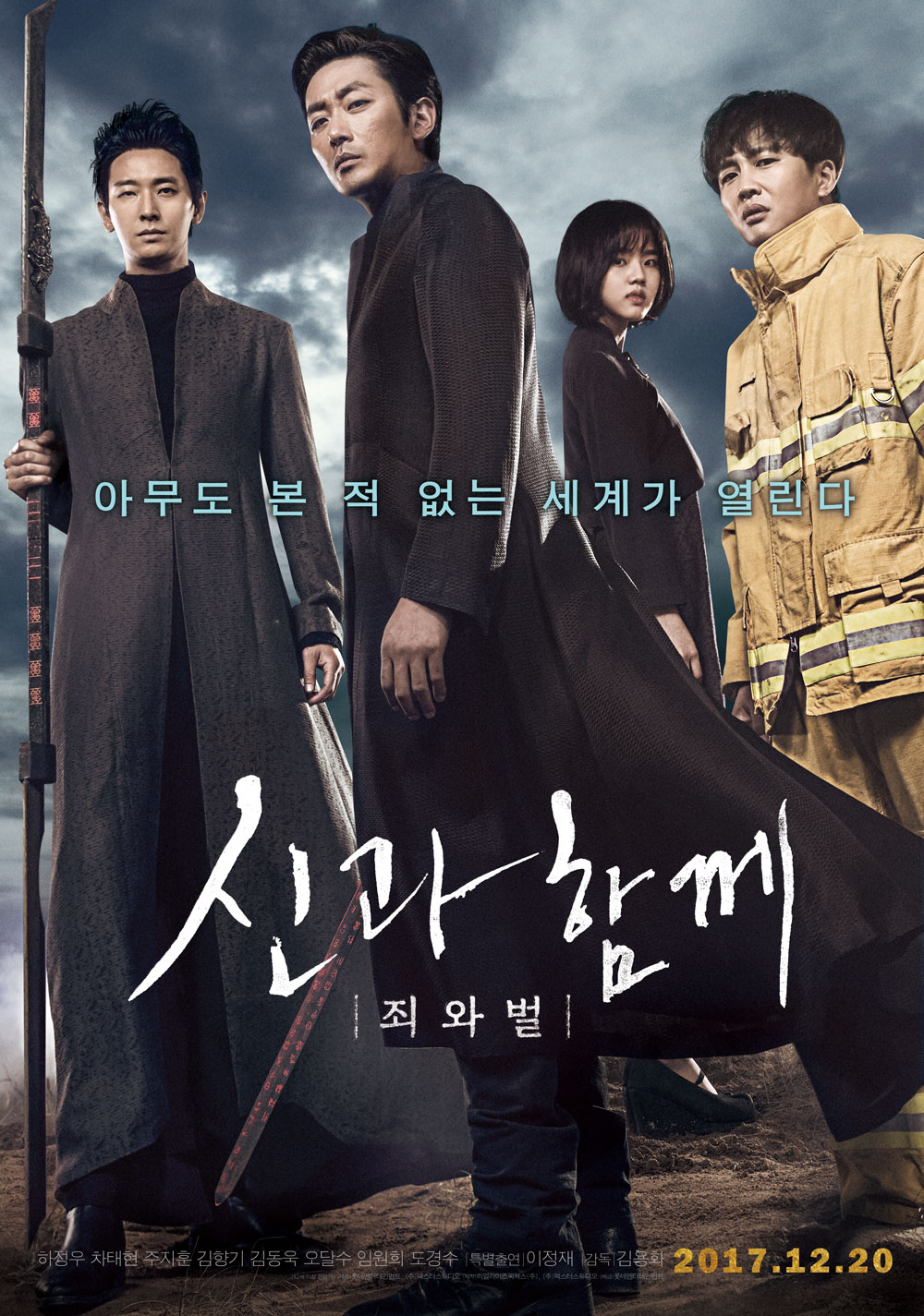
Along With the Gods: The Two Worlds (신과함께-죄와 벌, Kim Yong-hwa, 2017)

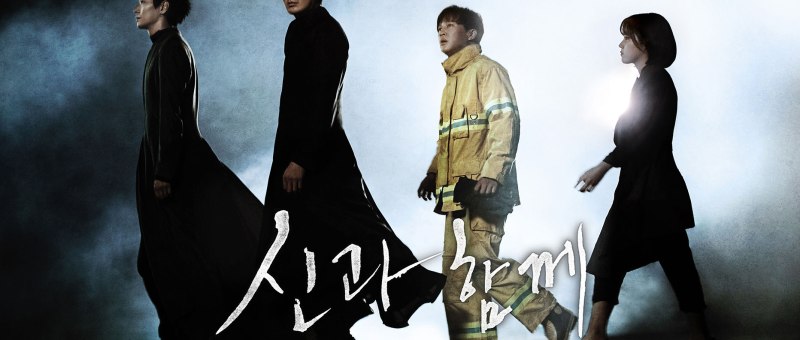
Along With the Gods- The Two Worlds posterThere’s nothing like death to give life perspective. If life is a series of tests, death is the finals but if you pass you get to come back and do it all again, otherwise you’ll have to spend some time in the afterlife thinking hard about what you’ve done and presumably studying for some kind of resits. At least, that’s how it seems to work in the complicated Buddhist hell of Kim Yong-hwa’s fantasy epic Along With the Gods: The Two Worlds (신과함께-죄와 벌, Sin gwa Hamkke – Joe wa Beol). The first in a two part series, The Two Worlds takes a saintly man and tries to pull him down only to build him back up again as a potent symbol of filial piety and wounded selflessness.

Firefighter Kim Ja-hong (Cha Tae-hyun) is killed leaping heroically from a burning building with a little girl wrapped in his arms. He doesn’t realise he’s dead until he’s greeted by two neatly suited, official looking types who explain to him that they are his “Guardians” and will be looking after him on his journey through the afterlife. It turns out that Ja-hong’s heroic death has earned him a “Paragon” badge – a rare occurrence, and he has a good chance of reincarnation before the 49th day if he can successfully pass each of the seven trials which mark passage through Buddhist Hell.

As the Guardians point out, it would be extremely difficult for a “normal” person to pass these seven trials and achieve reincarnation but as a Paragon Ja-hong should have an easier ride. Ja-hong is, however, an ordinary person with an ordinary person’s failings even if his faults are comparatively small. Ja-hong is literally on trial seven times – represented by his team of defence lawyers, the Guardians, he is charged with various sins each “judged” by a god presiding over a custom courtroom. Murder Hell is fiery chaos, indolence is assessed by a stern older lady (Kim Hae-sook), and deceit by (who else) a small child (Kim Soo-ahn) licking a large lollipop.

Ja-hong is indeed a “good person” but he has also been to dark places, wilfully deciding to turn and walk away from them in order to repurpose his rage and resentment into a determination to care for his seriously ill mother (Ye Soo-jung) and younger brother (Kim Dong-wook). Working tirelessly, Ja-hong has been selfless in the extreme, saving lives and saving money for his family whilst sacrificing his own life and prospect of happiness in order to provide for others. That’s not to say, however, that there isn’t a degree of “sin” in the selfishness of Ja-hong’s selflessness or that he hasn’t also been cowardly in making a symbolic recompense for a guilty secret rather than a personal apology.

Kim Yong-hwa weaves in a series of subplots including a lengthy shift into the life of Ja-hong’s brother Su-hong, a possibly gay soldier with an intense attachment to a comrade which eventually has tragic results. Su-hong’s mild resentment towards his brother becomes a key element in his trial, eventually developing into a more literal kind of spectre haunting the proceedings while perhaps creating even more turmoil and confusion in the living world thanks to a moustache twirling villain whose desire to “help” is probably more about saving face – the kind of “betrayal” which is not “beautiful” enough to get a pass from the Goddess.

In the end the court seems to bend towards Ja-hong’s moral philosophy, excusing his human failings through moral justification even when that justification remains flimsy as in the case of his “fake” letters intended to make people feel better through the comfort of lies. The essence of the judgement, however, looks for forgiveness – if a sin is forgiven in the mortal world, it is inadmissible in a celestial court. The message seems clear, face your problems head on and sort out your emotional difficulties properly while there’s time else you’ll end up with “unfinished business” and get bogged down in Buddhist Hell being attacked by fish with teeth and having old ladies asking you why you spent so much time watching movies about death rather than living life to the fullest.

Ambitious in its use of CGI, Along With the Gods: The Two Worlds acquits itself well enough in its carefully drawn (if lifeless) backgrounds and frequent flights of fancy which allow Ha Jung-woo’s enigmatic Gang-lim ample opportunity to whip out his fiery sword of justice. Narratively, however, it’s comparatively clumsy and content to revel in the melodrama of its tearjerking premise. A post-credits teaser linking part one and part two through the recurring figure of an old man who can see the Guardians presents a familiar face in an extremely unfamiliar light and hints at a great deal of fun to be had next time around – appropriate enough for a film about reincarnation, but then again it’s as well to have some fun in this life too, something The Two Worlds could have used a little more of.


Currently on limited UK cinema release courtesy of China Lion.

Original trailer (English subtitles)