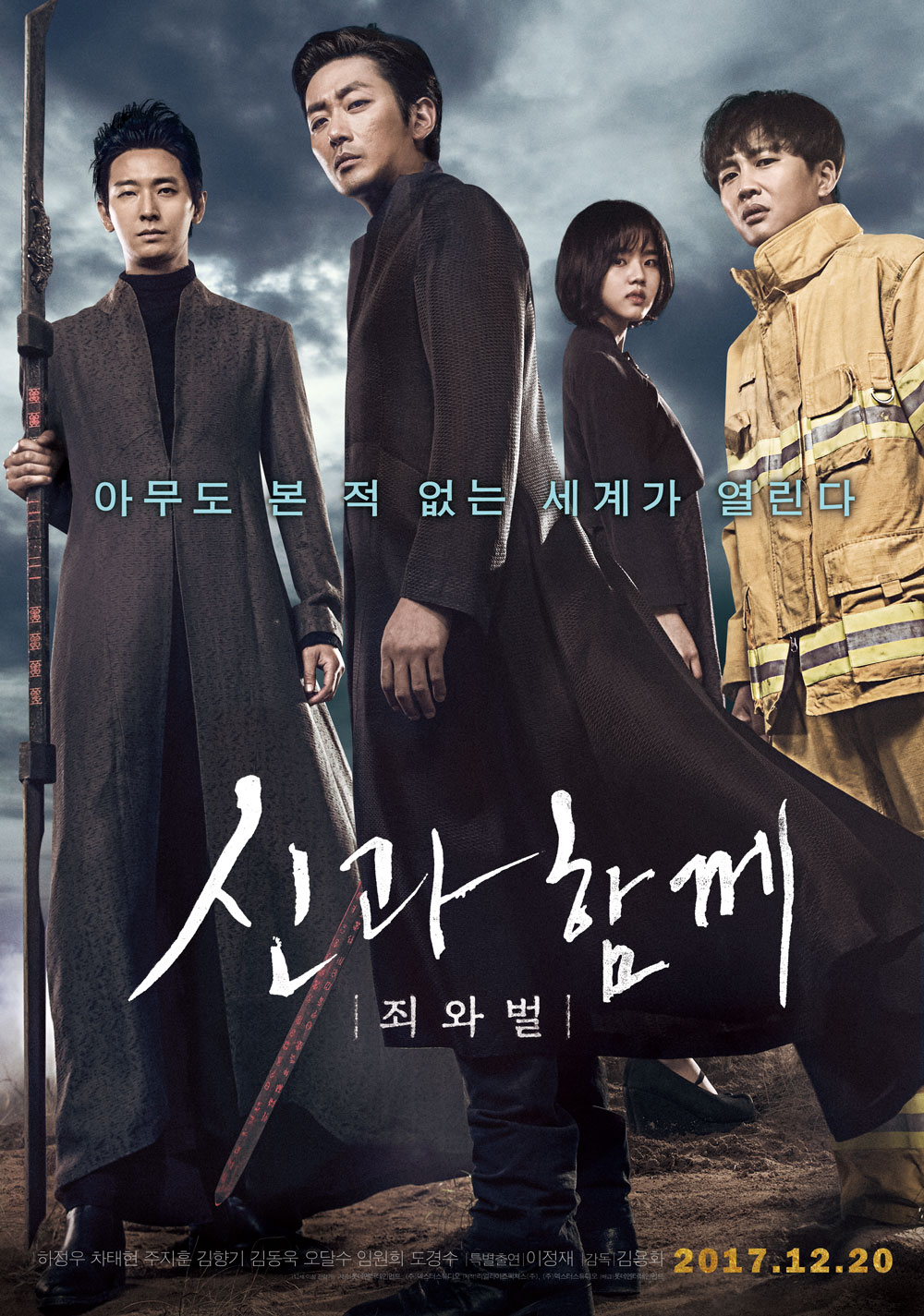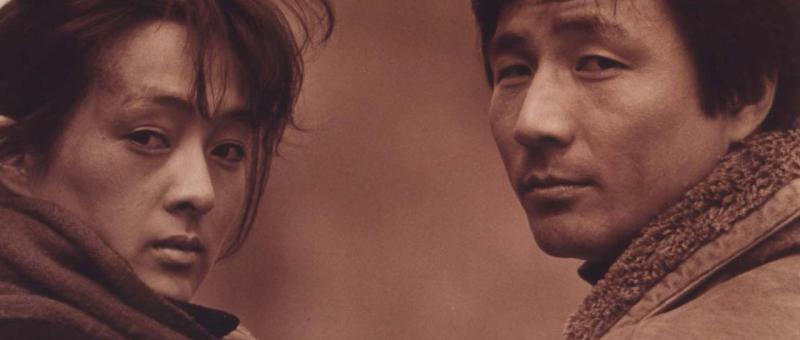
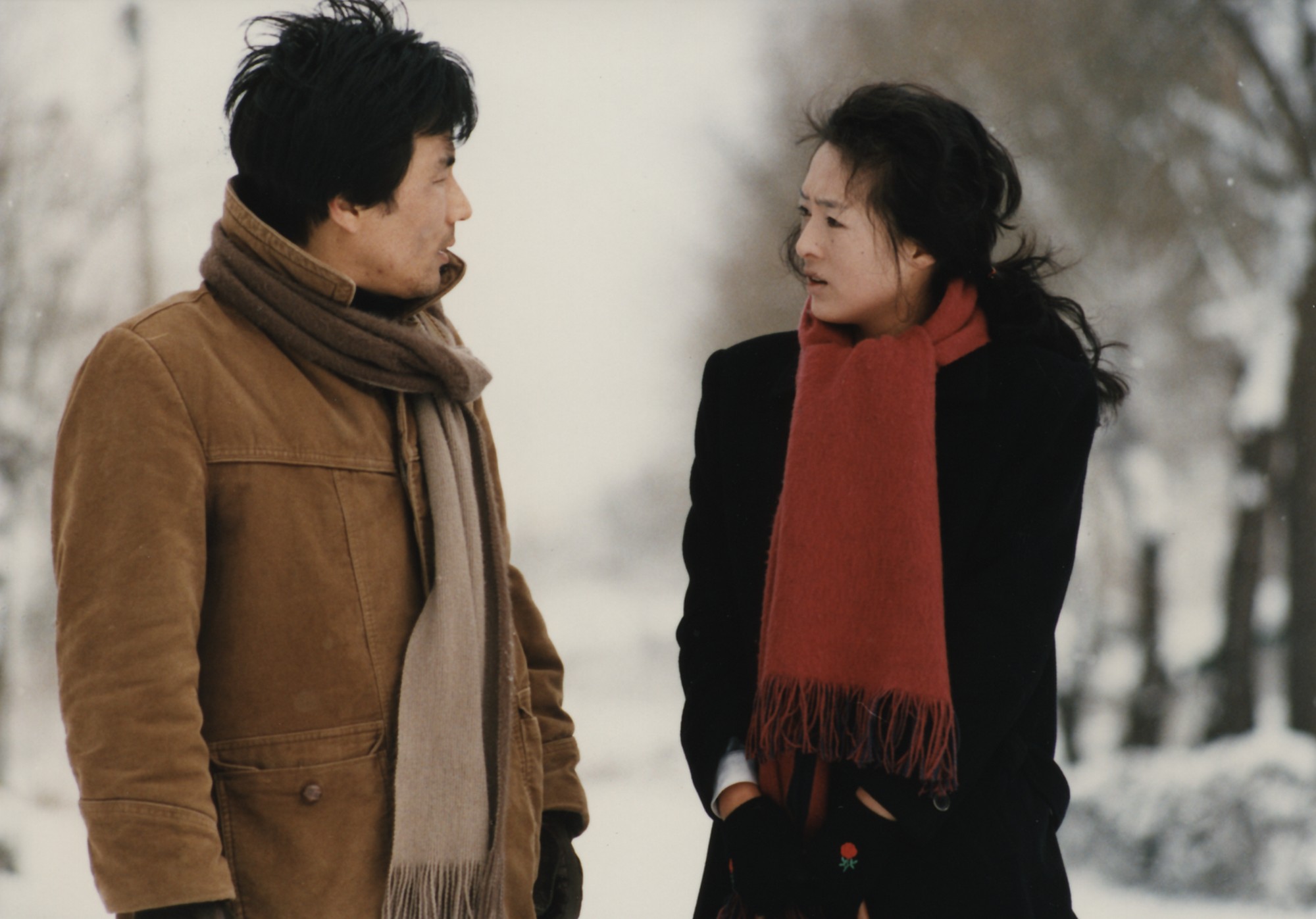
The Man with Three Coffins (나그네는 길에서도 쉬지 않는다, Lee Jang-ho, 1987)

“What a piteous soul who wanders around with sorrow.” The echoes of a funeral song haunt the melancholy hero of Lee Jang-ho’s Division Film, The Man With Three Coffins (나그네는 길에서도 쉬지 않는다, Nageuneneun kileseodo swiji anhneunda). Adapting a novel by Lee Je-ha, Lee Jang-ho positions the divided nation as a more literal kind of limbo filled with wandering ghosts and souls who no longer have a home to return to in which the echoes of shamanism ring with fatalistic intensity.

In Lee’s elliptical screenplay, moments replay and reverberate in a stream of memory that echoes the protagonist’s fractured state of being. What eventually becomes apparent is that he is on a quest to return his wife’s ashes to her hometown, the problem is that she was one of many displaced by the Korean War. She became separated from her parents and no longer knew where her hometown was except somewhere in the North. The man who is being discussed in the opening sequence, Mr Kim, is also on a quest to return to his hometown but like that of Sun-seok’s wife (Lee Bo-hee) it lies in the North and it is unlikely he can reach it. The old man tightly grips a photograph of his family before the war, finally releasing it only when some henchman working for his son who only sees the South as his home come to retrieve him and destroy his hopes of dying in the place where he was born.

During his journey, Sun-seok (Kim Myung-gon) passes a sign which reads “Road to Reunification” but the bridge alongside it has been removed with only the supports remaining like thorns embedded in the landscape. Another sign reads “Restricted Area” marking the line beyond which Sun-seok cannot pass, like the man in the funeral song unable to pass through mountain or water. As he nears his destination, Sun-seok’s paths are blocked by snow preventing him from moving on or from returning to his ordinary life in Seoul. He is in more ways than one a purgatorial figure, a man already dead but trapped in the mortal realm even as the shamans attempt to guide him towards his rightful direction, a direction which Sun-seok may finally realise only on witnessing a woman with whom he may have fallen in love join in with the shamanistic dance though she two had been as soulless as he was and it may be impossible to say which of them is bound for the land of the dead. 

Mrs. Choi (Lee Bo-hee), the only woman given a name, remarks that a shaman had told her that at 30 she would meet a man by a river who was carrying three coffins and that this man was her husband in a previous life. This might explain why all of Sun-seok’s women are played by the same actress, as if they are all echoes of the same soul though equally it could reflect Sun-seok’s myopic view in which there is only ever really one woman. In any case, their connection seems both fated and frustrated because in this divided world there are only ever partings. Unable to reach his destination, Sun-seok scatters his wife’s ashes in the closest town to the DMZ, the same town where Mrs Choi and Mr Kim are also prevented from moving forward though in this case pulled back towards the soulless capitalism of the contemporary South as symbolised by Mr Kim’s son and his political ambitions. 

The implication is that is the division itself which caused the death of Sun-seok’s wife, ultimately unable to reconcile the division within herself and eventually consumed by it. Her death is echoed in that of a sex worker who dies gripping her throat and foaming at the mouth shortly after an encounter with Sun-seok, while a sex worker he meets in another town suffers a similar fate as if he were somehow spreading death along his way bringing him to his three coffins, which are in a way one and also four including perhaps his own. The washed out red of Lee’s distinctive colour palate lends the dusty land a hellish glow while the unusual camera techniques, a copulating couple superimposed on Sun-seok’s playing cards and a giant hand suddenly appearing in the sky for example, add a sense of ominous dread enhanced by the constant intrusions of shamanic ritual. It seems that as the song says, a funeral lament for a boy who disappeared feared drowned but also for Sun-seok himself, he really can’t go anywhere and is condemned to wander, a lost soul in a divided land who cannot any longer return to his home.
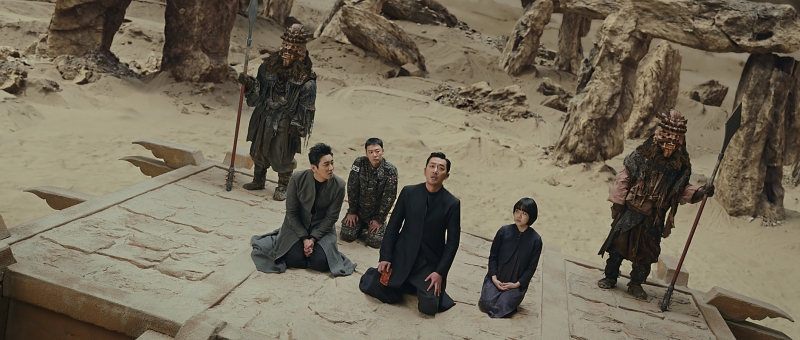
Along With the Gods: The Last 49 Days (신과함께-인과 연,Kim Yong-hwa, 2018)

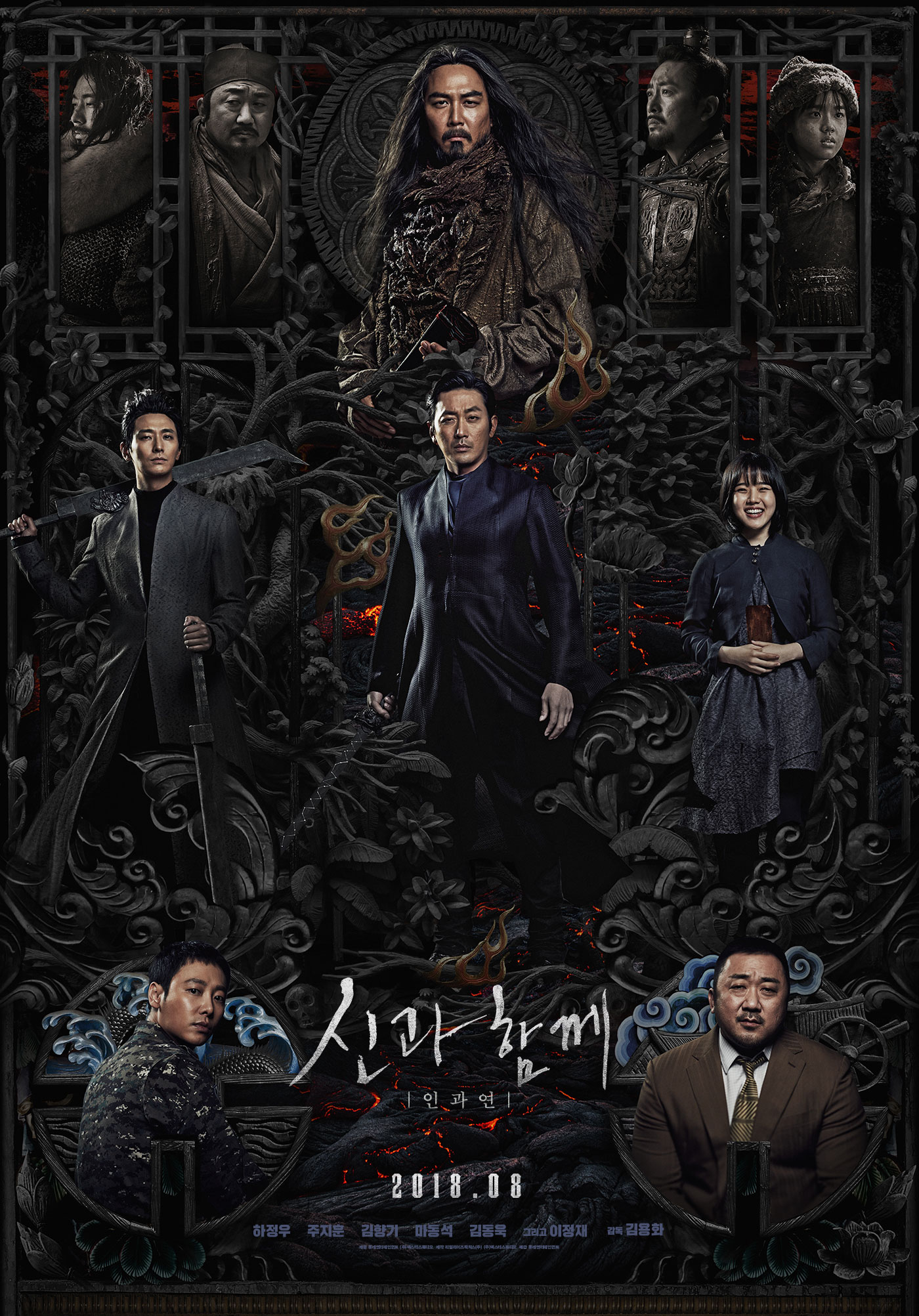
Along with the gods 2 posterKarma is a bitch, and Korean hell is apparently full of it. You don’t have to be guilty to work here, but it certainly seems to help. Picking up straight after the conclusion of the first film, Kim Yong-hwa’s Along with the Gods sequel, The Last 49 Days (신과함께-인과 연, Singwa Hamgge: Ingwa Yeon) sees stern grim reaper/celestial defence lawyer Gang-lim (Ha Jung-woo) make good on his promise to clear the name of a once vengeful spirit now cheerfully deceased, but willingly or otherwise it’s himself he’s putting on trial as the facts of his client’s case veer eerily close to his own. King Yeomra (Lee Jung-jae) is up to his old tricks once again.

Brother of the first film’s “paragon” Ja-hong, Kim Su-hong (Kim Dong-wook) is headed nowhere good – after being accidentally shot by one friend and then buried alive by another to cover it up, Su-hong became a vengeful spirit creating havoc in the mortal and underworlds. Gang-lim, however, is convinced that Su-hong’s death was “wrongful”, that he died as a deliberate act of murder rather than simply by a tragic accident, and commits himself to clearing Su-hong’s name so that he can be reincarnated immediately. He manages to win King Yeomra over, but there is one condition – an old man, Hur Choon-sam (Nam Il-Woo), is an overstayer in the mortal world and should have been “ascended” long ago but his household god, Sung-ju (Ma Dong-Seok), keeps despatching the Guardians to keep the old man safe. If Gang-lim and his assistants Hewonmak (Ju Ji-Hoon) and Deok-choon (Kim Hyang-Gi) can clear Su-hong’s name and ascend Choon-sam within 49 Days King Yeomra will at last set them free and allow them to be reincarnated.

Having dealt so thoroughly with the mechanics of hell in The Two Worlds, Kim expands and deepens his canvas to delve into the lives of our various Guardians. As it turns out Sung-ju was once a Guardian himself and so he knows a thing or two about our two underlings – Hewonmak and Deok-choon, whose memories were wiped when they became employees of King Yeomra. As Sung-ju spins a yarn, it becomes clear that the fates of the three Guardians were closely linked in life and death, bound by a series of traumatic events over a thousand years ago during the Goryeo dynasty.

As in the Two Worlds it all comes down to family. Gang-lim’s memories are fractured and confused, he’s convinced himself he’s a righteous man and wilfully misremembered his death (or at least misrepresented it to his cohorts). Stiff and lacking in compassion, Gang-lim was at odds with his gentle hearted father who, he thought, had found a better son in a boy orphaned by the cruelty of his own troops. These broken familial connections become a karmic circle of resentment and betrayal, enduring across millennia in the knowledge that even to ask for forgiveness may itself be another cruel and selfish act of violence. The circle cannot be closed without cosmic justice, but justice requires process and process requires a victim.

Gang-lim plays a bait and switch, he walks the strangely cheerful Su-hong through the various trials but it’s himself he’s testing, working towards a resolution of his own centuries old burdens of guilt and regret. There are, however, unintended victims in everything and the fate of orphans becomes a persistent theme from the orphaned foster brother Gang-lim feared so much, to those who lost their families in the wars of Goryeo, and a little boy who will be left all alone if Hewonmak and Deok-choon decide to ascend Choon-sam. Choon-sam’s adorable grandson is only young but he’s already been badly let down – his mother sadly passed away, but his father ran up gambling debts and then ran off to the Philippines never to be seen again. He didn’t ask for any of this, but there’s no cosmic justice waiting for him, only “uncle” Sang-ju who has taken the bold step of assuming human form to help the boy and his granddad out while trying to come up with a more permanent solution.

Nevertheless, compassion and forgiveness eventually triumph over the rigid business of the law, finally closing the circle through force of will. Kim doubles down on The Two Worlds’ carefully crafted aesthetic but perhaps indulges himself with a series of random digressions involving psychic dinosaur attacks and lengthy laments about stock market fluctuations and failing investments. Along With the Gods: The Last 49 Days may lack the narrative focus of its predecessor but is undoubtedly lighter in tone and filled with the sense of fun the first film lacked, which is just as well because it seems as if hell is not done with our three Guardians just yet.


Along with the Gods: The Last 49 Days is currently on limited release in UK cinemas.

Original trailer (English subtitles)

Along With the Gods: The Two Worlds (신과함께-죄와 벌, Kim Yong-hwa, 2017)

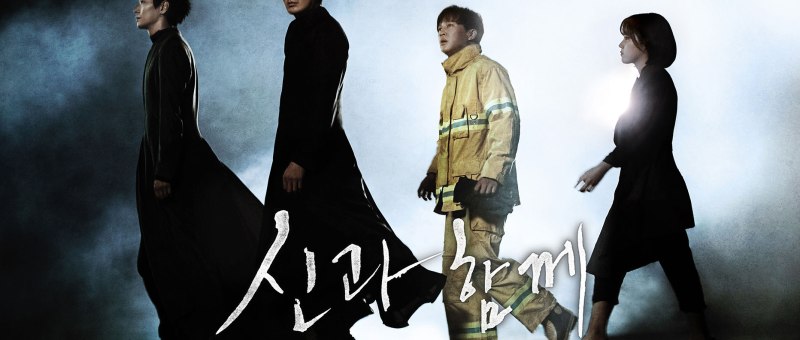
Along With the Gods- The Two Worlds posterThere’s nothing like death to give life perspective. If life is a series of tests, death is the finals but if you pass you get to come back and do it all again, otherwise you’ll have to spend some time in the afterlife thinking hard about what you’ve done and presumably studying for some kind of resits. At least, that’s how it seems to work in the complicated Buddhist hell of Kim Yong-hwa’s fantasy epic Along With the Gods: The Two Worlds (신과함께-죄와 벌, Sin gwa Hamkke – Joe wa Beol). The first in a two part series, The Two Worlds takes a saintly man and tries to pull him down only to build him back up again as a potent symbol of filial piety and wounded selflessness.

Firefighter Kim Ja-hong (Cha Tae-hyun) is killed leaping heroically from a burning building with a little girl wrapped in his arms. He doesn’t realise he’s dead until he’s greeted by two neatly suited, official looking types who explain to him that they are his “Guardians” and will be looking after him on his journey through the afterlife. It turns out that Ja-hong’s heroic death has earned him a “Paragon” badge – a rare occurrence, and he has a good chance of reincarnation before the 49th day if he can successfully pass each of the seven trials which mark passage through Buddhist Hell.

As the Guardians point out, it would be extremely difficult for a “normal” person to pass these seven trials and achieve reincarnation but as a Paragon Ja-hong should have an easier ride. Ja-hong is, however, an ordinary person with an ordinary person’s failings even if his faults are comparatively small. Ja-hong is literally on trial seven times – represented by his team of defence lawyers, the Guardians, he is charged with various sins each “judged” by a god presiding over a custom courtroom. Murder Hell is fiery chaos, indolence is assessed by a stern older lady (Kim Hae-sook), and deceit by (who else) a small child (Kim Soo-ahn) licking a large lollipop.

Ja-hong is indeed a “good person” but he has also been to dark places, wilfully deciding to turn and walk away from them in order to repurpose his rage and resentment into a determination to care for his seriously ill mother (Ye Soo-jung) and younger brother (Kim Dong-wook). Working tirelessly, Ja-hong has been selfless in the extreme, saving lives and saving money for his family whilst sacrificing his own life and prospect of happiness in order to provide for others. That’s not to say, however, that there isn’t a degree of “sin” in the selfishness of Ja-hong’s selflessness or that he hasn’t also been cowardly in making a symbolic recompense for a guilty secret rather than a personal apology.

Kim Yong-hwa weaves in a series of subplots including a lengthy shift into the life of Ja-hong’s brother Su-hong, a possibly gay soldier with an intense attachment to a comrade which eventually has tragic results. Su-hong’s mild resentment towards his brother becomes a key element in his trial, eventually developing into a more literal kind of spectre haunting the proceedings while perhaps creating even more turmoil and confusion in the living world thanks to a moustache twirling villain whose desire to “help” is probably more about saving face – the kind of “betrayal” which is not “beautiful” enough to get a pass from the Goddess.

In the end the court seems to bend towards Ja-hong’s moral philosophy, excusing his human failings through moral justification even when that justification remains flimsy as in the case of his “fake” letters intended to make people feel better through the comfort of lies. The essence of the judgement, however, looks for forgiveness – if a sin is forgiven in the mortal world, it is inadmissible in a celestial court. The message seems clear, face your problems head on and sort out your emotional difficulties properly while there’s time else you’ll end up with “unfinished business” and get bogged down in Buddhist Hell being attacked by fish with teeth and having old ladies asking you why you spent so much time watching movies about death rather than living life to the fullest.

Ambitious in its use of CGI, Along With the Gods: The Two Worlds acquits itself well enough in its carefully drawn (if lifeless) backgrounds and frequent flights of fancy which allow Ha Jung-woo’s enigmatic Gang-lim ample opportunity to whip out his fiery sword of justice. Narratively, however, it’s comparatively clumsy and content to revel in the melodrama of its tearjerking premise. A post-credits teaser linking part one and part two through the recurring figure of an old man who can see the Guardians presents a familiar face in an extremely unfamiliar light and hints at a great deal of fun to be had next time around – appropriate enough for a film about reincarnation, but then again it’s as well to have some fun in this life too, something The Two Worlds could have used a little more of.


Currently on limited UK cinema release courtesy of China Lion.

Original trailer (English subtitles)