The Fort of Death (五人の賞金稼ぎ, Eiichi Kudo, 1969)

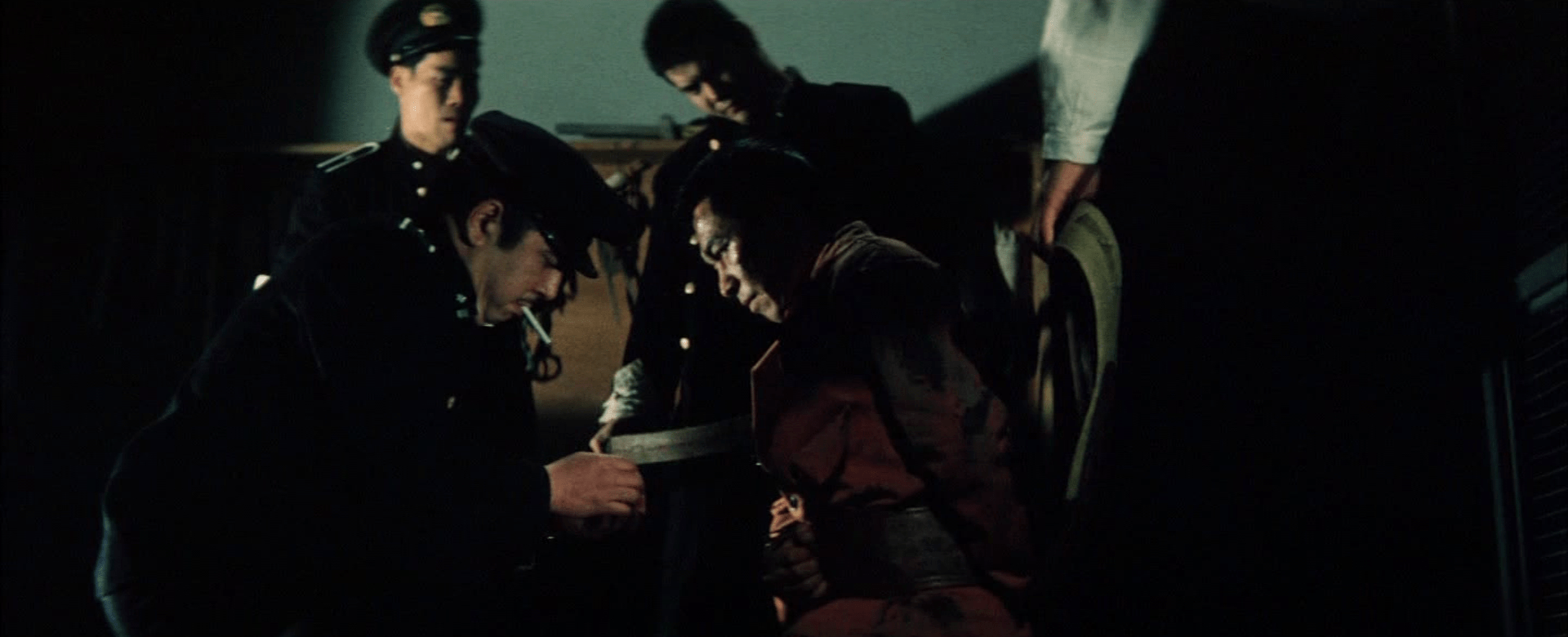
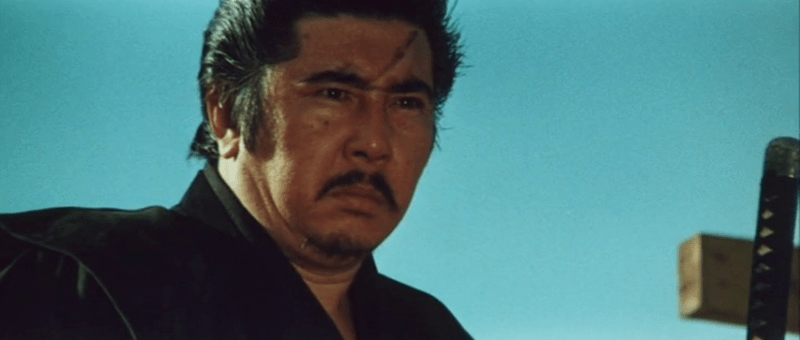
Shikoro Ichibei (Tomisaburo Wakayama) returns yet this time seemingly on the opposite side in the second in the Bounty Hunter series, The Fort of Death (五人の賞金稼ぎ, Gonin no Shokin Kasegi) this time directed by Eiichi Kudo. If the first film had been an Edo-era take on James Bond, the second is very much Spaghetti Western and feudal tragedy as Ichibei finds himself coming to, if not quite the rescue of the oppressed farmers, then at least moral support in taking stand against corrupt and self-interested lords.

This might be surprising in that in the first film Ichibei had been a shogunate spy and seemingly close friend of the man himself, yet this time around he’s working as a doctor while taking bounty hunter jobs to earn extra money to support the poor people who come to him for help. Like a true western hero, he has a small posse which includes the ninja lady, Kagero (Tomoko Mayama), from the first film only she’s being played by the actress who previously starred as his other love interest. In any case, he’s approached by a young man from a small village which is making a last-ditch appeal to the local lord to lower their tax burdens so they don’t all starve, though so far the lord’s response has been to add additional taxes and kill people for not paying them. 

On his arrival, Ichibei soon realises that the man who recommended him was actually the leader of the government forces during a previous peasant uprising at which Ichibei had also tried to help the farmers. In that case, Bessho (Shin Tokudaiji) had won, but it didn’t do him any good. His clan was dissolved and he became a wanderer, taken in by the village and now indebted to them, hoping Ichibei can help but fully aware of the brutality with which such challenges to the feudal order are put down. 

The lord later suggests it’s not really his fault. He has to curry favour with Edo to protect the domain, which is why he agreed to participate in a construction project that led him to confiscate all of his farmers’ rice and wheat. But then it’s also true that he is vain, and cruel. On realising the village has hired a man like Ichibei, some of the retainers suggest reopening negotiations but others complain that they must now crush the farmers or face ruin themselves while trying to ensure the strife in their domain does not come to the attention of the government in Edo. 

Part of their problem is that Ichibei simply has better technology in the form of gatling guns. Tying into the western themes, Ichibei is well versed in the use of firearms, while the samurai are mostly reliant on traditional weaponry such as arrows and swords. The lord later insists on using some canons, but is oblivious to the risk as the shogun has banned the use of gunpowder and using them may end up bringing him to his attention and thereby landing him in a lot of possible fatal trouble. 

In any case, it’s the villagers who suffer. Ichibei encounters a woman who has lost her mind, refusing to give up her baby who has died of malnutrition while her husband was executed for non payment of taxes. Meanwhile, some of the other ronin they hired attempt to rape a villager, and a young couple are prevented from marrying because the headman is worried that it would send the wrong message in a time so much strife. Then again, a woman basically attempts to rape Ichibei, descending on him while he’s still asleep which otherwise leads into a fairly comic sequence in which Ichibei must fight of a bunch of ninjas intent on stealing the gatling gun while dressed only his underwear.

Darkly comic it may be, but also surprisingly violent with a ninja at one point using a dead body as a Molotov cocktail not to mention the severed heads and limbs of the battle scenes. Ichibei is fully aware that the battle is a forlorn hope, but also that the villagers have no choice and perhaps this is better for them than simply accepting their fate and starving to death. Even so, he reserves his final words for the Edo inspector who arrives only when the battle is done to survey the scene, berating him that he ought to know what happened here from looking at the battlefield and deducing that this domain has not been run particularly well. It’s a tragedy of feudalism that provokes a tearful rage from the compassionate bounty hunter trying his best to heal the sickness in his society, though perhaps like the patient who visits him with a venereal complaint concluding the best solution is to cut it right off.

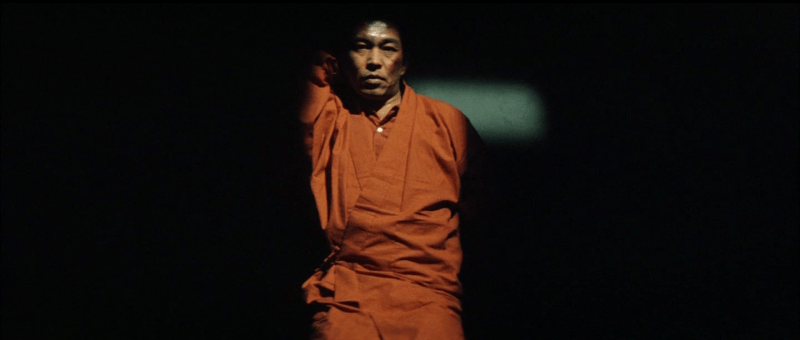
Wicked Priest 4: The Killer Priest Comes Back (極悪坊主 念仏三段斬り, Takashi Harada, 1970)

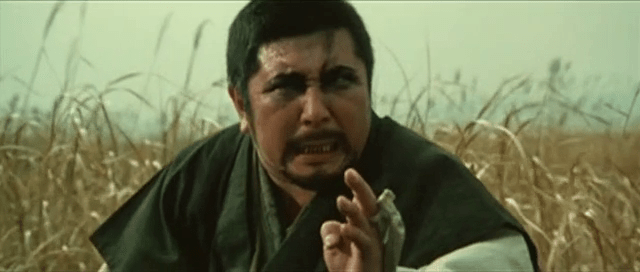
At the heart of the Wicked Priest series is an idea of rootlessness, the wandering monk Shinkai (Tomisaburo Wakayama), an orphan, often finding himself dragged into familial disputes between fathers and sons for one reason or another often estranged from each other. The aptly named Wicked Priest 4: The Killer Priest Comes Back (極悪坊主 念仏三段斬り, Gokuaku Bozu: Nenbutsu Sandangiri) finds Shinkai returning to his hometown after reencountering a childhood friend who’s found himself on the wrong side of a historical divide.

When Shinkai and Takegoro (Ichiro Nakatani) left their childhood village, they swore to become the best priest and mountain owner in Japan respectively but that obviously hasn’t worked too well for either of them. Takegoro evidently joined the wrong side during Bakumatsu chaos, a fact rammed home when his attempt to use currency issued by a feudal lord is rebuffed in a gambling den whose owner reminds him that it is now worthless. Only official currency issued by the central government is considered legal tender. On top of all that, it seems Takegoro might also have been cheating which signals just how far he has fallen. Running into him by chance, Shinkai ends up saving the day while accidentally humiliating a chastened Takegoro who is given a further dressing down by the old school lady yakuza boss Kuroda (Chieko Naniwa), also known as “the Thunder Woman”, who appears to be in charge, shooting off his little finger as an attempt to save face. 

In any case, the encounter has Shinkai feeling nostalgic and he decides to return to his hometown to hold a proper memorial service for his late mother. Only once there he ends up being drawn into another cycle of local corruption on discovering that the river workers are being exploited by rival yakuza groups who are working them to exhaustion and paying almost nothing. The leader of the Gondawara is quite obviously up to no good as he wears a western suit and has a handlebar moustache, quite clearly an amoral capitalist while his rival Ryuo (Eizo Kitamura) is a violent thug in ominous sunshades. In actuality, however, they are both branches of the yakuza syndicate led by Kuroda who is of the old school and doesn’t approve of their exploitative mindset. Just as she had Takegoro, she gives both men a good telling off reminding them that the river workers are essential for providing a steady supply of coal without which the new industrial economy will flounder. 

It’s also true that this same industry is fuelling militarisation and an eventual eye towards expanding imperialism, but Kuroda does seem to be mainly mindful of the workers welfare immediately insisting they should be paid a fair wage which is five times more than they’re currently getting. Ryuo and Godawara superficially agree but intend on simply exploiting their workers differently by demanding five times as much work for five times as much pay in a fifth of the time. Shinkai does his best to defend the rights of the local people, but is faced with a dilemma on realising that Takegoro is member of Godawara and hellbent on killing him having become cynical and desperate, willing to sell out a childhood friend for a few pennies. 

Part of Shinkai’s mission is winning Takegoro back over the side of right while reuniting him with his mother whom he’d been too ashamed to visit. On the other hand, this is perhaps the first time Shinkai shows a darker side to himself on threatening to rape a lascivious nun who tricked him into a martial arts contest while rebuffing his amorous intentions. He’s also still being pursued by Ryotatsu (Bunta Sugawara) and ironically ends up temporarily losing his sight himself but just as always Ryotatsu decides to come to his rescue mostly because it would be very annoying if someone else killed him first before he’s got his revenge. He also agrees to wait for Shinkai to finish his mother’s memorial service before scheduling their death match, the most patient revenger in jidaigeki history. In any case, it all ends with another massive showdown as a wounded Shinkai purifies the town of corrupt yakuza and liberates the river workers while finally getting to honour his late mother’s memory leaving Ryotatsu to make his exit deciding that vengeance can wait until the mourning’s over.


Eighteen Years in Prison (懲役十八年, Tai Kato, 1967)

Genre star Noburu Ando had a certain cachet in that he had been a yakuza prior to becoming an actor. He had in fact been the head of his own gang which at its high point had over 300 members and controlled much of the lucrative Shibuya nightlife scene. His first onscreen appearance was in a gangster movie in which he played himself. Rather than the jitsuroku epics he would later become associated with, Tai Kato’s Eighteen Years in Prison (懲役十八年, Choueki Juhachi Nen) essentially casts him in a ninkyo role as a noble if compromised former captain of the kamikaze squad who finds himself caught between the contradictions of post-war Japan and the American occupation. 

Indeed, in this as in many other yakuza movies set during the immediate post-war era, the Americans are really just the biggest gang. Suffering with survivor’s guilt, Captain Kawada (Noboru Ando) has set up an association together with former comrade Tsukada (Asao Koike) to look after he dependent relatives of men who fell in war. To do this, he has to resort to criminality raiding American boats for supplies such as sugar and rice which he redistributes to war widows and their families. His ultimate goal is amassing enough money to buy a patch of land in the town centre and do away with the black market which exploits the vulnerable replacing it with a legitimate market so the surviving family members can set up businesses to support themselves. 

Around this time, the association manages to track down the younger sister of one of their men who died as a kamikaze, Hisako (Hiroko Sakuramachi ), and discovers she is living in desperation having lost the family home to aerial bombing. As her mother is seriously ill and she needs money for food and medical treatment, Hisako contemplates turning to sex work and is almost assaulted by a gang of drunk and abusive American servicemen from whom she is rescued by a passing Kawada. This incident makes plain his resentment towards the occupation and sense that it is the American influence that is wilfully suppressing the efforts of the Japanese people to rebuild their society. It’s this resentment that lends a note of justification to Kawada’s decision to rob a nearby factory of valuable copper wire to get the money to save Hisako’s mother thereby saving her from falling into sex work and thereafter helping to achieve their ultimate goal of building the market. The raid, however, goes wrong. Kawada sends an injured Tsukada back to the association and is arrested.

In prison he discovers only more corrupt authority in which guards beat and torture prisoners, just another bigger gang. He finds out that block warden Hanya (Tomisaburo Wakayama) is actively accepting bribes and in cahoots with some of the inmates that attempt to terrorise newbies to the point that one attempts suicide by swallowing glass though Hanya refuses to call for help forcing Kawada and some of the other men to pull the alarm themselves. The sources of moral authority lie in the new college-educated deputy warden recently returned from five years as a POW in Manila, and a veteran yakuza with a grudge against Hanya who apparently had his girlfriend raped leading to her suicide. 

Though the film is titled eighteen years in prison, Kawada becomes eligible for parole in 1952 which is of course the year the occupation ends. By this point he discovers that Tsukada has abandoned their idealistic mission and turned full yakuza, building an immense red-light district on the land they bought for the market and making himself rich through the violent trafficking and exploitation of women. Eventually confronted, he tries to convince Kawada that the world has changed, that the post-war years of privation are over and that he sees only “the ghost of a nation that lost the war” rather than burgeoning new economy stimulated by the Korean War and an ironically a repositioned America now no longer occupiers but still somehow influential if leaving a vacuum a man like Tsukada may step into. It’s no coincidence that he threatens Hisako with deportation to a brothel in Okinawa he’s set up to service American servicemen in a place where the conditions of occupation are still largely in place. 

Tsukada clearly feels that he need have no more responsibility for his wartime conduct, roundly telling Kawada that the families of the fallen are not his responsibility and should “stop leeching off other people and start working for a living”. Hisako’s long lost younger brother Kenichi (Masaomi Kondo) who ended up alone on the streets after being conscripted as a student factory worker and returning to find his home in ashes, turns the blame back on the authorities reminding them that it’s their fault, they started the war the cost him his home and family and turned him into the half-crazed man of violence who immediately introduces himself as “King” on moving up from a juvie prison. Much of Kawada’s prison life is then given over to saving Kenichi, a representative of the next generation, from becoming mired in a life of nihilistic crime. 

In many ways, he remains a squad leader trying to atone for having sent so many young men to die by accepting the responsibility for their families while trying to protect those left behind from the vagaries of the post-war era including the amoral capitalism represented by the infinitely corrupt Tsukada. Dressed in a military uniform ironically pinched from an American soldier he goes on the rampage knowing that he has to deal with Tsukada himself in order to defend the post-war future from those like him who’ve apparently learned nothing much at all even from such recent history. Shooting from his characteristically low angles, Kato explores the seedy underbelly of the beginnings of the economic miracle while his noble hero does his best to offer a course correction to those who have already forgotten their responsibility not just to others but to those they left behind.


Road Warriors (あやめ笠 喧嘩街道, Tai Kato, 1960)

A penniless wanderer finds himself mixed up in chaos and conspiracy after deciding to help a lady travelling alone for the purposes of revenge in Tai Kato’s Toei chanbara, Road Warriors (あやめ笠 喧嘩街道, Ayame Kasa: Kenka Kaido). Truth be told, the hero isn’t much of a warrior at all and wisely prefers to avoid a fight if possible but is prepared to put his sword where his mouth is when the occasion calls. Still the conspiracy in this instance is small scale and incredibly petty as a trio of ambitious retainers attempt to frame their one time bodyguard for the murder of a lord.

Before all that, however, Gantaro (Ryuji Shinagawa) is as he’s fond of introducing himself a penniless traveller who makes his ends meet through gambling. In debt to local boss Hidegoro (Ushio Akashi) he agrees to act as an intermediary in a dispute with the greedy Onizo (Eijiro Yanagi) who has usurped some of their territory. Gantaro suggests they settle the matter through gambling but is then challenged to combat by the gang’s bodyguard, Akiyama (Shin Tokudaiji). The young man looks noticeably afraid, sweating at the temples and gripping his sword at an unusual angle, but holds his own in the fight until Onizo tries to cheat by sending in one of his minions to finish him off. Noticing what’s happening, Akiyama proves his nobility by ending the fight and accepting defeat. Onizo appears cheerful and even asks Gantaro to join his gang, but seconds after the young man leaves he sends his guys out after him and evidently has no intention of enforcing a truce with Hidegoro.

Meanwhile, Gantaro runs into a melancholy samurai woman, Miyuki (Kyoko Aoyama), chasing after a thief who has stolen something from her far more precious than money. Discovering the thief has robbed him too, Gantaro springs into action and soon discovers that Miyuki is on a quest for revenge against the man who killed her father but that she’s been betrayed by her three retainers and has managed to ditch them to proceed alone. Unsprisingly, the prime suspect appears to be Akiyama but as stabbing a man in the back and running away don’t seem to fit with the noble character he displayed in the fight, Gantaro has an idea that something’s not quite right. 

Of course, he also begins to fall for Miyuki despite the obvious affection held for him by Hidegoro’s daughter Omitsu (Hiromi Hanazono) which he otherwise seems keen to escape. It’s reasonable to assume that loveable rogue Gantaro is the love them and leave them type, though his love for a samurai’s daughter is always going to be an impossibility no matter how much she may come to admire him. Even so, the conspiracy angle along with Onizo’s smug and overbearing duplicity do begin to awaken his sense of justice especially while travelling with an incredibly cynical thief who will sell anything or anyone in search of a quick buck. Even he however eventually comes around to the idea of helping Miyuki get away from her retainers and enact her revenge especially after overhearing the truth while cowering behind some barrels. 

It may be an overly familiar chanbara tale if one enlivened by Gantaro’s wisecracking antics, but Kato brings to it his characteristic sense of uncertainty in the potent mists that seem to surround Gantaro and Miyuki as they travel the mountain paths in search their enemy. Then again, there are shades of unexpected darkness not least in the implication that Gantaro was about to rape Miyuki before she fainted and brought him back to his senses. Nevertheless, her retainers may tell her that she has “no choice” but to obey them, but Gantaro seems to feel differently if abruptly giving up his intention of protecting her on learning that she has someone else in her heart. This is indeed a harsh world for women samurai and otherwise, a mother and daughter are saved by Akiyama after being harassed by Onizo when he annexes the local market while both Miyuki and Omitsu are left to finish their father’s unfinished business in the wake of their untimely deaths. Notably, it is indeed they who finally strike the final blow to eliminate the corruption which surrounds them. Penniless wanderer Gantaro doesn’t have it that easy either, gambling his life away and ending up with debts both financial and moral that may have dangerous consequences while often beset by cynicism even if latterly deciding to help those in need for no reward. In any case, like any good wanderer all he can do is smile and wave as he departs for the next adventure on the violent streets of the Edo-era society.


The Phantom Goblin (まぼろし天狗, Nobuo Nakagawa, 1962)

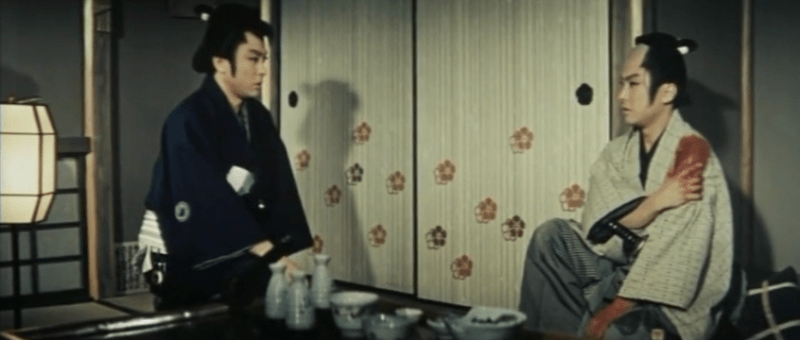
“Everything is money these days” as a pirate king cheerfully proclaims in Nobuo Nakagawa’s tale of Edo-era corruption, Phantom Goblin (まぼろし天狗, Maboroshi Tengu). Perhaps named to capitalise on Nakagawa’s reputation for spookiness, Phantom Goblin features no real ghosts and only metaphorical goblins in the bright red tengu masks sported by the hero’s mysterious clan while otherwise conforming to the Toei programmer house style and starring jidaigeki superstar Hashizo Okawa in a double role as brothers separated at birth and reunited by their resistance towards the inherently corrupt authority of Edo society. 

Drawing parallels with the present day, the film opens at a bawdy banquet at which corrupt councillor Tanuma (Isao Yamagata) is being entertained by a pair of local social climbers with a floor show of dancing girls. Shortly after the performance begins, however, one of the women collapses writhing in agony and loudly crying out for drugs. Embarrassed, the lords would rather this not get out deciding to finish the woman off and dump her body in a nearby well. Unfortunately for them, the plan is interrupted by local policeman Shuma Moriya (Hashizo Okawa) who arrives in time to hear the woman exclaim the words “drugs” and “mastermind” before she passes away. Determined to figure out the truth, Moriya heads to the not so secret hideout of a local gang but is shot in the arm and has to take refuge in an inn where he encounters a man who looks just like himself, Kyonosuke Asakawa (also Hashizo Okawa) of the Goblin clan, who eventually sends him to his estate to recover and assumes his position as policeman in order to root out the truth. 

A former hatamoto who apparently resigned his position after finding himself unable to support corrupt lords, Kyonosuke declares himself “frustrated with how things are run”, realising that the system is rotten beyond repair on hearing that Moriya has been fired by a corrupt magistrate apparently in league with the conspirators. While comparatively rare in Edo-era dramas, drugs are a controversial subject in any age but in keeping with the sensibilities of the early ‘60s Phantom Goblin eventually slips into the Sinophobia then rampant in contemporary crime dramas as it becomes clear the drugs trade in the feudal economy is being driven by Chinese pirates trafficking it in from overseas while weak willed lords enable their rise to power. 

There is however a touch of conservatism in Kyonosuke’s desire to see justice served in that he fears a world in which “if you can buy power and position with money, then one day we will have a chief counsellor who is a pirate”. While he’s undoubtedly got a point, it’s also true that he is in a sense protecting his own privilege conveyed by birth rather than worth in addition to rejecting the influence of the “foreign” as he raises his sword against a Chinese pirate in order to target the corrupt lords who’ve been collaborating with him in order to bolster their own power and position. Kyonosuke wanted to “clean out evil in Edo”, but eventually succeeds rather ironically in simply becoming a part of the system himself after having supposedly cleaned it out by getting rid of the “obviously” corrupt elites. 

Recovering from his shoulder injury and flirting with the adopted sister of Kyonosuke, Moriya is largely relegated to a secondary role though the secret brotherhood of the two never develops into much of a plot point even as they bond as men too honest for the world in which they live. Nor do the respective romantic dilemmas ever materialise even as the conflicted figure of a female bandit in love with the noble policeman is forced to pay for her crimes with her life, unable to progress into the purified world the brothers are about to create. Working in the Toei house style, Nakagawa abandons his taste for the strange or otherworldly contenting himself only with a few ironic tengu masks and the literal shadows surrounding the shady mastermind while indulging in genre staples such as the comic relief provided by Kyonosuke’s bumbling retainers and the double casting of Hashizo Okawa as two brothers alike in both appearance and sensibility who find themselves unable to accept the increasing corruption of their society and determine to oppose it.