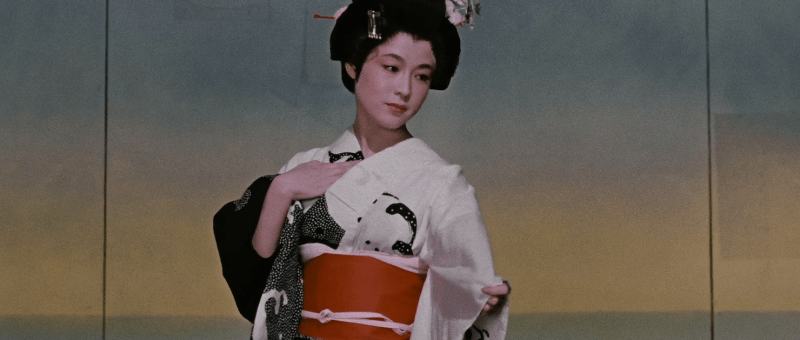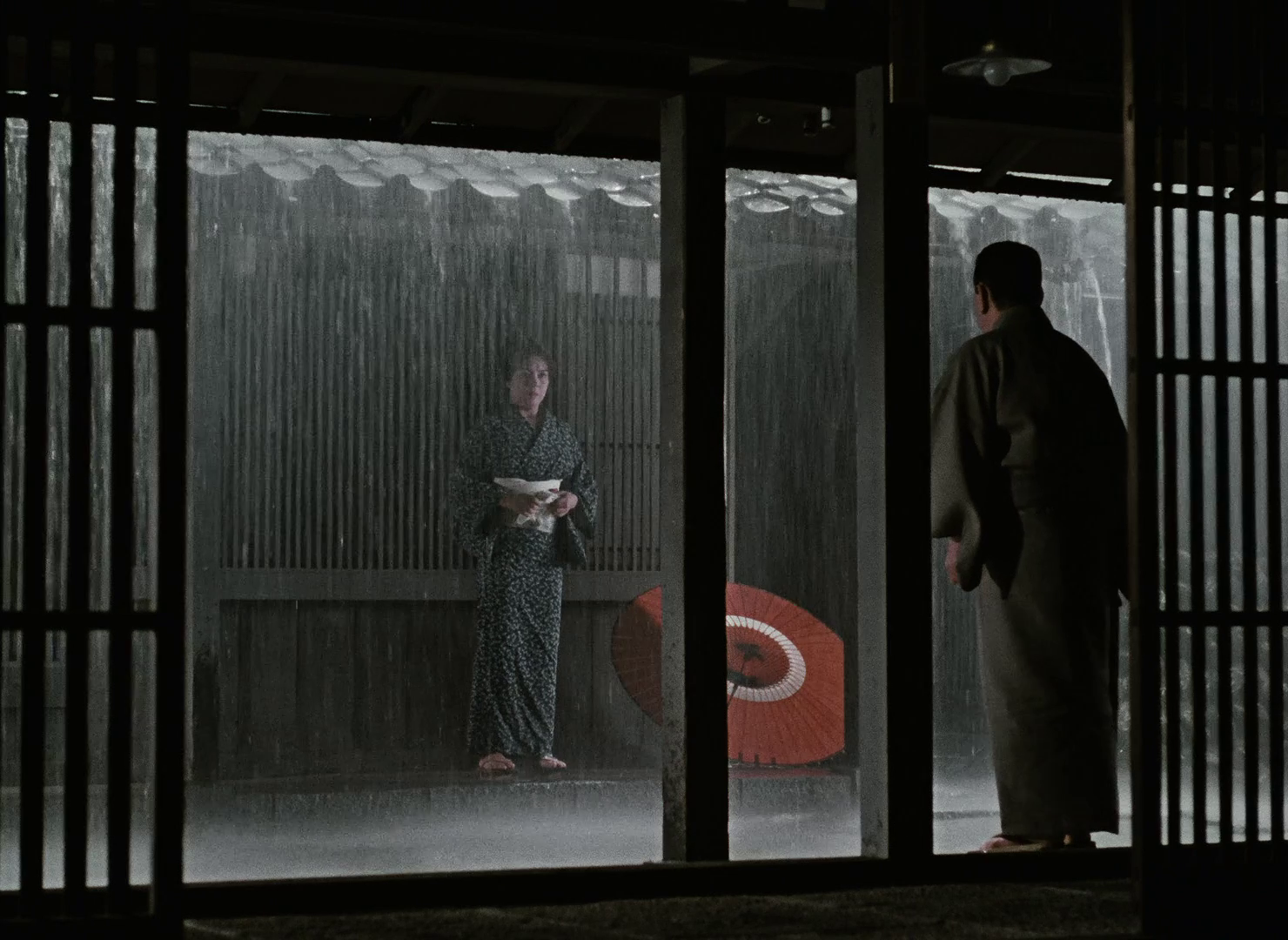
Floating Weeds (浮草, Yasujiro Ozu, 1959)

An oft-repeated criticism of the work of Yasujiro Ozu is that it is all the same. The similarity of the English-language titles with their ubiquitous seasonality doesn’t help, but you have to admit there is some truth in it. On closer inspection, however, it becomes clear that Ozu was not so interested in uniformity or repetition as he was in dialogue with himself. Thus Late Spring becomes Late Autumn and the abandoned father a conflicted mother, the two boys of I Was Born But… who rejected their father’s descent into corporate lackydom become arch consumerists seceding from society until their parents give them a TV set in Good Morning. Ozu refrained from remarking on the repurposing of old plots for new dramas, but did expressly regard his 1959 Floating Weeds as a “remake” of the 1934 A Story of Floating Weeds updated to the present day and filmed in the, by then, classic Ozu style. 

As in the 1934 version, the action centres on the arrival of a theatrical troupe to a small town which they have not visited in some years, in this case 12. This time around, the troupe is a little more exulted, performing kabuki-style narrative theatre rather than rustic entertainment, but is subject to many of the same problems. Kihachi is now Komajuro (Ganjiro Nakamura), a much older man though cheerful and energetic. He has chosen this town because it is home to an old flame, Oyoshi (Haruko Sugimura), who is the mother of his adolescent son, Kiyoshi (Hiroshi Kawaguchi). Kiyoshi thinks that Komajuro is his mother’s brother and that his father is long dead. He recognises Komajuro right away and is pleased to see him, though they evidently have not met in many years. 

The 1934 version had revolved around Kihachi’s corrupted paternity in his shame regarding the stigma of being a travelling player. By 1959 that is simply no longer so much of an issue, but whereas the financial difficulties Kihachi’s troupe faced were partly a symptom of the depression and partly of their misfortunes, those of Komajuro take on a more melancholy quality because it is obvious that this is a way of life which is coming to an end. When Kihachi says he’s going to start over, it seems futile but he is still young enough to have a credible chance. Komajuro is already “old” and it’s clear that he will struggle to support himself as a travelling actor simply because it is no longer a viable occupation. 

Thus Komajuro’s story is less one of frustrated fatherhood than of melancholy resignation to the vagaries of a lifetime. “Life is an unknown course”, he tells Oyoshi, “the only constant is change”. Like Kihachi he doesn’t want his son to see the show, though perhaps more out of embarrassment. Kiyoshi complains that the character in his play is “unrealistic” because he doesn’t relate to the modern world. Komajuro objects but explains that he is “a character from another era”, making it plain that he is talking as much about himself. Komajuro is a man left behind by time and incapable of understanding the world in which he now lives which may be one reason he seems to hang on to an intense desire to save Kiyoshi from being affected by the stigma of being the son of a travelling actor even though that is no longer something he would need saving from. 

This slight disconnect, along with Gajiro Nakamura’s cheekily comical performance, adds to the genial comedy which characterised the majority of Ozu’s colour films though this one is admittedly slightly less colourful owing to being produced by Daiei as one of a handful of films made outside Ozu’s home studio of Shochiku. Komajuro becomes a tragicomic rather than purely tragic figure, a man suddenly realising he has become old and facing the decline of his patriarchal authority. Like Kihachi he turns violence on both his mistress, Sumiko (Machiko Kyo), and the young actress Kayo (Ayako Wakao) who has fallen for his son, but it’s futile and born of desperation. A more sympathetic figure than 1934’s Otaka, Sumiko seems to genuinely like Komajuro and is hurt as well as jealous and threatened by the existence of his “secret” family. Her petty revenge is taken in response to Komajuro’s bitter claim that his son “belongs to a higher race” moments after bringing up her past as a sex worker. Rather than a simple desire for chaos and upset, she intends to pull Kiyoshi down to her level through getting him to sleep with Kayo, but Kayo falls for him for real only to worry she is perhaps ruining his bright future. 

“One can’t suddenly show up out of nowhere and assert one’s parental authority,” Komajuro eventually realises. His hopes are dashed by Kiyoshi’s relationship with Kayo not because of her proximity to the world of the travelling actor, but because he fears it means that Kiyoshi is just like him, an irresponsible womaniser. He wanted to save Kiyoshi as a means of saving himself, pushing his son into a more respectable world he had been unable to enter. Kiyoshi, however, rejects his sacrifice, describing his parents as “selfish” for keeping the secret all this time only to drop a bombshell now. He complains he’s been fine these 20 years and does not want or need a father beyond the one he already thought to be dead. Rather than the nobility Komajuro’s of paternal sacrifice, the focus is pulled back towards the son and his filial responsibility to live up to it by becoming a fine and upstanding young man while Komajuro is once again exiled back to the moribund world of the travelling actor. 

Of course, the world of 1959 was very different to that of 1934. The economy was at last improving and consumerist pleasures were very much on the horizon, meaning that for many life was comfortable at last. Japan was at peace if not completely free of political strife which removes the constant anxiety felt by those trying to survive the mid-1930s. But Ozu himself was also 25 years older and had perhaps reached that sense of resignation with the world that allowed him to sigh and laugh where before he may have trembled with fear or rage. Komajuro is as he always was, a floating weed, a man without a home, but now perhaps one of many rootless wanderers off the post-war landscape.


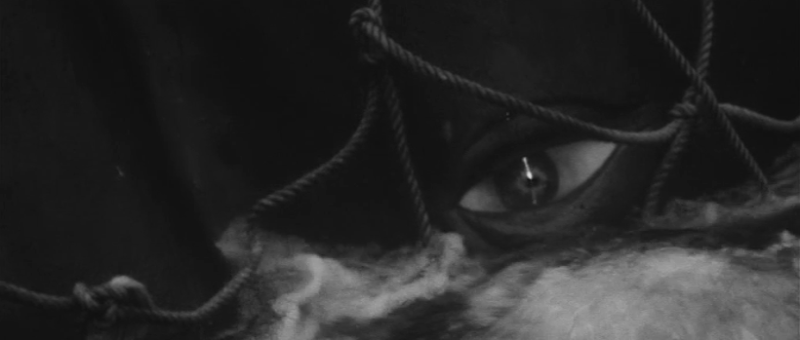
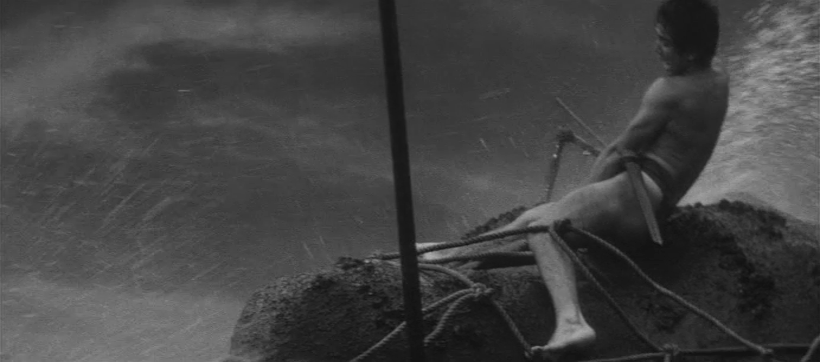
The Whale God (鯨神, Tokuzo Tanaka, 1962)

“You’re all mad” the hero of Tokuzo Tanaka’s The Whale God (鯨神, Kujiragami) finally exclaims, perhaps in a sense cured of the overwhelming mania that has defined his life but only at the cost of it. Adapted from the Akutagawa Prize-winning novel by Koichiro Uno which owes a significant debt to Moby Dick, Tanaka’s tokusatsu-adjacent drama is part haunting morality tale cautioning against the destructive absurdity of obsessive vengeance, and a kind of treatise on life in traditional village at a moment of eclipse as the burgeoning modernity of early Meiji washes up on its shores. 

Tanaka opens with a brief prologue in which an elderly man is killed attempting to destroy the “Whale God” only for his son to swear vengeance before being killed himself. The man’s mother instructs his sons to vow revenge, 10 years passing before she sends the oldest one out against the whale. He is also killed, instantly. The last of his line, young Shaki (Kojiro Hongo) is burdened with this piece of filial responsibility, forced to bear the weight of his family’s vengeance while the village elder (Takashi Shimura), a samurai, wants to ensure the Whale God’s destruction and offers up his own daughter, Toyo (Kyoko Enami), along with his lands and title to any who can bring him the snout of the whale. Shaki throws himself forward though he has little desire for the prize obsessed only with vengeance, while another challenger soon appears, Kishu (Shintaro Katsu), a uncouth drifter deciding to hang around after confirming that the offer is open to all no matter their origins. 

Origins do, however, matter. The village elder instructs Kishu to step back lest he spear his “stinking guts” for failing to know his place, a commoner with the temerity to encroach on a samurai’s personal space. The two men, Shaki and Kishu, in a sense represent two halves one whole, one resigned and contemplative and the other rough and greedy. Kishu attempts to challenge Shaki directly but is rebuffed, later settling for besting him through raping his girlfriend, Ei (Shiho Fujimura), who conceives a child as a consequence of the attack but somehow manages to keep the pregnancy entirely secret. Both the woman and the whale become a surrogate battleground for a contest of masculinity, Kishu symbolically ahead in having violated Ei while Shaki remained too consumed with vengeance to have consummated their union. 

Toyo, meanwhile, the samurai’s daughter, insists that she won’t be “the prize for a fisherman’s ambition”, rejecting the idea of becoming the wife of a lowly villager which would of course mean for her great shame. Nevertheless, she is as powerless as Shaki in her inability to shake off patriarchal authority or refuse her duty to obey her father’s orders even as he tells her it’s all a cruel joke, he doesn’t believe that any fisherman could kill the Whale God and survive. Nevertheless she develops a fascination with Shaki and is intensely offended to discover that he wants no part of her father’s bargain and has in fact married Ei claiming her child as his own. He does this in part in order to ensure that someone will exist in order to avenge his own death which he is sure is coming at the fins of the Whale God, resigned with fatalistic nihilism to the ancestral curse which has haunted him for almost all his life living only for vengeance. 

Yet he does in fact manage to kill the Whale God and live, if only for a brief time but long enough to hear Toyo echo that she must marry the man who killed the god in accordance with her father’s promise despite knowing he is already married with a child. His curse lifted, he understands that the whole village is affected by a kind of madness no longer understanding why a samurai’s daughter would agree to marry a man she didn’t love who was not her social equal. In a beatific state, he reflects on his rivalry with Kishu whom he comes to believe deliberately sacrificed himself in order to assure Shaki a survival he does not appear to want in order to ensure his own child would have a father. Discomfortingly, he asks Ei to forgive Kishu because of this fact, little acknowledging her suffering and reducing her once again to a token traded between men in their now concluded battle for masculine dominance. 

An old man having escaped the village’s madness had encouraged Shaki not to die for nothing, to live his life in rejection of his mother’s fatalistic deathbed instruction only to live until you die. In achieving his vengeance he reaches a kind of apotheosis becoming a Christ-like figure sacrificed on behalf of the village which has been liberated of the tyranny of the Whale God even if the Whale God has been exposed as merely a larger than average sea creature. Meanwhile, we can also see that modernity is hovering on the outskirts, the whale’s arrival is signalled by telegraph while Shaki’s childhood friend Kasuke (Yosuke Takemura) alone is able to see through the village’s “madness” leaving to study medicine in Nagasaki. When he returns a year later, Shaki relents and asks him to take his sister with him away from the maddening village towards a more enlightened land. 

The village is also surprisingly enough Christian, though the new religion does not seem to have eclipsed their traditional beliefs or practices. The fishermen still perform a ritual dance before a whale hunt and continue to demand vengeance against the Whale God even when cautioned against it. Shooting in intense gloominess Tanaka emphasises the sense of spiritual dread that accompanies this “ludicrous” vendetta, the village seemingly always cloaked in darkness as if awaiting its own destruction eventually hastened by the elder’s transgressive offering which in itself represents a small revolution that would make a peasant a king and therefore implode a feudal order that is already on its way out. The elder wants vengeance for glory, Kishu wants vengeance for gold, but only Shaki desires vengeance for peace and later wins it only to have nothing left to live for, ominously telling Ei to raise their son to become “a proud whaler”. Making great use of miniatures, Tanaka’s parabolic drama may park itself in the realms of tokusatsu but is in its own way stranger, and darker, yet also poetic in its examination of destructive obsession, traditional masculinity, feudalistic patriarchy, and existential futility through the story of a young man born to die for a father’s transgressive failures. 


Original trailer (no subtitles)

The Great White Tower (白い巨塔, Satsuo Yamamoto, 1966)

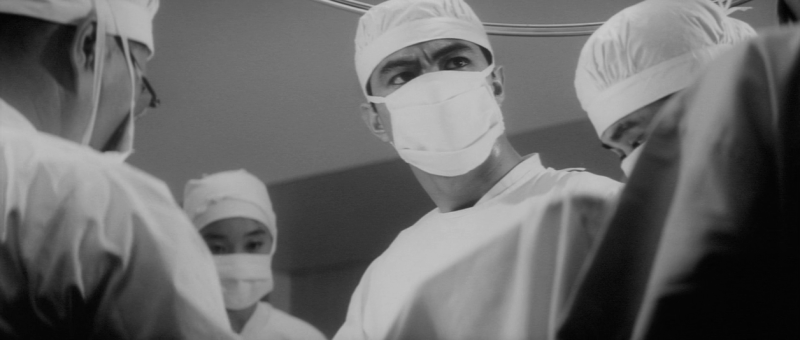
“It’s about the right thing to do, it’s about conscience, and Prof. Zaizen lacks conscience” according to a star witness at the conclusion of a medical malpractice trial in Satsuo Yamamoto’s adaptation of the novel by Toyoko Yamasaki, The Great White Tower (白い巨塔, Shiroi Kyoto). One of a series of films heavily critical of the medical system in the midst of rising economic prosperity, Yamamoto’s tense political drama presents the succession intrigue at a university hospital as an allegory for the nation as a whole implying that lingering feudalistic and authoritarian thinking has poisoned the contemporary society. 

This is in part reflected in the way in which major hospitals are often run as large family businesses where succession is a dynastic matter. In this case, however, the scene is a prominent university hospital in Osaka at which the head of the surgical department, Azuma (Eijiro Tono), is about to retire. Generally, one of his assistant professors would simply move up after being approved by a board comprised of other department heads but the problem is no one, and especially not Azuma, is particularly happy with the most likely candidate, Zaizen (Jiro Tamiya). The issue between them seems to be one of ambition and authority. Zaizen is regarded by all as an excellent doctor with a stellar track record but he is also cold and arrogant with no regard for departmental protocol all of which of course offends Azuma as does his background and person. The son of a country teacher, Zaizen prospered through the dedicated labour of his widowed mother along with family connections before marrying into the extraordinarily wealthy and influential Zaizen family who run a large obstetrics clinic. Consequently, he is free to pursue his interests and lacks the economic anxiety that might make another employee wary of pushing his luck. 

His humble background might have placed a chip on Zaizen’s shoulder but it’s also clear he’s part of a new generation that does things differently from the last, apparently keen to build a public media brand appearing in a glossy magazine which brands him “the magic scalpel” thanks to his success in treating pancreatic cancer. While they might not be able to argue with his track record, other doctors worry that Zaizen has developed a god complex and is slapdash with his practice often timing his operations and smugly pleased with himself when hitting a new record. Azuma first picks him up on this in the case of elderly patient, questioning his treatment decisions in accusing him of neglecting to fully consider the patient’s post-op wellbeing. This then becomes something of a recurring theme as good doctor Satomi (Takahiro Tamura) is minded to bring Zaizen in on the tricky case of a man, Sasaki (Nobuo Minamikata), he suspects may have pancreatic cancer but has been repeatedly diagnosed with chronic gastritis. 

Though it’s political intrigue that in some senses leads him to Zaizen, Satomi is otherwise depicted as the responsible physician who deeply cares for his patients’ wellbeing and not much at all for interoffice politics. Thus he continues to investigate Sasaki’s case even when other doctors tell him he’s wasting too much time on one patient and should just leave it at gastritis. Zaizen, meanwhile, is the exact opposite taking one look at the X-rays and deciding it is pancreatic cancer after all but thereafter ignoring Satomi’s advice after taking over the case refusing to run a CT scan to verify that the cancer hasn’t spread to the lungs as Satomi fears it might have. 

For Zaizen Sasaki ceases to matter, to him the human body is no different to a machine and he perhaps more engineer than doctor even as he proclaims medicine more art than science in insisting that he just knows the early signs of pancreatic cancer while others are unable to detect them. After the first operation we see him perform, a grateful wife stops to thank him profusely for saving her husband’s life though he treats her coldly and implies it’s all part of the job before going outside to celebrate his private glory in his record-breaking feat. It’s then a minor irony that he finds himself later slapped with a malpractice suit by Sasaki’s wife upset that he was unavailable as her husband was dying because he was preoccupied with the ongoing elections for Azuma’s successor.

The implication is that the dehumanisation of the health industry has reduced it to the status of any other company, the head doctors no better than ambitious salarymen whose lives are defined by their job titles. The various department heads eventually descend into factions with Azuma plumping for an external candidate, Kikukawa (Eiji Funakoshi), while others line up behind Zaizen or his internal rival Kasai (Koichi Ito). Influence is brokered largely by outright bribery or industry manipulation by external influential players including Zaizen’s wealthy father-in-law and a professor in Tokyo who can offer monetary perks, access to funding, and potential promotions to those willing to vote for their chosen candidate. The main argument against Zaizen is his bad character, yet the fact he has been carrying on an affair with a bar hostess is never used against him even as they prepare to smear a rival candidate with his mistress even suggesting they hire a hitman to take him out completely. Zaizen’s minions meanwhile make an ill-advised visit to Kikukawa to ask him to withdraw bizarrely stating the importance of maintaining “democracy” even as they themselves deliberately undermine it for their own gain.  

It’s this sense of feudalistic, fascistic authoritarian chumminess that Azuma’s daughter Saeko (Shiho Fujimura) later decries in asking her father why he did nothing to change such a destructive system while he himself had the power to do so the implication being that he saw no need because he continued benefit from it. Only she and Satomi present any kind of challenge to the hypocrisy that pervades the medical system but eventually discover that there is no place for integrity in the contemporary society. Zaizen miraculously falls upwards every time because his success is more expedient that his failure. Even the Tokyo professor brought in as an expert witness during the malpractice suit declares that Zaizen is unfit to be a physician because of his arrogance and total lack of human feeling but pulls back from testifying that he caused the death of his patient through negligence later explaining to a colleague that if a university professor were to be found guilty of malpractice it would undermine public faith in the medical system. 

If can’t they can’t have faith in the medical system, the very people who are supposed to care for them when they are most in need, how can they have faith in anything else? As the rather bleak conclusion makes clear, the entire system is rotten to the core and no longer has any place for idealists like Satomi who are continually pushed to the margins by those jockeying for power in this infinitely corrupt society defined by hierarchy and cronyism while ordinary people, like Sasaki, continue to pay the price. Just as in his opening sequence, Yamamoto takes a scalpel to the operations of the medical industry to expose the messy viscera below but ultimately can offer no real cure in the face of such an overwhelming systemic failure. 


Original trailer (no subtitles)

In a Ring of Mountains (中山七里, Kazuo Ikehiro, 1962)

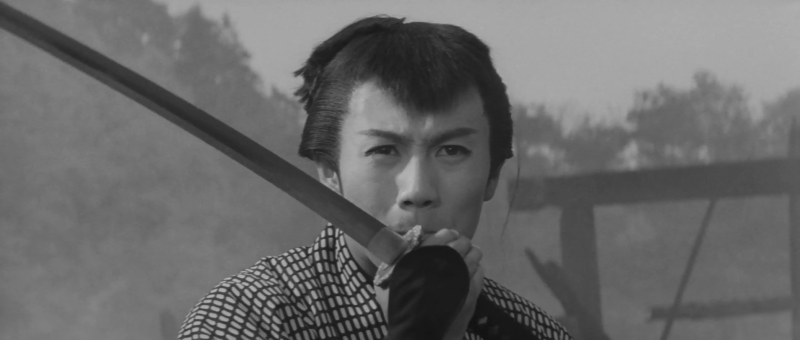
A noble-hearted libertine stands up for love in an increasingly corrupt Edo in Kazuo Ikehiro’s adaptation of the well-known novel by Shin Hasegawa, In a Ring of Mountains (中山七里, Nakayama Shichiri, AKA 7 Miles to Nakayama). The son of a Daiei executive, Ikehiro joined the studio in 1950 working as an AD to Kenji Mizoguchi, Kazuo Mori, and Kon Ichikawa before being promoted to director in 1960 and then briefly demoted back to AD for annoying studio head Masaichi Nagata with the satirical content of his second film. Nevertheless, he later developed a close working relationship with top star Raizo Ichikawa and gained a reputation for unconventional jidaigeki displaying many of the techniques associated with the New Wave rather than the often more classically minded period films which were a Daiei mainstay. 

In this rather more modern tale set sometime in the Edo era, Ichikawa stars as big guy around town Masakichi who is nevertheless viewed with suspicion by local law enforcement officer Tohachi (Koh Sugita) who rebukes him for spending too much time with “yakuza” while out on the road conducting business for the lumber yard where he works. As we’ll come to discover this is a bit rich because Tohachi is as bent as they come, later raiding a gambling den in order to seize the proceeds for himself while in cahoots with equally corrupt magistrate who is also Masakichi’s boss but has designs on his girlfriend Oshima (Tamao Nakamura). After Masakichi proposes to her and goes so far as to set up a house and set a date to solemnise the union, his boss rapes Oshima which leads to her committing suicide and Masakichi killing him thereafter heading out on the run vowing to be Tohachi’s enemy for evermore. Sometime later, however, he gets himself mixed up in intrigue in another town where the corrupt magistrate is actually running the illegal gambling den and taking advantage of a naive young man, Tokunosuke (Koichi Ose), to press him into debt while trying to get his hands on his fiancée Onaka (also Tamao Nakamura) who happens to look exactly like Oshima. 

Something is very definitely rotten in Edo, the corruption so rampant as to be all but inescapable but Masakichi is so jaded that to begin with he doesn’t much care only to be reawakened on realising the same thing is happening again and to another woman who looks like his first love. Before he even sees her, he half-heartedly tries to warn Tokunosuke off gambling realising that he has no idea what he’s doing and seems to be having a run of very bad luck but Tokunosuke is a stubborn and insecure man who doesn’t know what’s good for him making one bad decision after another. When they are forced on the run together, Tokunosuke can’t help but feel his masculinity is being challenged by Masakichi’s infinite capability and is convinced that Onaka will eventually choose to leave with him. Consequently he repeatedly attempts to convince Onaka that Masakichi is a third wheel while quite obviously out of his depth and entirely incapable of protecting her from the mess that he has in part made through his series of poor decisions and general uselessness. 

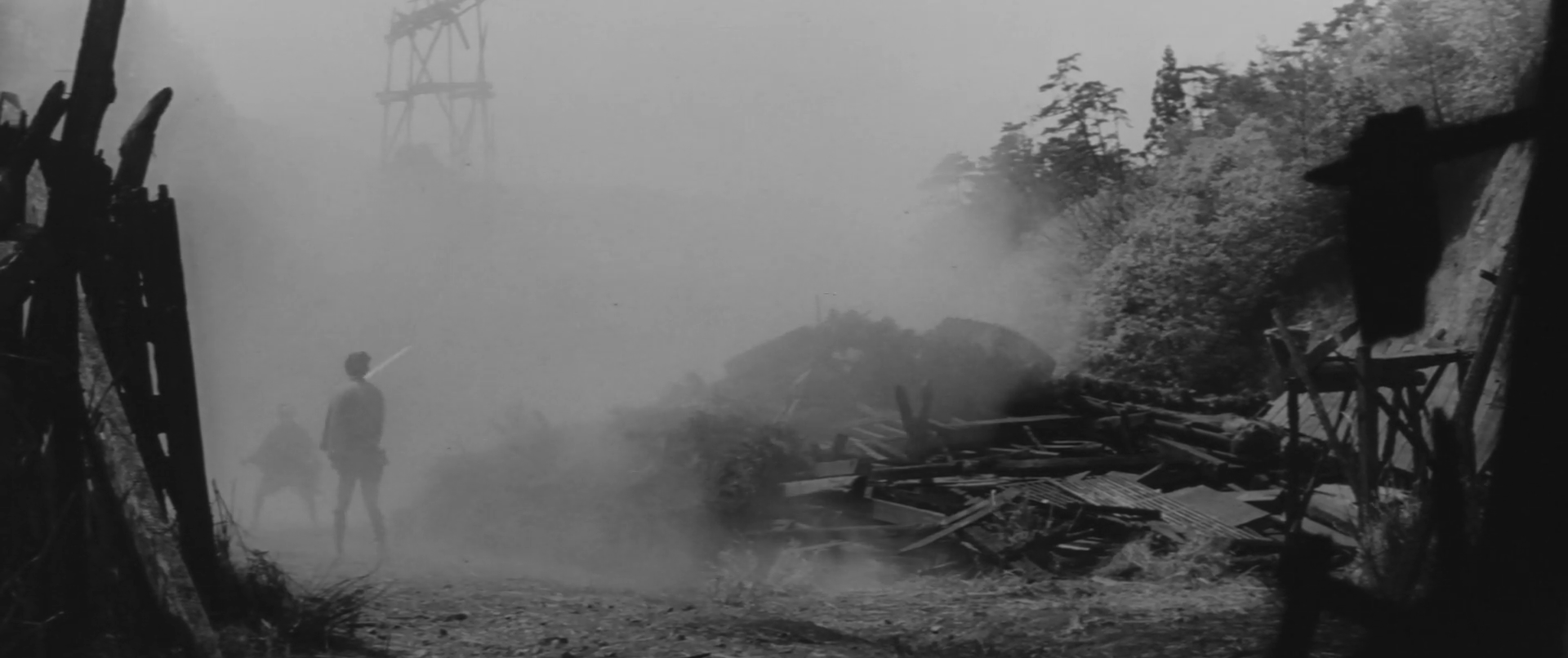
In this case, the hero isn’t so much standing up to injustice in the corrupt Edo-era society as standing up for love, exorcising his guilt over having been unable to protect Oshima by ensuring that Tokunosuke and Onaka’s romance is allowed to blossom. Even so, Onaka eventually concedes that his eyes frighten her while he remains trapped in the past reassuring her that he is aware she and Oshima are not the same and has no desire to intrude on her romantic destiny. The final showdown literally takes place in the ruins of the destroyed society as the trio take refuge in an abandoned village, an entire house later collapsing as Masakichi fights off Tohachi’s goons while beset by a heavy mist. Making frequent use of dissolves and canted angles to reflect Masakichi’s listlessness and sense of despair along with a couple of songs performed by Yukio Hashi, Ikehiro’s jidaigeki drama is an unusually romantic affair as the hero stands up to injustice only indirectly as means of rescuing love from the oppressive corruptions of Edo-era society. 


Trailer (no subtitles)

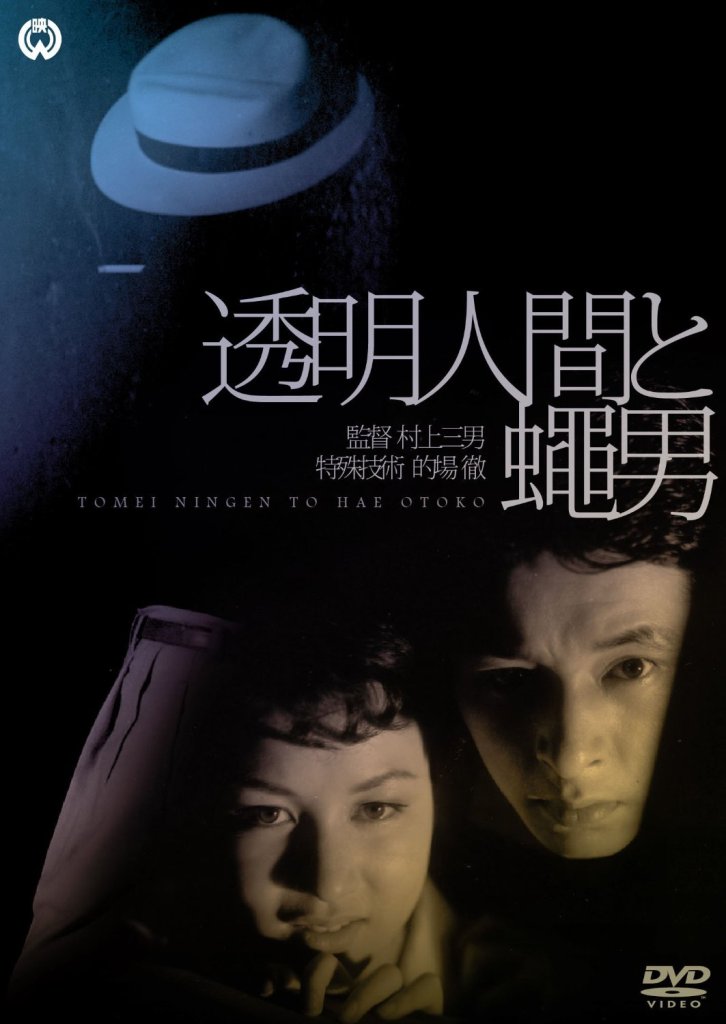
The Invisible Man vs The Human Fly (透明人間と蝿男, Mitsuo Murayama, 1957)

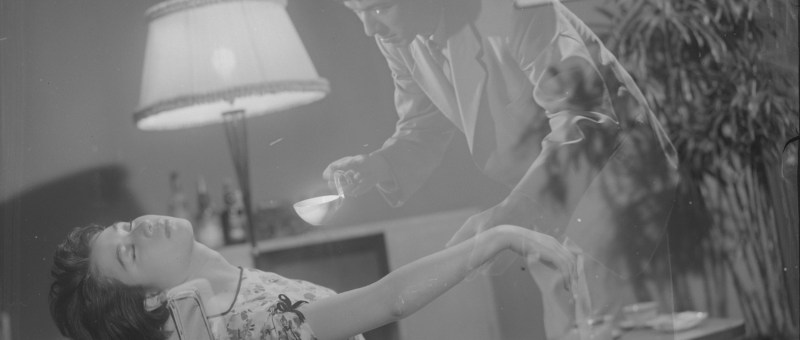
The Invisible Man Vs the Human FlyWho would win in a fight between The Invisible Man and The Human Fly? Well, when you think about it, the answer’s sort of obvious and how funny it would be to watch probably depends on your ability to detect the facial expressions of The Human Fly, but nevertheless Daiei managed to make an entire film out of this concept which is a sort of late follow-up to their original take on Invisible Man Appears from 1949. Like that film, The Invisible Man vs The Human Fly (透明人間と蝿男, Tomei Ningen to Hae Otoko) also adopts a deadpan, straightforward tone despite its rather ridiculous premise.

Tokyo is being plagued by a series of mysterious murders occurring in broad daylight in which the victim is stabbed through the back piercing the heart yet witnesses report seeing no suspicious activity near the crime scene. Perhaps The Invisible Man did it, hahaha….However, when the man sitting next to the professor in charge of researching the “imperceptibility device” is murdered in an aircraft toilet, the police get wise to a possibly surreal explanation for these bizarre crimes. The only other evidence they have is a connection between a sleazy nightclub owner, a friend of his and one of the murdered men who briefly served together during the war, the fact that one of the victims pointed at the sky before dying, and reports of a strange buzzing sound….

Interestingly, the major viewpoint here is from the policemen investigating the case and their attempts to get their heads around this extremely unusual series of events. As often happens with revisiting a form of technology which has been used for ill in the previous picture, here the “imperceptibility device” becomes a force for good as it might be able to help the powers at be stamp out The Human Fly. This time there’s not so much of the accompanying madness which is caused by going invisible but there’s still a heavy price to be paid as no one’s figured out a way of turning back which doesn’t involve rapid death from cancer immediately afterwards.

By contrast, The Human Fly is born of a man made serum developed by Japanese mad scientists during World War II and brought back by a man who was abandoned on an island by his comrades and subsequently left to take the wrap at a war crimes tribunal. He wants to use the technology to further his own success yet has a minion carrying out most of the dirty work. The Human Fly serum does, apparently, carry a number of psychological side effects including violent impulses, paranoia and addiction.

The special effects are not quite as good as in Invisible Man Appears though the invisible antics are not the focus of the film anyway. Bizarrely, The Human Fly is just a shrunken man who is somehow able to zip about like a regular fly even though he’s still dressed in his normal business suit and keeps his arms rigidly to his sides like some kind of human torpedo. Apparently, the buzzing sound is made because of his being very small (so says science) which gets around the inconvenient truth of him not having any wings or other fly-like characteristics other than the ability of flight.

It’s all very silly, though not quite silly enough in places. For the most part, the film plays out like a regular police procedural with slight noir undertones despite the obvious strangeness of the mysteries at hand. Though there’s obviously something to be made about the origin of the Human Fly serum and the anger of the “war criminal” who feels himself betrayed by his country, it’s a fairly subtle comment on post-war resentment. However, attitudes to the practice of scientific research do seem to have shifted with the researchers investigating the imperceptibility device cast as the good guys (though no particular reason for their work is ever offered) who can be relied upon to help catch the “bad guys” who are making use of “bad technology” to do “bad things”.

A fairly solid B-movie though one which is perhaps a little too po-faced for its genretastic title, The Invisible Man vs The Human Fly is an interesting mix of noir crime thriller with a little science fiction and even a few horror trappings thrown in. Thanks to its straightforward approach it may prove a little dull for genre enthusiasts but does offer its own kind of surreal iconography and it’s difficult to forget the sight of a tiny, angry looking besuited man flying around and committing random crimes while an invisible opponent stalks him from the shadows.