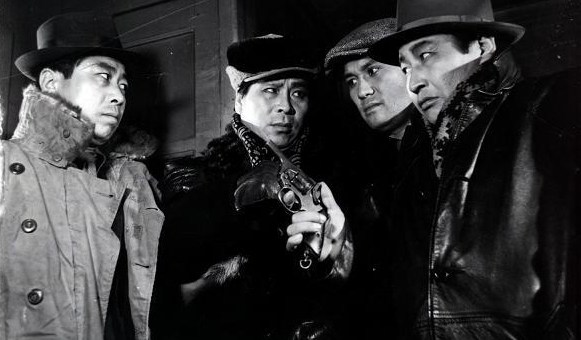
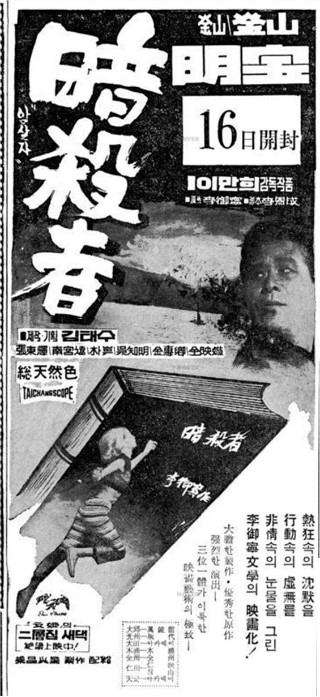
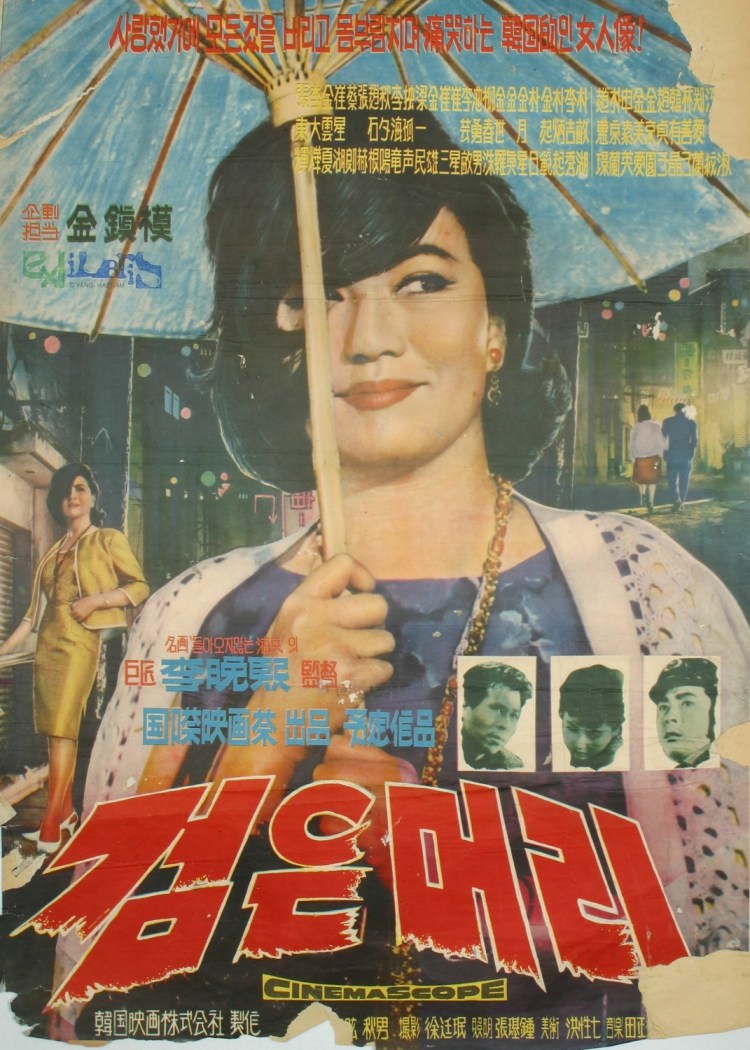
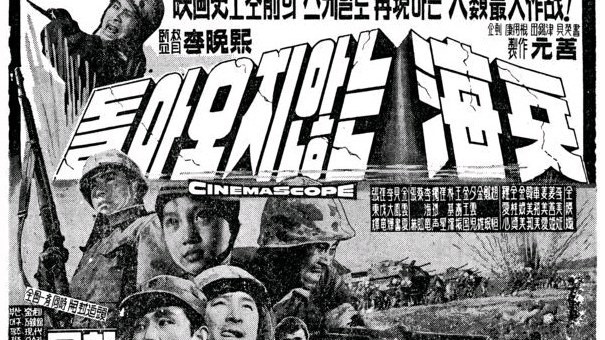
Lee Man-hee thought he’d made an “anti-communist” film in 1965, but apparently he was wrong. The Seven Female POWs was severely edited and retitled Returned Female Soldiers when eventually released, meanwhile Lee did some jail time for supposedly breaking the law in his sympathetic depiction of leftist soldiers. In 1969’s Assassin (암살자, Amsalija) he takes no chances. Set directly after the liberation, Assassin makes no attempt to deny that this was a cruel and chaotic time in which loyalties were to be questioned and honour mourned.
The hardline communists have a problem. One of their top generals, Nam (Park Am), is about to defect and ally with the ruling regime. They need to get rid of him in a hurry. Their plan is to hire an assassin and frame “the Right” before Nam can defect. The Assassin (Jang Dong-hui) they call on is the number one pro but some worry he’s too softhearted for what they have planned. Despite his cold hearted profession, the Assassin has been raising the daughter of a man he killed nine years ago as his own and will not take being dragged away from her at short notice kindly,
Though the communist agents turn up somewhat ominously – one hiding out and lending an umbrella to the Assassin’s little girl and the other inviting himself into the house, they do not directly threaten the Assassin or even offer him money when he tries to turn them down. He eventually decides to take the assignment only on hearing the target’s name and realising he would make a perfect addition to his hit list firstly because they have an old score to settle and secondly because the Assassin has long wanted to see the face of a man meeting his death bravely as he pulls the trigger.
Shooting in colour and with a more experimental mindset, Lee’s use of time is strange and bewildering. The entire enterprise takes place over one night yet much of the outdoor scenes are in daylight. He stages two monologues as a conversation by cutting between two different couples on boats – the Assassin recounting his childhood to a communist foot soldier, and Nam having a heart to heart with his lady love. Meanwhile, Lee also cuts back to the Assassin’s home where the innocent little girl is chatting playfully with another of the communist goons who has been sent to keep an eye on (and then perhaps eliminate) her while her father is out on the job.
Lee begins with a voice over stating that the film will expose the truth about communist violence, instantly locating its own political intentions. The communists are a bad bunch who have no honour, no loyalty, no compassion, and no interest in anything other than their own cause. The cause itself is thereby rendered irrelevant through their own hypocrisy. In order to get the job done, the communists have recruited a local boy to drive the boat and carry messages. They’ve promised him a place in a good school in Seoul. Needless to say they will not be honouring that promise. No one can know of this job – it’s supposed to be a rightest plot, and so all loose ends must be eliminated, including those currently members of the communist faction.
The Assassin does not approve of this. His ideas are old fashioned and he believes in a kind of code even within the darkness of his own profession. The Assassin’s only joy is in his little girl – really the daughter of a man he murdered. This is both proof of his adherence to his code of honour and to his generally compassionate nature. Nam is much the same. He has his code too, though it has recently been ruptured by the intrusion of love. Before, he could have said anything but now he’s found love he’s happy to go and will bear his sentence with dignity. Strangely, neither Nam nor the Assassin pause to consider what will happen to the women in their lives when they are gone, even if it is these women and their relations with them that have humanised their otherwise calculating hearts.
The Assassin’s little girl remains completely unaware of her adopted father’s profession or of the danger posed by a man she doesn’t know sitting at her bedside fondling a gun. Her one request of her father is that he bring her back an apple with the leaves still on it – a symbol of her own innocence and naivety, but the apples he picks for her are later smashed to smithereens under a communist’s boot. The communist gets his own comeuppance (these communists do seem to be quite a dim bunch, gleefully felling their fellow officers yet never guessing they may be next), but Lee’s rather unsubtle message is clear as “the left” stomps all over any and all signs of love, compassion, innocence or beauty.
Unlike Lee’s other films this one ends with a heavy handed voice over but no “The End” – presumably the story of the struggle against communism is not yet finished. The story is an old one, men who live by the sword die by the sword – they know this and accept it almost as a religious rite. Both Nam and the Assassin know their place within this cycle and so they submit to it with bravery and stoicism whereas the strangely manic villain attempts to run from his fate but fails miserably. Lee experiments with time and form, perhaps attempting to move past the obvious propaganda element of the project but never manages to escape it. Still, The Assassin is oddly moving in its final moments even if tinged with cynicism and a sense of the world’s cruelty untempered by Lee’s generally forgiving melancholy.
Assassin is the fourth and final film in The Korean Film Archive’s Lee Man-hee box set which comes with English subtitles on all four films as well as a bilingual booklet. Also available to stream online via the Korean Film Archive’s YouTube Channel.


 A relatively rare phenomenon, a lucid dream is one in which the dreamer is aware they are asleep and “awake” enough to influence the outcome. Rather than using the ability to probe some kind of existential question, Korean science fiction thriller Lucid Dream (루시드 드림) focusses on the evidence gathering possibilities, going one step further than hypnotic regression to revisit old memories and zoom in on previously missed details.
 It’s Not Her Sin (그 여자의 죄가 아니다, Geu yeoja-ui joega anida) is, in contrast to its title, nowhere near as dark or salacious as the harsher end of female melodramas coming out of Hollywood in the 1950s. It’s not exactly clear to which of the central heroines the title refers, nor is it clear which “sin” it seeks to deny, but neither of the two women in question are “bad” even if they have each transgressed in some way. Drawing inspiration from the murkiness of a film noir world, Shin Sang-ok adapts the popular novel by Austrian author Gina Kaus by way of a previous French adaptation, Conflit. Shin sets his tale in contemporary Korea, caught in a moment of transition as the nation, still rebuilding after a prolonged period of war and instability, prepares to move onto the global stage while social attitudes are also in shift, but only up to a point.
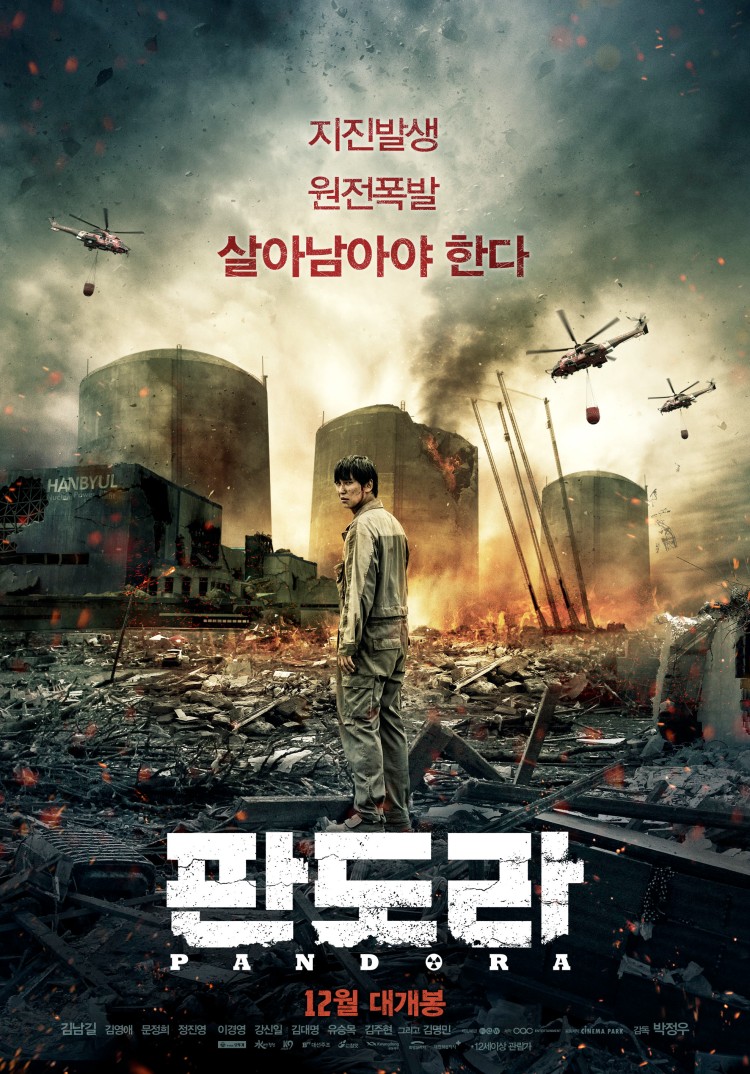 In a time of crisis, the populace looks to the government to take action and save the innocent from danger. A government, however, is often forced to consider the problem from a different angle – not simply saving lives but how their success or failure, decision-making process, and ability to handle the situation will be viewed by the electorate the next time they are asked who best deserves their faith and respect. Pandora (판도라) arrives at a time of particularly strained relations between the state and its people during which faith in the ruling elite is at an all time low following a tragic disaster badly mishandled and seemingly aided by the government’s failure to ensure public safety. Faced with an encroaching nuclear disaster to which their own failure to heed the warnings has played no small part, Pandora’s officials are left in a difficult position tasked with the dilemma of sacrificing a small town to save a nation or accepting their responsibility to their citizens as named individuals. Unsurprisingly, they are far from united in their final decision.
 North Koreans have become the go to bad guys recently, and so North Korean spies have become the instigators of fear and paranoia in many a contemporary political thriller. The Suspect (용의자, Yonguija), however, is quick to point the finger at a larger evil – personal greed, dodgy morals, and the all powerful reach of global corporations. Opting for a high octane action fest rather than a convoluted plot structure, Won’s approach is (mostly) an uncomplicated one as a wronged man pursues his revenge or redemption with no thought for his own future, only to be presented with the unexpected offering of one anyway alongside the equally unexpected bonus of exposing an international conspiracy.
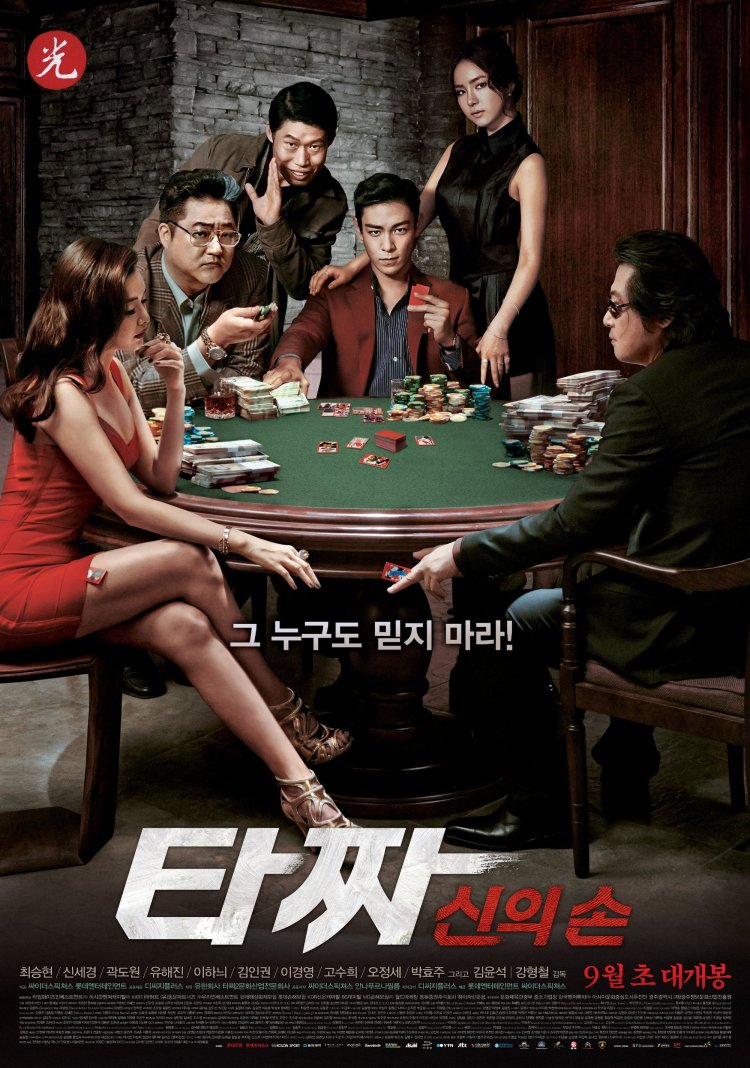 You gotta know how to hold ‘em, know when to fold ‘em, know when to walk away and know when to run. Apparently these rules of the table are just as important in the cutthroat world of the Korean card game Hwatu as they are in the rootinest tootinest saloon bar. Like most card games, having the winning hand is less important than the ability to play your opponent and so it’s more a question of who can cheat the best (without actually breaking the rules, or at least being caught doing so) than it is of skill or luck. A second generation sequel to 2006’s Tazza: The High Rollers, The Hidden Card (타짜-신의 손, Tajja: Shinui Son) is a slick, if overlong, journey into the dark, underground world of gambling addicted card players which turns out to be much more shady than the shiny suits and cheesy grins would suggest.
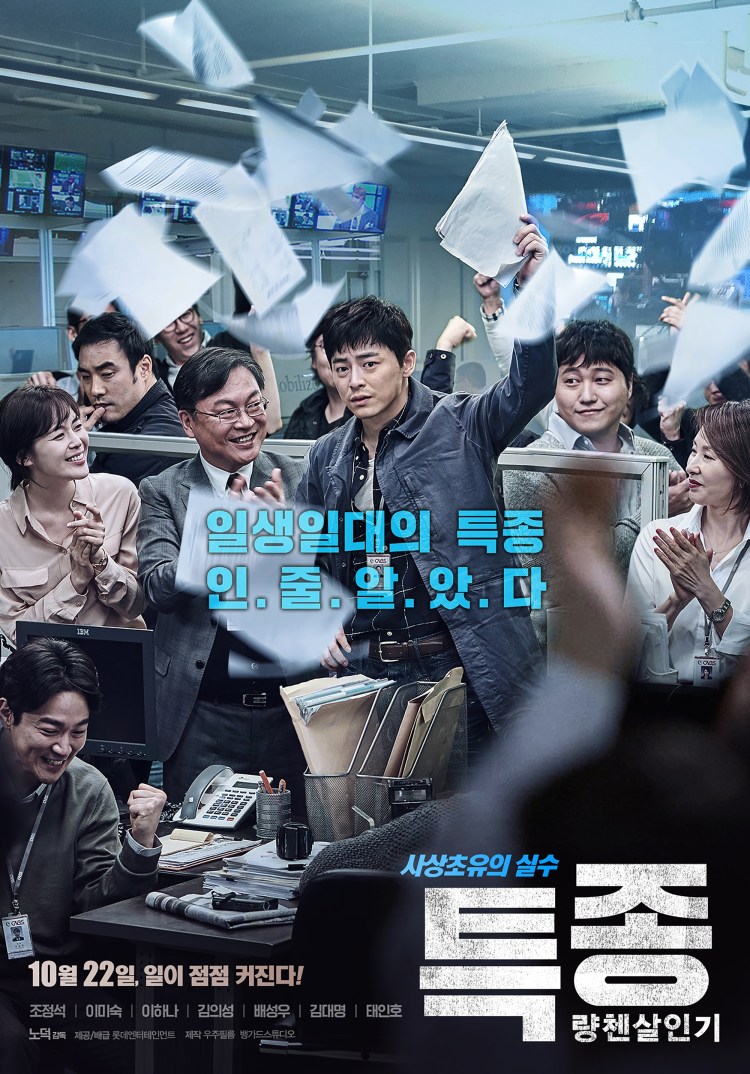 Some people just can’t keep themselves out of trouble. The down on his luck reporter at the centre of Roh Deok’s The Exclusive: Beat the Devil’s Tattoo (특종: 량첸살인기, Teukjong: Ryangchensalingi) is something of a trouble magnet as he makes mistake after mistake, requiring lie after lie to try and put him back on the straight and narrow. Unfortunately for him the deeper he gets the closer he turns out to be to the “real” truth. Only by that stage everyone has lost interest in “the truth” anyway – who cares about little things like facts against the overwhelming power of a constructed narrative.
 Windows on Worlds