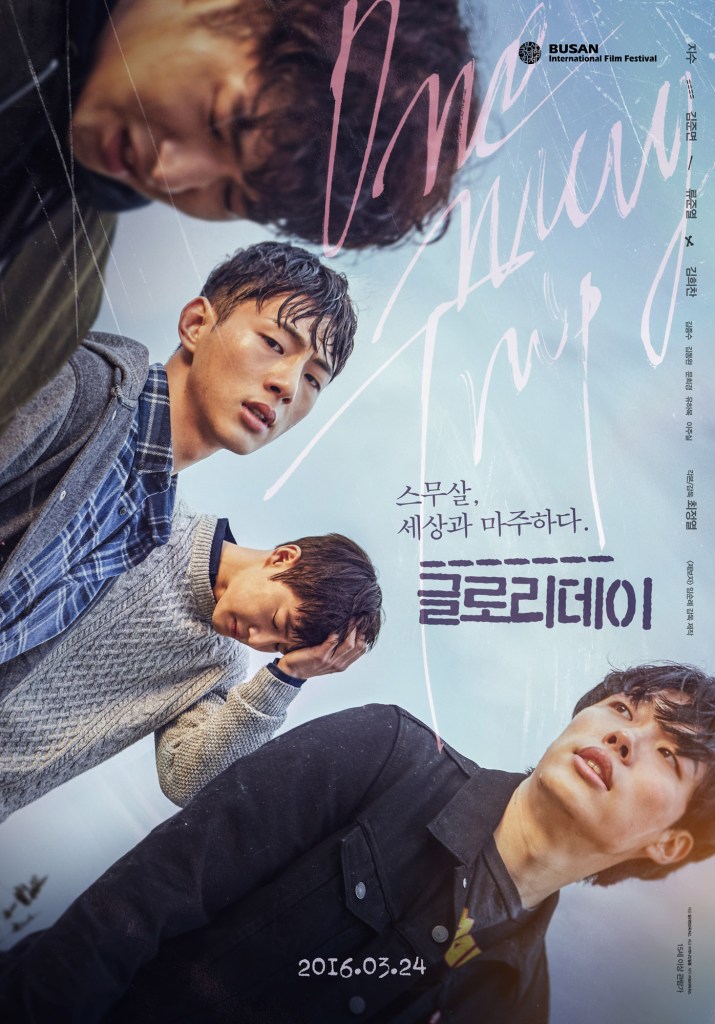
Young men just trying to do the right thing often end up losing out in the long run – so it is for the four best friends at the centre of Choi Jeong-yeol’s One Way Trip (글로리데이, AKA Glory Day). Caught right on the liminal divide between adolescence and adulthood, each of the four has a different path set before him, not entirely of their own choosing. De facto leader Young-bi (Ji Soo) seems the most directionless of the four but as the only one with a driving license he’s found an old banger of a van and got the guys together for one last road trip before Sang-woo (Suho) enlists in the military. Joined by city councilman’s son Ji-gong (Ryoo Joon-Yeol) and Doo-man (Kim Hee-Chan), a reluctant baseball player, the boys take off for the last real trip of their adolescent lives.
Things do not go to plan as the opening sequence features the guys furiously running away from the police, more worried about their parents finding out than any more serious consequences, but tragedy strikes when Sang-woo is knocked over in a hit and run accident. With Sang-woo unconscious in the hospital, the remaining three guys find themselves locked up on assault charges which later graduate to murder. How did their peaceful trip turn out like this?
Told largely through flashbacks explaining both the events of that night and the guys’ lives, One Way Trip examines the effect of a traumatic incident on each of the boys as they find their friendship coming under increasing pressure. Hanging around near the harbour, the guys spot a couple having a domestic dispute in a nearby car before the man drags the woman outside and proceeds to accuse her of having an affair whilst becoming increasingly violent. Headstrong Young-bi decides to intervene but goes too far in picking a fight with the guy while the woman gets herself to safety. When the violent husband falls into a nearby boat, the guys get scared and run off but the battered wife has already called the police who wind up chasing them through the town.
Panicking in the police station, distraught Young-bi gets himself into even more trouble sending their case straight up to the detectives. Though originally sympathetic, the police change their tune when it turns out that the woman involved is a high profile TV news reader. In an attempt to protect her reputation, she refuses to back the boys’ story and implicates them in the murder of her husband. The police, not overly interested in the finer details of the case, want a speedy resolution – a desire which is only echoed from further up where head office is getting pressure from the media.
These are all nice, ordinary kids who’ve never been in any kind of trouble before but suddenly they’re being encouraged to turn on each other and engineer the best possible outcome for themselves as individuals. Ji-gong’s mother (Moon Hee-kyung) is a prim woman most worried about what the neighbours will think, not to mention the impact on her husband’s political career. Doo-man’s father (Yoo Ha-bok) is even more panicked than his son and immediately starts making every conceivable kind of fuss at the police station, including attempted bribery. Young-bi, by contrast, has no one to speak for him as the only responsible adult is his older brother (Kim Dong-wan) – his father is already in jail. To the other parents, the answer is obvious, blame it on the no good delinquent their “nice” kid has been lead astray by and forget about the whole thing.
Though these boys are almost men, they have very little control over their own lives which continue to be dictated by parental expectation. Ji-gong’s overbearing mother locks him in the house to try and force him to study while Doo-man’s father ignores his pleas that he can’t stand playing baseball and is sick of the other players’ resentment because they know he’s only on the team because his father put him there. Young-bi has no firm parental input but his feelings about his family circumstances are what lead him to try and help a woman in peril, as well as the reason he loses his temper so quickly. Sang-woo, the most blameless among the boys, has only his grandmother whom he wanted to spare a life of hardship by serving in the military followed by a solid government guaranteed job afterwards.
Fear and external pressures start to work their magic on the three previously innocent guys who thought they were doing something good but have ended up paying the price. Heartbreak and betrayal are the order of the day as money, power, and influence will always win out over justice, goodness and friendship. Injustice is the force that governs the world, Young-bi thought he was doing the right thing by coming to the aid of a woman under attack only for everyone else to tell him he should have just minded his own business and not gotten involved. Bookended scenes of the four guys together having fun on the beach only reinforce the stark contrast between their youthful innocence, naively believing in friendship and the essential goodness of helping others, and their post-trip awakening to the self-centred indifference of the adult world.
Reviewed at the 2016 London Korean Film Festival.
International trailer:

 Politics in South Korea has never been exactly drama-free, though recent times have seen a multitude of storms engulf its top brass running from the national to the personal. Frequent Park Chan-wook collaborator Lee Kyoung-mi’s followup to her acclaimed 2008 debut Crush and Blush, The Truth Beneath (비밀은 없다, Bimileun Eobda) begins as if it’s going fit into the ‘70s dark political thriller mould but gradually shifts gear to present both a bleak family drama and the story of one woman’s descent into the near madness of grief as she attempts to uncover the true circumstances behind her private tragedy even as it plays out on a national stage.
 When it comes to intelligent farce, Kenji Uchida is Japan’s undisputed master so remaking his 2012 tale of love, crime, and mistaken identity Key of Life was always going to be a tall order. Thankfully it’s one Lee Gye-byeok largely manages to meet as he skilfully relocates the tale to South Korea and swaps Uchida’s complicated farce for a more lateral double sided comedy. While not as accomplished as Uchida’s hilariously intricate original, Luck-key (럭키) manages to charm with its thoroughly romantic, comically absurd, approach.
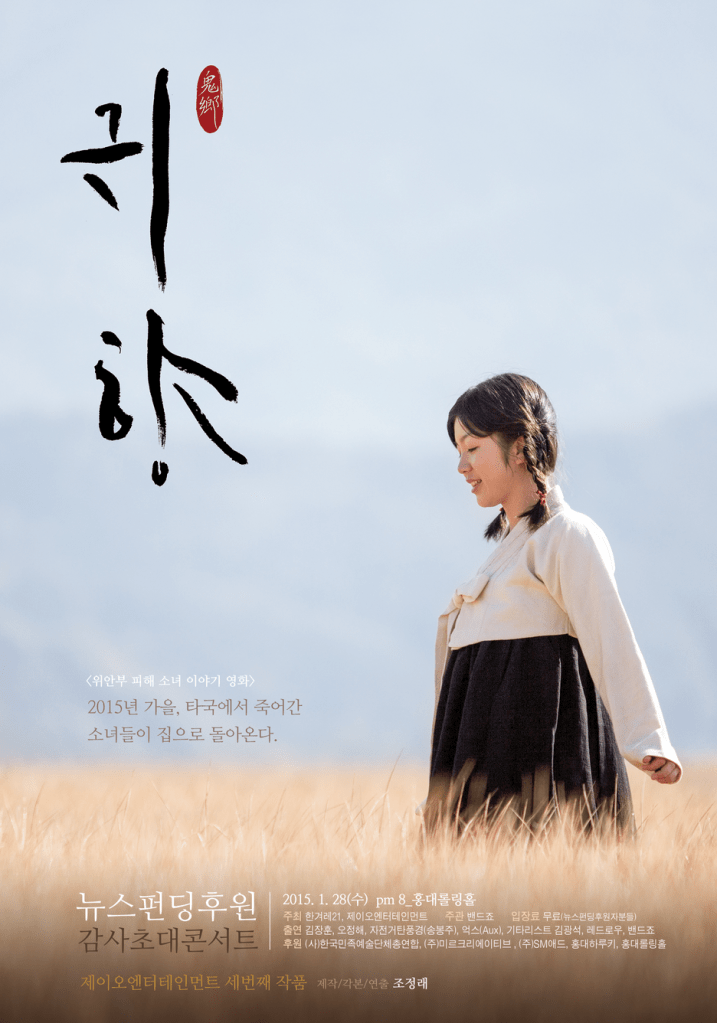 Of all the awful things that happened in the middle part of the 20th century, the trafficking, incarceration, enslavement and forced prostitution of women and girls from across Asia (including at least 65 Dutch women in what is now known as Indonesia) who were abducted for use as “comfort women” by the Japanese military remains one of the least discussed and most controversial. The issue (arguably) runs most deeply in Korea which had been experiencing a prolonged and often brutal era of colonial rule even prior to the intensification of hostilities in the early 1940s. The torment these women faced did not end with the ceasefire as entrenched social attitudes left them not only with a lifetime of physical and psychological trauma but also internalised shame which made it difficult for them to talk about their experiences even to those closest to them. Now more than ever, it is important that this story be told and the long suffering of these women, many of whom are no longer with us, is finally acknowledged.
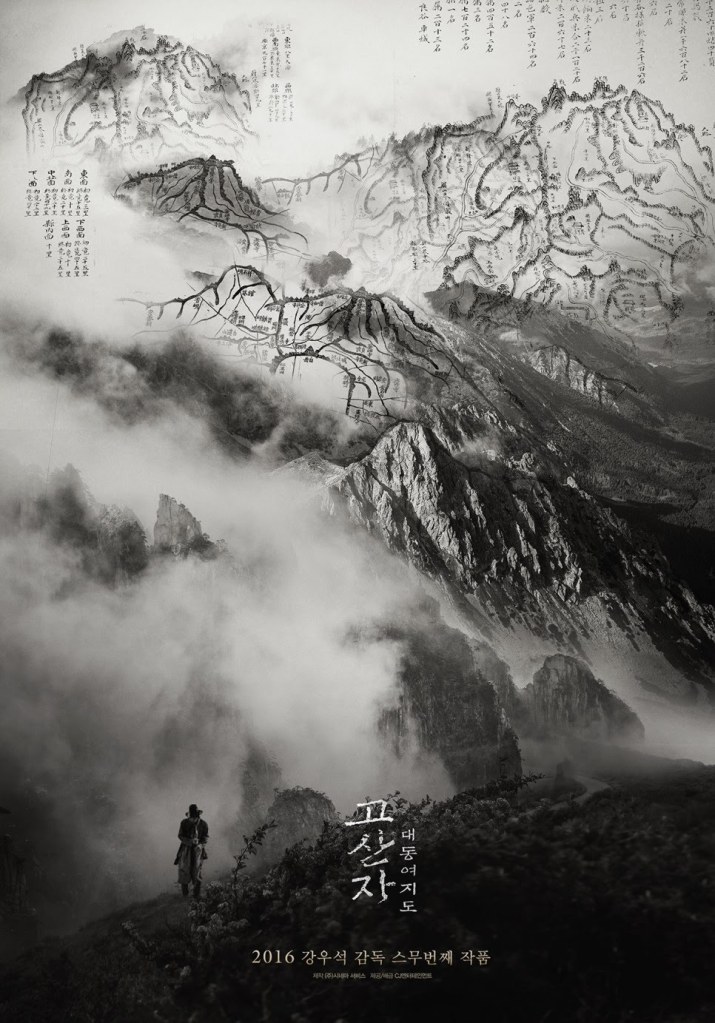 The map is not the territory – as the old adage goes. There’s always a difference between the thing itself and the perception of it but, as the “hero” of The Map Against the World (고산자, 대동여지도, Gosanja, Daedongyeojido) points out, if you’re about to set off on a long journey it’s a good idea to not to rely on a linear map else you’ll run out of good shoes long before you reach your destination. Kim Jeong-ho (Cha Seung-Won) was, apparently, a real person (though little is known about him) who set out to make a proper map of the Korean peninsula after a cartographic error led to the death of his father and many other men from his village when they ran out of resources crossing what they thought was one mountain but turned out to be one mountain range.
 There are three kinds of actors – those who wait for roles, those who choose roles, and those who make roles for themselves. Ageing actress Go Ju-yeon (Kim Hye-soo) claims to be the third type, but at any rate she’s currently between gigs and facing professional scandals and personal crises from each and every direction. An unusual family drama, Familyhood (굿바이 싱글, Gotbai Singkeul, AKA Goodbye Single) is the coming of age story of a middle aged woman finally forced into adulthood through an unlikely friendship with a pregnant teenage girl.
 Kim Jong-kwan’s award winning unexpected indie box office hit has been given the rather odd English title of Worst Woman (최악의 하루, Choeakui Haru) in contrast with the original Korean which simply means “The Worst Day”. In fact, the film is about two people – an aspiring Korean actress with problems in her personal life, and a Japanese writer visiting for the launch of the Korean translation of his novel, each of whom is indeed having an exceptionally unlucky day. Part walking and talking, part split focus romantic comedy, Worst Woman is a polished piece of indie filmmaking anchored by quality performances and an interesting approach to its material.
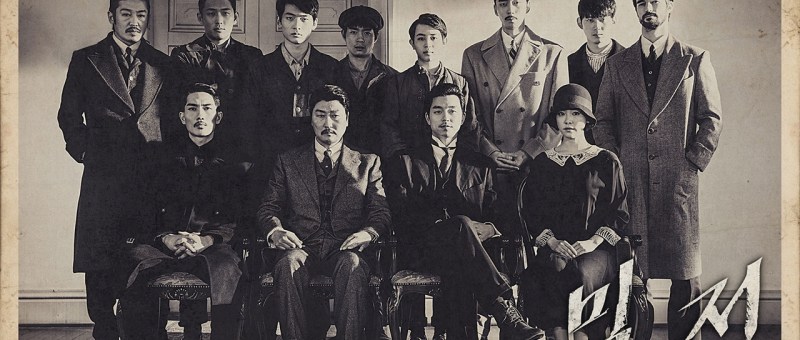
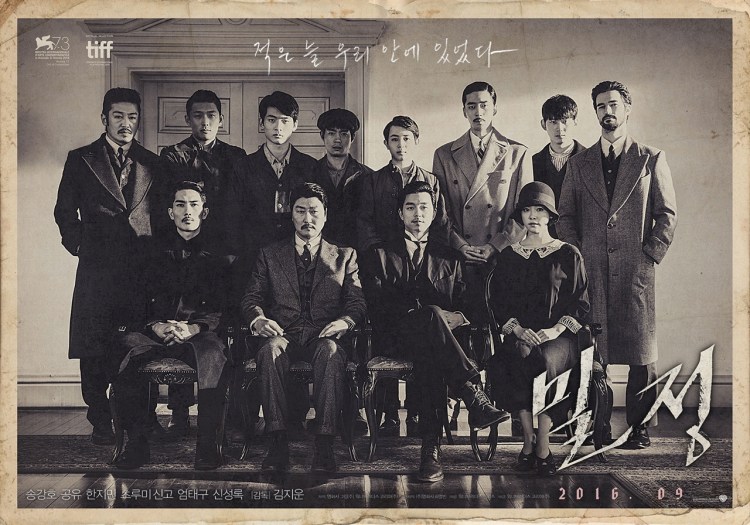 When the country of your birth has been occupied by another nation, what do you do? Do you fight back, insist on your independence and expel the tyrants, or quickly bow to your new overlords and resign yourself to no longer being what you once were? Kim Jee-woon becomes the latest director to take a look at Korea’s colonial past with the Resistance based thriller Age of Shadows (밀정, Miljung) which owes more than a little to Melville’s similarly titled Army of Shadows, as well as classic cold war spy dramas The Third Man and The Spy Who Came in From the Cold.
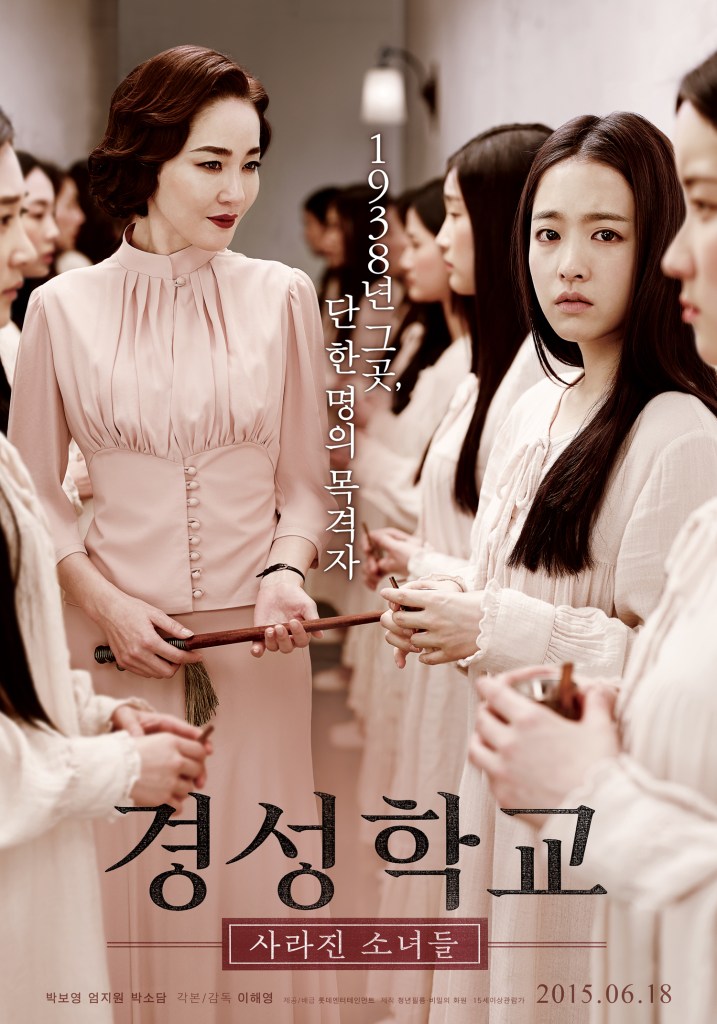 The Silenced (경성학교: 사라진 소녀들, Gyeongseonghakyoo: Sarajin Sonyeodeul) has all the classic genre aspects of the boarding school horror story familiar to fans of gothic literature everywhere, but this is no Victorian tale of repressed sexuality and hallucinatory psychosis. What The Silence does is take all of these essential elements and remix them as a metaphor for the horror of colonialism. Surrounded by quislings and forced into submission in order to survive, how does the essential soul of an oppressed people survive? The Silence would seem to argue that perhaps it can’t, but can evolve and learn to resist its colonisers even if it has to bend to do so.
 Windows on Worlds