Road Warriors (あやめ笠 喧嘩街道, Tai Kato, 1960)

A penniless wanderer finds himself mixed up in chaos and conspiracy after deciding to help a lady travelling alone for the purposes of revenge in Tai Kato’s Toei chanbara, Road Warriors (あやめ笠 喧嘩街道, Ayame Kasa: Kenka Kaido). Truth be told, the hero isn’t much of a warrior at all and wisely prefers to avoid a fight if possible but is prepared to put his sword where his mouth is when the occasion calls. Still the conspiracy in this instance is small scale and incredibly petty as a trio of ambitious retainers attempt to frame their one time bodyguard for the murder of a lord.

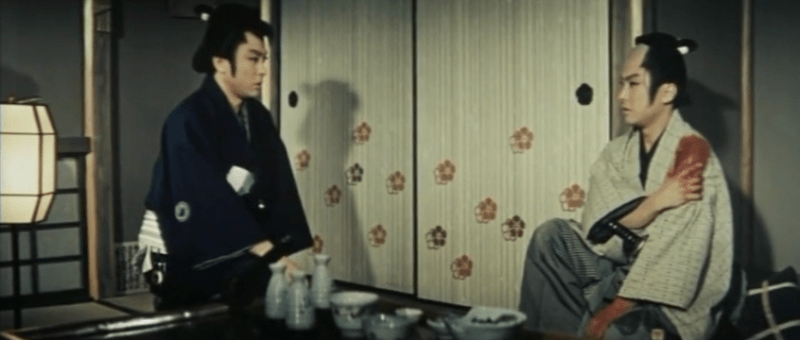
Before all that, however, Gantaro (Ryuji Shinagawa) is as he’s fond of introducing himself a penniless traveller who makes his ends meet through gambling. In debt to local boss Hidegoro (Ushio Akashi) he agrees to act as an intermediary in a dispute with the greedy Onizo (Eijiro Yanagi) who has usurped some of their territory. Gantaro suggests they settle the matter through gambling but is then challenged to combat by the gang’s bodyguard, Akiyama (Shin Tokudaiji). The young man looks noticeably afraid, sweating at the temples and gripping his sword at an unusual angle, but holds his own in the fight until Onizo tries to cheat by sending in one of his minions to finish him off. Noticing what’s happening, Akiyama proves his nobility by ending the fight and accepting defeat. Onizo appears cheerful and even asks Gantaro to join his gang, but seconds after the young man leaves he sends his guys out after him and evidently has no intention of enforcing a truce with Hidegoro.

Meanwhile, Gantaro runs into a melancholy samurai woman, Miyuki (Kyoko Aoyama), chasing after a thief who has stolen something from her far more precious than money. Discovering the thief has robbed him too, Gantaro springs into action and soon discovers that Miyuki is on a quest for revenge against the man who killed her father but that she’s been betrayed by her three retainers and has managed to ditch them to proceed alone. Unsprisingly, the prime suspect appears to be Akiyama but as stabbing a man in the back and running away don’t seem to fit with the noble character he displayed in the fight, Gantaro has an idea that something’s not quite right. 

Of course, he also begins to fall for Miyuki despite the obvious affection held for him by Hidegoro’s daughter Omitsu (Hiromi Hanazono) which he otherwise seems keen to escape. It’s reasonable to assume that loveable rogue Gantaro is the love them and leave them type, though his love for a samurai’s daughter is always going to be an impossibility no matter how much she may come to admire him. Even so, the conspiracy angle along with Onizo’s smug and overbearing duplicity do begin to awaken his sense of justice especially while travelling with an incredibly cynical thief who will sell anything or anyone in search of a quick buck. Even he however eventually comes around to the idea of helping Miyuki get away from her retainers and enact her revenge especially after overhearing the truth while cowering behind some barrels. 

It may be an overly familiar chanbara tale if one enlivened by Gantaro’s wisecracking antics, but Kato brings to it his characteristic sense of uncertainty in the potent mists that seem to surround Gantaro and Miyuki as they travel the mountain paths in search their enemy. Then again, there are shades of unexpected darkness not least in the implication that Gantaro was about to rape Miyuki before she fainted and brought him back to his senses. Nevertheless, her retainers may tell her that she has “no choice” but to obey them, but Gantaro seems to feel differently if abruptly giving up his intention of protecting her on learning that she has someone else in her heart. This is indeed a harsh world for women samurai and otherwise, a mother and daughter are saved by Akiyama after being harassed by Onizo when he annexes the local market while both Miyuki and Omitsu are left to finish their father’s unfinished business in the wake of their untimely deaths. Notably, it is indeed they who finally strike the final blow to eliminate the corruption which surrounds them. Penniless wanderer Gantaro doesn’t have it that easy either, gambling his life away and ending up with debts both financial and moral that may have dangerous consequences while often beset by cynicism even if latterly deciding to help those in need for no reward. In any case, like any good wanderer all he can do is smile and wave as he departs for the next adventure on the violent streets of the Edo-era society.

The Phantom Goblin (まぼろし天狗, Nobuo Nakagawa, 1962)

“Everything is money these days” as a pirate king cheerfully proclaims in Nobuo Nakagawa’s tale of Edo-era corruption, Phantom Goblin (まぼろし天狗, Maboroshi Tengu). Perhaps named to capitalise on Nakagawa’s reputation for spookiness, Phantom Goblin features no real ghosts and only metaphorical goblins in the bright red tengu masks sported by the hero’s mysterious clan while otherwise conforming to the Toei programmer house style and starring jidaigeki superstar Hashizo Okawa in a double role as brothers separated at birth and reunited by their resistance towards the inherently corrupt authority of Edo society. 

Drawing parallels with the present day, the film opens at a bawdy banquet at which corrupt councillor Tanuma (Isao Yamagata) is being entertained by a pair of local social climbers with a floor show of dancing girls. Shortly after the performance begins, however, one of the women collapses writhing in agony and loudly crying out for drugs. Embarrassed, the lords would rather this not get out deciding to finish the woman off and dump her body in a nearby well. Unfortunately for them, the plan is interrupted by local policeman Shuma Moriya (Hashizo Okawa) who arrives in time to hear the woman exclaim the words “drugs” and “mastermind” before she passes away. Determined to figure out the truth, Moriya heads to the not so secret hideout of a local gang but is shot in the arm and has to take refuge in an inn where he encounters a man who looks just like himself, Kyonosuke Asakawa (also Hashizo Okawa) of the Goblin clan, who eventually sends him to his estate to recover and assumes his position as policeman in order to root out the truth. 

A former hatamoto who apparently resigned his position after finding himself unable to support corrupt lords, Kyonosuke declares himself “frustrated with how things are run”, realising that the system is rotten beyond repair on hearing that Moriya has been fired by a corrupt magistrate apparently in league with the conspirators. While comparatively rare in Edo-era dramas, drugs are a controversial subject in any age but in keeping with the sensibilities of the early ‘60s Phantom Goblin eventually slips into the Sinophobia then rampant in contemporary crime dramas as it becomes clear the drugs trade in the feudal economy is being driven by Chinese pirates trafficking it in from overseas while weak willed lords enable their rise to power. 

There is however a touch of conservatism in Kyonosuke’s desire to see justice served in that he fears a world in which “if you can buy power and position with money, then one day we will have a chief counsellor who is a pirate”. While he’s undoubtedly got a point, it’s also true that he is in a sense protecting his own privilege conveyed by birth rather than worth in addition to rejecting the influence of the “foreign” as he raises his sword against a Chinese pirate in order to target the corrupt lords who’ve been collaborating with him in order to bolster their own power and position. Kyonosuke wanted to “clean out evil in Edo”, but eventually succeeds rather ironically in simply becoming a part of the system himself after having supposedly cleaned it out by getting rid of the “obviously” corrupt elites. 

Recovering from his shoulder injury and flirting with the adopted sister of Kyonosuke, Moriya is largely relegated to a secondary role though the secret brotherhood of the two never develops into much of a plot point even as they bond as men too honest for the world in which they live. Nor do the respective romantic dilemmas ever materialise even as the conflicted figure of a female bandit in love with the noble policeman is forced to pay for her crimes with her life, unable to progress into the purified world the brothers are about to create. Working in the Toei house style, Nakagawa abandons his taste for the strange or otherworldly contenting himself only with a few ironic tengu masks and the literal shadows surrounding the shady mastermind while indulging in genre staples such as the comic relief provided by Kyonosuke’s bumbling retainers and the double casting of Hashizo Okawa as two brothers alike in both appearance and sensibility who find themselves unable to accept the increasing corruption of their society and determine to oppose it. 


Gate of Hell (地獄門, Teinosuke Kinugasa, 1953)

Which is the greater challenge to the social order, love or ambition, or are they in the end facets of the same destabilising forces? Teinosuke Kinugasa’s Gate of Hell (地獄門, Jigokumon) is, from one angle, the story of a man driven mad by “love”, reduced to the depravity of a crazed stalker betraying his samurai honour in order to affirm his status, but it also paints his need as a response to the chaos of his age along with its many repressions while the heroine is, once again, convinced that the only freedom she possesses lies in death. Yet in the midst of all that, Kinugasa ends with a triumph of nobility as the compassionate samurai restores order by rejecting the heat of raw emotion for an internalised contemplation of the greater good. 

Set in the 12th century, the film opens in revolt as two ambitious lords combine forces to attack the Sanjo Palace in what would become known as the Heiji Rebellion. The lords have attacked knowing that Taira no Kiyomori (Koreya Senda) is not in residence, having departed on a pilgrimage. Fearful for the safety of his sister and father, retainers order decoys to be sent out to distract the rebels. Kesa (Machiko Kyo), a court lady in service to the emperor’s sister, agrees to be her decoy and Morito (Kazuo Hasegawa), a minor retainer, is ordered to protect her. He manages to escort her back to his family compound where he assumes she will be safe, transgressively giving her a kiss of life, pouring water into her mouth with his own, after she has fainted during the journey. Unfortunately, Morito has miscalculated. His brother has sided with the rebels and they are not safe here. During the chaos they go their separate ways, and as soon as Kiyomori returns he puts an end to the rebellion restoring the status quo.  

Shocked at his brother’s betrayal, Morito tells him that only a coward betrays a man to whom he has sworn an oath of loyalty but he explains that he is acting not out of cowardice but self interest. He has made an individualist choice to advance his status in direct opposition to the samurai code. Morito doesn’t yet know it but he is about to do something much the same. He has fallen in love with Kesa and after meeting her again at the Gate of Hell where they are each paying their respects to the fallen, his brother among them, is determined to marry her, so much so that he asks Kiyomori directly during a public ceremony rewarding loyal retainers for their service. The other men giggle at such an inappropriate, unmanly show of emotion but the joke soon fades once another retainer anxiously points out that Kesa is already married to one of the lord’s favoured retainers. Kiyomori apologises and tries to laugh it off, but Morito doubles down, requesting that Kiyomori give him another man’s wife. 

This series of challenges to the accepted order is compounded by a necessity for politeness. Morito is mocked and derided, told that his conduct is inappropriate and embarrassing, but never definitively ordered to stop. Making mischief or hoping to defuse the situation, Kiyomori engineers a meeting between Morito and Kesa, cautioning him that the matter rests with her and should she refuse him he should take it like a man and bow out gracefully. Kesa, for her part, has only ever been polite to Morito and is extremely confused, not to mention distressed, by this unexpected turn of events. She is quite happily married to Wataru (Isao Yamagata) who is the soul of samurai honour, kind, honest, and always acting with the utmost propriety. That might be why he too treats Morito with politeness, never directly telling him to back off but refusing to engage with his inappropriate conduct. That sense of being ignored, however, merely fuels Morito’s resentment. He accuses Kesa of not leaving her husband because Wataru is of a higher rank, as if she rejects him out of snobbishness, rather than accept the fact she does not like him. 

Morito continues in destructive fashion. We see him repeatedly, break, smash, and snap things out of a sense of violent frustration with the oppressions of his age until finally forced to realise that he has “destroyed a beautiful soul” in his attempt to conquer it. “One cannot change a person’s feelings by force” Wataru advises, but is that not the aim of every rebellion, convincing others they must follow one man and not another because he is in someway stronger? The priest whose head was cut off and displayed at the Gate of Hell was killed in part because he reaped what he had sown in beheading the defeated soldiers of a previous failed revolution. Morito kills a traitor and he falls seemingly into rolling waves which transition to an unrolling scroll reminding us that rebellions ebb and flow through time and all of this is of course transient. Only Wataru, perhaps ironically, as the unambiguously good samurai is able to end the cycle, refusing his revenge in the knowledge it would do no real good. Morito is forced to live on in the knowledge of the destruction his misplaced passion has wrought, standing at his own Gate of Hell as a man now exiled from his code and renouncing the world as one unfit to live in it. 


Gate of Hell is currently streaming on BFI Player as part of the BFI’s Japan season.

Hibari Ohako: Ojo Kichisa (ひばり十八番お嬢吉三, Yasushi Sasaki, 1960)

Ojo Kichisa still 1Following Benten Kozo, Ojo Kichisa (ひばり十八番お嬢吉三, Hibari Obako Ojo Kichisa) is the second in a small series of movies starring Hibari Misora in a tale adapted from a well known kabuki play and featuring a cross dressing hero/heroine. This time around Misora plays a young woman dressing as a man for the purposes of revenge who eventually meets up with two men sharing the same “Kichisa” name – a lord (Obo), and a priest (Osho), to form a brotherhood of three including her “Ojo” as in “young lady”. Together they fight the injustices of the feudal world (which are myriad) whilst helping Ojo Kichisa get revenge on the men who murdered her parents forcing her into a precarious life of self preservation.

Beginning with Misora singing the title song of the three Kichisa, the action then switches to a small drinking house where a young woman gets herself into trouble with a bossy samurai who accuses her of spilling sake on him. Though the woman, Otose (Eiko Maruyama), apologises profusely, the samurai threatens to make her pay with her body. Fortunately Ojo Kichisa strides in and fights the samurai into submission, temporarily saving the day. Unfortunately, the samurai come back later brandishing a loan agreement Otose’s father had signed and demand immediate repayment or they will take Otose in its stead.

Once again the feudal world is one of intense unfairness and corruption in which the samurai class abuse their privilege to oppress the ordinary men and women of the Edo era. The samurai who takes such extreme offence at Otose’s possible slip-up has no real reason to do so other than expressing his superiority and once humiliated by Ojo Kichisa feels himself duty bound to double down. The samurai order looks after its own and so his underlings spring into motion to manipulate Otose’s family into giving her up. The two loan sharks gleefully celebrate their good luck, confessing that a major reason for lending money to the needy is for occasions such as this – not only for the interest but for the leverage in getting the desired outcome in ongoing schemes.

Meanwhile, there is a bigger game at play concerning the new finance minister and local governor. The governor accepts “gifts” from a shopkeeper hoping to be promoted onto the council whilst subtly hinting that more “gifts” might be an idea while he needs to be turning a blind eye to the smuggling that’s currently going on in town. Of course, the governor turns out to be involved in Ojo Kichisa’s mission too and is currently being blackmailed by an old acquaintance who once helped him steal a famous sword from its rightful owner.

Another of Misora’s frequent cross-dressing roles, Ojo Kichisa starts out as male but is later revealed to be female having adopted male dress to survive in male dominated Edo and pursue revenge on those who rendered her an orphan. After losing her parents, Ojo Kichisa and her young brother Sannosuke (Takehiko Kayama) were travelling in search of relatives when they were abducted by slave traders and separated. Presumably, both managed to escape at some point and have been living by their wits vowing revenge and reunification but apparently largely untouched by the darkness of feudal society.

The darkness is something which gets pushed into the background in this otherwise comedic tale of the little guy standing up to corrupt elites. The three Kichisas each represent various areas of society – the priest, the noble lord who hates the cruelty of his class, and the elegant lady, Ojo. Obo Kichisa (Tomisaburo Wakayama), the lord with a conscience, is committed to protecting the weak and fighting injustice everywhere he sees it, but it’s not long before pretty much everyone has decided the governor has to go thanks to his inherently corrupt approach to governing in which he’s all about take and never about give, neglecting the townspeople under his care and prioritising his personal gain.

Hibari Misora sings the title song twice – at the opening and closing, as well as another insert song but her brother Sannosuke also gets an opportunity to showcase his singing his voice in a mild departure from the star vehicle norm (actor Takehiko Kayama was also Misora’s real life brother). As in Benten Kozo, Wakayama takes on the bulk of the heroic fighting but Misora gives it her all in the many fight scenes in which she too gets to defeat injustice and rescue maidens to her heart’s content. A straightforward jidaigeki idol movie, Ojo Kichisa is unremarkable in many ways but nevertheless another entertaining example of Misora’s talent for playing ambiguous gender roles.