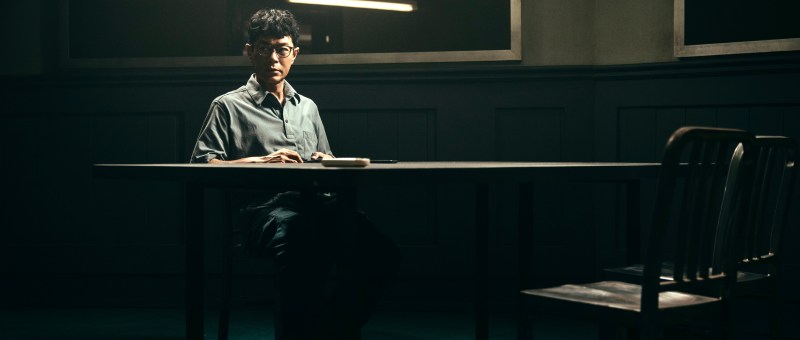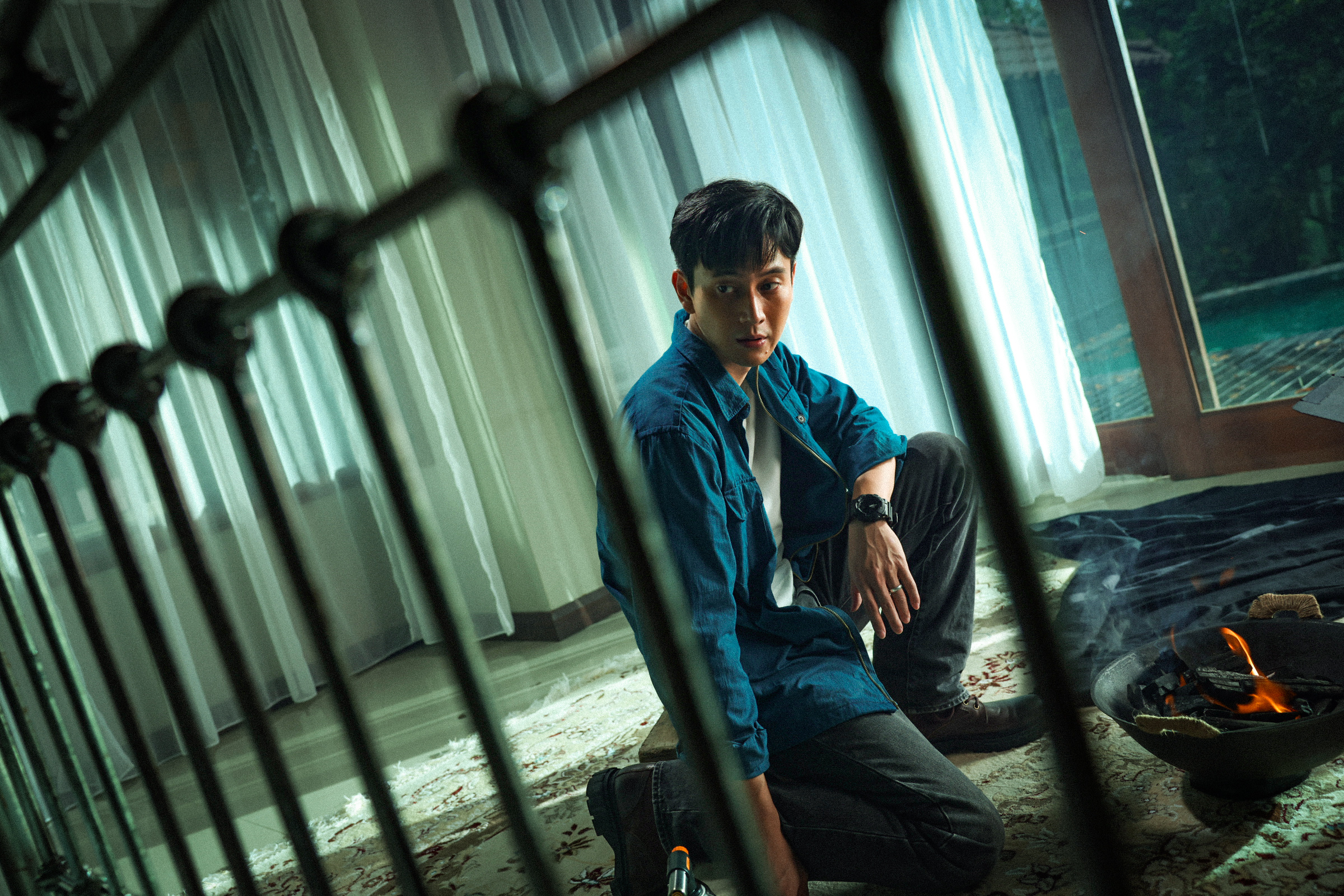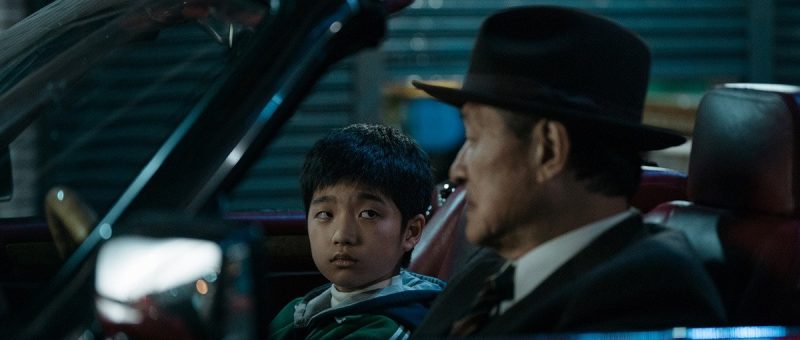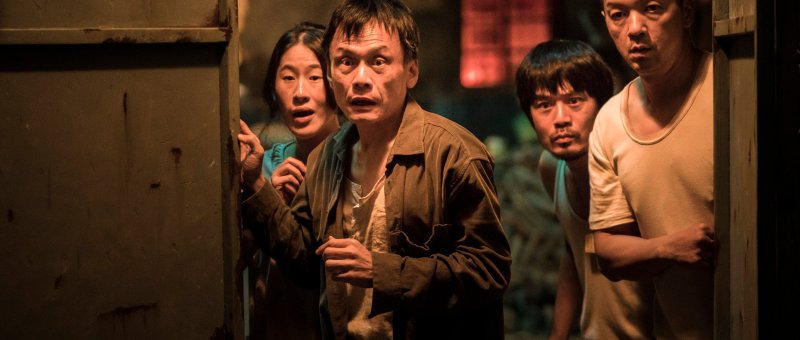

Behind the Shadows (私家偵探, Jonathan Li Tsz-Chun & Chou Man-Yu, 2025)

“At our age, we do what we have to do instead of obsessing over the good old days,” according to a put upon wife sick of waiting for her husband to make good on his promises. Jonathan Li Tsz-Chun and Chou Man-Yu’s Malaysia-set drama Behind the Shadows (私家偵探) is in its way as much about the disconnect in modern romance which has now been corrupted by capitalistic desires and frustrated notions of traditional masculinity as its central mystery. 

As someone says, in the old days women hired private detectives to chase their men, but now it’s the other way around. In someways, the parade of men rocking up at Wai-yip’s (Louis Koo Tin-lok) office to hire him to follow their wives, girlfriends, or women with whom they may not actually have much of a connection, all seem to be trying to regain control over their lives by asserting it over a lover they fear has betrayed them. Ironically, this is sort of true of Wai-yip too in that he’s taken to spending his evenings at his friend’s restaurant to escape his moribund marriage. When one customer brings him a photo of his own wife, Kuan (Chrissie Chau Sau-na), little knowing he’s the other man Wai-yip is irate but not as surprised as might be expected. Still, he hands the case off to a junior associate and tries to avoid thinking about it while otherwise passively seething about his wife’s potential betrayal.

But the ironic thing is that Kuan might only have done this to get Wai-yip’s attention and force him to confront their fracturing relationship. While Wai-yip hangs back, tries to act with maturity, and struggles to accept his wife’s decision, she privately wants him to fight back, to shout at her or punch her lover as a sign of manly love. She attacks his masculinity by berating him for being work-shy and refusing to have a child because they can’t afford it, though she can support them all on her salary, while Wai-yip remains hung up on the lost glory of his life in Hong Kong which he gave up to marry Kuan and move to Malaysia. The suggestion is that Wai-yip has been trapped in a kind of limbo, unable to let go of the past and embrace his new life and now Kuan is sick of waiting for him. 

The circumstances of his own marriage and the cynicism of 20 years spent chasing cheating spouses cause Wai-yip to be wary when a man comes and asks him to look for a runaway fiancée. He wonders if they’ve just had a tiff, if she’s left because the man was violent or unfaithful, or if the man is delusional and the woman doesn’t believe herself to be in a relationship with him and so is just happily living her own life. Along with all these anxieties is his sense of responsibility in knowing that this woman may be in danger if he finds her, as will Betty if Wai-yip manages to uncover evidence of her infidelity and relays it back to her gangster boyfriend. Like Kuan, Betty (Renci Yeung Sz-wing) says she just wants a man who will listen to her when she wants to talk and is half-minded to let Wai-yip send the video to find out if the gang boss cares about her enough to actually do anything about it. 

But the consequences of inaction are also brought home to Wai-yip when one of the women he’s following is murdered after he leaves his investigation to chase Kuan and her lover. Trying to makeup for his failure brings him into contact with a zombified cop, Chen (Liu Kuan-ting), whose wife is in a coma after a car accident. While Chen’s solicitous care and repeated pleading that his wife wake up may paint him as a lovelorn man, the marks on her arm that perfectly fit his fingers suggest a violent and controlling past along with a thinly concealed rage that she may have escaped him at last. “There’s nothing much the police can’t do,” he ominously tells Wai-yip while hinting at his desire for authoritarian control as mediated through the patriarchal institution of the police force and his rejection of a woman’s sexual freedom. Wai-yip feels similarly trapped as his own increasing sense of inadequacy deepens the gap between his wife and himself that leaves him unable to have an honest conversation with her about how he really feels and prevents him from healing the rifts within his own marriage even as he chases answers on behalf of other insecure men. What he indeed realises is that it’s time to move on from the past and live in the present, though as it turns out not even he may be strong enough to leave his insecurities behind. 


Behind the Shadows screened as part of this year’s New York Asian Film Festival.

Trailer (Traditional Chinese / English subtitles)

Old Fox (老狐狸 , Hsiao Ya-chuan, 2023)

It’s all about “inequality”, according to the titular Old Fox (老狐狸, lǎohúli). Or at least knowing how to leverage it. Inequality is something that’s coming to bother the young hero of Hsiao Ya-chuan’s coming-of-age drama in which a small boy finds himself torn between two father figures, one a wily old slumlandlord with a heart of stone and the other his melancholy and disappointed but kindhearted father who simply endures the many blows that life has dealt him. 

Set in Taipei in 1989 shortly before an apocalyptic stock market crash in the post-martial law economy crushes the hopes of millions of ordinary people convinced to invest their savings, the film wastes no time in showing us the various inequalities in play in small alleyway of traditional stores all owned by Boss Xie (Akio Chen) whom many seem to regard as a kind of saviour even if he cares not at all about them. Jie’s (Bai Run-yin) father Tai-lai (Liu Kuan-ting) works in a local restaurant and rents a room above a beef noodle cafe for which he pays in cash every week to Miss Lin (Eugenie Liu), a pretty young woman working for Boss Xie and enjoying an unusual amount of power for someone of her age and gender for a society still somewhat conservative. 

Tai-lai has been patiently saving money so that he can afford to buy a house and open a hair salon which was the dream of his late wife, but obvlious to the world around him he hasn’t noticed that prices are continuing to rise placing his dream of homeownership further out of his reach. Meanwhile, Jie is bullied at school and called a “snitch” without understanding why or even what the word means. This sense powerlessness and inferiority maybe be why he’s drawn to Boss Xie, a man who does after all exude power if also a sense of menace and melancholy. Xie in turn sees in Jie a potential protégé, both a mirror of his younger self and an echo of the son he lost who rebelled against everything he represents.

Nicknamed Old Fox, Xie stands for everything that’s wrong with the contemporary society which is about to implode in the financial crash. Wounded by his childhood poverty in which he, like Jie, also pleaded with a local landlord to sell his mother a property, Xie has adopted a ruthlessly selfish disregard for the lives of others teaching Jie his mantra of “none of my damn business” while the boy develops a worrying admiration for the aura a man like Xie projects and actively enjoys the sensation that others fear him. While hanging out with Xie he comes to look down on men like his father whom Xie calls “losers” who care only for others and disregard themselves. Xie teaches him to leverage the inequalities of power and turn his enemies’ weakness back against them to increase his own strength placing him further at odds with Tai-lai’s innate goodness and down-to-earth humanity. 

Yet we can also see that Tai-lai has had a life of disappointment. A woman who comes into the restaurant (Mugi Kadowaki) now married to a thuggish local big wig is a former childhood sweetheart from whom he was separated by time and circumstance while it also seems that Miss Lin has taken a liking to him though he appears not to have noticed. At home he plays the saxophone and takes in tailoring while resigned to saving a little longer before he’ll finally be able to buy a house and achieve his dreams. Tai-lai is one of the few who does not play the stock market and is therefore free of the danger it represents while Jie soon becomes sick of his his father’s frugality in their regular practice of turning the boiler off after having a bath and keeping their taps on a slow drip so they don’t trip the water metre and longs to become a man like Boss Xie unafraid to exploit any advantage in complete disregard for the lives of others. 

A brief coda set in the present in the day suggests that the older Jie may have found a happy medium, at least disguising a genuine concern for the safety and happiness of others as being solely about profit, while Xie’s sadness and doubts about the path his life has taken are never far from the surface as the society teeters on the brink of financial disaster. Capturing a palpable sense of late ’80s Taipei the film has a nostalgic atmosphere but also an equally prescient quality in the things that are only half-visible to the younger Jie in the melancholy disappointments of the adults who surround him still struggling to reroot themselves in a new society while overburdened by the failures of the old.


Old Fox screens April 22nd as part of this year’s San Diego Asian Film Festival Spring Showcase.

Original trailer (English subtitles)

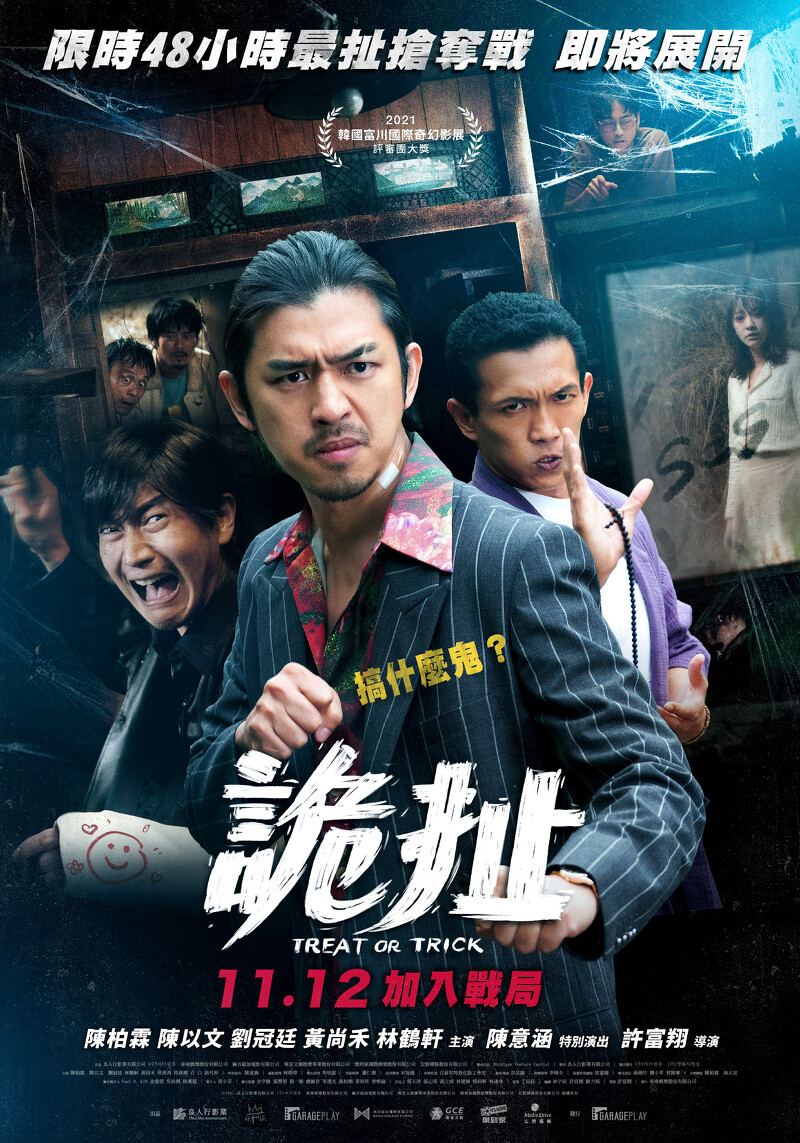
Treat or Trick (詭扯, Hsu Fu-Hsiang, 2021)

Diamonds, What it is it about them that makes everyone crazy? A bag of the elusive gemstones leads a series of corrupt cops towards a purgatorial hellscape deep in the mountains in Hsu Fu-Hsiang’s remake of the 2004 Korean film To Catch a Virgin Ghost, Treat or Trick? (詭扯, guǐ chě). The title could stand in for diamonds themselves which after all have little intrinsic value outside the illusionary desirability they evoke, but also hints at the “trickster” nature of its duplicitous hero. 

Corrupt cop Feng (Chen Bolin) admits that he didn’t join the police out of a fierce sense of justice, but because it was more convenient for his gangster lifestyle as he demonstrates in arresting a bunch of crooks only to stage a secondary robbery, getting his best friend Chiang (Yen Sheng-yu) to pose as a thief taking him hostage and running off with a bag of diamonds. Only, unbeknownst to Feng, Chiang has been picked as a fall guy for Boss Lin (Yu An-shun) to whom they were supposed to deliver the diamonds and has taken off with them. This is obviously a problem for Lin who takes cop Psycho hostage and charges Feng, his buddy Monk, and a guy from the gang Yang (Liu Kuan-ting), to track him down and bring the diamonds back. The trouble is that Chiang got into a car accident swerving to avoid the ghostly presence of a young woman and has wandered into a very weird village where everyone seems to be acting suspiciously. 

In many ways, you could see the village as a kind of purgatorial space inhabited by those trapped between two worlds towards which the gang of corrupt cops is beckoned to answer for their transgressions. Meanwhile, they’re also haunted by the figure of the mysterious woman whose presence is both help and hindrance hinting at dark goings on in this very remote area where visitors are a rarity. Having found out about the diamonds, the villagers are obviously keen to keep hold of them but then there are only so many to go round and it’s not as if you can cut a diamond in half, so the dilemma remains exactly who is going end up with the loot and how creating division on both sides. 

You couldn’t really say that either of these groups are the good guys, but it’s true enough that the villagers variously end up paying a high price for their greed usually caught out by their attempts to get one up on the cops, injured by backfiring weapons or caught in their own traps. Meanwhile, even Chiang falls victim to the essential weirdness of the village in succumbing to a freak accident which leads some to believe that he is dead though in a running gag he turns out to be more or less unkillable as if the eeriness of the place will not allow him to die no matter how many times he’s thrown off a hill, nailed in the head, crushed under falling objects, or set on fire. Yet Feng and his buddies remain largely untouched, outsiders in this strange world and completely by accident occupying some kind of murky moral high ground in trying to rescue their friend (along with diamonds which they need to get Psycho back and save their own lives by smoothing things over with Lin).

Hopping from the gangster movie to supernatural horror, martial arts, and mystery Hsu’s absurd morality farce throws in a series of running gags from “unlucky” Chiang’s strange ability to survive the unsurvivable to frequent allusions to the diamond sutra while possessing its own sense of karma as the greedy find themselves victims of their own scheming, but then perhaps not as the final twist might imply. Even so in this weird place, natures and destinies perhaps possess the ability to change, eccentric thug Yang getting far too into his role as a cop and finally deciding he’d like to be a “good guy” after all while guided by their brotherhood Feng and Monk too find themselves rediscovering a sense of justice in accidentally helping to solve a long dormant cold case. It’s all curiously circular, which is perhaps fitting for this farcical morality tale, but the jury seems to be out on whether even the brotherhood between Feng and his buddies not to mention their newfound sense of justice can survive the cursed allure of the stolen diamonds. 


Treat or Trick screens in Chicago April 9 as part of the 14th season of Asian Pop-Up Cinema.

Original trailer (Traditional Chinese / English subtitles)

A Leg (腿, Chang Yao-sheng, 2020)

“Life is long. We all have some regrets.” a grieving widow is told by a disingenuous doctor in full damage limitation mode. He’s not necessarily wrong, nor is his advice that the widow’s pointless quest to retrieve her late husband’s amputated limb has little practical value though of course it means something to her and as he’d pointed out seconds earlier a physician’s duty is to alleviate suffering of all kinds. Apparently inspired by the true story of director Chang Yao-sheng’s mother, A Leg (腿, Tuǐ) is in many ways a story of letting go as the deceased man himself makes a presumably unheard ghostly confession while his wife attempts to do the only thing she can in order to lay him to rest. 

Husband Zi-han (Tony Yang) is in hospital to deal with a painful, seemingly necrotic foot which eventually has to be amputated in a last ditch attempt to cure his septicaemia. “Keep the leg and lose your life, or keep your life and lose the leg” the otherwise unsympathetic doctor advices wife Yu-ying (Gwei Lun-mei) in a remark which will come to seem ironic as, unfortunately, Zi-han’s case turns out to be more serious than first thought and he doesn’t make it through the night. Grief-stricken, Yu-ying leaves in an ambulance with the body but later turns back, determined to retrieve the amputated foot in order that her husband be buried “complete” only it turns out that it’s not as simple as she assumed it would be. 

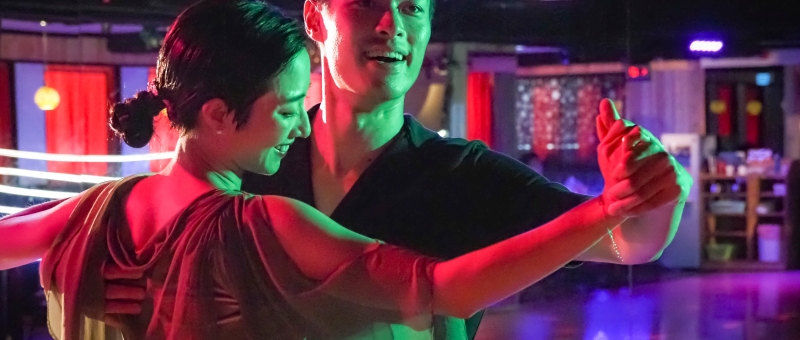
The loss of Zi-han’s foot is all the more ironic as the couple had been a pair of ballroom dancers. As Yu-ying makes a nuisance of herself at the hospital, Zi-han begins to narrate the story of their romance which began when he fell in love with a photo of her dancing in the window of his friend’s photography studio. Explaining that, having died, he’s reached the realisation that everything beautiful is in the past only he was too foolish to appreciate it, Zi-han looks back over his tragic love story acknowledging that he was at best an imperfect husband who caused his wife nothing but pain and disappointment until the marriage finally broke down. He offers no real explanation for his self-destructive behaviour save the unrealistic justification that he only wanted Yu-ying to live comfortably and perhaps implies that his death is partly a means of freeing her from the series of catastrophes he brought into her life. 

Given Zi-han’s beyond the grave testimony, the accusation levelled at Yu-ying by his doctor that the couple could not have been on good terms because Zi-han must have been ill for a long time with no one to look after him seems unfair though perhaps hints at the guilt Yu-ying feels in not having been there for her husband when he needed her. As we later discover, however, this is also partly Zi-han’s fault in that he over invested in a single piece of medical advice and resisted getting checked out by a hospital until he managed to sort out an insurance scam using his photographer friend, wrongly as it turned out believing he had a few months slack before the situation became critical and paying a high price for his tendency to do everything on the cheap. Nevertheless, Yu-ying’s quest to reattach his leg is her way of making amends, doing this one last thing for the husband whom she loved deeply even though he appears to have caused her nothing but misery since the day they met. 

In order to placate her, the slimy hospital chief offers to have a buddhist sculptor carve a wooden replica of Zi-han’s leg made from wood destined for a statue of Guan-yin goddess of mercy but Yu-ying eventually turns it down, struck by the beauty of the object but convinced that turning it to ash along with her husband’s body would be wrong while believing that wood ash and bone ash are fundamentally different. She regrets having ticked the box on the consent form stating she didn’t want to keep the “specimen”, never for one moment assuming that her husband would not recover. Despite their dancing dreams, she thought the leg was worth sacrificing against the long years they would have spent together after, though this too seems a little unlikely considering the state of their relationship prior to her discovery of Zi-han’s precarious health. Zi-han meanwhile is filled with regret for his continually awful behaviour and the obvious pain he caused his wife. Getting his leg back allows him to begin “moving on” while doing something much the same for Yu-ying though his afterlife pledge about the endurance of love seems a little trite given how he behaved while alive. A little more maudlin than your average quirky rom-com, A Leg nevertheless takes a few potshots at a sometimes cold, cynical, and inefficient medical system, inserting a plea for a little more empathy from a pair of unexpectedly sympathetic police officers, while insisting that it’s important to dance through life with feeling for as long as you’re allowed. 


A Leg screens Aug. 14  & streams in the US Aug. 15 – 20 as part of this year’s New York Asian Film Festival.

Original trailer (English/Traditional Chinese subtitles)

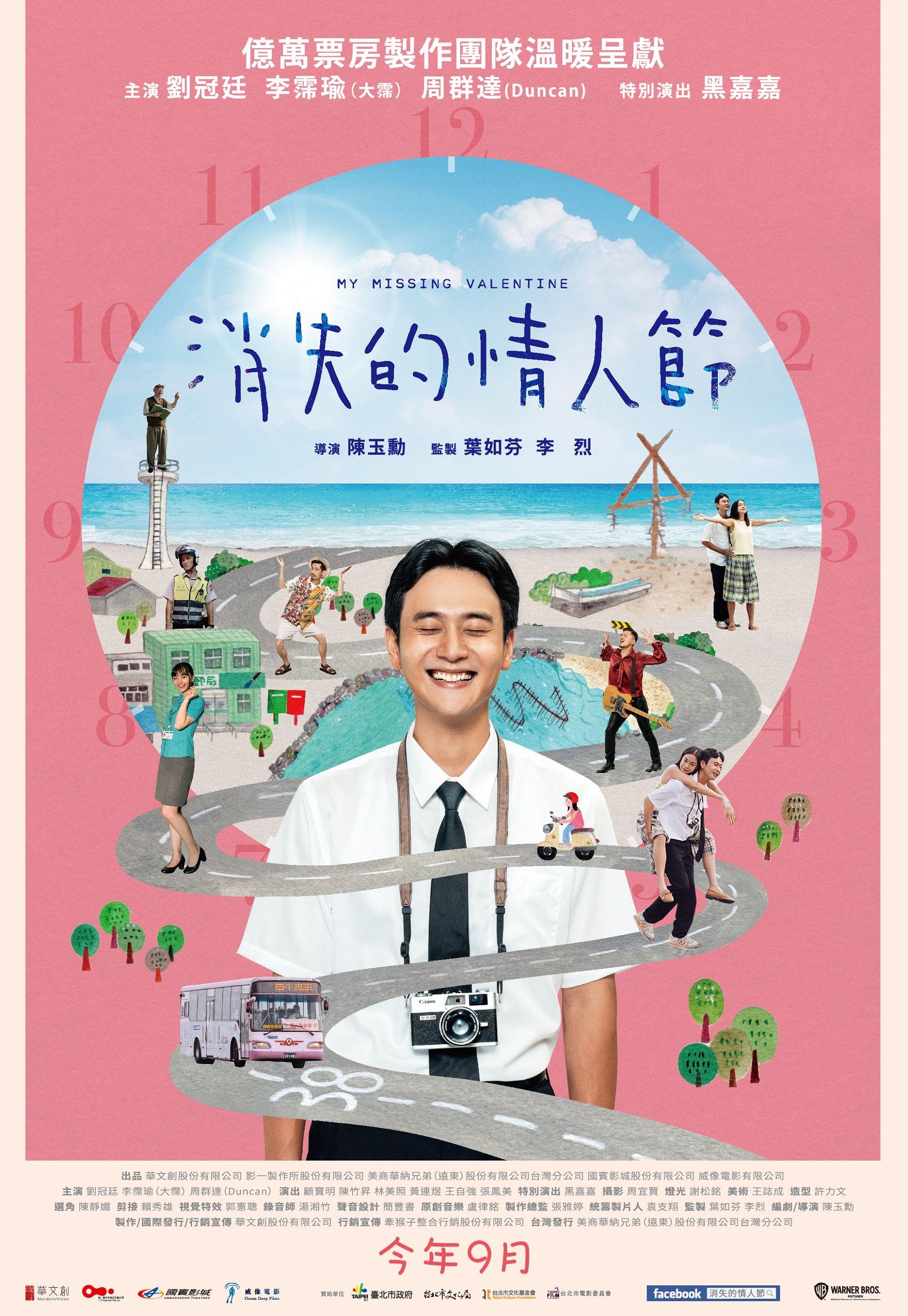
My Missing Valentine (消失的情人節, Chen Yu-Hsun, 2020)

“There’s a lot you don’t remember” the heroine of Chen Yu-Hsun’s quirky rom-com My Missing Valentine (消失的情人節, Xiāoshī de Qíngrénjié) is advised by a mysterious dream gecko arriving with clues retrieved from her subconscious to guide the way towards her romantic destiny. He also tells her that love is a matter of self-hypnosis, and in a sense he might be right in that what Hsiao-Chi (Patty Lee Pei-Yu) apparently needs is a time out, quite literally, to enable her gain a slightly different perspective in order to make peace with the half-remembered past and repair her fracturing sense of self. 

At 30, Hsiao-chi laments that she’s always been slightly out of sync with the world around her, perpetually racing ahead, laughing before the punchline and caught with her eyes closed in photographs. She blames this case of bad timing for her continued romantic failure along with the sudden disappearance of her father ten years previously who went out for tofu pudding and never came back. When she joins in with a dance class in the park and is courted by the handsome teacher (Duncan Chow) who asks her out on Chinese Valentine’s Day she thinks her luck is beginning to change, but when she wakes up with a mysterious sunburn and is told Valentine’s has been and gone she’s left only with a sense of existential confusion. 

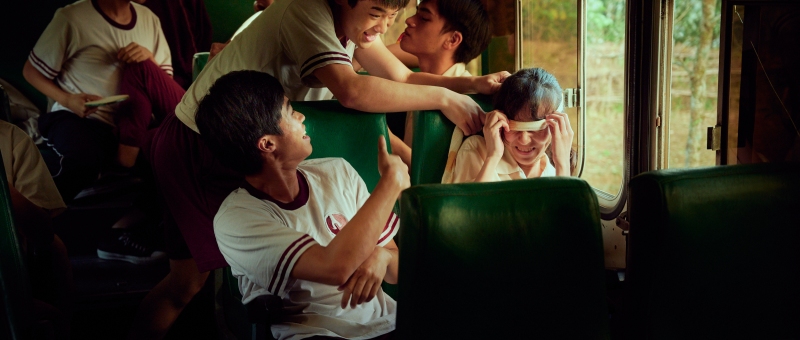
As the gecko implies, Hsiao-chi’s existence is defined by the things that she’s “lost”, be they fathers, orphaned memories, or an entire day. The sunburn at least tells her that she experienced Valentine’s outdoors, only she has no memory of it, while she later comes across a photo of herself, unblinking, taken in a place in which she’s sure she’s never been. As it happens, the sweet and funny explanation has its unpalatable qualities, Hsiao-Chi quite literally manipulated without her knowledge or consent unwittingly on an awkward “date” while in a catatonic state but nevertheless guided back towards the hidden secrets of her past the discovery of which will eventually allow her to shift into sync with the world around her.

Meanwhile she remains hopelessly smitten with the improbably suave dance teacher, falling for his obvious scam as he sells her a sob story about his traumatic past and an orphan with a heart condition only for her to ironically suggest they enter a three-legged race in an effort to get money to help her. She resents her pretty colleague at the post office (Joanne Missingham), complaining that ability is irrelevant when all anyone cares about is the superficial while presented with a series of eccentric characters including a chubby guy in search of a wife and a pervert professor, lowkey dismissive of a young man she refers to as the “weirdo” (Liu Kuan-ting) who comes in every day to mail a letter. Living in a rundown house share with another set of unusual people, she penny pinches for all she’s worth while listening to a sympathetic talk radio host and dreaming of romantic fantasy. Ironically what she finds is that she needs to slow down, see things from a different perspective not quite as “superficial” or judgemental as she’s hitherto been while opening herself up to receiving the messages from her past she’d long forgotten were even waiting for her. 

With its retro colour scheme and quirky worldview, Chen’s charmingly sophisticated screenplay marries an intriguing puzzle box structure with a genuine sense of existential questioning as Hsiao-chi ponders the nature of loss wondering if it’s really possible to mislay an entire day even trying to report it to the police as stolen while wondering if her new “boyfriend”, also missing, is more than mere romantic fantasy. The irony is that Hsiao-Chi works at the post office but struggles with communication, finally discovering she can only unlock the secrets of her past through the recollections of others, adding their perspective to her own in order to complete the panorama of their lives and allowing her interior mantra to shift from “love yourself because no one else will” to “love yourself because someone out there loves you”. Hsiao-Chi’s missing Valentine is in many ways the one to her herself as she rediscovers a sense of self-acceptance while finally finding her rhythm in sync with the world around her as she resolves to wait for love hopeful that it too will eventually catch her up. 


My Missing Valentine streams California until May 2 as part of San Diego Asian Film Festival’s Spring Showcase.

Original trailer (English subtitles)


The Silent Forest (無聲, Ko Chen-Nien, 2020)

There can be no justice in silence, but when those in a position to help refuse to listen what can be done? Inspired by true events, Ko Chen-Nien’s The Silent Forest (無聲, Wúshēng) takes aim at cycles of abuse and systems of oppression in society at large through a thorough investigation of the culture of silence at a school for deaf children in which endemic bullying spreads like a virus emanating from a single trauma inflicted by a negligent authority. Yet this kind of violence cannot be fought with violence and there must be empathy too for the bully or the chain will never end as Ko’s ambivalent conclusion makes clear. 

The film opens with a boy on the run, finally chasing down an old man and tackling him to the ground pummelling him until the police turn up and separate them. The policemen are frustrated. This is apparently the first time they’ve ever come into contact with a deaf person and have no idea how to communicate with him. Chang Cheng (Troy Liu Tzu-Chuan) tries to protest their injustice, but they continue to treat him as aggressor rather than victim even as he explains in writing that the old man had stolen his wallet (the old man claims he “found” it and was planning to hand it in). Finally a teacher from his new school, Mr. Wang (Liu Kuan-ting), turns up and interprets but it quickly becomes clear that he too is in a sense complicit, reporting that Cheng is sorry for what he did and grateful to the officers. In his view at least, the boy has his wallet back and there’s no harm done so why make a fuss? Just let it go and everyone goes home.

It’s this conflict between “silence” and justice that continues to prey upon Cheng’s mind after he starts at the school and becomes aware of the widespread culture of bullying witnessing a girl he likes being sexually abused by a gang of boys at the back of the school bus while the teacher sitting at the front does nothing. He tries to convince the girl, Beibei (Buffy Chen Yan-Fei), to tell one of the other teachers but she refuses, not wanting to “betray” her “friends”, insisting they were “just playing around”. Her reluctance however mainly stems from an intense fear of being sent away, that she might have to leave the school which is the only place she feels accepted. Both she and Cheng feel intensely othered in the hearing world, wary of being blamed for things that weren’t their fault as if their very existence were bothersome or “abnormal”. Even if it means putting up with extreme degradation, she would prefer it to the loneliness she felt before she found the school.

Yet the sense of social isolation is only one of the various oppressions to be found at the institution which ironically cultivates a culture of silence as regards the ongoing abuse as a means of preserving its reputation and therefore the “greater good” in providing the “safe space” from the social stigma the children face in the hearing world. Beibei points out that she was screaming, yet nobody could hear her. At first she tried to tell a teacher, but the teacher blamed it on her and implicitly on her disability insisting that the boys were “good kids” who were “just playing around” and didn’t understand she didn’t like it because she failed to communicate that she was uncomfortable. If they knew she was suffering they’d have stopped, the teacher insists before coldly walking away. Mr. Wang feels quite differently and wants to help but discovers that the culture of silence extends much deeper than he thought and the problem most likely cannot be solved through a few simple countermeasures but requires whole-scale systemic reform.

In fact, very little is done by the authorities leaving Chang Cheng with a hero complex believing that he has to be strong to beat the bad guys and save Beibei, but his righteous desire still leads him back towards complicity in order to protect her. The arch antagonist, Xiao Guang (Kim Hyun-Bin), bullies as a defence mechanism insisting that no one would dare bully him, manipulating others to do his bidding through the same mentality that one can either be a bully or a victim. Yet Xiao Guang is also a victim himself, a wounded damaged boy let down by a culture ruled by shame and unable to defend himself by any other means though apparently uniquely vulnerable to one particular aggressor. Only by addressing the root of his trauma can the cycle be brought to an end, but the concurrent cycles which he set in motion will in turn require their own resolution. A painful allegory, The Silent Forest boldly makes the case for speaking out but also admits that it doesn’t matter how loud you shout if no one is listening and without the desire for empathy and communication in all its forms the cycles will grow and repeat until the end of time.


The Silent Forest streams in Illinois until March 21 as part of the 12th season of Asian Pop-Up Cinema.

Original trailer (English subtitles)

Dear Loneliness (致親愛的孤獨者, Lien Chien-hung & Sunny Yu & Liao Che-yi, 2019)

“After 10 years or 20 years, you will feel less lonely. Surely you will not be hurt anymore due to your pure feeling and kindness” a warmhearted bookstore owner (played by literary superstar Lo Yi-chin AKA Lou Yi-chun/Luo Yijun) advises a series of young women in a parting letter, reminding them that the reason they suffer so is only their youth and that too shall pass. Inspired by Hou Chi-jan’s documentary series Poetries from the Bookstores which highlighted 40 Taiwanese indie bookshops, omnibus film Dear Loneliness (致親愛的孤獨者, Zhì Qīn’ài de Gūdú Zhě) features three segments helmed by three promising young directors selected through Dreamland Image’s Storylab featuring three women each consumed by loneliness at differing stages of youth. 

In the first of the stories, 12-year-old Xiaoyu (Lin Chi-en) is introverted and friendless. In common with the heroines of the other two segments, she is disconnected from her family, raised by a grumpy grandpa who hates her reading habit which he sees as a waste of time because it makes no money. Like many of the other girls at school, she has a crush on handsome teacher David (Chung Cheng-Chun) whose obvious enjoyment of the attention he receives has his relatively more authoritative colleague feeling worried enough to ask him if his behaviour isn’t a little inappropriate. Burying herself in romance novels and engaging in mental fantasies of her teacher Xiaoyu struggles with her adolescent desire while firmly rejected by her peer group, the girl on the next desk going so far as to adjust the angle of her selfie to avoid Xiaoyu being caught in the background. The irony is that David may indeed be engaging in inappropriate conduct with his students, just not with Xiaoyu whose jealousy and resentment may accidentally expose him for what he is but leave her even more marginalised. 

Kai-han (Angel Lee), meanwhile, also experiences parental alienation, yelled at by her unsupportive father just at the moment she really needs some help. Having left her small town for uni in Taipei she discovers a girl from the Mainland already in the room she thought was hers. Owing to some kind of mix up, she finds herself abruptly without accommodation with term about while the harried office admin lady is decidedly unhelpful. After taking temporary refuge in a bookshop where she’s berated by her father over the phone who accuses her of being lax with details and bringing this on herself, she decides to try getting the Mainlander to vacate “her’ room, but she is understandably unwilling seeing as she’s paid her rent for the term already. Things take a turn for the unpleasant when Kai-han discovers her wallet missing and after reading a series of xenophobic online comments decides the Mainland girl took it. She tries to get it back, perhaps mistakenly feeling she’s standing up for herself and taking responsibility but incurring only tragic consequences which yield ironic results. 

The oldest of the women, Xiaoxun (Chang Ning) who gives her age perhaps unconvincingly as 20, left her “indifferent” family in Kaohsiung for love, ending up on the fringes of the sex trade because she needed money. Yet she ends up taking a strange job in prison “rehabilitation”, flirting with the various lonely men who request her and vowing to wait for each of them until they get out. Prisoner 2923 (Liu Kuan-ting) is a little different, deep and introspective he forces her to realise that she too is imprisoned. “Each day goes by whether you’re happy or sad” she cheerfully advances, deflecting his questioning until the time runs out. He sends her to a book store, because you can’t recommend the best book, the best book chooses you. Meanwhile, she reflects on her problematic relationship with her ex who is now dating her friend before realising she’s hooked on the mystery of 2923, eventually hearing his story but allowing it to free her from her sense of shame and inertia as she ponders a return to source, perhaps finally meaning it when she tells him too that she will wait for him. 

The three women each experience loneliness and despair at different stages of life, but as the bookseller points out they are all very young. The key to escaping their loneliness, he claims, lies in experience, filling the void with “the fullness of life”. Asked what it is they should do he can’t say, but assures them that he would give them a hug “because you are very precious, you just don’t realise that now”. A strangely life affirming experience, Dear Loneliness is a gentle hand in the darkness pointing the way for those who feel hopeless and alone back towards a place of light and safety to be found, it seems, in your local indie bookshop.


Dear Loneliness streamed as part of this year’s New York Asian Film Festival.

Original trailer (English/Traditional Chinese subtitles)

It’s a Mad, Mad, Mad, Mad Show (瘋狂電視台瘋電影, Hsieh Nien Tsu, 2019)

It's a Mad, Mad, Mad, Mad Show poster 1New Year comedies are usually about food and community, but for those lonely souls with no one to go home to, perhaps TV can fill the void. That’s certainly been the way for kindhearted TV variety show producer Yeh (Ou Han-Sheng). As a young boy he was often all alone at home and turned to TV for comfort, but with the industry as soulless as it is, is it still possible to lose yourself in the glow of the television screen?

In truth, Yeh’s programming has never been very successful which is perhaps why he finds himself unexpectedly promoted to director by his shady boss Lo (Lin Yu-Chih) who abruptly fires almost everybody else while suddenly insisting on round the clock programming. Unbeknownst to the crew, Lo has fallen foul of eccentric gangster David (Yen Cheng-kuo) who has showbiz ambitions and is determined to buy Crazy TV at a rock bottom price. Lo promoted Yeh in the hope that he’d fail so the ratings would crash and the station would go bust. Yeh’s programming, however, while not exactly a smash begins to find its audience largely through the zany schemes he comes up with to make the most of his budget like substituting repetitive ads for a “signal problem” warning, running cutesy phone-in kids TV, and a deliberately boring overnight program narrated by a guy in a sheep costume and featuring complicated maths problems and military history designed to send you straight to sleep.

Meanwhile, the backstage drama kicks off as Yeh begins to get closer to aspiring Malayasian actress Diva (Lin Min-Chen) while still nursing a broken heart over a failed relationship with a rising star who dumped him for her career. The main issue is, however, his obsession with television as a lifelong friend. As lonely child, TV was there for him, and it was still there for him as an ambitious adult, but somehow it’s lost its way and Yeh isn’t sure how to guide it home. Eventually he has to consider selling his house and earning his living as a noodle vendor while he waits for TV to rediscover its sense of self.

Filled with references to retro Taiwanese television and Western movies, It’s a Mad, Mad, Mad, Mad Show (瘋狂電視台瘋電影, Fēngkuáng Diànshì Tái Fēng Diànyǐngwears its love of the medium on its sleeve but is clearly unafraid to stick the knife in as Crazy TV lives up to its name with a series of bizarre skits created to make up for the fact they have no actual reporters so cannot actually report the news. The only way back in for Yeh, his aspiring actor friend Abi (Liu Kuan-Ting), and Diva is to enter a competition where they have to go head to head with Mr. David reenacting The Godfather, a singer, a guy reading a book, and a pair of gamers. They choose the surreal with a high risk strategy inspired by the movie Money Monster which eventually goes in an unexpected direction. 

A chance meeting with an old friend currently shooting an indie movie brings home to Yeh what exactly has been missing in his TV life – “value”, as in everyone has something valuable in their hearts that ought to be expressed but often isn’t in the increasingly commercialised TV industry. The veteran director deposed during Lo’s mass purge eventually says something similar, that the audience for their programming is mostly the elderly and children and that therefore they should accept a little more responsibility for the programmes that they air and do their best to send positive messages rather than focus on sensationalist stunts designed to win short-term ratings.

Yeh’s epiphany comes a little late, but eventually leads him to realise that if TV was a friend to him it can be a friend of everyone else and then they can all be mutual friends bonding in shared enjoyment even if they’re apart. In true New Year spirit, it really was all about community after all. Adapted from the stage play by variety TV legend Hsieh Nien Tsu, It’s a Mad, Mad, Mad, Mad Show is a warmhearted tribute to the healing power of silly TV, bringing tired people together through shared bemusement as they eagerly tune in to the next crazy onscreen antics as an antidote the increasingly surreal offscreen reality.


It’s a Mad, Mad, Mad, Mad Show screens on 4th July as part of the 2019 New York Asian Film Festival. It will also be screened in Australia on 26th July as part of the Taiwan Film Festival in Sydney.

Original trailer (English/Traditional Chinese subtitles)