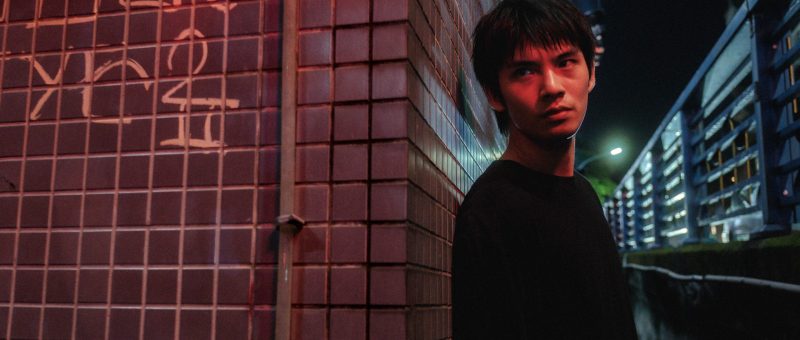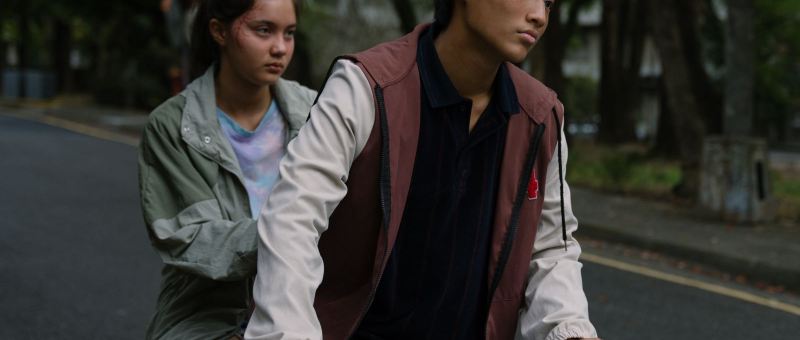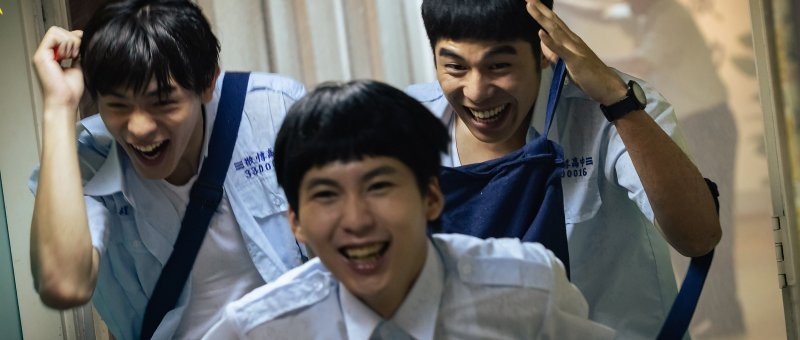
After School (成功補習班, Lan Cheng-lung, 2023)

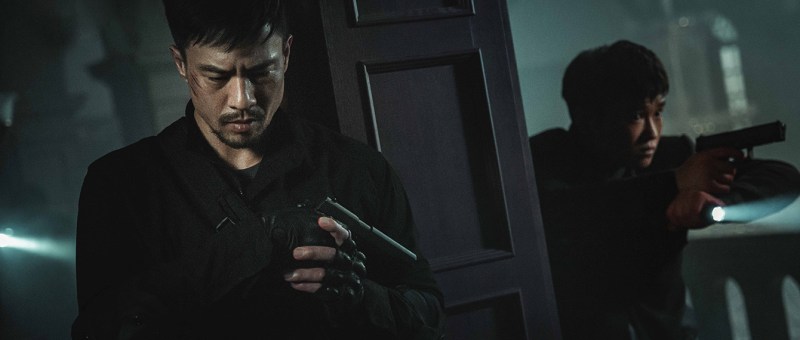
In an odd kind of way, Lan Cheng-lung’s autobiographically inspired coming-age drama After School (成功補習班) charts how far Taiwan has come since the mid-90s while pivoting around the figure of Mickey Chen, a hugely influential LGBTQ+ filmmaker who passed away 2018. Chen was in fact Lan’s own cram school teacher and in terms of the film a voice for the future giving the children the permission to be themselves in the post-martial law society even as they struggle to break free of the authoritarian and fiercely patriarchal past. 

In a sense, cram school itself is the manifestation of that culture in that most of the kids have been forced to go there by their parents to pursue futures not of their choosing. The hero Cheng Heng (Zhan Huai-Yun), Lan’s stand in, wants to be a filmmaker but his dad wants him to be a maths teacher. That might be one reason he and his friend Cheng Hsiang (Chui Yi-tai), who lives with his family because problems with his own, spend most of their time messing around and playing childish pranks on the teachers and admin staff. Meanwhile, they’re far mare interested in potential romance than studying with Cheng Hsiang a bit of a ladies man and Cheng Heng nursing a crush on the school’s most popular girl Chen Si (Charlize Lamb). 

Nevertheless, the closeness between the boys gives rise to a few rumours that they may be gay. The idea is only further cemented by an ironic incident in which Cheng Heng sustains an embarrassing injury to his groin while watching a pornographic video he swiped from a cousin little realising that it was actually gay porn. His parents, or really more his father, do not take well to this and see it perhaps as just more evidence of his rebelliousness and lack of respect for his family in his desire to follow his own path rather than the one they’ve set down for him of getting a steady, respectable job as a teacher. 

That’s one reason that the arrival of Mickey (Hou Yan-xi), a recent graduate taking a temporary teaching job to save for studying abroad, is thought so disruptive because he encourages the kids to be who they are not who they’re taught to be. Mickey holds progressive sessions on sex and sexual identity, explaining concepts such sexual orientation and safe sex which is surprising not least because this is a cram school which exists solely to help kids do well on standardised tests rather than give them any broader kind of education. The headmaster, who is also the father of the boys’ friend Ho Shang (Wu Chien-Ho), is by contrast an authoritarian remnant of the martial law era who can’t permit any kind of liberalisation or individualisation and often inflicts corporate punishment on pupils deemed to have transgressed the rules of a polite society. 

But it’s Mickey who tries to help the boys accept and become comfortable with their sexuality and that of others, taking them to a gay bar where he interviews several of the regulars for his documentary. The barman once entered a marriage of convenience and had a child to please his parents but feels deep guilt and regret for the way he treated his wife and his since been disowned by his family. Now he hosts a New Year dinner for others like him who have nowhere else to go because their families have rejected them. The boys too are rejected by their fathers solely on the suspicion of homosexuality while the mothers remain broadly supportive of their children but trapped by those same patriarchal social codes caught between their authoritarian husbands and love for their sons.

Yet even with these more distressing themes, Lan’s film is at times a little too rosy, sticking to its lighthearted tone rather than fully address the implications of society’s attitude to the LGBTQ+ community in the mid-1990s as opposed to that of today in which Taiwan became the first Asian nation to legalise same sex marriage. Nevertheless, it presents a warm-hearted firsthand account of the effect Mickey had on those around him as the teens rebel against the authoritarian past to embrace their freedom and identities, no longer afraid to speak their feelings but determined to be themselves and accept the selves of others rather than live under the constraints of oppressive patriarchy and traditions.


After School screened as part of the 18th Season of Asian Pop-Up Cinema.

Trailer (Traditional Chinese / English subtitles)

Yolo (热辣滚烫, Jia Ling, 2024)

In the training footage which plays over the closing credits of Jia Ling’s YOLO (热辣滚烫, Rè là gǔntàng), someone asks her why she’s learning to draw and she replies that she’s trying to become a better version of herself. The same is very much true of the movie’s heroine who trying to rediscover her will to keep fighting in a world that seems to have beaten her down and destroyed her spirit. Inspired by Masaharu Take’s 2014 boxing drama 100 Yen Love, Jia’s film is kinder and less cynical in tone while also taking on a meta quality in documenting the actress’ own transformation.

Then again, the film opens with a sequence laying bare the petty prejudices that surround Leying (Jia Ling) as a woman in her 30s unemployed and still living with her parents. It’s never revealed what exactly caused her to leave the job she got after college though she explains that she was unable to get another because she finds it difficult to talk to people. What seems apparent is that she is likely living with a heavy depression that is all too often dismissed as mere laziness by those around her and most particularly her mean and judgmental older sister (Zhang Xiaofei). The crunch time comes when her cousin Doudou (Yang Zi) who works for a TV company producing a reality programme about finding jobs for people who for various reasons struggle to get one, tries to bamboozle her into appearing on the show by turning up with a camera for an impromptu family intervention before even asking her if she wanted to take part.

In the attitudes of her family and most particularly the TV show which is ironically called “Find Yourself”, there is a degree of fat shaming in which Leying is treated in certain ways just because of her weight which is assumed be the outward manifestation of her problems. Doudou’s previous guest on the show had been a man who was obese and had mobility issues so they got him a job posing as Buddha for photos. It’s tempting to read Leying’s transformation as complicity with culturally defined notions of feminine beauty and ideal body shape, but the point really is that Leying is unhappy and as a people pleaser with low self-esteem unable to care for herself until she discovers boxing and literally learns to fight back. It is therefore also a little bit awkward that her first steps towards self-care are taken in order to look after a man, insecure boxer Hao Kun (Lei Jiayin), as she tries to help him achieve his dream while allowing him to mooch off her even though he treats her poorly.

Nevertheless, it’s seeing him give up without at fight that eventually spurs her on to start fighting back by taking up boxing herself and surprising those around her with her seriousness and determination. Asked why she’s doing it, she says that she just wants to win for once and eventually comes around to the idea of winning in her own way which doesn’t necessarily mean being named as the champion or beating someone else but holding her own and staying in the fight. What she regains is self-confidence and self-respect, no longer a willing doormat accepting whatever humiliation comes her way to avoid upsetting someone else but standing up for herself and gaining the courage to say no to things she doesn’t want to do. 

There is something quite moving in witnessing the actual transformation of actress Jia Ling throughout the credits sequence and most particularly when she comes to film the scene in which she walks parallel with her old self and has to turn back because it’s too much for her on a personal level. Jia shows us just how unhappy and hopeless Leying had become because of the way the world treated her, but also how singleminded pursuit of her goal gave her a new sense of purpose and a means of fighting back that showed her she could win in her own way when it came to life as well as in the ring. Swapping the grimness of Take’s original for something more broadly inspirational, Jia nevertheless hints at the prejudices of the contemporary society and its money-loving superficiality while simultaneously allowing her heroine to find and occupy her own space born of her own individual happiness rather than the acquisition of things other people think she should want but actually does not.


Original trailer (English subtitles)

A Song Sung Blue (小白船, Geng Zihan, 2023)

Late into Geng Zihan ’s coming-of-age drama A Song Sung Blue (小白船, xiǎo bái chuán), the heroine’s father (Liang Long) who perhaps knows a little more about her than we might have assumed, tells her that love and resentment are often the same thing. At least, they are both unforgettable. Resentments are something Xian (Zhou Meijun) has in spades, though she has little way of expressing them outside of her sullenness and silence while perhaps learning some unhelpful lessons in her seemingly unreturned attraction to the daughter of her father’s receptionist. 

Firstly, Xian is resentful towards her mother who has abandoned her to go on a humanitarian mission to Africa for an entire year explaining that the hospital have promised her a long awaited promotion after which she won’t have to do the nightshifts and so can spend more with her daughter, the irony being that by that time Xian will be in her late teens and perhaps less keen to spend time with her mum. Secondly, Xian is resentful towards her estranged father whom she only sees at family gatherings and has little connection with. She also seems resentful towards the other children in the choir and has no real friends. When the choir runs out of female uniforms she’s told to wear one of the boys and stand at the back hoping no one will notice. Meanwhile, she’s a little surprised after venturing backstage and catching sight of her choir mistress embracing another woman. 

Yet in other ways Mingmei (Huang Ziqi), the daughter of her father’s receptionist with whom he is also in a relationship, is simply her inverse. Flighty and confident, Mingmei appears much older than her years and is training to be an air stewardess but inwardly seems hurt and vulnerable. She lives a fairly chaotic life in which she’s learned at an early age how to weaponise her sexuality and largely relies on sugar daddies for her financial upkeep while hating herself for doing so. It’s after learning that the man in question maybe about to leave his wife and marry Mingmei that Xian abruptly kisses her but is immediately rebuffed, Mingmei running a thumb across Xian’s lips as if more concerned about what she may have passed to Xian than outraged or offended.

Then again, Mingmei seems to have been aware of Xian’s attraction while no doubt tipped off by the fact that she was playing around with a stethoscope and presumably noticed her heart beating unusually fast. At times she seems insensitive, wilfully so or otherwise, or perhaps simply doesn’t know how not to manipulate the attraction that she inspires in others cruelly taking Xian along on one of her sugar daddy dates or asking her to help her dress. But then Xian also learns some problematic lessons, adopting some of Mingmei’s behaviour patterns in attempting to manipulate the attraction shown for her by a boy in the choir she is otherwise uninterested in by virtually forcing herself on him and then asking for a loan to get the money for Mingmei to open a store so she won’t have to rely on potentially violent sugar daddies and would therefore be more available to Xian who has also developed a white night desire to save her from her self-destructive instincts.

The only bright spot in Xian’s melancholy existence which is generally coloured in blue, her desire for Mingmei is palpable even gazing at the many photos of her taken by her father including one in striking red. Yet there’s an another sense of distance in her longing given that Mingmei is a member of the Chinese-Korean community. Xian is at once struck by this additional layer of exocitity and bewildered by her inability to understand it knowing no Korean nor much of Mingmei’s culture. The film takes its Chinese title from the song Xian sings at the choir recital, the traditional folksong Little White Boat which actually originated in Korea. Xian is disappointed not to spot Mingmei in the audience little knowing that she had been there but left early. Later in the film, Mingmei sings the song herself but in Korean perhaps a way of letting Xian know she came after all, or else simply intended in the way song is often sung as one of parting. In any case, Xian is indeed like the little boat dotting the horizon drifting along barely noticed and with no means of controlling her direction. Geng frames her with a quiet empathy and a gentle sense of recognition for those whose gaze is rarely returned.


A Song Sung Blue screened as part of this year’s Queer East.

Trailer (English subtitles)
Polar Rescue (搜救, Lo Chi-leung, 2022)

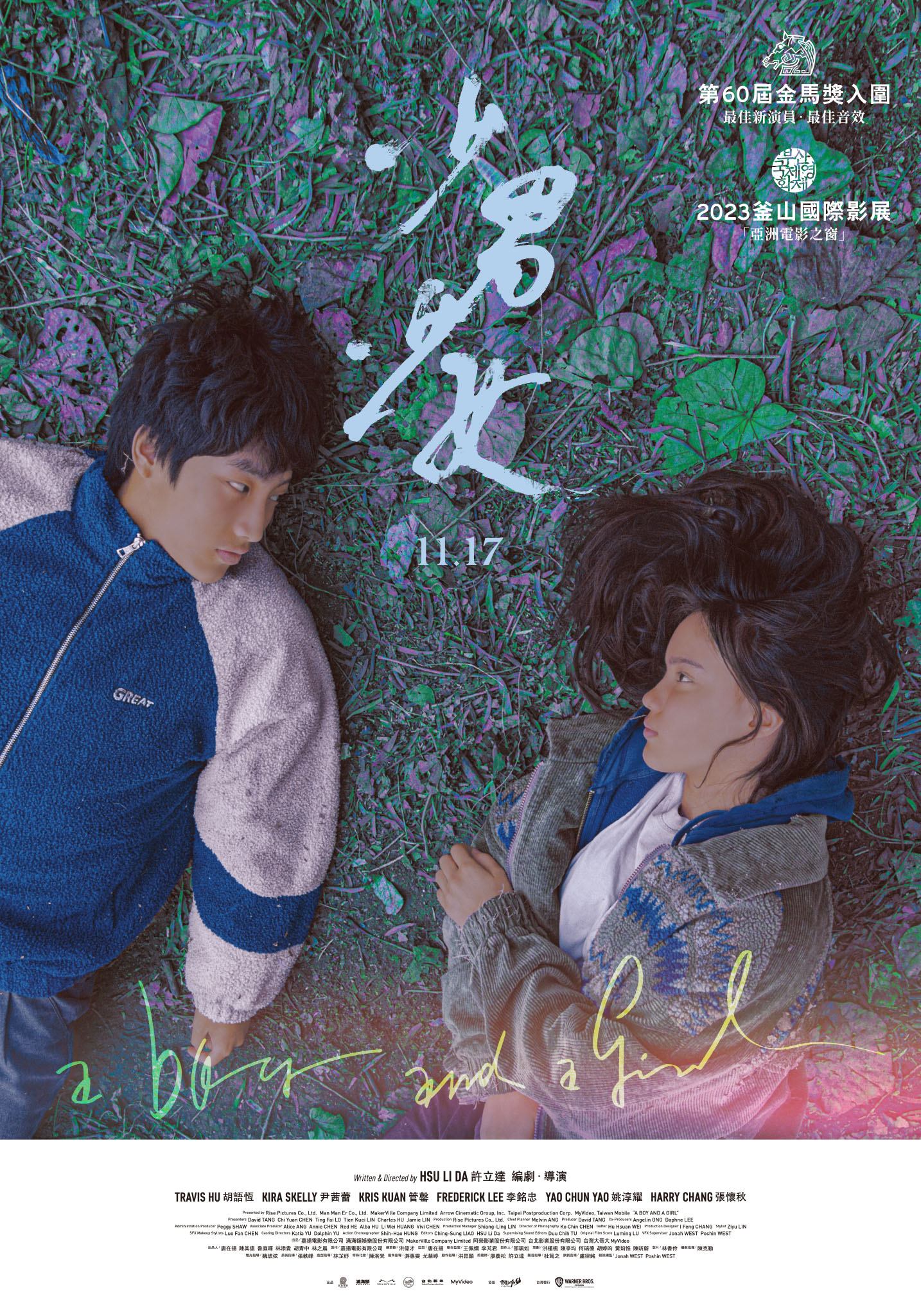
One of the more surprising things about Polar Rescue (搜救, sōujiù, AKA Come Back Home), a rare vehicle for Donnie Yen outside of the martial arts and action genres, is just how unheroic its panicked hero is. Though he may start off as a frantic parent who has our sympathies, we later begin to realise that he is at least severely flawed while there are also a few perhaps subversive hints towards the pressures of the modern China which have frustrated his attempts to be what he would assume a good father to be.

Despite later hints that the family is in a spot of financial bother, they’ve all gone on what looks like a fairly expensive skiing holiday in a European-style resort. The problem begins towards the end of their stay when eight-year-old Lele starts acting up in part because his father, De (Donnie Yen), promised to take him to Lake Tian to see the monster but has broken his word because of road closures due to the adverse weather. Wanting to make it up to his son, De decides to try going anyway via the backroads which are still open but soon enough gets stuck in a ditch. Events from this point on are deliberately obscured, but somehow Lele gets separated from his parents and sister and goes missing in the freezing wilderness. 

Rather than a father’s one man race against time to find his missing son, the film soon shifts into familiar China has your back territory as the full force of artic rescue complete with helicopters and specialist equipment is deployed to find this one missing boy. De is still not satisfied and at several points frustrates the rescue effort by getting into trouble himself without really reflecting that it’s his own irresponsibility and paternal failure that have caused the rescuers to risk their own lives trying to find his son. 

Though we might originally have sympathised with him, particularly as it seems clear Lele is behaving very badly and will not listen to either of his parents, we later come to doubt De on learning that Lele’s disappearance is at least in part related to an incredibly ill-advised though perhaps understandable parenting decision. As the film would have it, De is both too old fashioned in his authoritarian approach in which he’s often been violent towards his son, and too slack as evidenced by the boy’s bad behaviour. He’s failing in most metrics as a father given that he’s run into career difficulty as an engineer after challenging some of the nation’s famously lax safety regulations on a site he was working on he believed to be unsafe and then getting swindled on another construction project by a client who ran off with all the money. He also seems reluctant to allow his wife (Han Xue) to work to ease the family’s financial burden out of a mistaken sense of male pride. 

This ties in somewhat to the propagandist themes as we see him totting up how much it would cost to send his kids to school overseas only for his wife to tut that Chinese education is good too, while the fact the family have two children also hints at a new ideal in the wake of the loosening of the One Child Policy to encourage correction to the rapidly ageing population. The rescuers, meanwhile, are portrayed in a perhaps slightly ambiguous light given than many of them quickly become sick of De and think they should stop looking given the unlikeliness of a child surviving alone for several days in such freezing conditions. Some even suspect De may be responsible for his son’s disappearance and is using them to cover up the crime. Even so, they get to sing a rousing song to the tune of Bella Ciao and re-echo their commitment not to give up until they’ve found Lele even if it turns out to be too late to save him.

A subplot about the two-sided nature of social media in cases like these is dealt with only superficially, while many other things do not quite make sense including the inclusion of a bear and his cub whose appearance, though obviously serving a symbolic purpose, seems like overkill. Nevertheless, there’s a good degree of ambiguity in the central disappearance that helps to head off the otherwise predictable nature of its trajectory. 


Polar Rescue is out now in the US on Digital and Blu-ray courtesy of Well Go Usa.

US trailer (English subtitles)

The Soul (緝魂, Cheng Wei-Hao, 2021)

“Affection is the greatest obstacle on the path to success” according to the villain at the centre of Cheng Wei-Hao’s philosophical mystery, The Soul (緝魂, Jī Hún). Adapted from a science-fiction novel by Jiang Bo, Cheng’s near future tale has a series of questions to ask about legacy, family, love, and repression as its earnest investigator tries to come to terms with his oncoming end while living with treatment resistant cancer and trying to decide what is the best way to support his wife and unborn child in his impending absence. 

In 2032, police are called to the palatial estate of a local tycoon only to find him brutally murdered. Perhaps there’s nothing so shocking about that, powerful men have enemies, yet the strange thing is that Wang (Samuel Ku) was already dying of brain cancer and had a very short time left to live so there would seem to be little advantage in bumping him off early. The prime suspect is his disgruntled son Tien-yu (Erek Lin) who was seen leaving the mansion in a hurry and is known to bear a grudge against his father over his mother’s death while Wang’s much younger second wife Li Yen (Sun Anke) also identifies him as the killer. But there are definitely a few things which don’t add up here. Why is Wang’s business partner Wan named as his second choice as heir after Li Yen despite the rumours he had been having an affair with first wife Su-chen (Baijia Zhang), why are there security cameras in Li Yen’s bedroom, and why would a man with so little time left to live opt for an arranged marriage to an orphaned 20-year-old woman from one of the orphanages his philanthropic organisation supports?

Those are all questions which immediately present themselves to veteran investigator Liang (Chang Chen) whose own wife Pau (Janine Chang Chun-ning), also a policewoman, is pregnant with their child while he has just learnt that his cancer has resisted all treatment and may in fact be incurable. Deciding his remaining time may be best spent providing what he can for his family he asks his boss for his job back and specifically to be put on the Wang case, immediately homing in on the company’s radical new treatment for cancer through transplanting rejuvenated neurons directly into the brain. He begins to wonder what comes with it if you begin implanting neurons that belong to someone else but gets no reply from Wan in the middle of his sales pitch. 

Hinted at in the Chinese title the question that arises is that of the connection between soul and flesh and whether it becomes possible to achieve a kind of immortality through colonising brains in healthy bodies, an idea which might of course prove appealing to Liang if he were not so innately incorruptible. Then again as his wife says, perhaps it’s easier to die. It’s the ones left behind who have it hardest, suddenly left to deal with everything on their own. That might be why she finds herself tempted by their rather obvious conflict of interest in compromising her integrity to buy her husband a few more days while he wonders what the point of such a sacrifice might be.

Yet what we discover in the unhappy saga of the Wangs is both a megalomaniacal obsession with control that extends beyond one’s own lifetime and a tragic love story born of internalised shame that led to a lifetime of repression and unhappiness in the inability to be one’s authentic self. Liang describes the RNA treatment as an expression of the living’s obsession with the dead, while others describe it as “modern necromancy” oddly echoing the black magic which Su-chen, herself a neuroscientist, and her son had apparently been practicing in their intense resentment of Wang. Pau insists she’d rather believe a soul exists no matter in what form, but if you make division of yourself you may also face an unexpected existential threat born of your own internal conflicts and mutual desire for survival. A slow burn mystery, Cheng’s eerie drama has its share of hokum but nevertheless asks some pertinent questions about the nature of humanity in an increasingly technological age, what it is we leave behind and how it is we move forward (or not) with the process of letting go even as its ironic final moments provide a kind of justice emotional and literal in restoration of a family. 


Postman (邮差, He Jianjun, 1995)

“You young people ask too many questions,” an exasperated postmaster tells a young man trying to refuse a job transfer but somehow embodying an authoritarian voice of order in post-Tiananmen China. The statement is in many ways ironic not least of them being that Xiao Dou (Feng Yuanzheng) barely speaks at all and mounts only a passive resistance to his dissatisfying existence. A portrait of repression, alienation, despair and hopelessness He Jianjun’s epistolary drama Postman (邮差, Yóuchāi) casts its hero as little different from the pillar boxes he instals on behalf of a distant authority, a soulless conduit for the thoughts and feelings of others. 

Xiao Dou is only “promoted” to the role of postman after his predecessor, an elderly man, confesses that he had taken to reading the letters he was supposed to be delivering and is ominously put into the back of a police van. In any case, it’s not long before Xiao Dou starts doing the same thing himself, transgressively relishing in his life as an epistolary voyeur reading the correspondence between an unhappily married woman and her lover with salacious obsession. Objecting to the affair on moral grounds he rejects his role as a passive messenger to interfere in their lives and put to a stop to it though later finds himself visiting a sex worker whose letters to a doctor he had stolen, while otherwise withholding a letter from a young man to his father in which he informs him of his intention to take his own life. 

Ironically assigned to the “Happiness District”, Xiao Dou encounters only yearning and confusion which echo the sense of hopelessness and despair among post-Tiananmen youth which continues to flounder in the changing China of the mid-90s. Then again in this rural backwater not much seems to have changed in the past few decades. The post-office where Xiao Dou works is marked by the maddening rhythms of his colleague Yun Qing (Huang Jianxin) rapidly stamping letters individually by hand before handing them off to Xiao Dou to deliver. The relentless sound and motion seems to reflect her own sexual repression which she eventually relieves by seducing the shy Xiao Dou who then takes another step forward towards transcending himself in completely abandoning conventional morality and compassion for others. 

Hitherto, Xiao Dou had not shown much interest in women and is annoyed when his sister suggests introducing him to a girl from the factory. His first visit to the sex worker, more out of voyeuristic curiosity than desire, ended in failure, yet he remains obsessively invested in the melancholy love letters he collects on his rounds detailing the longing and unhappiness of those around him. Perhaps the most surprising is between a gay writer who has become a drug user and his lover who seems to have disappeared. The writer later dies, presumably of an overdose if one provoked by a broken heart and despair for his life, but the existence of homosexual relationships usually considered so problematic by the censor’s board is otherwise depicted without comment save the uncomfortable implication that is a symptom of the moral decline of contemporary society. In any case, Xiao Dou does not seem to object to it or to the drug taking in the same way he does the affair though he may just assume it will eventually take care of itself. 

Like the writer’s lover, however, disappearances become common place. We see someone approach the pillar box to post a letter but when Xiao Dou turns around they have disappeared almost as if they too were sucked inside. Later he will disappear behind a pillar box he has just fitted in a new part of town the mail did not previously reach while his sister watches him fade out of view from the window of a bus as it rounds a corner. Xiao Dou’s sister had been keen for him to marry because she wanted to get married herself but was reluctant to leave the home their parents left them and wary of Xiao Dou’s ability to get by on his own. Yet through his various transgressions, Xiao Dou in a sense comes of age and is able of overcome his own repression to embrace his otherwise taboo desires in defiance of conventional morality. 

Xiao Dou asks his colleague why it is that things that are so hard to say come out easier in letters, but she answers him that for her it’s the opposite. She prefers to talk and once wrote a letter to a friend only to find herself unable to post it while standing in front of the box ironically enough because she doubted that it would arrive safely. His sense of reticence reflects the enforced silence of life in post-Tiananmen China, men and women afraid to speak their minds and imparting their true souls only to a trusted confidant in a letter but discovering that not even that is safe from prying eyes or the oppressive judgement of an unseen authority. Xiao Dou may see himself as a kind of angel, a passive emissary working on behalf of a higher power, but in liberating himself from his own repression falls still further a product of an ongoing moral disintegration born of nihilistic despair. 


Trouble Girl (小曉, Chin Chia-hua, 2023)

The sad thing about Xiaoxiao’s life is that everyone is so intent on making her just like everyone else rather than trying to find ways to allow her to be more of herself. The film’s English title, Trouble Girl (the Chinese being simply her name, 小曉, xiǎo xiǎo), might hint at the external attitudes towards her in which she is seen only as a disruptive troublemaker while largely friendless and bullied by the other kids in her class.

The irony is that it’s only her teacher, Mr Chen (Terrance Lau Chun-him), who is actively trying to help her but he does so from a place of corrupted paternity in that he’s been having an affair with her mother, Wei-fang (Ivy Chen Yi-han), which began as a consequence of their meetings to discuss Xiaoxiao’s ADHD diagnosis and how to manage it at school. Seemingly under stimulated, Xiaoxiao ignores her classes and plays video games instead while Mr Chen doesn’t really say anything before gently taking her aside to suggest it’s not a good idea. He’s a proponent of positive reinforcement but is also a regarded as a soft touch by some of the other parents who increasingly turn against Xiaoxiao, regarding her as a disruptive presence damaging their kids’ education. 

Then again, it’s mostly these kids who are bullying Xiaoxiao for being not quite like them. Mr Chen has started some kind of secret program in which kids can get stickers for being nice to her, but it’s largely backfired as they alternately provoke Xiaoxaio because they think it’s funny when she loses her temper and act friendly when the teachers are around. Rather than attempting to make some accommodations for her, the school is only capable of trying to force her to behave in exactly the same way as everyone else. On an awkward camping trip with her mother and Mr Chen, he suggests capturing a frog but despite her fascination with them Xiaoxiao rejects the idea. She wouldn’t want the frog to be trapped in a bottle, and later attempts to free an owl from a cage symbolising her own desire to be free to be herself. After being suspended from school, she heartbreakingly tells her mother that she just wants to stay home and learn not to take pills anymore.

But then Wei-fang has problems of her own. She’s trapped too. Her husband has been living abroad for some time and it’s clear the marriage is all but over while she struggles to bond with Xiaoxiao and is ill-equipped to deal with her needs, perhaps on some level ashamed that she isn’t living up to the middle class ideals professed by the other mothers. She even may even resent her for trapping her in a dissatisfying domestic arrangement but is alternately frustrated that Xiaoxiao does not really want to play with her and prefers her father or Mr Chen. We see her struggle with her emotions too, sometimes slapping Xiaoxiao and shouting at her for doing something wrong or getting into trouble. 

Her affair with Chen may be a kind of escapist fantasy, but he seems to take it seriously and provides a positive, paternal presence in the absence of Xiaoxiao’s father who though he seemed caring later offers quite a harsh critique of his daughter that suggests he regards her as a disappointment. Nevertheless, it’s quite troubling that her sort of friend Xiaoshan calls Mr Chen “Paul” and is friendlier with him than seems appropriate but then her parents are involved with running the school so perhaps she simply knows him on a more personal level. Even so, the connection seems to arouse an odd kind of jealously that interacts with her disapproval of her mother’s betrayal of her father in having the affair. 

When Xiaoxiao tries to free the owl, she is surprised to discover that it simply flies back to its porch as trapped as both she and her mother though no longer with any desire for escape. Sympathetic towards the film’s twin heroines, Chin shoots with a down to earth naturalism though through the eyes of Xiaoxiao who is really just looking to be accepted for who she is while observing that her mother is much the same but even approaching middle-age seems no closer to finding accommodation or fulfilment.


Trouble Girl screened as part of this year’s Osaka Asian Film Festival.

Original trailer (English subtitles)
Article 20 (第二十条, Zhang Yimou, 2024)

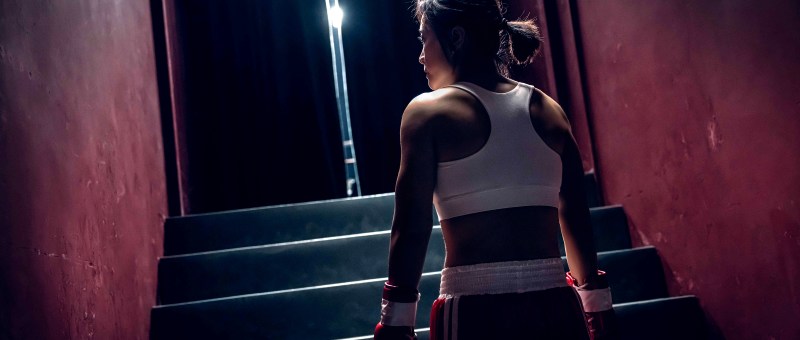
There’s something quite strange going on in Zhang Yimou’s New Year legal dramedy Article 20 (第二十条, dì èrshí tiáo). Generally speaking, the authorities have not looked kindly on people standing up to injustice in case it gives them ideas, yet the film ends in an impassioned defence of the individual’s right to fight back in arguing that fear of prosecution should not deter “good” people from doing “the right thing” such as intervening when others are in danger. Nevertheless, the usual post-credits sequences remind us that the legal system is working exactly as it should and the guilty parties were all caught and forced to pay for their crimes.

In this particular case, the issue is one akin to a kind of coercive control. Wang (Yu Hewei) stabs Liu 26 times following a prolonged period of abuse and humiliation. After taking out a loan to pay for medical treatment for his daughter who is deaf and mute like her mother Xiuping (Zhao Liying), Wang was terrorised by Liu who chained him up like a dog and repeatedly raped his wife. Prosecutor Han Ming (Lei Jiayin) eventually argues that his attacking Liu qualifies as self defence under Article 20 of the constitution because even if his life was not directly threatened at the time it was in the long term and he did what he did to protect himself and his family from an ongoing threat.

Han Ming becomes mixed up in several different cases along the same lines only with differing levels of severity. Some years ago he’d worked on the case of a bus driver who was prosecuted after stepping in to help a young woman who was being harassed by two louts. His problem was that he got back up after they knocked him down and returned to the woman which makes him the assailant. Zhang has spent most of his life since his conviction filing hopeless petitions in Beijing. Meanwhile, Han Ming’s son, Chen (Liu Yaowen), gets into trouble at school after stepping in to stop obnoxious rich kid and Dean’s son Zhang Ke from bullying another student.

Now jaded and middle-aged, Chen first tells his son that he should he give in an apologise to get the boy’s litigious father off his back though Chen is indignant and refuses to do so when all he did was the right thing in standing up to a bully. Bullying is the real subject of the film which paints the authoritarian society itself as a bully that rules by fear and leaves the wronged too afraid to speak up. The choice Han Ming faces is between an acceptance of injustice in the pursuit of a quiet life and the necessity of countering it rather than live in fear while bullies prosper.

The thesis is in its way surprising given that the last thing you expect to see in a film like this is encouragement to resist oppression even if the idea maybe more than citizens should feel free to police and protect each other from the immorality and greed of others. It is true enough that it’s those who fight back who are punished, while the aggressor often goes free but according to Han Ming at least the law should not be as black and white as some would have nor be used as a tool by the powerful, or just intimidating, to oppress those with less power than themselves. 

Other than the theatrical drums which play over the title card, there is curiously little here of Zhang Yimou’s signature style while the film itself is not particularly well shot or edited. It also walks a fine line between the farcical comedy of Han Ming’s home life in which he perpetually bickers with his feisty wife (an always on point Ma Li) who worries he’s too interested in his colleague Lingling (Gao Ye) who turns out to be an old flame from his college days during which he too was punished for standing up to a bully by being relegated to the provinces for 20 years. A minor subplot implies that the justice-minded Lingling is largely ignored because of the sexist attitudes of her bosses who feel her to be too aggressive and often dismiss anything she has to say in what amounts to another low level instance of bullying. The film ends in a rousing speech which seems more than a little disingenuous but even so ironically advocates for the right to self-defence against a bullying culture while simultaneously making a case for the authorities having the best interests of the citizen at heart which would almost certainly not stand up particularly well in court.


Article 20 is on limited release in UK cinemas courtesy of CMC.

International trailer (English subtitles)

Monk Comes Down the Mountain (道士下山, Chen Kaige, 2015)

A wandering monk is forced to consider a series of dualities presented by his traditional upbringing and burgeoning modernity in Chen Kaige’s ‘30s wuxia Monk Comes Down the Mountain (道士下山, dàoshì xiàshān), inspired by the work of novelist Xu Haofeng. Essentially a picaresque, Chen sets orphan He Anxia (Wang Baoqiang) adrift in the secular world where he learns to see good and bad and perhaps the murky overlap between the two while simultaneously telling a rather subversive tale of frustrated same sex love and corrupt authorities. 

When the temple at which he was abandoned as a baby falls into financial difficulty, He Anxia enters a kung fu fighting competition he believes will put him first in line for food only in cryptic monk fashion the “prize” turns out to be exile as the winner is obviously the most capable of looking after themselves alone in the world. He Anxia is however something of an innocent and despite the monk’s warning to stay true to himself soon falls into difficultly yet ends up discovering a new father figure in monk turned pharmacist Tsui while trying to steal his fish. For all of Tsui’s goodness, however, there is discord in his house as his pretty young wife Yuzhen (Lin Chi-ling) prefers his dandyish brother, Daorong (Vanness Wu), who has abandoned the filial piety of the past to chase modern consumerist pleasures in selling the shop he inherited for a fancy ring. When the situation escalates, Anxia finds himself taking drastic action only to wonder if he did the right thing. 

Head of a local temple Rusong (Wang Xueqi) encourages him to think beyond dualities, wondering if he did the right thing for the wrong reasons or the wrong for right. This temple is famous for helping women have male children through praying to goddess of mercy Guan Yin, yet under Rusong’s predecessor they adopted a much less spiritual solution to the problem in simply providing a place where other men could father their sons. Rusong again asks him if the men who took part were sinners or saints while laying bare the paradoxes of the monastic life in the contemporary society. A petitioner goes so far as to ask Anxia if he might be her saviour, pointing out that if she cannot provide a male heir even though the problem may lie with her husband she may be cast out of her family, thereby disgraced not to mention financially ruined. Having lived all his life in the temple surrounded by men, gender inequality is not something Anxia had been very aware of. He tells her that though he had no family he was able to find one only to lose it, little understanding why she might not be able to do the same. 

On the other hand, he appears to show surprising perspicacity in the touching moments in which he must say goodbye to his second father figure, reclusive kung fu master Xiyu (Aaron Kwok), in realising the depth of his feelings for army buddy Boss Zha (Chang Chen) who then becomes his final master. Ironically, the obviously homoerotic relationship between Xiyu and Boss Zha was perhaps less controversial in 2015 than it might be in the present day but its inclusion is nevertheless surprising if also poignant as Xiyu tells Boss Zha that he should resume his stage career, marry and have children, while he will live a quiet and lonely life perfecting his kung fu though he will always keep him in his heart. Fiercely loyal to his mentors, Anxia accepts this relationship totally and appears to fully understand its import to Boss Zha to whom he subsequently transfers his allegiance as they band together to face off against big bad Peng. 

Playing into the good fathers and bad motif, Peng’s problem is his sense of paternal rejection in being passed over by his biological father in favour of Xiyu whose skills are stronger. After having ousted his rival, Peng fears the same thing will happen to his own son who is not only lacking in aptitude for martial arts but also appears to have a drug problem. To win they resort to cheating in picking up a pistol signalling both their own lack of jianghu honour and the nature of the changing times in which the very nature of kung fu has perhaps become obsolete. Meanwhile, Anxin and Zha are targeted by the police commissioner, Chao, who happens to be a former triad and also points his gun at them if less successfully while in cahoots with the amoral Peng and son.

Only through each of these subsequent encounters does Anxia begin to realise why he was cast down from mountain, understanding that he had to witness the good and bad of the secular world in order to understand his Buddhist teachings and finally find his place. With sumptuous production values perfectly recreating the 1930s setting, Chen’s quietly subversive 20th century wuxia takes aim at the ills of the contemporary society in its tales of corrupt authorities and amoral greed, but eventually finds solace in simple human goodness and genuine relationships as Anxin continues on his long strange journey to find his way home. 


International trailer (English subtitles)
The Storm (大雨, Yang Zhigang, 2024)

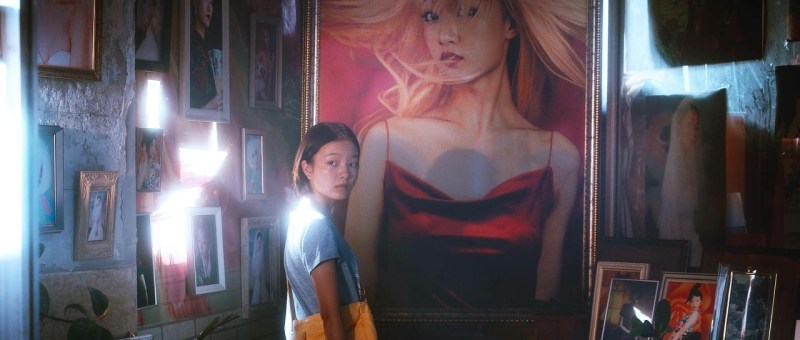
A cosmic storm is likened to the chaos of life in Busifan’s beautifully drawn but narratively obscure family animation, The Storm (大雨, dàyǔ). Set seemingly in a fantasy past which is also a kind of post-apocalyptic future in which mankind has ruined itself through greed, the film is at heart a kind of redemption story in which those left behind attempt to exorcise the negative emotions of the past and ease the destruction they have wrought by abandoning outdated ideas of wealth and status. 

The hero, Bun, is a young orphan adopted by the elusive Biggie who found him drifting down a river in a chest. Biggie decided to adopt the boy as his own but never allowed him to call him father while himself struggling the stigma of having been a criminal. Biggie sometimes leaves Bun on his own while he goes off to try and earn money to give him a better life and justifies his actions that everything he’s doing is only for Bun. Later in the film he expresses regret for “lying” to him, pretending the world was not so chaotic as is it is as the pair become embroiled in a supernatural curse while looking for the famed Nuralumin Satin said to be aboard a mysterious black ship filled with monsters. 

According to biggie, the Black Dragon Army hunting the Nuralumin birds into extinction led to an explosion in the jellyfish population while a prophesy states that the jellyfish will soon unite with another monstrous force during a cosmic storm becoming an awesome dragon that casts a shadow over the land. The ship itself seems to be a symbol of insatiable greed, a kind of floating marketplace in which people entered in search of riches but did not leave again. Inside, they became monsters devoid of all humanity and hungry only for material gain. 

The king’s own mother is said to have fallen victim to the curse, while his nephew also knew a troupe of opera singers who boarded the boat in search of an audience but have apparently lost their way. The spirits of the opera singers recount their plight, that as lowly entertainers they were only ever looked down on and abused no matter if they entertained the king himself and all his other royals. That they fell victim to the curse seems to be a condemnation of outdated ideas about social class and the stigmatisation of a profession, while Biggie’s fate seems to imply something similar. No matter how much he tried to turn himself around and be a good father to Bun, the world continued to reject him and he was left only with crime as a means to support himself. That’s one reason he wants the Satin, so that Bun will be looked after for the rest of his life and they won’t have to debase themselves anymore. 

We can see that the area they live in which is close to the famed Dragon Bay where the Black Ship eventually resurfaces is rundown and abandoned perhaps itself because of the lore that surrounds the area. Even so, the backgrounds are gorgeously animated with flowers in full bloom and Bun making his way through colourful and lively vistas of rural beauty. Yet it’s just this beauty that mankind’s greed has destroyed in the Dragon Army’s senseless killing of the Numalurin birds for which their guardian tribe has never forgiven them. Only the return of these birds and the giant deity that protects them can help end the curse, restoring the proper balance to the land in which the jellyfish are kept in check and the dragon cannot be formed. 

It has to be said that narratively the film is incredibly confusing and difficult to follow, at least for viewers who do not speak Mandarin. Nevertheless, what shines through is Bun’s redemptive power as he desperately tries to rescue Biggie from his own worst impulses, his greed and desperation in being drawn to the black ship like moth to a flame and in danger of being turned into one of the monsters. Constantly accompanied by round ball of fluff he encounters several other cute creatures while otherwise guided by a handsome young man who seems to be made of cloud while his wish that he really could stop Biggie from leaving by treading on his shadow might in an odd way come true. Boundlessly inventive, the film’s ideas sometimes get ahead of itself but are more than made up for in the unshowy beauty of its fantasy world. 


International trailer (Simplified Chinese / English subtitles)