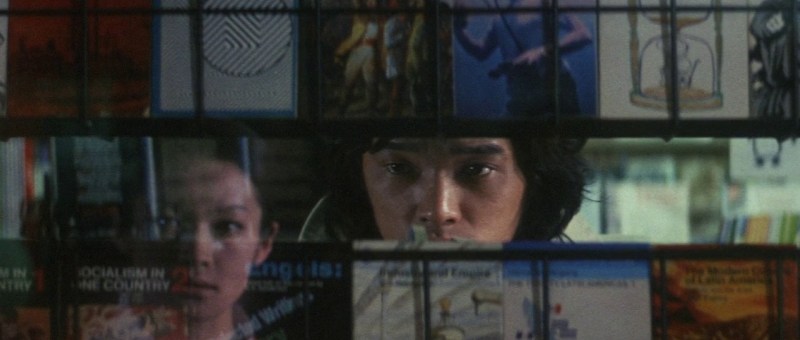

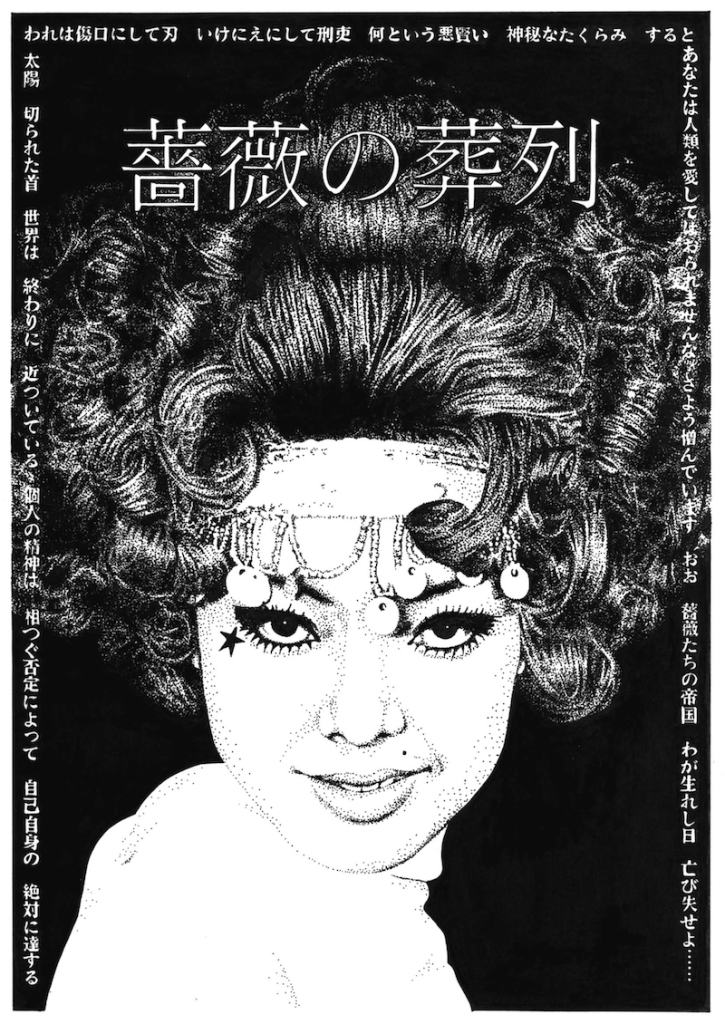
An angst-ridden medical student wrestles with truth and responsibility while drawn into a toxic relationship with a childhood friend and trying to avoid the estranged mother he resents in Masahiro Shinoda’s dread-laden melodrama The Petrified Forest (化石の森, Kaseki no Mori). Based on a novel by Shintaro Ishihara who later became a very conservative mayor of Tokyo and made his name with a series of “Sun Tribe” novels centring on the nihilistic hedonism of wealthy post-war youth, Shinoda’s noirish drama paints contemporary Tokyo as a duplicitous place in which hate is the only possible emotion and self-delusion the only path out of existential loneliness.
Haruo’s (Kenichi Hagiwara) first conflict, however, is with the medical profession. He objects to the old-fashioned methods of his professor, Miyaji (Torahiko Hamada), who adopts the position of the physician as god only giving his patients the information he thinks they should have rather than the truth. A young boy, Kazuhiko (Masami Horiuchi ), is brought in with an aggressive brain tumour. Given how how quickly it regrows, there is a possibility that the boy cannot be cured while operating will likely mean he will lose his hearing. Though Miyaji knows all of this, he continues to give false reassurance to the boy’s mother, Kikue (Masako Yagi), even after making a snap decision on the table to excise the tumour knowing it will leave him deaf telling her that her son’s hearing might come back in time. Pressed for an answer, Haruo gives her the more honest prognosis that it “might”, “if he’s lucky”, but resents himself for “lying” knowing that Kazuhiko will be deaf all his life and the tumour may still recur. One of the reasons he wants Miyaji to tell the truth is so that the family can accept the situation and start working on the best ways to help Kazuhiko adjust, but Miyaji refuses to explain and in fact threatens to fire him if he won’t do as he’s told.
This resistance to a male authority figure might explain why he identifies so closely with childhood friend Eiko (Sayoko Ninomiya) now in Tokyo working at a barber’s offering male beauty treatments. Eiko is being sexually harassed by her middle-aged boss who is jealous and possessive. At one point she claims that he beat her and locked her up in a cupboard for two days after she told him she had slept with Haruo. The pair agree that he boss needs to die, rebelling against his corrupt and patriarchal authority. ”When you hate you must hate all the way” Haruo insists, explaining that the human race is “petrified”. They can only hate and loathe and lie to themselves in order to bear it. Haruo suggests they’ll eventually come to hate each other, but Eiko is certain that he’s her one exception though as will be revealed hate is eventually where they will end up.
Fascinated by a high tech pesticide supposedly discovered by the Germans while they were testing poisonous gases but perfected by Japan Pharma, Haruo decides to use it poison to Eiko’s boss suggesting she put it in nail varnish and offer him a manicure. But once the deed is done he finds himself conflicted, unable to live with himself as a murderer which he now is seeing as he was present and applied the gauze soaked in the poison to the boss’ face while “treating” him after he had been “taken ill”. He distances himself from Eiko who irritates him by bringing over her hoover, somehow confused by her intention to move in now that they are married not least by their crime. Eiko, however, allies herself with his estranged mother Tatsuko (Haruko Sugimura) who is desperate to live with Haruo as it turns out by any means possible.
There is an undeniable whiff of misogyny in the depiction of the two women, Eiko less damsel in distress than wilful manipulator and Tatsuko a classic overbearing mother though one apparently indifferent to her other two children including an apparently doting younger son. Haruo is caught between the two while otherwise drawn to Kikue in part because of her relationship with her son laying bare the apparent mother complex which defines his life as Eiko eventually points out calling him a coward who secretly craves his mother’s approval. Haruo’s resentment towards Tatsuko stems from having caught her with another man, his reaction both sexual jealously and puritanism unable to forgive for the transgression of adultery. Yet history later repeats itself, Kazuhiko who is at that point deaf walking in on Haruo and his mother. Haruo hugs him and covers his eyes only for the boy to later lose his sight and Kikue to go out of her mind wailing that she has destroyed her son through her sexual transgressions.
Kikue had taken Haruo to a strange cult where she hoped Kazuhiko would be cured though he wouldn’t enter the church and later got into a conversation with the monk who is a former doctor but now believes medicine is a con because it cannot offer you salvation tacitly agreeing with Haruo’s assertion that doctors too are dishonest. This tendency to hate has rendered everyone lonely, Tatsuko’s daughter reminding her that she is lonely too even with her husband and children while Tatsuko later cruelly uses Eiko’s loneliness against her as a tool of manipulation. “Eiko trusted me too much” she explains, her attempt at female solidarity and forging a bond through their shared desire to possess Haruo obviously failing to overcome Tatsuko’s matriarchal machinations. The eerie blue colour of the poison vial, mirrored in the nebuliser forever used by Tatsuko, seems to loom behind them as a reminder of human loathing while mother and son are frequently caught in multiple mirrors in an echo of their duplicity yet in the end as Tatsuko says they share the same sin and it seems Haruo will never really be able to escape the matriarchal net.
 “It’s not all about tofu!” screams the heroine of Akanezora: Beyond the Crimson Sky (あかね空), a film which is all about tofu. Like tofu though, it has its own subtle flavour, gradually becoming richer by absorbing the spice of life. Based on a novel by Ichiriki Yamamoto, Akanezora is co-scripted by veteran of the Japanese New Wave, Masahiro Shinoda and directed by Masaki Hamamoto who had worked with Shinoda on Owl’s Castle and Spy Sorge prior to the director’s retirement in 2003. Like the majority of Shinoda’s work, Akanezora takes place in the past but echoes the future as it takes a sideways look at the nation’s most representative genre – the family drama. Fathers, sons, legacy and innovation come together in the story of a young man travelling from an old capital to a new one with a traditional craft he will have to make his own in order to succeed.
 Masahiro Shinoda, a consumate stylist, allies himself to Japan’s premier literary impressionist Yasunari Kawabata in an adaptation that the author felt among the best of his works. With Beauty and Sorrow (美しさと哀しみと, Utsukushisa to Kanashimi to), as its title perhaps implies, examines painful stories of love as they become ever more complicated and intertwined throughout the course of a life. The sins of the father are eventually visited on his son, but the interest here is less the fatalism of retribution as the author protagonist might frame it than the power of jealousy and its fiery determination to destroy all in a quest for self possession.
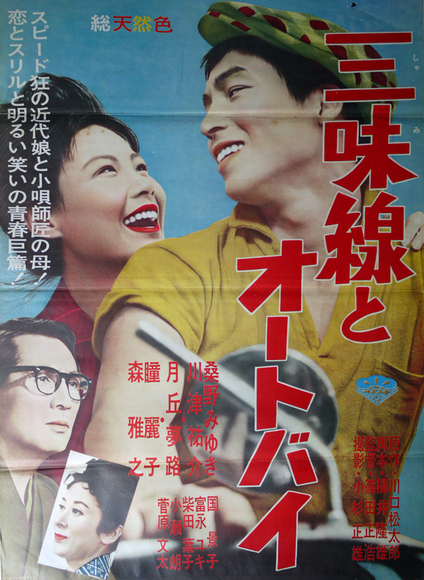 Masahiro Shinoda’s first film for Shochiku,
  Although Masahiro Shinoda has long been admitted into the pantheon of Japanese New Wave masters, he is mostly remembered only for his 1969 adaptation of a Chikamatsu play, Double Suicide. Less overtly political than many of his contemporaries during the heady years of protest and rebellion, Shinoda was a consummate stylist whose films aimed to dazzle with visual flair or often to deliberately disorientate with their worlds of constant uncertainty. Like so many of the directors who would go on to form what would retrospectively become known as the Japanese New Wave, Shinoda also started out as a junior AD, in this case at Shochiku where he felt himself stifled by the studio’s famously safe, inoffensive approach to filmmaking.
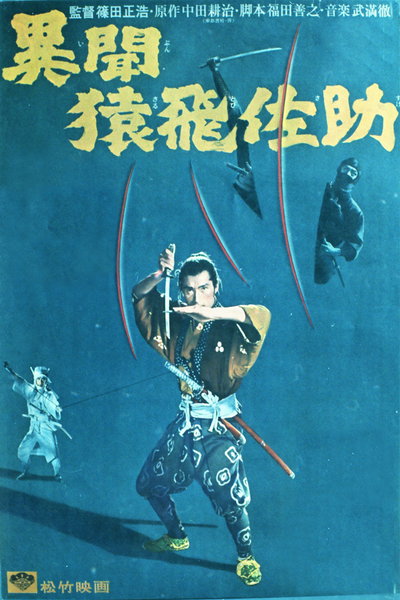 Nothing is certain these days, so say the protagonists at the centre of Masahiro Shinoda’s whirlwind of intrigue, Samurai Spy (異聞猿飛佐助, Ibun Sarutobi Sasuke). Set 14 years after the battle of Sekigahara which ushered in a long period of peace under the banner of the Tokugawa Shogunate, Samurai Spy effectively imports its contemporary cold war atmosphere to feudal Japan in which warring states continue to vie for power through the use of covert spy networks run from Edo and Osaka respectively. Sides are switched, friends are betrayed, innocents are murdered. The peace is fragile, but is it worth preserving even at such mounting cost?
 Every once in a while an artist emerges whose work is so far ahead of its time that the audience of the day is unwilling to accept but generations to come will finally recognise for the achievement it represents. So it is for Sharaku – a young man whose abilities and ambitions are ruthlessly manipulated by those around him for their own gain. Brought to the screen by veteran new wave director Masahiro Shinoda, Sharaku (写楽) is an attempt to throw some light on the life of this mysterious historical figure who comes to symbolise, in many ways, the turbulence of his era.
 Windows on Worlds