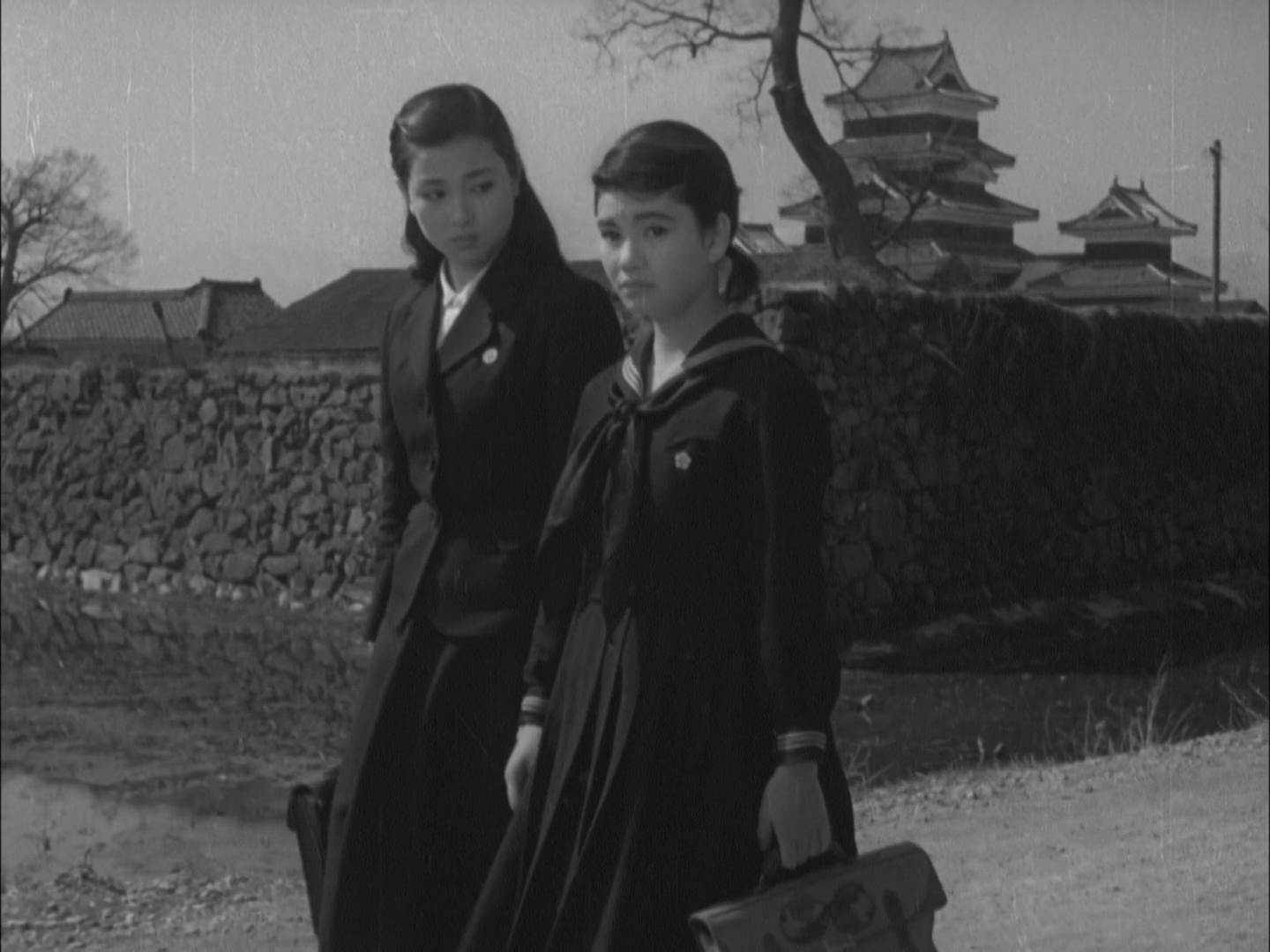
Sisters (姉妹, Miyoji Ieki, 1955)

Two sisters find their paths diverging amid the changing society of post-war Japan in Miyoji Ieki’s adaptation of the autobiographical novel by Fumi Kuroyanagi, Sisters (姉妹, Kyodai). Updated to the present day and co-scripted by Kaneto Shindo, the film paints the sisters as representing a generational divide with the older, much more conservative of the girls is drawn to a traditional lifestyle while equally corrupted by the city in her conversion to Christianity, while the younger is a truth-telling free spirit deciding that she doesn’t want that kind of life and will find a husband for herself if indeed she ever decides to marry.

The Kondo family is evidently quite progressive in that they are not wealthy but have chosen to send both of their older daughters to study at middle and high school in the town where they lodge with their mother’s sister (Yuko Mochizuki). They also have three younger brothers who have stayed with their parents in the village, while their father (Akitake Kono) works at a hydroelectric dam. The fact that he works at a power plant aligns him with the post-war recovery which is largely built on the back of these new engineering endeavours, but there is little discussion of the ways in which they’ve changed and disrupted rural life. 

As New Year approaches, everyone is looking forward to them meeting their end of the year challenge so they’ll get a 1000 yen bonus only for a sudden outage to occur on the deadline day. The older sister, Keiko (Hitomi Nozoe), becomes fond of a worker named Oka (Taketoshi Naito) who is part of the labour movement and often sings Russian songs but is an economic migrant from another town living frugally while sending most of his pay back to his mother and siblings. He is already supporting a family, and therefore has no prospect of marriage for the foreseeable future. Even if he and Keiko have taken a liking to each other, they each accept the practical reality and agree that it is better that Keiko accept an arranged match her parents have set up for her with a young man who works in a bank. The groom’s occupation echoes the increasing urbanisation of the nation, as the parents clearly believe the marriage will buy Keiko a much more comfortable life in a higher social class even if Keiko seems to want to stay in the village.

While they lived in the town, Keiko converted to Christianity out of loneliness because she could talk to God any time she wanted. Toshiko (Hitomi Nakahara), the younger sister, points out it might have been a better idea to make friends who were a bit more local, but despite appearances Keiko seems better suited to a more old-fashioned way of life. Christianity reinforces her conservatism in that she hopes to always be pure and correct and takes against those she does not think to be. On their visit home, the girls witness a young woman they know be beaten by her husband who is much older than her. Keiko takes against the woman and rudely leaves her home. Later the woman is beaten again because her husband discovers a young man in their home. No additional explanations are sought, the woman is assumed to have been involved with another man more her own age, but surprisingly some of the villagers speak in her defence telling her husband he’s being unreasonable and raising the double standard that men do this sort of thing all the time. The woman tells Keiko to be careful whom she chooses for a husband. She came to this village never having met the man she would marry, and now she’s stuck here with a child. Her only ray of light is that she will raise her son to be a better man than his father. 

Keiko’s future happiness depends entirely on the nature of a man she doesn’t know. In the town, the girls had been somewhat disillusioned when their long-absent uncle Ginzaburo (Jun Tatara) returns home from working away and they catch him drunk in the street cavorting with geisha. This is really a double betrayal, not only stepping out their aunt, but selfishly spending what little money they have on trivial pleasures for himself. But like an inverted picture of village life, their aunt seems not to mind and accept it as just something men do. The same uncle is also picked up for illegal gambling, which is more of problem in a practical sense aside from additional evidence of this moral failings. 

All of these experiences have certainly soured Toshiko’s view of marriage, and most particularly of arranged ones which are something that belongs to the older Japan that Keiko still inhabits. A worker at the plant asks Keiko if she’ll be going to university, but she replies that girls in her family don’t and that she’d rather be married. Toshiko, meanwhile, on witnessing the suffering of those around her and most particularly the poor decides she’d rather be a doctor or politician to try and change society. She supports the strikers at the plant who are protesting against job cuts, but also says they should have resisted more when the protests fail as if they were somehow at fault in their lack of commitment. Her father’s reaction to failing to stop the lay-offs is to stop Toshiko going on her school trip because the other workers’ children can’t even go to school now their fathers have been let go, which doesn’t really make sense and is not really fair, though he is also worried about his job amid this very changeable society. 

For Toshiko’s part, she remains staunchly of the village but is ironically more suited to life in the town, which is to say the future. People are always telling her that she speaks her mind too often and that people in the town aren’t as forgiving as those in the village, but she continues to speak as she finds and indifferent to censure. Keiko criticises her for behaving like a boy, wearing rustic work clothes and chopping wood while they’re home for New Year and not helping out with the domestic work like cooking and cleaning which she thinks of as a daughter’s duty. Toshiko develops a friendship with a wealthy girl from school who apparently likes her more than a friend and asks her to be her first kiss, lending a queer-coded dimension to Toshiko’s rejection of traditional gender roles and desire for a more independent life in the town. 

She recognises both that greater class disparities exist in the urban environment than they did in the village, but also feels sorry for her friend who shares the same name but is trapped by her privilege. When Toshiko visits their home, it’s clear the girl’s mother looks down on her because she’s not of their social class, while Toshiko’s friend has an older sister and younger brother with apparent disabilities that the family keeps hidden away in shame. Meanwhile, the sisters become aquatinted with an elderly couple who are both disabled themselves while their daughter is ill with TB. Without thinking, Toshiko uses a slur word to describe a disabled person when talking about her friend’s family without thinking about the fact that the father is also blind. They don’t mind at all, but if even Toshiko is thoughtless enough to use a word like that it only reinforces the prejudice of the world around her.

The implication is that if the old couple lived in the village, there would be people around to help them, but in the town everyone is anonymous and indifferent. The state should be filling in for the community, but it isn’t and there’s no one to help the vulnerable in the increasingly capitalistic post-war society. The irony is that Uncle Ginzaburo says everything was better in the war and that Japan can’t survive without conflict, while the fact the economy is improving in the mid-1950s is entirely due to the stimulus of the Korean War. Even so, Toshiko remains generous of spirit. She doesn’t agree with her sister’s decision and is worried for her, but also agrees that they can only be true to themselves and follow their own paths. This is what Keiko has chosen, no matter how it might turn out, while Toshiko has rejected it, insisting she’ll find her own husband if she wants one and vowing to be useful and fight injustice in the wider world whatever form that may take. She wishes her sister good luck as she watches her disappear over the horizon, and sets off on her own path into a future that’s equally of her own choosing.


Until We Meet Again (また逢う日まで, Tadashi Imai, 1950)

Til we meet again poster 1Despite later becoming a member of the Communist Party, Tadashi Imai had spent the war years making propaganda pictures for the militarist regime. He later described his role in the propagation of Japanese imperialism as “the worst mistake of my life”, and thereafter committed himself to socially conscious filmmaking. Imai was later identified most closely with a style that was the anthesis of many his contemporaries branded “realism without tears”. Nevertheless, in 1950 he found himself making a full on romantic melodrama with anti-war themes. Until We Meet Again (また逢う日まで, Mata Au Hi Made) was, unofficially, an adaptation of Romain Rolland’s 1920 novel Pierre et Luce in which war conspires against the pure hearted love between two innocent young people.

Relocated to the Tokyo of 1943, Until We Meet Again begins at its conclusion with anxious student Saburo (Eiji Okada) pacing the floor, prevented from meeting his one true love, Keiko (Yoshiko Kuga), because his sister-in-law has fallen dangerously ill. Having just received notice that his draft date has been moved up and he’s expected to report for duty that very night, he fears he may never see her again whereupon he flashes back to their early courtship, all adolescent innocence and filled with the pure joy of falling in love for the first time.

Yet, as much as the war is the destructive force which will always stand between them, it’s also the one which brings them together. Saburo makes nervous eye contact with a pretty girl sheltering in a subway during an air raid. They are both afraid, and he chivalrously comforts and shields her with his body. Most particularly in the Japan of 1943, such bodily contact with a stranger of the opposite sex would be considered extremely inappropriate. There would be no other opportunity to enter this mild kind of physical intimacy save for the external pressures of life in war. Saburo doesn’t yet know the name of the woman in the subway, but can seemingly think of little else, seeing her everywhere he goes and looking for her in every face he sees. When they finally “meet”, they both agree that they are already acquainted and the intimacy between them quickly deepens through unexpected and perhaps transgressive physicality – a hand taken and placed inside a jacket to fight the cold, an embrace taken to guard against one explosion but leading to another. This innocent diffidence eventually leads to the film’s most famous scene in which Saburo, lamenting he must leave Keiko’s home, returns briefly to look at her in the icy window through which they share a chaste kiss.

Saburo, a wealthy young man too sensitive for the times in which lives, is ill-equipped to understand the difficulties of Keiko’s life. A closeup on her ragged shoes and her hard-nosed practicality make plain her penury and her determination to escape it. If he allowed himself to dream seriously of a life with her after the war, he might have to consider the words of his hardline brother, once sensitive like him but now fully committed to the militarist cause, who reminds him that an idle romance may be irresponsible considering that it will only cause them both, and more particularly her, pain when he must leave perhaps never to return. Saburo knows his brother might be right, wrestling with his love for Keiko while she professes that she would rather be with him no matter what pain might come.

Saburo’s friends tell him that “love is taboo”, and his brother something similar when he berates him for wasting his time hanging around with girls rather than preparing for the military. The enemy is less “the war” than it is the persistent austerity of militarism which crushes individuality and emotion to make love itself an act of treason. Yet it’s the very presence of the looming threat of war that makes their race towards romance possible. Saburo will be shipping out. Everything is fraught and desperate. There may not be another time and so the only time is now. It’s no coincidence that each incremental step in the couple’s relationship is preceded by an explosion, or that alarms are constantly ringing, while clocks tick ominously counting down their time.

Having been seriously injured in a freak accident despite wielding his privilege to serve in Japan and not on the front line, Saburo’s brother reconsiders and tells him that he is leaving his share of life’s happiness to him and so he has a duty to be doubly happy. Keiko too just wants her little “slice of happiness”, but it’s something this world has seen fit to deny them. The couple daydream about furnishing a house filled with children, but it’s a fantasy that will never materialise because theirs are the unrealised hopes of the youth of Japan cruelly denied their rightful futures because of a foolish war waged by their fathers and their grandfathers. The poignant final scenes suggest the older generation too will collapse under the weight of the tragedy they provoked, but sympathy remains with men like Saburo who went to war unwillingly because they had no other choice, unable to protect the things they loved from the chaos they left behind.


Kokoro (こころ, Kon Ichikawa, 1955)

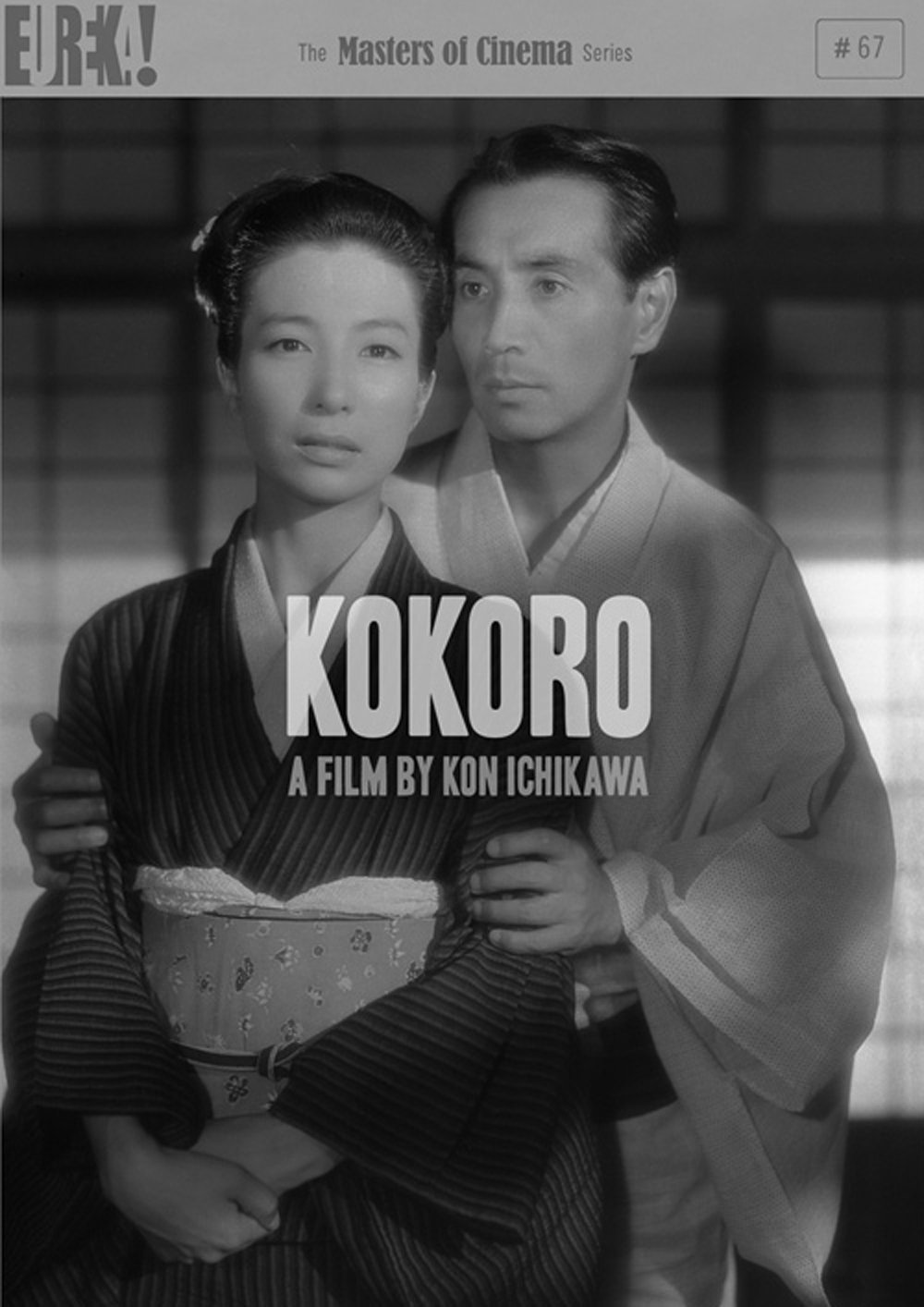
kokoro coverAmong the most well-regarded of his works, Natsume Soseki’s Kokoro (こころ) is a deeply felt mediation on guilt, repression, atonement, and despair as well as an examination of life on a temporal threshold. Kon Ichikawa’s long career would be marked by literary adaptations both of classics and genre fiction but even among these Kokoro is something of an exception, marshalling all of his skills bar his trademark irony in a melancholy tale of loneliness, self loathing, and the destructive effects self-destruction on those caught in the cross fire.

Ichikawa opens in media res as Nobuchi (Masayuki Mori) and his wife, Shizu (Michiyo Aratama), appear to have had an argument. She darns angrily while he paces and eventually seems to relent on his decision not to let her accompany him to the grave of a mutual friend, Kaji (Tatsuya Mihashi), who died when Nobuchi was still a student. Eventually Nobuchi goes alone but is disturbed in the graveyard by the approach of an enthusiastic young university student, Hioki (Shoji Yasui), who has been redirected by Shizu after turning up to ask to borrow some books. Nobuchi is not really in the mood to talk but the two men chat, eventually sharing a drink together in the local bar before Nobuchi abruptly returns home, pausing only to invite Hioki to visit another time for the books he wanted to borrow.

Though the marriage of Nobuchi and Shizu may seem to be a model one, their lives together are mostly performance. Nobuchi is a melancholy, gloomy man who does not work and lives the life of a scholar, living off family money. The household is not wealthy but they are able to afford one maid and live in reasonable comfort. They have no children and, it seems, the marriage may be one of companionship rather than passion.

On their first meeting Nobuchi refuses to tell Hioki the reason why he is the way he is, but decides he must explain and that Hioki is the only person he can unburden himself to. Badly let down by those who should have had his best interests at heart at a young age, Nobuchi has learned not to trust, believes that love is a “sin”, and that he is unworthy of any kind of personal happiness or fulfilment. As a young man, Nobuchi did something completely unforgivable for the most selfish (and fiendishly complicated) of reasons and his best friend, Kaji, later died as a direct result.

Where Nobuchi is cynical, Kaji is ascetic and closed off but sincere in his Buddhist practice. Nobuchi’s actions are not only hurtful in their deliberate betrayal, but amount to a slow implosion of Kaji’s entire spiritual universe. Having been tempted away from his religious beliefs by irrepressible desire, Kaji’s path to spiritual fulfilment has been severed and his path to other kinds of happiness blocked by Nobuchi’s own panicked act of personal betrayal. Unable to reconcile his cowardly, cruel actions which have, in a sense, broken Kaji’s “heart”, Nobuchi resolves to deny himself the life he stole from his friend, committing himself to a living death defined by the absence of physical love, desire, or success.

Hioki first meets Nobuchi when he sees him attempt to walk into the sea and saves him from drowning. Immediately drawn to him, Hioki believes he and the man he calls “sensei” share the same kind of existential loneliness. His eagerness to forge a friendship with the older, aloof scholar may seem strange but Ichikawa is keen to build on a much disputed subtext of the original novel in Nobuchi’s possible repressed homosexuality. Hioki steps into the space vacated by Kaji which has been empty the last 15 years as the sort of man who might understand Nobuchi’s “heart”.

Shizu attempts to ask the question directly, both about Nobuchi’s relationship with Kaji whose name she is forbidden to mention and to new friend Hioki whom she fears maybe taking Kaji’s place in her husband’s affections. Pleading that she just wants to understand his “heart”, Shizu tries to get some clarification on the empty hell that is her married life, but Nobuchi’s heart is firmly closed to her and she’s shut out once again.

On hearing of the death of the Emperor Meiji, Nobuchi’s gloom descends still further as he feels himself to be a man who’s outlived his age. At one point, long before, he pushes Kaji on his spiritual weaknesses prompting him to admit he doesn’t know whether to go forward or back. Nobuchi, cynical and perceptive, points out that there likely is no back even if you wanted to go there. Taking the teacher/student relationship to its natural conclusion, Nobuchi’s final testament in which he confesses the circumstances which have led to his spiritual death is intended only for Hioki in the hope that the younger man can learn from his mistakes and prepare himself to step forward into the bright new age where Nobuchi fears to tread. Once again his actions are selfish in the extreme, but there is something universally understood in Nobuchi’s particular pain and the steps he takes to ease it.


Previously available on DVD from Eureka, now sadly OOP.

Scene from midway through the film