Carlos (カルロス, Kazuhiro Kiuchi, 1991)

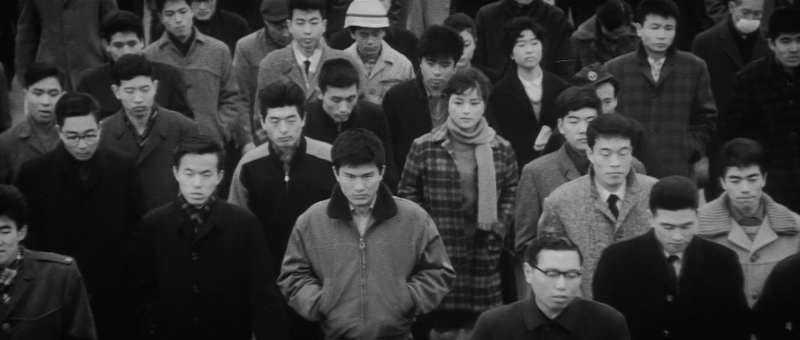
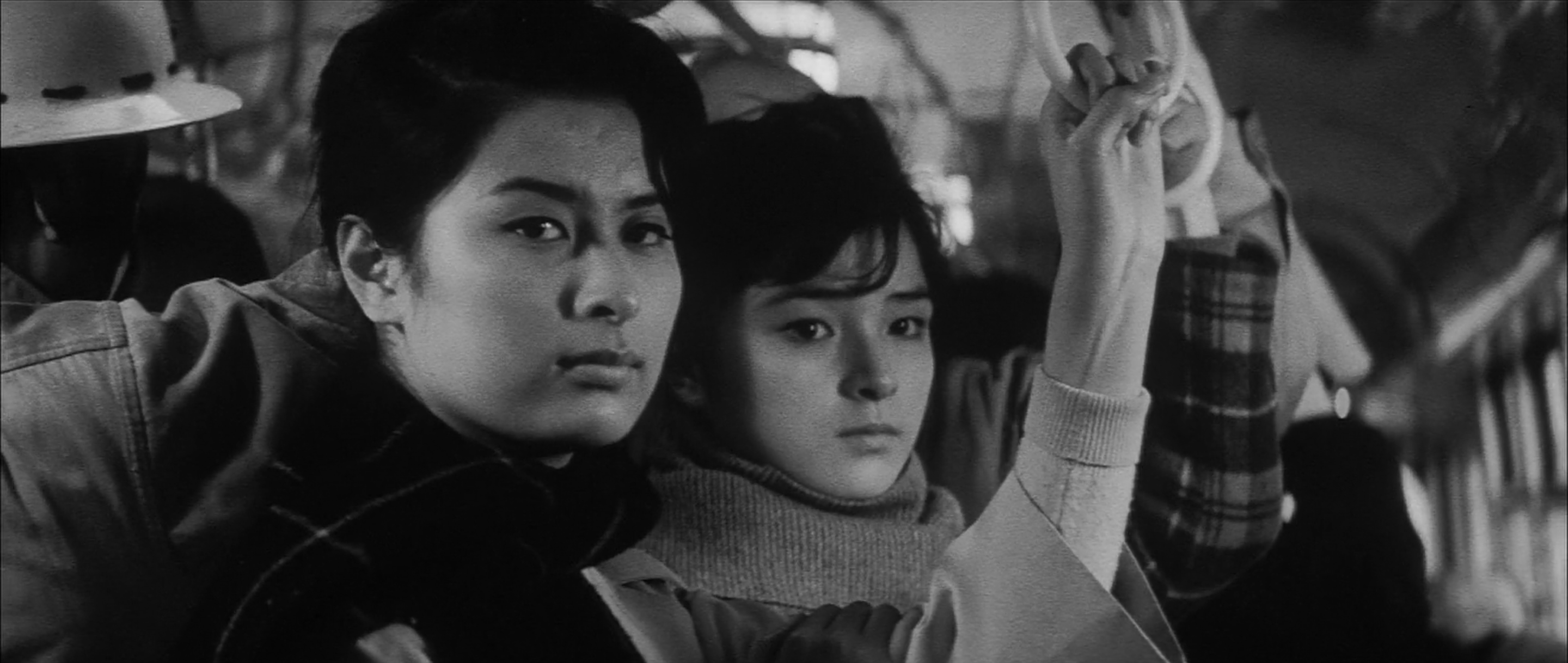
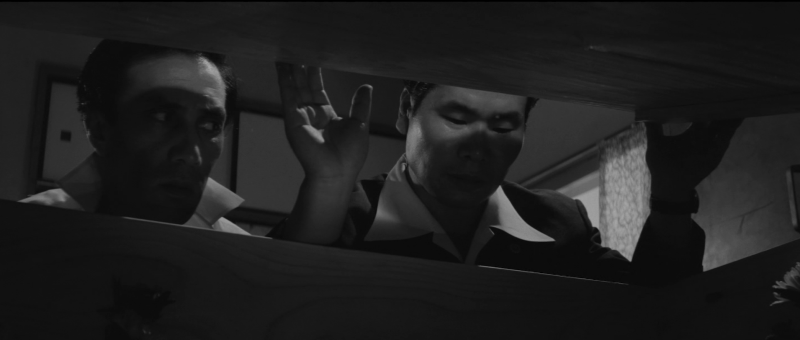
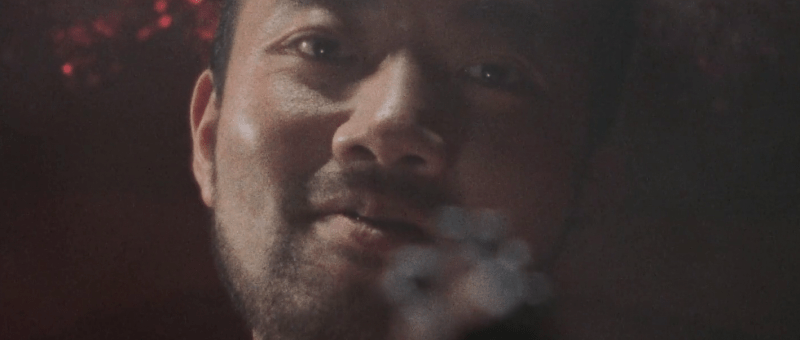
Fleeing a gang war with Columbian drug lords, a Brazilian gangster of Japanese descent tries his luck on the mainland but finds himself a perpetual outsider who can’t get himself taken seriously in Kazuhiro Kiuchi’s moody adaptation of his own manga, Carlos (カルロス). Owing a little bit to Brian De Palma’s Scarface, the tale takes place in a Japan mired in hopelessness and despair amid the spectre of economic collapse, while Carlos tries to play one gang off against another to exploit the terminal decline of the old school yakuza.

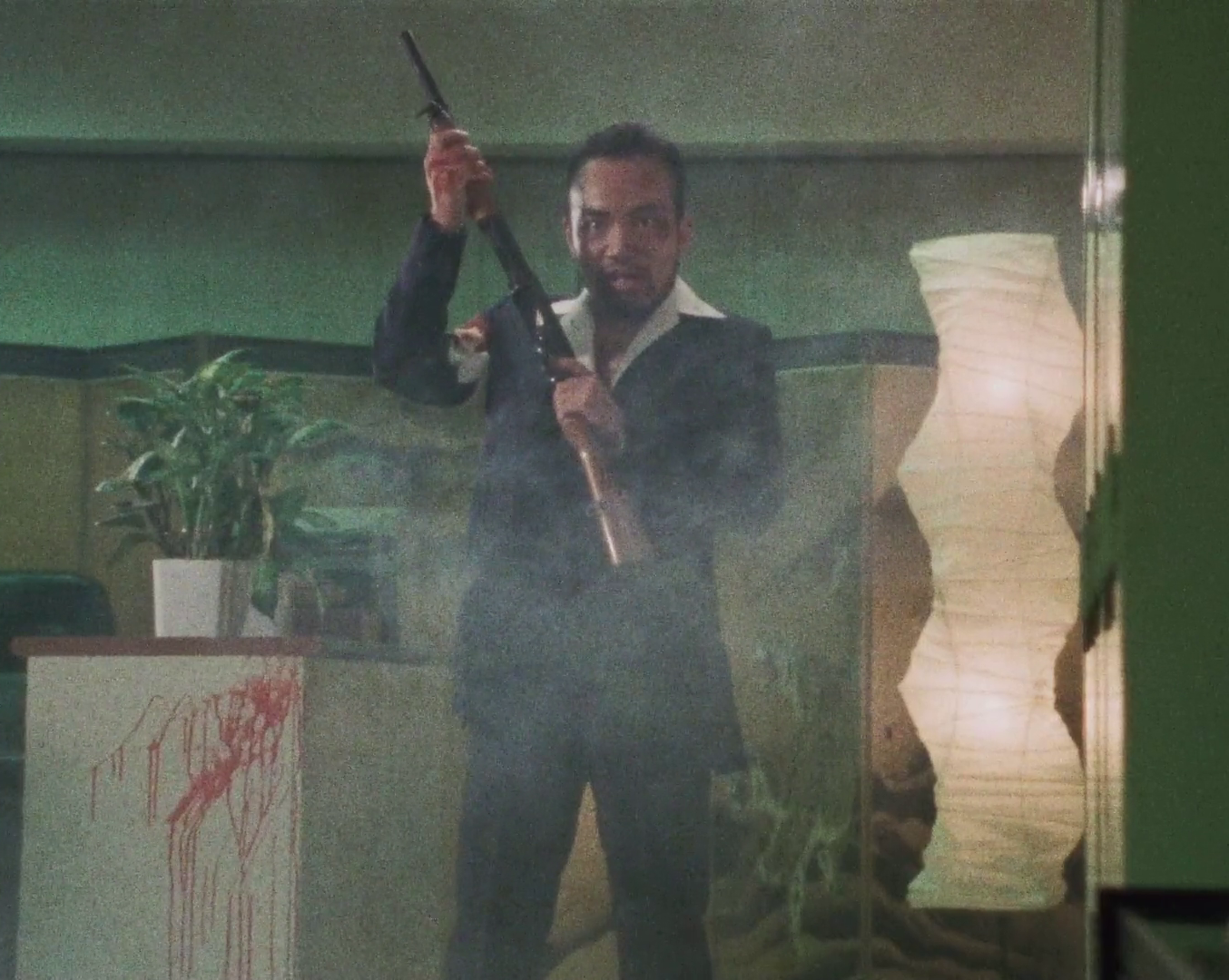
What we have here is a succession crisis. The Yamashiro boss (Minoru Oki) is planning to step down due to ill health though in the middle of a long-running dispute with the Hayakawa gang. When two of their guys are randomly killed, they assume only Hayakawa could be behind it little knowing that Carlos (Naoto Takenaka), a Brazilian-Japanese gangster on the run in Japan after killing eight policemen in a gang war in Brazil, killed them because they thought they didn’t need to obey the rules of the underworld with a “foreign” gangster. “We don’t need to treat those Brazilians as equals,” one says while already late to their appointed meeting. They haven’t paid Carlos for the guns he sold them, and when challenged, try to intimidate him into giving them away for free. But Carlos is sick of being intimidated and bumps them off himself. 

Carlos faces constant microaggressions about not being Japanese enough, though he speaks the language fluently without an accent. “Your crude taste doesn’t fly in Japan,” a yakuza tells him, criticising his outfit for being too informal when yakuza of this era generally dress in fancy suits and style their hair with military precision. That’s not really something that bothers Carlos, but he’s annoyed to be so easily dismissed and it’s true enough that he’s being used because they think he’s disposable. Not only is he not a “yakuza”, but as they don’t see him as Japanese either, they don’t need to accord him even the dignity they’d grant to a gang member. When Katayama hires Carlos to knock of his rival for the succession, Sato, he’s pissed off when Carlos takes things too far and puts on a show that threatens to blow the whole thing wide open by massacring Sato’s guys at baseball practice. To a man like Katayama, this is total idiocy and attributable to Carlos’ foreignness, both in his capacity for unnecessary violence and his lack of understanding of the rules of Japanese gangsterdom.

But the one place Carlos and his brother Antonio are fully Japanese is in the home of his aunt who also migrated from Brazil and their Japanese-born cousin Tomomi. Carlos’ aunt refers to them both by their Japanese names, Shiro and Goro, and cooks them Japanese food like sukiyaki. This pleasant domestic environment seems to represent a more settled life Carlos could have found outside of a crime family, especially as his brother Antonio grows closer to Tomomi, but there are also hints of darkness in his uncle’s early death from cirrhosis of the liver which suggests he may have had a hard life in Japan and taken to drink. Nevertheless, his aunt seems to have made a nice life for herself and her daughter and is overjoyed to expand her family by welcoming Carlos and Antonio.

Yet this sort of life seems outside of Carlos’ reach while he continues to play the yakuza gangs off against each other while simultaneously longing for some kind of recognition and almost willing them to figure out it was him who killed Sugita and Yano, the obnoxious Yamashiro guys. Meanwhile, the weakened yakuza have also turned to a foreign hitman, a brooding and robotic American who lacks compassion or compunction and unlike Carlos seems to be a mindless killing machine. When Carlos bests him, it’s an eerie moment echoing Blue Velvet as his body rocks and then falls. By contrast, when Carlos fights his way to the head of the Yamashiro gang, Yamashiro gets puffed up and draws his sword swearing he’ll teach Carlos what a mistake it is to underestimate the Japanese mob, only Carlos simply shoots him in a moment of clear victory over this outdated adherence to a traditional code. Nevertheless, it’s clear that Carlos can’t win here either and there is no room in Japan for a man like him. His only option is to go out all guns blazing as a means of validating himself as a force to be reckoned with, someone who was worthy of attention and of being taken seriously. Shot by the legendary Seizo Sengen, Kiuchi’s manga-informed compositions dissolve into visions of loneliness and despair but in its final moments reaches a crescendo of defiance if discovered only in futility.

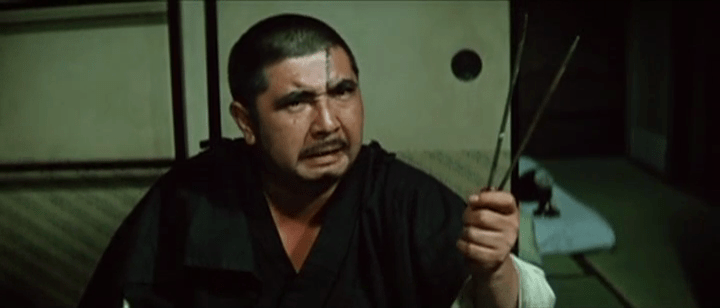
Bloody Shuriken (赤い手裏剣, Tokuzo Tanaka, 1965)

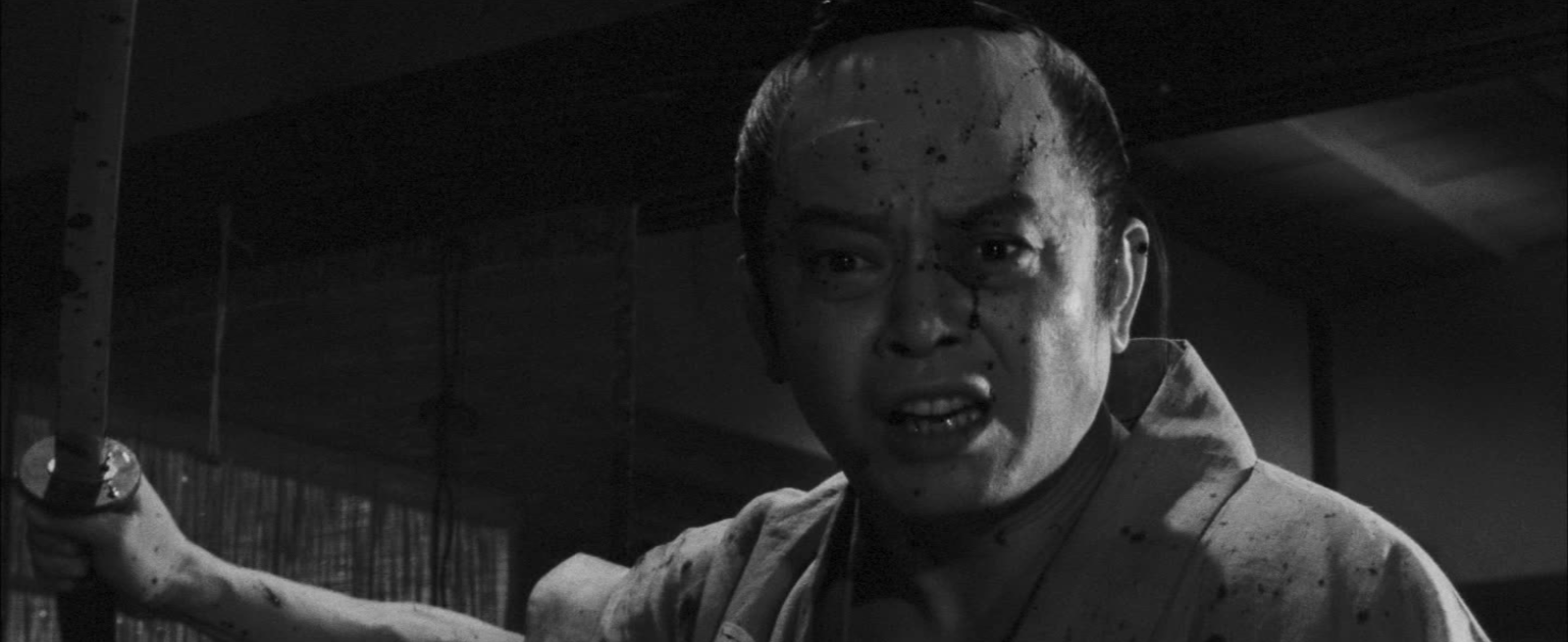
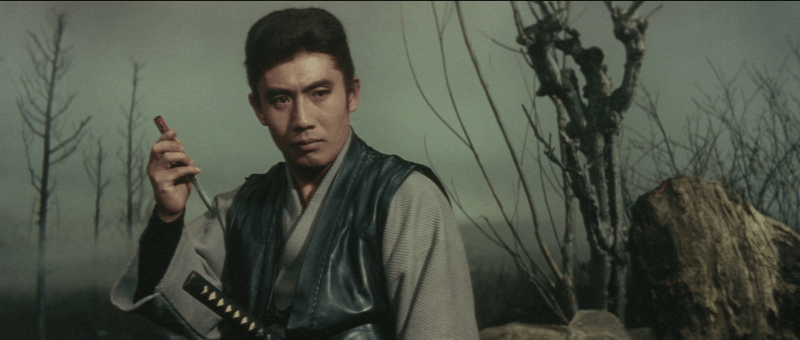
A cynical ronin spots a business opportunity when he rides into a town beset by gangsters in Tokuzo Tanaka’s samurai western, Bloody Shuriken (赤い手裏剣, Akai Shuriken). Despite the name, this is not a ninja movie. The title refers to the knives the hero throws with almost supernatural skill. Adapted from a short story by noir master Haruhiko Oyabu, the action may sound reminiscent of Yojimbo but there’s a different kind of irony in its humour and a lightheartedness to its cynicism even if its final message is that the wages of greed are death.

We can tell that Ibuki (Raizo Ichikawa) is both good man and bad in that he immediately breaks up a fight between rival gangs on entering town, depriving the men in question of their money, but then handing it straight to the owner of the bar they were fighting in to cover the damage. He’s concerned about his horse too, but can’t quite afford the lodging fees at the stable run by the grumpy Yuki (Chitose Kobayashi) who loathes samurai, and with good reason. After hearing about the complicated makeup of the town’s hierarchy, Ibuki decides to stay and make some money by essentially playing each of the three gang leaders off against each other so they end up taking care of themselves. 

So far, so Yojimbo. But this town seems to be even further out, much more like a decrepit western outpost filled with scum and villainy. When the wind picks up, the dust blows through as if signalling the murky air and sense of futility. We’re told that the leader of the biggest gang, Hotoke (Isao Yamagata), is also the police chief, while his rival Sumiya (Yoshio Yoshida) complains that he’s usurped his position as his family has been there longer. Hotoke arrived a starving man three years previously and got back on his feet thanks to the support of the community, but then he turned around and got rich running a gambling den targeting local miners. Kinuya (Fujio Suga) has been here a little longer, but is otherwise biding his time until the other gangs fall from grace.

Of course, Ibuki foments conflict and strikes deals with all of them, but the real trouble is some missing gold that was stolen from the government causing even more disruption in the town with inspectors targeting ordinary people who weren’t even involved. Bar owner Chinami (Masumi Harukawa) is one of many interested in finding out what happened to the money, but she’s also in a precarious position, on the one hand throwing her lot in with Hotoke but on the other hating him and approaching both Ibuki and moody ronin Masa (Koji Nanbara ) to help her be free of the troublesome gangster. 

The fact that the two most prominent business owners are women is perhaps uncomfortably intended to signal the breakdown of the town in which Ibuki becomes the only real “proper” man amid bumbling gangsters and crazed ronin. Yet Chinami is directly contrasted with the pure and innocent Yuki who hates all the gangsters, as well as the samurai and generally everyone who isn’t a horse. Cynical and greedy, Chinami wants the gold and she’s prepared to use her body to manipulate men into doing what she wants, whereas Yuki defiantly keeps her head down and refuses to participate in gangster nonsense because she just wants to run her stables in peace. Only later does she develop a fondness for Ibuki on realising that he’s not so cynical after all and is interested in a kind of justice and getting rid of the corruption in the town for reasons other than money. Having discovered the location for the gold, he leaves the knowledge to Yuki so she can avenge her father who was killed during the robbery. 

But in other ways, this is already a post-apocalyptic hellscape as Ibuki discovers on spotting a pair of crows feeding on a corpse in a river. Perhaps taking pity on one less fortunate than himself, he throws one of his darts and skewers them. Ibuki’s knife supply seems to be inexhaustible, and he never appears to go back and retrieve the ones he’s thrown though his skill does seem to lend him an almost supernatural quality. In any case, Tanaka injects a degree of weird humour in the strange town with its eccentric residents including ronin Masa who looks permanently evil yet has a strange love of dolls, while the fight scenes themselves are often somewhat comical as the gangs seem to clash like a pair of cats slapping each other. There’s even something quite funny about the way the film bluntly drops exposition at unexpected moments even in the midst of the farcical scheming between the gangsters and Ibuki running back and forth to stoke the fires of conflict. This land is so bleak, it seems to say, all you can do is laugh or you’ll end up face down in a river with crows picking at your back too, so you might as well ride off into the sunset like Ibuki looking for the next corrupt town to purify and onward towards the bounty on the horizon. 


Trailer (no subtitles)

Wicked Priest 2: Ballad of Murder (極悪坊主 人斬り数え唄, Takashi Harada, 1968)

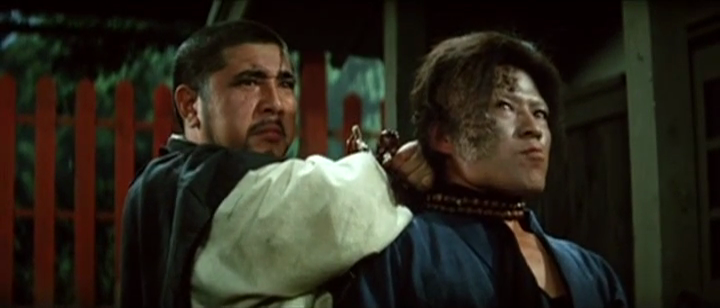
The Wicked Priest returns for a second instalment but once again finds himself confronted with imperfect paternity in The Wicked Priest 2: Ballad of Murder (極悪坊主 人斬り数え唄, Gokuaku Bozu: Hitokiri Kazoe Uta). This time directed by Takashi Harada, the series begins to embrace its anarchic nature in the sometimes cartoonish exploits of its hero who largely just wants to have a good time but is inconveniently called to missions of justice while silently stalked by ghosts of the past in the form of spooky monk Ryutatsu (Bunta Sugawara) whom he blinded in a fight at the end of the previous film. 

Now a lonely wanderer, Shinkai (Tomisaburo Wakayama) comes across a fleeing yakuza with a small boy in tow and steps in to help. As he discovers, the man, Rentaro (Asao Koike), is a former gangster whose wife has passed away leaving him the sole parent to Seiichi, a little boy of around six. Rentaro wants to turn himself in to the police so he can fully sever his ties to the underworld and start again along a more honest path to raise his son right, but needs to deliver him to his father, a jujitsu instructor, before he can. Somewhat surprisingly, Rentaro suddenly asks Shinkai, a man he’s never met before, to take Seiichi to his grandfather before rushing off supposedly to give himself over to justice. When Shinkai arrives, however, Iwai (Hideto Kagawa), the grandfather, refuses to let them in having disowned his son over a local scandal some years previously. 


As in the first film the major theme is paternal disconnection, Rentaro caught between wanting to be a good father to his son and seeking his own father’s approval. Fatherless himself, Shinkai cannot understand nor condone Iwai’s stubbornness in refusing even to look at his small grandson but resolves to care for him himself until his grandfather changes his mind or for as long as he is needed. Meanwhile it turns out that Rentaro was once involved with the evil gang, Godo, who have been causing trouble in the town by trying to muscle on the local cockfighting scene. 

Godo have also been force recruiting some of the local men to increase their dominance while schmoozing with a corrupt politician, Kadowaki (Hosei Komatsu), hoping to make cockfighting a local speciality, even going so far as to kidnap a young woman known to Shinkai and gift her to him. Shinkai manages to rescue her after dressing up as a head priest and subtly suggesting to Kadowaki that his election prospects might suffer if any rumours were to get out about untoward goings on in his household. Iwai explains that jujitsu is not meant to be a violent art used to tackle evil gangsters but is anyway posited as a kind of local resistance leader standing up to Godo but with little effect other than making himself a target for their ire while left vulnerable in their ability to use Rentaro against him. 

While getting mixed up in a local dispute trying to stand on the side of the little guy while looking after Seiichi, Shinkai’s exploits are often comedic in nature as he continues to play the part of the ironic monk though with real sincerity. Sneaking into a temple and belatedly discovering it to be a convent he becomes captivated by a Buddhist nun who appears to experience some kind of sexual awakening but then becomes fixated on him, insisting on becoming his wife and causing him to hide in a chicken coop to avoid her. On the other hand, his stalking by Ryutatsu takes on an almost spiritual quality as the near silent monk, now even more gaunt than before, shuffles his way towards him. Yet this Ryutatsu is a little more spiritual than before, agreeing to postpone his quest for vengeance unwilling to fight Shinkai with little Seiichi looking on and even at one point stepping in to protect him himself because all children are Buddha. Nevertheless, the film ends with another bloody battle surprising in its intensity with severed limbs and sudden violence as Shinkai ensures that those in the wrong get what’s coming to them, speeding up the wheel of karma by a turn or two to make sure they face justice, of one sort of another, in this world if not the next.  


Curse of the Blood (怪談残酷物語, Kazuo Hase, 1968)

Vengeful ghosts in Japanese cinema usually originate from some kind of injustice. Generally, they’ve met a bad end through no real fault of their own while the person who killed them continues to prosper, though it’s also true that becoming a vengeful ghost means becoming an embodiment of vengeance which is itself indiscriminate and directed towards an unjust society more than one particular transgressor. In The Ghost of Kasane, for example, the curse extends to target the murdered man’s own daughter rather than just the descents of the man who murdered him.

Loosely based on the same tale, Curse of the Blood (怪談残酷物語, Kaidan Zankoku Monogatari) is indeed rooted in an injustice, but the emotions that create the ghost are greed and pettiness much more than a desire for retribution. A hatamoto lord has borrowed a large sum of money from a blind masseur evidently running a sideline as a loan shark. The monk, Sojun (Nobuo Kaneko), points out the term is coming to a close and the money should be repaid but Shinzaemon (Rokko Toura) doesn’t want to pay. Having just watched Sojun give his wife Toyo a sexually charged acupuncture session, he coldly remarks that he’ll be paying with his wife’s body. Toyo is obviously not really onboard with this plan, while Sojun at first declines only for Shinzaemon to state that he has the husband’s permission so it’s all fine. But Sojun then attempts to pay Shinzaemon with the improbably large sum of money he’s currently carrying, agreeing to sleep with Toyo but stating that the debt and interest will remain unchanged.

In any case, as soon as Sojun begins caressing his wife’s body Shinzaemon brutally cuts him down. He asks his recently returned grown up son Shinichiro (Masakazu Tamura) to help him dump the body in a nearby lake. Shinichiro complies, but it soon becomes evident that he disapproves of his father’s debauched ways and treatment of his mother. Despite being in debt to Sojun, Shinzaemon has a mistress and an illegitimate child with another woman he is also raising in his house. Shinichiro is painted as the good samurai son, one who behaves with the proper decorum and is unlike his father in his sense of righteousness. Shinzaemon even says as much, urging him to study Confucius and martial arts to one day restore the family he has ruined through his moral transgressions. 

But in taking a sword to the mistress, Shinichiro is himself corrupted. She merely seduces him and it seems to be this that pulls him over to the dark side. Some years later, Shinichiro becomes a bandit, conman, and murderer accidentally killing a woman during rough sex and then running off with the stash of gold from the home of the man who had taken him and promised him a respectable future. Then again, the man had run a pawn shop so perhaps he was’t as morally upright as he might seem despite his kindness to Shinichiro while it also transpires that he was extracting sexual favours from the maid, Ohana (Yukie Kagawa), who turns out to be one of Sojun’s two daughters. 

In another strange twist it was Ohana and her sister Suga (Saeda Kawaguchi) that Sojun had cursed when he died. He blamed them for somehow orchestrating his death and was insistent he was taking his money to hell with him, so they couldn’t have any of it. Suga takes him to task, decrying that he wasn’t fit to be a father and tormented their mother to death while otherwise complaining that he’s a sleazy old miser who doesn’t share his wealth with them so she’s taking it and running away. Suga’s determination to take the money is an attempt to seize autonomy, but she ends up using it in much the same way as her father, essentially as means of buying sexual companionship. Unbeknownst to her, she becomes besotted by Shinzo (Yusuke Kawazu), Shizaemon’s now grown-up illegitimate son, and binds him to her through her wealth.

Just like Shinichiro, Shinzo has been corrupted by the world around him and has little sense of humanity or morality. As he says, you’d have to be a fool to be honest in this world. Like his brother he has a caustic voiceover stating what he really thinks in contrast to his meek and obedient exterior, decrying Suga as an ugly old hag and expressing disgust at the idea of sleeping with her but also a willingness to put up with it in order to get his hands on her gold. Money lies at the root of all problems, but less so the need for it than simple greed. Shinzo has unwittingly entered a more romantic sexual relationship with Ohisa (Hiroko Sakurai), who turns out to be his half-sister, but her material desires outweigh his own and they are unable to move forward with their lives because they lack the economic stability to set up home. 

To that extent, money is a means of overcoming the barriers of social class or gender to pursue greater freedom that inevitably becomes a means in itself. Sojun does not appear often as a ghost but haunts all the same, an evil smile on his face each time he manifests and takes pleasure in the sight of those who robbed him of his wealth paying the price. Simply put, he remains jealous of his money and can’t bear the thought of anyone else having it so is determined to drag it all the way to hell. Shinzaemon may have cursed his family through his immoral behaviour, but Sojun is simply annoyed about the money. Then again, perhaps he’s just a product of the world in which he lives in which money is the only way to overcome the oppressive barriers of disability, social class, and gender for to be without it is to be a lonely ghost with no currency or agency in society ruled by a fiercely patriarchal hierarchy. Hase conjures some haunting ghost imagery and uses bouts of solarisation as if the world itself were being bleached by all this cruelty and cynicism, occasionally isolating each of the protagonists in a theatrical spotlight which doubles as a personal hell yet in the end suggesting that there really is no escape from the vengeful haunting of an unjust society.  


The Threat (脅迫, Kinji Fukasaku, 1966)

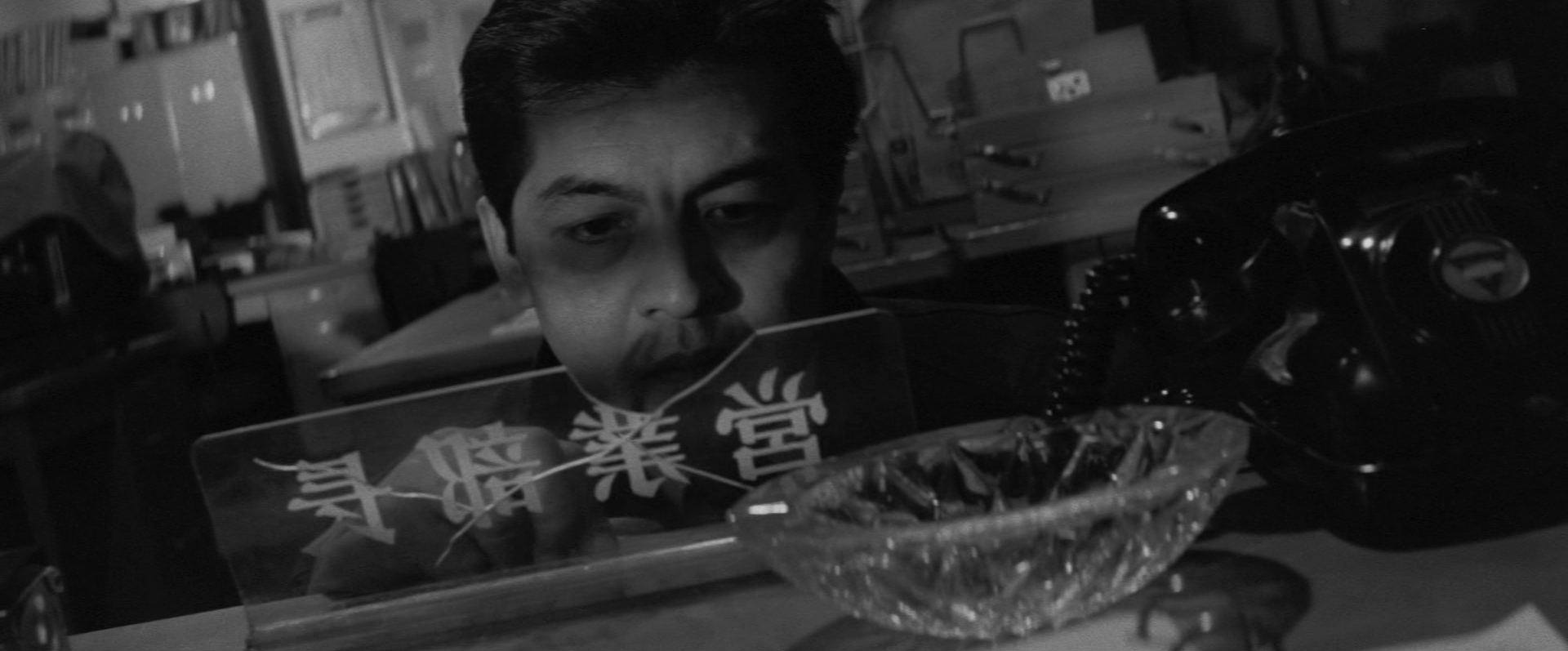
An ambitious executive is confronted with the emasculating nature of the salaryman dream when escaped convicts invade his home in an early thriller from Kinji Fukasaku, The Threat (脅迫, Odoshi). The threat in this case is to his family and implicitly his manhood in his ability or otherwise to protect them while accepting that his aspirational life has come at the expense of his integrity and left him, ironically, hostage to the whims of his superiors.

This much is obvious from the opening sequence which takes place at a wedding where Misawa (Rentaro Mikuni) is giving a speech congratulating two employees on their marriage. Misawa’s speech is long and boring, as such speeches tend to be, and according to some of the other guests disingenuous in giving glowing reports of two ordinary office workers while skirting around the elephant in the room which is that Misawa has played matchmaker to convince an ambitious junior to marry his boss’ mistress for appearance’s sake. As Misawa himself has done, the employee has sacrificed a vision of masculinity for professional gain in accepting that his wife’s body will “belong” to another man and it is the boss who will continue sleeping with her. 

The only person not aware what’s going on is Misawa’s naive wife, Hiroko (Masumi Harukawa), who enjoyed the wedding and remarked that the couple seemed very well suited giving rise to an ironic laugh from Misawa who of course knows that not to be the case. They return by car to a nice-looking home but one that stands alone at the end of a street preceded by a series of vacant lots presumably available to other similarly aspirant salarymen yet to make a purchase. Shortly after they arrive, two men force their way in and insist on staying explaining that they are the pair of escaped death row convicts that have been in the papers and are in fact in the middle of a kidnapping having taken the grandson of a prominent doctor with the intention of using the ransom money to illicitly board a ship and leave the country. 

Naked and covered in soap suds having been caught in the bath, Misawa is fairly powerless to resist and can only hope to appease the men hoping they will leave when their business is done. His acquiescence lowers his estimation in the eyes of his young son, Masao (Pepe Hozumi), who later calls him a coward and is forever doing things to annoy the kidnappers such as attempting to raise the alarm with visitors by smashing a glass or speaking out against them while Misawa vacillates between going along with the kidnapper’s demands or defying them to contact the police. After failing to retrieve the money when ordered to act as the bag man, Misawa stays out trying to find another way to get the cash and Masao wonders if he’ll come back or will in fact abandon them and seek safety on his own. Misawa really is tempted, darting onto a train out of the city his eyes flitting between the sorry scene of a small boy with a tearstained face tugging the sleeves of his father who seems to have fallen down drunk on the station steps, and a woman across from him breastfeeding an infant. He gets off the train only at the last minute as it begins to leave the station as if suddenly remembering his role as a father and a husband and deciding to make a stand to reclaim his patriarchal masculinity. 

The brainier of the kidnappers, Kawanishi (Ko Nishimura), had described Misawa as a like robot, idly playing with Masao’s scalextrics insisting that he could only follow the path they were laying down for him much as he’d already been railroaded by the salaryman dream. During a car ride Kawanishi had asked Misawa what he’d done in the war. Misawa replied that he was in the army, but had not killed anyone. Kawanishi jokes that he’d probably never raped a woman either, but to that Misawa gives no answer. Realising that the other kidnapper, Sabu (Hideo Murota), had tried to rape Hiroko he turns his anger towards her rather than the kidnappers striking her across the face and later raping her himself avenging his wounded masculinity on the body his of wife while unable to stand up to either of the other men. 

Kawanishi giggles and describes him as exactly the kind of man he assumed him to be but he’s both wrong and right. Misawa had been spineless, insecure in the masculinity he largely defined through corporate success though as Kawanishi points out most of what’s in the house is likely being paid for in instalments meaning that technically none of it’s actually his. He defined his position as a father as that of a provider, ensuring a comfortable life his wife and son rather than placing importance on his ability to protect them physically from the more rarefied threats of the contemporary society such as crime and violence. On leaving the train, another symbol of the path laid down for him both by the salaryman existence and by Kawanishi, he is able to reclaim a more primal side of his manhood in formulating a plan of resistance to lure the kidnappers away from his wife and son. 

But then in another sense, it’s Hiroko who is the most defiant often telling the kidnappers exactly what she thinks of them while taking care of the kidnapped baby and doing what she can to mitigate this awful and impossible situation in light of her husband’s ineffectuality and possible disregard. She is the one who finally tells Kawanishi that she no longer cares if he kills her but she refuses bow to his authority and he no longer has any control over her. Even so, the film’s conclusion is founded on Misawa’s reacceptance of his paternity in a literal embrace of his son, redefining his vision of masculinity as seen through the prism of that he wishes to convey to Masao as an image of proper manhood. Fukasaku sets Misawa adrift in a confusing city lit by corporatising neon in which the spectre of the Mitsubishi building seems to haunt him amid the urgent montage and tilting angles of the director’s signature style still in the process of refinement as Misawa contemplates how to negotiate the return of his own kidnapped family from the clutches of a consumerist society. 


The Ghost of the Hunchback (怪談せむし男, Hajime Sato, 1965)

The old, dark house fetches up in Japan in Hajime Sato’s slice of weird, gothic horror The Ghost of the Hunchback (怪談せむし男, Kaidan Semushi Otoko, AKA House of Terrors). Long in circulation only in an Italian dub, Sato’s B-movie romp owes an obvious debt to Mario Bava but also to similarly themed gothic chillers such as Robert Wise’s The Haunting somewhat repurposing the central nexus of the cursed mansion as a black hole of morality sucking into its orbit the sinners of the post-war society each it seems both victims and embodiments of their times. 

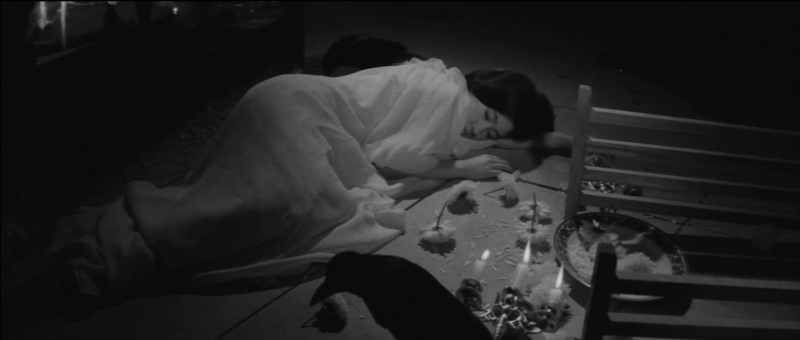
Opening in true gothic fashion with lightning and a full moon, Sato zooms in to a strangely creepy yet ordinary Western-style villa where the soon-to-be widowed Yoshie (Yuko Kusunoki) is woken from a dream in which she had a premonition that her husband, who we learn has been in a vegetative state for some time, had something he desperately wanted to tell her. Shinichi has indeed passed away while apparently imprisoned under the care of his father, Munekata (Kazuo Kitamura), a psychiatrist who seems less than moved by his son’s death describing it as the least he could do to repay the debt he owed to his parents. It seems that Shinichi had been in the hospital following an “incident” some time previously and though Munekata insists that his brain had been “destroyed”, younger doctor Yamashita (Shinjiro Ebara) echoes Yoshie’s dream in informing her that immediately before he died it seemed that Shinichi, who had long been mute, was desperately trying to tell him something. Meanwhile, Yoshie begins hearing strange noises emanating from the coffin and opens it to find a chrysanthemum clenched between her husband’s teeth. 

After the funeral, she’s visited by a lawyer claiming that Shinichi entrusted a key to him to be given to his wife in the event of his death along with the deed for a mountain villa where “the incident” took place. Later, everyone comes to the conclusion that what Shinichi wanted to tell them was not to go to the mansion, but of course what else was Yoshie supposed to do other than investigate. A classic gothic estate swathed in fog and hidden behind ornate iron gates, the remote country house also turns out to have a hunchback custodian (Ko Nishimura) as well as a weird, demonic statue standing inconveniently in the hallway. Soon after arriving Yoshie is attacked by a crow, told of “the incident” by the hunchback, and begins to hear strange noises including disembodied laughter before she is eventually joined by Munekata, Yamashita, and her niece Kazuko (Yoko Hayama).

Yamashita tries to rationalise that the noises are just the normal kinds of creaking born of “deformation” as a building naturally ages, literally becoming warped with time, while the stress of living in such an environment, he claims, can eventually drive one mad. He’s come along to investigate believing that Shinichi’s illness is connected to the mansion. Yet the old, dark house in this case is somewhat divorced from its gothic roots in being transported to Japan where it is in a sense “new” and “foreign” rather than an ancient relic weighing heavily on the shoulders of declining aristocracy. Even so we do indeed have something of that in the later revelations of previous owner Baron Tominaga and his particular grudges which, in this case, are if only partially rooted in wartime trauma, the mansion apparently also once home to an anti-aircraft depot the remains of which can be seen in the grounds. 

The war may not be the corrupting force in play but it’s certainly a factor, especially the surprising accusation thrown at Dr. Munekata that he participated in wartime atrocity in being party to vivisection, a claim he does not dispute but defends in insisting his actions were justified in the name of science. The house has not so much called them, but each of the “guests” is in their own way morally compromised, Munekata not only a war criminal but a venal, lecherous old man hoping to get his hands on the house to open a sanatorium by fulfilling his quasi-incestuous desire for Yoshie. Yamashita, meanwhile, is not exactly pure hearted either, using what he knows about Munekata to blackmail him into standing down so he can become the director in his place and marry his wealthy girlfriend, Akiko (Keiko Yumi), who has also turned up to join in the haunted house fun. As far as sin goes, Yoshie is largely without it but perhaps pays for daring to own her sexuality, rejecting Munekata’s advances but apparently having made a habit of getting into bed with her comatose husband despite knowing of his many affairs which may be the reason for his punishment by the house. Only Kazuko remains pure and innocent save her one-sided attraction to Yamashita, the only one of the gang to show any kind of compassion towards the admittedly strange hunchback. 

In keeping with the house, Tominaga and the hunchback are later revealed to be Christians, though in a gothic inversion they are also the source of the “evil” that infects the creepy old mansion once again positioning Christianity as a foreign corruption but also in this case punishing post-war moral failure. Sato conjures an atmosphere of pure gothic chill complete with oversize cobwebs, doors which open and close on their own, a crow infestation, and even a passing shinto priestess (Mitsue Suzuki) who just had to drop in because of the powerful emanations of evil echoing from the mansion but leaves his collection of extremely flawed humans very much at the mercy of their own demons as they desperately try to escape from the House of Terrors. 


Our Marriage (私たちの結婚, Masahiro Shinoda, 1962)

Like many directors of his age, Masahiro Shinoda had to serve his apprenticeship at Shochiku contributing to the studio’s particular brand of light and cheerful melodramas though 1962’s Our Marriage (私たちの結婚, Watashitachi no Kekkon) did perhaps allow him to explore some of his persistent themes in its ultimately empathetic exploration of the romantic and existential dilemmas of two sisters who ultimately find themselves taking different paths in the complicated post-war society. Co-scripted by Zenzo Matsuyama, Our Marriage is essentially a chronicle of changing times and the crises of modernity, but it’s also surprisingly even-handed in its refusal to judge or indeed to sugarcoat the “romance” of a working class life. 

Keiko (Noriko Maki) and her younger sister Saeko (Chieko Baisho) both have jobs in the local factory with Keiko working in the accounts department which is where she first meets the brooding and self-righteous Komakura (Shinichiro Mikami) when he marches straight into the office to complain that he’s been shorted on his pay-packet to the tune of 10 yen. The ladies are non-plussed, it’s only 10 yen after all so perhaps there’s no need to be so unpleasant about it, but Komakura insists on having it looked into even after they give him the single coin in an effort to make him go away. Getting so upset about 10 yen is perhaps disproportionate, but then it is Komakura’s 10 yen and he has a point that if a mistake has been made it needs to be acknowledged and corrected especially when you’re dealing with people’s livelihoods to ensure that everyone is being paid fairly. On the other hand, marching in and shouting at people is unlikely to help the situation. 

It just so happens that Komakura is a good friend of Saeko’s who perhaps reads more into the mild embarrassment he and her sister each experience on meeting in another context to assume that they are romantically involved, immediately swinging into action to get them together. Meanwhile, another potential suitor has turned up at home in the form of Matsumoto (Isao Kimura), apparently an old friend dropping in on their parents out of courtesy. Matsumoto is very good looking and apparently now has a well paying job in the textiles trade, but despite their politeness to him the parents later have their doubts because it turns out that he was their blackmarket dealer during the dark days of the immediate post-war era. 

The Hibino family make their living as seaweed farmers and live in a small two-story home in a fishing village. Times are hard because the sea is dying. Increased industrial pollution, land reclamation, and the new airport have reduced the harvest to almost nothing and the girls’ father (Eijiro Tono) can no longer make ends meet. The union hasn’t paid him and he can’t ask about it because he’s still in debt from a previous loan, which is why Keiko’s mother (Sadako Sawamura) is always asking her for extra money to help with household expenses. Keiko intensely resents this, especially as her father’s irresponsible drinking habits continue to adversely affect the family’s finances. They haven’t really been thinking about her marriage perhaps partly because they need her salary but are now forced to because of all the sudden and unexpected interest. On top of Matsumoto and Komakura, it seems that the union leader’s widowed son is also interested which would, admittedly, be quite beneficial to the family. 

Keiko, however, is insistent that her husband must have a decent salary and that her married home must have a refrigerator and a washing machine. Quite the consumerist, Keiko has had enough of poverty and of feckless men like her authoritarian father who waste all their money on drink while relying on female labour to keep them out of trouble. When Matsumoto writes a formal letter proposing marriage, the parents decide to push the union leader’s son instead hoping to avoid embarrassment all round. Keiko immediately assumes the worst, that her father is trying to sell her to the union leader in exchange for the cancelation of his debts. She insists that she will decide her own future, leading Saeko to make a disastrous intervention revealing Keiko’s relationship with Komakura which only has the effect of enraging her father who brands her an ungrateful “whore” while shouting that a mere workman is not good enough for his daughter despite having previously stated that the union leader’s son was really “too good” and they were only in the running because it’s a second marriage. 

Both women still implicitly feel that marriage will define their futures, they do not have an expectation of living independently. Nevertheless, marriage itself may not be an answer. Everyone keeps talking about how happy Miyoko (Fumiko Hirayama) is with her new husband and she herself is forever extolling the joys of married life even in poverty, insisting to Saeko that “a woman’s happiness lies in marrying and having babies”. It’s a cruel irony then that we later see her arguing with her husband who is trying to force her to have an abortion against her will because they cannot afford to raise a child. Keiko has had enough of poverty, she wants to be more than comfortable, enjoying the new consumerist age. Re-encountering an old schoolfriend who has become a glamorous social butterfly she is mildly scandalised when she tells her that she obtained all her treasures through a complex network of compensated dating arrangements with foreigners, but later decides to check it out for herself when directly faced with the hopelessness of her situation. 

The fact remains, however, that no matter the initial attraction and her sister’s earnest attempts to make it work, Keiko and Komakura are fundamentally unsuited. They have entirely different ways of thinking about the world and want completely different things. Komakura is an angry young man but committed to his working class roots. He isn’t trying to get on, he’s happy with working in the factory for the rest of his life and just wants a quiet, honest existence. Keiko wants more, she thinks that people who say they’re poor but happy have merely given up on life. Revealing himself, Matsumoto says that he was struck by Keiko’s harsh words to him when she was a child, her calling him a blackmarketeer to his face apparently showing him what he was. He claims to have reformed and now fears the various ways that poverty can corrupt, something Keiko feels herself after her brief brush with the shady world of compensated dating. They are very much on the same page, both intent on seizing the benefits of the consumerist age but hoping they won’t have to stoop too low to get them. 

Saeko meanwhile is a little younger, still naive, and unlike her sister completely resistant to the corruptions of consumerism. Part of that might be because Keiko has shielded her from some of the harsh consequences of the way their family lives such as the financial burden of her father’s drinking, leaving her with a rosier view of poor but honest life which has her taking notes from Miyoko on how it’s easy to be happy even when you don’t have enough to eat. She and Komakura are in fact perfectly suited and perhaps she is already in love with him but either afraid of her feelings or unable to recognise them, pushing him towards her “prettier” sister instead. Then again, is there anything to say that Komakura will not turn into another man like her father, embittered and old, trying to drown his disappointment in sake? There’s no guarantee Keiko will be happy with Matsumoto, or perhaps with anyone, but they are at least moving forward in the same direction, as are Saeko and Komakura even as they blend back in with a hundred other cheerful youngsters making their way towards the factory. Our Marriage offers no judgment on its heroines’ choices, merely stating that people make their own paths in life pursuing their particular ideal of happiness and it happens that those paths might necessarily diverge but the people are still the same ones they always were and perhaps you don’t need to reject them for choosing differently than you might have done. Isn’t that what post-war freedom is all about after all?


The Glamorous Ghost (散歩する霊柩車, Hajime Sato, 1964)

Best known for Shochiku horror Goke the Body Snatcher from Hell, Hajime Sato spent the majority of his career at Toei which he joined in 1952 after graduating with an economics degree from Keio University. After directing his first film in 1960 he mainly worked on monster movies, sci-fi, and action while transitioning into television from the late ‘60s. 1964’s The Glamorous Ghost (散歩する霊柩車, Sanpo Suru Reikyusha), however, features no special effects at all and in fact no actual “ghost”, instead painting a dark satire of the increasingly greedy and consumerist post-war society in a nihilistic tale of crime and futility. 

As the film opens, taxi driver Asami (Ko Nishimura) is ostentatiously shadowing his wife, Sugie (Masumi Harukawa), whom he suspects of having numerous affairs, through a busy department store. He later confronts her, suggesting that she’s the mysterious adulterous woman pictured in the paper but she denies everything before suggesting that if he’s so suspicious perhaps they should split up. He doesn’t appear to like that suggestion and becomes violent. A fight breaks out during which we see Asami strangle Sugie before an abrupt cut places him in the cab of a hearse sitting next to the driver, Mouri (Kiyoshi Atsumi), dressed in his best suit. Strangely, however, they don’t go to a funeral, but to a wedding where Asami confronts the father of the bride, Kitamura (Meicho Soganoya), showing him Sugie’s body with a prominent scar around her neck he says from her suicide producing a note that says she took her own life out of shame in having betrayed the husband who loved her so very much. The letter is dedicated to a KY, and Asami wants to know who it was his wife was sleeping with though Kitamura is careful not to admit anything while subtly promising him money if he goes away. Asami and the driver then make a second stop at a hospital where he tries the same thing with dodgy surgeon Yamagoshi (Nobuo Kaneko) who admits that he slept with Sugie but says it was only one time a while ago and he’s not sure why he’d be in her suicide note. 

As expected, not everything is quite as it seems. Sugie is not really dead, they’re just running a scam to blackmail her former lovers in order to get money to make a fresh start, possibly with a pig farm in the country which is why they didn’t bother with gigalo Tamio (Jiro Okazaki), the apparently penniless yet sportscar-driving young man Sugie was canoodling with in the park. “5 million yen would turn anyone into a murderer” one of their marks later admits after the scam goes south in several different ways, laying bare their sense of desperation in their otherwise perfectly fine if unsatisfying lives.

Yamagoshi, a doctor so compromised his admin staff assume the unexpected arrival of a hearse means he’s made another mistake, is desperate for money because he wants to open his own clinic. Sugie, meanwhile, gives a series of contradictory explanations for having come up with the scam, telling her marks she wants the money in order to get away from Asami and telling him that it’s for their future so they can live a happily married life. Asami’s male pride had indeed been wounded by Tamio in several different ways, firstly by his youth and vitality, but later by his assertion that a “shorty like him” couldn’t satisfy his wife which is why she puts it about at the club where she has to work because Asami’s cabbing job evidently doesn’t make enough to support them both. 

Sugie’s “death”, leaving aside fact that he “killed” her which is never brought up again, apparently helps him remember what she means to him, that if she really had died he’d be “lifeless” like the empty shell of a cicada. Scamming Sugie’s lovers probably does help rehabilitate his masculine pride and even though she is the one running the show it also suggests that she’s in a sense chosen him and wants to escape their disappointing urban life for something more wholesome as a happily married couple unburdened by financial anxiety. Meanwhile, we see her embarrassingly continue to chase the vacuous Tamio, an overgrown man child with expensive tastes and a room full of toy cars who lusts after a Porsche and appears to have a more age appropriate girlfriend he’d rather hang out in it with. Money corrupts human relationships whichever way you see it, and in the peculiarly toxic marriage of Sugie and Asami we can never quite be sure who’s playing whom. 

Then again in a fairly ironic touch, it may be the blissfully ignorant Tamio who is the only real “winner” seemingly continuing to live his life of empty consumerist pleasures without ever noticing the corruption of the world all around him. Gleefully cynical and accompanied by a playfully ironic, horror-inflected score, The Glamorous Ghost is a pitch black farce shot in the half light with crazy film noir framing and extreme depth of field in which it’s less money everyone wants than a less disappointing future and it seems they’re literally prepared to “die” to get it.


Title sequence (no subtitles)

Boxer (ボクサー, Shuji Terayama, 1977)

Boxer posterArtistic polymath Shuji Terayama was fond of claiming that more could be learned about life from boxing rings and race courses than from conventional study. Immersing himself in the countercultural epicentre of mid-century Shinjuku, he became known for iconoclastic street theatre before shifting to film, instantly recognisable for his striking use of colour filter and theatrical, avant-garde aesthetic. 1977’s Boxer (ボクサー) is, however, his most conventional experiment, a generic tale of a struggling boxer yearning to be a champion and battling himself, along with his society, in the claustrophobic arena of the ring, but for all the expected triumph it’s futility which marks his life and the ropes which restrain rather than liberate.

Former boxing champion Hayato (Bunta Sugawara) now lives a lonely existence alone with his beloved dog in a rundown boarding house. His brother is about to be married and wanted him to be in the engagement photos, but he told the young couple to go ahead without him. He may come to regret that because his brother quickly becomes the victim of an accident that may not have been quite that at the construction site where he and his fiancée worked. It seems that another employee, Tenma (Kentaro Shimizu) – an aspiring boxer with a limp, had taken a liking to the same girl and, either distracted by the news she intended to marry someone else, or not thinking clearly, he allowed his digger to hit Hayato’s brother and kill him. Of course, Hayato is not happy about that and determines to track Tenma down, looking for him at a neighbourhood bar where a small boy guides him to the gym, which he is eventually expelled from by the other boxers. Nevertheless, Tenma, having heard about Hayato’s past and been dismissed by his trainers because of his disability, is determined to overcome the debt that exists between them and become Hayato’s mentee hoping to go on to boxing glory.

Like many a Shinjuku tale, this is one of scrappy chancers longing to escape the vice-like grip of an underworld that refuses to release them. In the land of broken dreams, the hopeless man is king, and Hayato is nothing if not hopeless. Years ago, we’re told, he was a champion, yet he suddenly quit boxing mid-way through a bout that he was clearly winning. He had a wife and daughter, but now lives alone (except for the dog), making a living by pasting up flyers. In response to Tenma’s request, Hayato recounts to him the histories of boxing champions in Japan all of whom met a sticky end: dying of typhus in Manchuria, drowning after demobilisation, dying under a bridge, hit by a train, suicide after revenge on a yakuza who’d killed his brother, killed when a runaway truck hit his home, car accidents etc. The boxing match which opens the film is preceded by a minute of silence for a champion who died just a few days previously. So what, Hayato seems to say, we fight but we all die in the ring anyway. What’s the point?

Still, for all the meaningless of his success, he too finds a kind of purpose in Tenma’s quest even if he knows it’s futile and that it is perhaps perverse to commit to saving the man who killed his brother either by accident, as he claims, or out of romantic jealousy. Tenma tells him that he wants to be a champion to appear on TV and be famous. He has, it seems, something to prove. Hayato tells him that boxing’s not for everyone, cruelly echoing the words of the president of the boxing society in his letter explaining to Tenma that there is no place for him in the boxing world because of his disability. His reasoning is however different. He asks him if he is able to hate, to which which he replies that yes, he hates his mother, father, brother, and in fact “the whole damn world” which makes him a perfect mirror for his defeated mentor.

Terayama opens the film with a melancholy black and white sequence in which a boxer walks down a long corridor towards a door filled with light while other contenders pass him from the opposite direction, some badly beaten and others unable to walk. This is the price, he seems to say, a literal manifestation of life’s battery. Even the denizens of the strangely colourful, warm and cheerful little neighbourhood bar with its Taisho intellectual, former actress turned streetwalker, smoking child, and bookmakers who don’t pay their bills, are fighting a heavy battle, crushed under the weight of their broken dreams. Hayato tries to offer encouragement from the sidelines, “Get up if you refuse to be a loser”, he yells to a barely conscious Tenma struggling raise himself from the mat, but even if he does what will he gain? Suitcase in hand the women leave looking for better lives, while Tenma struggles to escape from the ring, chasing hollow victories of illusionary manhood but finding salvation only in the struggle.


Opening sequence (no subtitles)

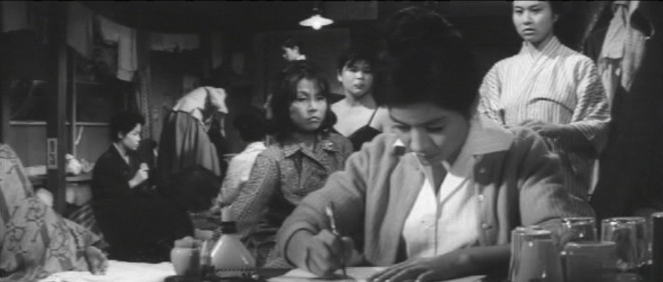
Girls of the Night (女ばかりの夜, Kinuyo Tanaka, 1961)

vlcsnap-2019-03-15-00h18m28s351

Working from a Keisuke Kinoshita script, Kinuyo Tanaka’s first film as a director, Love Letter, made a point of exploring the often hypocritical and contradictory attitudes towards women who had engaged in sex work or become the mistresses of American servicemen in the immediate aftermath of the defeat. For her fifth film, Tanaka returns to the same subject but this time adapting a novel by Masako Yana scripted by Sumie Tanaka (no relation) with whom she’d previously collaborated on The Eternal Breasts. Somewhat suggestively retitled Girls of the Night (女ばかりの夜, Onna Bakari no Yoru), Tanaka’s adaptation tones down the novel’s sensuality but dares to ask a series of subversive questions regarding female agency and sexuality in the rapidly changing post-war society.

Set in the contemporary era, the film opens with reportage-style voiceover and newspaper clippings highlighting the enforcement of the anti-prostitution laws of 1958. According to the voiceover, the red light districts of Japan may have all but disappeared but streetwalking and other forms of casual sex work are still very much a part of the post-war economy. In an attempt to bridge the gap between the old ways and new, those arrested by the police are divided into two camps – those deemed beyond “redemption” sent to prison, and the rest to reform centres such as the Shiragiku Protective Facility for Women which is where we find our heroines.

The reform centre itself is a fairly progressive place and much more forward looking that seen in the earlier Women of the Night though perhaps sometimes patronising even as it makes a strenuous attempt not look down on the women who enter its care. Our first entry into the facility is in the company of a similarly well meaning women’s association whose misplaced pity only reinforces their innately privileged position. They are as far from many of these women as it is possible to be and struggle to understand how it is possible that they found themselves engaging in a practice they find both shameful and degrading. Having got to know many of the women through trying to help them, the school’s headmistress Nogami (Chikage Awashima) and her assistant are better placed to understand even if they also apologise that many of the women in their care are of “low IQ” and fail to convey the kinds of pressures that many have been subject to from desperate poverty to bad family situations and abusive relationships.

Abuse and the trauma of abuse remains one of the barriers to the women moving on, as in the reason many of them found themselves in sex work was because of their relationship with an exploitative partner who either forced them to sell their bodies or left them with no other choice in order to support themselves through being unable or unwilling to work. Nogami, a compassionate and understanding woman, is at pains to insist that the reason many of these women see nothing wrong in sex work is that they have an insufficient level of self respect and value their bodily autonomy too cheaply in allowing others to buy and sell access to it without full consideration of everything that implies.

Then again, asked by one of her most promising cases, Kuniko (Hisako Hara), what is actually so “bad” about sex work, Nogami is forced to admit that she doesn’t know – only that it is now illegal and her job is to help these women live “honest” lives within law. It is difficult to evade the hypocrisy that Nogami is telling these women that they should exercise full agency over their bodies while simultaneously telling them what they shouldn’t be doing with them, but then for all the centre’s talk about “purity” Nogami herself is refreshingly frank and practical in her approach to helping these women towards reintegration into mainstream society in the assumption that that is something they would want rather than out of any quasi-religious ideas of moral goodness.

Shame and social stigma, however, become another barrier as Kuniko finds to her cost in her attempts to move on from the centre. At her first placement as a live-in assistant at a grocer’s, she is quickly outed by a nosy deliveryman already acquainted with the true nature of the Shiragiku centre. The exposure of Kuniko’s past provokes not only mild disgust and suspicion among “respectable” people but also unwanted male attention from those who assume her former life as a sex worker means that they are already entitled to her sexuality with or without her consent.

Thinking the direct approach might be better, Kuniko decides to share her past with the ladies in the dorm at her next job in a factory but they are not quite as supportive as she might have hoped. Despite the fact that many of these young women are sexually active and in fact involved in what might be thought of as acts of casual sex work, they collectively look down on Kuniko while also seeking to exploit her both for the practical knowledge they assume she must have and by attempting to pimp her out to other men they know. When the attempt fails (Kuniko humiliates the three men who try to pressure her into sex by frightening them off with nothing more than confidence and self-possession), the women turn on her and enact an extremely violent and sadistic revenge.

Despite what she observed at the centre, Kuniko learns to her cost that she cannot necessarily rely on female solidarity as a bulwark against male exploitation. Nevertheless, it is to female communities and friendships that she ultimately returns. The leader of the women’s group from the beginning turns out to be less of a dilettante than she first seems and eventually takes Kuniko in with a promising job in a rose a garden which seems to suit her perfectly. Roses, however, have thorns – this one’s being her tentative relationship with gardener Hayakawa (Yosuke Natsuki) who is aware of her past but falls in love with her anyway only for her romance to hit the barrier of entrenched social mores when she discovers that Hayakawa is in fact a member of a noble family. In another instance of women not helping women, Hayakawa’s mother puts the kibosh on her daughter-in-law being a former sex worker which both reinforces Kuniko’s sense of being irreparably damaged and makes her feel as if she has become a problem for a man with whom she has fallen in love. Vowing to live up to Hayakawa’s vision of her as a “pure” woman, Kuniko retreats once again to a supportive community of women – this time of pearl divers in what seems to be an act of spiritual cleansing.

In Kuniko’s final identification of the “disgracefulness” of her past and declaration that she does not hate the world but only herself, Girls of the Night shifts into a more conventional register than the broadly empathetic, subversively positive attitude it had hitherto adopted towards the idea of sex work and the women who engage in it, opting to blame the woman rather than engage with the various forces of social oppression which attempt to micromanage female sexuality. Nevertheless, Tanaka’s deft touch remains as sympathetic as it’s possible to be in affirming that there is a path forward for those who might feel trapped by past transgression even if it simultaneously insists that its heroine save herself only by rejecting her happy ending in atonement for her past “sins”.